2019 International Conference on Computer Science, Communications and Big Data (CSCBD 2019) ISBN: 978-1-60595-626-8
The Exploration on the Method of Extracting Sound Demand Information
of CNC Machine Tools under the Background of Big Data
Li-fang YANG and Wei-chao LIU*
Harbin Institute of Technology, Nangang District, Harbin, Heilongjiang, China
*Corresponding author
Keywords: CNC Machine Tool, Sound Demand, Information mining, UGC.
Abstract. The sound of CNC machine tool impact the users’ work efficiency, work safety, physical
health and experience feeling. In order to mine the user's sound demand information, this paper explored on the method of collecting information through UGC platform corpus collection method, identifying or supplementing information and exploring user psychological needs through directive interviews, verifying the universality of information through questionnaires. I have obtained the specific sound demand information based on research results. The specific sound demand can guide the later research to improve the sound of CNC machine tools.
Introduction
"Five senses" is the most important way for humans to obtain products’ information [1]. Hearing is an important approach in the interactive interface [2]. The sound of CNC machine tools is an important factor affecting work efficiency, work safety, health and experience feeling of the operators.
Sound is one of the ways that the machine expresses itself [3]. The CNC machine tool sound is a medium for the machine tool to transmit operational feedback, status feedback, information prompts, warning and other information to the operator.In addition, the study found that: CNC machine tools are generally in long-term working state [4], continuous contact noise is more influential to the human body than indirect contact [5]. Therefor good sound can accurately and clearly respond the effect of the operation, the state of the machine tool to the operator, or has an effect on generating assistance, enhancing memory, and sharing overload information and experience feeling, which can improve the efficiency of operators and reduce errors [6], increase safety.
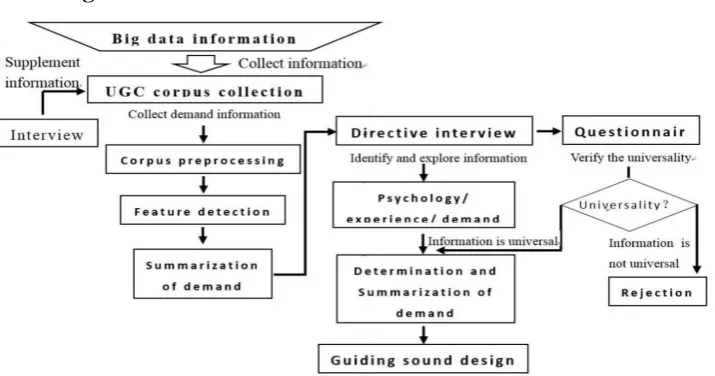
Based on the UGC platform's corpus collection, directed interviews and questionnaires, this paper has explored a method for mining the sound demand information of CNC machine tools.
[image:1.595.120.478.576.764.2]Method of Extracting Sound Information
UGC Corpus Collection and Preprocessing
User-Generated Content (UGC) is a new type of network usage that Internet users display or provide original content to other users through a network platform [8]. Users can express their experiences or opinions through the posting of content on UGC web platforms such as Post Bar, Forum and Weibo. The CNC machine tools sound corpus come from Zhihu, Baidu Post Bar, Baidu Webpage, Sina Weibo, China Machinery Community and China Industrial Control Website.
(1) Screening and Classification
The information is screened in the process of searching, and the valid information is saved by screenshots and classified by sound source type. The valid information obtained is as shown in the following table, totaling 132.
Table 1. Collecting valid information by each platform according to sound source classification.
Type ID A B C D E F G H I
Sound source
Machine Integrated
sound
Start Cutting operation
Shaft Human Power Cutters change
Clamping Others(Butto n/Alarm/doo r/motor,etc) Number of
messages
44 27 19 13 7 4 4 4 10
(2) Corpus Denoising
Corpus denoising means the invalid content in the corpus should be deleted, the network term should be converted into a formal term, and the punctuation and expression should be removed. As shown in Figure 2, after the descriptive information, punctuation marks in the post are removed, get the keywords "Thirty years ago, gap, Japanese machine tool, start sound, “shua”, Chinese machine tool, start sound, “guang”. Then adjust the word order: "Chinese machine tool start sound “guang” compare with Japanese machine tool 30 years ago start sound “shua” has a gap."
Figure 2. Corpus.
After all the corpus texts have been processed as above, they should be stored in a txt for use.
Feature Detection
Word co-occurrence means that two or more words appear together in the same language unit, reflecting the association between words to express a potential topic [7]. In this study, the ROST News Analysis software is used to analyze the lexical frequency and word co-occurrence. The word co-occurrence graph treats the text as an unordered word set G. Its expression is:
G = {V, E, ω} (1)
𝑉𝑖—a word in the text
𝐸—edge set
𝜔—Edge weight, it has symmetry and means the distance between words, the range is (0,1]. The side formed by the word u and the word v as vertices is an undirected side, and ω(u, v) = ω(v, u). Suppose c({u,v}) is used to represent the number of linguistic units in which the word u and the word v occur simultaneously. If the number of co-occurring units is zero, the edge weight is zero, otherwise the edge weight is calculated as:
The questionnaire is aimed at verifying the universality of information. Therefore, the content of the questionnaire should be based on the information collected from the previous UGC corpus collection and interviews. It is mainly to verify whether this phenomenon is universal and to determine the necessity of designing for demand information.
Discovery of Sound Information Extraction
Results of UGC Corpus Analysis Processing
[image:3.595.51.538.243.430.2]The semantic meaning, psychology and demand are analyzed based on the content of 132 sound information, and the information expressed by the sound and the users demand information embodied in the corpus are classified and summarized as follows.
Table 2. The information expressed by the sound and the users demand information in the UGC corpus.
Expressed information Sound type ID Users demand information
Machine state A, C Hope sound and vibration not to feel uncomfortable, affecting work or rest
C, G Hope to judge the working state by sound. Machine grade and
quality
A, B, F, I Hope the sound makes people feel comfortable and enjoy the feeling of high quality of the machine.
Fault information A, D, F, I Hope to judge the type of fault by sound.
Notice information B, D, H, I Hope there will be sound notice when starting, the shaft is rotating, the clamp is clamped, and the motor is working.
Operation feedback information
G, H, I Hope there is sound feedback whether the tool is changed, the workpiece is clamped, and the door is closed successfully.
I Hope some of the buttons have audible feedback. Verbal communication
information
E Hoped not to affect normal language communication in the working sound environment
Warning information I Hope to easily hear the alarm sound at any time and in any position.
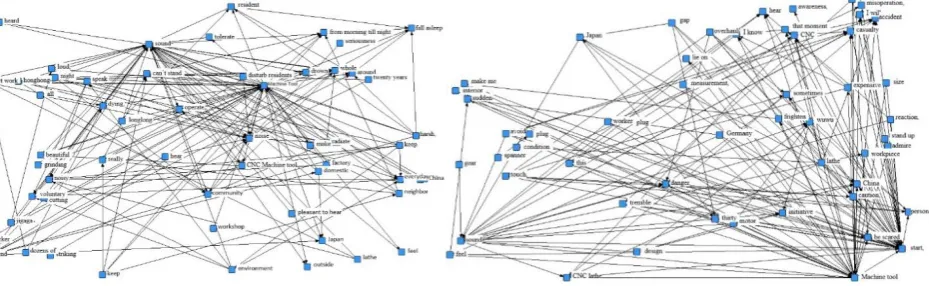
The corpus of the sound of machine integrated and start were selected for co-occurrence and word frequency analysis. Through the software ROST Mews Analysis, the word co-occurrence map and the high-frequency vocabulary were obtained. As follows.
Figure 3. Machine Integrated sound words co-occurrence map. Figure 4. Start sound words co-occurrence map.
It can be seen from the co-occurrence map, for the integrated sound, the vocabulary of too much, noise, harshness, drowning, enduring, and unbearable is closely related to machine tool and sound; for the start sound, misoperation, accident are close, the vocabulary such as reaction, standing up, being careful, and taking the initiative are closely related to the machine tool and start.
[image:3.595.67.532.484.627.2]Table 3. High frequency vocabulary.
Sound type Machine Integrated sound Start sound
Object CNC Machine tools, sound, lathes Machine tools, sound, CNC lathes, workers Events and
feelings
Hear, operate, send, keep, loud, noisy, unbearable, drown, harsh, dying, unable to
fall asleep
start, accident, avoid, overhaul, touch, measurement, misoperation, reaction, awareness,
caution, danger, admire, scare, sudden Onomatopoeia Longlong, jigaga, honghong Guang, shua
According to the above table, for the machine integrated sound, the users don’t want to feel uncomfortable even intolerable; the start sound is hoped to have notice function to avoid accidents.
Results of Directive Interview Analysis
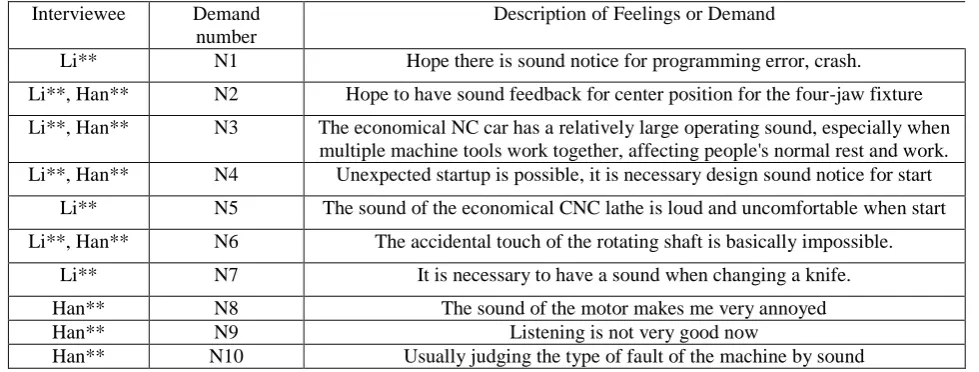
[image:4.595.63.538.88.167.2]On December 13, 2018, I interviewed worker Li (male), who has 18 years of experience in CNC lathe operation at a university engineering training center, including J1CK6132 CNC lathe, i5T3.1 smart lathe, ETC3650 CNC lathe; on December 23, 2018, I interviewed worker Han (female), a retired lathe operator with 11 years of experience in CNC lathe operation in a machine repair factory in Hebei Province, including CK6130 CNC lathe, CK6140 CNC lathe. The results are as follows.
Table 4. Description of demand information obtained from interviews.
Interviewee Demand number
Description of Feelings or Demand
Li** N1 Hope there is sound notice for programming error, crash.
Li**, Han** N2 Hope to have sound feedback for center position for the four-jaw fixture
Li**, Han** N3 The economical NC car has a relatively large operating sound, especially when multiple machine tools work together, affecting people's normal rest and work. Li**, Han** N4 Unexpected startup is possible, it is necessary design sound notice for start
Li** N5 The sound of the economical CNC lathe is loud and uncomfortable when start
Li**, Han** N6 The accidental touch of the rotating shaft is basically impossible.
Li** N7 It is necessary to have a sound when changing a knife.
Han** N8 The sound of the motor makes me very annoyed
Han** N9 Listening is not very good now
Han** N10 Usually judging the type of fault of the machine by sound
Some of the demand information confirmed the results of the UGC corpus analysis, such as N3, N4, N5, N7, N8, N9, N10, we also got new demand information, such as N1, N2.
Results of the Questionnaire Analysis
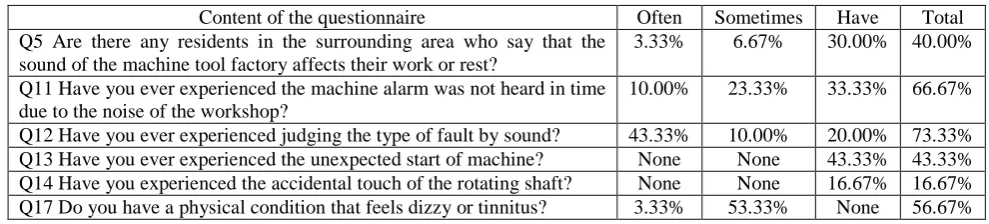
The questionnaire data was obtained from the CNC machine tool workers in a company in Liaoning province, a machine repair factory in Hebei province and a university engineering training center. A total of 34 questionnaires were collected, including 30 valid questionnaires.
Table 5. Average of subjective data of surveyed users.
Content of the questionnaire Average data
[image:4.595.54.544.319.505.2]Table 6. Experience data of surveyed users.
Content of the questionnaire Often Sometimes Have Total Q5 Are there any residents in the surrounding area who say that the
sound of the machine tool factory affects their work or rest?
3.33% 6.67% 30.00% 40.00%
Q11 Have you ever experienced the machine alarm was not heard in time due to the noise of the workshop?
10.00% 23.33% 33.33% 66.67%
Q12 Have you ever experienced judging the type of fault by sound? 43.33% 10.00% 20.00% 73.33% Q13 Have you ever experienced the unexpected start of machine? None None 43.33% 43.33% Q14 Have you experienced the accidental touch of the rotating shaft? None None 16.67% 16.67% Q17 Do you have a physical condition that feels dizzy or tinnitus? 3.33% 53.33% None 56.67%
The data of Q11 and Q12 is obviously higher than half of the 50%, indicating that the user thinks that the conditions described by Q11 and Q12 are universal.
Conclusion
Through the collection, analysis and verification of sound demand information, we have obtained the specific sound demand of CNC machine tools, which can be divided into ergonomic demand, safety demand, and experience feeling demand.
In terms of ergonomic demand, the sound of the machine tool affects the mood of the operator, which affects the operational efficiency; the machine vibration affects the operational efficiency; the sound feedback of some buttons is beneficial to improve the operational efficiency; the sound feedback for the four-jaw fixture design is beneficial to improve Operational efficiency; the sound environment of the workshop affects the alarm sound to be heard in time; the fault type of the machine tool can be judged by sound. In terms of safety demand, the notice information of start sound has a great effect on the operator when the CNC machine starts unexpectedly. In terms of experience feeling demand, the feeling for machine sound affect the evaluation of machine quality.
References
[1] Xian Wu. Application of Five Senses in Product Design [J]. Science and Technology Outlook, 2015(18).
[2] Zhen Zhao, Ying Wang, Wei Song. Research on Sound Design in Industrial Design [J]. Packaging Engineering, 2009, 30(1): 154-157.
[3] Xudong Zhao. Image design of soundscape and sound [D]. Hefei University of Technology, 2005.
[4] Kangyin Tan, Bingliang Liu. Analysis of Noise Source and Control Technology of CNC Machine Tools [J]. China Science and Technology Information, 2007(23): 69-69.
[5] Yunfeng Nie. The Harm and Protection of Noise [J]. Hunan Safety and Disaster Prevention, 2014(12).
[6] Wei Song. Research on sound design based on software interface interactivity [D]. Wuhan University of Technology, 2008.