2018 International Conference on Communication, Network and Artificial Intelligence (CNAI 2018) ISBN: 978-1-60595-065-5
Image Enhancement Based on Improved Antlion Optimization Algorithm
Wen-yan GUO*, Xuan ZHANG, Ke-xin LIU and Jiao-jiao ZHANG
School of Science, Xi’an University of Technology, Xi’an Shaanxi 710054, China
*Corresponding author
Keywords:Image enhancement, Antlion optimization, Quadratic interpolation, Swarm intelligence algorithm.
Abstract. Swarm intelligence based image enhancement method is an important method to improve
the image visual effect. In order to improve the image enhancement algorithm based on the antlion optimization, a quadratic interpolation technique is introduced to improve the image enhancement algorithm of the antlion optimization method which has the disadvantages of slow convergence speed and low computational accuracy. The new algorithm uses quadratic interpolation to accelerate the convergence speed of ant population and antlion population, to balance the global and local searching ability of the antlion algorithm, so as to improve the estimation precision of the optimal parameters in the incomplete Beta function and improve the image quality. The two evaluation indexes verify that the new algorithm is better than the contrast algorithm in statistical meaning, and extend the research of the antlion optimization algorithm.
Introduction
Image contrast enhancement is an important part of image processing and an important means to improve the visual effect of image. The image enhancement method based on incomplete Beta
function is to stretch and compress the image according to the different values of two parameters to make the gray scale of the image more uniform and more accord with the human visual characteristics. Estimating the optimal parameter value is the key of this method.
In recent years, swarm intelligence algorithm has become the main method to solve the optimization problem by the competition, cooperation and sharing mechanism among groups. The swarm intelligence algorithm has been developed in the past few years, which makes the group evolve to the best direction.
In the image enhancement algorithm based on swarm intelligence, the optimal parameters of the incomplete Beta function are calculated by intelligent optimization mechanism and used to improve the image enhancement effect. Antlion optimization algorithm (ALO) [1] is a new intelligent method proposed in 2015. By simulating the survival mechanism of antlion hunting ants, the global and local search strategy is designed to solve the global optimization problem to obtain the solution, which has the advantages of simple calculation and easy execution, has been used to solve many practical problems. The slow convergence speed of ALO and the low computing precision attract many scholars to study it. Because of the shortcomings of the ALO algorithm, the image enhancement method based on the optimization of the antlion is not ideal.
Quadratic interpolation [2] is an effective method to accelerate the convergence speed of optimization algorithm and improve the accuracy of calculation. This paper introduces an antlion optimization based quadratic interpolation to enhance the computing precision of ALO algorithm, then proposes an improved antlion optimization image enhancement method. The new algorithm speeds up solving of the optimal parameters and improves the accuracy of the optimal parameters. The experimental results show that the new algorithm is better than the contrast algorithm, and improves the visual effect of the image.
Normalized Incomplete Beta Function Applied to Image Enhancement
0
1 1
1
) 1 ( )
, ( ) , ,
(x B t t dt
F . (1)
where,0x1,, 0.
dt t t
B 1 1
0 1
) 1 ( )
,
(
. (2)Combining incomplete Beta functions with intelligent algorithms can automatically derive and value.
Image Enhancement Based on Improved Antlion Optimization Algorithm
Improved Antlion Optimization Algorithm(QIALO)
The antlion optimization algorithm [1] first randomly generates n ants and n antlions. Calculate and sort the fitness of the antlion, and find the best antlion as the elite antlion (eAL). Randomly select an antlion as the choice antlion (wAL) through roulette. The ants randomly walk around the elite antlion and the choice antlion, the formula for random walk of ants is (Apply to each dimension):
0, (2 ( ) 1), (2 ( ) 1), , (2 ( ) 1)
)
(t cumsum r t1 cumsum r t2 cumsum r tmax
x . (3)
where, cumsum is an array cumulative value function, tk(k1,2,max) is the kth iteration, and
max
t is the maximum number of iterations, r(t) is a random number function:
5 . 0
5 . 0
0 1 ) (
rand rand t
r ,rand
0,1. (4)In order to keep the random walk of ants in search space, they are normalized using Eq.5.
t i i
i
t i t i i t i t
i c
a b
c d a X
X
( )( ) . (5)
where, Xit is the position of the ith ant in the ant after the tth iteration. aiand biare the minimum and
maximum values of the ith ant's random walk, and citanddit are the minimum and maximum value of the ith variable of iteration t. The boundaries of the ant's random walk are affected by the position of the antlion, that is:
t t i t i
t t i t i
d Al d
c Al c
. (6)
where, ct and dt are the minimum and maximum values of all variables in the tth iteration, t is the current number of iterations, and Alit is the position of the eAl or wAL on the tth iteration.
Then update the ants position according to Eq.7.
2 ) ( ) ( e )
( R t R t
A
w i i
t i
. (7)
where, Riw(t) is the position where the ith ant moves randomly around the wAL at the tth iteration,
and Rie(t) is the position at which the ith ant moves randomly around the eAL at the tth iteration. Because the basic antlion optimization algorithm has the disadvantages of slow convergence and low calculation accuracy, the quadratic interpolation algorithm was introduced to update the ants' position for the second time. The ant fitness values of the first update are sorted in ascending order,and select three ants in turn it
t i t
i A A
A 1 2
) (
,
)) ( , ( )), ( , ( )), ( ,
( 1 1 2 2
t i t i t i t i t i t
i f A A f A A f A
A . Using Eq.8 calculates the new position of ant, that is Ai(t):
( ) ( ) ( ) ( ) ( ) ( )
2 ) )( ( ) )( ( ) )( ( ) ( 2 ) ( 1 ) ( ) ( 1 ) ( ) ( 2 ) ( ) ( 2 ) ( 1 2 ) ( 2 2 ) ( 1 ) ( 2 ) ( 2 ) ( 2 ) ( 1 2 ) ( 1 2 ) ( ) ( 2 ) ( t i t i t i t i t i t i t i t i t i t i t i t i t i t i t i t i t i t i t i A f A A A f A A A f A A A A A f A A A f A A A f A . (8)
The final update position of ant is:
) ( ) ( , ) ( ) ( , ) ( ) ( ) ( ) ( ) ( ) ( ) ( t i t i t i t i t i t i t i A f A f A A f A f A
A . (9)
The formula for updating the position of the antlion is:
)] ( ) ( [ () () ) ) ( t i t i t i t
i A if f A f AL
AL ( . (10)
where, AL(it) is the position of the ith antlion for the tth iteration, and Ai(t) is the position of the ith ant for the tth iteration, and f is the fitness function.
Image Enhancement Based on QIALO
To overcome the shortcomings of slow convergence speed and low computational accuracy of image enhancement algorithms based on ant lion optimization [3], the antlion optimization algorithm based on quadratic interpolation was applied to image enhancement in order to improve image quality. Image enhancement algorithm based on QIALO is proposed. The specific steps are as follows.
Step1: Use the Eq.11 to normalize the original image:
MI MA MI x x x j i f j i u (, ) ) ,
( . (11)
where, the original image is f(i,j), xMA and xMI are the max and min values of the grayscale in the original image.
Step2: Using QIALO algorithm, and Eq.12 as the image quality evaluation function, the optimal and parameters of the normalized incomplete Beta function are calculated.
2 1 1 1 1 2 ) , ( 1 ) , ( 1 ) , (
L i W j L i W j j i f LW j i f LW j iE . (12)
where, L and W are the length and width of the image. Because the value of the evaluation function is larger the better, the values of and needed to satisfy the value of the evaluation function are the greatest.
Step3: Combining Eq.1 and Eq.2 to transform the normalized image:
)) , ( ( ) , ( ' j i u F j i
u . (13)
Step4: Use the Eq.14 to anti-normalize the transformed image. The output image is g(i,j):
MI MI
MA x x
x j i u j i
g( , ) '( , )( ) . (14)
Experiment Results and Analysis
QIALO's effectiveness on image enhancement. The formula of PSNR is:
) (
log 20 ) (
log
10 10
2 10
MSE MAX MSE
MAX
PSNR . (15)
where, MSE is the mean square error between the original image and the processed image. MAX
indicates the maximum value of the image color. The greater the PSNR value, the better the image enhancement effect.
The formula of FSIM is:
x m
x L m
x PC
x PC x S FSIM
) (
) ( ) (
. (16)
where, represents the entire spatial domain of the image, SL(x)is the similarity between the reference image and the evaluated image, PCm(x) is used to adjust the importance of SL(x) in
image evaluation. The closer the FSIM value is to 1, the higher the image quality.
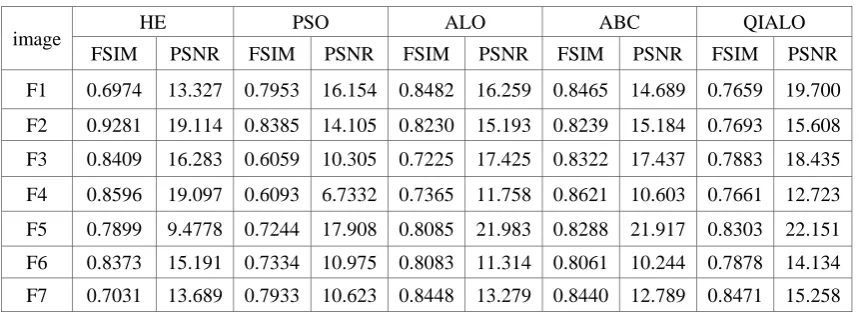
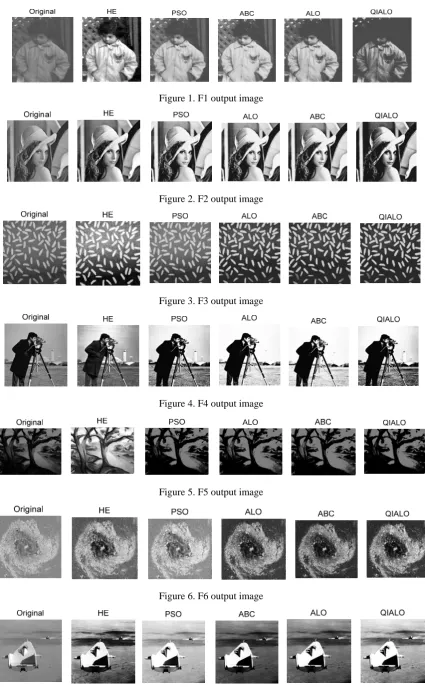
The obtained FSIM and PSNR values are recorded in Table 1, the obtained and values are recorded in Table 2, and the original and enhanced images are shown in Fig.1 to Fig.7 (the population number is 15, the maximum number of iterations is 25, and the algorithms runs 20 times to obtain the average value).
Table 1. FSIM and PSNR results obtained with QIALO and alignment algorithm
image HE PSO ALO ABC QIALO
FSIM PSNR FSIM PSNR FSIM PSNR FSIM PSNR FSIM PSNR
F1 0.6974 13.327 0.7953 16.154 0.8482 16.259 0.8465 14.689 0.7659 19.700
F2 0.9281 19.114 0.8385 14.105 0.8230 15.193 0.8239 15.184 0.7693 15.608
F3 0.8409 16.283 0.6059 10.305 0.7225 17.425 0.8322 17.437 0.7883 18.435
F4 0.8596 19.097 0.6093 6.7332 0.7365 11.758 0.8621 10.603 0.7661 12.723
F5 0.7899 9.4778 0.7244 17.908 0.8085 21.983 0.8288 21.917 0.8303 22.151
F6 0.8373 15.191 0.7334 10.975 0.8083 11.314 0.8061 10.244 0.7878 14.134
[image:4.595.84.514.382.540.2]F7 0.7031 13.689 0.7933 10.623 0.8448 13.279 0.8440 12.789 0.8471 15.258
Table 2. Obtained and values
image PSO ALO ABC QIALO
F1 6.16914 7.11617 4.01876 9.86963 3.24812 9.99264 14.51209 17.70971
F2 5.27624 4.82298 8.23206 9.99649 8.22113 9.98545 14.55661 14.06858
F3 7.11316 8.34884 10.00000 9.24530 9.97731 8.928567 18.91270 16.79278
F4 4.88344 6.31275 7.372674 10.00000 4.91365 9.998482 17.18437 18.18658
F5 7.79689 8.68495 6.14465 9.991565 5.67155 9.99615 16.22446 15.36852
F6 4.92017 3.75524 9.99924 5.22536 9.99890 5.20647 15.10295 19.43060
Figure 1. F1 output image
Figure 2. F2 output image
Figure 3. F3 output image
Figure 4. F4 output image
PSO ALO
Figure 5. F5 output image
Figure 6. F6 output image
The results in Table 1 show that for the four images F3, F4, F5 and F7, and the FSIM and PSNR values obtained by the QIALO algorithm are better than the index values obtained by the other intelligent algorithms (except HE), and the two index values of F5 and F7 are also better than those obtained by the HE algorithm. For the three images F1, F2 and F6, although the FSIM value obtained by the QIALO algorithm is not the best, the PSNR value is the best than other intelligent algorithms except HE. From these index values, it can be concluded that QIALO as a whole is still very effective for image enhancement. In Fig.2, Fig.4 and Fig.7, the contrast of QIALO-enhanced image from the human visual perception is still obvious. In general, the improved ALO algorithm based on quadratic interpolation has a significant effect on image enhancement.
Summary
Quadratic interpolation is an effective method to speed up the convergence of the optimization algorithm and improve the accuracy of the calculation. In order to overcome the shortcomings of slow convergence and low computational accuracy of image enhancement algorithms based on antlion optimization, this paper introduces quadratic interpolation, and it was used to the image enhancement based on the antlion optimization, and proposes an improved new antlion optimized image enhancement method. The new algorithm accelerates the speed of the optimal parameters and improves the accuracy of the optimal parameters. In this paper, the experiment compares QIALO with several other algorithms and verifies that the new algorithm is better than the contrast algorithm, improves the visual effect of the image, and expands the application field of the Antlion optimization algorithm.
Acknowledgement
This work was supported by National Nature Science Foundation of China (No.61772416, 11601419) and Xi’an University of Technology Program (No.252051654).
References
[1] Seyedali Mirjalil. The Ant Lion Optimizer. Advances in Engineering Software. 2015, 83:80-98.
[2] Junwen Li. Optimization design of quadratic interpolation method based on MATLAB. Journal of Guangdong Polytechnic Normal University. 2013, 7: 37-39.
[3] Zongni Li, Weimin Wu, Zhiyi Lin. An image enhancement method using ant lion optimization algorithm. Computer Application Research. 2017, 35: 1-6.
[4] Yaohui Li, Baojun Liu. Image enhancement based on histogram equalization. Journal of North China University of Science and Technology. 2003, 2 (5): 65-67.
[5] Wei Yang, Qiqiang Li. Review of particle swarm optimization. Chinese Journal of Engineering Science. 2004, 5 (6): 87-94.
[6] Ahui Chen, anjuan Li , Jifeng Guo. A review of artificial bee colony algorithms. Intelligent Computers and Applications. 2014, 6 (4): 20-24.
[7] Yubing Tong, Qishan Zhang, Yunping Qi. Image quality evaluation model based on the combination of PSNR and SSM. Chinese Journal of Image Science. 2006, 12 (11): 1759-1763.
[8] Changxin Liu, Zhen Liu, Shengwei Yang, Liang Lu. Application of PSNR in the digital image quality evaluation of halftone. Packaging Engineering. 2012, 33 (7): 108-111, 136.