2018 International Conference on Physics, Computing and Mathematical Modeling (PCMM 2018) ISBN: 978-1-60595-549-0
The Experience of Probabilistic Modeling and Optimization of a
Centralized Heat Supply System Which is an Object for Modernization
Andrey Kostogryzov
1,2,3,4*, Leonid Grigoriev
2, Petr Kanygin
4, Sergey Golovin
5,
Andrey Nistratov
6and George Nistratov
71Federal Research Center “Computer Science and Control” of the Russian Academy of Sciences,
Vavilova Str. 44, bld.2, Moscow, Russia, 119333
2
The Gubkin Russian State University of Oil and Gas, Leninsky Pr. 65, Moscow, Russia, 119991
3
Main Scientific Research Test Center (MSRTC) of the Russian Ministry of Defence, Seriogina Str. 5, Moscow, Russia, 119001
4
Chamber of Commerce and Industry of Russian Federation, bld.1,6/1, Ilyinka street, Moscow, Russia, 109012
5
Moscow State Technical University of Radioengineering, Electronics and Automatics, Moscow, Russia
6The Russian Power Agency of Ministry for the Power Generating Industry, Schepkina Str. 40, bld.1,
Moscow, Russia, 129110
7
The Research Institute of Applied Mathematics and Certification, Krasnobogatyrskaja 2, bld.2, Moscow, Russia, 107564
*
Corresponding author
Keywords: Modeling, Optimization, Probability, Reliability, System.
Abstract. Modern changes of a climate lead to colds during those periods when preparation for them is not finished yet, or in those regions where frosts did not come long years (for example, snow in Africa in March 2018). The present work is devoted to the application of probabilistic modeling and optimization of a centralized heat supply system (CHSS) at hard limitations on time and resources for modernization. A use of offered experience allows to avoid many system errors and to reach desirable effects.
Introduction
Coming back to history, we will remind – frosts of autumn 2005 in Moscow region to 10 degrees Celsius below zero have led to emergencies on heating mains. In the conditions of coming winter and resources limitations there was a question of modernization. The municipal management has decided to prove and optimize the actions scientifically. In the present work the got positive experience of the scientific researches, allowing to carry out effective modernization of central heat supply system (CHSS) for municipal city, is proposed and explained.
In conditions of time and resources limitations as an experienced use case model the next sequence of the works is implemented:
the analysis of features and choice of probabilistic models for estimations; estimation of existing CHSS reliability with all real lacks;
estimation of ideal CHSS reliability (all components are new);
estimation of investigated variants of CHSS modernization (taking into account possible resources and terms);
The Analysis of Specificity and Choice of Probabilistic Models for Estimations
The specificity of CHSS in Moscow regions (Russia) is the requirement to provide a reliable heat supply within 214 days of a cold season of heating.
From reliability point of view an emergency on CHSS with heat supply switching-off is defined as failure. A precondition to failure is defined as anomaly in CHSS operation. Anomalies may be owing to the high technical deterioration, occurrence of malfunctions, external negative influences on CHSS or mistaken actions of the staff, leading to temperature drop in heated premises of inhabited and public buildings below +12 degrees Celsius. So, 3 incident damages of voltage drop with short-term stop of boilers, estimated as precondition to failure, were in 2004 (without the heat supply switching-off). It is an example of external negative influences which could lead to failure and heat supply switching-off. In 2005 there have been registered more than 140 damages on the thermal municipal networks, many of which potentially could become the reason of heat supply switching-off (emergency on CHSS). A boiler plant is a source of the centralized heat supply of a city. A heat supply from a boiler plant is performed through the central thermal point (CTP) from which heating main beams disperse. Every boiler plant is a set of the polytypic equipment with various degree of physical and moral wear that is one of the reasons of potential failures in CHSS.
For probabilistic estimations of the technologies in application to given prognostic period the next limited space of two elementary events for a CHSS element is set: “reliable condition” and “unreliable condition” (when at least once the failure is and some actions are needed for recovering “reliable condition”).
The probabilistic model “Protection against dangerous influences”, developed of authors of this work, and ideas for new models generations [1-6] are chosen. It allows to estimate CHSS reliability for technology 1 (proactive diagnostic of system integrity) and more general technology 2 (monitoring). After the next diagnostic the recovery of the CHSS element is started, if needed. The difference of technology 2 is the next: if results of monitoring have revealed symptoms of failure (anomalies), the recovery of the integrity is started before the beginning the next diagnostic. For estimation of the complex systems with parallel or serial structure existing models are developed [1-6].
The next metrics are used for probabilistic estimations [1-6]:
The probability of reliable CHSS operation (if all time during given prognostic period all subsystems or elements with logic connection "AND" are in elementary event “reliable condition” or at least one element from parallel construction with reservation using logic connection "OR" is in elementary event “reliable condition”);
The probability of failure (if at least once during this given period the failure will be) - as addition to 1 the probability of reliable CHSS operation.
The input data for probabilistic estimating CHSS element reliability are [1-6]: the given prognostic period; the frequency of anomalies; the mean activation time (from anomaly to failure); the time between the end of diagnostic and the beginning of the next diagnostic; the diagnostic time; only for technology 2 – the mean time between operator’s error during continuous monitoring of CHSS conditions.
Estimation of Existing Centralized Heat Supply System
The formal structure of existing CHSS was presented as serial-parallel connections with interpretation of “AND” and/or “OR” logic conditions from reliability point of view. The next subsystems were: 1st subsystem is boiler plant (as a main heat source), 2nd subsystem is CTP and overground boiler rooms, subsystems from 3 to 9 are heating mains.
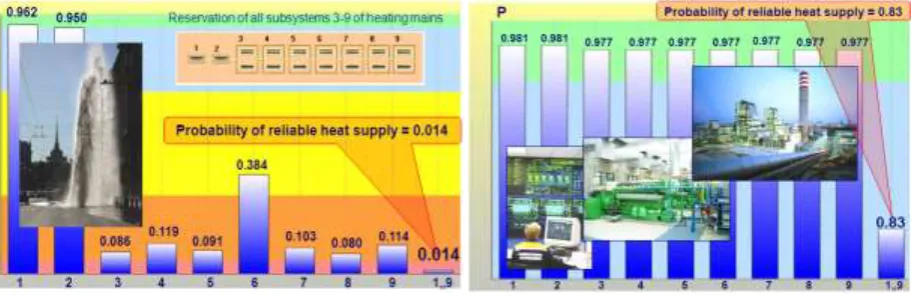
Figure 1. Estimations for existing (left) and ideal (right) CHSS.
The results of modeling have shown that mean time before failure (MTBF) is equal to 62 hours without reservation and to 93 hours with the reservation. It means an anomaly every 2-3 days has been. Thus the probability of reliable heat supply during a cold season (without anomalies and emergencies) was on level 0.008 without reservation and .014 with reservation (i.e. zero for every variant). Actually these figures explain the inevitability of CHSS failures during a cold season.
The conclusion about necessity of urgent improvement of existing CHSS is right. Thermal networks were the most unreliable subsystems of CHSS ("bottlenecks").
Estimation of Ideal Centralized Heat Supply System
Before making the rational decision, we have asked the question, “What level of reliability is achievable for ideal CHSS?”. For the answer the assumption that all elements of interested CHSS are absolutely new with characteristics of non-failure operation of the equipment guaranteed suppliers (about 25 years and more). Results of modeling are presented on Figure 1 right. For this ideal CHSS the probability of a reliable heat supply within 214 days will be nearby 0.83, and by a heat supply operating time on dangerous damage is estimated about 3 years. It means an operating time of existing system of a heat supply in comparison with ideal more low more than in 400 times. It is that unattainable practical limit to which it is necessary to aspire.
Estimation of Investigated Variants of Modernization
In the projects executed by the specialized organization, three possible variants of CHSS modernization for municipal city have been proposed. The given possible variants are developed taking into account prospects of building new habitation, structure of existing CHSS and economic indicators.
Variant 1
1 – two boiler plants
2 – central thermal point (CTP) 3..9 – heating mains beams 1..7 with reservation
Variant 2
1 – four boiler plants
2 – central thermal point (CTP)
3 – heating main beam 7 with reservation
4 – heating mains beams 4, 5, 6 with reservation
5 – heating mains beams 1, 2, 3 with reservation
Variant 3
1 – three boiler plants
2 – central thermal point (CTP)
3 – heating main beam 7 with reservation
4 – heating mains beams 4, 5, 6 with reservation
5 – heating mains beams 1, 2, 3 with reservation
[image:4.595.131.515.72.251.2]6 – individual boilers for new houses
Figure 2. Investigated variants of modernization.
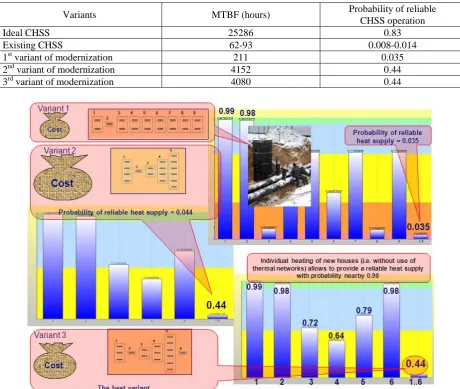
[image:4.595.66.527.340.729.2]Results of modeling for the modernized CHSS consider a case of full reservation of all parts of heating mains by pipelines with similar characteristics of reliability. Results are presented in Table 1 and on Figure 3.
Table 1. Comparison of variants.
Variants MTBF (hours) Probability of reliable
CHSS operation
Ideal CHSS 25286 0.83
Existing CHSS 62-93 0.008-0.014
1st variant of modernization 211 0.035
2nd variant of modernization 4152 0.44
3rd variant of modernization 4080 0.44
Figure 3. Estimations for the 1st, 2nd and 3rd variants of CHSS modernization.
The analysis has shown the following.
bring high expected effect for reliability of all CHSS. The new boiler plant only will raise reliability of sources of heat. As a whole implementation of a 1st variant will not provide reliability of a heat supply of a city. For the 2nd and 3rd variants creation of quarter boiler plants considerably increases CHSS reliability. Application of individual boilers for new houses allows to reach the maximum of reliability. At the same time, it is necessary to notice, that the basic and alternative fuel for boilers are not considered in details. Selective replacement of pipes on the oldest beams, considering their actual technical condition (frequency of anomalies), will lead to MTBF growth during a cold season.
Optimization by Criterion “Efficiency - Reliability”
The analysis has shown, that 2nd and 3rd variants of CHSS modernizations allow to raise MTBF in 50 times and more. Their implementation allows to increase probability of a reliable heat supply during a cold season from 0.008-0.014 to 0.44. It is 10 times more in comparison with the 1st variant of modernization. With equal levels of reliability (0.44) the 3rd variant is more preferable in comparison with 2nd variant by criterion “Efficiency - Reliability”. As a whole thermal networks still remain the "bottlenecks" of system. Their modernization is recommended taking into account a real technical condition.
Instead of conclusion: individual heating of new houses (i.e. without use of thermal networks) allows to provide a reliable heat supply with probability nearby 0.98 (see Figure 3 right below). It is the optimistic result for new settlers!
References
[1]A. Kostogryzov, G. Nistratov and A. Nistratov, “Some Applicable Methods to Analyze and Optimize System Processes in Quality Management”, Total Quality Management and Six Sigma,
InTech, 2012, pp. 127-196, Available from:
http://www.intechopen.com/books/total-quality-management-and-six-sigma/some-applicable-metho ds-to-analyze-and-optimize-system-processes-in-quality-management
[2]A. Kostogryzov, G. Nistratov and A. Nistratov, The Innovative Probability Models and Software Technologies of Risks Prediction for Systems Operating in Various Fields. International Journal of Engineering and Innovative Technology (IJEIT), Volume 3, Issue 3, September 2013, pp. 146-155. http://www.ijeit.com/archive.php
[3]A. Kostogryzov, P. Stepanov, A. Nistratov, G. Nistratov, O. Atakishchev and V. Kiselev, Risks Prediction and Processes Optimization for Complex Systems on the Base of Probabilistic Modeling, Proceedings of the 2016 International Conference on Applied Mathematics, Simulation and Modelling (AMSM2016), May 28-29, 2016, Beijing, China, pp. 186-192.
[4]A. Kostogryzov, P. Stepanov, L. Grigoriev, O. Atakishchev, A. Nistratov and G. Nistratov, Improvement of Existing Risks Control Concept for Complex Systems by the Automatic Combination and Generation of Probabilistic Models and Forming the Storehouse of Risks Predictions Knowledge, Proceedings of the 2nd International Conference on Applied Mathematics, Simulation and Modelling (AMSM 2017), August 6-7, Phuket, Thailand. DEStech Publications, Inc., pp. 279-283.