Mass and spin co-evolution during the alignment of a black hole in
a warped accretion disc
A. Perego,
1M. Dotti,
2M. Colpi
3and M. Volonteri
21Department of Physics, University of Basel, Klingelbergstr. 82, 4056 Basel, Switzerland 2Department of Astronomy, University of Michigan, Ann Arbor, MI 48109, USA
3Dipartimento di Fisica, Universit`a degli Studi di Milano-Bicocca, Piazza Della Scienza 3, 20126 Milano, Italy
Accepted 2009 July 20. Received 2009 July 20; in original form 2009 March 16
A B S T R A C T
In this paper, we explore the gravitomagnetic interaction of a black hole (BH) with a misaligned accretion disc to study BH spinprecessionandalignmentjointly with BH massMBHand spin
parameter a evolution, under the assumption that the disc is continually fed, in its outer region, by matter with angular momentum fixed on a given direction ˆJdisc,out. We develop an
iterative scheme based on the adiabatic approximation to study the BH–disc co-evolution: in this approach, the accretion disc transits through a sequence of quasi-steady warped states (Bardeen–Petterson effect) and interacts with the BH until the spin JBHaligns with ˆJdisc,out.
For a BH aligning with a corotating disc, the fractional increase in mass is typically less than a few per cent, while the spin modulus can increase up to a few tens of per cent. The alignment time-scale tal ∝ a5/7M˙−32/35 is of ∼105–106 yr for a maximally rotating BH accreting at
the Eddington rate. BH–disc alignment from an initially counter-rotating disc tends to be more efficient compared to the specular corotating case due to the asymmetry seeded in the Kerr metric: counter-rotating matter carries a larger and opposite angular momentum when crossing the innermost stable orbit, so that the spin modulus decreases faster and so the relative inclination angle.
Key words: accretion, accretion discs – black hole physics – galaxies: active – galaxies: evolution – quasars: general.
1 I N T R O D U C T I O N
Astrophysical black holes (BHs) are Kerr BHs fully characterized by their massMBHand spinJBH, customarily expressed in terms of
the dimensionless spin parametera(≤1), and unit vector ˆJBH:
JBH=a
GM2 BH
c JˆBH. (1)
The spin and mass of BHs residing in galaxy nuclei do not remain constant, close to their birth values, but change sizeably through cosmic time, in response to major accretion events. In current cos-mological scenarios for the evolution of galaxies, repeated inter-actions among gas-rich haloes play a key role not only in shaping galaxies, but also in triggering quasar activity (White & Rees 1978; Di Matteo, Springel & Hernquist 2005). Massive gaseous nuclear discs that form in the aftermath of major galaxy mergers (Mihos & Hernquist 1996; Mayer et al. 2007) may provide enough fuel to feed, on sub-parsec scales, the BH through a Keplerian accretion disc (Dotti et al. 2007, 2009). If these episodes repeat recursively
E-mail: [email protected]
and/or at random phases (King & Pringle 2006), the BH spinJBH
is expected, initially, to be misaligned relative to the direction of the angular momentum of the disc ˆJdisc,outat its unperturbed, outer
edge Rout. In this configuration, the gas elements inside the disc undergo Lense–Thirring precession (see e.g. Wilkins 1972). In the fluid, the action of viscosity on to the differentially precessing disc ensures that the inner portion of the accretion disc aligns (or anti-aligns) its orbital angular momentum with the BH spinJBH, out to a
transition radiusRwarpbeyond which the disc remains aligned to the outer disc, as first shown by Bardeen & Petterson (1975) (see also Armitage & Natarajan 1999; Nelson & Papaloizou 2000; Fragile & Anninos 2005; Fragile et al. 2007). Warping of the inner disc at distanceRfrom the BH is communicated through the fluid ele-ments on a time-scaletBP(R) related to the vertical shear viscosity
of the accretion disc. Therefore, the inner regions of the disc align (or counteralign if the disc is counter rotating) with the BH spin on the scaletBP(Rwarp) when the viscous time for vertical propagation
JBHis a consequence of angular momentum conservation: since the
BH acts on the disc with a torque that warps the disc then an equal and opposite gravitomagnetic torque acts on the BH that modifies its directiononly.
BH spin alignment has been studied in two main contexts. In the first, explored by King et al. (2005) and Lodato & Pringle (2006), the focus is on anclosedsystem where the accretion disc has a finite mass and radial extent. Here, the total angular momentum Jtot=
JBH +Jdisc is well-defined vector, and the BH eventually aligns
it spin vector to the direction of Jtot. In the second, explored by
Scheuer & Feiler (1996), Natarajan & Armitage (1999) and Martin, Pringle & Tout (2007), the focus is on anopensystem, where the accretion disc has infinite extension and it is continually fed at its outer edge by matter whose angular momentum has constant direction ˆJdisc,out. In this second case, the BH aligns its spin to the
outer disc direction ˆJdisc,outon a time-scaletalthat exceedstBPby
a few orders of magnitude (Scheuer & Feiler 1996; Martin et al. 2007).
In this paper, we progress on the study of BH alignment including the contemporary change in mass and spin modulus due to accretion of matter, neglected in previous works. During BH precession and alignment, matter flows inwards and accretes carrying the energy and the specific angular momentum of the innermost stable circular orbit (ISO). This study thus provides estimates of the fractional in-crease of massMBH/MBH,0and spina/a0during BH alignment
(the subscript 0 refers to initial conditions), together with a sensible expression for the alignment timetal. In our context, we assume a continuous and coherent feeding of the accretion disc around the BH, at least for a time as long as the alignment time-scaletal. Thus, we consider an open system and we fix the orbital angular momentum direction ˆJdisc,outat the outer edge of the disc.
In Section 2, we introduce key parameters and highlight our model assumptions. Section 3 surveys properties of steady-state warped discs and key scales associated to the Bardeen–Petterson effect; disc models with constant and power-law viscosity profile are explored for completeness. In Section 4, we describe the equations for the BH mass and spin evolution, and introduce the adiabatic approximation to solve these equations. In the same section, we also revisit the expression for the BH alignment time. Results are illustrated in Section 5; there we also explore the tendency to align in initially counter-rotating warped discs. Section 6 contains the discussion of the results and our conclusions.
2 I N I T I A L A S S U M P T I O N S A N D M A I N PA R A M E T E R S
We consider a BH with spin JBH, surrounded by a geometrically
thin, standard Shakura–Sunyaevα-disc (e.g. Shakura & Syunyaev 1973; Frank, King & Raine 2002). Theα-disc is initially misaligned relative to JBH, i.e. the angular momentum unit vector of the disc
at the outer edge is ˆJdisc,out = JˆBH; the relative inclination angle
between the two unit vectors isθout.
Following Pringle (1992), we assume that the accretion disc has a high viscosity (α > H /R, whereHis the disc vertical scaleheight) so that perturbations propagate diffusively. We introduce two viscosity parameters,ν1andν2:ν1is the standard radial shear viscosity while
ν2is the vertical share viscosity associated to the diffusion of vertical
warps through the disc, due to Lense–Thirring precession. Forν1,
we adopt theαprescription
[image:2.595.390.462.83.149.2]ν1=αH cs, (2)
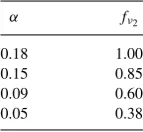
Table 1. Table of the coefficientsαandfν2.
α fν2
0.18 1.00
0.15 0.85
0.09 0.60
0.05 0.38
wherecsis the sound speed inside the accretion disc. It is still poorly understood which is the relation between the radial and the vertical viscosity, in particular, ifν1∼ν2orν1ν2. In order to simplify
our discussion, we refer to the recent analysis of Lodato & Pringle (2007), and forν2we take
ν2
ν1
= fν2
2α2, (3)
wherefν2(given in Table 1) is a coefficient determined in numerical
simulations that accounts for non-linear effects.
The disc model is defined after specifying five free parameters (subscript 0 will be introduced to indicate initial values when mass and spin evolution is considered).
(1) The BH mass,MBH; we explore a mass range between 105<
MBH<107M. For the BH mass, we introduce the dimensionless
parameterM6asMBH=M6×106M.
(2) The spin modulus, in terms of the dimensionless spin pa-rametera, which varies between 0< a≤0.95. We do not use the theoretical limita=1 because, if accretion is driven by magneto-rotational instabilities in a relativistic MHD disc, the final equilib-rium spin due to continuous accretion isa≈0.95 (Gammie, Shapiro & McKinney 2004).
(3) The relative inclination angleθout between the spin versor
ˆ
JBHand the orbital angular momentum versor at the external edge
of the accretion disc, ˆJdisc,out. This angle varies isotropically from 0
toπ. In the following, however, we will confine this interval to (0,
∼π/6) in order to satisfy the used approximations.
(4) The viscosity parameterαwhich is assumed to vary between 10−2 α10−1 to bracket uncertainties (King, Pringle & Livio
2007). For our purposes, we selected values ofαaccording to Lodato & Pringle (2007), as in Table 1. In this study,αis considered as a constant inside the disc.
(5) The accretion rate on to the BH, ˙M,is expressed in terms of the Eddington ratiofEdd=L/LEddand of the accretion efficiency
η(whereLEddis the Eddington luminosity): ˙M=fEddLEdd/(ηc2).
We consider values offEdd in the interval 10−4 < fEdd <1 and
computeηas a function of the BH spin modulus.
If the disc, warped in its innermost parts, is described to first order by the Shakura–Sunyaevα-model, bothν1andν2 follow a
power law. If viscosities satisfy relation (3) andαis assumed to be constant, their exponent are equal:
ν1=Aν1R
β
and ν2=Aν2R
β
. (4)
Following standard Shakura–Sunyaev disc solutions for external regions of an accretion disc (Frank et al. 2002), we haveβ=3/4 and
Aν1 =9.14×10
6
α04/.15M 1/20 6
fEdd
η0.1
3/10
cm5/4s−1,
Aν2 =
ν2
ν1
Aν1=50fν2α −2
In equation (5), α0.1 and η0.1 are theα coefficient and the BH
radiative efficiency in unit of 0.1.fν2is tabulated in Table 1 (Lodato
& Pringle 2007).
3 WA R P E D AC C R E T I O N D I S C
3.1 The angular momentum content of discs: extended versus truncated discs
The dynamics of a fluid element in a misaligned disc around a spinning BH is given by the combination of three different motions: the Keplerian rotation around the BH; the radial drift, due to radial shear viscosity, and finally the Lense–Thirring precession, due to the gravitomagnetic fieldHgmgenerated byJBH(see e.g. Weinberg
1972; Thorne et al. 1986). In response to Lense–Thirring induced precession, viscous stresses in the disc acts rapidly to produce in the vicinity of the BH an axisymmetric configuration whereby adjacent fluid elements rotate in the equatorial plane of the spinning BH. The disc thus warps and the warp disturbance propagates diffusely (Papaloizou & Pringle 1983) in the disc.
As the Bardeen–Petterson effect modifies the inclination of the orbital plane of consecutive infinitesimal rings then the warped profile of the accretion disc can be described by the specific angular momentum density,L, expressed as
L=Llˆ= KR2lˆ, (6)
where ˆl(R) is a unit vector indicating the local direction of the orbital angular momentum,Lis the modulus, is the surface density of the disc andK the local Keplerian angular velocity. The angle
describing the tilted disc is defined as
θ(R)=cos−1[ ˆl(R)·JˆBH], (7)
so that ˆl(R) carries information of the warped structure of the ac-cretion disc. The angular momentum of the acac-cretion disc within radiusRis given by
Jdisc(R)=
R
RISO
2πxL(x)dx, (8)
where the integration domain extends from the innermost stable orbit RISO out to R. In order to calculate the totaldisc angular momentum, we define an outermost radius,Rout. For an extended disc with Rout → ∞, the disc angular momentum Jdisc always
dominates overJBH.
Real discs are likely to be truncated by their own self-gravity that becomes important at distances where the disc massMdisc(R) ∼
(H /R)MBH(see e.g. Pringle 1981; Frank et al. 2002; Lodato 2007).
Outside the truncation radius, gas can be either turned into stars or expelled by winds from stars which do form (King & Pringle 2007; Levin 2007). Thus, we are led to define a disc outer edge as the distance where the Toomre parameter for stability,Q = κcs/(πG ) [whereκ2=R(d2/dR)+42], becomes less than
unity, and the cooling time-scale of the clumping gas is less than its dynamical time-scale. When the Toomre parameter drops to-wards unity, the disc becomes unstable on a length-scale λ = c2
s/(G ) (Polyachenko, Polyachenko & Strel’Nikov 1997; Levine
et al. 2008); for a nearly Keplerian, Shakura–Sunyaevα-disc, this scale is much smaller than the disc radial dimension, and the cooling time of the associated perturbation is less or of the same order of its orbital period. Then, as long as the accretion disc can be described
as a Shakura–Sunyaev disc,1the external radius can be defined from
the conditionQ(Rout)=1, so that
Rout=1.21×10⁵α 28/45 0.1 M
−52/45 6
fEdd
η0.1
−22/45
RS, (9)
whereRS =2GMBH/c2is the Schwarschild radius. At the outer
edge of the disc, ˆl(Rout)= Jˆdisc,outandθ(Rout)=θout.
Definitions (6) and (8) forLandJdisc(R) hold for any disc profile.
At first order, we can neglect details about the warped disc structure around Rwarp assuming ˆl ≈ (0,0,1), and estimate the modulus of the orbital angular momentum within radiusR,Jdisc(R), using
Shakura–Sunyaev solutions for a flat disc. In this approximation, the surface density is flat ≈M/˙ (3πν1) (see e.g. Pringle 1981; Frank
et al. 2002) and
L(R)≈ M˙ 3πν1
GMBHR. (10)
Using equations (8) and (10), and expression (4) forν1in the case
ofβ=3/4, the modulus of the disc angular momentum withinR
reads: Jdisc(R)=
8 21
˙
M√GMBH
Aν1
R7/4. (11)
If expression (11) is estimated at the outer radius (9), the resulting dimensionless ratio between the disc and BH angular momenta is
Jdisc(Rout)
JBH
=7.3α013.1/45M− 37/45 6
fEdd
η0.1
−7/45
a−1. (12)
3.2 Time-scales and warp radius
The time-dependent evolution of the disc is described by the conti-nuity equation
R∂
∂t +
∂
∂R(vR R)=0, (13) wherevRis the radial component of the velocity vector, and by the
equation of conservation of angular momentum. In presence of a gravitomagnetic field, for a geometrically thin disc characterized by the two viscositiesν1andν2, the equation reads (Pringle 1992):
∂L ∂t = −
1 R
∂
∂R(RLvR)+ 1 R
∂ ∂R
ν1 R3
d dRlˆ
+ 1
R
∂ ∂R
1 2ν2RL
∂lˆ ∂R
+2G
c2
JBH×L
R3 . (14)
The last term is the Lense–Thirring precession term and the associ-ated angular velocity is
LT(R)=
2G c2
JBH
R3 . (15)
The time-dependent equation (14) describes the radial drift of matter and the diffusion of warping disturbances across the high-viscosity disc.
This equation introduces several key scales.
1This condition is fulfilled only for (M
6 fEdd)/(α0.1η0.1)4.3. If this
condition is not satisfied, the gas temperature drops below∼104K, in the
(i) The viscous/accretion time-scale for radial drift, related to the angular momentum transport parallel toJdisc,out,tacc(R). It can
be seen as the time it takes for a fluid element atRto accrete on to the BH (see e.g. Pringle 1981). Considering equation (14), the balance between the advection term and the viscous term proportional toν1
(both on the right-hand side of equation 14) leads to an estimate of the accretion time:
tacc(R)∼R2/ν1. (16)
According to equation (16), we can introduce the disc consump-tion time-scaletdisc, a concept useful when considering transient, truncated discs, as the accretion time-scale at the outer radius: tdisc∼tacc(Rout)
= 1.71×10⁶α−1/45 0.1 M
−11/45 6
fEdd
η0.1
−41/45
yr.
(17) (ii) The time-scale for warp propagation, related to the radial diffusion of gravitomagnetic perturbations that transport the com-ponent of the disc angular momentum lying in the plane of the disc; this scale is inferred from equation (14) considering the term proportional toν2,
tBP(R)∼
R2 ν2 ∼ ν1 ν2
tacc(R). (18)
The physical interpretation of this time-scale has been recently investigated by solving numerically equation (14) for a thin disc (Lodato & Pringle 2006): starting att=0 with a flat disc misaligned relative to the fixed BH spin,t≈tBP(R) indicates the time it takes
for the radial diffusion of the warp to reach radiusR; on longer time-scale, the disc approaches a steady warped state.
(iii) The characteristic extension of the warp Rwarp, defined as the distance at which the Bardeen–Petterson time-scaletBP(R)
equals the Lense–Thirring precession time-scale−LT1:
Rwarp=
4GJBH
ν2c2
. (19)
For power-law viscosity model, equations (1), (5) and (19) give
Rwarp=476α 24/35 0.1 f−
4/7
ν2 M
4/35 6
fEdd
η0.1
−6/35
a4/7RS. (20)
The warp radius represents the division between the outer region for RRwarp, where the disc keeps its original inclination, given by
ˆ
Jdisc,out, and the inner region forRRwarp, where the disc aligns
(or anti-aligns) its orbital angular momentum with the BH spin,
ˆ
l JˆBH. The warp radius fixes also the magnitude of the relevant
Bardeen–Petterson time-scale, which reads
tBP(Rwarp)=33.5α 72/35 0.1 f−
12/7
ν2 M
47/35 6
fEdd
η0.1
−18/35
a5/7 yr. (21)
If we define the function
ψ(R)=.
dlˆ
dR
(22)
andRBPthe radius where the disc is maximally deformed
=. ψ(RBP)=max (ψ), (23)
we expect that
RBP=nBPRwarp (24)
withnBPof the order of unity.RBPhas two important properties:
first, if it is the radius where the disc is maximally warped, i.e. where the diffusive propagation of vertical perturbations is more
significant; secondly, it provides a reliable estimate of the distance from the BH where the gravitomagnetic interaction is stronger. From equation (14), this interaction is proportional to (L×JBH)/R3: this
term vanishes in the inner part of the disc (R RBP) since the
Bardeen–Petterson effect alignsLwith JBH, and also in the outer
regions (RRBP), due to the rapid decline withR. Accordingly, the
region nearRBP(or equivalentlyRwarp) is the only one significantly
misaligned withJBH.
3.3 Analytical solutions
In this section, we summarize the properties of the steady warped disc structure used to compute the joint evolution of the disc and the BH.
Following previous studies, we assume that the viscosity profiles are power laws with exponentβ, as in equation (4), and explore two possible cases. In the first, we formally extend the Shakura– Sunyaev solution everywhere in the disc, i.e.ν1 ∝Rβ withβ=
3/4, andν2given by equation (3) (Martin et al. 2007). In the second
case, we assume the viscosities to remain approximately constant everywhere in the disc (Scheuer & Feiler 1996). In order to compare the two models (cf. Martin et al. 2007), we impose the continuity of the viscosities atRBPwhere the gravitomagnetic torque is most important.
Before solving equations (13) and (14), we introduce two appro-priate reference frames. The first is the inertial reference frameOxyz
referred to the outer disc; we can always rotate it so that itsz-axis is parallel to the direction of ˆJdisc,out. The second reference frame
is the not-inertial frameOxyzreferred to the BH spin, which is always centred to the BH and whosez-axis is parallel to the BH time varying spinJBH. If we use the adiabatic approximation then
frameOxyzcan be approximated, with timet, as a sequence of frames, one for every quasi-stationary state of the system. The shape of the warped accretion disc is studied in theOxyzframes and the Cartesian components of any vectorvare there indicated asvx, vy,vz;Oxyzis the natural frame to study the temporal evolution of the BH spin and here the Cartesian components of the previous vector are denoted asvx,vy,vz.
For a stationary state, continuity equation (13) can be easily inte-grated introducing the accretion rate ˙Mas constant of integration:
R vR= −
˙ M
2π, (25)
while the projection of equation (14) along ˆlreads:
3 2ν1
dL dR −
˙
M√GMBH
4π√R
+1
2Rν2L
dˆl
dR
2
=0. (26)
In the small deformation approximation (Scheuer & Feiler 1996), the warp is gradual and we can neglect the non-linear term, propor-tional to|∂l/∂R|2. Using the boundary condition (R
ISO)=0, the
integral of (26) is
L(R)= M˙ 3πν1
GMBHR
1− RISO R
. (27)
This means that, in this approximation scheme, the modulus of the angular momentum density for a warped accretion disc far from the horizon is the same as for a flat disc (equation 10).
Following Scheuer & Feiler (1996), we study the disc profile of the steady disc introducing the complex variableW = ˆlx+iˆly
and considering the caseθout <π/2. Using power-law viscosities
deformation approximation have been found by Martin et al. (2007):
WPL =B
R Rwarp
−1 4
×K1/2(1+β)
√
2(1−i) (1+β)
R Rwarp
−1+β
2
, (28)
whereBis a complex constant of integration, depending on the boundary condition at the external edge, the subscript ‘PL’ is a reminder of the power-law viscosities andK1/[2(1+β)]is the modified
Bessel function of the order of 1/[2(1+β)]. In the particular case where we consider constant viscosities, i.e.β=0, the solution can be written as
WC =Aexp
−√2(1−i)
R Rwarp
−1 2
, (29)
whereA is a complex constant of integration and the subscript ‘C’ is a reminder of the constant viscosity model (Scheuer & Feiler 1996). In this latter case,nBPis calculated self-consistently, using the definition (24) and the prescription for constant viscosity evaluation atRBP; we find that, for every possible parameter set,nBP≈0.42.
We note thatW(and so alsoψ) depends on the radiusRthrough the dimensionless ratioR/Rwarp(Martin et al. 2007).
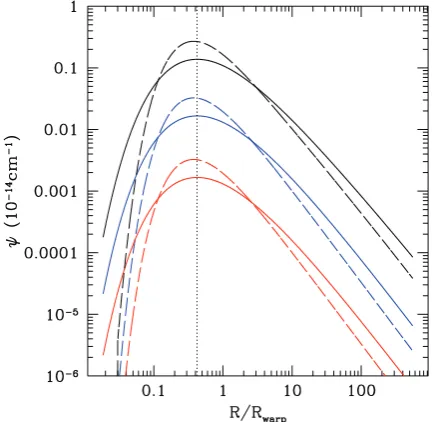
In Fig. 1, we plot the modulus of the gradient of ˆl, ψ(R), which is a local measure of the deformation degree of the disc, for a particular set of parameters and for three different angles,θout=π/3,π/30,
π/300. The shape ofψis similar for the two different disc profiles and for all the angles: there is a well-defined maximum nearRwarp, where we expect the disc to be more deformed. At radii smaller than
Rwarpand far fromRwarp, the disc is almost flat (note that the graph is logarithmic in both axes). For the constant viscosity (power-law) profile, the peak is atRBP ≈0.42Rwarp (RBP ≈0.38Rwarp).
[image:5.595.58.277.456.667.2]In Fig. 1, we also see that a constant viscosity disc is less warped (since the maximum deformation is the smaller) than the power-law viscosity disc. The ratio between the maximum deformations in the
Figure 1.ψas function ofR/Rwarp, forWC(solid line) andWPL(dashed
line) for different inclination angles: black lines correspond toθout=π/3,
blue lines toπ/30, red lines toπ/300. The vertical black dotted line repre-sentsRBP/Rwarp=0.42, the Bardeen–Petterson radius for constant viscosity
profiles. The parameter set for the BH and the disc is given byMBH,0=
106M
,a=0.5,fEdd=0.1,α=0.09.
power law versus constant viscosity is roughly a factor of 2, and it does not depend on the inclination angle (except for a scalefactor, approximately equal to the ratio between the corresponding angles).
3.4 Validity of the approximation
We calculated the warped disc profile under the small deformation approximation. We neglected second-order terms in equation (26) and found an analytic solution forL; in order to verify the consis-tence of this approximation, we defineχβas the ratio between the
neglected term and the first term into the round brackets of (26), assuming to have a Keplerian disc with power-law viscosity profile with exponentβ, like in equation (4). Considering equations (27) forL, we have dL/dR≈(1/2+β)(L/R) and thenχβreads
χβ(R)=
2 3 (β+1)
ν2
ν1
ddRl
2R2. (30)
Once we know the explicit solutions, the consistence of this approx-imation can be tested a posteriori calculatingχβ: the approximation
is well satisfied ifχβ1. From equation (30),χβcan be expressed
also as a function ofR/Rwarpandψ:
χβ=
2 3 (β+1)
ν2
ν1
R2warp
R Rwarp
2
ψ2
R Rwarp
[image:5.595.320.537.457.668.2]
. (31)
Fig. 2 shows the function χβ=0 for constant viscosity profiles
(dashed lines) and the functionχβ=3/4for power-law viscosity
pro-files (solid lines), for the same parameters as in Fig. 1.
The function χβ exhibits a maximum, (χβ)max, around Rwarp.
Far fromRwarp, the accuracy of the approximation increases, albeit slowly. The functionχβ is most sensitive to the inclination angle,
as expected (note that Fig. 2 uses logarithmic axes).
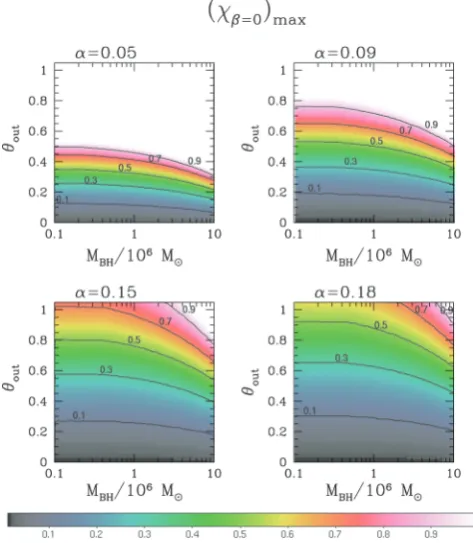
In Fig. 3, we test the validity of the small deformation approxi-mation plotting, in the BH mass versusθoutplane, the colour coded
values of (χβ=0)max, for different values of the viscosity
parame-terα(Table 1), using the constant viscosity profile model (we fix
Figure 2. χβ=0(R) (solid line) andχβ=3/4(dashed lines) as functions of
R/Rwarpfor different inclination angles. Black lines correspond toθout=
π/3, blue ones toπ/30, red ones toπ/300; the vertical black dotted line representsRBP/Rwarp=0.42, the Bardeen–Petterson radius for constant
viscosity profiles. The parameter set for the BH and the disc is given by
Figure 3. Colour-coded plot of (χβ)maxin theθoutversusMBHplane, for
four differentαparameters:α=0.05 – top left-hand panel;α=0.09 – top right-hand panel;α=0.15 – bottom left-hand panel;α=0.18 – bottom right-hand panel. The disc has constant viscosity profiles, i.e.β=0. The accretion rate isfEdd=0.1 and the spin parameter isa=0.9.
fEdd=0.1 anda=0.9). White zones represent the regions where
(χβ=0)max > 1, i.e. where the small deformation approximation
becomes invalid. (χβ=0)max shows mainly a strong dependence on
inclination angleθout, but also a weaker dependence on the BH mass
which reveals that the small deformation approximation is less ac-curate for MBH 106Mand increasing BH mass. Comparing
differentα values, the approximation is better satisfied for large viscosities parameters (i.e.α=0.18). We repeated the analysis for the power-law viscosity model that shows no significant differences in the parameters’ dependence.
In Fig. 4, using the same colour conventions, we explored (χβ)max
in theθoutversusa(left-hand panels) andfEddversusθout(right-hand
panels) planes, once we have fixed the viscosity parameter (α= 0.09), the BH mass (MBH=106M) andfEdd=0.1 for the
left-hand panels anda=0.9 for the right-hand panels. For both constant (β=0) and power-law (β=3/4) models, the relative inclination angle is again the leading parameter gauging the goodness of the fit as the approximation depends very weakly onaandfEdd.
4 B L AC K H O L E E VO L U T I O N
4.1 Basic equations
In this section, we explore the equations for the BH evolution. The BH is accreting and its mass increases, from an initial valueMBH,0,
according to dMBH
dt = ˙ ME(RISO)
c2 , (32)
whereE(RISO) is the energy per unit mass of a test particle at the
[image:6.595.307.544.64.325.2]innermost stable orbit.E(RISO)/c2 = 1− η(a) is related to the
Figure 4. Left-hand panels: colour-coded plot of (χβ)maxin theaversus
θout plane, forα=0.09,MBH =105MandfEdd =0.1. Right-hand
panels: colour-coded plot of (χβ)maxin thefEddversusθoutplane, forα=
0.09,MBH=105Manda=0.9. Top panels refer to constant viscosity
profiles, bottom panels to power-law viscosity profiles.
efficiencyη(a) that depends only on the spin parameter (Bardeen 1970; Bardeen, Press & Teukolsky 1972). Equation (32) introduces a natural time-scale for BH mass growth, known as Salpeter time
tS:
tS=4.5×10⁸
η fEdd(1−η)
yr. (33)
As argued by Rees (1978) and shown by Thorne et al. (1986), there is a coupling between the BH spin and the angular momentum of the disc. Even though the disc is much less massive that the BH, the moving fluid elements perturb the Kerr metric and interact with the BH spin, causing spinprecessionand, if viscous dissipation is present,alignment. For an infinitesimal ring of inviscid matter with total angular momentumJring, the BH spin precesses, following the
equation dJBH
dt = 2G
c2
Jring
R3 ×JBH, (34)
with a precession frequency
precessionBH =LT
Jring
JBH
. (35)
Equation (34) can be extended to the case of an accretion disc to yield
dJBH
dt = ˙
M(RISO)ˆl(RISO)+
4πG c2
disc
L(R)×JBH
R2 dR. (36)
The first contribution is due to accretion of matter atRISO where (RISO) indicates the orbital angular momentum per unit mass
carried by matter at ISO; the Bardeen–Petterson effect ensures that the direction of ˆl(RISO) is parallel or antiparallel to ˆJBH, so that the
accretion modifies only the spin modulus. As shown by Bardeen (1970), a variation of mass MBH =
√
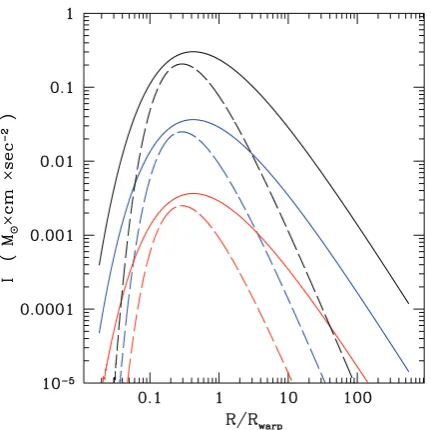
Figure 5. In this figure, we draw modulus of gravitomagnetic interaction term,I, as a function of radius normalized to warp radius,R/Rwarp. Disc
profiles are obtained by BH withMBH=106Manda=0.5, and accretion
disc withfEdd=0.1 andα=0.09. Solid (dashed) lines refer to constant
(power-law) viscosity profiles; black lines toθout=π/3, blue lines toθout=
π/30, red lines toθout=π/300.
pass from a Schwarzschild BH (a= 0) to an extreme Kerr BH (a=1), while spin flip ofπ, due only to accretion on an initially extreme Kerr BH, needsMBH=3MBH,0. So, the spin accretion
time-scale for the spin modulus is of the same order of the mass accretion time-scaletS. The second term in equation (36) describes the gravitomagnetic interaction between the rotating viscous disc and the BH spin vector. This term modifies only thespin direction
of the BH in order to conserve the total angular momentum of the system. Under the working hypothesis that the disc is continually fed by matter carrying the same angular momentum (see Section 6 for a critical discussion), the BH aligns its spinJBHin the direction
of ˆJdisc,out. Alignment implies thatθout(t)=cos−1[ ˆJBH(t)·Jˆdisc,out]
goes to 0 with time. Fig. 5 shows the functionI defined as the modulus of the integral kernel of equation (36)
I(R)= 4πG c2
L(R)JBHsin[θ(R)]
R2 (37)
as a function ofR/Rwarp, for different value ofθout=π/3,π/30,
π/300, where θ(R) is computed along the profile of the steady warped disc of equations (28) and (29). The functionI, similarly to ψ(defined in equation 22), peaks nearRwarp. Contrary toψ,
power-law viscosity profiles have lower peaks, compared with constant viscosity profiles. This figure indicates also that the BH–disc grav-itomagnetic interaction is spread over a relatively small region of the disc around the warp radius; the characteristic spreading length, which is slightly larger for constant viscosity profiles, is usually of a few warp radii.
4.2 Alignment time
In this section, we want to give simple estimations for the alignment and the precession time-scales, starting from equation (36).
Assuming BH mass and spin modulus variations due to accretion to be small compared with gravitomagnetic effects during the align-ment, we neglect the term proportional to(RISO) in (36); if BH
spin aligns and precesses, left-hand side of (36) can be estimated introducing a characteristic gravitomagnetic time-scaleτgmas
dJBH
dt
∼ |JBH|
τgm
∼ JBHsinθout,0
τgm
,
and the integral on the right-hand side as
4πc2G
disc
L(R)×JBH
R2 dR
∼ 4πG
c2
L(Rwarp)JBHsinθout
Rwarp
since the bulk of the gravitomagnetic interaction occurs around
Rwarp. Equating these two expressions and using equation (27) for the specific angular momentum density modulus, we obtain
τgm∼
3 4
cν1(Rwarp)
GM˙
Rwarp
RS
. (38)
Using equations (19) and (11) which imply ˙M√GMBH/ν1(Rwarp)≈
(21/8)Jdisc(Rwarp)R−warp5/2, the gravitomagnetic scaleτgmcan be
writ-ten in terms of the Bardeen–Petterson warp time-scale (equa-tion 18):
τgm∼
4√2 7
JBH
Jdisc(Rwarp)
tBP(Rwarp) (39)
and also in term of the accretion time-scale (equation 16)
τgm∼
4√2 7
ν1
ν2
JBH
Jdisc(Rwarp)
tacc(Rwarp), (40)
whereJdisc(Rwarp) is the disc angular momentum modulus within
the warp radius, estimated by (11). Finally, considering equations (11) and (16) for tacc together with the expression for the spin modulus and Schwarzschild radius,τgmof expression (40) can be
rearranged as
τgm∼
3 2a
ν1
ν2
MBH
˙ M
RS
Rwarp
. (41)
Since the disc carries very little angular momentum at the warp radius, from equation (39)τgmtBP, always. The gravitomagnetic
BH–disc interaction causes BH spin precession and alignment at the same time, and then introduces two scales related withτgm, the precessionand thealignmenttime-scales,tprecandtal, respectively. We separate their relative importance following Martin et al. (2007) results, and define the parameterμ, so that
tal=
τgm
cosμ, tprec= τgm
sinμ. (42)
The exact value ofμdepends on the viscosity profile, and can be estimated either analytically (Martin et al. 2007) or numerically as in this paper. Initially, we assume alignment and precession to have the same time-scale, cosμ=sinμ=√2/2 according to Scheuer & Feiler (1996). Substituting expressions (5) for the viscosities, (20) for the warp radius, and (38) forτgm in (42), the alignment
time reads
tal=1.13×10⁵α580.1/35f− 5/7
ν2 M −2/35 6
fEdd
η0.1
−32/35
a5/7yr. (43)
The time-scaletalincreases witha, indicating that a rapidly rotating Kerr BH offers some resistance before changing its direction. In-terestingly, the alignment time-scale does not depend on the initial inclinationθout,0since a more inclined configuration implies more
pronounced disc deformations and stronger mutual gravitomagnetic interactions (as also shown in Figs 1 and 5).talhas a weak depen-dence on the BH mass and scales nearly as ˙M−1: a higher accretion
stronger gravitomagnetic coupling. We also note that, apart from numerical factors of order unity, this time-scale is consistent with the alignment scales found by Scheuer & Feiler (1996), Natarajan & Pringle (1998), Natarajan & Armitage (1999) and Martin et al. (2007).
4.3 The adiabatic approximation
In Sections 3.2 and 4.1, we described the equations governing the evolution of a warped accretion disc around a fixed BH, and the evolution of an accreting Kerr BH in gravitomagnetic interaction with its accretion disc. The BH and the accretion disc evolve con-temporary and their evolution is coupled, so that we can solve simultaneously equations (13) and (14) for a Keplerian disc and (32) and (36) for the accreting and precessing BH.
In this paper, we solve these coupled equations using the adi-abaticapproximation that separates the rapid temporal evolution of the warped disc from the longer temporal evolution of the BH. Equations are integrated starting from given initial conditions: att= 0, the BH spin ˆJBHis inclined with respect to ˆJdisc,outby an angle
θout,0and the warped disc profile is described by a quasi-stationary
profileL(R,t=0);MBH,0and JBH,0are the initial BH mass and
spin.
In order to justify this approximation scheme, we survey the BH and disc time-scales, as functions ofMBHandfEdd, for two selected
values of the viscosity and spin parameter:α=0.15 anda=0.9. In Figs 6 and 7, we draw in theMBH–fEddplane lines of constant
tBP(Rw)/talandtS/talratios. The comparison between the different
time-scales lead to the following hierarchy of time-scales: tBP(Rwarp)taltS. (44)
Then, in the adiabatic approximation, the disc transits through a sequence of warped states over the shortest time-scaletBP(Rwarp)
while, on the longer time-scaletal, the BH aligns its spin to ˆJdisc,out,
and modifies a little its spin modulus and mass due to accretion. Considering one of these disc quasi-steady-states, initially at time
[image:8.595.316.537.57.264.2]t, after a time gapδt ∼tBP(Rwarp) the BH mass and spin JBH are
Figure 6. In the MBH versus fEdd plane, we draw lines of constant
tBP(Rwarp)/tal ratio for a BH witha =0.9 and an accretion disc with
[image:8.595.56.271.489.695.2]α=0.09.
Figure 7. In theMBHversusfEddplane, we draw lines of constanttS/tal
ratio for a BH witha=0.9 and an accretion disc withα=0.09.
updated according to
MBH[t+tBP(Rwarp)]=MBH(t)+δMBH
JBH[t+tBP(Rwarp)]= JBH(t)+δJBH
(45)
and these variations produce a new quasi-stationary warped state at t+tBP(Rwarp),L[R,t+tBP(Rwarp)].
For the BH mass variationδMBH, we integrate equation (32) from ttot+tBP(RBP):
δMBH≈M˙
E(RISO)
c2 tBP(RBP), (46)
whereRISO is the last innermost stable orbit associated with the
current value ofa(t).
For the spin variation, we need to integrate equation (36) that includes the two different and coupled contributions due to accretion and gravitomagnetic interaction; ifδMBHandδJBHare small on the
time-scaletBP(RBP), to first order the two contributions decouple
and they can be integrated separately:
(δJBH)acc≈M˙ (RISO)tBP(RBP), (47)
(δJBH)gm≈
4πG c2 tBP(RBP)
disc
L(R, t)×JBH(t)
R2 dR, (48)
where (δJBH)acc is due to accretion and changes only the spin
modulus while (δJBH)gmis due to gravitomagnetic interaction and
changes only the spin direction. After the intervaltBP(RBP), the
angular momentum of (45) is updated according to this rule:
JBH[t+tBP(Rwarp)]=
JBH(t)+(δJBH)gm
×JBH(t)+(δJBH)acc
JBH(t)
. (49)
This procedure can be repeated iteratively on a time-scaletal to study the coupled evolution ofL(R,t), JBH andMBHduring the
alignment process.
5 S P I N A L I G N M E N T
5.1 Set up
previous section, in order to infer the evolution ofMBHandJBHas
a function of time, in response to the gravitomagnetic interaction and matter accretion.
Att=0, the outer disc, extending up to a radiusRout, defines the fixed reference frameOxyz. In this frame, the external edge of the disc lies in thex,yplane and the orbital angular momentum atRout
is
[Lx(Rout), Ly(Rout), Lz(Rout)]=L(Rout)(0,0,1) (50)
while the BH spin is initially inclined ofθout,0 with respect to the z-axis:
(JBH,x, JBH,y, JBH,z)=JBH(sinθout,0,0,cosθout,0). (51)
If att=0 we know the components ofJBHin the fixed reference
frameOxyzthere is always a rotated reference frameOxyzwhere
JBHis along the newz-axis (see also the discussion about reference
frames of Section 3.3). The two reference frames are related by a rotationR, which depends only on the componentsJBH,x,JBH,y,
JBH,z of JBH(t) in the fixed reference frame. IfRij is the matrix
associated with this rotation, we can easily find the components of
JBH(t) andL(Rout,t) in the rotated frame:
JBH ,i(t)=RijJBH,j(t)⇒JBH (t)=[0,0, JBH(t)],
Li(Rout, t)=RijLj(Rout, t). (52)
As shown by Scheuer & Feiler (1996) for the constant viscosity profile and Martin et al. (2007) for the power-law viscosity profile, in this special rotated frame of reference it is possible to calculate analytically the expression of the gravitomagnetic torque, using equation (48):
(δJBH ,x+iδJBH ,y)gm
=
−i4πGJBH(t) c2
disc
L(R, t)W(R, t) R2 dR
tBP(Rwarp),
(53) whereL(R,t) is given by (27) andW(R,t) by (29) or (28). The analytic expressions of the gravitomagnetic torques for the two viscosity profiles are reported in the Appendix. From the torques, it is possible to find the values of the spin variations (δJBH,x)gm,
(δJBH,y)gmand (δJBH,z)gmin this rotated reference frame. Finally,
in order to know their expressions in our fixed reference frameOxyz, we have to rotate them back, using the inverse rotationR−1
(δJBH,i)gm=(R−1)ij(δJBH ,j)gm. (54)
Once we know the spin variations due to gravitomagnetic coupling, the modulus variation can be calculated from equation (47) and the global spin variation from equation (49).
5.2 Results
We computed, within the adiabatic approximation, the joint evolu-tion of the BH mass and spin during the process of alignment under the assumption that matter is corotating with the BH. We iterated equations (46) and (49), from the initial conditions (50) and (51), recording the updated values ofMBH,aand of the relative
inclina-tion angleθoutevery snapshot of timeδt∼tBP(Rwarp). We initially
choose a spinning BH withMBH =106Manda=0.5, and an
accretion disc with ˙M =0.1 ˙MEdd, α= 0.09; both power-law and
constant viscosity profiles are considered. Three initial relative in-clination angles ofθout,0=π/3,π/6,π/30 have been tested. Fig. 8
shows as a function of time the inclination angleθout(t) and the
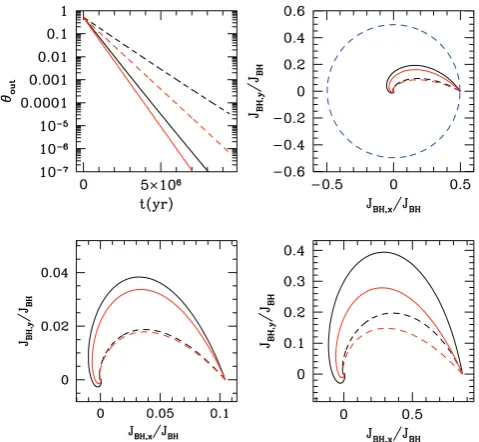
[image:9.595.310.550.55.276.2]two components of the BH spin unit vector in the planeOxy; red
Figure 8. Results for precession and alignment processes. Black lines refer to our result while red lines refer to results published by Martin et al. (2007); solid lines (dashed lines) refer to constant (power-law) viscosity profile. Top left-hand panel represents temporal evolution of relative inclination angle
θoutwhile top right shows evolution ofJBH,x/JBHagainstJBH,y/JBH, both
for an initial BH withMBH,0=106M,a0=0.5 and an accretion disc with
fEdd=0.1 andα=0.09, withθout,0=π/6. Blue dashed line represents
the evolution of the spin components for a pure precession motion around ˆ
Jdisc,out||zˆ. In bottom left-hand (right-hand) panel, we represent evolution
ofJBH,x/JBH againstJBH,y/JBH for an initial relative inclination angle
θout,0=π/30 (θout,0=π/3), for an initial BH withMBH,0 =106M,
a0=0.5 and an accretion disc withfEdd=0.1 andα=0.09.
lines refer to the analytic solutions given by Martin et al. (2007). As shown in top left-hand panel of Fig. 8, the relative inclination angleθoutdecreases exponentially with time on the scaletaland the
decrease is more rapid for the constant viscosity disc (solid line). The BH spin aligns with the external disc and precesses, as il-lustrated in the top-right panel, where we compare also the ac-tual evolution of the spin versor with a pure precessional motion (blue dashed line). Our results are only qualitatively consistent with Martin’s results; in our calculations, the alignment process appears to be less efficient and the spin precession more pronounced. The difference between our results and Martin’s analytical solutions arises from three facts: (i) we included mass and spin modulus evo-lution; (ii) Martin et al. neglected to carry out the rotation connecting the BH reference frameOxyz to the disc frameOxyz; (iii) for constant viscosity profile, we evaluateν1andν2from equation (5) at
the Bardeen–Petterson radius,RBP≈0.4Rwarp, while Martin et al.
evaluate them at the warp radius,Rwarp. For an initially not very inclined BH spin, the difference tends to disappear, because the rotation matrix nears the identity matrix. However, for largeθout,0
the discrepancy becomes more important (see e.g. bottom panels of Fig. 8).
Fig. 9 shows the evolution of θout and aas functions of time
and of the increasing BH mass, for an initial BH withMBH,0 =
106M
,θout,0=π/6 and spin parametera0=0.5, and forfEdd=
Figure 9. Coupled evolution of the relative inclination angleθout, BH mass
MBHand spin parametera. Solid (dashed) lines refer to constant
(power-law) viscosity profile. Black lines tofEdd =1, red lines tofEdd=0.1,
blue lines to fEdd = 0.01. Dotted horizontal lines which appear in top
panels represent anglesθout/θout,0=10−1, 10−2, 10−3. Initial configuration:
MBH,0=106M,a0=0.5,fEdd=0.1 andα=0.09, withθout,0=π/6.
from 3.0×10⁵yr (5.3×10⁵yr) forf
Edd =1 to 1.86×10⁷yr
(3.63×10⁷yr) forf
Edd =0.01. During this alignment time, the
BH has increased its mass by a small fraction, between 0.74 per cent (1.30 per cent) forfEdd=1 and 0.46 per cent (0.89 per cent)
forfEdd=0.01. The spin parameteraincreases due to accretion,
but only by a small amount, between 3.13 per cent (5.47 per cent) forfEdd=1 and 1.96 per cent (3.79 per cent) forfEdd=0.01.
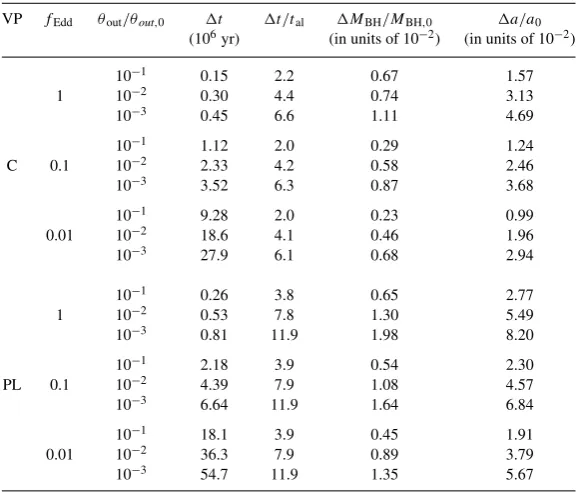
In Table 2, we summarize the results of Fig. 9. There, we compare also the timetnecessary to decrease the initial inclination angle by a given amount, withtalestimated from equation (43): the values of the timetare consistent with the interpretation oftalas e-folding time. For constant viscosity profiles, a closer match oftalwith the numerical outcomes requires (cosμ)C≈0.78 instead of
√
2/2, and (cosμ)PL≈0.41 for power-law viscosity profiles (subscripts C and
PL simply remind that for different viscosity prescriptions we found different cosμvalues). Then, the ratios between the precession and the alignment time-scales are (tprec/tal)C=0.81 and (tprec/tal)PL=
2.2. These results are still qualitatively consistent with Martin et al. (2007), who have shown that bothtalandtprec/talincrease with the
exponentβof the viscosity profile; small quantitative differences are due to different assumptions and different calculations methods. Finally, we note that the scaling oftwithfEddis in good agreement
with estimation (43).
5.3 Exploring the parameter space
Here, we explore more systematically how the fractional increases ofMBHanda, and the alignment time vary with initial massMBH,0,
spin a0, fEdd and α, for both constant and power-law viscosity
profiles, fixingθout,0 =π/6. The evolution is followed untilθout
has decreased by a factor of 100; we define astθ0→θ0/100the
cor-responding ‘alignment’ time, computed self-consistently. We also infer from the numerical model the relative growths of BH mass MBH/MBH,0and spin parametera/a0duringtθ0→θ0/100.
[image:10.595.150.439.445.691.2]Figs 10 and 11 show the weak dependence of the alignment timetθ0→θ0/100on the initial BH massMBH,0, and of the relative
Table 2. Summary of our parameters and results for the corotating case; we consider viscosity coefficientα=0.09 and initial inclination angleθout,0=π/6, both for constant
(C) and power-law (PL) viscosity profiles (VP).
VP fEdd θout/θout,0 t t/tal MBH/MBH,0 a/a0
(106yr) (in units of 10−2) (in units of 10−2)
10−1 0.15 2.2 0.67 1.57
1 10−2 0.30 4.4 0.74 3.13
10−3 0.45 6.6 1.11 4.69
10−1 1.12 2.0 0.29 1.24
C 0.1 10−2 2.33 4.2 0.58 2.46
10−3 3.52 6.3 0.87 3.68
10−1 9.28 2.0 0.23 0.99
0.01 10−2 18.6 4.1 0.46 1.96
10−3 27.9 6.1 0.68 2.94
10−1 0.26 3.8 0.65 2.77
1 10−2 0.53 7.8 1.30 5.49
10−3 0.81 11.9 1.98 8.20
10−1 2.18 3.9 0.54 2.30
PL 0.1 10−2 4.39 7.9 1.08 4.57
10−3 6.64 11.9 1.64 6.84
10−1 18.1 3.9 0.45 1.91
0.01 10−2 36.3 7.9 0.89 3.79
10−3 54.7 11.9 1.35 5.67
Note. The initial BH hasMBH,0=106Manda0=0.5. Accretion ratefEddvaries over
Figure 10. Alignment time (defined as the time needed for the relative inclination angle to reduce of two orders of magnitude, going fromπ/6 to
π/600), as a function of the initial BH mass,MBH,0, for constant viscosity
profile. The black lines refer tofEdd=1 and the red ones tofEdd=0.001;
the solid lines are for initial spin parametera0=0.9 while the dashed ones
a0=0.1; finally, the thin lines representα=0.09 and the thick onesα=
0.18.
Figure 11.Mass and spin relative increase during the alignment time (de-fined as the time needed for the relative inclination angle to reduce of two orders of magnitude, going fromπ/6 toπ/600) as a function of the initial BH mass, for constant viscosity profile. Black (red) lines refer tofEdd=1
(fEdd=0.001). Solid (dashed) lines are fora0=0.9 (a0=0.1); finally, the
thin (thick) lines representα=0.09 (α=0.18).
mass and spin parameter increases, for eight different sets of the other parameters. Comparing numerical scaling factors forM6 in tθ0→θ0/100 with that of expression (43), we note again a good
agreement, in particular forfEddnot too close to the Eddington limit andMBH,0106M.
By contrast, the alignment process is more sensitive onfEdd,a0
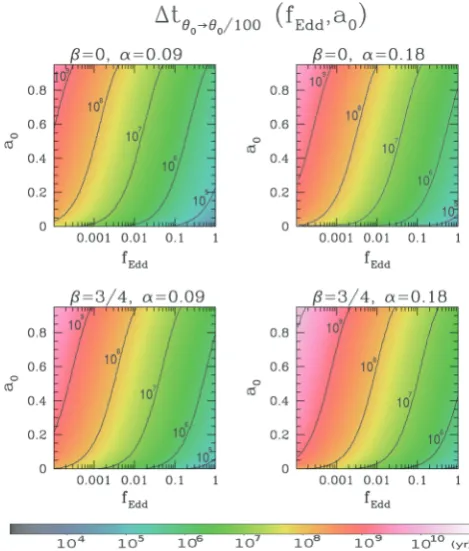
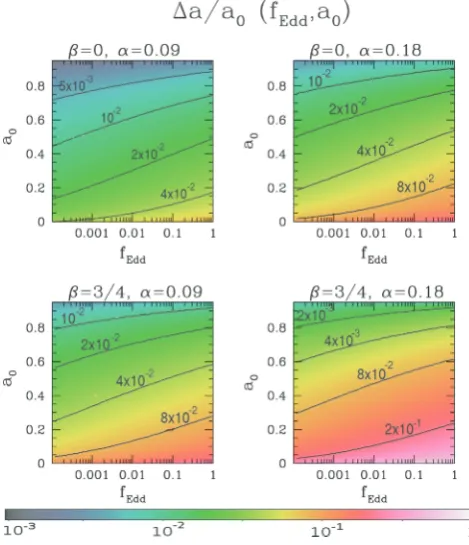
andα. Colour-coded maps oftθ0→θ0/100(Fig. 12), ofM/MBH,0
[image:11.595.308.543.56.332.2](Fig. 13) and ofa/a0(Fig. 14) are constructed in thea0 versus
Figure 12. Colour-coded map of the alignment time (defined as the time necessary for the relative inclination angle to go fromθout,0=π/6 toθout=
π/600) for a BH ofMBH,0=106M, as a function of the accretion rate
expressed through the Eddington factorfEdd and of the initial BH spin
parametera0. The colour scale representstalin years. Top (bottom) panels
refer to the constant (power-law) viscosity profile. Left-hand (right-hand) panels refer toα=0.09 (α=0.18).
fEddplane, varying the coefficientαand the viscosity law inside the
accretion disc.
In Fig. 12, we infer the interval of the alignment timetθ0→θ0/100
(as inferred from the numerical model) of interest for the study of BH evolution. The alignment time can vary by many orders of magnitude from∼105to∼1010yr, and it reveals strong
dependen-cies both on the accretion rate and on the initial spin parameter. In addition, smaller viscosities (α=0.09) give shorter time-scales compared to higher viscosities (α=0.18). A simple comparison between alignment timestθ0→θ0/100 for different initial spin
pa-rameters, but identicalfEdd, reveals that the scaling factors fora
andη0.1(a) in equation (43) are in good agreement with numerical
results.
Fig. 13 shows that the relative amount of mass accreted during the alignment process is small, compared to the initial BH mass. It varies between ∼10−3 and ∼ 10−2 for the constant viscosity
profile, and between∼2.5×10⁻³and∼3×10⁻²for the power-law
viscosity profile. Even if the accretion rate varies over four orders of magnitude, there are no comparable variations for the relative BH mass growth, in fact a larger fEdd means a larger accretion
rate, but it also reduces the alignment time. The relative increase of the spin parameterais shown in Fig. 14. The evolution ofais the combination of different, and sometime opposite, tendencies: a highly spinning BH requires a longer time to align, but the particles at its innermost stable orbit carry on the BH a smaller angular momentum. The spin modulus increases significantly during the alignment for initially slowly rotating BHs and high accretion rates, typically with 5× 10⁻³ a/a
[image:11.595.48.284.351.564.2]Figure 13. Colour-coded map of the relative increase of mass during the alignment time (defined as the time necessary for the relative inclination angle to go fromθout,0 =π/6 toθout =π/600) for a BH ofMBH,0 =
106M, as a function of the accretion rate expressed through the Edding-ton factorfEddand of the initial BH spin parametera0. The colour scale
representsMBH/MBH,0. Top (bottom) panels refer to the constant
(power-law) viscosity profile. Left-hand (right-hand) panels refer toα=0.09 (α=
0.18).
viscosity profile and 10−2a/a
02×10−1for a power-law
profile.
5.4 Counter-rotating case
In this section, we investigate the counter-rotating configuration for a BH and its misaligned accretion disc, for initial values ofθout,0
close toπ.
As shown by Scheuer & Feiler (1996) and Martin et al. (2007), on the time-scaletalthe BH spin again aligns with the outer regions
of the accretion disc, if this disc is regularly and coherently fed. Due to the Bardeen–Petterson effect, we expect the innermost part of the disc (approximately withinRwarp) to orbit in a plane which is perpendicular toJBH, with orbital angular momentum densityL
counteraligned with respect to the BH spin. In this BH–disc config-uration, one of the major changes is in the radius of the innermost stable orbit, which increases due to the asymmetry seeded in the geodetic motion of particles in Kerr metrics. As a consequence, the energy and the orbital angular momentum of particles atRISO
in-crease, while the BH radiative efficiency decreases (see e.g. Wilkins 1972; Bardeen et al. 1972). The Bardeen–Petterson time-scale (18) and the warp radius (19) have the same values as in the corotating case. SincetBPtal, the adiabatic approximation holds again, but
the small deformation approximation2has a limited validity,
requir-2The functionsψandχ, defined in equations (22) and (30), are invariant
under the transformationθout→(π−θout).
Figure 14. Colour-coded map of the relative increase of spin parameter during the alignment time (defined as the time necessary for the relative inclination angle to go fromθout,0 =π/6 toθout =π/600) for a BH of
MBH,0=106M, as a function of the accretion rate expressed through the
Eddington factorfEddand of the initial BH spin parametera0. The colour
scale representsa/a0. Top (bottom) panels refer to the constant
(power-law) viscosity profile. Left-hand (right-hand) panels refer toα=0.09 (α=
0.18).
ingθout∼π. In order to remain consistent with the approximation
scheme, we trace the alignment process, fromπto (π−π/6), only. In the couter-rotating case and small deformation approxima-tion (i.e.θout∼π), the disc profile can be solved analytically. We
choose a reference frameOxyzwhere ˆJBH =(0,0,−1) and
we solved equation (14) for ˆl in it. For constant viscosities, the functionW(R/Rwarp)=lˆx+iˆlydescribing the warp is
WC,cnt=Cexp
−√2(1+i)
R Rwarp
−1 2
, (55)
while for a power-law viscosity profile
WPL,cnt=D
R Rwarp
−1 4
× K1/2(1+β)
√
2(1+i) (1+β)
R Rwarp
−1+β
2
. (56)
We then apply the adiabatic approximation to study the coupled evo-lutions of the system BH–disc. The jointed evoevo-lutions ofθout,MBH
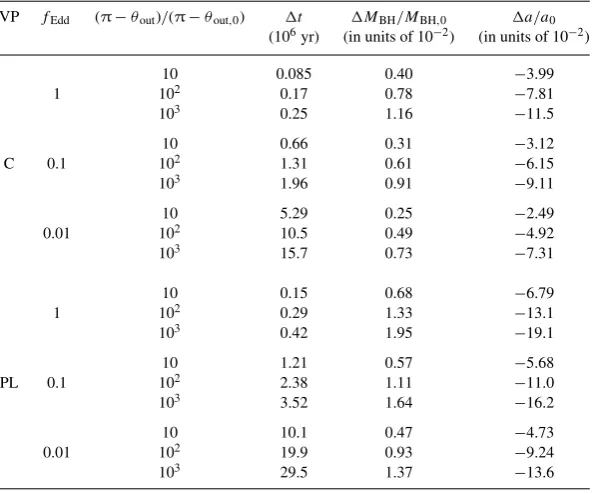
andaare presented in Fig. 15 and Table 3, for different accretion rates and viscosity profiles. The shorter time-scales in the counter-rotating configuration stem from the dependence of the alignment time-scale on the spin modulus,tal∝a5/7. Counter-rotating matter
[image:12.595.306.541.58.331.2]Figure 15. Coupled evolution of the relative inclination angle (π−θout),
BH massMBH and spin parametera for a counter-rotating disc. Solid
(dashed) lines refer to constant (power-law) viscosity profile. Black lines tofEdd =1, red lines tofEdd=0.1, blue lines tofEdd=0.01. Dotted
horizontal lines which appear in top panels represent anglesθout/θout,0=
10, 102, 103. Initial configuration:M
BH,0=106M,a0=0.5,fEdd=0.1
andα=0.09, withπ−θout,0=π/600.
6 D I S C U S S I O N A N D C O N C L U S I O N S
In this paper, we followed the joint evolution of the massMBHand spin JBH of a BH inside a geometrically thin, extended accretion
disc. The BH spin is initially misaligned with the angular momen-tum of the disc in its outer regions. On the short Bardeen–Petterson time-scale, the disc responds to the Lense–Thirring precession, im-posed by the BH spin, and propagates a warp that is maximum aroundRwarp; within this radius, matter orbits around the BH in a
plane which is perpendicular to the BH spin. According to angu-lar momentum conservation, the warped disc interacts with the BH spin and, on the longer alignment time-scale the BH aligns its spin to ˆJdisc,out. In its outer regions, the disc is assumed to be fed by
matter that flows along a plane that keeps its coherence in direction ˆ
Jdisc,out for a sufficiently long time-scale to allow for the
gravito-magnetic interaction to complete BH–disc alignment. While doing so the BH is accreting matter and angular momentum from the in-ner portion of the disc, which is aligned or anti-aligned to the BH spin. Given the mismatch between the time-scale for warp propa-gation and the alignment time (Scheuer & Feiler 1996; Natarajan & Pringle 1998), we devised a method that enabled us to follow, in the small-deformation approximation, the co-evolution of the BH mass and spin in a self-consistent manner, carrying out a large survey of the parameter space and a critical review of the used approximations.
It is found that, considering an initial small relative inclination angle (θout,0 π/6, small deformation approximation), matter in
the inner part of the accretion disc has orbital angular momentum density parallel to JBH. The gravitomagnetic interaction of the BH
with this warped accretion disc and their coupled evolution bring the BH into alignment with the outer regions of the disc, i.e.θout(t)→
0. The time-scaletal of equation (43) gives a good estimate of the
BH–disc alignment time for an e-folding reduction of the angle of misalignment, in very good agreement with numerical results. For a maximally rotating Kerr BH accreting at the Eddington rate,tal∼
105−6 yr, depending on the viscosity parameter α and on the
Table 3. Summary of our parameters and results for the counter-rotating case; we consider viscosity coefficientα=0.09 and initial inclination angleθout,0=π(1−1/6000), both for
constant (C) and power-law (PL) viscosity profiles (VP).
VP fEdd (π−θout)/(π−θout,0) t MBH/MBH,0 a/a0
(106yr) (in units of 10−2) (in units of 10−2)
10 0.085 0.40 −3.99
1 102 0.17 0.78 −7.81
103 0.25 1.16 −11.5
10 0.66 0.31 −3.12
C 0.1 102 1.31 0.61 −6.15
103 1.96 0.91 −9.11
10 5.29 0.25 −2.49
0.01 102 10.5 0.49 −4.92
103 15.7 0.73 −7.31
10 0.15 0.68 −6.79
1 102 0.29 1.33 −13.1
103 0.42 1.95 −19.1
10 1.21 0.57 −5.68
PL 0.1 102 2.38 1.11 −11.0
103 3.52 1.64 −16.2
10 10.1 0.47 −4.73
0.01 102 19.9 0.93 −9.24
103 29.5 1.37 −13.6
Note. The initial BH hasMBH,0=106Manda0=0.5. Accretion ratefEddvaries over three
orders of magnitude and we record times needed to (π−θout, 0) of a factor 10, 100 or 1000;
[image:13.595.150.447.456.703.2]