R E S E A R C H
Open Access
A difference-based approach in the
partially linear model with dependent errors
Zhen Zeng
1and Xiangdong Liu
1**Correspondence:
[email protected]; [email protected]
1Department of Statistics, Jinan
University, Guangzhou, P.R. China
Abstract
We study asymptotic properties of estimators of parameter and non-parameter in a partially linear model in which errors are dependent. Using a difference-based and ordinary least square (DOLS) method, the estimator of an unknown parametric component is given and the asymptotic normality of the DOLS estimator is obtained. Meanwhile, the estimator of a nonparametric component is derived by the wavelet method, and asymptotic normality and the weak convergence rate of the wavelet estimator are discussed. Finally, the performance of the proposed estimator is evaluated by a simulation study.
MSC: 62G05; 62G20
Keywords: NSD random variables; Partially linear model; Asymptotic normality; Finite difference; Least square
1 Introduction
Consider the partially linear model (PLM)
yi=xTi β+f(ti) +ei, 1≤i≤n, (1)
where the superscriptT denotes the transpose, yi are scalar response variables, xi=
(xi1, . . . ,xid)T are explanatory variables, β is a d-dimensional column vector of the
un-known parameter,f(·) is an unknown function,ti are deterministic with 0≤t1≤ · · · ≤ tn≤1, andeiare random errors.
PLM was first considered by Engle et al. [1], and now is one of the most widely used statistical models. It can be applied in almost every field, such as engineering, economics, medical sciences and ecology, etc. There are many authors (see [2–8]) concerned with var-ious estimation methods to obtain estimators of the unknown parameters and nonparam-eters for partially linear model. Deep results such as asymptotic normality of estimators have been obtained.
In this paper, by a difference-based approach, we will use the ordinary least square and wavelet to investigate model (1). The differencing procedures provide a convenient means for introducing nonparametric techniques to practitioners in a way which parallels their knowledge of parametric techniques, and differencing procedures may easily be combined with other procedures. For example, Wang et al. [9] obtained a difference-based approach to the semiparametric partially linear model. Tabakan et al. [10] studied a difference-based
ridge in partially linear model. Duran et al. [11] investigated the difference-based ridge and Liu type estimators in semiparametric regression models. Hu et al. [12] used a difference-based Huber Dutter estimator (DHD) to obtain the root varianceσand parametricβfor partially linear model. Wu [13] constructed the restricted difference-based Liu estima-tor for the parametric component of partially linear model. However, in the majority of the previous work it is assumed that errors are independent. The asymptotic problem of difference-based estimators of partially linear model with dependent errors is in practice important. In this paper, we use a difference-based and ordinary least square method to study the partially linear model with dependent errors.
For the dependent errorseiwe confine ourselves to negatively superadditive dependent
(NSD) random variables. There are many applications of NSD random variables in multi-variate statistical analysis; see [14–23]. Hence, it is meaningful to study the properties of NSD random variables. The formal definition of NSD random variables is the following.
Definition 1(Kemperman [24]) A function: Rn→Ris called superadditive if(x∨ y) +(x∧y)≥(x) +(y) for allx,y∈Rn, where∨stands for componentwise maximum,
and∧for componentwise minimum.
Definition 2(Hu [25]) A sequence{e1,e2, . . . ,en}is said to be NSD if
E(e1,e2, . . . ,en)≤E(Y1,Y2, . . . ,Yn), (2)
whereY1,Y2, . . . ,Ynare independent withei=dYifor eachi, andis a superadditive
func-tion such that the expectafunc-tions in (2) exist. An infinite sequence{en,n≥1} of random
variables is said to be NSD if{e1,e2, . . . ,en}is NSD for alln≥1.
In addition, using the wavelet method (see [26–29]), the weak convergence rate and asymptotic normality of the estimator off(·) are obtained.
Throughout the paper we fix the following notations.β0is the true value of the unknown
parameterβ. Z is the set of integers, N is the set of natural numbers, R is the set of real numbers. Denotex+=max(x, 0), andx–= (–x)+. LetC1,C2,C3,C4are positive constants.
For a sequence of random variablesηnand a positive sequencedn, writeηn=o(dn) ifηn/dn
converges to 0 andηn=O(dn) ifηn/dnis bounded. We can similarly define the notations
ofoP andOPfor stochastic convergence and stochastic bounded. Weak convergence of
a distribution is denoted by Hn D
→H, and for random variables byYn D
→Y.xis the Euclidean norm ofx, and x=max{k∈Z:k≤x}.
2 Estimation method
Define the (n–m)×ndifferencing matrixDas
D= ⎛ ⎜ ⎜ ⎜ ⎜ ⎜ ⎜ ⎜ ⎝
d0 d1 d2 · · · dm 0 · · · 0
0 d0 d1 d2 · · · dm 0 · · · 0
..
. ... ... ... ... ... ... ... ... ... ... ... 0 · · · 0 d0 d1 d2 · · · 0 0 · · · 0 d0 d1 d2 · · · dm
where the positive integer numbermis the order of differencing and d0,d1, . . . ,dm are
differencing weights satisfying
m
q=0 dq= 0,
m
q=0
dq2= 1. (3)
This differencing matrix is given by Yatchew [30]. Using the differencing matrix to model (1), we have
DY=DXβ+Df+De. (4)
From Yatchew [30], the application of differencing matrixDin model (1) can remove the nonparametric effect in large samples, so we will ignore the presence ofDf. Thus, we can rewrite (4) as
˜
Y=Xβ˜ +˜e, (5)
where Y˜ = (y1˜ , . . . ,y˜n–m)T,X˜ = (x1˜ , . . . ,x˜n–m)T andn=X˜TX˜ is nonsingular for largen, ˜
e= (e1˜ , . . . ,e˜n–m)T,y˜i= mq=0dqyi+q,x˜i= mq=0dqxi+q,e˜i= qm=0dqei+q,i= 1, . . . ,n–m.
As a usual regression model, the ordinary least square estimator βˆnof the unknown
parameterβis given as
ˆ
βn=arg min
β
n–m
i=1
˜ yi–x˜Ti β
2
. (6)
Then the estimator satisfies
–2
n–m
i=1 ˜ xi
˜ yi–x˜Tiβˆn
= 0,
and hence
ˆ
βn=–1n X˜TY˜. (7)
In the following, we use wavelet techniques to estimatef(·) ifβˆnis known.
Suppose that there exists a scaling functionφ(·) in the Schwartz spaceSland a
multires-olution analysis{Vm˜}in the concomitant Hilbert spaceL2(R), with the reproducing kernel
Em˜(t,s) given by
Em˜(t,s) = 2m˜E0
2m˜t, 2m˜s= 2m˜
k∈Z
φ2m˜t–kφ2m˜s–k.
LetAi= [si–1,si] denote intervals that partition [0, 1] withti∈Aifor 1≤i≤n. Then the
estimator of the nonparameterf(t) is given by
ˆ fn(t) =
n
i=1
yi–xTiβˆn Ai
3 Preliminary conditions and lemmas
In this section, we give the following conditions and lemmas which will be used to obtain the main results.
(C1) max1≤i≤nxi=C1<∞.
(C2) f(·)∈Hα(Sobolev space), for someα> 1/2. (C3) f(·)is Lipschitz function of orderγ > 0.
(C4) φ(·)belongs toSl, which is a Schwartz space forl≥α.φ(·)is a Lipschitz function
of order 1 and has compact support, in addition to| ˆφ(ξ) – 1|=O(ξ)asξ→0, whereφˆdenotes Fourier transform ofφ.
(C5) si,1≤i≤n, satisfymax1≤i≤n(si–si–1) =O(n–1), and2m˜ =O(n1/3).
Remark3.1 Condition (C1) is standard and often imposed in the estimator of partial linear models, once can refer to Zhao et al. [31]. Conditions (C2)–(C5) are used by Hu et al. [29]. Therefore, our conditions are very mild and can easily be satisfied.
Lemma 3.1(Hu [25]) Suppose that{e1,e2, . . . ,en}is NSD.
(i) Ifg1,g2, . . . ,gnare nondecreasing functions,then{g1(e1),g2(e2), . . . ,gn(en)}is NSD.
(ii) For any2≤m≤nand1≤i1<i2<· · ·<im,{ei1,ei2, . . . ,eim}is NSD.
Lemma 3.2(Wang et al. [17]) Let p> 1.Let{en,n≥1}be a sequence of NSD random variables with Een= 0and E|en|p<∞for each n≥1.Then for all n≥1,
E
max
1≤k≤n
k
i=1 ei
p ≤23–p
n
i=1
E|ei|p for1 <p≤2 (9)
and
E
max
1≤k≤n
k
i=1 ei
p ≤2
15p
lnp
pn
i=1 E|ei|p+
n
i=1 Ee2i
p/2
for p> 2. (10)
Lemma 3.3 Let p> 1.Let{en,n≥1}be a sequence of NSD random variables with Een= 0 and E|en|p<∞for all n≥1,and{cq, 0≤q≤m}be a sequence of real constants.Then for all n≥1,
E
max
1≤k≤n–m
k
i=1 m
q=0 cqei+q
p
≤4mp–1 n
i=1 m
q=0
E|cqei+q|p for1 <p≤2 (11)
and,for p> 2,
E
max
1≤k≤n–m
k
i=1 m
q=0 cqei+q
p
(12)
≤2p+1mp–1
15p
lnp
pn
i=1 m
q=0
E|cqei+q|p+
n
i=1 m
q=0
E(cqei+q)2
p/2
.
Proof Letz1i= mq=0c+qei+q,z2i= mq=0c–qei+q, then mq=0cqei+q=z1i–z2i, and{c+qei+q,i≥1}
and{c–
Cr-inequality,
E
max
1≤k≤n–m
k i=1 m q=0 cqei+q
p =E max
1≤k≤n–m
k i=1
(z1i–z2i)
p
≤2p–1
E
max
1≤k≤n–m
k i=1 z1i p +E max
1≤k≤n–m
k i=1 z2i p
≤2p–1mp–1 m q=0 E max
1≤k≤n–m
k i=1 c+qei+q
p +E max
1≤k≤n–m
k i=1 c–qei+q
p
.
In the case 1 <p≤2, it follows from Lemma3.2that
E
max
1≤k≤n–m
k k=1 m q=0 cqei+q
p
≤2p–1mp–1 m q=0 E max
1≤k≤n–m
k i=1 c+qei+q
p +E max
1≤k≤n–m
k i=1 c–qei+q
p
≤4mp–1
n–m
i=1 m
q=0
Ec+qei+qp+ n–m
i=1 m
q=0
Ec–qei+qp
. (13)
Note that|cq|p=|c+q|p+|c–q|p, the desired result (11) follows from (13) immediately. In the
same way, we also have (12). The proof is completed.
Remark3.2 From Lemma3.3and Lemma3.1, we have, for 1 <p≤2,
E
i∈S m
q=0 cqei+q
p
≤4mp–1
i∈S m
q=0
E|cqei+q|p
(14)
and, forp> 2,
E
i∈S m
q=0 cqei+q
p
≤2p+1mp–1
15p
lnp
p
i∈S m
q=0
E|cqei+q|p+
i∈S m
q=0
E(cqei+q)2
p/2
, (15)
whereS⊂ {1, 2, . . . ,n}.
Lemma 3.4 Let A and B be disjoint subsets ofN,and{Xj,j∈A∪B}be a sequence of NSD random variables.Let f: R→Rand g: R→Rbe differentiable with bounded derivatives,
and · ∞stand for supnorm.Then
Cov
f
i∈A aiXi
,g
j∈A ajXj
≤f∞g∞Cov
i∈A aiXi,
j∈B ajXj
provided the covariation on the right hand side exists,where{ai, 1≤i≤n}is an array of real numbers.
Proof For a pair of random variablesZ1= i∈AaiXi,Z2= j∈BajXj, we have
H(z1,z2) =P(Z1≤z1,Z2≤z2) –P(Z1≤z1)P(Z2≤z2).
Denote by F(z1,z2) the joint distribution functions of (Z1,Z2), and FZ1(z2),FZ2(z2) the marginal distribution function ofZ1,Z2, one gets
Cov(Z1,Z2) =E(Z1Z2) –E(Z1)E(Z2)
= F(z1,z2) –FZ1(z1)FZ2(z2)
dz1dz2= H(z1,z2)dz1dz2,
this relation was established in Lehmann [32] for any two random variablesZ1andZ2with Cov(Z1,Z2) exist. Letf,gare complex valued function on R with derivativesf,g<∞, then we have
Covf(Z1),g(Z2)
= f(Z1)g(Z2)H(z1,z2)dz1dz2
≤ f(Z1)g(Z2)H(z1,z2)dz1dz2≤f∞g∞Cov(Z1,Z2).
The proof is completed.
Lemma 3.5 Let{en,n≥1}be a sequence of NSD random variable with Een= 0.Let˜eij= m
q=0dqeij+q,and|ij–ik|>m if j=k.Then
Eexp
i
n
j=1 tije˜ij
–
n
j=1
Eexp(itije˜ij)
≤–
n
j=1 n
k=j+1 m
q1=0 m
q2=0
t02Cov(eij+q1,eik+q2), (16)
wherei =√–1, mq=0dq= 0and mq=0d2q= 1,ti1,ti2, . . . ,tinare real numbers with|tij| ≤t0.
Proof Notice that the result is true forn= 1.
For n = 2, let f(˜ei1) = exp{iti1e˜i1},g(e˜i2) = exp{iti2˜ei2}. Then, by Lemma 3.4 and
m
q=0d2q= 1,
Eexp{iti1˜ei1+ iti2˜ei2}–Eexp{iti1e˜i1}Eexp{iti2e˜i2}
=Covexp{iti1e˜i1},exp{iti2e˜i2}
≤t20
m
q1=0 m
q2=0
dq1dq2Cov(ei1+q1,ei2+q2)
≤–t20 m
q1=0 m
q2=0
Hence, the result is true forn= 2.
Moreover, suppose that (16) holds forn– 1. By Lemma3.4, we have, forn, Eexp i n j=1 tije˜ij
–
n
j=1
Eexp{itije˜ij}
≤Eexp
i
n
j=1 tije˜ij
–Eexp
i
n–1
j=1 tij˜eij
Eexp{itin˜ein}
+ Eexp i n–1 i=1 tij˜eij
Eexp{itin˜ein}– n–1
j=1
Eexp{itije˜ij}Eexp{itine˜in}
≤Cov exp i n–1 i=1 tije˜ij
,exp{itine˜in}
+ Eexp i n–1 j=1 tije˜ij
–
n–1
j=1
Eexp{itije˜ij}
≤Cov exp i n–1 i=1 tije˜ij
,exp{itine˜in}
+ n–1 j=1 n–1
k=j+1 m q1=0 m q2=0
t02Cov(eij+q1,eik+q2)
≤–t2 0 n j=1 n
k=j+1 m q1=0 m q2=0
Cov(eij+q1,eik+q2),
which completes the proof.
Lemma 3.6(Hu et al. [29]) If Condition(C3)holds,then
(a1) |E0(t,s)| ≤(1+C|t–ks|)k,|Em˜(t,s)| ≤ 2
˜
mC
(1+2m˜|t–s|)k (wherek∈NandC=C(k)is a constant
depending onkonly).
(a2) sup0≤s≤1|Em˜(t,s)|=O(2m˜).
(a3) supt01|Em˜(t,s)|ds≤C2.
(a4) 01Em˜(t,s)ds→1,n→ ∞.
Lemma 3.7(Rao [33]) Suppose that{Xn,n≥1}are independent random variables with EXn= 0and s–(2+n δ) nj=1E|Xj|2+δ→0for someδ> 0.Then
s–1n n
j=1 Xj
D
→N(0, 1),
where s2
n= nj=1EXj2=Var( n j=1Xj).
Lemma 3.8(Yu et al. [34]) Let{en,n≥1}be a sequence of NSD random variable satisfying Een= 0,supj≥1 i:|i–j|≥u|Cov(ei,ej)| →0as u→ ∞,and{ani, 1≤i≤n,n≥1}be an array of real numbers withmax1≤i≤n|ani| →0and ni=1a2ni=O(1).Suppose that{en,n≥1}is uniformly integral in L2,then
σn–1 n
i=1 aniei
D
→N(0, 1),
4 Main results and their proofs
Theorem 4.1 Under Condition(C1),suppose that{en,n≥1}is a sequence of NSD random variables with Een= 0and
(i) supn≥1E|en|2+δ<∞for someδ> 0,
(ii) supj≥1 i:|i–j|≥u|Cov(ei,ej)| →0asu→ ∞.Then
(n–m)–12τ–1
β n(βˆn–β0) D
−→N(0,Id) (17)
provided that
τβ2= lim
n→∞(n–m) –1
n–m
i=1 ˜
xix˜Ti Var(˜ei) + 2 n–m
i=1 n–m
j=i+1 ˜
xix˜Tj Cov(˜ei,e˜j)
(18)
is a positive definite matrix,whereIdis the identity matrix of orderd.
Proof By Condition (i), we have
sup
n≥1
Ee2n<∞ and lim
x→∞supn≥1Ee
2 nI
|en|>x
= 0,
from which it follows that
C3:=sup n>m
(n–m)–1
n–m
i=1 m
q=0
Var(dqei+q) <∞,
and for allε> 0
(n–m)–1
n–m
i=1 m
q=0
E(dqei+q)2I
|dqei+q| ≥ √
n–mε→0 asn→ ∞.
Then we can find a positive number sequence{εn,n≥1}withεn→0 such that
(n–m)–1
n–m
i=1 m
q=0
E(dqei+q)2I
|dqei+q| ≥ √
n–mεn
→0 asn→ ∞.
Now, we define the integers:m0= 0, and, for eachj= 0, 1, 2, . . . , put
m2j+1=min
m:m≥m2j, (n–m)–1 m
i=m2j+1
m
q=0
Var(dqei+q) >√εn
,
m2j+2=m2j+1+
1
εn
+m.
Denote
Ij={k:m2j<k≤m2j+1,j= 0, . . . ,l} and
wherel=l(n) is the number of blocks of indicesIj. Then
l√εn≤(n–m)–1 l
j=1
i∈Ij m
q=0
Var(dqei+q)≤(n–m)–1 n–m
i=1 m
q=0
E(dqei+q)2≤C3, (19)
and hence we havel≤C3/√εn. If the number of the remainder term is not zero when the
construction ends, then we put all the remainder terms into a block denoted byJl. By (7),
we have
n(βˆn–β0) = n–m
i=1 ˜
xie˜i. (20)
Then to prove (17), it is enough to prove that
(n–m)–1/2τβ–1 n–m
i=1 ˜ xie˜i
D
→N(0,Id). (21)
Letube an arbitraryd-dimensional column vector withu= 1, and setai=uTτβ–1x˜i.
Then, by the Cramér–Wold device, to prove (21) it suffices to prove that
1
√ n–m
n–m
i=1 aie˜i
D
→N(0, 1). (22)
Write
1
√ n–m
n–m
i=1 aie˜i=
1
√ n–m
l
j=1
i∈Ij aie˜i+
1
√ n–m
l
j=1
i∈Jj aie˜i
:=I+J.
Moreover, note thatmax0≤q≤m|dq| ≤1 andmax1≤i≤n|ai|<∞by Condition (C1), then
applying Lemma3.3withp= 2 we have
E
1
√ n–m
l
j=1
i∈Jj ai˜ei
2
= 1
n–mE
l
j=1
i∈Jj m
q=0 aidqei+q
2
≤ 4m n–m
l
j=1
i∈Jj m
q=0
E|aidqei+q|2
≤ 4m n–m
! max
m1≤i≤m2l+2
a2i
"l
j=1
i∈Jj m
q=0
E|dqei+q|2
≤ 4m n–m
! max
m1≤i≤m2l+2
a2i
"l
j=1
i∈Jj m
q=0
E|dqei+q|2I
|dqei+q| ≥ √
n–mεn
+ 4m
n–m
! max
m1≤i≤m2l+2
a2i
"l
j=1
i∈Jj m
q=0
E|dqei+q|2I
|dqei+q|< √
n–mεn
≤ 4m n–m
! max
m1≤i≤m2l+2
a2i
"l
j=1
i∈Jj m
q=0
E|dqei+q|2I
|dqei+q| ≥ √
n–mεn
+ 4m
n–m
! max
m1≤i≤m2l+2
a2i"l#ε–1n $+m(n–m)ε2n
≤ 4m n–m
! max
m1≤i≤m2l+2
a2i" n–m
i=1 m
q=0
E(dqei+q)2I
|dqei+q| ≥ √
n–mεn
+ 4m
! max
m1≤i≤m2l+2
a2i
"
C3εn–1/2
#
εn–1$+mεn2
→0 asn→ ∞, (23)
which follows from
J→P 0 asn→ ∞
by the Markov inequality. Therefore, to prove (22), it suffices to show that
1
√ n–m
l
j=1
i∈Ij aie˜i
D
→N(0, 1). (24)
On the one hand, by the definition ofτβ2, it is easy to show that
lim
n→∞Var
1
√ n–m
n–m
i=1 aie˜i
= 1.
Therefore by the above formula and (23),
lim
n→∞Var
1
√ n–m
l
j=1
i∈Ij ai˜ei
= 1. (25)
On the other hand, by Lemma3.5and (ii), we have
Eexp i l j=1
i∈Ij tie˜i
– l j=1 E
i∈Ij
exp(itie˜i)
≤–t20 l
p=1 l
s=p+1
i∈Ip
j∈Is m q1=0 m q2=0
Cov(ei+q1,ej+q2)
= –t02 m q1=0 m q2=0
i+q1–j–q2≥ 1 εn+m
Cov(ei+q1,ej+q2)
which implies that the problem now is reduced to study the asymptotic behavior of inde-pendent and non-identically distribution random variables{ i∈I
jaie˜i}.
To complete the proof of (24), it is enough to show that random variables{ i∈Ijai˜ei}
satisfies the condition of Lemma3.7. Set
C4= max 1≤i≤m2l+2|
ai|2+δ and τn2=Var
1
√ n–m
n–m
i=1 ai˜ei
.
By the definition ofIj,
(n–m)–1 i∈Ij
m
q=0
E(dqei+q)2
= (n–m)–1
m2j+1
m2j m
q=0
E(dqei+q)2
= (n–m)–1
m2j+1–1
m2j m
q=0
E(dqei+q)2+ (n–m)–1 m
d=0
E(dqem2j+1+q)
2
≤√εn+ (n–m)–1 m
q=0
E(dqem2j+1+q)
2
≤√εn+ (n–m)–1sup n≥1
Ee2n. (27)
By Lemma3.3withp= 2 +δand (27), and recalling thatl≤C3/√εn,
τn–(2+δ) l
j=1
E(n–m)–1/2
i∈Ij ai˜ei
2+δ
=τn–(2+δ)(n–m)–(2+δ)/2
l
j=1 E
i∈Ij m
q=0 aidqei+q
2+δ
≤τn–(2+δ)(n–m)–(2+δ)/2C42δ+3mδ+1
15(2 +δ) ln(2 +δ)
2+δl
j=1
i∈Ij m
q=0
E|dqei+q|2+δ
+τn–(2+δ)C42δ+3mδ+1
15(2 +δ) ln(2 +δ)
2+δl
j=1
(n–m)–1
i∈Ij m
q=0
E(dqei+q)2
(2+δ)/2
≤τn–(2+δ)(n–m)–δ/2C42δ+3mδ+2
15(2 +δ) ln(2 +δ)
2+δ sup
n≥1E|en| 2+δ
+τn–(2+δ)C42δ+3mδ+1
15(2 +δ) ln(2 +δ)
2+δ
·C3εn–1/2
%√
εn+ (n–m)–1sup n≥1
Ee2n
&(2+δ)/2
→0, (28)
sinceτn→1 and (i).
Corollary 4.1 Under Condition(C1),let{en,n≥1}be a sequence of independent random variables with Een= 0,and suppose that(i)of Theorem4.1holds and Ee2n=σ2for all n≥1. Then
(n–m)–12τ–1
β n(βˆn–β0) D
−→N(0,Id),
provided that
τβ2= lim
n→∞(n–m)
–1
n–m
i=1 ˜ xix˜Ti σ
2+ 2 m
k=1 n–m–k
i=1 ˜
xix˜Ti+k(d0dk+d1dk+· · ·+dm–kdm)σ2
is a positive definite matrix.
Proof Since{en,n≥1} is a sequence of independent random variables, we haveCov(ei, ej) = 0 ifi=jand henceCov(˜ei,˜ej) = 0 if|i–j|>m. It follows that
τβ2= lim
n→∞(n–m) –1
n–m
i=1 ˜
xix˜Ti Var(˜ei) + n–m
i=1 n–m
j=1,j=i ˜
xix˜Tj Cov(˜ei,˜ej)
= lim
n→∞(n–m) –1
n–m
i=1 ˜
xix˜Ti σ2+ 2 m
k=1 n–m–k
i=1 ˜
xix˜Ti+k(d0dk+d1dk+1+· · ·
+dm–kdm)σ2
(29)
from the conditions of Corollary4.1, we see thatτβ2is a positive definite matrix. Thus the
result follows from (29).
Theorem 4.2 Assume the conditions of Theorem4.1,and further assume that Conditions
(C2)–(C5)hold.Then
sup
0≤t≤1
fˆn(t) –f(t)=OP
n–γ+OP(τm˜) +OP
n–1/3Mn
as n→ ∞, (30)
where Mn→ ∞in arbitrary slowly rate,andτm˜ = 2–m˜(α–1/2)if1/2 <α< 3/2,τm˜ =
√ ˜ m2–m˜ ifα= 3/2,andτm˜ = 2–m˜ ifα> 3/2.
Proof We can prove Theorem4.2by a similar argument to Theorem3.2of Hu et al. [12],
so we omit the detail.
Theorem 4.3 Under the Conditions of Theorem4.2,we have ˆ
fn(t) –f(t) τt
D
→N(0, 1), (31)
whereτ2 t =Var(
n i=1ei
Proof Note
ˆ
fn(t) –f(t) = n
i=1
yi–xTiβˆn Ai
Em˜(t,s)ds–f(t)
=
n
i=1
xT
iβ+f(ti) +ei–xTi βˆn Ai
Em˜(t,s)ds–f(t)
=
n
i=1
xTi(β–βˆn)
Ai
Em˜(t,s)ds
+
n
i=1 f(ti)
Ai
Em˜(t,s)ds–f(t)
+
n
i=1 ei
Ai
Em˜(t,s)ds
:=I1+I2+I3, (32)
from the proof of Theorem 3.2 in Hu et al. [12], we getI1=OP(n–1/2),I2=OP(n–γ) +OP(τm˜)
andI3=OP(n–1/3Mn), and it implies that
I1=oP(I3)
and
I2=oP(I3).
Then we should prove
I3 τt
=
n i=1ei
AiEm˜(t,s)ds
'
Var( ni=1ei
AiEm˜(t,s)ds) D
→N(0, 1). (33)
Letani=τt–1
AiEm˜(t,s)ds, then, by Lemma3.6and (C5),max1≤i≤n|ani| →0, and n i=1a2ni= O(1), and condition (i) implies that{en,n≥1}is a uniformly integral family onL2, then,
by Lemma3.8and (ii), we have
τt–1fˆn(t) –f(t)
D
→N(0, 1). (34)
The proof is completed.
5 A simulation example
In this section, we perform a simulation example to verify the accuracy of Theorem4.1 and Theorem4.3. Consider the partially linear model
yi=xiβ+f(ti) +ei, i= 1, 2, . . . ,n,
wherexi=cos(2πti),f(ti) =sin(2πti),β0= 5,ti=i/n,eiis NSD sequence and raised as
fol-lows.
Let{e1,e2, . . . ,en}be a sequence of independent and identically distributed random
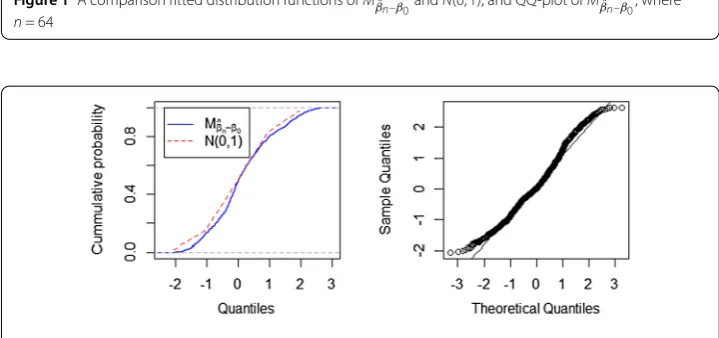
Figure 1A comparison fitted distribution functions ofMβnˆ–β
0andN(0, 1), and QQ-plot ofMβnˆ–β0, where
n= 64
Figure 2A comparison fitted distribution functions ofMβnˆ–β
0andN(0, 1), and QQ-plot ofMβnˆ–β0, where
n= 128
Setm= 3 and the difference sequenced0=√3/4,d1=d2=d3= –√1/12 (Wang et al. [9]). We first evaluate theMβˆn–β0= (n–m)
–12τ–1
β n(βˆn–β0) approximation. Figures1and
2show the results for two sample size specifications (n= 64,n= 128). Panel 1 in Fig.1 com-pares the empirical distribution functions ofMβˆn–β0andN(0, 1). Panel 2 in Fig.1gives the QQ-plot ofMβˆn–β0. Figure1shows that the distribution ofMβˆn–β0can approximateN(0, 1) well even if the sample size are not large (n= 64). Comparison of Fig.2with Fig.1indicates that the distribution approximation for the larger sample size is much more accurate than that for the small one.
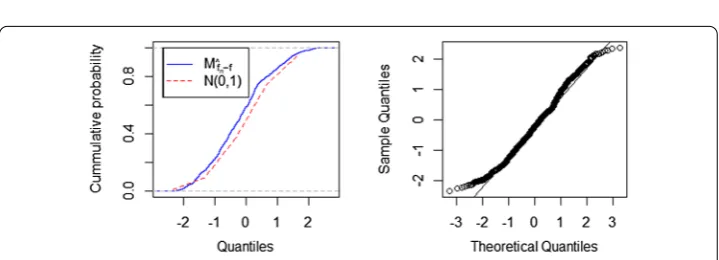
Choose the Daubechies scaling function2φ(t) as in Hu et al. [29]. Figures3and4show
that the distribution of Mˆfn–f =τt–1(ˆfn(t) –f(t)) is closer and closer to N(0, 1) with the
increasing sample size.
6 Conclusions
[image:14.595.117.477.213.382.2]Figure 3A comparison fitted distribution functions ofMˆ
fn–fandN(0, 1), and QQ-plot ofMˆfn–f, wheren= 64
Figure 4A comparison fitted distribution functions ofMˆ
fn–fandN(0, 1), and QQ-plot ofMˆfn–f, wheren= 128
Funding
The research is supported by National Natural Science Foundation of China [grant number 71471075].
Competing interests
The authors declare that they have no competing interests.
Authors’ contributions
All authors contributed equally to the writing of this paper. All authors read and approved the final manuscript.
Publisher’s Note
Springer Nature remains neutral with regard to jurisdictional claims in published maps and institutional affiliations.
Received: 10 June 2018 Accepted: 18 September 2018
References
1. Engle, R.F., Granger, C.W.J., Rice, J., Weiss, A.: Semiparametric estimates of the relation between weather and electricity sales. J. Am. Stat. Assoc.81, 310–320 (1986)
2. Silvapullé, M.J.: Asymptotic behavior of robust estimators of regression and scale parameters with fixed carriers. Ann. Stat.13(4), 1490–1497 (1985)
3. Kim, S., Cho, H.R.: Efficient estimation in the partially linear quantile regression model for longitudinal data. Electron. J. Stat.12(1), 824–850 (2018)
4. Härdle, W., Gao, J., Liang, H.: Partially Linear Models. Springer, New York (2000)
5. Chang, X.W., Qu, L.: Wavelet estimation of partially linear models. Comput. Stat. Data Anal.47, 31–48 (2004) 6. Liang, H., Wang, S.J., Carroll, R.J.: Partially linear models with missing response variables and error-prone covariates.
Biometrika94(1), 185–198 (2007)
7. Holland, A.D.: Penalized spline estimation in the partially linear model. J. Multivar. Anal.153, 211–235 (2017) 8. Zhao, T., Cheng, G., Liu, H.: A partially linear framework for massive heterogeneous data. Ann. Stat.44(4), 1400–1437
(2016)
9. Wang, L., Brown, L.D., Cai, T.T.: A difference based approach to the semiparametric partial linear model. Electron. J. Stat.5, 619–641 (2011)
10. Tabakan, G., Akdeniz, F.: Difference-based ridge estimator of parameters in partial linear model. Stat. Pap.51, 357–368 (2010)
11. Duran, E.A., Hädle, W.K., Osipenko, M.: Difference based ridge and Liu type estimators in semiparametric regression models. J. Multivar. Anal.105(1), 164–175 (2012)
[image:15.595.118.478.230.360.2]13. Wu, J.: Restricted difference-based Liu estimator in partially linear model. J. Comput. Appl. Math.300, 97–102 (2016) 14. Shen, Y., Wang, X.J., Yang, W.Z., Hu, S.H.: Almost sure convergence theorem and strong stability for weighted sums of
NSD random variables. Acta Math. Sin. Engl. Ser.29(4), 743–756 (2013)
15. Xue, Z., Zhang, L.L., Lei, Y.J., Chen, Z.J.: Complete moment convergence for weighted sums of negatively superadditive dependent random variables. J. Inequal. Appl.2015, Article ID 117 (2015)
16. Shen, Y., Wang, X.J., Hu, S.H.: On the strong convergence and some inequalities for negatively superadditive dependent sequences. J. Inequal. Appl.2013, Article ID 448 (2013)
17. Wang, X.J., Deng, X., Zheng, L.L., Hu, S.H.: Complete convergence for arrays of rowwise negatively superadditive dependent random variables and its applications. Statistics48(4), 834–850 (2014)
18. Wang, X.J., Shen, A.T., Chen, Z.Y., Hu, S.H.: Complete convergence for weighted sums of NSD random variables and its application in the EV regression model. Test24, 166–184 (2015)
19. Meng, B., Wang, D., Wu, Q.: On the strong convergence for weighted sums of negatively superadditive dependent random variables. J. Inequal. Appl.2017, Article ID 269 (2017)
20. Shen, A.T., Wang, X.H.: Kaplan–Meier estimator and hazard estimator for censored negatively superadditive dependent data. Statistics50(2), 377–388 (2016)
21. Shen, A.T., Xue, M.X., Volodin, A.: Complete moment convergence for arrays of rowwise NSD random variables. Stochastics88(4), 606–621 (2016)
22. Wang, X.J., Wu, Y., Hu, S.H.: Strong and weak consistency of LS estimators in the EV regression model with negatively superadditive-dependent errors. AStA Adv. Stat. Anal.102, 41–65 (2018)
23. Wang, X.J., Wu, Y., Hu, S.H.: Complete moment convergence for double-indexed randomly weighted sums and its applications. Statistics52(3), 503–518 (2018)
24. Kemperman, J.H.B.: On the FKG-inequalities for measures on a partially ordered space. Proc. Akad. Wet., Ser. A80, 313–331 (1977)
25. Hu, T.Z.: Negatively superadditive dependence of random variables with applications. Chinese J. Appl. Probab. Statist.
16(2), 133–144 (2000)
26. Gannaz, I.: Robust estimation and wavelet thresholding in partially linear models. Stat. Comput.17, 293–310 (2007) 27. Hu, H.C., Wu, L.: Convergence rates of wavelet estimators in semiparametric regression models under NA samples.
Chin. Ann. Math.33(4), 609–624 (2012)
28. Christophe, C., Isha, D., Hassan, D.: Nonparametric estimation of a quantile density function by wavelet methods. Comput. Stat. Data Anal.94, 161–174 (2016)
29. Hu, H.C., Cui, H.J., Li, K.C.: Asymptotic properties of wavelet estimators in partially linear errors-in-variables models with long memory errors. Acta Math. Appl. Sin. Engl. Ser.34(1), 77–96 (2018)
30. Yatchew, A.: An elementary estimator for the partial linear model. Econ. Lett.5, 135–143 (1997)
31. Zhao, H., You, J.: Difference based estimation for partially linear regression models with measurement errors. J. Multivar. Anal.102, 1321–1338 (2011)
32. Lehmann, E.L.: Some concepts of dependence. Ann. Math. Stat.37, 1137–1153 (1966) 33. Rao, B.L.S.P.: Asymptotic Theory of Statistical Inference. Wiley, New York (1987)