2019 International Conference on Artificial Intelligence and Computing Science (ICAICS 2019) ISBN: 978-1-60595-615-2
A Fast Image Encryption Algorithm Based on Self-confusion Method
Yong ZHANG
*, Ai-guo CHEN, Ben CHEN and Han-cheng LIAO
School of Software and Internet-of-Things Engineering, Jiangxi University of Finance and Economics, Nanchang, 330013, P.R. China
*Corresponding author
Keywords: Image encryption, Self-confusion, Diffusion, Chaos.
Abstract. A novel image encryption algorithm based on self-confusion was proposed in this paper. The image encryption process is composed of covering operation, self-confusion and diffusion. The chaotic system was employed to generate one pseudo-random matrix and two pseudo-random sequences for image encryption. The matrix is used to cover the image, and the sequences are used to diffuse the image. The image is shuffled in the self-confusion by its own data, making the proposed image encryption algorithm be plaintext-related. The simulation results show that the proposed scheme has the merits of fast speed and good security, and can be a candidate for image information security.
Introduction
In recent years, with the development of computer network and wireless communication technology, image encryption has become a hotspot in the field of information security [1-4]. The image encryption is the most effective means to protect the security of image information transmitted and stored on the internet.
However, some image cryptosystems based on chaotic systems were proved to be unsecure [5-8]. Those image cryptosystems having been cracked used the plaintext-unrelated encryption algorithms, failing to resist the known/chosen plaintext attacks. Therefore, a good image encryption scheme must be plaintext-related, i.e. the equivalent secret keys of the scheme are not only related to the secret key, but also to the plain images [9-11].
Recently, the plaintext-related confusion algorithms were deeply studied. Since the confusion process only changes the position of each pixel, the sum or information entropy of all the pixels in the image are invariants in the confusion process. These invariants can be used to select the confusion modes [12-13]. In this paper, a new plaintext-related image confusion algorithm was proposed, which was called self-confusion because it only related to its own data.
Image Encryption Scheme
[image:1.612.106.502.617.694.2]The proposed image encryption scheme is shown in Fig. 1. As can be seen from Fig. 1, the proposed image encryption system includes two parts: the pseudo-random number generator based on chaotic system and the encryption process composed of covering, confusion and diffusion. Here, the Lorenz system is chosen as the chaotic system of pseudo-random generator.
The Lorenz system is shown as follows.
= −
= − −
= − (1)
where, a=10, b=8/3, c=28. The size of discretization step used in simulation test is dt=0.02.
Now, denote the plain image as P of size M×N, ciphered image as C of size M×N, and secret key as K of length 240 bits.
Pseudo-Random Sequence Generator
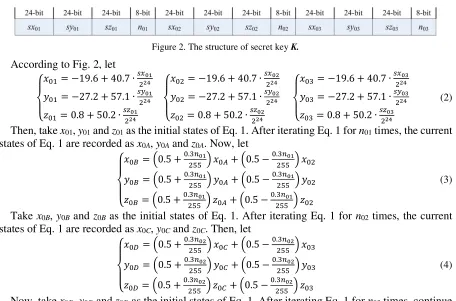
[image:2.612.80.536.216.517.2]The structure of the key K is shown in Fig. 2.
Figure 2. The structure of secret key K.
According to Fig. 2, let
⎩ ⎨
⎧ = −19.6 + 40.7 ∙ !
= −27.2 + 57.1 ∙ $ !
= 0.8 + 50.2 ∙ & !
⎩ ⎨
⎧ = −19.6 + 40.7 ∙ !
= −27.2 + 57.1 ∙ $ !
= 0.8 + 50.2 ∙ & !
⎩ ⎨
⎧ '= −19.6 + 40.7 ∙ !( '= −27.2 + 57.1 ∙ $ !(
'= 0.8 + 50.2 ∙ & !(
(2)
Then, take x01, y01 and z01 as the initial states of Eq. 1. After iterating Eq. 1 for n01 times, the current states of Eq. 1 are recorded as x0A, y0A and z0A. Now, let
⎩ ⎪ ⎨ ⎪
⎧ *= +0.5 + .',-- . /+ +0.5 − .',-- . * = +0.5 + .',-- . /+ +0.5 − .',-- .
*= +0.5 + .',-- . /+ +0.5 − .',-- .
(3)
Take x0B, y0B and z0B as the initial states of Eq. 1. After iterating Eq. 1 for n02 times, the current
states of Eq. 1 are recorded as x0C, y0C and z0C. Then, let
⎩ ⎪ ⎨ ⎪
⎧ 0 = +0.5 + .',-- . 1+ +0.5 − .',-- . ' 0 = +0.5 + .',-- . 1+ +0.5 − .',-- . '
0 = +0.5 + .',-- . 1+ +0.5 − .',-- . '
(4)
Now, take x0D, y0D and z0D as the initial states of Eq. 1. After iterating Eq. 1 for n03 times, continue
to iterate it for MN times to obtain three state sequences of length MN, denoted by {xi}, {yi} and {zi}, i=0,1,2,…,MN-1. Get a pseudo-random matrix D and two pseudo-random vectors E and F from the three state sequences as follows:
⎩ ⎪ ⎨ ⎪
⎧2 3, 5 = 65778 +109∙ : ;<=>− 65778 ;<=> ?. A7B 256
C D = 65778 +109∙ :
E− 65778 E ?. A7B 256
F D = 65778 +109∙ :
E− 65778 E ?. A7B 256
(5)
where, k=0,1,2,…,M-1, l=0,1,2,…,N-1. i=0,1,2,…,MN-1.
Encryption Process
In Fig. 1, the encryption process includes the covering, confusion and diffusion operations. The inputs of covering are P and D, and its output is A. The covering algorithm is as follows:
equally divided into two vectors, i.e. Q1(i)=Q(i/N, i mod N), Q2(j-MN/2)=Q(j/N, j mod N), i=0,1,…,
MN/2-1, j=MN/2,MN/2+1,…,MN-1. Then, let
⎩ ⎪⎪ ⎨ ⎪⎪
⎧N 0 = :O 0 + C 0 ? A7B 256
N D = :N D − 1 + O D + C D ? A7B 256
N +P<− 1. = QO +P<− 1. + F LM − 1 R A7B 256 N H = QN H + 1 + O H + F +H +P<.R A7B 256
(7)
where, i=1,2,…,MN/2-1, j=MN/2-2,MN/2-3,…,2,1,0. Here, Eq. 7 can be parallelly executed. Based on the Q1 and Q2 in Eq. 7, diffusion-II performs the following operations.
⎩ ⎪⎪ ⎨ ⎪⎪
⎧S +P<− 1. = QN +P<− 1. + F +P<− 1.R A7B 256 S D = :S D + 1 + N D + F D ? A7B 256
S 0 = :N 0 + C LM/2 ? A7B 256
S H = QS H − 1 + N H + C +H +P<.R A7B 256
(8)
where, i= MN/2-2,MN/2-3,…,2,1,0, j=1,2,…,MN/2-1. Here, Eq. 8 can be parallelly executed. Combine C1 and C2 into the matrix C such that C(i,j)=C1(iN+j), C(k,j)=C2(kN+j), i=0,1,…,M/2-1,
k=M/2,M/2+1,…,M-1, j=0,1,2,…,N-1. C is the ciphered image.
Self-Confusion Process
The self-confusion process does not require the pseudo-random numbers. The input of self-confusion is the matrix A, and its output is the matrix B, as shown in Fig. 1. The self-confusion performs the following operations.
O D, H = G +:∑P G 3, H
;V − G D, H ? A7B L, :∑<;V G D, 3 − G D, H ? A7B M. (9)
where, i=0,1,2,…,M-1, j=0,1,2,…,N-1. If the element of A calculated by Eq. 9 is in the i-th row or in the j-th column, then the assignment operation in Eq. 9 is not performed, but B(i,j)=A(i,j).
Decryption Process
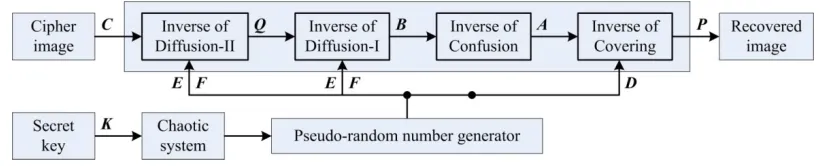
The decryption process is the inverse of the encryption process, as shown in Fig. 3. In Fig. 3, the inverse algorithm of the confusion process is as follows.
G D, H = O +:∑P O 3, H
;V − O D, H ? A7B L, :∑<;V O D, 3 − O D, H ? A7B M. (10)
[image:3.612.99.512.527.610.2]where, i=M-1,M-2,…,2,1,0, j=N-1,N-2,…,2,1,0. If the element of B calculate by Eq. 10 is in the i-th row or in the j-th column, then let A(i,j)=B(i,j).
Figure 3. Proposed image decryption scheme.
Simulation Results
The computer is configured with Intel® Core™ i7-8650U, 16GB RAM, Windows 10. The tested images are Lena, Baboon and Pepper of all size 256×256, as shown in Figs. 4a-4c, respectively.
Without losing generality, the secret key K='826AED5A4440EA974B69DE949B7E96CDC887983
(a) (b) (c) (d) (e) (f) (g) (h) (i)
Figure 4. Encryption and decryption results. (a) Lena; (b) Baboon; (c) Pepper; (d)-(f) Ciphered images of (a)-(c), respectively; (g)-(i) Recovered images of (d)-(f), respectively.
Performance Analysis
Encryption and Decryption Speed
In the computer in Section 3, under the environment of MATLAB 2018a for the image of size 256×256, the encrypted time is 0.2054s, and the decrypted time is 0.1808s. So the encryption speed is about 2.5525Mbps, and the decryption speed is about 2.8998Mbps. Considering the interpretive execution of MATLAB program, the encryption/decryption speed is quite fast.
Key Space
The secret key of proposed image cryptosystem is 240 bits, so the size of key space is 2240≈1.7669 ×1072. Using the computer in Section 3, it takes at least 5.0648×1063 years to try the keys in the half key space. So the key space is large enough to resist exhaustive attack.
Correlation Analysis
Generally, the correlation coefficients between adjacent pixels in an image are calculated by the following formula.
8 = ∑\]W^ WXY Z $WXY [ _∑\]W^ WXY Z _∑\]W^ $WXY [
(11)
where, n represents the number of adjacent pixels selected from the image, and E(x) returns the average value of x.
Here, take Figs. 4a-4f as examples to calculate their correlation coefficients. Let n=2000, and list the calculated results in Table 1.
Table 1. The results of correlation analysis.
Image Horizontal Vertical Diagonal Counter-diagonal
Fig. 4a 0.9671 0.9358 0.9200 0.9371
Fig. 4b 0.8293 0.8674 0.7679 0.7964
Fig. 4c 0.9711 0.9621 0.9369 0.9490
Fig. 4d 0.0408 -0.0009 0.0249 0.0300
Fig. 4e -0.0630 0.0207 0.0451 0.0245
Fig. 4f 0.0031 -0.0013 0.0068 -0.0428
Table 1 shows that the correlation coefficients in each direction of plain images are close to 1, while the correlation coefficients in each direction of ciphered images tend to 0. So the ciphered images can resist the correlation analysis.
Information Entropy Analysis
The information entropy of an image is calculated by the following formula: ` = − ∑ a D log a D
--EV (12)
For the 8-bit grayscale image, the maximum value of entropy is 8 bits. Here, the values of entropy of Figs. 4a-4f are calculated and then listed in Table 2.
Table 2. The results of information entropy test (unit: bit).
Table 2 shows that the information entropies of ciphered images (Figs. 4d-4f) are larger than those of plain images (Figs. 4a-4c) and are close to 8. Therefore, the ciphered images approximate the noise image and have no visual information.
Sensitivity Analysis
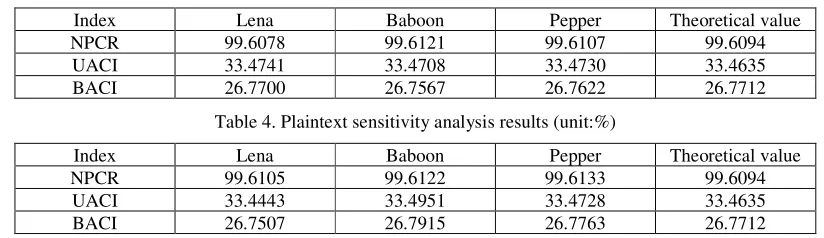
The key sensitivity and plaintext sensitivity of proposed image cryptosystem are analyzed with the help of NPCR, UACI [1] and BACI [4]. The results are shown in Tables 3-4.
Table 3. Key sensitivity analysis results (unit:%).
Index Lena Baboon Pepper Theoretical value
NPCR 99.6078 99.6121 99.6107 99.6094
UACI 33.4741 33.4708 33.4730 33.4635
[image:5.612.98.510.174.293.2]BACI 26.7700 26.7567 26.7622 26.7712
Table 4. Plaintext sensitivity analysis results (unit:%)
Index Lena Baboon Pepper Theoretical value
NPCR 99.6105 99.6122 99.6133 99.6094
UACI 33.4443 33.4951 33.4728 33.4635
BACI 26.7507 26.7915 26.7763 26.7712
Tables 3-4 show that the results of sensitivity analysis are very close to their respective theoretical values, which indicate that the proposed image encryption system has both strong key sensitivity and plaintext sensitivity, and can resist the cryptanalysis method based on differential operations.
Conclusion
In this paper, a new fast image encryption system with 240-bit long external key was proposed. The Lorenz system is employed to generate the pseudo-random equivalent keys. Then, the covering, self-confusion and diffusion operations are employed to convert plain images into the noise-like ciphered images. The simulation results show that the proposed image cryptosystem has the characteristics of fast speed and strong security, and can be applied to practical network image information security.
Acknowledgement
This research was financially supported by the National Natural Science Foundation of China (Grant Nos. 61562035 and 61762043).
References
[1] G. Chen, Y. Mao, C.K. Chui, A symmetric image encryption scheme based on 3D chaotic cat
maps, Chaos Soliton. Fract. 21 (2004) 749-761.
[2] M. Khan, Z. Asghar, A novel construction of substitution box for image encryption applications with Gingerbreadman chaotic map and S8 permutation, Neural Comput. Appl. 29 (2018) 93-999.
[3] Y. Zhang, X. Jia, The fast image encryption algorithm based on substitution and diffusion, KSII T. Internet Inf. 12 (2018) 4487-4511.
[4] Y. Zhang, The unified image encryption algorithm based on chaos and cubic S-Box, Inform. Sciences 450 (2018) 361-377.
[6] E.Y. Xie, C. Li, S. Yu, J. Lv, On the cryptanalysis of Fridrich’s chaotic image encryption scheme, Signal Process. 132 (2017) 150-154.
[7] A. Akhavan, A. Samsudin, A. Akhshani, Cryptanalysis of an image encryption algorithm based on DNA encoding, Opt. Laser Technol. 95 (2017) 94-99.
[8] M. Li, Y. Guo, J. Huang, Y. Li, Cryptanalysis of a chaotic image encryption scheme based on permutation-diffusion structure, Signal Process. Image Commun. 62 (2018) 164-172.
[9] Y. Luo, R. Zhou, J. Liu, Y. Cao, X. Ding, A parallel image encryption algorithm based on the piecewise linear chaotic map and hyper-chaotic map, Nonlinear Dyn. 93 (2018) 1165-1181.
[10]Y. Zhang, Y. Tang, A plaintext-related image encryption algorithm based on chaos, Multimed. Tools Appl. 77 (2018) 6647-6669.
[11]P. Li, K.T. Lo, Joint image compression and encryption based on order-8 alternating transfoms, J. Vis. Commun. Image R. 44 (2017) 61-71.
[12]G. Ye, C. Pan, X. Huang, Z. Zhao, J. He, A chaotic image encryption algorithm based on information entropy. Int. J. Bifurc. Chaos 28 (2018) 1850010 (11 pages).