R E S E A R C H
Open Access
Comparing the excepted values of
atom-bond connectivity and
geometric–arithmetic indices in random
spiro chains
Shouliu Wei
1*, Xiaoling Ke
1and Guoliang Hao
2*Correspondence:
[email protected] 1Department of Mathematics,
Minjiang University, Fuzhou, P.R. China
Full list of author information is available at the end of the article
Abstract
The atom-bond connectivity (ABC) index and geometric–arithmetic (GA) index are two well-studied topological indices, which are useful tools in QSPR and QSAR investigations. In this paper, we first obtain explicit formulae for the expected values ofABCandGAindices in random spiro chains, which are graphs of a class of unbranched polycyclic aromatic hydrocarbons. Based on these formulae, we then present the average values ofABCandGAindices with respect to the set of all spiro chains withnhexagons and make a comparison between the expected values ofABC andGAindices in random spiro chains.
MSC: 05C05; 05C12
Keywords: ABCindex;GAindex; Spiro chain; Average value; Comparison
1 Introduction
A connected graph with maximum vertex degree at most 4 is said to be amolecular graph. Its graphical representation may resemble a structural formula of some (usually organic) molecule. That was a primary reason for employing graph theory in chemistry. Nowa-days this area of mathematical chemistry is calledchemical graph theory[1]. Molecular descriptors play a significant role and have found wide applications in chemical graph the-ory especially in investigations of the quantitative structure-property relations (QSPR) and quantitative structure-activity relations (QSAR). Among them, topological indices have a prominent place [2]. There exists a legion of topological indices that have some applica-tions in chemistry [2, 3]. One of the best known and widely used topological indices is the connectivity index (Randić index) introduced in 1975 by Randić [4], who has shown that this index can reflect molecular branching. Some results on molecular branching can be found in [5–9] and the references therein. However, many physico-chemical properties depend on factors rather different from branching.
All graphs considered in this paper are simple, undirected, and connected. The notation not defined in this paper can be found in the book [10]. LetGbe a graph with vertex set
V(G) ={v1,v2, . . . ,vn}and edge setE(G). Denote bydithe degree of the vertexviinG. If an
edge connects a vertex of degreeiand a vertex of degreejinG, then we call it an (i,j)-edge. Letmij(G) denote the number of (i,j)-edges inG.
In 1998, Estrada et al. [11] proposed a topological index of a graphG, known as the
atom-bond connectivity index, which is abbreviated asABC(G) and defined as
ABC(G) =
vivj∈E(G)
di+dj– 2
didj
, (1)
where the summation goes over all edges ofG. TheABCindex has been proven to be a valuable predictive index in the study of the heat of formation in alkanes and has been applied up to now to study the stability of alkanes and the strain energy of cycloalkanes [11, 12]. For some recent contributions on theABCindex, we refer to [13–17].
As an analogue to theABCindex, a new topological index of a graphG, named the
geometric–arithmetic indexand abbreviatedGA(G), was considered by Vukićević and Fur-tula [18] in 2009. TheGAindex is defined as follows:
GA(G) =
vivj∈E(G)
2didj
di+dj
, (2)
where the summation goes over all edges ofG. It is noted in [18] that theGAindex is well correlated with a variety of physico-chemical properties and the predictive power ofGA
index is somewhat better than the Randić index. Up to now, many mathematical properties ofGAindex were investigated in [15, 19–23] and the references therein.
Polyphenyls and their derivatives, which can be used in organic synthesis, drug synthe-sis, heat exchanger, and so on, attracted the attention of chemists for many years [24–26]. Apolyphenyl chainof lengthnis obtained from a sequence of hexagonsh1,h2, . . . ,hnby
adding a cut edge to each pair of consecutive hexagons, which is denoted byPPCn. The
hexagonhi is called theith hexagonofPPCnfor 1≤i≤n. Figure 1(a) shows a general
polyphenyl chain, wherevn–1is a vertex ofhn–1inPPCn–1. Note that, there are three ways
to add a cut edge between two consecutive hexagons. SoPPCnis not unique whenn≥3.
Lethn–1=x1x2x3x4x5x6inPPCn–1forn≥3. There is a cut edge connectingx1andvn–2,
which is a vertex inhn–2. By symmetry there are three ways to add a cut edge between the
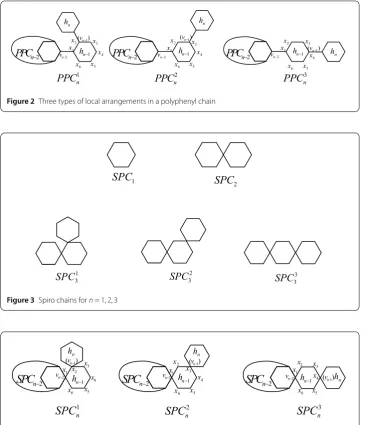
(n– 1)th hexagonhn–1ofPPCn–1to the extra hexagonhn. Precisely, letPPC1n,PPC2n, and
PPC3
nbe the graphs obtained by adding a cut edge connecting a vertex of the extra hexagon
hnwith vertexxi+1ofhn–1(see Figure 2), wherei= 1, 2, 3. Many results on matching and
[image:2.595.117.480.642.710.2]independent set, Wiener index, Merrified–Simmons index, Kirchhoff index, and Hosoya index of polyphenyl chains were reported in [27–32] and the references therein.
Figure 2Three types of local arrangements in a polyphenyl chain
Figure 3Spiro chains forn= 1, 2, 3
Figure 4Three types of local arrangements in the spiro chain corresponding to a polyphenyl chain
A spiro chain of lengthn, denotedSPCn, can be obtained from a polyphenyl chainPPCn
by contracting each cut edge between each pair of consecutive hexagons inPPCn. Figure 3
shows the unique spiro chains forn= 1, 2 and all spiro chains forn= 3, and Figure 1(b) shows a general case, wherevn–1is a vertex ofhn–1inSPCn–1. Similarly to the construction
of a polyphenyl chainPPCn, it is clear thatSPCnis also not unique whenn≥3 and has
three types of local arrangements, which are denoted bySPC1n,SPC2n, andSPC3n(Figure 4). We may assume that getting anSPCnfrom a fixedSPCn–1is a random process. Namely,
the probabilities of gettingSPC1
n, SPC2n, and SPC3nfrom a fixedSPCn–1 arep1,p2, and
1 –p1–p2, respectively. We also assume that the probabilitiesp1andp2are constants and independent ofn, that is, the process described is a zeroth-order Markov process. After associating probabilities, such a spiro chain is called arandom spiro chainand denoted by
SPC(n;p1,p2). For some contributions on spiro chains, the readers are referred to [27, 28,
in a random spiro chain. For more results concerning other random chains, we refer to [36–42] and the references therein.
The rest of this paper is organized as follows. In Section 2, we present explicit formulae for the expected values of theABCandGAindices of random spiro chains. Based on these formulae, we then give the average values of theABCandGAindices with respect to the set of all spiro chains withnhexagons in Section 3 and make a comparison between the expected values of theABCandGAindices in random spiro chains in Section 4.
2 TheABCandGAindices in random spiro chains
In this section, we consider theABCandGAindices in a random spiro chain. We keep the notation defined in Section 1. LetSPCnbe the spiro chain obtained by attaching a
new hexagonhntoSPCn–1as described in Figure 1(b). Assume thathn=x1x2x3x4x5x6as
shown in Figure 2. Clearly, there are only (2, 2)-, (2, 4)-, and (4, 4)-edges in a spiro chain
SPCn. By the definitions of theABCandGAindices we can directly check that
ABC(SPCn) =
√
2
2 m22(SPCn) +
√
2
2 m24(SPCn) +
√
6
4 m44(SPCn) (3) and
GA(SPCn) =m22(SPCn) +
2√2
3 m24(SPCn) +m44(SPCn). (4) Thus, to compute theABCandGAindices ofSPCn, we just need to determinem22(SPCn),
m24(SPCn), andm44(SPCn).
Recall thatSPC(n;p1,p2) is a random spiro chain of lengthn. Clearly, bothABC(SPC(n; p1,p2)) andGA(SPC(n;p1,p2)) are random variables. For convenience, denote their ex-pected values byEa
n=E[ABC(SPC(n;p1,p2))] andE g
n=E[GA(SPC(n;p1,p2))], respectively.
We first give a formula for the expected value of theABCindex of a random spiro chain.
Theorem 2.1 Let SPC(n;p1,p2)be a random spiro chain of length n≥1.Then
EABCSPC(n;p1,p2)=
√
6 4 –
√
2 2
p1+ 3√2
n+
√
2 2 –
√
6 4
p1.
Proof Whenn= 1, there is only one hexagon. SoEa
1= 6×
√
2 2 = 3
√
2.
Whenn≥2, it is obvious thatm22(SPCn),m24(SPCn), andm44(SPCn) depend on the
three possible constructions as shown in Figure 3. (i) IfSPCn–1→SPC1nwith probabilityp1, then we have
m22SPC1n=m22(SPCn–1) + 3,m24
SPC1n=m24(SPCn–1) + 2
and
m44
SPC1n=m44(SPCn–1) + 1.
Therefore by (3) we have
ABCSPC1n=ABC(SPCn–1) +
5√2 2 +
√
(ii) IfSPCn–1→SPC2nwith probabilityp2, then we have
m22SPC2n=m22(SPCn–1) + 2,m24
SPC2n=m24(SPCn–1) + 4
and
m44SPC2n=m44(SPCn–1).
Therefore by (3) we have
ABCSPC2n=ABC(SPCn–1) + 3 √
2.
(iii) IfSPCn–1→SPC3nwith probability 1 –p1–p2, then we have m22SPC3n=m22(SPCn–1) + 2,m24
SPC3n=m24(SPCn–1) + 4
and
m44SPC3n=m44(SPCn–1).
Therefore by (3) we have
ABCSPC3n=ABC(SPCn–1) + 3 √
2. Thus we obtain
Ean=EABCSPC(n,p1,p2) =p1ABC
SPC1n+p2ABC
SPC2n+ (1 –p1–p2)ABC
SPC3n
=ABC(SPCn–1) + √
6 4 –
√
2 2
p1+ 3√2.
Note thatE[Ea
n] =Ena. Applying the expectation operator to the last equation, we get
Ean=Ena–1+
√
6 4 –
√
2 2
p1+ 3
√
2 forn≥2. (5)
Since equation (5) is a first-order nonhomogeneous linear difference equation with con-stant coefficients. It is clear that the general solution of the homogeneous part of equation (5) isEa=c, a constant.
LetEa∗=anbe a particular solution of equation (5). SubstitutingEa∗into equation (5)
and comparing the constant term, we have
a=
√
6 4 –
√
2 2
p1+ 3√2.
Consequently, the general solution of equation (5) is
Ean=Ea∗+Ea=EABCSPC(n;p1,p2)
=
√
6 4 –
√
2 2
p1+ 3
√
2
Substituting the initial condition, we obtain
C=
√
2 2 –
√
6 4
p1.
Therefore we have
Ean=
√
6 4 –
√
2 2
p1+ 3√2
n+
√
2 2 –
√
6 4
p1.
This completes the proof. We now give the formula for the expected value of theGAindex of a random spiro chain.
Theorem 2.2 Let SPC(n;p1,p2)be a random spiro chain of length n≥1.Then
EGASPC(n;p1,p2)
= 2 –4
√
2 3
p1+ 2 +
8√2 3
n+
4√2 3 – 2
p1+
4 –8
√
2 3
.
Proof Whenn= 1, there is only one hexagon. SoEg1=E[GA(SPC(1;p1,p2))] = 6.
Whenn≥2, it is obvious thatm22(SPCn),m24(SPCn), andm44(SPCn) depend on the
three possible constructions as shown in Figure 3. (i) IfSPCn–1→SPC1nwith probabilityp1, then we get
m22
SPC1n=m22(SPCn–1) + 3,m24
SPC1n=m24(SPCn–1) + 2
and
m44
SPC1n=m44(SPCn–1) + 1.
Therefore by (4) we have
GASPC1n=GA(SPCn–1) + 4 +
4√2 3 .
(ii) IfSPCn–1→SPC2nwith probabilityp2, then we get
m22
SPC2n=m22(SPCn–1) + 2,m24
SPC2n=m24(SPCn–1) + 4
and
m44
SPC2n=m44(SPCn–1).
Therefore by (4) we have
GASPC2n=GA(SPCn–1) + 2 +
(iii) IfSPCn–1→SPC3nwith probability 1 –p1–p2, then we have
m22SPC3n=m22(SPCn–1) + 2,m24
SPC3n=m24(SPCn–1) + 4
and
m44SPC3n=m44(SPCn–1).
Therefore by (4) we have
GASPC3n=GA(SPCn–1) + 2 +
8√2 3 . Thus we obtain
Egn=EGASPC(n,p1,p2) =p1GA
SPC1n+p2GA
SPC2n+ (1 –p1–p2)GA
SPC3n
=GA(SPCn–1) +
2 –4
√ 2 3 p1+
2 +8
√
2 3
.
Note thatE[Egn] =Egn. Applying the expectation operator to the last equation, we get
Egn=Egn–1+
2 –4
√ 2 3 p1+
2 +8
√
2 3
, forn≥2. (6)
Since equation (6) is a first-order nonhomogeneous linear difference equation with con-stant coefficients, it is clear that the general solution of the homogeneous part of equation (6) isEg=c, a constant.
LetEg∗=anbe a particular solution of equation (6). SubstitutingEg∗into equation (6)
and comparing the constant term, we have
a=
2 –4
√
2 3
p1+
2 +8
√
2 3
.
Consequently, the general solution of equation (6) is
Egn=Eg∗+Eg=EGASPC(n;p1,p2)
= 2 –4
√ 2 3 p1+
2 +8
√
2 3
n+C forn≥1.
Substituting the initial condition, we obtain
C=
4√2 3 – 2
p1+
4 –8
√
2 3
.
Therefore we have
Egn= 2 –4
√ 2 3 p1+
2 +8
√ 2 3 n+
4√2 3 – 2
p1+
4 –8
√
2 3
,
In Theorems 2.1 and 2.2, we observe that bothE[ABC(SPC(n;p1,p2))] andE[GA(SPC(n;
p1,p2))] are asymptotic tonand linear inp1. Therefore, by Theorems 2.1 and 2.2 we can easily obtain theABCandGAindices of spiro meta-chainOn, spiro orth-chainMn, and
spiro para-chainPn(defined in [30]).
Corollary 2.3 The ABC indices of the spiro meta-chain On,the spiro orth-chain Mn,and
the spiro para-chain Pnare
ABC(On) =
√
6 4 +
5√2 2
n+
√
2 2 –
√
6 4
and
ABC(Mn) =ABC(Pn) = 3
√
2n.
Corollary 2.4 The GA indices of the spiro meta-chain On,the spiro orth-chain Mn,and
the spiro para-chain Pnare
GA(On) =
4 +4
√
2 3
n+ 2 –4
√
2 3
and
GA(Mn) =GA(Pn) =
2 +8
√
2 3
n+ 4 –8
√
2 3 .
3 The average values ofABCandGAindices
In this section, we present the average values of theABCandGAindices with respect to the set of all spiro chains withnhexagons.
LetSPnbe the set of all spiro chains withnhexagons. The average values of theABC
andGAindices ofSPnare defined by
ABCavr(SPn) =
1
|SPn|
G∈SPn
ABC(G)
and
GAavr(SPn) =
1
|SPn|
G∈SPn GA(G),
respectively. In fact, this is the population mean of theABCandGAindices of all elements inSPn. Since every element occurring inSPnhas the same probability, we havep1=p2=
1 –p1–p2. Thus we can apply Theorems 2.1 and 2.2 by puttingp1=p2= 1 –p1–p2=13 and obtain the following result.
Theorem 3.1 The average values of the ABC and GA indices with respect toSPnare
ABCavr(SPn) =
√
6 12 +
17√2 6
n+
√
2 6 –
√
and
GAavr(SPn) =
8 3+
20√2 9
n+10
3 – 20√2
9 .
From Theorem 3.1, as well as from Corollaries 2.3 and 2.4, it is no difficult to see that the average values of theABCandGAindices with respect to{On,Mn,Pn}are
ABC(On) +ABC(Mn) +ABC(Pn)
3 =
√
6 12 +
17√2 6
n+
√
2 6 –
√
6 12 and
GA(On) +GA(Mn) +GA(Pn)
3 =
8 3+
20√2 9
n+10
3 – 20√2
9 ,
which indicate that the average values of theABCandGAindices with respect toSPnare
exactly equal to the average values of theABCandGAindices with respect to{On,Mn,Pn},
respectively.
4 A comparison between the expected values ofABCandGAindices
Das and Trinajstić [15] compared the firstGAindex andABCindex for chemical trees, molecular graphs, and simple graphs with some restricted conditions. Recently, Ke [40] also compared the expected values of the GAindex and ABCindex for a random polyphenyl chain. Using Theorems 2.1 and 2.2, we now make a comparison between the expected values for theABCandGAindices of a random spiro chain with the same prob-abilitypi(i= 1, 2).
Theorem 4.1 Let SPC(n;p1,p2)be a random spiro chain with n hexagons.Then
EGA(SPC(n;p1,p2)>EABC(SPC(n;p1,p2).
Proof Whenn= 1, it is clear that
EGA(SPC(1;p1,p2)= 6 > 3√2 =EABC(SPC(1;p1,p2).
Whenn≥2, by Theorems 2.1 and 2.2 we have
EGA(SPC(n;p1,p2)–EABC(SPC(n;p1,p2) = 2 –
√
6 4 –
4√2 3 +
√
2 2
p1+ 2 +8
√
2 3 – 3
√
2
n
+
4√2 3 – 2 –
√
2 2 +
√
6 4
p1+ 4 –8
√
Noting that 2 –
√
6 4 –
4√2 3 +
√
2
2 > 0 and 0≤p1≤1, we get EGA(SPC(n;p1,p2)
–EABC(SPC(n;p1,p2)
≥
2 +8
√
2 3 – 3
√
2
n+
4√2 3 – 2 –
√
2 2 +
√
6 4
×1 + 4 –8
√
2 3 =
2 –
√
2 3
n+ 2 +
√
6 4 –
11√2 6
≥
2 –
√
2 3
×2 + 2 +
√
6 4 –
11√2 6 > 0,
as desired. This completes the proof. Theorem 4.1 states that the expected value of theABCindex is less than the expected value of theGAindex for a random spiro chain, which is similar to the result for a random polyphenyl chain [40].
5 Conclusions
In this paper, we mainly study theABCandGAindices in random spiro chains. Firstly, we study explicit formulae for the expected values of theABCandGAindices in random spiro chains, similar to the results obtained in [30, 33]. Secondly, we present the average values of theABCandGAindices with respect to the set of all spiro chains withnhexagons. Finally, we compare the expected values of theABCandGAindices in random spiro chains and show that the expected value of theABCindex is less than the expected value of theGA
index.
Acknowledgements
The authors would like to thank the anonymous referees for their constructive suggestions and valuable comments on this paper, which have contributed to the final preparation of the paper. This project is supported by Natural Science Foundation of Fujian Province under Grant No. 2015J01589, Science Foundation for the Education Department of Fujian Province under Grant No. JAT160386, and Science Foundation of Minjiang University under Grants Nos. MYK15004, Mjyp201608.
Competing interests
The authors declare that they have no competing interests.
Authors’ contributions
SW carried out the proofs of the main results in the manuscript. XK and GH participated in the design of the study and drafted the manuscript. All the authors read and approved the final manuscript.
Author details
1Department of Mathematics, Minjiang University, Fuzhou, P.R. China.2College of Science, East China University of
Technology, Nanchang, P.R. China.
Publisher’s Note
Springer Nature remains neutral with regard to jurisdictional claims in published maps and institutional affiliations.
Received: 29 July 2017 Accepted: 7 February 2018
References
1. Trinajsti´c, N.: Chemical Graph Theory. CRC Press, Boca Raton (1983)
5. Gutman, I., Vukiˇcevi´c, D., Žerovnik, J.: A class of modified Wiener indices. Croat. Chem. Acta77, 103–109 (2004) 6. Vukiˇcevi´c, D.: Distinction between modifications of Wiener indices. MATCH Commun. Math. Comput. Chem.47,
87–105 (2003)
7. Vukiˇcevi´c, D., Gutman, I.: Note on a class of modified Wiener indices. MATCH Commun. Math. Comput. Chem.47, 107–117 (2003)
8. Vukiˇcevi´c, D., Žerovnik, J.: Variable Wiener indices. MATCH Commun. Math. Comput. Chem.53, 385–402 (2005) 9. Vukiˇcevi´c, D., Žerovnik, J.: New indices based on the modified Wiener indices. MATCH Commun. Math. Comput.
Chem.60, 119–132 (2008)
10. Bondy, J.A., Murty, U.S.R.: Graph Theory with Applications. MacMillan, New York (1976)
11. Estrada, E., Torres, L., Rodríguez, L., Gutman, I.: An atom-bond connectivity index: modelling the enthalpy of formation of alkanes. Indian J. Chem.37A, 849–855 (1998)
12. Estrada, E.: Atom-bond connectivity and the energetic of branched alkanes. Chem. Phys. Lett.463, 422–425 (2008) 13. Chen, J., Guo, X.: Extreme atom-bond connectivity index of graphs. MATCH Commun. Math. Comput. Chem.65,
713–722 (2011)
14. Das, K.C.: Atom-bond connectivity index of graphs. Discrete Appl. Math.158, 1181–1188 (2010)
15. Das, K.C., Trinajsti´c, N.: Comparison between first geometric–arithmetic index and atom-bond connectivity index. Chem. Phys. Lett.497, 149–151 (2010)
16. Ke, X.: Atom-bond connectivity index of benzenoid systems and fluoranthene congeners. Polycycl. Aromat. Compd.
32, 27–35 (2012)
17. Furtula, B., Graovac, A., Vukiˇcevi´c, D.: Atom-bond connectivity index of trees. Discrete Appl. Math.157, 2828–2835 (2009)
18. Vukiˇcevi´c, D., Furtula, B.: Topological index based on the ratios of geometrical and arithmetical means of end-vertex degrees of edges. J. Math. Chem.46, 1369–1376 (2009)
19. Das, K.C.: On geometric–arithmetic index of graphs. MATCH Commun. Math. Comput. Chem.64(3), 619–630 (2010) 20. Divni´c, T., Milivojevi´c, M., Pavlovi´c, L.: Extremal graphs for the geometric–arithmetic index with given minimum
degree. Discrete Appl. Math.162, 386–390 (2014)
21. Rodríguez, J.M., Sigarreta, J.M.: Spectral properties of geometric–arithmetic index. Appl. Math. Comput.277, 142–153 (2016)
22. Yuan, Y., Zhou, B., Trinajsti´c, N.: On geometric–arithmetic index. J. Math. Chem.47, 833–841 (2010)
23. Zhou, B., Gutman, I., Furtula, B., Du, Z.: On two types of geometric–arithmetic index. Chem. Phys. Lett.482, 153–155 (2009)
24. Flower, D.R.: On the properties of bit string-based measures of chemical similarity. J. Chem. Inf. Comput. Sci.38, 379–386 (1998)
25. Li, Q.R., Yang, Q., Yin, H., Yang, S.: Analysis of by-products from improved Ullmann reaction using TOFMS and GCTOFMS. J. Univ. Sci. Technol. China34, 335–341 (2004)
26. Tepavcevic, S., Wroble, A.T., Bissen, M., Wallace, D.J., Choi, Y., Hanley, L.: Photoemission studies of polythiophene and polyphenyl films produced via surface polymerization by ion-assisted deposition. J. Phys. Chem. B109, 7134–7140 (2005)
27. Deng, H.: Wiener indices of spiro and polyphenyl hexagonal chains. Math. Comput. Model.55, 634–644 (2012) 28. Deng, H., Tang, Z.: Kirchhoff indices of spiro and polyphenyl hexagonal chains. Util. Math.95, 113–128 (2014) 29. Došli´c, T., Litz, M.S.: Matchings and independent sets in polyphenylene chains. MATCH Commun. Math. Comput.
Chem.67, 313–330 (2012)
30. Huang, G., Kuang, M., Deng, H.: The expected values of Kirchhoff indices in the random polyphenyl and spiro chains. Ars Math. Contemp.9, 197–207 (2015)
31. Huang, G., Kuang, M., Deng, H.: The expected values of Hosoya index and Merrifield–Simmons index in a random polyphenylene chain. J. Comb. Optim.32, 550–562 (2016)
32. Yang, W., Zhang, F.: Wiener index in random polyphenyl chains. MATCH Commun. Math. Comput. Chem.68, 371–376 (2012)
33. Chen, X., Zhao, B., Zhao, P.: Six-membered ring spiro chains with extremal Merrifild–Simmons index and Hosaya index. MATCH Commun. Math. Comput. Chem.62, 657–665 (2009)
34. Yang, Y., Liu, H., Wang, H., Fu, H.: Subtrees of spiro and polyphenyl hexagonal chains. Appl. Math. Comput.268, 547–560 (2015)
35. Yang, Y., Liu, H., Wang, H., Sun, S.: On spiro and polyphenyl hexagonal chains with respect to the number of BC-subtrees. Int. J. Comput. Math.94(4), 774–799 (2017)
36. Chen, A., Zhang, F.: Wiener index and perfect matchings in random phenylene chains. MATCH Commun. Math. Comput. Chem.61, 623–630 (2009)
37. Gutman, I., Kennedy, J.W., Quintas, L.V.: Wiener numbers of random benzenoid chains. Chem. Phys. Lett.173, 403–408 (1990)
38. Gutman, I.: The number of perfect matchings in a random hexagonal chain. Graph Theory Notes N. Y.16, 26–28 (1989)
39. Gutman, I., Kennedy, J.W., Quintas, L.V.: Perfect matchings in random hexagonal chain graphs. J. Math. Chem.6, 377–383 (1991)