R E S E A R C H
Open Access
The modified split generalized
equilibrium problem for quasi-nonexpansive
mappings and applications
Kanyarat Cheawchan
1and Atid Kangtunyakarn
1**Correspondence:
1Department of Mathematics,
Faculty of Science, King Mongkut’s Institute of Technology Ladkrabang, Bangkok, Thailand
Abstract
In this paper, we introduce a new problem, the modified split generalized equilibrium problem, which extends the generalized equilibrium problem, the split equilibrium problem and the split variational inequality problem. We introduce a new method of an iterative scheme{xn}for finding a common element of the set of solutions of variational inequality problems and the set of common fixed points of a finite family of quasi-nonexpansive mappings and the set of solutions of the modified split generalized equilibrium problem without assuming a demicloseness condition and
Tω:= (1 –
ω)
I+ω
T, whereTis a quasi-nonexpansive mapping andω
∈(0,12); a difficult proof in the framework of Hilbert space. In addition, we give a numerical example to support our main result.MSC: 47B40; 47H10; 47J20
Keywords: The modified split generalized equilibrium problem;
Quasi-nonexpansive mapping; Variational Inequality problem; Fixed Point problem
1 Introduction
LetCbe a nonempty closed convex subset of a real Hilbert spaceH. The set of fixed points ofTis denoted byF(T). The mappingT:C→Cis said to bequasi-nonexpansiveif
Tx–p ≤ x–p,
for allx∈Candp∈F(T).
Definition 1.1([1]) LetT:H→H. Then the following are equivalent: 1. Tis firmly nonexpansive,
2. Tx–Ty2≤ x–y,Tx–Ty,∀x,y∈H, 3. Tx–Ty, (I–T)x– (I–T)y ≥0,∀x,y∈H.
LetA:C→Hbe a mapping. Thevariational inequalityis to find a pointu∈Csuch that
Au,v–u ≥0, (1.1)
for allv∈C. The set of solutions of (1.1) is denoted byVI(C,A). A mappingA:C→His calledα-inverse strongly monotoneif there exists a positive real numberα> 0 such that
Ax–Ay,x–y ≥αAx–Ay2,
for allx,y∈C. They have been investigated in the literature; see, for example, [2, 3]. Let F be a bifunction ofC×CintoR, whereRis the set of real numbers. Theequilibrium problemforF:C×C→Ris to findx∈Csuch that
F(x,y)≥0, ∀y∈C. (1.2)
The set of solutions of (1.2) is denoted byEP(F). Equilibrium problems were introduced by [4] in 1994 and included many well-known problems such as variational inequality, optimization problem, nonexpansive mapping and fixed point problem; see, for example, [5–8].
LetF be a function ofC×CintoRand letf :H→Hbe a mapping. Thegeneralized equilibrium problemis to findx∈Csuch that
F(x,y) +f(x),y–x≥0, (1.3)
for ally∈C. The set of solutions of (1.3) is denoted byEP(F,f). Whenf ≡0,EP(F,f) is denoted byEP(F) andF≡0,EP(F,f) is denoted byVI(C,f).
Throughout this section, letH1,H2be real Hilbert spaces and letC,Qbe nonempty
closed convex subsets of real Hilbert spacesH1andH2, respectively. LetA:H1→H2be
a bounded linear operator.
In 1994, Censor and Elfving [9] introduced thesplit feasibility problem(in short, SFP) which is to find a pointx∈Csuch thatAx∈Q. The set of all solutions of split feasibility problem is denoted byϕ={x∈C:Ax∈Q}.
To solve the SFP, Byrne [10] introducedCQalgorithm whose sequence{xn}is generated
by
xn+1=PC1
xn–γA∗(I–PC2)Axn
,
where the initialx0∈H1 andγ ∈(0, 2/L),L is the spectral radius of the operatorA∗A
andA∗ is the adjoint ofA. Then the CQalgorithm converges to a solution of the SFP, whenever solutions exist. If there are no solutions of the SFP, theCQalgorithm converges to a minimizer of the function
1
2(I–PC2)Ax 2
,
whenever such minimizers exist.
LetU:H1→H1andT:H2→H2be two nonlinear operators. Thesplit common fixed
points problem(SCFPP) [11, 12] is to find a pointx∗such that
The solution set of SCFPP is denoted by={p∗∈F(U) :Ap∗∈F(T)}. The split common fixed point problem is a generalization of the split feasibility problem.
In 2017, Wang [13] introduced a new method for solving SCFPP as follows:
xn+1=xn–ρn
(I–U)xn+A∗(I–T)Axn
,
whereρn⊂(0,∞) is chosen such that
ρn=
(I–U)xn2+(I–T)Axn2
(I–U)xn+A∗(I–T)Axn2
(1.4)
andUandTare firmly quasi-nonexpansive mappings. Then the sequence{xn}converges
weakly toz, wherez=limn→∞Pxn.
Censor et al. [11, 14] introduced the prototypicalsplit inverse problem(SIP) which is a generalization of the split common fixed points problem. In this, there are given two vector spacesXandYand a linear operatorA:X→Y. In addition, two inverse problems are involved. The first one, denoted IP1, is formulated in the spaceXand the second one,
denoted IP2, is formulated in the spaceY. Given these data, the split inverse problem is
formulated as follows:
find a pointx∗∈Xthat solves IP1, (1.5)
and such that
find a pointy∗∈Ythat solves IP2. (1.6)
This problem is used in many modeling arising in sensor networks, radiation therapy treat-ment planning, color imaging, etc.
Thesplit equilibrium problem(SEP) [12] is to findx∈Csuch that
F1(x,x)≥0, ∀x∈C, (1.7)
and such that
y=Ax∈Q solvesF2(y,y)≥0, ∀y∈Q, (1.8)
whereF1:C×C→RandF2:Q×Q→Rbe nonlinear bifunctions. If we consider only
problem (1.7), it is the equilibrium problem and we denoted its solution set byEP(F1). The
solution set of SEP is denoted by={p∈EP(F1) :Ap∈EP(F2)}. SEP is reduced toEP(F),
whereH1≡H2,F1≡F2andA≡I.EP(F) is an unifying model for several problems arising
in physics, engineering, science, optimization, economics, etc.
Thesplit variational inequality problems(in short, SVIP) were introduced and studied by Cencor et al. [11]: findx∈Csuch that
f1(x),x–x
and such that
y=Ax∈Q solvesf2(y),y–y
≥0, ∀y∈Q, (1.10)
wheref1:C→H1andf2:Q→H2are nonlinear mappings. The solution set of SVIP is
denoted by ={p∈VI(C,f1) :Ap∈VI(Q,f2)}. The split variational inequality problems
have already been studied and used in practice as a model in intensity-modulated radia-tion therapy (IMRT) treatment planning; see, for example, [15] and the modeling of many inverse problems arising for phase retrieval and other real-world problems; for instance, in sensor networks in computerized tomography and data compression; see, for example, [16, 17].
By investigating SEP and SVIP, we introduce themodified split generalized equilibrium problem(MSGEP) which is to findx∗∈Csuch that
F1
x∗,x+f1
x∗,x–x∗≥0, ∀x∈C, (1.11)
and such that
y∗=Ax∗∈Q solvesF2
y∗,y+f2
y∗,y–y∗≥0, ∀y∈Q, (1.12)
whereF1:C×C→RandF2:Q×Q→Rare nonlinear bifunctions andf1:C→H1and
f2:Q→H2are nonlinear mappings. The solution set of MSGEP is denoted by={p∗∈
EP(F1,f1) :Ap∗∈EP(F2,f2)}.
Remark1.1
1. If we putf1≡f2≡0in MSGEP then the MSGEP is reduced to SEP.
2. If we putF1≡F2≡0in MSGEP then the MSGEP is reduced to SVIP.
3. In the case of bifunctionsF1andF2are according to (A1)–(A4). From (1.11), (1.12)
and Lemma 2.2, we havex∗∈F(TF1
r (I–rf1))andAx∗∈F(TsF2(I–sf2)), for all
r,s> 0. So, MSGEP can be viewed as SCFPP.
MSGEP is a generalization of the generalized equilibrium problem, the split equilib-rium problem and the split variational inequality problem. So, this problem can be used in sensor networks, data compression, practice as a model in intensity-modulated radia-tion therapy (IMRT) treatment planning, robustness to marginal changes and equilibrium stability etc.
Example1.2 LetH1= [0, 6],H2= [0, 18],C= [2, 5] andQ= [6, 10]. LetA:H1→H2be
defined byAx= 3xfor allx∈H1. Let the mappingF1:C×C→Rbe defined by
F1
x∗,x= –x∗– 22+ (x– 2)2, ∀x,y∈C,
andF2:Q×Q→Rbe defined by
F2
Let the mappingf1:C→H1be defined byf1x=x–29 ,∀x∈Cand the mappingf2:Q→H2
be defined byf2x=x–67 ,∀x∈Q.
Then 2∈. Therefore 2 is a solution of MSGEP.
In 2012, Tain and Jin [18] introduced iterative algorithms involving a quasi-nonexpansive mapping. They generated the iterative as follows:
xn+1=αnγf(xn) + (I–αnA)Tωxn,
whereAis a bounded linear operator onH,Tis a quasi-nonexpansive mapping onH,f is a contraction with coefficientaunder suitable conditions of the parametersαn,γ andω.
By assumingω∈(0,12),Tω:= (1 –ω)I+ωTandTis demiclosed onH.
Motivated by SFP and SVIP, we introduced a new problem, the modified split general-ized equilibrium problem, which extends the generalgeneral-ized equilibrium problem, the split equilibrium problem and the split variational inequality problem. Many authors proved strong convergence theorem involving a quasi-nonexpansive mapping T by assuming Tω:= (1 –ω)I+ωTandTis demiclosed onH; a difficult proof. Motivated by [19], we
in-troduced Remark 2.5 and [11, 12] and [18], we introduce a new method of iterative scheme {xn}for finding a common element of the set of solutions of variational inequality
prob-lems and the set of common fixed points of a finite family of quasi-nonexpansive mappings and the set of solutions of the modified split generalized equilibrium problem without the condition above in the framework of a Hilbert space.
2 Preliminaries
LetH be a real Hilbert space with inner product·,·and norm · . Throughout this paper, we use the notations of weak and strong convergence by “” and “→”, respectively. Recall thatHsatisfiesOpial’s condition[20], i.e., for any sequence{xn}withxnx, the
inequalitylimn→∞infxn–x<limn→∞infxn–y, holds for everyy∈Hwithy=x.
For solving the equilibrium problem, we assume that the bifunctionF :C×C→R satisfy the following conditions:
(A1) F(x,x) = 0for allx∈C,
(A2) Fis monotone, i.e.,F(x,y) +F(y,x)≤0for allx,y∈C, (A3) for eachx,y,z∈C,limt↓0F(tz+ (1 –t)x,y)≤F(x,y),
(A4) for eachx∈C,y→F(x,y)is convex and lower semicontinuous.
Lemma 2.1([4]) Let C be a nonempty closed convex subset of H and let F be a bifunction of C×C intoRsatisfying(A1)–(A4).Let r> 0and x∈H.Then there exists z∈C such that
F(z,y) +1
ry–z,z–x ≥0, ∀y∈C.
Lemma 2.2([21]) Assume that F:C×C→Rsatisfies (A1)–(A4).For r> 0,define a mapping Tr:H→C as follows:
Tr(x) =
z∈C:F(z,y) +1
ry–z,z–x ≥0,∀y∈C
(1) Tris single-valued,
(2) Tris firmly nonexpansive,i.e.,for anyx,y∈H,
Tr(x) –Tr(y)2≤
Tr(x) –Tr(y),x–y
,
(3) F(Tr) =EP(F),
(4) EP(F)is closed and convex.
Lemma 2.3([22]) Let H be a real Hilbert space,let C be a nonempty closed convex subset of H and let A be a mapping of C into H.Let u∈C.Then,forλ> 0,
u=PC(I–λA)u ⇔ u∈VI(C,A),
where PCis the metric projection of H onto C.
Lemma 2.4 Let C be a nonempty closed convex subset of a real Hilbert space H.Let{Ti}Ni=1
be a finite family of quasi-nonexpansive mappings of C into H withNi=1F(Ti)=∅and let
0 <ai< 1with
N
i=1ai= 1.Then
N
i=1
F(Ti) =VI
C,
N
i=1
ai(I–Ti)
.
Proof In this lemma, we show thatNi=1F(Ti) =
N
i=1VI(C,I–Ti) and
N
i=1VI(C,I–Ti) =
VI(C,Ni=1ai(I–Ti)). Lastly, we have
N
i=1
F(Ti) =VI
C,
N
i=1
ai(I–Ti)
.
To start with, it is easy to see thatNi=1F(Ti)⊆
N
i=1VI(C,I–Ti). Next, we show that
N
i=1VI(C,I–Ti)⊆
N
i=1F(Ti). Letu∈
N
i=1VI(C,I–Ti) and
N
i=1F(Ti)=∅. So, we get
u∈VI(C,I–Ti),∀i= 1, 2, . . . ,N. We may write
u–v, (I–Ti)u
≤0, ∀v∈C. (2.1)
There existsv∗∈Csuch thatv∗=Tiv∗,∀i= 1, 2, . . . ,N. SinceTiis a quasi-nonexpansive
mapping,∀i= 1, 2, . . . ,N, it follows that
Tiu–v∗2
=u–v∗– (I–Ti)u
2
=u–v∗2– 2u–v∗, (I–Ti)u
+(I–Ti)u
2
≤u–v∗2. (2.2)
By using (2.1) and (2.2), we conclude that
(I–Ti)u
2
≤2u–v∗, (I–Ti)u
It implies thatu∈Ni=1F(Ti). Therefore
N
i=1VI(C,I–Ti)⊆
N
i=1F(Ti). Hence
N
i=1
F(Ti) = N
i=1
VI(C,I–Ti).
After that, we show Ni=1VI(C,I –Ti) =VI(C,
N
i=1ai(I –Ti)) where 0 <ai < 1 and
N
i=1ai= 1. Observe that
u∈
N
i=1
VI(C,I–Ti)
⇔ u∈VI(C,I–Ti), ∀i= 1, 2, . . . ,N
⇔ (I–Ti)u,v–u
≥0, ∀v∈Cand∀i= 1, 2, . . . ,N
⇔
N
i=1
ai
(I–Ti)u,v–u
≥0, ∀v∈C
⇔ N
i=1
ai(I–Ti)u,v–u
≥0, ∀v∈C
⇔ u∈VI
C,
N
i=1
ai(I–Ti)
.
ThereforeNi=1VI(C,I–Ti) =VI(C,
N
i=1ai(I–Ti)). Hence
N
i=1F(Ti) =VI(C,
N i=1ai(I–
Ti)).
Remark2.5 From Lemma 2.3 and Lemma 2.4, we have
N
i=1
F(Ti) =VI
C,
N
i=1
ai(I–Ti)
=F
PC
I–λ
N
i=1
ai(I–Ti)
,
for allλ> 0 and 0 <ai< 1 with
N i=1ai= 1.
Lemma 2.6([23]) Let{sn}be a sequence of nonnegative real numbers satisfying
sn+1≤(1 –αn)sn+δn, ∀n≥0,
where{αn}is a sequence in(0, 1)and{δn}is a sequence such that
(1) ∞
n=1
αn=∞, (2) lim sup n→∞
δn
αn ≤
0 or ∞
n=1
|δn|<∞.
Thenlimn→∞sn= 0.
3 Main results
Lemma 3.1 Let C and Q be nonempty closed convex subsets of a real Hilbert spaces H1and
F2:Q×Q→Rbe the bifunctions satisfying(A1)–(A4).Let f1:H1→H1be aρ-inverse
strongly monotone mapping and f2:H2→H2be a firmly nonexpansive mapping.Then
1. TF1
r (I–rf1)andTsF2(I–sf2)are nonexpansive mapping,
2.
TF1
r (I–rf1)
p+γA∗TF2
s (I–sf2) –I
Ap
–TF1
r (I–rf1)
q+γA∗TF2
s (I–sf2) –I
Aq2
≤ p–q2+γ(γL– 1)TF2
s (I–sf2) –I
Ap–TF2
s (I–sf2) –I
Aq2,
for all p,q∈C,where r∈(0, 2ρ),s∈(0, 1),γ ∈(0, 1/L),L is the spectral radius of the oper-ator A∗A and A∗is the adjoint of A,TF1
r :H1→C defined by
TF1
r (x) =
z∈C:F1(z,y) +
1
ry–z,z–x ≥0,∀y∈C ,
for all x∈H1and TsF2:H2→Q defined by
TF2
s (x) =
z∈Q:F2(z,y) +
1
sy–z,z–x ≥0,∀y∈Q ,
for all x∈H2.
Proof Letp,q∈C. First, we show 1 is true. Sincef1 is aρ-inverse strongly monotone
mapping andr∈(0, 2ρ), we obtain TF1
r (I–rf1)p–TrF1(I–rf1)q 2
≤ p–q2– 2rp–q,f1p–f1q+r2f1p–f1q2
≤ p–q2+r(r– 2ρ)f1p–f1q2
≤ p–q2.
ThusTF1
r (I–rf1) is a nonexpansive mapping. Sincef2is a firmly nonexpansive mapping
ands∈(0, 1), we get
TF2
s (I–sf2)p–TsF2(I–sf2)q 2
≤ p–q2– 2sp–q,f2p–f2q+s2f2p–f2q2
≤ p–q2–s(2 –s)f2p–f2q2
≤ p–q2,
for allp,q∈Q. ThereforeTF2
s (I–sf2) is a nonexpansive mapping.
Next, we show 2 is true. From Lemma 3.1(1), we have
TF1
r (I–rf1)
p+γA∗TF2
s (I–sf2) –I
Ap
–TF1
r (I–rf1)
q+γA∗TF2
s (I–sf2) –I
Aq2
≤(p–q) +γA∗TF2
s (I–sf2) –I
Ap–A∗TF2
s (I–sf2) –I
Aq2
≤ p–q2+ 2γAp–Aq,TF2
s (I–sf2) –I
Ap–TF2
s (I–sf2) –I
Aq
+γ2LTF2
s (I–sf2) –I
Ap–TF2
s (I–sf2) –I
From the property ofTF2
s , we get
(I–sf2)Ap– (I–sf2)Aq 2
≥TF2
s (I–sf2)Ap–TsF2(I–sf2)Aq– (Ap–Aq) + (Ap–Aq) 2
=TF2
s (I–sf2) –I
Ap–TF2
s (I–sf2) –I
Aq2
+ 2TF2
s (I–sf2) –I
Ap–TF2
s (I–sf2) –I
Aq,Ap–Aq
+Ap–Aq2. (3.2)
We have
(I–sf2)Ap– (I–sf2)Aq 2
=Ap–Aq2– 2sAp–Aq,f2Ap–f2Aq
+s2f2Ap–f2Aq2. (3.3)
From (3.2), (3.3) and the property of firmly nonexpansive mapping, we get
2TF2
s (I–sf2) –I
Ap–TF2
s (I–sf2) –I
Aq,Ap–Aq
≤–TF2
s (I–sf2) –I
Ap–TF2
s (I–sf2) –I
Aq2
– 2sAp–Aq,f2Ap–f2Aq+s2f2Ap–f2Aq2
≤–TF2
s (I–sf2) –I
Ap–TF2
s (I–sf2) –I
Aq2.
That is,
2γTF2
s (I–sf2) –I
Ap–TF2
s (I–sf2) –I
Aq,Ap–Aq
≤–γTF2
s (I–sf2) –I
Ap–TF2
s (I–sf2) –I
Aq2. (3.4)
Substituting (3.4) in (3.1), we obtain
TF1
r (I–rf1)
p+γA∗TF2
s (I–sf2) –I
Ap
–TF1
r (I–rf1)
q+γA∗TF2
s (I–sf2) –I
Aq2
≤ p–q2–γTF2
s (I–sf2) –I
Ap–TF2
s (I–sf2) –I
Aq2
+γ2LTF2
s (I–sf2) –I
Ap–TF2
s (I–sf2) –I
Aq2
=p–q2+γ(γL– 1)TF2
s (I–sf2) –I
Ap–TF2
s (I–sf2) –I
Aq2.
Lemma 3.2 Let C be a nonempty closed convex subset of a real Hilbert space H and let T:C→C be a quasi-nonexpansive mapping with F(T)=∅.Then
Proof Letx∈Candz∈F(T). SinceT is a quasi-nonexpansive mapping, we get
Tx–z2=(x–z) – (I–T)x2
=x–z2– 2x–z, (I–T)x+(I–T)x2
≤ x–z2.
We can conclude that
(I–T)x2≤2x–z, (I–T)x.
Lemma 3.3 Let C be a nonempty closed convex subset of a real Hilbert space H.Let{Ti}Ni=1
be a finite family of quasi-nonexpansive mappings of C into itself withNi=1F(Ti)=∅.Then
PC
I–λ
N
i=1
ki(I–Ti)
x–z
2
≤ x–z2,
for all x∈C,where0 <ki< 1with
N
i=1ki= 1and0 <λ< 1.
Proof Letx∈Candz∈Ni=1F(Ti). From Remark 2.5 andz∈
N
i=1F(Ti), we have z∈
F(PC(I–λ(Ni=1ki(I–Ti)))) andz=Tiz,∀i= 1, 2, . . . ,N. SincePCis nonexpansive mapping,
0 <λ< 1 and Lemma 3.2, we have
PC
I–λ
N
i=1
ki(I–Ti)
x–z
2
= PC
I–λ
N
i=1
ki(I–Ti)
x–PC
I–λ
N
i=1
ki(I–Ti)
z
2
≤ x–z2– 2λ
N
i=1
ki
x–z, (I–Ti)x
+λ2
N
i=1
ki(I–Ti)x2
≤ x–z2–λ
N
i=1
ki(I–Ti)x
2
+λ2
N
i=1
ki(I–Ti)x
2
≤ x–z2. (3.5)
Next, we prove a strong convergence theorem for solving the modified split generalized equilibrium problem (MSGEP).
Theorem 3.4 Let C and Q be nonempty closed convex subsets of a real Hilbert spaces H1
and H2,respectively.Let A:H1→H2be a bounded linear operator.Let D1,D2:C→H1
beα, β-inverse strongly monotone mappings,respectively.Let F1:C×C→Rand F2 :
Q×Q→Rbe the bifunctions satisfying(A1)–(A4).Let{Ti}Ni=1be a finite family of
quasi-nonexpansive mappings of C into itself withNi=1F(Ti)=∅.Let f1:H1→H1be aρ-inverse
strongly monotone mapping and f2:H2→H2be a firmly nonexpansive mapping.Assume
F=VI(C,D1)∩VI(C,D2)∩
N
{yn}be sequences generated by
⎧ ⎪ ⎪ ⎨ ⎪ ⎪ ⎩
un=TrF1(I–rf1)(xn+γA∗(TsF2(I–sf2) –I)Axn),
yn=PC(I–d1D1)(aun+ (1 –a)PC(I–d2D2)un),
xn+1=αnu+βnxn+γnPC(I–λn(
N
i=1ki(I–Ti)))yn, ∀n∈N,
(3.6)
where d1∈(0, 2α),d2∈(0, 2β),r∈(0, 2ρ),s∈(0, 1),a∈[0, 1], 0 <ki< 1with
N i=1ki= 1,
γ ∈(0, 1/L),L is the spectral radius of the operator A∗A and A∗is the adjoint of A.Also{αn},
{βn},{γn}are sequences in[0, 1]withαn+βn+γn= 1for all n∈N.Suppose the following
conditions hold:
(i) limn→∞αn= 0and
∞
n=1αn=∞,
(ii) 0 <c≤βn,γn≤d< 1for somec,d> 0for alln≥1,
(iii) ∞n=1λn<∞and0 <λn< 1,
(iv) ∞n=1|αn+1–αn|<∞,
∞
n=1|βn+1–βn|<∞.
Then{xn},{un}and{yn}converge strongly to z=PFu.
Proof Letx,y∈Candz∈F. First, we show that (I–d1D1) is a nonexpansive mapping.
SinceD1is anα-inverse strongly monotone mapping, we obtain
(I–d1D1)x– (I–d1D1)y 2
=x–y2– 2d1x–y,D1x–D1y+d21D1x–D1y2
≤ x–y2+d1(d1– 2α)D1x–D1y2≤ x–y2.
Thus (I–d1D1) is a nonexpansive mapping. By using the same method as above, we see that
(I–d2D2) is a nonexpansive mapping. Sincef1is aρ-inverse strongly monotone mapping
andf2is a firmly nonexpansive mapping. From Lemma 3.1(1), we have (TrF1(I–rf1)) and
(TF2
s (I–sf2)) are nonexpansive mappings. Sincez∈
N
i=1F(Ti) and Lemma 3.3, we have
PC
I–λn
N
i=1
ki(I–Ti)
yn–z
2
≤ yn–z2. (3.7)
Sincez∈VI(C,D1) andz∈VI(C,D2) and using the property of (I–d1D1) and (I–d2D2),
we get
yn–z2=PC(I–d1D1)
aun+ (1 –a)PC(I–d2D2)un
–PC(I–d1D1)z 2
≤aun–z2+ (1 –a)PC(I–d2D2)un–z
2
(3.8)
≤ un–z2. (3.9)
Sincez∈, we havez=TF1
r (I–rf1)zandAz=TsF2(I–sf2)Az. From Lemma 3.1(2) and
γ ∈(0, 1/L), we obtain
un–z2=TrF1(I–rf1)
xn+γA∗
TF2
s (I–sf2) –I
Axn
–TF1
r (I–rf1)z 2
≤ xn–z2+γ(Lγ – 1)TsF2(I–sf2) –I
Axn
2
(3.10)
Using the definition ofxn, (3.7), (3.9) and (3.11), we get
xn+1–z=
αn(u–z) +βn(xn–z)
+γn
PC
I–λn
N
i=1
ki(I–Ti)
yn–z
≤αnu–z+βnxn–z+γnyn–z
≤αnu–z+βnxn–z+γnun–z
≤αnu–z+ (1 –αn)xn–z.
Using induction, we can conclude that
xn–z ≤max
u–z,x1–z
for alln≥1. This implies that the sequence{xn}is bounded and so are{yn}and{un}. From
Lemma 3.1 (2) andγ ∈(0, 1/L), we obtain
un–un–12
=TF1
r (I–rf1)
xn+γA∗
TF2
s (I–sf2) –I
Axn
–TF1
r (I–rf1)
xn–1+γA∗
TF2
s (I–sf2) –I
Axn–1
2
≤ xn–xn–12+γ(γL– 1)TsF2(I–sf2) –I
Axn–
TF2
s (I–sf2) –I
Axn–1
2
≤ xn–xn–12. (3.12)
Next, we show thatlimn→∞xn+1–xn= 0. According to Eq. (3.12), we have
xn+1–xn
=
αnu+βnxn+γnPC
I–λn
N
i=1
ki(I–Ti)
yn
–
αn–1u+βn–1xn–1+γn–1PC
I–λn–1
N
i=1
ki(I–Ti)
yn–1
≤ |αn–αn–1|u+βnxn–xn–1+|βn–βn–1|xn–1+γnyn–yn–1
+λn
N i=1
ki(I–Ti)
yn–
N
i=1
ki(I–Ti)
yn–1
+|λn–λn–1|
N i=1
ki(I–Ti)
yn–1
+|γn–γn–1|
PC
I–λn–1
N
i=1
ki(I–Ti)
yn–1
+λn N i=1
ki(I–Ti)
yn–
N
i=1
ki(I–Ti)
yn–1
+|λn–λn–1|
N i=1
ki(I–Ti)
yn–1
+|γn–γn–1|
PC
I–λn–1
N
i=1
ki(I–Ti)
yn–1
≤(1 –αn)xn–xn–1+|αn–αn–1|M+|βn–βn–1|M+λnM
+|λn–λn–1|M+|γn–γn–1|M,
where
M:=max
n∈N
u,xn,
N i=1
ki(I–Ti)
yn+1–
N
i=1
ki(I–Ti)
yn , N i=1
ki(I–Ti)
yn , PC I–λn
N
i=1
ki(I–Ti)
yn .
From condition (i), (iii), (iv) and Lemma 2.6, we have
lim
n→∞xn+1–xn= 0. (3.13)
According to Eqs. (3.7), (3.9) and (3.10), we have
xn+1–z2≤αnu–z2+γn
PC
I–λn
N
i=1
ki(I–Ti)
yn–z
2
+βnxn–z2–βnγn
xn–PC
I–λn
N
i=1
ki(I–Ti)
yn 2
≤αnu–z2+βnxn–z2+γnyn–z2
–βnγn
xn–PC
I–λn
N
i=1
ki(I–Ti)
yn 2 (3.14)
≤αnu–z2+βnxn–z2+γnun–z2
–βnγn
xn–PC
I–λn
N
i=1
ki(I–Ti)
yn 2 (3.15)
≤αnu–z2+ (1 –αn)xn–z2+γnγ(Lγ– 1)TsF2(I–sf2) –I
Axn
2
–βnγn
xn–PC
I–λn
N
i=1
ki(I–Ti)
yn 2 .
This implies that
γnγ(1 –Lγ)TsF2(I–sf2) –I
Axn
2
≤αnu–z2+xn–xn+1
xn–z+xn+1–z
By using condition (i) and (3.13), we have
lim
n→∞T
F2
s (I–sf2) –I
Axn= 0. (3.16)
By using the same method as (3.16), we have
lim
n→∞
xn–PC
I–λn
N
i=1
ki(I–Ti)
yn
= 0. (3.17)
LetMn=xn+γA∗(TsF2(I–sf2) –I)Axn. Applying the inequality (3.11), we have
Mn–z ≤ xn–z. (3.18)
Using the property of inverse strongly monotone operators and (3.18), we have
un–z2=TrF1(I–rf1)Mn–TrF1(I–rf1)z 2
≤(I–rf1)Mn– (I–rf1)z 2
=Mn–z2– 2rMn–z,f1Mn–f1z+r2f1Mn–f1z2
≤ xn–z2+r(r– 2ρ)f1Mn–f1z2. (3.19)
Substituting (3.19) in (3.15), we have
xn+1–z2≤αnu–z2+βnxn–z2
+γn
xn–z2+r(r– 2ρ)f1Mn–f1z2
≤αnu–z2+ (1 –αn)xn–z2+γnr(r– 2ρ)f1Mn–f1z2.
That is,
γnr(2ρ–r)f1Mn–f1z2≤αnu–z2+xn–xn+1
xn–z+xn+1–z
.
According to condition (i) and (3.13), we get
lim
n→∞f1Mn–f1z= 0. (3.20)
By the property of firmly nonexpansive mappings, we have
un–z2=TrF1(I–rf1)Mn–TrF1(I–rf1)z 2
≤un–z, (I–rf1)Mn– (I–rf1)z
=1 2
un–z2+(I–rf1)Mn– (I–rf1)z 2
–(un–z) –
(I–rf1)Mn– (I–rf1)z 2
That is,
un–z2≤(I–rf1)Mn– (I–rf1)z 2
–(un–Mn) +r(f1Mn–f1z) 2
≤ Mn–z2–
un–Mn2+ 2run–Mn,f1Mn–f1z
+r2f1Mn–f1z2
≤ Mn–z2–un–Mn2+ 2run–Mnf1Mn–f1z
–r2f1Mn–f1z2. (3.22)
Substituting (3.22) in (3.15), we get
xn+1–z2≤αnu–z2+βnxn–z2+γn
Mn–z2–un–Mn2
+ 2run–Mnf1Mn–f1z–r2f1Mn–f1z2
≤αnu–z2+ (1 –αn)xn–z2–γnun–Mn2
+ 2rγnun–Mnf1Mn–f1z.
It follows that
γnun–Mn2≤αnu–z2+xn–xn+1
xn–z+xn+1–z
+ 2rγnun–Mnf1Mn–f1z.
From condition (i), (3.13) and (3.20), we ensure that
lim
n→∞un–Mn= 0. (3.23)
From (3.16) and (3.23), we also have
un–xn ≤ un–Mn+Mn–xn
=un–Mn+xn+γA∗
TF2
s (I–sf2) –I
Axn–xn
≤ un–Mn+γATsF2(I–sf2) –I
Axn.
Then we have
lim
n→∞un–xn= 0. (3.24)
By using the same method as (3.19), we have
PC(I–d2D2)un–z2≤ xn–z2+d2(d2– 2β)D2un–D2z2. (3.25)
Substituting (3.8) and (3.25) in (3.14), we have
xn+1–z2≤αnu–z2+βnxn–z2+γn
aun–z2
+ (1 –a)PC(I–d2D2)un–z
≤αnu–z2+ (1 –αn)xn–z2
+γn(1 –a)d2(d2– 2β)D2un–D2z2.
We can conclude that
γn(1 –a)d2(2β–d2)D2un–D2z2
≤αnu–z2+xn–xn+1
xn–z+xn+1–z
.
According to condition (i) and (3.13), we get
lim
n→∞D2un–D2z= 0. (3.26)
SincePCis a firmly nonexpansive mapping and using the same method as (3.21), we get
PC(I–d2D2)un–z2
≤1
2PC(I–d2D2)un–z
2
+(I–d2D2)un– (I–d2D2)z 2
–PC(I–d2D2)un–z– (I–d2D2)un+ (I–d2D2)z 2
.
That is,
PC(I–d2D2)un–z
2
≤ un–z2–PC(I–d2D2)un–un
+d2(D2un–D2z) 2
≤ xn–z2–PC(I–d2D2)un–un
2
+ 2d2PC(I–d2D2)un–unD2un–D2z
–d22D2un–D2z2. (3.27)
Substituting (3.8) and (3.27) in (3.14), we have
xn+1–z2
≤αnu–z2+βnxn–z2+γn
aun–z2+ (1 –a)PC(I–d2D2)un–z
2
≤αnu–z2+βnxn–z2+γn
axn–z2+ (1 –a)
xn–z2
–PC(I–d2D2)un–un
2
+ 2d2PC(I–d2D2)un–unD2un–D2z
–d22D2un–D2z2
≤αnu–z2+ (1 –αn)xn–z2–γn(1 –a)PC(I–d2D2)un–un
2
+ 2d2γn(1 –a)PC(I–d2D2)un–unD2un–D2z.
Therefore
γn(1 –a)PC(I–d2D2)un–un
2
≤αnu–z2+xn–xn+1
xn–z+xn+1–z
From condition (i), (3.13) and (3.26), we get
lim
n→∞PC(I–d2D2)un–un= 0. (3.28)
Letkn=aun+ (1 –a)PC(I–d2D2)un. By using the same method as (3.19), we have
yn–z2≤ xn–z2+d1(d1– 2α)D1kn–D1z2. (3.29)
Substituting (3.29) in (3.14), we have
xn+1–z2
≤αnu–z2+βnxn–z2+γn
xn–z2+d1(d1– 2α)D1kn–D1z2
≤αnu–z2+ (1 –αn)xn–z2+d1(d1– 2α)γnD1kn–D1z2.
This implies that
d1(2α–d1)γnD1kn–D1z2≤αnu–z2+xn–xn+1
xn–z+xn+1–z
.
According to condition (i) and (3.13), we have
lim
n→∞D1kn–D1z= 0. (3.30)
By using the same method as (3.21), we have
yn–z2≤
1 2
yn–z2+(I–d1D1)kn– (I–d1D1)z2
–(yn–kn) +d1(D1kn–D1z)2
.
That is,
yn–z2≤ kn–z2–
yn–kn2+ 2d1yn–kn,D1kn–D1z
+d21D1kn–D1z2
≤ xn–z2–yn–kn2+ 2d1yn–knD1kn–D1z
–d12D1kn–D1z2. (3.31)
Substituting (3.31) in (3.14), we have
xn+1–z2≤αnu–z2+βnxn–z2+γn
xn–z2–yn–kn2
+ 2d1yn–knD1kn–d1z–d21D1kn–D1z2
≤αnu–z2+ (1 –αn)xn–z2–γnyn–kn2
This implies that
γnyn–kn2≤αnu–z2+xn–xn+1
xn–z+xn+1–z
+ 2γnd1yn–knD1kn–D1z.
According to condition (i), (3.13) and (3.30), we get
lim
n→∞yn–kn= 0. (3.33)
From (3.28) and (3.33)
yn–un ≤ yn–kn+kn–un
≤ yn–kn+ (1 –a)PC(I–d2D2)un–un,
we conclude that
lim
n→∞yn–un= 0. (3.34)
By (3.24) and (3.34), we also conclude that
lim
n→∞yn–xn= 0. (3.35)
Afterward, we show thatlim supn→∞u–z,xn–z ≤0, wherez=PFu.
To show this, choose a subsequence{xnj}of{xn}such that
lim sup
n→∞ u–z,xn–z=jlim→∞u–z,xnj–z. (3.36)
Without loss of generality, we may assume thatxnj ωasj→ ∞. From (3.35), we obtain ynj ωasj→ ∞. From Lemma 2.3, we haveVI(C,D1) =F(PC(I–d1D1)). Assume that ω∈/VI(C,D1), we haveω= PC(I–d1D1)ω. Using Opial’s condition, (3.33), we obtain
lim inf
j→∞ ynj–ω<lim infj→∞
ynj–PC(I–d1D1)ω
≤lim inf
j→∞ PC(I–d1D1)knj–PC(I–d1D1)ynj
+PC(I–d1D1)ynj–PC(I–d1D1)ω ≤lim inf
j→∞
knj–ynj+ynj–ω
≤lim inf
j→∞ ynj–ω.
This is a contradiction, so we have
From (3.24), we haveunj ωasj→ ∞. By (3.28) and using the same method as (3.37), we obtain
ω∈VI(C,D2). (3.38)
Next, we show thatω∈Ni=1F(Ti). From Lemma 2.5, we have
N
i=1
F(Ti) =F
PC
I–λnj
N
i=1
ki(I–Ti)
.
Assume thatω∈/Ni=1F(Ti), and thatω=PC(I–λnj(
N
i=1ki(I–Ti)))ω. Using Opial’s
con-dition, (3.17) and (3.35), we obtain
lim inf
j→∞ xnj–ω
<lim inf
j→∞
xnj–PC
I–λnj
N
i=1
ki(I–Ti)
ω
≤lim inf
j→∞
xnj–PC
I–λnj
N
i=1
ki(I–Ti)
ynj
+ PC I–λnj
N
i=1
ki(I–Ti)
ynj–PC
I–λnj
N
i=1
ki(I–Ti)
xnj
+ PC I–λnj
N
i=1
ki(I–Ti)
xnj–PC
I–λnj
N
i=1
ki(I–Ti)
ω
≤lim inf
j→∞
ynj–xnj+λnj
N i=1
ki(I–Ti)
ynj–
N
i=1
ki(I–Ti)
xnj
+xnj–ω+λnj
N i=1
ki(I–Ti)
xnj–
N
i=1
ki(I–Ti)
ω
≤lim inf
j→∞ xnj–ω.
This is a contradiction, so we have
ω∈
N
i=1
F(Ti). (3.39)
After that, we show thatω∈. Assumeω∈/EP(F1,f1). SinceEP(F1,f1) =F(TrF1(I–rf1)),
we obtainω=TF1
r (I–rf1)ω. Using Opial’s condition and (3.23), we get
lim inf
j→∞ unj–ω<lim infj→∞
unj–T
F1
r (I–rf1)ω
≤lim inf
j→∞ T
F1
r (I–rf1)Mnj–T
F1
r (I–rf1)unj
+TF1
r (I–rf1)unj–T
F1
≤lim inf
j→∞
Mnj–unj+unj–ω
≤lim inf
j→∞ unj–ω.
This is a contradiction, so we have
ω∈EP(F1,f1). (3.40)
Next, we show thatAω∈EP(F2,f2). SinceAis bounded linear operator so thatAxnj Aωasj→ ∞. AssumeAω∈/EP(F2,f2). SinceEP(F2,f2) =F(TsF2(I–sf2)), we obtainAω=
TF2
s (I–sfs)Aω. Using Opial’s condition and (3.16), we have
Aω∈EP(F2,f2). (3.41)
We can conclude thatω∈. Thereforeω∈F. Sincexnj ωasj→ ∞, we have
lim sup
n→∞ u
–z,xn–z=lim
j→∞u–z,xnj–z
=u–z,ω–z ≤0. (3.42)
Finally, we show that the sequence{xn}converges strongly toz=PFu. By (3.7), (3.9) and
(3.11), we get
xn+1–z2=
αn(u–z) +βn(xn–z) +γn
PC
I–λn
N
i=1
ki(I–Ti)
yn–z
2
≤βn(xn–z) +γn
PC
I–λn
N
i=1
ki(I–Ti)
yn–z
2
+ 2αnu–z,xn+1–z
≤βnxn–z+γnun–z
2
+ 2αnu–z,xn+1–z
≤(1 –αn)xn–z2+ 2αnu–z,xn+1–z.
According to condition (i), (3.42) and Lemma 2.6, we can conclude that{xn}converges
strongly toz=PFu. By (3.24) and (3.35), we have{un}and{yn}converge strongly toz=
PFu. This completes the proof.
These results are directly proved from Theorem 3.4. Therefore, we omit the proof.
Corollary 3.5 Let C and Q be nonempty closed convex subsets of a real Hilbert space H1
and H2,respectively.Let A:H1→H2be a bounded linear operator.Let D1,D2:C→H1
beα,β-inverse strongly monotone mappings,respectively.Let F1:C×C→Rand F2:Q×
Q→Rbe the bifunctions satisfying(A1)–(A4).Let T be a quasi-nonexpansive mapping of C into itself.Let f1:H1→H1be aρ-inverse strongly monotone mapping and f2:H2→H2
given x1,u∈C,and let{xn},{un}and{yn}be sequences generated by
⎧ ⎪ ⎪ ⎨ ⎪ ⎪ ⎩
un=TrF1(I–rf1)(xn+γA∗(TsF2(I–sf2) –I)Axn),
yn=PC(I–d1D1)(aun+ (1 –a)PC(I–d2D2)un),
xn+1=αnu+βnxn+γnPC(I–λn(I–T))yn, ∀n∈N,
where d1∈(0, 2α),d2∈(0, 2β),r∈(0, 2ρ),s∈(0, 1),a∈[0, 1],γ∈(0, 1/L),L is the spectral
radius of the operator A∗A and A∗is the adjoint of A.Also{αn},{βn},{γn}are sequences
in[0, 1]withαn+βn+γn= 1for all n∈N.Suppose the conditions(i)–(iv)of Theorem3.4
hold.Then{xn},{un}and{yn}converge strongly to z=PFu.
Corollary 3.6 Let C be nonempty closed convex subset of a real Hilbert space H1. Let
D1,D2:C→H1beα,β-inverse strongly monotone mappings,respectively.Let F1:C×C→ Rbe the bifunction satisfying(A1)–(A4).Let{Ti}Ni=1be a finite family of quasi-nonexpansive
mappings of C into itself withNi=1F(Ti)=∅.Let f1:H1→H1be aρ-inverse strongly
mono-tone mapping.AssumeF=VI(C,D1)∩VI(C,D2)∩
N
i=1F(Ti)∩EP(F1,f1)=∅.For given
x1,u∈C and let{xn},{un}and{yn}be sequences generated by
⎧ ⎪ ⎪ ⎨ ⎪ ⎪ ⎩
un=TrF1(I–rf1)xn,
yn=PC(I–d1D1)(aun+ (1 –a)PC(I–d2D2)un),
xn+1=αnu+βnxn+γnPC(I–λn(
N
i=1ki(I–Ti)))yn, ∀n∈N,
where d1∈(0, 2α),d2∈(0, 2β),r∈(0, 2ρ),a∈[0, 1], 0 <ki< 1with
N
i=1ki= 1.Also{αn},
{βn},{γn}are sequences in[0, 1]withαn+βn+γn= 1for all n∈N.Suppose the conditions
(i)–(iv)of Theorem3.4hold.Then{xn},{un}and{yn}converge strongly to z=PFu.
Corollary 3.7 Let C and Q be nonempty closed convex subsets of a real Hilbert space H1
and H2, respectively. Let A:H1→H2 be a bounded linear operator. Let D1,D2:C→
H1 beα, β-inverse strongly monotone mappings, respectively.Let F1:C×C→Rand
F2:Q×Q→Rbe the bifunctions satisfying(A1)–(A4).Let{Ti}Ni=1 be a finite family of
quasi-nonexpansive mappings of C into itself withNi=1F(Ti)=∅.AssumeF=VI(C,D1)∩
VI(C,D2)∩
N
i=1F(Ti)∩=∅.For given x1,u∈C and let{xn},{un}and{yn}be sequences
generated by
⎧ ⎪ ⎪ ⎨ ⎪ ⎪ ⎩
un=TrF1(xn+γA∗(TsF2–I)Axn),
yn=PC(I–d1D1)(aun+ (1 –a)PC(I–d2D2)un),
xn+1=αnu+βnxn+γnPC(I–λn(
N
i=1ki(I–Ti)))yn, ∀n∈N,
where d1∈(0, 2α),d2∈(0, 2β),a∈[0, 1], 0 <ki< 1with
N
i=1ki= 1,γ ∈(0, 1/L),L is the
spectral radius of the operator A∗A and A∗ is the adjoint of A.Also{αn},{βn},{γn}are
sequences in[0, 1]withαn+βn+γn= 1for all n∈N.Suppose the conditions(i)–(iv)of
Theorem3.4hold.Then{xn},{un}and{yn}converge strongly to z=PFu.
of fixed points of a quasi-nonexpansive mapping and the set of solutions of the modified split generalized equilibrium problem. From previous result, we can apply by using the same method as Theorem 4.5 in [24]. We have a strong convergence for finding a common element of the set of solutions of variational inequality problems and the set of fixed points of a finite family of nonspreading mappings and the set of solutions of the modified split generalized equilibrium problem. By using our main result, Theorem 3.4 reduces to the Corollary 3.6, the solution of the generalized equilibrium problem and Corollary 3.7, the split equilibrium problem. All theorems are found as regards the solution of common fixed points of a finite family of quasi-nonexpansive mappings without assumingTω:= (1 –ω)I+
ωT andTis demiclosed; a difficult proof in a framework of Hilbert space.
4 Application
The following knowledge is used to prove Theorem 4.4. A mappingT:C→Cis called nonspreading if
2Tx–Ty2≤ Tx–y2+Ty–x2, ∀x,y∈C. (4.1)
Such a mapping is defined by Kohsaka and Takahashi [25].
In 2009, Iemoto and Takahashi [26] proved that (4.1) is equivalent to
Tx–Ty2≤ x–y2+ 2x–Tx,y–Ty, ∀x,y∈C. (4.2)
Remark4.1 A nonspreading mappingTwithF(T)=∅is quasi-nonexpansive mappingT.
Lemma 4.2([25]) Let H be a Hilbert space,let C be a nonempty closed convex subset of H,and let S be a nonspreading mapping of C into itself.Then F(S)is closed and convex.
In 2009, Kangtunyakarn and Suantai[27] introduced the S-mapping generated by T1,T2,T3, . . . ,TN andλ1,λ2, . . . ,λN as follows.
Definition 4.1 LetCbe a nonempty convex subset of a real Banach space. Let{Ti}Ni=1be
a finite family of (nonexpansive) mappings ofCinto itself. For eachj= 1, 2, . . . ,N, letαj=
(αj1,α2j,αj3)∈I×I×I, whereI∈[0, 1] andα1j+α2j+α3j= 1. Define the mappingS:C→C as follows:
U0=I,
U1=α11T1U0+α21U0+α31I,
U2=α12T2U1+α22U1+α32I,
U3=α13T3U2+α23U2+α33I,
.. .
UN–1=αN1–1TN–1UN–2+αN2–1UN–2+α3N–1I,
S=UN =αN1TNUN–1+α2NUN–1+α3NI.
Lemma 4.3([28]) Let C be a nonempty closed convex subset of a real Hilbert space.Let {Ti}Ni=1be a finite family of nonspreading mappings of C into C with
N
i=1F(Ti)=∅,and let
αj= (α1j,α
j
2,α
j
3)∈I×I×I,j= 1, 2, . . . ,N,where I= [0, 1],α
j
1+α
j
2+α
j
3= 1,α
j
1,α
j
3∈(0, 1)for
all j= 1, 2, . . . ,N– 1andαN1 ∈(0, 1],α3N∈[0, 1),α2j∈[0, 1)for all j= 1, 2, . . . ,N.Let S be the mapping generated by T1,T2, . . . ,TN andα1,α2, . . . ,αN.Then F(S) =
N
i=1F(Ti)and S is a
quasi-nonexpansive mapping.
By using these results, we obtain the following theorems.
Theorem 4.4 Let C and Q be nonempty closed convex subsets of a real Hilbert space H1
and H2,respectively.Let A:H1→H2be a bounded linear operator.Let D1,D2:C→H1
beα,β-inverse strongly monotone mappings,respectively.Let F1:C×C→Rand F2:Q×
Q→Rbe the bifunctions satisfying(A1)–(A4).Let{Ti}Ni=1be a finite family of nonspreading
mappings of C into C withNi=1F(Ti)=∅,and letαj= (α j
1,α
j
2,α
j
3)∈I×I×I,j= 1, 2, . . . ,N,
where I= [0, 1],αj1+α2j+α3j= 1,α1j,αj3∈(0, 1)for all j= 1, 2, . . . ,N– 1andα1N∈(0, 1],αN3 ∈ [0, 1),α2j∈[0, 1)for all j= 1, 2, . . . ,N.Let S be the mapping generated by T1,T2, . . . ,TNand
α1,α2, . . . ,αN.Let f1:H1→H1be aρ-inverse strongly monotone mapping and f2:H2→H2
be a firmly nonexpansive mapping.AssumeF=VI(C,D1)∩VI(C,D2)∩Ni=1F(Ti)∩=∅.
For given x1,u∈C and let{xn},{un}and{yn}be sequences generated by
⎧ ⎪ ⎪ ⎨ ⎪ ⎪ ⎩
un=TrF1(I–rf1)(xn+γA∗(TsF2(I–sf2) –I)Axn),
yn=PC(I–d1D1)(aun+ (1 –a)PC(I–d2D2)un),
xn+1=αnu+βnxn+γnPC(I–λn(I–S))yn, ∀n∈N,
where d1∈(0, 2α),d2∈(0, 2β),r∈(0, 2ρ),s∈(0, 1),a∈[0, 1],γ∈(0, 1/L),L is the spectral
radius of the operator A∗A and A∗is the adjoint of A.Also{αn},{βn},{γn}are sequences
in[0, 1]withαn+βn+γn= 1for all n∈N.Suppose the conditions(i)–(iv)of Theorem3.4
hold.Then{xn},{un}and{yn}converge strongly to z=PFu.
Proof By using Corollary 3.5 and Lemma 4.3, we obtain the conclusion.
5 Example and numerical results
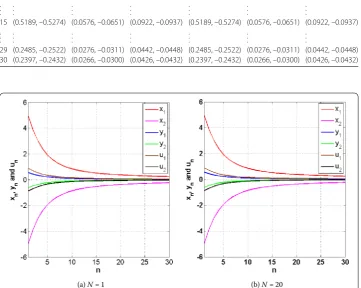
In this section, an example is given for supporting Theorem 3.4. In Example 5.1, we only instance an example in infinite dimensional Hilbert space for supporting Theorem 3.4. We omit the computer programming.
Example5.1 LetH1=H2=C=Q=2be the linear space whose elements consist of all
2-summable sequences (x1,x2, . . . ,xj, . . .) of scalars, i.e.,
2=
x:x= (x1,x2, . . . ,xj, . . .) and
∞
j=1
|xj|2<∞
,
with an inner product·,·:2×2→Rdefined byx,y=
∞
j=1xjyjwherex={xj}∞j=1,y=
{yj}∞j=1∈2and a norm · :2→Rdefined byx2= (
∞
j=1|xj|2)
1
2 wherex={xj}∞
j=1∈2.
Let the mappingA:2→2be defined byAx= (x31,x32, . . . ,
xj
3, . . .) for all x={xj}∞j=1∈2
andA∗:2→2be defined byA∗z= (z31,z32, . . . ,
zj