Online Appendix:
A Stackelberg Game Model for Botnet Data
Exfiltration
June 29, 2017
We first provide Lemma 1 showing that the urban security problem presented in (Jain et al. 2011) (see the Related Work section of the main paper) is a special case of the botnet defense problem with uni-exfiltration under some specific conditions. Based on Lemma 1, we then prove the NP-hardness of the attacker and defender oracle problems.
1
Appendix A
Lemma 1. The urban security problem presented in (Jain et al. 2011) is reducible to the botnet defense problem with respect to data uni-exfiltration conditioned on: (i) the attacker only exfiltrates data from one single mission-critical node; (ii) there is no resource limit for the attacker; and (iii) the defender does not deploy detectors on mission-critical nodes.
Proof. Let’s consider an arbitrary instance of the urban network security problem. There is an urban road network which is represented as a graph Gu = (Vu,Eu). The attacker starts at one of the source nodess∈S⊂Vuand travels along a path to attack one of the targetst∈Tu⊂Vu. The attacker’s pure strategies are all possible paths in the graph, each starts from a sources∈Suand ends at a targett ∈Tu. On the other hand, the defender attempts to protect the targets by placing limited security resources on edges of the graph. The defender’s pure strategies are thus all possible allocations of these resources to the edges.
We now construct the corresponding instanceG= (V,E)of the botnet defense problem as follows. Essentially, the computer network graphG = (V,E)is an in-tersection graph of the edge setEu. In particular, for each edgee∈Euof the urban graph, we create a new nodeve ∈ Vin the computer graph. Furthermore, for each pair of nodesve, ve0 ∈Vin the computer graph, if the corresponding edgese, e0 ∈Eu share a same vertex, we create a new edge(ve, ve0)∈Ein the computer graph.
For each targett∈Tu, we add a new mission-critical nodeh
tto the vertex setV. The data value associated with this mission-critical node is equal to the value of target
e1
e8 e7
e6
e5 e4 e3
e2
e9 e10 e11
t1 t2
s1 s2
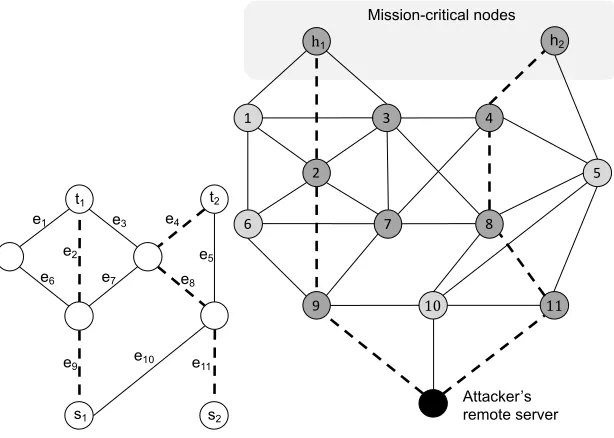
(a) An instance of urban security 1
5
6 7 8
9
4 3
2
h1 h2
10 11
Mission-critical nodes
Attacker’s remote server
[image:2.612.152.459.125.344.2](b) The corresponding instance of botnet defense
Figure 1: In the instance of urban security,{t1, t2}are the two targets while{s1, s2} are the source nodes. In addition, there are other four intermediate nodes and11edges denoted by{e1, e2, . . . , e11}in the urban graph. In the corresponding instance of bot-net defense, there are11nodes with respect to to the11edges in the urban graph. The connectivity of the nodes in the computer graph is determined based on the connectiv-ity of the edges in urban graph. For example, there is an edge between nodes1 and
2since the edgese1ande2connect viat1. The two mission-critical nodesh1andh2 correspond to the two targetst1andt2. In addition, the mission-critical nodeh1 con-nects to the nodes{1,2,3}since targett1belongs to edges{e1, e2, e3}. The attacker path(e9, e2)from the sources1to the targett1in the urban graph is equivalent to the exfiltration path(h1,2,9, Sa)in the computer graph. Conversely, the exfiltration path (h2,4,8,11, Sa)leads to the path(e4, e8, e11).
we create a corresponding new edge that connect the mission-critical nodehtto node
ve ∈V. In total, there are|Tu|corresponding mission-critical nodes inVc. Finally, we create a remote server of the attackerSa. For each sources∈Suand for each edge
e∈ Euthat containss, we create a new edge which connectsSawithve ∈ V. An example of our computer graph construction is in Figure 1.
x"2
x"2
x3
x"1
x"3
x"4
x"2
x"3
x4
x1
x"1
x2
x1
x3
x"3
x4
x"4
Sa
[image:3.612.139.454.126.231.2]h
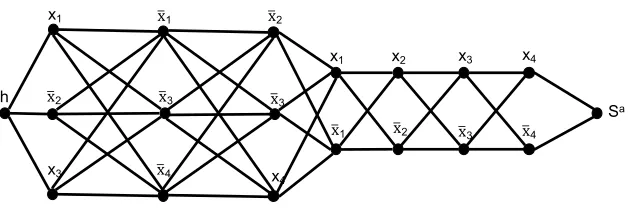
Figure 2: The 3-SAT instance: (x1∨x¯2∨x3)∧(¯x1∨x¯3∨x¯4)∧(¯x2∨x¯3∨x4) with three clauses and four variables(x1, x2, x3, x4). In the corresponding computer network, there is a mission-critical nodeh. An attack path for the attacker can start from the mission-critical nodehgoing through edges on the graph to the serverSa, with the maximum number of compromised nodes is4 + 3 + 1 = 8. The defender has eight pure strategies; each includes all nodes corresponding to a literal (e.g., protecting two nodes w.r.t.x1or three nodes w.r.t.x¯3) and is played with probability 18.
pure strategy of the defender in the computer graph.
In the instance of the botnet defense game, since the attacker aims at exfiltrating data from one single mission-critical node only without resource-limited constraint, each pure strategy of the attacker can be represented as a path from a mission-critical node to the attacker serverSa to exfiltrate data. We are going to show that each ex-filtration path in the computer graph corresponds to an attack path in the urban graph and vice versa. First, any path from a sourcesto a targettof the attacker in the urban graph is an ordered set of edges{e1, e2, . . . , eK}wheres∈e1andt∈eK such that each pair of consecutive edges{ek, ek+1}shares a vertex. Thus, this path corresponds to an exfiltration path from the mission-critical nodeht
1to the attacker’s server, which is a set of ordered vertices{ht
1, veK, . . . , ve2, ve1, Sa}. Conversely, considering an ex-filtration path from a mission-critical nodehttoSa, which consists of ordered vertices
{ht, veK, . . . , ve2, ve1, Sa}, we obtain a set of edges{e1, e2, . . . , eK}where there are a sources∈e1and a targett∈eKin the urban graph. Since these edges are connected (each pair of consecutive edges shares a vertex), there exists a path from the sources
to the targettover these edges, which is a pure strategy of the attacker in the urban security game.
Therefore, the payoff matrix of these two security games is equivalent. Or, finding an SSE of the urban security game is equivalent to finding an SSE in the corresponding instance of the botnet defense game.
2
Appendix B: Proposition 1
Proposition 1. The attacker oracle problem corresponding to data uni-exfiltration is NP-hard.
proving the NP-hardness of the attacker oracle problem with data uni-exfiltration. In particular, we show that any instance of the 3-SAT problem can be reducible to an instance of the attacker oracle problem. Let’s consider an arbitrary instance of the 3-SAT problem havingnvariables{xi}fori= 1, . . . , nandkclauses. Each clause is a disjunction of three literals in which each literal is either a variable or the negation of that variable.
(Jain et al. 2011) construct a corresponding instance of the attacker oracle in the urban security problem for each particular instance of the 3-SAT problem. Based on Lemma 1, we can also construct a corresponding instance of the attacker oracle prob-lem in the botnet defense probprob-lem in a similar way. In particular, we construct a com-puter network as follows: there aren+k layers in the network. The firstk layers correspond tokclauses of the 3-SAT problem; each layer has three nodes — each node refers to a literal of the corresponding layer. The nextnlayers correspond ton
variables of the 3-SAT problem; each layer has two nodes referring to a variable and its negation. For the connectivity between consecutive layers, all the nodes in the con-secutive layers will connect with each others. In addition to then+klayers, there is a mission-critical node which contains sensitive data. This mission-critical node con-nects with all the nodes in the first layer. Finally, there is an edge from all the nodes of the last layers to the attacker’s serverSa. An example of the constructed computer network is in Figure 2.
The defender’s mixed strategy (D,x∗)is defined as follows: there are 2n pure strategies inD; each pure strategy corresponds to a literal and the nodes that cor-responding to that literal in the network, i.e., these nodes are monitored by the de-fender’s pure strategy. In addition, each pure strategy is played with equal probability ofxi = 21n. In addition, the attacker can compromisedn+k+ 1nodes at most. We can show that there is an assignment of values to variables in the 3-SAT instance so that the formula is true iff there is an exfiltration path from the mission-critical node to
Sain the corresponding attacker oracle instance which is blocked with probability at most12, which is similar to (Jain et al. 2011).
3
Appendix C: Proposition 2
Proposition 2. The defender oracle problem corresponding to data uni-exfiltration is NP-hard.
Proof. Similar to (Jain et al. 2011), we also show that any instance of the set-cover problem can be reducible to an instance of the defender oracle problem. In particular, in the Set-Cover problem, there is a setU, a collectionSof subsets ofU, i.e.,S⊆U
such thatSincludes all singleton subsets of U, and an integer k. The question is whether there exists a sub-familyC⊆Sof sizeksuch thatS
c∈Cc=U.
{1,2}
{1,4}
{2,4}
{Sa} h1
h4 h3 h2
u1''
u2''
u3''
u4''
Figure 3: The set U = {1,2,3,4} and the collection of subsets
S = {{1},{2},{3},{4},{1,2},{1,4},{2,4}}. The corresponding com-puter network is constructed with four mission critical nodes (h1, h2, h3, h4). There are three nodes corresponding to the three non-singleton subsets
{1,2},{1,4},{2,4}. In addition, four pure strategies of the attacker include
inS, there is a corresponding node in the network. There are edges from nodes of non-singleton subsets ofSto nodes in(u001, u002, ..., u00|U|)if these subsets contain those nodes. Furthermore, there are also edges from each mission-critical nodehito nodes of non-singleton subsets inScontaining this mission-critical node ’s corresponding element inU. In addition, there are edges between subsets in Sof which intersec-tion is not an empty set. Finally, there is an edge betweenhi andu00i if there is no non-singleton subset inScontaining the corresponding element inCof these nodes. Figure 3 show an example of the computer network.
The current strategy of the attacker(A,a∗)is defined as follows: there are totally
|U|pure strategies of the attacker inA. Each pure strategy consists of an exfiltration path of the attacker and a set of compromised nodes which are the nodes on the exfil-tration path. In particular, each exfilexfil-tration path starts from each mission-critical node
hi, going through all nodes of non-singleton subsets inScontaining the corresponding element ofU, and then ending atSa. These pure strategies of the attacker are played with equal probability of |U1|. We show that Uis covered by ksubsets in Sif and only if the defender can block all the attacker’s exfiltration paths withkresources in the corresponding instance of the defender oracle problem, which is similar to (Jain et al. 2011).
4
Appendix D: Proposition 3
Proposition 3. The attacker oracle problem corresponding to data broad-exfiltration is NP-hard.
Proof. We extend the proof of Proposition 1 to prove the NP-hardness of the attacker oracle problem with broad-exfiltration as follows. In the computer network graph con-structed in Proposition 1, we add a new dummy nodewand edges connectingw to all other nodes in the network. The network controller uses the following routing al-gorithm to route data within the network: for any pair of nodes(u, v), if these two nodes do not have a direct connection (i.e., there is no edge connecting them), the routing path fromutov isP(u, v) = u→ w → v. Otherwise, the routing path is
P(u, v) =u→v. In addition, in the instance of attacker oracle problem with broad-exfiltration, the number of attacker resources is equal to the number of layers in the computer network plus one, i.e.,Ka = n+k+ 1. The defender’s mixed strategy
(D,x∗)is defined similarly as in Proposition 1 but with an addition detector on the dummy nodewin each pure strategy of the defender.
{1,2}
{1,4}
{2,4}
{Sa}
h1
h4 h3 h2
u1''
u2''
u3''
[image:7.612.138.466.128.339.2]u4'' w
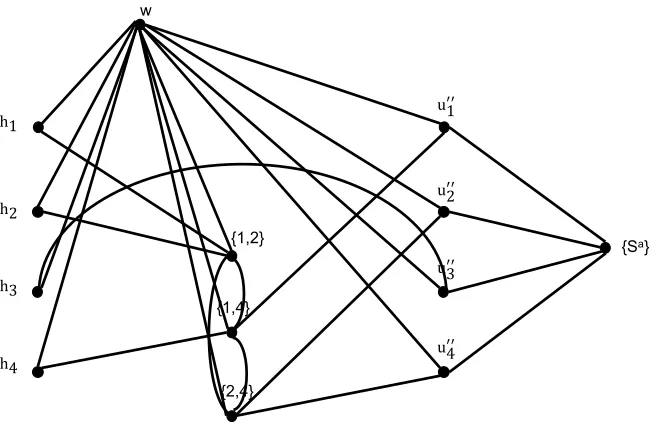
Figure 4: The set U = {1,2,3,4} and the collection of subsets S =
{{1},{2},{3},{4},{1,2},{1,4},{2,4}}. The corresponding computer network is constructed with four mission critical nodes(h1, h2, h3, h4). There are three nodes cor-responding to the three non-singleton subsets{1,2},{1,4},{2,4}. The lexicographi-cal order of these three nodes is{1,2}<{1,4}<{2,4}. In addition, four pure strate-gies of the attacker are the four sets of compromised nodes:(h1,{1,2},{1,4}, u001, Sa), (h2,{1,2},{2,4}, u002, Sa), (h3, u300, Sa), and (h4,{1,4},{2,4}, u004, Sa). For each pure strategy, for example (h1,{1,2},{1,4}, u001, Sa), although there are multiple exfiltration paths corresponding to that strategy, the only exfiltration path that mat-ters is({1} → {1,2} → {1,4} →u00
1 →Sa)since all other exfiltration paths such as (hi → {1,2} →w→u001 →Sa)need to go through the dummy monitored nodew. It is clearly that one of the minimum set covering forUis{{1},{3},{2,4}}. Equiva-lently, the defender can also put3detectors on nodes{h1},{h3}, and{2,4}to block the attacker’s exfiltration.
5
Appendix E: Proposition 4
Proposition 4. The defender oracle problem corresponding to data broad-exfiltration is NP-hard.
Proof. We extend the proof of Proposition 2 to prove the NP-hardness of the defender oracle problem with broad-exfiltration. In particular, in constructing a correspond-ing computer network graph instanceG = (V,E)for an instance of the Set-Cover problem, the set of nodes inGis created as the same as in Proposition 2. Nevertheless, unlike Proposition 2, we create a set of edgesEsuch that for each mission-critical node
In order to do so, we put all the non-singleton nodes in the lexicographical order. We iterate over mission-critical nodes{hi}. For eachhi, we create an edge fromhito the first non-singleton node in the lexicographical order which contains the corresponding element ofhi. We also create an edge from the last non-singleton node in the lexico-graphical order which contains the corresponding element ofu00i tou00i. Furthermore, we create edges connecting consecutive non-singleton nodes in the lexicographical or-der which has the element ofUcorresponding to(hi, u00i). Finally, there is an edge betweenhiandu00i if no non-singleton subset inScontains the corresponding element of these nodes.
We add a new dummy nodewand edges connectingwwith all other nodes in the network. The routing algorithm is determined the same as in Proposition 3. Figure 4 shows an example of the constructed computer network.
The current strategy of the attacker(A,a∗)is defined as follows: there are totally
|U|pure strategies of the attacker in|A|, each corresponds to an element inU. Each pure strategy consists of all the nodes in the graph corresponding to an element of
Uand the non-singleton subset ofScontaining that element. Now even though the attacker can broadcast the stolen data, the only exfiltration path in each pure strategy corresponding to the elementi∈Uwhich matters is to start from the mission-critical nodehi, going through all nodes in the lexicographical order which correspond to non-singleton subsets inScontainingi, passingu00
i and ending atSa.