© 2018, IRJET | Impact Factor value: 7.211 | ISO 9001:2008 Certified Journal | Page 2561
Comprehensive Study On Characterization of Sugar Pressmud Along
with Suitable Microbial Consortium For Pressmud Composting
SHIVAJEET AMBIGAR
1, AMAR BYAKODI
21Postgraduate Student, Department of Civil Engineering, Suresh Angadi Education Foundation’s
Angadi Institute Of Technology & Management, Savagoan Road, Belagavi – 590009
2 Assistant Professor, Department of Civil Engineering, Suresh Angadi Education Foundation’s
Angadi Institute Of Technology & Management, Savagoan Road, Belagavi – 590009
---***---Abstract - India is highly dependent on Agriculture, which is
main income source and employment-generating sector for the economic growth of the country. Sugar cane is the most important crop from which sugar can be produced in commercial quantity. India is a second largest sugar producing country. The Bagasse, molasses & press mud this are the waste products from sugar industry produced and to handle this large quantity of waste products safe and eco-friendly disposal is required. Sugar Pressmud is an By-Product obtain from sugarcae juice. If it discharge to Environment without proper treatment it cause change of colour of soil and water as a result impcat on Eco-System. Pressmud has high Nutrition value and Chemical composition so it can used as a Bio-Composting Material.Present study was conducted to form bio- fertilizer from Sugar pressmud by activity of microorganims and action of nutrient mixture. For preparing bio-compost we prepare a sample with raw pressmud, cowdung, nutrient mixture with microorganims.
Key Words: Sugar Press mud, Compost mixture, Nutrient
mixture.
1. INTRODUCTION
India is highly dependent on Agriculture, which is main income source and employment-generating sector for the economic growth of the country. Sugar cane is the most important crop from which sugar can be produced in commercial quantity. India is a second largest sugar producing country. According to growth rate analysis Maharashtra is one of the large sugar manufacturing state in India. Agriculture sector is the primary role for developing countries like India and about 60-70 percentage of the total population is dependent on agriculture sector in India. The Bagasse, molasses & press mud this are the waste products from sugar industry produced and to handle this large quantity of waste products safe and eco-friendly disposal is required. Due to high nutrient value of pressmud and is required for Soil-Nutrition so it’s important to know the process of composting to use pressmud as bio-composting material.
2. MATERIALS AND METHODOLOGY
Sugar pressmud is the residual solid product obtained from sugarcane juice before crystallization of sugar; the Pressmud is converting into stable humus like material using activity of microorganisms, stable humus like material is known as Bio-compost.
Present study has been carried out in Angadi Institute of Technology and Management, Belagavi. Sugar Pressmud was brought for the study from Doodhaganga Krishna Sahakari Sakkare Karkhana Niyamat, Chikodi. The collected samples were stored in a cool place along with precautions for preventing insect nuisance.
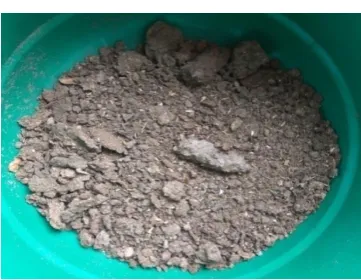
Fig-1: Shows the Raw Pressmud collection
[image:1.595.335.534.417.573.2] [image:1.595.343.524.598.738.2]© 2018, IRJET | Impact Factor value: 7.211 | ISO 9001:2008 Certified Journal | Page 2562 Fig-3: Shows the selected two plastic container for
composting
Plastic container has the total Volume of 0.02m3 (20lit).
2.1 Microorganisms and Nutrient Mixture used
The Nutrient mixture act as an accelerator for increasing rate of composting and the microorganisms used in composting process are mainly Trichoderma, Aspergillus Niger, Pleurotus, and Phaenerochaete are collected from University of Agriculture Dharwad. Explanation regarding these microorganisms is discussed below
Trichoderma is a Fungus and Bio fungicide, this play important role to decompose the cellulosic matter into glucose.
Aspergillus Niger it belongs to Fungi Kingdom and it is a one of the most common organism of genus Aspergillus. It present all most anywhere including plant & soil. Aspergillus commonly use as a preservative for food and Industrial products then also use for chemical and biological products generation.
Pleurotus is a commonly cultivated organism of Oyster Mushroom and found in dead plants. It is white to greyish brown to brown in colour.
Phaenerochaete is a saprophytic fungus or it is white root funguses because of it decompose the polymer lignin and also decompose the harmful chemicals. It can active/sustain in moderate temperature in 400.
Fig-4: Collected Microorganisms & Nutrient Mixture
3. COMPOSTING PROCESS
Composting is one of the most commonly used treatments for organic solid waste. Pressmud is a highly organic waste, which has a high potential of converting itself into organic manure, through proper composting technique. For the present study composting of press mud was carried out by inoculating pressmud with various microorganisms, along with cowdung as a nutrient in the initial stages.
The present study concentrates on effectiveness of various microorganisms on decomposition of pressmud with a nutrient mixture. As per the literature four microorganisms are chosen for the study, which are capable of decomposing the pressmud as a stable material. Details of the same are discussed below.
3.1 Compost Mixture
As per the literature study, microorganism plays a very important role in decomposition of pressmud. Collected pressmud was oven dried to remove all the moisture content, then 5 kg of pressmud was weighed accurately. 0.60 kg of decomposed cowdung was mixed with 2.5 lit of water and was added to the pressmud, along with 1% nutrient mixture of weight of pressmud of and combination of Trichoderma, Aspergillus Niger, Pleurotus, and Phaenerochaete for acclimatization process. Dosage of microorganisms for the composting process was 1% by weight of pressmud. All the microorganisms were mixed equally to prepare the culture for composting.
Moisture content was also maintained between 40 to 60% to aid in acclimatization of microorganisms. The entire contents were added in a plastic container of total Volume 0.02m3 (20lit), and heaps were prepared to provide proper aeration and to maintain optimum temperature. As per the evaporation addition of water was carried out at an interval of every 3 days along with mixing of entire contents to provide proper aeration.
Temperature of the composting heap was measured on a daily basis to monitor the composting process & it was observed that the temperature is in the range of 280 to 390
during composting process.
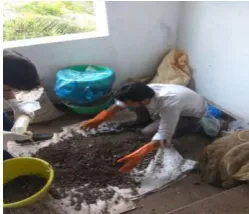
[image:2.595.36.294.100.218.2] [image:2.595.46.285.618.745.2] [image:2.595.370.495.627.734.2]© 2018, IRJET | Impact Factor value: 7.211 | ISO 9001:2008 Certified Journal | Page 2563 Fig-6: Shows the Compost mixture
Fig-7: Shows the 3rd day compost mixture
Fig-8: Shows the 25 days compost mixture
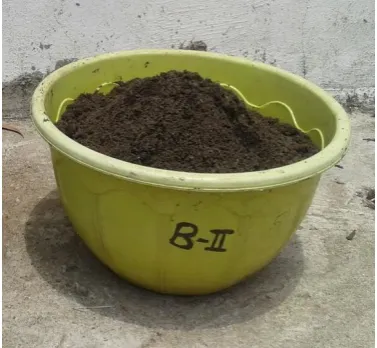
Fig-9: Shows final bio-compost
4. RESULTS AND DISCUSSION
Pressmud is by-product of sugarcane industries; it is light black color material has high potential value so without proper treatment if discharge to environment its cause imbalance in environment-system, so we have to used as a compost material for safe disposal and eco-friendly disposal. In composting process by the action of microbial organic matter convert into stable like material is known as Bio-Compost.
Decomposition process is continued with proper Aeration / Turning every 3days with required amount of moisture content, also with regular temperature monitoring.
[image:3.595.333.532.100.293.2] [image:3.595.75.251.108.286.2] [image:3.595.76.246.315.489.2] [image:3.595.67.256.527.701.2]© 2018, IRJET | Impact Factor value: 7.211 | ISO 9001:2008 Certified Journal | Page 2564 Table-1: Physico-Chemical characteristics of Compost
Samples
SI.No. Parameter Pressmud Raw Days 15 Days 25 Days 50 Unit
1 pH 6.25 6.8 7.12 6.35
2 Electrical conductivity 6.554 2.36 2.05 3.06 mS/cm
3 Moisture Content 72.50 77.95 71.98 77.76 %
4 Total Organic
Carbon 12.53 15.91 18.13 17.69 %
5 Total Kjeldhal
Nitrogen 0.48 1.82 1.78 2.36 %
6 Total Phosphorus (as P2O5)
0.40 3.52 5.79 3.02 %
7 Total Potassium (as K2O)
1.09 0.74 1.01 1.43 %
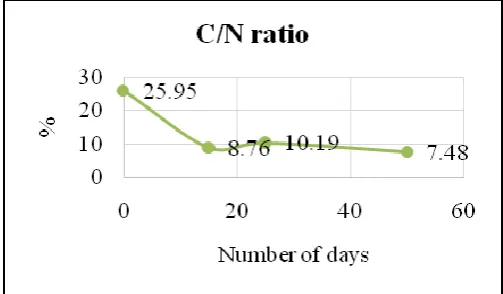
8 C/N ratio 25.95 8.76 10.19 7.48 %
9 Iron 0.15 72.30 74.02 61.24 mg/kg
Chart-1: Graph shows pH variations during composting
Above graph shows the variation of pH during composting. Raw pressmud has pH of 6.25. After 15 days pH rise to 6.8 then after 25 days pH is 7.12. End of the composting period pH is 6.35, thus the pH values are in nearly to neutral range it suitable for aerobic composting.
Chart -2: Graph shows Total Organic Carbon variations during composting
From above graph Total organic carbon at initial stage is 12.53% after 15 days composting it rise to 15.91% due to more microbial activity to degrade the organic matter. Composting continues for 25 days then the value rise to 18.13%. After final compost values at 50days value is 17.69.
Chart-3: Graph shows C/N ratio variations during composting
© 2018, IRJET | Impact Factor value: 7.211 | ISO 9001:2008 Certified Journal | Page 2565 Chart-4: Graph shows Total Kjeldhal Nitrogen variations
during composting
From above graph shows that raw sample has 0.48% total Kjeldhal nitrogen, after 15days of composting it increase to 1.82%. At 25 days of composting values are reducing to 1.78%. At the end of composting value increases to 2.36%.
5. CONCLUSIONS
Present study has been carried out in Angadi Institute of Technology and Management, Belagavi. Sugar Pressmud was brought for the study from Doodhaganga Krishna Sahakari Sakkare Karkhana Niyamat, Chikodi.
Sugar pressmud have rich in soil nutrition hence it use as a composting material with suitable aerobic microbial activity organic material convert into stable material is known as bio-compost. Entire study carried out for one stage with combination of pressmud,cowdung, nutrient mixture and microorganims. As per Analysis of samples after 50days of composting process compost sample has C/N ratio of 7.48%, Total potassium of 1.43% and Total organic carbon of 17.69. Thus we conclude that it has better composting values because of addition of Nutrient mixture with inoculation of Trichoderma, Aspergillus Niger, Pleurotus, and Phaenerochaete microorganims. This final compost material rich in nutrient and chemical composition thus used as a bio-compost for agriculture field to improve the soil nutrient ratio.
REFERENCES
[1] E.Sanjeeva Rayudu and M. Srimurali, K.Venkaiah (2018), “a study on Macronutrients of Alkaline soils by using Pressmud”, International Journal Scientific Research & Review. Vol.7, pp. 97-105.
[2] Nagesh N. Patil, Sumit Jadhav, Sachin S. Ghorpade and Abhijeet Kumar B. Sharma (2013), “isolation and enrichment of sugar Pressmud (spm) adapted microorganism for production of Biofertilizer by using sugar press mud”, International Journal of Advanced Biotechnology and Research. Vol.4, Issue 1, pp. 96-104.
[3] Mr.Anil C.Ranveer, Deepali Munde and Snehal Sutar (2015), “Vermicomposting of Pressmud from Sugar industry”, International Journal of innovation in engineering research and technology (IJIERT). Vol.2, Issue 4, pp. 1-10.
[4] Mohammad Arshad, Arshad Nawaz chaudhry, Ghulam Shaheer,Shakir Farroq, Shuja Manzoor and Ahsan Raza (2017), “Effect of Physico-chemical properties on decomposition rates and nutrients release during composting”, International Journal of Biosciences (IJB). Vol.12, pp. 330-337.
[5] Er.Ashutosh Mishra, Dr.M.Z.Khan and Er.Amit Singh (2014), “In-Situ Incorporation of Pressmud Cake in Sugarcane Fields: Impact on Manorial Value of Soil Environment”, International Journal of Engineering Research & Technology (IJERT).Vol.3, Issue 2, pp. 2889-2892.
[6] Sunil Kumar , RS Meena , Dinesh Jinger , Hanuman Singh Jatav and Tejram Banjara (2017), “Use of Pressmud compost for improving Crop productivity and Soil health”, International Journal of Chemical Studies. Vol.5 (2), pp. 384 – 389.
[7] Shilpa V. Chogatapur, Vishwajith and Reshma Satar (2017), “Organic sugarcane: a review”, International Journal of – Current Micro-Biology and Applied Sciences. Vol.6 (12), pp. 1729 – 1738.
[8] Patil Ganeshgouda I, Mahajana Shetti S.B and Patil Somanagouda I, (2016), “Performance of Sugar Industry in major sugar producing states of India”, International Journal of Agriculture Sciences. Vol.8, Issue 61, pp. 3414-3417.
[9] Youssef Salma, Mohammed Chennaoui, Mohammed EI Amraoui and Mohammed Mountadar (2016), “ A Review of Compost Produced from Biological Wastes: Sugarcane Industry Waste ”, International Journal of Food Science and Biotechnology. Vol.1 (1), pp. 24-37.
[10] N.N.Nadoni, G.S.Ananth, P.S.Dhananjaya Swamy and Manjunath S.Kerur (2013), “Performance Appraisal of Co-operative and Private Sugar Factory in Belgaum District – An Economic”, Global Journal of Management and Business Studies. Vol.3, Number 10, pp. 1197-1204.
[11] Arief Budiono, Suharjono, Imam Santoso and Soemarno (2015), “Composting Mud Cake by Trichoderma Viride Apt 01”, International Journal of Environmental and Agriculture Research (IJOEAR). Vol.1, Issue 5, pp. 26-29.
[12] B.Rajesh, J.Arockia John Paul, N.Karmegam, (2014), “Composting of Pressmud using Inoculants Isolated from Earthworm Gut”, International Journal of Current Research in Biosciences and Plant Biology. Vol.1, Number 4, pp. 52-60.
© 2018, IRJET | Impact Factor value: 7.211 | ISO 9001:2008 Certified Journal | Page 2566 saline Irrigation Water”, J. Soil Sci. and Agri. Eng., Mansoura
Univ., Vol.7(8),pp. 557-563.