An Efficient Design of Vedic Multiplier using New
Encoding Scheme
Jai Skand Tripathi
P.G Student, United College of Engineering & Research, India
Priya Keerti Tripathi
P.G Student, Jaypee University of Engineering & Technology, India
Deepti Shakti Tripathi
P.G Student, National Institute of Technology, Rourkela, India
ABSTRACT
This paper presents a design of efficient Digital Vedic Multiplier using the Vedic sutras from ancient Indian Vedic mathematics. If we are looking towards the signal processing, we will find multipliers and adders plays a very important roll. In fact if we make our focus we can see speed of the Digital signal processing systems is mainly dependent on multipliers and adders. A processor requires more hardware and processing time during multiplication rather than addition and subtraction. In this paper we proposed a new digital Vedic multiplier structure based on a new encoding algorithm. We found that this algorithm reduces the number of partial products so reduces the adders. Thus multiplier is going to faster. In this paper we use Xilinx VHDL module for simulation of Encoder.
General Terms
FFT, Urdhva-Triryakbhyam sutra , Hardware complexity,
Keywords
ppi – ith partial product, Vedic mathematics, Adders, Encoder
1.
INTRODUCTION
The primordial and core of all the digital signal processors are arithmetic operations such as multiplication & addition. Adders are simply constructed but constructions of multipliers are complex. Two prominent measurements are associated with multiplication algorithms that are latency and throughput of system. The Latency is defined as the real computation delay of a function and Throughput is the measure of how many computations can be performed during given processing time. The execution time in DSP systems are dependent on multipliers so we need supreme multipliers.
The term Vedic is nascent from the Indian Sanskrit text known as Vedas which means accumulation of intellection. The present Vedic mathematics is due to the 8 years impassable research of Shri Bharati Krshna Tirtha on Vedas [1-2]. After his research of 8 years he finally concluded 16 sutras for Vedic mathematics which enables us to fast multiplication. Actually all the Vedic formula are based on the natural principles on which our mind works. There are various designs of Vedic multiplier [3-4-5]. Vedic multiplier works on the parallel processing and we know parallel processing is faster than serial processing. It has the speed better than simple digital multipliers but it has large number of gates.
2.
VEDIC MULTIPLICATION
Vedic mathematics is based on 16 sutras. But in this paper we are using Urdhva-Triryakbhyam sutra for implementation. Urdhva-Triryakbhyam deals with the multiplication of numbers. It is also known as vertically and crosswise technique. Urdhva-Triryakbhyam sutra has been traditionally
used for multiplication of decimal numbers. Here we are applying that sutra for digital multiplication. Line diagram for 4-Bit multiplication is shown in Figure-1.
Step-1 Step-2 Step-3
Step-4 Step-5 Step-6
Step-7
[image:1.595.317.481.267.450.2]
Figure 1:Line diagram of Vedic multiplication
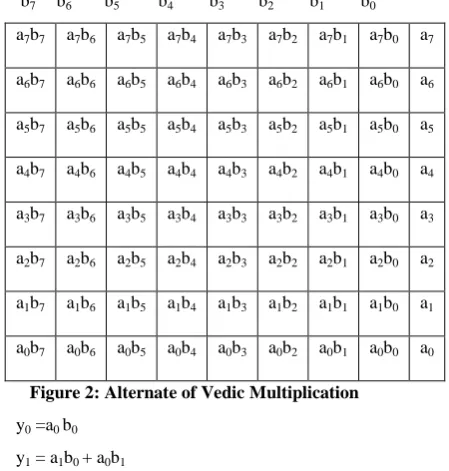
Figure-2 shows the alternate method of Vedic multiplication algorithm. Here each block shows partial product. In Figure-2 we don’t show carry but it is present there. Let we have two 8-Bit numbers P & Q. They can be represented as
P=
∑
Q=
∑
Y=P*Q
If we have to find the product of P&Q, we have 8 partial products. There product after applying Urdhva-Triryakbhyam sutra and arranging all partial product in order to design a Digital circuit is given in Figure-2.Array multiplication & Vedic multiplication is approximately same with a little difference. The architecture of multiplier based on Urdhva-Triryakbhyam sutra is seen to be similar to array multiplier which uses an array of adders to find final product [6]. Vedic multiplication uses parallel processing. In Figure -2 aibj
represents product of ith bit of multiplicand with jth bit of multiplier and ci represent carry due to ith summation.
b7 b6 b5 b4 b3 b2 b1 b0
a7b7 a7b6 a7b5 a7b4 a7b3 a7b2 a7b1 a7b0 a7
a6b7 a6b6 a6b5 a6b4 a6b3 a6b2 a6b1 a6b0 a6
a5b7 a5b6 a5b5 a5b4 a5b3 a5b2 a5b1 a5b0 a5
a4b7 a4b6 a4b5 a4b4 a4b3 a4b2 a4b1 a4b0 a4
a3b7 a3b6 a3b5 a3b4 a3b3 a3b2 a3b1 a3b0 a3
a2b7 a2b6 a2b5 a2b4 a2b3 a2b2 a2b1 a2b0 a2
a1b7 a1b6 a1b5 a1b4 a1b3 a1b2 a1b1 a1b0 a1
a0b7 a0b6 a0b5 a0b4 a0b3 a0b2 a0b1 a0b0 a0
Figure 2: Alternate of Vedic Multiplication
y0 =a0 b0
y1 = a1b0 + a0b1
y2 = a2b0 + a1b1 + a0b2+c1
y3 = a3b0 + a2b1 + a1b2 + a0b3+c2
y4 = a4 b0 + a3b1 + a2b2 + a1b3 + a0b4+c3
y5 = a5 b0 + a4 b1 + a3b2 + a2b3 + a1b4 + a0b5+c4
y6 = a6b0+a5b1+ a4b2 + a3b3 + a2b4 + a1b5 + a0b6+c5
y7=a7b0+a6b1+a5b2+a4b3+a3b4+a2b5+a1b6 + a0b7+c6
y8 = a7b1+ a6 b2+ a5 b3+ a4b4+a3b5 + a2b6 + a1b7 +c7
y9 = a7b2 + a6b3 + a5b4 + a4b5 + a3b6 + a2b7 +c8
y10 = a7b3 + a6 b4 + a5b5 + a4b6 + a3b7+c9
y11 = a7 b4 + a6b5 + a5b6 + a4b7+c10
y12 = a7b5 + a6b6 + a5b7+c11
y13 = a6b7 + a6b7 +c12
y14=a6b7 +c13
[image:2.595.46.271.77.313.2]y15=c14
Figure 3: Table for partial product generated by figure 2.
3.
PROPOSED NEW
ENCODING
3.1
Need For New scheme
The multiplication involves two processes first is generation of partial product and second is addition of generated partial product. We can enhance the speed of multiplier either by reducing the number of partial product or by using fast addition algorithms. In this paper we reduce the number of partial products. Although Vedic multiplier works on parallel processing but it has 8 partial products for 8 Bit Multiplier.
3.2
New Encoding Technique
In this encoding technique we tried to resolve the complexity of a multiplier.Figure-4 shows the grouping of multiplier bits for generation of code. In this algorithm we break a binary number in combination of 2-2 bits starting from LSB and provide a unique code to them according to encoding table given in Table1.
b7 b6 b5 b4 b3 b2 b1 b0
A3 A2 A1 A0
Figure 4: Grouping Bits of New Encoder Table 1. New Encoding Table
b
i+1b
i Ai0 0 0
0 1 1
1 0 2
1 1 3
Algorithm: If Ai ==0
pp(i) = 0;
end; If Ai ==1
pp(i) = multiplicand;
end; If Ai ==2
pp(i) = shift the multiplicand 1 position left;
end; If Ai ==3
pp(i) = sum of pp(i) for code 1 & 2.
Algorithm for this encoding technique involves various steps:
Step1- Take the multiplier number and start grouping 2-2 Bits from LSB.
Step2- Compare the all received 2-bit number with encoding table.
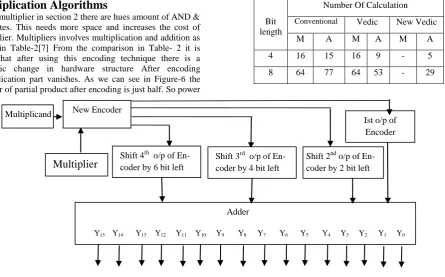
Step3- According to encoding table we apply the multiplicand to the Adder with a shift of 2 bit, 4 bit 6 bit one by one. Step4- Output of Adder is real product.
Encoder
3.4
Design of New Encoder circuit
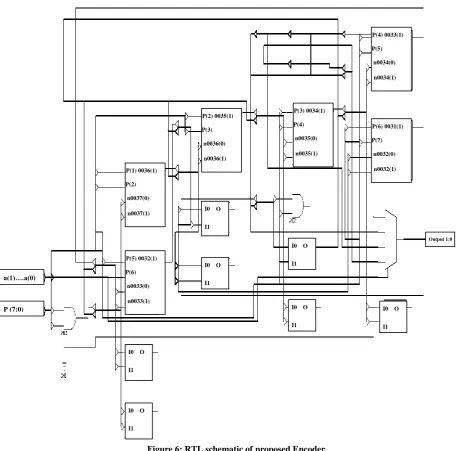
The encoder is designed on Xilinx VHDL module. Input to this encoder is multiplicand and 2 bit of multiplier from LSB , the output is 1st partial product row then next 2 bits of multiplier is applied while multiplicand is fix it will give second partial product row similarly remaining bits will give 3rd and 4th partial product rows.
3.5
Comparison with various
multiplication Algorithms
Vedic multiplier in section 2 there are hues amount of AND & OR gates. This needs more space and increases the cost of Multiplier. Multipliers involves multiplication and addition as given in Table-2[7] From the comparison in Table- 2 it is clear that after using this encoding technique there is a dramatic change in hardware structure After encoding multiplication part vanishes. As we can see in Figure-6 the number of partial product after encoding is just half. So power
[image:3.595.79.525.166.443.2]consumption is less. If we compare our encoder with Booth encoder for unsigned numbers then we find the Same work is done by Radix-4 encoder whose total gate delay is 17.431ns[12] which is large. Radix 4 Booth encoder is more complex than our encoder. It groups 3 bits for encoding out of which on bit is overlapping.
Table 2. Comparison between different Techniques
Figure 5: Block level Architecture of proposed Multiplier
From here we can see that after applying encoding technique to Vedic multiplier we get a great reduction. Normally we have 8
partial product row for 8*8 bit Multiplier but here we have 4 Partial product row.
a7 a6 a5 a4 a3 a2 a1 a0
X b7 b6 b5 b4 b3 b2 b1 b0
PP07 PP06 PP05 PP04 PP03 PP02 PP01 PP00
PP17 PP16 PP15 PP14 PP13 PP12 PP11 PP10
PP27 PP26 PP25 PP24 PP23 PP22 PP21 PP20
PP37 PP36 PP35 PP34 PP33 PP32 PP31 PP30
---
[image:3.595.60.398.516.639.2]Y15 Y14 Y13 Y12 Y11 Y10 Y9 Y8 Y7 Y6 Y5 Y4 Y3 Y2 Y1 Y0
Figure 7: Partial Product of 8 bit Multiplier with encoding
Bit length
Number Of Calculation
Conventional Vedic New Vedic
M A M A M A
4 16 15 16 9 - 5
8 64 77 64 53 - 29
New Encoder
Adder
Y15 Y14 Y13 Y12 Y11 Y10 Y9 Y8 Y7 Y6 Y5 Y4 Y3 Y2 Y1 Y0
Shift 4th o/p of En- coder by 6 bit left
Shift 3rd o/p of En- coder by 4 bit left
Shift 2nd o/p of En- coder by 2 bit left
Ist o/p of Encoder
Multiplier
Figure 6: RTL schematic of proposed Encoder
Parameters of Proposed Encoder:
Number of Slices: 19 out of 192 - 9 % Number of 4 input LUTs: 35 out of 384 - 9% Number of bonded IOBs : 20 out of 90 - 22%
Total gate delay: 15.118ns (8.260ns logic, 6.858ns route) (54.6% logic, 45.4% route)
Table 3. Comparison with Booth Encoder
Parameter Booth Radix-4 Encoder
Proposed Encoder
Total Delay 17.431ns 15.118ns
Area Large Comparatively
Less Padding of
Zero
Required Not Required
4.
CONCLUSION AND FUTURE
SCOPE
In this way we can conclude that Vedic multiplier is better than conventional multiplier but after including new encoding algorithm new design is going to be faster. It reduces the complexity associated with Vedic multiplier. Due to reduction in hardware it is going to be less costly than previous structures. Propagation delay in case of multiplier is high but here it is
a(1)….a(0)
I0 O
I1
P(2) 0035(1) P(3) n0036(0)
n0036(1)
I0 O
I1
P(3) 0034(1) P(4) n0035(0)
n0035(1)
P(6) 0031(1) P(7) n0032(0)
n0032(1)
P(4) 0033(1) P(5) n0034(0)
n0034(1)
P (7:0)
I0 O
I1 I0 O
I1
I0 O
I1
I0 O
I1
I0 O
I1 P(1) 0036(1)
P(2) n0037(0)
n0037(1)
P(5) 0032(1) P(6) n0033(0)
n0033(1)
5.
ACKNOWLEDGMENTS
The author would like to thanks Prof. B.K.Mohanty & Mr. Dharmendra Kumar for their guidance. The author wish to thank to their family members and close friends for many fruitful discussions.
6.
REFERENCES
[1] Swami Bharati Krshna Tirtha, “Vedic Mathematics,” Motilal Banarsidass Publishers, Delhi, 1965.
[2] Vedic Mathematics [Online]. Available: http://www. hinduism.co.za/ vedic.htm
[3] Prabir Saha, Arindham Banerajee, Partha Battacharyya, Anup Dhandapat,”High speed design of complex multiplier using Vedic Mathematics”, Proceeding of the 2011 IEEE student technology symposium,IIT kharagpur, jan.2011. [4] Sumit Vaidya & Deepak Dandekar, “Delay-Power
performance comparison of Multipliers in VLSI circuit design”, International journal of Computer Networks & Communications, July 2010.
[5] Pushpalata Verma, “Design of 4*4 bit Multiplier using EDA Tool”, Vol 48 International journal of Computer Application,2012
[6] Harpreet singh Dhillon & Abhijiit Mitra, “ A Digital Multiplier Architecture using Urdhava Tiryakbhyam Sutra of Vedic Mathematics” IEEE Conference Proceeding,2008
[7] Nidhi Mittal, Abhijeet Kumar, “Hardware implementation of FFT using vertically and crosswise Algorithm”vol 35 International journal of Computer Application, 2011. [8] Mr. Abhishek Gupta, Mr. Utsav Malviya, Prof. Vinod
Kapse, “A Novel Approach to Design High Speed Arithmetic Logic Unit Based on Ancient Vedic Multiplication Technique” Vol.2 International Journal of Modern Engineering Research. 2012
[9] P.D. Chidgupkar, Mangesh T. Karad,“The implementation of Vedic Algorithms in Digital Signal Processing” Global J. of Education, Vol.8 2004.
[10]Dr. S.M. Khairnar, Ms. Sheetal Kapade, Mr. Naresh Ghorpade “Vedic Mathematics-The cosmic software for implementation of Fast Algorithms”
[11]Mr. Ashish Raman, Anvesh Kumar and R.K.sarin, “High speed Reconfigurable FFT Design By Vedic Mathematics” Vol.1 Journal of computer science and Engineering, 2010. [12]K.C.Chang “Digital System design with VHDL and