A Simulink Modeling to Develop a Control
System of Stirred Tank Heater with Multifarious
Operating Conditions
Abdur Raquib Ridwan
LecturerIslamic University of Technology, EEE Department
Ishtiza Ibne Azad
Lecturer Islamic University of Technology, EEE DepartmentMd. Ibnea Sina Bony
Islamic University of Technology, EEE DepartmentABSTRACT
This paper represents a novel design and control architecture of a non-linear stirred tank heater based on its mathematical equivalent modeling of the physical system. The method involves both single and two manipulated of four input variables mainly the temperature of the fluid through the jacket and the flow rate of the fluid through the jacket where the others are considered as unmeasured disturbances. A Model Predictive Controller (MPC) is used over PID based controller to maintain the tank temperature at 1500F using MATLAB simulations. Finally, a comparative tabulated result is presented for both MPC and PID based controllers for single manipulated input variables and offered MPC based control considering the operating decisive factor as a MISO system(single output and two manipulated input variables) for optimum control process.
General Terms
Nonlinear Control, Model Predictive Control, Manipulated Inputs, Stirred Tank Heater.
Keywords
PID controller, Model Predictive Controller, Temperature Control, MISO control
1.
INTRODUCTION
MPC is a widely used technology in process control due its ability of dealing with multiple input variables [8][9]. It works in two stages: Identification step and implementation step. A previous identification is necessary to get a linear model of the process plant and then it takes less time for implementation step. In this paper our motto is to keep the tank temperature of a stirred tank heater at a fixed temperature for optimum utilization in different industries by using both MPC and PID controllers [1][3].The performance and quality of responses was judged on the basis of settling time and overshoot of the tank's temperature from the step responses at manipulated inputs (jacket inlet flow rate & temperature) of the simple linearized system which is presented in this paper. The rest of the paper is organized as follows: In section 2, we started with the physical modeling of the stirred tank heater and developing a mathematical model in section 3. Simulink model of the STH is also shown in this section along with LTI state space equations to be applicable appropriately in MPC and PID controller. Next in section 4 & 5, Simulink model of PID and MPC controllers are developed respectively to manipulate jackets temperature to achieve an optimum control of tank inlet temperature[4][5]. The simulation results associated with each manipulation is also presented in this section. Section 6 deals with the manipulation of two input variables in case of MPC controller as PID’s can’t work with
MISO systems. Our simulation results are discussed in section 7 along with a result table showing all the results we obtained from our simulation work. We concluded in section 8 with references in section 9.
2.
PHYSICAL MODELLING OF STH
The parameters for the model are taken as standardized values of a certain chemical process where the temperature of the tank needs to be maintained at a certain optimum temperatures[7][13]. The assumptions taken to develop the mathematical dynamic model of the stirred tank heater are as follows:
1. A constant volume with constant liquid density and heat capacity
2. Perfect Mixing in both Tank and Jacket
3. Inflow and outflow of the fluid in the Jacket and Tank is assumed to be constant.
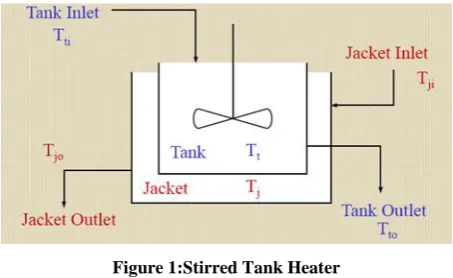
[image:1.595.315.542.440.579.2]A pictorial representation of a typical Stirred Tank heater is illustrated as follows:
Figure 1:Stirred Tank Heater
3.
MATHEMATICAL EQUIVALENT
MODEL OF STH
The governing mathematical equation can be represented as follows:
Conservation of Mass around the Tank and Jacket gives:
(1)
(2)
Conservation of Energy around the Tank and Jacket gives:
(3)
(4)
(5)
3.1
EQUIVQLENT SIMULINK MODEL OF STH
[image:2.595.61.279.238.442.2]From the above equations a dynamic model of a stirred tank heater can be obtained. The Simulink model of the stirred water tank heater is shown below:
Figure 2: Simulink Model of Stirred Tank Heater
The input-output Simulink model of the stirred water tank heater is shown below:
Figure3: Input-Output Model of Stirred Tank Heater
3.2
LTI MODELING OF NONLINIEAR TANK
HEATER
Since it is convenient and necessary for the model predictive controller to be able to process a linear model, the linearized model is obtained via the “linmod” command in Matlab with the operating point set such that the initial temperature of the tank was set to 00F and the temperature of the Jacket at 150
0
F. The obtained LTI State Space equation for the nonlinear Stirred Water Tank Heater model is as follows:
(6)
(7)
Where, is the temperature of the tank to be controlled. The system is stable because the eigenvalues are 3.5793 and -0.1169. They are negative and they lie on the left half plane.
4.
JACKET’S TEMPERATURE
MANIPULATION for the Model
4.1
PID BASED SIMULINK MODEL OF STH
Our objective is to keep the temperature of the tank at 150 0F under different operating conditions. The simulation is carried out with Jacket inlet temperature as the manipulated
variables with the PID controller [6] while keeping the input disturbance values to 1 ft^3/min (Tank inlet flow rate ), 50
0
F (Tank inlet temperature ) and 2 ft^3/min (Jacket inlet
flow rate ). The Simulink block diagram of the system with such configuration is shown below:
Figure 4
We finally simulate the model with all the specifications using first of all using the PID controller.
4.2
MPC BASED MODEL OF STH
The Model Predictive Controller Block Diagram [6] used to carry out the simulations under different operating conditions with the Jacket Inlet temperature as the manipulated variable is shown below
:
[image:2.595.56.284.496.582.2]5.
SIMULATIONS AND RESULTS
5.1
Simulation Results for PID controller
The results obtained after simulation with the PID controller keeping the input disturbance values when the Tank inlet flow rate is 1 ft^3/min, Tank inlet temperature is 50 0F and
Jacket inlet flow rate is 2 ft^3/min are shown below:
Figure 6
The settling time is 20 seconds and overshoot percentage is 38%.
The corresponding input (Jacket inlet temperature ) is shown below:
Figure 7
The Jacket inlet temperature has become negative at certain time intervals which is not desirable at all. Changing the Tank inlet temperature to 60 0F the
simulation results with PID are as follows:
Figure 8
The settling time is 22 seconds and the overshoot percentage is 38%.
[image:3.595.318.537.101.239.2]The corresponding input (Jacket inlet temperature ) is shown below:
Figure 9
The Jacket inlet temperature has become negative at certain time intervals which is not desirable at all.
[image:3.595.55.274.165.294.2]The PID controller with the input variable as the (Jacket inlet temperature ) was adaptively tuned [5] to:
Table 1: PID Controller Parameters
Parameters Values
Proportional Constant(Kp) 0.08
Integral Constant (Ki) 0.013
Derivative Constant (Kd) -0.06
Filter Coefficient (N) 0.85
5.2
Simulation Results for MPC controller
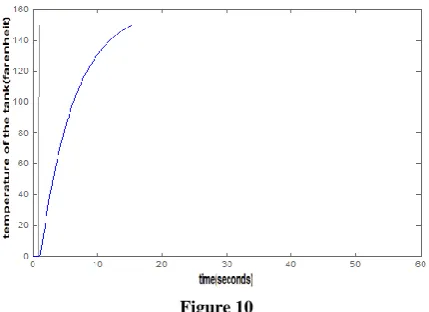
The results obtained after simulation with the MPC controller keeping the input disturbance values to 1 ft^3/min (Tank inlet flow rate ), 50 0F (Tank inlet temperature ) and 2 ft^3/min
[image:3.595.320.535.500.656.2](Jacket inlet flow rate ) is shown below:
Figure 10
The settling time is 17 seconds and the overshoot percentage is zero.
Figure 11
The Jacket inlet temperature has never reached negative which is a constraint that has to be maintained.
[image:4.595.316.537.278.448.2]Changing the Tank inlet temperature to 60 0F the simulation results with MPC are as follows:
Figure 12
The settling time is 34 seconds and the overshoot percentage is zero.
The corresponding input (Jacket inlet temperature ) is shown below:
Figure 13
The Jacket inlet temperature has never reached negative which is a constraint that has to be maintained.
6.
MPC BASED CONTROLLER
MANIPULATING TWO INPUT
VARIABLES
6.1
Simulink Model of STH
Finally two manipulated variables which are the Jacket inlet flow rate and Jacket inlet temperature are considered for maintaining the temperature of the tank at 150 0F while keeping the other variables constant at 1 ft^3/min (Tank inlet flow rate ) and 50 0F (Tank inlet temperature )
respectively. MPC controller is designed to carry out this operation while the PID controller is rendered quite unworthy because it is generally applicable for Input Output (SISO) systems but not for a Multiple-input Single-Output (MISO) systems [10].
The block diagram of the system utilizing the MPC controller is shown below:
Figure 14: Simulink model of MPC based STH
6.2
SIMULATION RESULTS
The simulation results obtained for this MISO system are shown below.
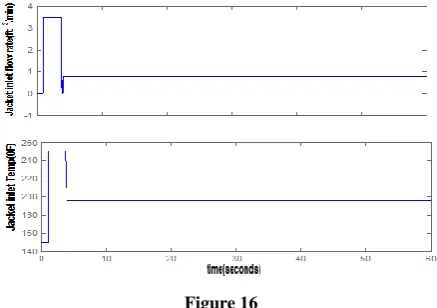
[image:4.595.62.276.284.460.2]The settling time is 3 seconds and the overshoot percentage is zero.
[image:5.595.56.275.129.283.2]The corresponding changes in the inputs, Jacket inlet temperature and Jacket inlet flow rate are shown below:
Figure 16
The inputs have never reached negative which is constrained to a desired value.
Changing the Tank inlet temperature to 60 0F the
[image:5.595.56.279.341.489.2]simulation results with MISO-MPC system are as follows:
Figure 17
The settling time is 3.1 seconds and the overshoot percentage is zero.
[image:5.595.57.276.549.710.2]The corresponding changes in the inputs, Jacket inlet temperature and Jacket inlet flow rate are shown below:
Figure 18
The inputs have never reached negative which is constrained to a desired value.
Figure 19
The bode plot showing the system stability is given below: All the simulations done with the MPC controller was carried out with the parameters of the MPC controller fixed to:
Table 2: MPC Controller Parameters
Parameters Values
Control Interval 0.05 Prediction Horizon 20 Control Horizon 5
7.
Discussion:
While undergoing the control of temperature of the tank it was necessary to maintain the inputs to non-negative value because under no circumstances would the fluid through the jacket be drawn out of the system and the temperature of the fluid in the Jacket cannot be decreased to a temperature below 0 0F because it would require a complicated actuator to
undergo a negative change [14][15]. The temperature of the tank was required to be maintained at 150 0F which is the optimum temperature for wet process chemical plants such as Ware washes and food processing operations.
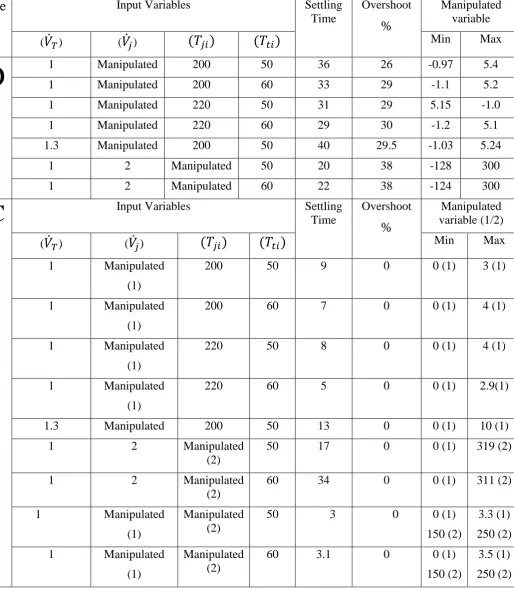
Table 3: PID & MPC Controller simulation comparison
Controlle
rs
Input Variables
Settling
Time
Overshoot
%
Manipulated
variable
(
)
(
)
Min
Max
PID
1
1
Manipulated
Manipulated
200
200
50
60
36
33
26
29
-0.97
-1.1
5.4
5.2
1
Manipulated
220
50
31
29
5.15
-1.0
1
Manipulated
220
60
29
30
-1.2
5.1
1.3
Manipulated
200
50
40
29.5
-1.03
5.24
1
2
Manipulated
50
20
38
-128
300
1
2
Manipulated
60
22
38
-124
300
MPC
Input Variables
Settling
Time
Overshoot
%
Manipulated
variable (1/2)
(
)
(
)
Min
Max
1
Manipulated
(1)
200
50
9
0
0 (1)
3 (1)
1
Manipulated
(1)
200
60
7
0
0 (1)
4 (1)
1
Manipulated
(1)
220
50
8
0
0 (1)
4 (1)
1
Manipulated
(1)
220
60
5
0
0 (1)
2.9(1)
1.3
Manipulated
200
50
13
0
0 (1)
10 (1)
1
2
Manipulated
(2)
50
17
0
0 (1)
319 (2)
1
2
Manipulated
(2)
60
34
0
0 (1)
311 (2)
1
Manipulated
(1)
Manipulated
(2)
50
3
0
0 (1)
150 (2)
3.3 (1)
250 (2)
1
Manipulated
(1)
Manipulated
(2)
60
3.1
0
0 (1)
150 (2)
3.5 (1)
From the tabulated data showing all the data’s obtained from the simulation results, it is quite apparent that the performance of MPC completely overhauls the performance of the adaptive PID controller.
8.
CONCLUSION
In the case of controlling the Stirred Tank Heater with a single input, it was observed that the input values had gone negative at certain time intervals while using PID controller. This is derogatory for maintaining STH because it will lead to a complicated and a costly actuator for controlling the temperature of the tank [12]. It is also necessary to eliminate any presence of overshoot responses while controlling STH. This was not possible with the PID controller. All of these negative impacts while using the PID controller were totally eliminated when MPC was used. It was also possible to control the temperature of STH by manipulating both the Jacket Inlet flow rate and Jacket Inlet Temperature with the MPC controller. Moreover the input controlling signals were also constrained for optimum performance of STH. Hence the temperature control of STH has quite remarkably improved by using the Model Predictive Controller [10].
9.
REFERENCES
[1] Nina F Thornhill, Sachin C Patwardhan, Sirish L Shah, “A continuous stirred tank heater simulation model with applications,” Journal of Process Control, 18, 2008, pp. 347 – 360
[2] Stuart Bennett, “A brief history of automatic control,” IEEE Control Systems, June 1996, pp. 17-25
[3] Vishal Vishnoi, Subhransu Padhee, Gagandeep Kaur, “Controller Performance Evaluation for Concentration Control of Isothermal Continuous Stirred Tank Reactor” International Journal of Scientific and Research Publications, Volume 2, Issue 6, June 2012
[4] Jose Alvarez-Ramirez, America Morales, “PI control of continuously stirred tank reactors: stability and
performance,” Chemical Engineering Sciences, 55, 2000, pp. 5497 – 5507
[5] G. P Liu and S. Daley, “Optimal-tuning PID control for industrial systems,” Control Engineering Practice, 9, 2001, pp. 1185-1194
[6] J Prakash and K Srinivasan, “Design of nonlinear PID controller and nonlinear model predictive controller for a continuous stirred tank reactor,” ISA Transactions, 48, 2009, pp. 273 – 282
[7] B Wayne Bequette, Process Control: Modeling, Design and Simulation, Prentice Hall India, 2008.
[8] Allgower, F., and A. Zheng, Nonlinear Model Predictive Control, Springer-Verlag, 2000.
[9] Camacho, E. F., and C. Bordons, Model Predictive Control, Springer-Verlag, 1999.
[10] A. Rahideh, M.H.Shaheed , “Constrained output feedback model predictive control for nonlinear systems”, Control Engineering Practice 20 (2012) 431– 443
[11] Man Gyun Na, “Auto-Tuned PID Controller Using a Model Predictive Control Method for the Steam Generator Water Level”, IEEE transactions on nuclear science, vol. 48, no. 5, October 2001
[12] Kouvaritakis, B., and M. Cannon, Non-Linear Predictive Control: Theory & Practice, IEE Publishing, 2001. [13] Prett, D., and C. Garcia, Fundamental Process Control,
Butterworths, 1988.
[14] Rossiter, J. A., Model-Based Predictive Control: A Practical Approach, CRC Press, 2003.