Technology (IJRASET)
Performance Analysis of Physical Layer of WiMAX
802.16 using 64 QAM
Krishna Pandey1
, Priya
1,2
Department of Electronics & Communication Engineering,
University Institute of Engineering and Technology, Kurukshetra University, Kurukshetra, Haryana, India
Abstract: IEEE 802.16 is an emerging technology for the future telecommunication standards. All Communication standards follows the basic OSI model.OSI model have seven layers. Upper layers responsible for user interface and lower layers responsible for the network interface. Different method of evaluating the performance depends upon the different layers of OSI model. In this paper we analyze the performance of WiMAX 802.16 physical layer. Performance is measured in the terms of BER (bit error rate).We use the 64 Quadrature Amplitude Modulation techniques to analyze the behavior of physical layer with different channel conditions.
Keywords: WiMAX(Worldwide Interoperability for Microwave Access), CDMA(Code Division Multiple Access), OFDM(Orthogonal Frequency Division Multiplexing), TDD(Time Division Duplexing),FDD(Frequency Division Duplexing), QoS(Quality of Services), MIMO(Multiple Input Multiple Output), BER(Bit Error Rate), QAM(Quadrature Amplitude Modulation), SNR(Signal to Noise Ratio)
I. INTRODUCTION
IEEE 802.16 is a set of telecommunications technology standards aimed at providing wireless access over long geographical area by the various ways - from point-to-point links to full mobile cellular type access. WiMAX covers a long area of several kilometers that’s why it is also called WirelessMAN. Theoretically, a WiMAX base station can covers a in range of up to 50 kms for fixed stations and 5 to 15 kms for mobile stations with a maximum throughput of up to 73 Mbps [1], [2] compared to 802.11a with 54 Mbps up to several hundred meters, EDGE with 384 kbps to a few kms, or CDMA2000 (Code-Division Multiple Access 2000) with 2 Mbps for a few kms.
IEEE 802.16 standards group has been developing a set of standards for BWA for a metropolitan area. Since 2001, several amendments are going through of standards that have been published and are still being developed. Like other standards, these specifications are also a compromise of various competing proposals and contain many optional features and mechanisms. The Worldwide Interoperability for Microwave Access Forum or WiMAX Forum is a group of 400+ service providers, component manufacturers, networking equipment manufacturer vendors and users that decide which of the legion options allowed in the IEEE 802.16 standards or not so that equipment from different vendors are interoperable. Several features such as unlicensed band operation, 60 GHz operation, while specified in the IEEE 802.16 are not a part of WiMAX networks so that these are not in the standard profiles by the WiMAX Forum. For an equipment to be certified as WiMAX compliant, the equipment has to pass the inter-operability tests specified by the WiMAX Forum. For the rest of this paper, the terms WiMAX and the IEEE 802.16 are used interchangeably.
A. Findings of WiMAX Networks
There is some open issues in WiMAX networks that differentiate it from other metropolitan area wireless access technologies are-
1) Its use of Orthogonal Frequency Division Multiple Access (OFDMA),
2) Scalable use of any spectrum width (varying from 1.25 MHz to 28 MHz),
3) Time and Frequency Division Duplexing (TDD and FDD),
4) Advanced antenna techniques such as beam forming, Multiple Input Multiple Output (MIMO),
5) Per subscriber adaptive modulation,
6) Error Free Communication
7) Advanced coding techniques such as space-time coding and turbo coding,
Technology (IJRASET)
B. Performance Evaluation
Performance is displayed in the following figure in terms of the BER versus SNR logarithmic plot, time-scatter plots for each module; Signal-to-Noise Ratios, time-scatter plot for the output from the transmitter and FFT scope diagram for the transmitted signal.
The BER plot obtained in the performance analysis showed that model works well on according to the channel condition. The time-scatter plots demonstrate the time-scattering of the transmitted and received signals at different values of the Signal-to-Noise Ratios. It also shows that at very low SNR the symbols are very difficult to recognize.
1) Module-I
a) Parameter (64-QAM- 2/3)
i) Modulation scheme:: 64-QAM
ii) Source:: Random Number (randint(143*8,1); )
iii) R-S Coding Rate:: (64,48,8)
iv) Convolution Encoding:: 3/4
v) Interleaving:: [1; 1; 0; 1; 1; 0]
vi) FFT Size:: 256
vii) Channel:: 16
viii)Simulation:: 50,000 bits
ix) Noise:: Multipath Rayleigh + AWGN
b) Parameter (64-QAM- 3/4)
i) Modulation scheme:: 64-QAM
ii) Source:: Random Number (randint(143*8,1); )
iii) R-S Coding Rate:: (80,72,4)
iv) Convolution Encoding:: 5/6
v) Interleaving:: [1; 1; 0; 1; 1; 0; 0; 1; 1; 0]
vi) FFT Size:: 256
vii) Channel:: 16
viii) Simulation:: 50,000 bits
ix) Noise:: Multipath Rayleigh + AWGN
[image:3.612.84.528.507.711.2]c) Result
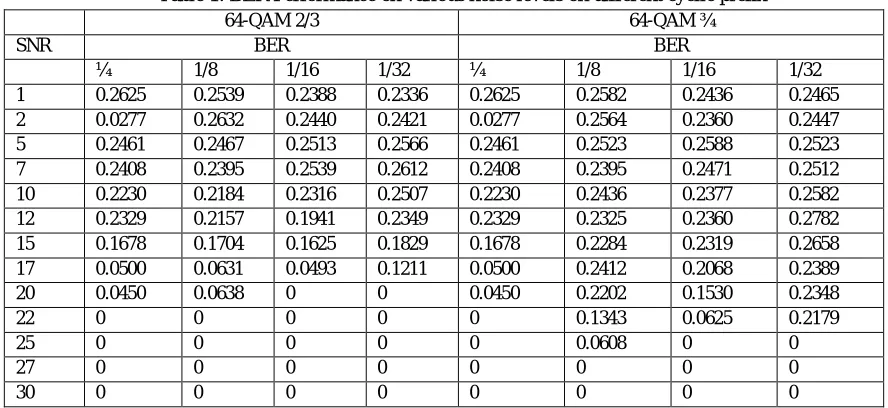
Table 1: BER Performance on various noise levels on different cyclic prefix
64-QAM 2/3 64-QAM ¾
SNR BER BER
¼ 1/8 1/16 1/32 ¼ 1/8 1/16 1/32
1 0.2625 0.2539 0.2388 0.2336 0.2625 0.2582 0.2436 0.2465
2 0.0277 0.2632 0.2440 0.2421 0.0277 0.2564 0.2360 0.2447
5 0.2461 0.2467 0.2513 0.2566 0.2461 0.2523 0.2588 0.2523
7 0.2408 0.2395 0.2539 0.2612 0.2408 0.2395 0.2471 0.2512
10 0.2230 0.2184 0.2316 0.2507 0.2230 0.2436 0.2377 0.2582
12 0.2329 0.2157 0.1941 0.2349 0.2329 0.2325 0.2360 0.2782
15 0.1678 0.1704 0.1625 0.1829 0.1678 0.2284 0.2319 0.2658
17 0.0500 0.0631 0.0493 0.1211 0.0500 0.2412 0.2068 0.2389
20 0.0450 0.0638 0 0 0.0450 0.2202 0.1530 0.2348
22 0 0 0 0 0 0.1343 0.0625 0.2179
25 0 0 0 0 0 0.0608 0 0
27 0 0 0 0 0 0 0 0
Technology (IJRASET)
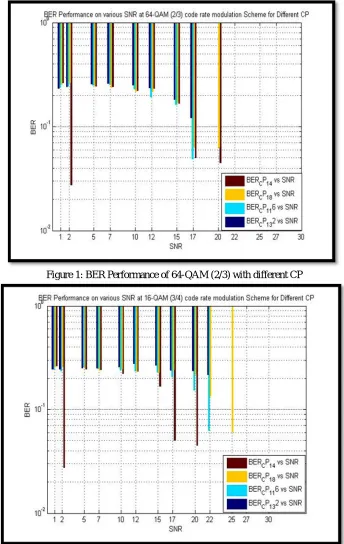
II. RESULT DISCUSSIONIn this module we can see that when the SNR is high then we get the perfect communication, on the other hand we can see that the BER is also depending on the FEC scheme when the error correcting coding is more efficient then the BER is minimum.
[image:4.612.132.476.157.701.2]The result shows that the higher rate (when more bits are sending on same time of interval) is only possible when the channel condition is good as we are saying in AMC. So it is clear that there is a tradeoff between the throughput and BER on the constant SNR.
Figure 1: BER Performance of 64-QAM (2/3) with different CP
Technology (IJRASET)
Figure 3: 64-QAM result in term of Signal Strength and constellation diagram
III. CONCLUSION AND FUTURE WORK
In this work we have prepared a simulation model of the physical layer of IEEE 802.16e. The performance is measure for different modulation technique with different coding rate in terms of BER. We know that fading is one of the main aspects of wireless communication. At the starting of our simulation, we used AWGN channel and got same results using Rayleigh fading and AWGN. After obtaining the result it was found that with the same channel condition the lower modulation technique gives the lower BER and lower transmission efficiency where higher modulation technique like 64-QAM give higher BER with better transmission efficiency. This model is very useful for analysis the effect of different modulation technique, and also this model helps to optimize the overall system.. In future we try to include MIMO and Higher modulation technique (like 64-qam and 128-qam) in the system and also trying to introduce the MAC layer functionality to provide the QoS for the classified traffic.
REFERENCES
[1] Ghosh, A.; Wolter, D.R.; Andrews, J.G.; Chen, R., “Broadband wireless access with WiMax/802.16: current performance benchmarks and future potential”, Communications Magazine, IEEE, Vol.43, Iss.2, Feb. 2005, PP: 129-136
[2] “IEEE Standard 802.16 for Global Broadband Wireless Access,” http://ieee802.org/16/docs/03/C8021603_14.pdf” last accessed 15.05.07
[3] IEEE Std 802.162001,”IEEE Std. 802.162001 IEEE Standard for Local and Metropolitan area networks Part 16: Air Interface for Fixed Broadband Wireless Access Systems”, December 2001
[4] IEEE Std 802.16e2005 and IEEE Std 802.162004/Cor 12005 (Amendment and Corrigendum to IEEE Std 802.162004), ”IEEE Standard for Local and metropolitan area networks Part 16: Air Interface for Fixed and Mobile Broadband Wireless Access Systems Amendment 2: Physical and Medium Access Control Layers for Combined Fixed and Mobile Operation in Licensed Bands and Corrigendum 1”, February 2006
[5] IEEE Std 802.16a2003(Amendment to IEEE Std 802.162001), “IEEE Standard for Local and metropolitan area networks Part 16: Air Interface for Fixed Broadband Wireless Access Systems Amendment 2: Medium Access Control Modifications and Additional Physical Layer Specifications for 211 GHz”, January 2003
[6] WiMAX Forum, “Mobile WiMAX – Part 1: A Technical Overview and Performance Evaluation”, August 2006. [7] Johnston D., Walker J., “Overview of IEEE 802.16 Security”, IEEE Computer Society, 2004.
[8] IEEE 802.16e-2005, “IEEE Standard for Local and Metropolitan Area Networks, part 16, Air Interface or Fixed and Mobile Broadband Wireless Access Systems”, IEEE Press, 2006.
[9] http://www.wimaxforum.org