Technology (IJRASET)
©IJRASET: All Rights are Reserved
548
Genetic Algorithm Based Optimization of Design
Variable for Minimization of Non-Dimensionalized
Maximum Deflection of a Laminated Composite
Plate
Gaurav Kumar Goyal1, Leeladhar Rajput2
1
M. Tech. Scholar, Department of Mechanical Engineering, IT GGV, Bilaspur, (C.G) 495009, India 2
Assistant Professor, Department of Industrial and Production Engineering, IT GGV, Bilaspur, (C.G) 495009, India
Abstract— This research paper deals with the static analysis of a thin rectangular laminated composite plate. The main objective of the proposed work is to minimize the non-dimensionalized maximum deflection of the laminated composite plate by optimization of fiber-orientation of individual lamina. A Finite Element Model of the laminated composite plate has been developed considering First Order Shear Deformation Theory (FSDT). Genetic Algorithm (GA) has been utilized for the purpose of optimization. Simply supported boundary condition for the system has been considered for analysis. The results obtained through different cross-over and mutation probabilities have been compared and the optimized laminate configuration has been found out.
Keywords— Optimization, Genetic algorithm, FEM, FSDT, Composite material.
I. INTRODUCTION
When two or more materials are combined together with the purpose of attaining certain desirable properties that cannot be achieved with any of the constituents alone, then such a material is called as a Composite Material. For example, high strength and high modulus fibers are possessed by Fiber-reinforced composite material. An example of fiber-reinforced composites is reinforced steel bars embedded in concrete. In such composites, fibers are the major load-carrying members whereas the matrix material binds the fibers together thereby providing a load-transfer medium between fibers and protecting fibers from environmental degrading agents like heat, moisture, humidity, etc. Since the length to diameter ratio of fibers is very high, composites can be very strong and stiff, yielding high strength‑to‑weight and stiffness‑to‑weight ratios which are very large as compare to conventional material like steel or aluminium. Such a composition also leads to an increased fatigue properties compared to common engineering metals. In context of part designing, a plate shaped geometry is widely adopted in various engineering applications. When a body is bounded by surfaces, flat in geometry, whose lateral dimensions are large compared to the separation between the surfaces, then the concerned body is called as a Plate. Analyses of composite plates in the past have been based on many approaches where the first order shear deformation theory has been widely used in previous researches. In the first-order shear deformation laminated plate theory (FSDT), the transverse normal does not remain perpendicular to the mid-surface after deformation which results in consideration of transverse shear strains during deformation. Optimization of design variables of composite plate for achieving desired engineering behaviour has an also been an area of interest as seen in past literature. Of all available optimization technique, genetic algorithm has found numerous applications in design engineering. GA’s are search based optimization methods based on the mechanics of natural selection and natural genetics. They combine survival of the fittest string structures using a structured yet randomized information exchange method to form a search algorithm. This algorithm is used to find approximate solutions to optimization and search problems on the basis of a local search technique. Genetic algorithms are a particular class of evolutionary algorithms that use techniques inspired by evolutionary biology such as inheritance, mutation, selection, and crossover.
II. FINITEELEMENTFORMULATION
Technology (IJRASET)
©IJRASET: All Rights are Reserved
549
displacement function is to be selected with only 8 constant. Thus,
[image:3.612.203.381.282.479.2]( , ) = + + + + + + +
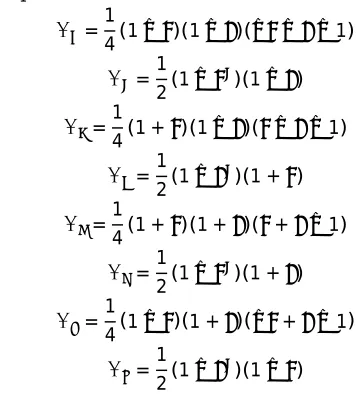
Fig 1: Eight-noded serendipity element with natural coordinates The eight-noded isoparametric element shape function will be:
=1
4(1− )(1− )(− − −1)
=1
2(1− )(1− )
=1
4(1 + )(1− )( − −1)
=1
2(1− )(1 + )
=1
4(1 + )(1 + )( + −1)
=1
2(1− )(1 + )
=1
4(1− )(1 + )(− + −1)
=1
2(1− )(1− )
To establish the transformation of derivatives from local to global system the Jacobian matrix is needed, which is given by:
[J]=
The relationship between strain at any point in the element with nodal displacement is established by following equation:
{ } = [ ] { }
Maximum deflection is found in the center of plate. Maximum deflection is dimensionalized by using following a non-dimensionalization factor. The non- dimensionalized maximum deflection is:
= (
2,2) ×
100 ℎ
Where,
Technology (IJRASET)
©IJRASET: All Rights are Reserved
550
III. OPTIMIZATIONFORMULATION
Present problem is to minimize the non-dimensionalized maximum deflection ( ) for the optimum combination of ply-angles ( , , ) of the square laminated plate having three layers. Hence the problem can be mathematically written as:
= min{ ( )}, θ ⊂ ( = 1,2,3 )
Subject to following constraint:
−90∘≤ ≤ 90∘
IV. NUMERICALRESULTS
[image:4.612.66.552.283.340.2]The comparison of non-dimensionalized maximum deflection of simply supported three layer cross-ply (0/90/0) square plates subjected to sinusoidal loading with different thickness ratio (a/h) for the present and aforementioned analysis [2] is shown in Table1.
Table I: Comparison between Non-Dimensionalized Maximum Deflection of Present Analysis and Reference for SSSS Boundary Condition
a/h Reference [2] Present analysis
10 0.6692 0.6675
20 0.4921 0.4921
100 0.4336 0.4334
The boundary condition considered is SSSS i.e. all sides of the square plate are simply supported. In this case, optimization of square plate results in minimization of the non-dimensionalized maximum deflection. Set of fiber angle values for the optimized three layered laminated square plate is (44.97/-44.97/44.97). This set of fiber angles yields a value of maximum deflection which is reduced by 23.28% compared to standard cross ply (0/90/0) pattern of laminated square composite plate. A separate optimization using different initial population also results in same set of fiber angles.
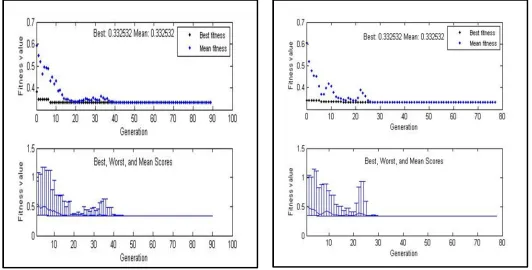
Fig 2: Convergence diagram for Fitness value (Non-Dimensionalized Max Deflection) for SSSS Boundary Condition (Population size 75, Crossover probability 0.7)
[image:4.612.38.570.419.689.2]Technology (IJRASET)
©IJRASET: All Rights are Reserved
551
Fig 4: Convergence diagram for Fitness value (Non-Dimensionalized Max Deflection) for SSSS Boundary Condition (Population size 75, Crossover probability 0.8)
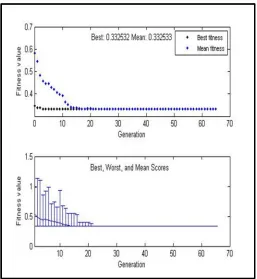
Fig 5: Convergence diagram for Fitness value (Non-Dimensionalized Max Deflection) for SSSS Boundary Condition (Population size 125, Crossover probability 0.7)
Fig 6: Convergence diagram for Fitness value (Non-Dimensionalized Max Deflection) for SSSS Boundary Condition (Population size 125, Crossover probability 0.75)
[image:5.612.231.555.77.368.2] [image:5.612.40.297.419.698.2] [image:5.612.310.568.420.699.2]Technology (IJRASET)
©IJRASET: All Rights are Reserved
552
Figures 2-7 show the generation wise variation of maximum deflection wherein the best and mean fitness values have been depicted in the upper sub-plot and best, worst and mean scores in lower sub-plot subjected to a SSSS Boundary Condition with different population sizes and crossover probabilities. Considered a/h ratio is 100.
Table 2 shows the comparison between optimized and non-optimized Maximum Deflection (Non-Dimensionalized) values for three different a/h ratio which is 20, 50 and 100 in case of SSSS boundary condition. It can be seen that before optimization Non-Dimensionalized Maximum Deflection decreases as value of a/h ratio increases. After optimization process for all value of a/h ratio the optimized angle is same which is (44.97/-44.97/44.97). Percentage reduction shows the amount of reduction in maximum deflection obtained by optimization process compared to standard cross ply (0/90/0) pattern of laminated square composite plate without optimization. Also percentage reduction increases with an increase in the a/h ratio.
Table II: Comparison between optimized and non-optimized Maximum Deflection values for different (a/h) ratio in case of SSSS boundary condition
Processing Criteria Angle
Maximum Deflection
a/h = 20 a/h = 50 a/h = 100
Without
Optimization (0/90/0) 0.4921 0.4413 0.4334
With Optimization (44.97/-44.97/44.97) 0.4108 0.3576 0.3325
% Reduction ̶ 16.52 % 18.96 % 23.28
V. CONCLUSION
An optimized square laminate configuration in context of ply-angle having minimized non-dimensionalized maximum deflection was obtained via utilization of genetic algorithm. The FEM model was fabricated in MATLAB and optimization was also done using the same. Following conclusions may be drawn from the present work. An FEM model of a square laminated composite plate was designed and verified with the analysis conducted by [2] for a simply supported boundary condition. The obtained results were in good agreement with showing a variation of 0.04 % only, for a/h ratio equal to 100. The FEM model was then optimized using Genetic Algorithm with the aim to minimize the non-dimensionalized maximum deflection considering ply-angle as a design variable for each boundary condition. It was found that the optimization of design variable of laminated square plate yielded a percentage reduction in non-dimensionalized maximum deflection equal to 23.28 % compared to non-optimized standard cross-ply laminated pattern for an SSSS boundary condition with a/h ratio considered as 100. An increase in a/h ratio resulted in decreased non-dimensionalized maximum deflection values. The percentage reduction in non-dimensionalized maximum deflection values for optimized laminated square plate compared to non-optimized/standard cross-ply laminated pattern increased with increase in the value of a/h ratio.
REFERENCES
[1] Autar K. Kaw, Mechanics of Composite Material, 2nd ed., Taylor & Francis Group, LLC, 2006.
[2] J. N. Reddy, Mechanics of Laminated Composite Plates and Shells Theory and Analysis, 2nd ed., CRC Press LLC, 2004. [3] Robert M. Jones, Mechanics of Composite Material, 2nd ed., Taylor & Francis Group, 1999.
[4] Randy L. Haupt and Sue Ellen Haupt, Practical Genetic Algorithms, 2nd ed., John Wiley & Sons, Inc., 2004. [5] S.S. Bhavikatti, Finite Element Analysis, New Age International (P) Ltd, 2005.
[6] Maloy K. Singha, L. S. Ramachandra and J. N. Bandyopadhyay “Optimum Design of Laminated Composite Plates for Maximum Thermal Buckling Loads,” Journal of COMPOSITE MATERIALS, Vol. 34, No. 23, pp. 1982–1997, 2000.
[7] Y.X. Zhang, and C.H. Yang, “Recent developments in finite element analysis for laminated composite plates”, Composite Structures 88, Elsevier Ltd., pp. 147-157, 2009.
[8] Maenghyo Cho and Jun-Sik Kim, “Four-Noded Finite Element Post-Process Method using a Displacement Field of Higher-Order Laminated Composite Plate Theory”, Computers & Structures, Vol. 61, No. 2, pp. 283-290, 1996.
[9] A. Ghorbanpour Arani, Sh. Maghamikia, M. Mohammadimehr and A. Arefmanesh, “Buckling analysis of laminated composite rectangular plates reinforced by SWCNTs using analytical and finite element methods”, Journal of Mechanical Science and Technology, Vol. 25 (3), pp. 809-820, 2011.
[10] U. Topal and U. Uzman, “Thermal buckling load optimization of laminated composite plates”, Thin-Walled Structures, Vol. 46, pp. 667–675, 2008.
[11] G. B. Chai, K. T. Ooi and P. W. Khong, “Buckling Strength Optimization of Laminates Composite Plates”, Computers & Structures, Vol. 46(1), pp. 77-82, 1993.
Technology (IJRASET)
©IJRASET: All Rights are Reserved
553
COMPOSITE MATERIALS, Vol. 23, pp. 348-369, 1989.
[13] Rodolphe Le Riche and Raphael T. Haftka, “Optimization of Laminate Stacking Sequence for Buckling Load Maximization by Genetic Algorithm”, AIAA JOURNAL, Vol. 31 (5), pp. 951-956, 1993.
[14] Rahul Malhotra, Narinder Singh and Yaduvir Singh, “Genetic Algorithms: Concepts, Design for Optimization of Process Controllers”, Computer and Information Science, Vol. 4, pp. 39-54, 2011.