Technology (IJRASET)
©IJRASET: All Rights are Reserved
121
Medical Image Security Using Watermarking In
Back Propagation Neural Network
A.N.S. Anusha1, Dr. Y. Ratna Kumar2 1
PGScholar (Biomedical Engineering), 2Asst.Professor(C), Dept. of Electronics and Communication Engineering, Andhra University College of Engineering (A), Visakhapatnam, Andhrapradesh, India
Abstract: In modern world, medical data became more sensitive where the need of privacy became most prominent. In order to provide the privacy and authentication to the medical data which includes the medical records of a patient digital water marking technique is chosen. The aim of the paper is to authenticate the medical data by digital watermarking technique using neural networks. The host data is processed through 4 level DWT then applied to a back propagation neural network where the secret image is embedded along with different noise attacks. The obtained image is processed through IDWT which is either stored or transmitted. At viewer or receiver side the reverse process is done to extract the secret image from the watermarked image. Compared to existing neural network algorithms back propagation algorithm yields better PSNR values.
Keywords: DWT, IDWT, Digital watermarking ,PSNR, Back Propagation Algorithm.
I. INTRODUCTION
The widespread use of computer technology and the popularity of electronic managing of medical records have made it possible for digital medical images to be shared across the world for services such as telemedicine, teleradiology, telediagnosis, and teleconsultation. These e-Health services are introducing new practices for the profession as well as for the patients by enabling remote access, transmission, and interpretation of the medical images for diagnosis purposes. Instant diagnosis and understanding of a certain disease as well as cutting down the number of misdiagnosis has had extensive social and economic impact, clearly showing the need for efficient patient information sharing between specialists of different hospitals. In the handling of medical images, the main priority is to secure protection for the patient’s documents against any act of tampering by unauthorized persons include include image retention and fraud, privacy, malpractice liability, licensing and credentialing,. Thus, the main concern of the existing electronic medical system is to develop some standard solution to preserve the authenticity and integrity of the content of medical images
II. DIGITAL WATERMARKING
Digital watermarking is the process of embedding information, or a watermark into a digital multimedia object such that the watermark can be detected or extracted later to make an assertion about the object. Watermarking has proven to be a reliable mean to provide copyright protection and authenticity proof for digital media.
The watermarking system consists of two processes a) Embedding
b) Extracting
The process of inserting the watermark data into host data is called embedding. A secret key is used which is helpful in ensuring more security. The process of retrieving the watermark data from the watermarked data is called detection or extraction
III. DISCRETE WAVELET TRANSFORM
The Wavelet Series is just a sampled version of CWT and its computation may consume significant amount of time and resources, depending on the resolution required. The Discrete Wavelet Transform (DWT), which is based on sub-band coding, is found to yield a fast computation of Wavelet Transform. It is easy to implement and reduces the computation time and resources required. If the signal, scaling functions, and wavelets are discrete in time, then the wavelet series of the discrete-time signal is called the DWT. The DWT of a sequence consists of two series expansions, one corresponding to the approximation and the other to the details of the
sequence. The formal definition of DWT of an N-point sequence x [n], 0 ≤ n ≤ N − 1 is given by
{ ( )} = ∅( , ) + ( , )
©IJRASET: All Rights are Reserved
122
∅( , ) =
√ [ ]∅ , [ ]
∅( , ) = 1
√ [ ] , [ ], ≥
The sequence x [n] ,0 ≤ n ≤ N − 1 can be recovered from the DWT coefficients Wφ and Wψ as given by
[ ] = 1
√ [ ]∅ , [ ] +
1
√ [ ] , [ ]
The scale parameter in the second summation of above equation has an infinite number of terms. But in practice the upper limit for the scale parameter is usually fixed at some value say, J. The starting scale value j0 is usually set to zero and corresponds to the original signal. Thus, the DWT coefficients for x [n] ,0 ≤ n ≤N − 1 are computed for j = 0, 1, . . . , J − 1 and k = 0, 1, . . . ,2J− 1.
[image:3.612.210.398.232.589.2]Also, N is typically a power of 2, of the form N = 2J.
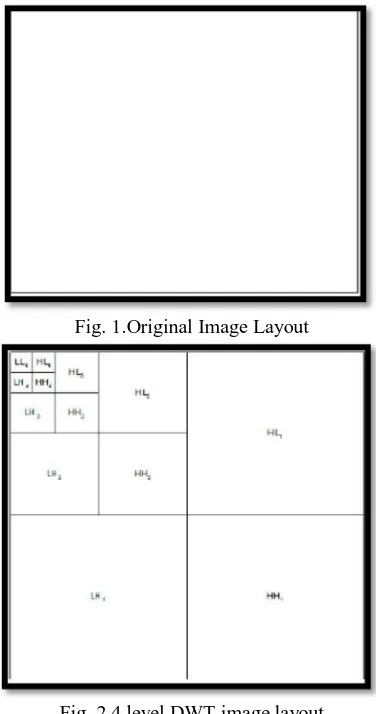
Fig. 1.Original Image Layout
Fig. 2.4 level DWT image layout
IV. NEURAL NETWORK
A Neural Network is a powerful tool that is able to represent complex and highly complicated input/output relationships. The development of neural network technology leads to development of artificial system that can perform complex tasks which are performed by human brains. Neural Networks resembles the human brain in the following ways:
A Neural Network can be equipped with knowledge through learning methods.
Technology (IJRASET)
[image:4.612.214.418.88.195.2]©IJRASET: All Rights are Reserved
123
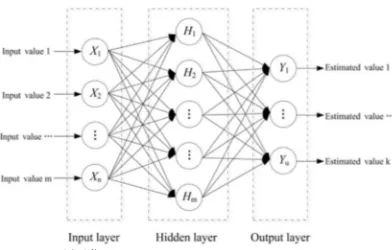
Fig. 3. Basic structure of a neural network
V. BACKPROPAGATION ALGORITHM:
The simple perceptron is just able to handle linearly separable or linearly independent problems. By taking the partial derivative of the error of the network with respect to each weight, we will learn a little about the direction the error of the network is moving. In fact, if we take the negative of this derivative (i.e. the rate change of the error as the value of the weight increases) and then proceed to add it to the weight, the error will decrease until it reaches local minima. This makes sense because if the derivative is positive, this tells us that the error is increasing when the weight is increasing. The obvious thing to do then is to add a negative value to the weight and vice versa if the derivative is negative. Because the taking of these partial derivatives and then applying them to each of the weights takes place, starting from the output layer to hidden layer weights, then the hidden layer to input layer weights (as it turns out, this is necessary since changing these set of weights requires that we know the partial derivatives calculated in the layer downstream), this algorithm has been called the back propagation algorithm. It has been shown that back propagation learning with sufficient hidden layers can approximate any nonlinear function to arbitrary accuracy. This makes back propagation learning neural network a good candidate for signal prediction and system modelling.
Fig. 4. Back Propagation Neural Network
VI. PROPOSED WORK
A. Proposed System for Embedding
Selection of cover image and watermark image of suitable sizes i.e., 512x512 and 32x32. Performing 4-level 2D-DWT on cover image.
Select the beginning location (LL4) to embed the watermark using secret key.
Quantize the DWT coefficient T (j + key) by Q as the input to BPNN.
Embed the watermark using following equation
T′( )= BPNN T( ) + LL4 + x
Wherex is the random watermark sequence
Perform IDWT on each coefficient to get watermarked image.
[image:4.612.207.403.390.515.2]©IJRASET: All Rights are Reserved
124
Apply DWT on watermarked image.
Quantize the DWT coefficient T’’(j) by Q as the input to BPNN then get the output of BPNN as BPNN(T’’(j)/Q).
Extract the watermark using the equation
′ = ′′( )− 4− (T’’(j)/Q)
Calculate the PSNR of the watermarked image.
Measure the NCC value of the extracted watermark ′ and the original watermarkx.
VII. RESULTS
Fig. 6. Host Image Fig 7. Watermark Image
Fig. 8.Watermarked Image Fig. 9.Extracted Image
The results of PSNR and NCC Values obtained after applying vatious noise attacs on the watermarked image are tabulated below.
Attack Applied PSNR (dB) Normalized Cross Correlation
No Attack 54.96 1
Rotation 47.83 0.8530
Median Filtering 46.98 0.7767
Bluring 45.27 0.8754
Resizing 44.37 0.7748
Low Pass Filtering 43.29 0.8005
Salt &Pepper Noise 39.94 0.7490
Row Column Copying 38.34 0.8223
Poisson Noise 37.55 0.6308
Gaussian Noise 37.12 0.6643
Row column blanking 36.50 0.8520
Sharpening 33.77 0.6228
cropping 28.98 0.6726
Technology (IJRASET)
©IJRASET: All Rights are Reserved
125
VIII. CONCLUSION
The Digital Watermarking Technique, as per the proposed algorithm was implemented by using Neural Networks. The PSNR value without applying any attack is found to be 54.96 dB. Correlation without applying any attack is 1.The algorithm is robust to attacks like resizing, blurring, Median Filtering, Salt and pepper noise, Row column copying, Cropping. However, the correlation after application of attacks like Row Column Blanking and Rotation seemed to be relatively less. PSNR and Correlation depends on embedding strength i.e, performance increases with increase in number of layers.
REFERENCES
[1] N.Mohananthini, G. Yamuna, “Watermarking For Images Using Wavelet Domain In Back propagation Neural Network”, 2012. [2] Kaur1, Supreet Singh2, “Analysis of Digital Watermarking using full CounterPropagation Neural Networks and Hopfield Model”, 2013.
[3] Poorvi Saxena and Murlidhar Vishwakarma, “A Digital WatermarkingAlgorithm Based onWavelet Packet Transform and RBF Neural Network”, 2013. [4] Hung-Hsu Tsaia, Yu-Jie Jhuanga and Yen-Shou Lai, “An SVD-Based Image Watermarking In Wavelet Domain Using SVR And PSO”, 2012. [5] Vafaei, and Homayoun Mahdavi-Nasab, “A Novel Digital Watermarking Scheme Using Neural Networks with Tamper Detection Capability”, 2013. [6] Nallagarla Ramamurthy, “Robust Digital Image Watermarking Using Quantization And Back Propagation Neural Network”, 2012.
[7] Nanda yalamali , Mr.Manjunath Asuti, “ An Adaptive image watermarking algorithm based on Neural networks”, 2012. [8] V.santhi, Arun kumar Thangavelu, “Region of Non-Interest Based Digital Image Watermarking Using Neural Networks”, 2011. [9] Samesh oueslati, “Adaptative Image Watermarking Scheme Based On Neural Network”, 2011.
[10] YU Chang-hui, FENG Wan-li, ZHOU Hong, “The Digital Watermarking Technology based on Neural Networks”, 2011.
BIOGRAPHY
A.N.S.Anusha did his B.TECH in Gayatri Vidya Parshiad college of engineering and technology affiliated by JNTU Kakinada. At present iam pursuing my M.TECH in Biomedical Engineering in the Centre for Biomedical Engineering, Dept. Of Electronics and Communication Engineering, AU College of Engineering (A), Visakhapatnam