(
E
,
E
)-1,2-Bis[3-(prop-2-yn-1-yloxy)-benzylidene]hydrazine
Wisam Naji Atiyah Al-Mehana,aRosiyah Yahya,aFaridah Sonsudinband Kong Mun Loa*
aDepartment of Chemistry, University of Malaya, 50603 Kuala Lumpur, Malaysia,
andbCentre for Foundation Studies in Science, University of Malaya, 50603 Kuala
Lumpur, Malaysia
Correspondence e-mail: [email protected]
Received 15 May 2012; accepted 5 June 2012
Key indicators: single-crystal X-ray study;T= 100 K; mean(C–C) = 0.002 A˚; Rfactor = 0.041;wRfactor = 0.122; data-to-parameter ratio = 15.7.
The molecule of the title compound, C20H16N2O2, is
centrosymmetric, the inversion center being located at the mid-point of the central azine bond. The conformation around the C N bond isE. The whole molecule (except for the H atoms) is essentially planar, with an r.m.s. deviation of 0.07 A˚ . In the crystal, molecules are linked head-to-tail by pairs of C— H O hydrogen bonds, forming inversion dimers, and resulting in the formation of chains propagating along [011].
Related literature
For biological properties and practical appplications of diacetylene compounds, see: Zloh et al. (2007); Buckley & Neumeister (1992). For the structure of (E,E )-1,2-bis[3-(prop-2-yn-1-yloxy)benzylindene]hydrazine see: Al-Mehana et al.
(2011).
Crystal data
C20H16N2O2 Mr= 316.35
Triclinic,P1
a= 4.5700 (3) A˚
b= 9.4947 (7) A˚
c= 9.8920 (8) A˚
= 67.986 (7)
= 77.487 (6)
= 84.132 (6)
V= 388.37 (5) A˚3 Z= 1
MoKradiation
= 0.09 mm1 T= 100 K
0.10.080.08 mm
Data collection
Agilent SuperNova Dual (Cu) Atlas diffractometer
Absorption correction: multi-scan (CrysAlis PRO; Agilent, 2012)
Tmin= 0.440,Tmax= 1.000
2956 measured reflections 1710 independent reflections 1508 reflections withI> 2(I)
Rint= 0.027
Refinement
R[F2> 2(F2)] = 0.041 wR(F2) = 0.122 S= 1.02 1710 reflections
109 parameters
H-atom parameters constrained
max= 0.23 e A˚3
min=0.29 e A˚3
Table 1
Hydrogen-bond geometry (A˚ ,).
D—H A D—H H A D A D—H A
C5—H5 O1i
0.93 2.52 3.4467 (16) 177
Symmetry code: (i)x;yþ2;zþ1.
Data collection: CrysAlis PRO(Agilent, 2012); cell refinement: CrysAlis PRO; data reduction: CrysAlis PRO; program(s) used to solve structure: SHELXS97(Sheldrick, 2008); program(s) used to refine structure:SHELXL97(Sheldrick, 2008); molecular graphics: X-SEED (Barbour, 2001); software used to prepare material for publication:pubCIF(Westrip, 2010).
We thank the University of Malaya (FRGS grant No. FP001/2010 A) and the Ministry of Higher Education of Malaysia (grant No. UM.C/HIR/MOHE/SC/12) for supporting this study.
Supplementary data and figures for this paper are available from the IUCr electronic archives (Reference: SU2430).
References
Agilent (2012).CrysAlis PRO. Agilent Technologies, Yarnton, England. Al-Mehana, W. N. A., Yahya, R. & Lo, K. M. (2011).Acta Cryst.E67, o2900. Barbour, L. J. (2001).J. Supramol. Chem.1, 189–191.
Buckley, L. J. & Neumeister, G. C. (1992).J. Smart Mat. Struct.pp. 1–4. Sheldrick, G. M. (2008).Acta Cryst.A64, 112–122.
Westrip, S. P. (2010).J. Appl. Cryst.43, 920–925.
Zloh, M., Bucar, F. & Gibbons, S. (2007).J. Theor. Chem. Acc.117, 247-252.
Structure Reports
Online
supplementary materials
Acta Cryst. (2012). E68, o2087 [doi:10.1107/S1600536812025524]
(
E
,
E
)-1,2-Bis[3-(prop-2-yn-1-yloxy)benzylidene]hydrazine
Wisam Naji Atiyah Al-Mehana, Rosiyah Yahya, Faridah Sonsudin and Kong Mun Lo
Comment
Diacetylene compounds are known to have antitumour and antimicrobial activities (Zloh et al., 2007). In addition to their biological activities, diacetylenes are also used as coating and surface treatment agents and as inner cladding material for
silica fibre-optic cores (Buckley & Neumeister, 1992). A recent study detailed the crystal structure of (E,E )-1,2-Bis[4-(prop-2-yn-1-yloxy)benzylindene]hydrazine (Al-Mehana et al., 2011). Herein we report on the synthesis and crystal structure of the 3-substituted isomer of this diacetylene compound.
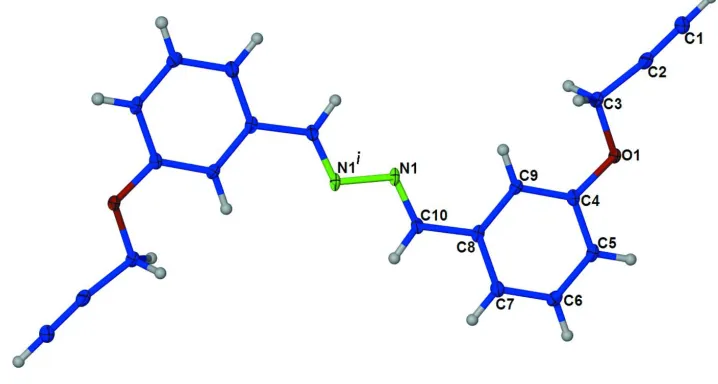
Like the above mentioned compound, the title compound, Fig. 1, is also centrosymmetric around the central azine bond
[N1—N1i = 1.415 (1) Å; Symmetry code: (i) -x+2, -y+1, -z+2], with an E conformation about the N1═C10 bond
[1.2810 (18) Å].
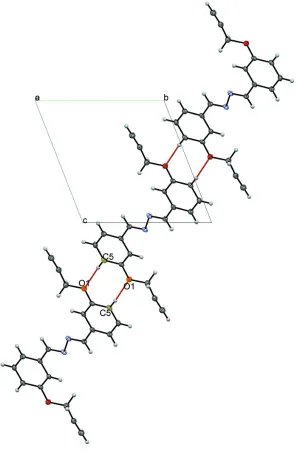
The title compound differs from the 4-substituted isomer (Al-Mehana et al., 2011) as it adopts a different type of C— H···O interaction in its crystal packing. Here, one of the aromatic H atoms is a hydrogen bond donor to the adjacent
phen-oxy O atom resulting in the formation of an infinite polymeric chain propagating along [011] (Table 1 and Fig. 2).
Experimental
3,3′-(E, E)-hydrazine-1,2-diylidene bis(methan-1-yl-1-ylidene)diphenol (L1) was prepared by stirring
3-hydroxy-benzaldehyde (3 g, 24.5 mmol), hydrazine sulfate (1.65 g, 12.6 mmol) and 1.5 ml of concentrated ammonium solution in
a mixture of ethanol and water (20 ml) for 3 h. The product was obtained as a yellow crystalline solid, m.p. 487 - 488 K.
A mixture of the diphenol, L1 (2 g, 8.3 mmol) and anhydrous potassium carbonate (1.84 g, 8.6 mmol) in 20 ml of dry
acetone was stirred for 30 minutes. Then an excess of propargyl bromide (2.28 g, 19.2 mmol) was added drop wise and
the resulting mixture was left under reflux for 48 h. The solvent was then evaporated under reduced pressure. The product
was extracted with 100 ml of diethyl ether. The organic layer was washed with brine and dried with MgSO4. A yellow
amorphous solid was obtained upon slow evaporation of the ethereal solution and was recrystallized with a 1:1 ethyl
acetate-methanol mixture, to yield pure yellow block-like crystals of the title compound [M.p. 401 - 403 K].
Refinement
Hydrogen atoms were included in calculated positions and treated as riding atoms: C–H 0.93 Å (CH) and 0.97 Å (CH2)
with Uiso(H) = 1.2Ueq(C).
Computing details
Figure 1
The molecular structure of the title molecule, with the atom numbering. The displacement ellipsoids are drawn at the
Figure 2
A partial view along the a axis of the crystal packing of the title compound, illustrating the formation of the
intermolecular chain along [011]. The C—H···O interactions are shown as red lines; see Table 1 for details.
(E,E)-1,2-Bis[3-(prop-2-yn-1-yloxy)benzylidene]hydrazine
Crystal data
C20H16N2O2
Mr = 316.35
Triclinic, P1 Hall symbol: -P 1
a = 4.5700 (3) Å
b = 9.4947 (7) Å
c = 9.8920 (8) Å
α = 67.986 (7)°
β = 77.487 (6)°
γ = 84.132 (6)°
V = 388.37 (5) Å3
Z = 1
F(000) = 166
Dx = 1.353 Mg m−3
Melting point = 401–403 K Mo Kα radiation, λ = 0.71073 Å Cell parameters from 1636 reflections
T = 100 K 0.1 × 0.08 × 0.08 mm
Data collection
Agilent SuperNova Dual (Cu at zero) Atlas diffractometer
Radiation source: SuperNova (Mo) X-ray Source
Mirror monochromator
ω scans
Absorption correction: multi-scan (CrysAlis PRO; Agilent, 2012)
Tmin = 0.440, Tmax = 1.000
2956 measured reflections 1710 independent reflections 1508 reflections with I > 2σ(I)
Rint = 0.027
θmax = 27.5°, θmin = 2.3°
h = −5→4
k = −12→12
l = −12→12
Refinement
Refinement on F2
Least-squares matrix: full
R[F2 > 2σ(F2)] = 0.041
wR(F2) = 0.122
S = 1.02 1710 reflections 109 parameters 0 restraints
Primary atom site location: structure-invariant direct methods
Secondary atom site location: difference Fourier map
Hydrogen site location: inferred from neighbouring sites
H-atom parameters constrained
w = 1/[σ2(F
o2) + (0.0756P)2 + 0.0718P]
where P = (Fo2 + 2Fc2)/3
(Δ/σ)max < 0.001
Δρmax = 0.23 e Å−3
Δρmin = −0.29 e Å−3
Special details
Geometry. Bond distances, angles etc. have been calculated using the rounded fractional coordinates. All su's are estimated from the variances of the (full) variance-covariance matrix. The cell esds are taken into account in the estimation of distances, angles and torsion angles
Refinement. Refinement of F2 against ALL reflections. The weighted R-factor wR and goodness of fit S are based on F2,
conventional R-factors R are based on F, with F set to zero for negative F2. The threshold expression of F2 > σ(F2) is used
only for calculating R-factors(gt) etc. and is not relevant to the choice of reflections for refinement. R-factors based on F2
are statistically about twice as large as those based on F, and R- factors based on ALL data will be even larger.
Fractional atomic coordinates and isotropic or equivalent isotropic displacement parameters (Å2)
x y z Uiso*/Ueq
O1 0.26162 (18) 0.81143 (9) 0.53750 (8) 0.0186 (3)
N1 0.9141 (2) 0.53809 (10) 0.94457 (10) 0.0154 (3)
C1 0.1926 (3) 0.64779 (13) 0.28726 (13) 0.0223 (3)
C2 0.2727 (3) 0.67068 (13) 0.38360 (13) 0.0201 (3)
C3 0.3877 (3) 0.68058 (13) 0.50670 (13) 0.0202 (3)
C4 0.3322 (2) 0.82703 (12) 0.65948 (12) 0.0150 (3)
C5 0.1900 (3) 0.94943 (13) 0.69477 (13) 0.0173 (3)
C6 0.2352 (3) 0.97068 (12) 0.81942 (13) 0.0186 (3)
C7 0.4213 (3) 0.87082 (13) 0.90930 (13) 0.0176 (3)
C8 0.5677 (2) 0.75107 (12) 0.87209 (12) 0.0151 (3)
C9 0.5252 (2) 0.72894 (12) 0.74544 (12) 0.0148 (3)
C10 0.7639 (2) 0.65050 (12) 0.96900 (12) 0.0150 (3)
H1 0.13000 0.62990 0.21190 0.0270*
H3B 0.60440 0.68700 0.48080 0.0240*
H5 0.06580 1.01620 0.63490 0.0210*
H6 0.14090 1.05210 0.84350 0.0220*
H7 0.44750 0.88440 0.99420 0.0210*
H9 0.62480 0.64970 0.71920 0.0180*
H10 0.78030 0.66930 1.05280 0.0180*
Atomic displacement parameters (Å2)
U11 U22 U33 U12 U13 U23
O1 0.0223 (5) 0.0187 (4) 0.0173 (4) 0.0091 (3) −0.0109 (3) −0.0080 (3)
N1 0.0141 (5) 0.0152 (5) 0.0162 (5) 0.0017 (4) −0.0086 (4) −0.0022 (4)
C1 0.0254 (6) 0.0225 (6) 0.0209 (6) 0.0061 (5) −0.0105 (5) −0.0083 (5)
C2 0.0206 (6) 0.0183 (6) 0.0204 (6) 0.0069 (4) −0.0071 (4) −0.0061 (5)
C3 0.0218 (6) 0.0209 (6) 0.0208 (6) 0.0085 (5) −0.0101 (5) −0.0098 (5)
C4 0.0146 (5) 0.0156 (5) 0.0135 (5) −0.0005 (4) −0.0045 (4) −0.0027 (4)
C5 0.0166 (6) 0.0146 (5) 0.0184 (6) 0.0037 (4) −0.0076 (4) −0.0021 (4)
C6 0.0205 (6) 0.0132 (5) 0.0225 (6) 0.0049 (4) −0.0069 (5) −0.0069 (4)
C7 0.0194 (6) 0.0170 (5) 0.0184 (5) 0.0014 (4) −0.0082 (4) −0.0065 (4)
C8 0.0126 (5) 0.0136 (5) 0.0175 (5) −0.0001 (4) −0.0050 (4) −0.0028 (4)
C9 0.0142 (5) 0.0128 (5) 0.0166 (5) 0.0026 (4) −0.0044 (4) −0.0044 (4)
C10 0.0150 (5) 0.0152 (5) 0.0160 (5) 0.0000 (4) −0.0067 (4) −0.0050 (4)
Geometric parameters (Å, º)
O1—C3 1.4247 (16) C8—C9 1.4009 (16)
O1—C4 1.3763 (13) C8—C10 1.4649 (15)
N1—C10 1.2808 (15) C1—H1 0.9300
N1—N1i 1.4158 (13) C3—H3A 0.9700
C1—C2 1.1883 (18) C3—H3B 0.9700
C2—C3 1.4632 (18) C5—H5 0.9300
C4—C5 1.3951 (18) C6—H6 0.9300
C4—C9 1.3899 (15) C7—H7 0.9300
C5—C6 1.3817 (17) C9—H9 0.9300
C6—C7 1.3941 (18) C10—H10 0.9300
C7—C8 1.3883 (18)
C3—O1—C4 115.61 (9) O1—C3—H3A 110.00
N1i—N1—C10 111.29 (9) O1—C3—H3B 110.00
C1—C2—C3 173.13 (14) C2—C3—H3A 110.00
O1—C3—C2 109.82 (11) C2—C3—H3B 110.00
O1—C4—C5 115.01 (10) H3A—C3—H3B 108.00
O1—C4—C9 124.05 (11) C4—C5—H5 120.00
C5—C4—C9 120.93 (11) C6—C5—H5 120.00
C4—C5—C6 119.44 (12) C5—C6—H6 120.00
C5—C6—C7 120.38 (12) C7—C6—H6 120.00
C6—C7—C8 120.04 (11) C6—C7—H7 120.00
C7—C8—C9 120.09 (10) C8—C7—H7 120.00
C7—C8—C10 117.97 (10) C4—C9—H9 120.00
N1—C10—C8 123.54 (10) C8—C10—H10 118.00
C2—C1—H1 180.00
C3—O1—C4—C9 3.31 (15) C4—C5—C6—C7 0.0 (2)
C4—O1—C3—C2 174.74 (10) C5—C6—C7—C8 1.4 (2)
C3—O1—C4—C5 −175.53 (10) C6—C7—C8—C10 179.20 (11)
C10—N1—N1i—C10i 179.98 (10) C6—C7—C8—C9 −0.97 (18)
N1i—N1—C10—C8 179.47 (9) C7—C8—C9—C4 −0.85 (16)
O1—C4—C5—C6 177.00 (11) C7—C8—C10—N1 −178.79 (11)
C9—C4—C5—C6 −1.88 (18) C9—C8—C10—N1 1.38 (17)
C5—C4—C9—C8 2.29 (16) C10—C8—C9—C4 178.97 (10)
O1—C4—C9—C8 −176.49 (10)
Symmetry code: (i) −x+2, −y+1, −z+2.
Hydrogen-bond geometry (Å, º)
D—H···A D—H H···A D···A D—H···A
C5—H5···O1ii 0.93 2.52 3.4467 (16) 177