5
III
March 2017
Technology (IJRASET)
©IJRASET: All Rights are Reserved
243
Recognition of American Sign Language
Fingerspelling by Applying Matrix Matching
Algorithm Using Leap Motion Controller
Sensor
Aljhon N. Abila1, Rafael Joseph C. Dichoso2, Reditt John B. Rance3, Jhon Nathaniel M. Umali4, Ralph Anthony C. Yanza5, Roselito E. Tolentino6
12345
Students of Electronics Engineering Department, Polytechnic University of the Philippines, Santa Rosa
6
Professor of Electronics Engineering Department, Polytechnic University of the Philippines, Santa Rosa
Abstract: This paper presents the recognition of American Sign Language Fingerspelling by applying Matrix Matching algorithm using Leap Motion Controller Sensor. The study focused on the recognition of all the static and dynamic letters to increase the recognition rate and avoid misclassification. With proper hand orientation of the user and using the Leap Motion Controller Sensor’s skeletal tracking feature, the researchers were able to acquire the joint coordinates of the distal and proximal phalanges of the human hand. These acquired joint coordinates were then used to create two matrices where matrix multiplication was then applied to generate a unique output matrix. Reduction of row elements as well as the column elements were used by the researchers to derive the Horizontal and Vertical resultant matrices to uniquely represent the letters in American Sign Language Fingerspelling. The letters would then be recognized by the system once the generated resultant matrix matched the reference resultant matrix in the system program. The process of matrix subtraction was executed in the matching process of the algorithm.
Keywords: American Sign Language Fingerspelling, Leap Motion Controller sensor, Matrix Matching Algorithm, Horizontal Resultant Matrix, Vertical Resultant Matrix
I. INTRODUCTION
American Sign Language is the predominant sign language exploited by deaf individuals in the United States and some part of Canada. It is also widely used in many countries around the world including West Africa and parts of Southeast Asia. The Deaf Community utilizes American Sign Language through the use of gestures as a medium in communicating with other people. Fingerspelling, as part of American Sign Language, is a system where each letter of the English alphabet is represented by a unique hand gesture. Fingerspelling is an important part of the language, in which signers spell out a word as a sequence of hand shapes corresponding to individual letters.
Many researches and studies regarding American Sign Language and Hand Gesture recognition have been made and developed [2][3]. The study Hand Gesture Recognition with Leap Motion and Kinect Devices proposed a novel hand gesture recognition scheme explicitly targeted to Leap Motion data. An ad-hoc feature set based on the positions and orientation of the fingertips is computed and fed into a multi-class Support Vector Machine (SVM) classifier in order to recognize the performed gestures. A set of features is also extracted from the depth computed from the Kinect and combined with the Leap Motion in order to improve the recognition performance. There are some of the gestures that frequently fail in the recognition, because these gestures were still critical for the Leap Motion from the combined feature set used in the study [4].
A recent study entitled American Sign Language Recognition Using Leap Motion Sensor uses two algorithms, the k-Nearest Neighbor and Support Vector Machine for the recognition of the letters. But the recognition on some of the signs were still inaccurate, which causes for some of the letters to be misclassified by the system. The experiment result of the study shows that the highest average classification rates of 72.78% and 79.83% were achieved by k-Nearest Neighbor and Support Vector Machine respectively. Due to this inaccuracy rate, some of the letters are being mislabeled. Generally, the misclassification can be explained by the similarity of the hand shapes between the letters [1].
Technology (IJRASET)
unique and distinct data will be generated to solve the misclassification of the letters of American Sign Language Fingerspelling. The whole study focused on the American Sign Language Fingerspelling developing a system that would help the deaf people to communicate with other people. The study also aimed to highlight how the concept of matrices helps in the recognition of letters in American Sign Language and prevent misclassification in the system recognition.
II. METHODOLOGY
As the user provides a fingerspelling hand gesture positioning his hand above the Leap Motion controller sensor within its interaction area, the controller then operates identifying the position of the hand and palm center, orientation of each finger bone, and provides the vector coordinates of the user’s finger joints. After then, through the Leap Motion controller sensor, the system acquires the distal and proximal phalangeal joint coordinates of the human hand that is being tracked. The researchers used the acquired joint coordinates forming two distinct matrices. The process of Matrix Multiplication was then applied between the generated matrices for distal and proximal phalangeal joints generating an output matrix. Through reduction of row elements and reduction of column elements, Horizontal Resultant Matrix and Vertical Resultant Matrix were then formed. The application of
Matrix Matching Algorithm was then used in the recognition of the letters in American Sign Language Fingerspelling. The process of matrix subtraction was executed in the matching process of the algorithm.
A. Determining the Resultant Matrix
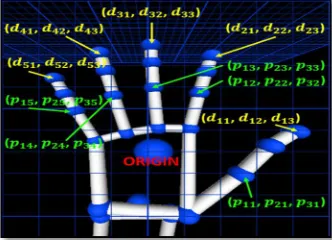
Acquisition of Distal and Proximal Phalangeal Joint Coordinates of the Human Hand: The researchers used the Leap Motion controller sensor’s skeletal tracking feature that focuses on tracking human’s fingers to obtain the 3D skeletal joint coordinates. The researchers integrated the Software Development Kit (SDK) skeletal tracking feature of the sensor with Visual Studio software, and created a C# code to acquire the values of the joint coordinates of the human hand. The palm center of the human hand was being set as the origin.
Fig. 1 Distal and proximal phalangeal joints of the human hand
The researchers selected the five distal and five proximal phalanges to acquire the distal and proximal phalangeal joint coordinates of the human hand with respect to the palm center as the origin. These were selected since these two phalanges generally best represent the handshape of the fingerspelling hand-gesture in order to establish a distinct feature.
1) Forming Matrices and Applying Matrix Multiplication: The researchers used the concept of matrix to represent the distal and proximal joint coordinates. Hence, generating two matrices: a matrix for the distal phalangeal joint coordinates (distal matrix or
Matrix D) and another matrix for the proximal phalangeal joint coordinates (proximal matrix or Matrix P).
[image:3.612.221.387.552.672.2]Technology (IJRASET)
©IJRASET: All Rights are Reserved
245
=
⎣ ⎢ ⎢ ⎢ ⎡
⎦ ⎥ ⎥ ⎥ ⎤
thumb index middle
ring little
(1)
thumb index middle ring little
=
(2)
After the distal and proximal matrices were formed, the researchers then used the concept of matrix multiplication from Advanced Engineering Mathematicsto derive a single matrix that would represent the letter in American Sign Language Fingerspelling. Let the distal and proximal matrix be represented by the expressions = and = respectively.The output matrix then would have the size of a (row of distal Matrix D) by d (column of proximal Matrix P). The process is explained by the equations below, that is:
= (3)
= [ ] [ ] (4) = ,
ℎ , = [ ] (5) Solving for the output matrix O, we have:
=
⎣ ⎢ ⎢ ⎢ ⎡
⎦ ⎥ ⎥ ⎥ ⎤
(6)
Hence, the output matrix then will be a five by five matrix O = [5 x 5] and is considered to be a square matrix. For the simplicity of the analysis, we let the elements of the output matrix be represented defined as:
=
⎣ ⎢ ⎢ ⎢ ⎡
⎦ ⎥ ⎥ ⎥ ⎤
(7)
2) Obtaining Horizontal and Vertical Resultant Matrices: Reduction of row elements is then next. The researchers determined the minimum and maximum element values for each of the five rows in the output matrix. Each minimum element value was then subtracted to the five elements of that specific row to which the minimum element value corresponded.
For instance (case for letter A), we let the minimum element values be represented by the column vector , that is:
=
⎣ ⎢ ⎢ ⎢
⎡
⎦
⎥ ⎥ ⎥ ⎤
(8)
The new resulting matrix R was derived as:
R = O - (9)
=
⎣ ⎢ ⎢ ⎢ ⎡
⎦ ⎥ ⎥ ⎥ ⎤
-
⎣ ⎢ ⎢ ⎢ ⎡
⎦
⎥ ⎥ ⎥ ⎤
(10)
()
Technology (IJRASET)
= ⎣ ⎢ ⎢ ⎢ ⎡ −− − − − ⎦ ⎥ ⎥ ⎥ ⎤ (11)The column vector was then divided from the obtained matrix R, corresponding to the five elements of that specific row to which the maximum element value corresponded. Consequently, all the other numerical matrix elements aside from 0 and 1 were assigned as 2. The resultant matrix (Horizontal matrix)was then derived as follows:
= R / (12)
= ⎣ ⎢ ⎢ ⎢ ⎢ ⎢ ⎢ ⎢ ⎡ ⎦ ⎥ ⎥ ⎥ ⎥ ⎥ ⎥ ⎥ ⎤ (13) = ⎣ ⎢ ⎢ ⎢ ⎡11 22
1 2
2 2 0
2 2 0
2 2 0
0 2
0 2
1 2 2
2 2 1⎦
⎥ ⎥ ⎥ ⎤ (14) Reduction of column elements also constitute the same concept of the algorithm. The process was applied on every column elements vertically. Let the minimum element values be represented by the row vector c, that is:
= [ ] (15)
We then let the maximum element values be represented by the row vector , that is:
= [ − − − − − ] (16)
The resultant matrix (Vertical matrix)was then derived as:
=
⎣ ⎢ ⎢ ⎢ ⎡1 12 2
2 2
1 0 0
2 2 2 2 2 2 2 2
0 0
2 2 2
0 1 1⎦
⎥ ⎥ ⎥ ⎤
(17)
The obtained resultant matrices and were then used to represent a unique letter in American Sign Language Fingerspelling.
In the formed resultant matrices, only the order of zeroes and ones elements within the matrices were significant.
In general, every letter of the American Sign Language Fingerspelling has a unique reference matrix in the system program. In order for the system to recognize a letter, the order of zeroes and ones of the resultant Horizontal Matrix or Vertical Matrix generated from the hand gesture of the user must match the order of zeroes and ones of the reference matrix corresponding to a unique letter in American Sign Language Fingerspelling.
The matching process of the algorithm is done by subtracting the generated resultant matrix and the reference resultant matrix. If the difference of the two matrices is a null matrix , then the generated resultant matrix has matched the expected matrix for that particular letter and therefore, the letter is recognized.
That is, for instance in the recognition of letter A:
− = (18)
Technology (IJRASET)
©IJRASET: All Rights are Reserved
247
⎣⎢ ⎢ ⎢ ⎡1 21 2
1 2
2 2 0 2 2 0 2 2 0 0 2
0 2
1 2 2
2 2 1⎦
⎥ ⎥ ⎥ ⎤ − ⎣ ⎢ ⎢ ⎢ ⎡1 21 2
1 2
2 2 0 2 2 0 2 2 0 0 2
0 2
1 2 2
2 2 1⎦
⎥ ⎥ ⎥ ⎤ = ⎣ ⎢ ⎢ ⎢ ⎡0 00 0
0 0
0 0 0 0 0 0 0 0 0 0 0
0 0
0 0 0
0 0 0⎦
⎥ ⎥ ⎥ ⎤ (20) ⎣ ⎢ ⎢ ⎢ ⎡1 12 2
2 2
1 0 0 2 2 2 2 2 2 2 2
0 0
2 2 2
0 1 1⎦
⎥ ⎥ ⎥ ⎤ − ⎣ ⎢ ⎢ ⎢ ⎡1 12 2
2 2
1 0 0 2 2 2 2 2 2 2 2
0 0
2 2 2
0 1 1⎦
⎥ ⎥ ⎥ ⎤ = ⎣ ⎢ ⎢ ⎢ ⎡0 00 0
0 0
0 0 0 0 0 0 0 0 0 0 0
0 0
0 0 0
0 0 0⎦
⎥ ⎥ ⎥ ⎤
(21)
The researchers had set several conditions in obtaining the resultant Reference Matrix to be used in the recognition of American Sign Language Fingerspelling.
B. Determining the Reliability of the System
To obtain the reliability of the system in recognizing every letter of American Sign Language Fingerspelling, the researchers conducted four (4) sets of trials involving different users that performed fingerspelling on the system, not including the researchers who performed fingerspelling in obtaining the resultant matrix which served as the reference matrix in the recognition of the letters. Each user then performed seventy-six (76) trial observations for every letter in ASL fingerspelling. This number of trial observations was based on the previous study.
During the test, the total number of successful recognitions were recorded along with the total number of trials performed. The formula below was used in order to obtain the percentage of the reliability of recognition:
= .
. 100% (22)
The researchers had also set conditions to be considered whether a certain trial observation is a success or a failure.
III. RESULTSANDDISCUSSION
A. Resultant Matrices
From the acquired joint coordinates, the researchers were able to generate two initial matrices, namely the Distal Matrix and Proximal Matrix. They were formed from the five hand fingers with corresponding 3D vector x, y, and z-coordinates.
TABLEI
DISTAL MATRIX OF LETTERS A AND S
Letters Distal Matrix
A = ⎣ ⎢ ⎢ ⎢
⎡−−53.351919.7553 −−24.924243.3237 −−24.14617.21545
−10.7831 5.373228 19.84522 −47.7051 −46.9761 −37.2877 −5.93026 −7.89806 −7.24823 S = ⎣ ⎢ ⎢
⎡−−18.1394718.6076
−10.4985 1.695625 15.95667 −50.4975 −48.2355 −51.43 −46.1707 −38.7488 −7.65513 4.145813 10.60368 14.45738 9.520821 TABLEII
Technology (IJRASET)
A P
=
−48.7503 −24.7176 −5.57548 15.7088
−16.6092 −17.0044 −16.91 −14.3807
0.550156 −28.678 −30.4112 −26.5306
S P
=
−31.21829 −22.5971 −5.99134 12.96543
−38.88016 −17.5097 −17.6584 −15.9033
[image:7.612.216.395.295.392.2]4.525692 −22.5166 −21.7601 −16.4329
Table 1 and Table 2 shows the Distal Matrix and Proximal Matrix of sample letters A and S respectively. However, for the dynamic
letters J and Z, the researchers obtained multiple sets of distal and proximal matrices. Hence, there is a need to match series of matrices in order to recognize the movement of these letters. With this, there will be multiple distal, proximal, output, and resultant matrices for letters J and Z.
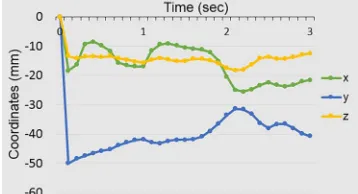
Fig. 3Distal joint coordinates versus time graph of letter S
The joint coordinates acquired were then analyzed by the researchers. Figure 3 shows the graphical interpretation of the values of x, y and z-coordinates of distal joint of the thumb finger while performing the fingerspelling for letter S, as an example, within a thee-second time frame. The graph shows that there are random variations in the values of the joint coordinates showing some instability due to unstable detection of the Leap Motion Controller sensor even though there is no such movement in the actual testing performed by the user.
TABLEIII
OUTPUT MATRIX OF LETTERS A,E,M,N,S, AND T
LETTE
RS OUTPUT MATRIX
A
⎣ ⎢ ⎢ ⎢
⎡3001.603 2435.0111678.674 1431.92 1453.239 160.94171062.177 504.1212
1314.759 1247.797 513.9413
−352.13
892.4862 351.3924
1047.159 673.9736 1004.595
740.3146
969.4934 1040.266
E
⎣ ⎢ ⎢ ⎢
⎡2300.834 893.61191872.467 2773.33 688.2107 298.93132419.484 1492.981
1671.615 2590.782 939.147
290.8077
1988.719 1133.178
2549.185 1935.061 2438.656
1818.473
[image:7.612.189.427.527.692.2]©IJRASET: All Rights are Reserved
249
M ⎣ ⎢ ⎢ ⎢⎡1431.607 963.52951605.81 1228.882 1107.627 1109.396914.6431 453.571
1625.037 952.2344 1401.151 999.854 581.6136 127.8547 771.9872 469.5157 673.9973 468.0085 673.9678 759.2613 LETTE
RS OUTPUT MATRIX
N
⎣ ⎢ ⎢ ⎢
⎡1423.809 1436.5881750.08 2299.331 1597.358 1300.9711852.114 957.2366
1794.079 1939.097 1737.309 1351.339 233.6392 −33.2986 1750.752 1169.637 261.2104 283.1684 732.9089 875.7805 S ⎣ ⎢ ⎢ ⎢
⎡2494.988 1466.4622475.063 1171.717 1166.961 693.6876873.0325 457.7209
2375.342 899.0013 1807.617 1051.507 444.5875 103.5298 740.3348 507.5414 490.5463 381.4655 518.6743 666.6648 T ⎣ ⎢ ⎢ ⎢
⎡1439.094 1496.1921650.204 1178.284 1200.479 714.7112908.3671 517.6244
1513.539 840.076 1085.179 612.6772 373.4453 126.059 697.7738 480.8385 426.7036 347.7241 455.4523 553.1268 TABLEIV
HORIZONTAL AND VERTICAL MATRIX OF LETTERS A,E,M,N,S, AND T
RESULTANT MATRIX Finger- spelling Letters Leap Motion SDK Visualizer Horizontal Matrix Vertical Matrix ⎣ ⎢ ⎢ ⎢
⎡1 2 2 22 1 2 2
2 1 2 2 0 2 2 2
0 2 2 2 ⎣
⎢ ⎢ ⎢
⎡1 1 1 02 2 2 2
2 2 2 2 2 2 2 2 0 0 0 1
⎣ ⎢ ⎢ ⎢
⎡1 2 2 22 1 2 2
0 2 1 2 0 2 2 1
0 2 2 2 ⎣
⎢ ⎢ ⎢
⎡1 0 0 02 1 2 2
2 2 1 2 2 2 2 1 0 2 2 2
⎣ ⎢ ⎢ ⎢
⎡1 0 2 21 2 2 2
1 2 2 2 1 0 2 2
2 0 2 2 ⎣
⎢ ⎢ ⎢
⎡2 2 2 12 1 2 0
Technology (IJRASET)
Table 3 shows the obtained output matrix for the letters A, E, M, N, S, and T. It is the initial matrix used to represent the letters in American Sign Language Fingerspelling.
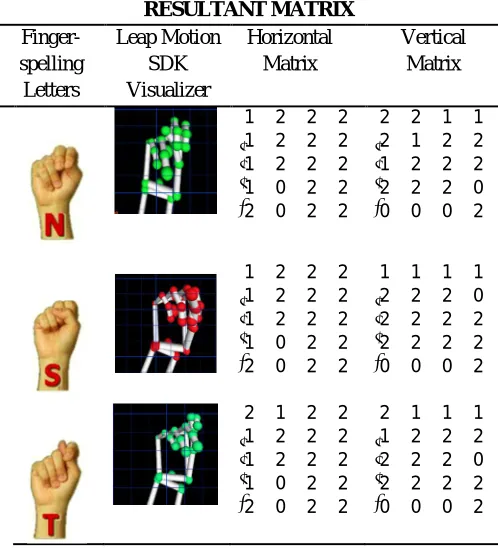
The fingerspelling of the letters A, E, M, N, S, and T share a common hand feature. They were grouped since all these letters have their index finger, middle finger, ring finger, and little finger closed but with their closed thumb placed in different places. As shown in Table 4, the obtained Horizontal and Vertical Matrix of these letters are distinct and unique compared to other letter matrices. These matrix pattern are then used for the recognition of the letters to increase the recognition rate and avoid misclassification.
[image:9.612.201.412.511.632.2]As such, the letters M and N have distinct element values on first row in the Horizontal matrix, and distinct element values on first, third and fourth columns in Vertical matrix. Analyzing the resultant matrices of the letters S and T, they have distinct element values on first row in the Horizontal matrix, and distinct element values on first and fourth columns in Vertical matrix.
Fig. 4 Recognition of letter A
Table 5 shows the differences between the reference matrices of the letters A, E, M, N, S, and T and the generated resultant matrix of letter A. And based on the algorithm, letter A will then be recognized by the system since the resulted difference between the matrices is a null matrix. The recognized letter A is shown in Figure 4.
The obtained resultant matrices for the 26 letters of American Sign Language Fingerspelling are unique and distinct, and hence used
RESULTANT MATRIX
Finger- spelling Letters
Leap Motion SDK Visualizer
Horizontal Matrix
Vertical Matrix
⎣ ⎢ ⎢ ⎢
⎡1 2 2 21 2 2 2
1 2 2 2 1 0 2 2
2 0 2 2 ⎣
⎢ ⎢ ⎢
⎡2 2 1 12 1 2 2
1 2 2 2 2 2 2 0 0 0 0 2
⎣ ⎢ ⎢ ⎢
⎡1 2 2 21 2 2 2
1 2 2 2 1 0 2 2
2 0 2 2 ⎣
⎢ ⎢ ⎢
⎡1 1 1 12 2 2 0
2 2 2 2 2 2 2 2 0 0 0 2
⎣ ⎢ ⎢ ⎢
⎡2 1 2 21 2 2 2
1 2 2 2 1 0 2 2
2 0 2 2 ⎣
⎢ ⎢ ⎢
⎡2 1 1 11 2 2 2
Technology (IJRASET)
©IJRASET: All Rights are Reserved
251
TABLEV
DIFFERENCE BETWEEN THE REFERENCE RESULTANT MATRIX OF LETTERS A,E,M,N,S,AND TAND THE GENERATED RESULTANT
MATRIX OF LETTER A
Letter Generated Horizontal Resultant Matrix Reference Horizontal Resultant Matrix Difference A ⎣ ⎢ ⎢ ⎢
⎡1 2 2 22 1 2 2
2 1 2 2 0 2 2 2 0 2 2 2
R
⎣ ⎢ ⎢ ⎢
⎡1 2 2 22 1 2 2
2 1 2 2 0 2 2 2
0 2 2 2 ⎣
⎢ ⎢ ⎢
⎡0 0 0 0 00 0 0 0 0
0 0 0 0 0 0 0 0 0 0
0 0 0 0 0⎦
⎥ ⎥ ⎥ ⎤ R ⎣ ⎢ ⎢ ⎢
⎡1 2 2 22 1 2 2
0 2 1 2 0 2 2 1
0 2 2 2 ⎣
⎢ ⎢ ⎢
⎡ 00 00 00 00
−2 1 −1 0
0 0 0 −1
0 0 0 0
R
⎣ ⎢ ⎢ ⎢
⎡1 0 2 21 2 2 2
1 2 2 2 1 0 2 2
2 0 2 2 ⎣
⎢ ⎢ ⎢
⎡−01 −12 0 00 0
−1 1 0 0
1 −2 0 0
2 −2 0 0
R
⎣ ⎢ ⎢ ⎢
⎡1 2 2 21 2 2 2
1 2 2 2 1 0 2 2
2 0 2 2 ⎣
⎢ ⎢ ⎢
⎡−01 01 0 00 0
−1 1 0 0
1 −2 0 0
2 −2 0 0
R
⎣ ⎢ ⎢ ⎢
⎡1 2 2 21 2 2 2
1 2 2 2 1 0 2 2
2 0 2 2 ⎣
⎢ ⎢ ⎢
⎡−01 01 0 00 0
−1 1 0 0
1 −2 0 0
2 −2 0 0
R
⎣ ⎢ ⎢ ⎢
⎡2 1 2 21 2 2 2
1 2 2 2 1 0 2 2
2 0 2 2 ⎣
⎢ ⎢ ⎢
⎡−11 −11 0 00 0
−1 1 0 0
1 −2 0 0
2 −2 0 0
B. Reliability of the System
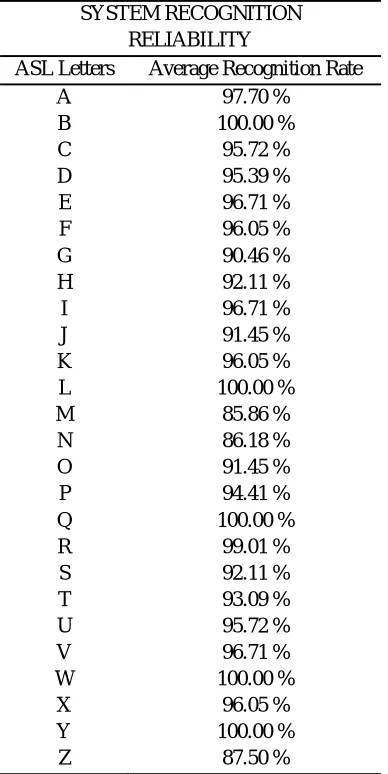
The system recognition reliability was shown in Table 6 indicating the average recognition rate for every letter in American Sign Language Fingerspelling obtained from the test recognition result performed by the four users. It can be noted that the letters B, L, Q, W, and Y obtained the highest average recognition rate which is perfectly 100.00 %. This is generally because of the uniqueness of the letters’ static hand gesture compared to other letters. Specifically the letters’ static hand gesture are fingerspelled open and wide, and formed with the fingers involved separate from each other. Hence generating a more unique and distinct resultant matrix pattern compared to other letters.
Technology (IJRASET)
TABLEVI
AVERAGE RECOGNITION RATE FOR EVERY LETTER IN ASLFINGERSPELLING
Table 7 shows the average recognition rate of every user in the test recognition they had performed. It can be seen that the highest average recognition rate is 96.0526 % performed by User 1. Generally, the overall system reliability is 94.8634 % based on the result.
TABLEVII
SYSTEM RECOGNITION RELIABILITY SHOWING THE AVERAGE RECOGNITION RATE FOR EVERY USER
SYSTEM RECOGNITION RELIABILITY
ASL Letters Average Recognition Rate
A 97.70 %
B 100.00 %
C 95.72 %
D 95.39 %
E 96.71 %
F 96.05 %
G 90.46 %
H 92.11 %
I 96.71 %
J 91.45 %
K 96.05 %
L 100.00 %
M 85.86 %
N 86.18 %
O 91.45 %
P 94.41 %
Q 100.00 %
R 99.01 %
S 92.11 %
T 93.09 %
U 95.72 %
V 96.71 %
W 100.00 %
X 96.05 %
Y 100.00 %
Z 87.50 %
SYSTEM RECOGNITION RELIABILITY
USER Average Recognition Rate
1 96.0526 %
2 94.8381 %
3 93.9777 %
4 94.5850 %
[image:11.612.211.405.109.496.2]Technology (IJRASET)
©IJRASET: All Rights are Reserved
253
IV. CONCLUSIONSBased from the data gathered, the formed output matrices for the letters of American Sign Language Fingerspelling are distinct. However, there are some letters having their output matrix elements close to other letters’ matrix elements. Also, during the joint coordinate acquisition, some discrepancies such as improper positioning and unnecessary motions of the fingers between the actual appearance of user’s hand gesture while performing Fingerspelling and its graphical representation in Leap Motion Sensor visualizer can be observed. This problem causes unstable reading and unwanted variations in the values of the joint coordinates needed to form the necessary resultant matrices which could result to misclassification.
Most of the letters were recognized by the system resulting to a desirable overall reliability. However, undesirable results had been observed for letters M and N having the lowest recognition rates. This problem is mainly due to the failure of Leap Motion Controller sensor to properly detect joints of overlapping fingers of closed hands and/or actual positioning of the fingers while performing fingerspelling for these letters. On the other hand, the average recognition rates for letters having dynamic hand gestures J and Z are quite lower than average recognition rates of most of the letters having static hand gestures. Since the system is designed to generate and match multiple resultant matrices to recognize hand movements while performing fingerspelling for letters J and Z, any improper and/or unintentional movement of the fingers and the hand itself causes mismatch between the generated resultant matrices and reference resultant matrices. Notwithstanding these problems, the data gathered show that the overall reliability of the system is satisfactory and therefore, the use of Matrix Matching Algorithm is effective in recognizing the letters in American Sign Language Fingerspelling.
V. ACKNOWLEDGMENT
The authors would like to thank Engr. Marie Grace P. Tolentino, Engr. Teresita B. Gonzales, and Engr. Katrina B. Acapulco for their valuable suggestions that were of immense help in the development of the system prototype in this research.
REFERENCES
[1] C. Chuan, C. Guardino, and E. Regina, “American Sign Language Recognition Using Leap Motion Sensor,” 13th IEEE International Conference on Machine Learning and Applications, 2014
[2] K. Fok et. al., “A Real-Time ASL Recognition System Using Leap Motion Sensors,” International Conference on Cyber-Enabled Distributed Computing and Knowledge Discovery, 2015
[3] S. Bhowmick, A. Kumar, and S. Kumar, “Hand Gesture Recognition of English Alphabets using Artificial Neural Network,” IEEE 2nd International Conference on Recent Trends in Information Systems (ReTIS), 2015