Technology (IJRASET)
An Improved Data Transmission Protocol for
VANETS Using Link State Information
K.Venkatesh1, J. Mohamed Yousuff2, J.Jayavel3 1,2
Department of Information Technology, Anna university Regional centre-Coimbatore, 3
Teaching Assistant, Anna University Regional Centre-Coimbatore
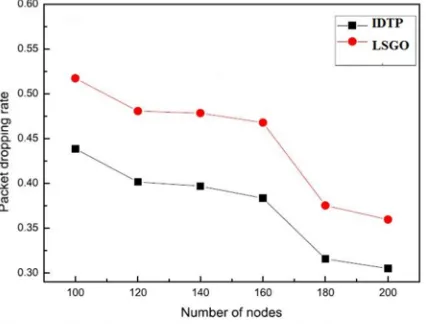
Abstract: Efficient data delivery in vehicular ad hoc networks (VANETs) with high mobility is a challenging issue due to dynamic topology changes and unstable wireless links. The opportunistic routing protocols can improve the reliability of routing by making full use of the broadcast characteristics and assist in data transmission through additional backup links. In this paper, to improve the Data Transmission Protocol for Link State Information which exploits a combination of geographic location and the link state information as the routing metric? The IDTP aims to improve the reliability of data transmission in a highly dynamic environment, which selects the forwarders and prioritizes them based on the vehicle’s geographic location and the link’s quality. By performance of LSGO with GpsrJ + which removes the unnecessary stop at a junction and greedy traffic aware routing protocol (GyTAR) using OMNET++. The simulation results show that it opens more nodes to participate in the opportunistic data forwarding and increases a connection’s throughput while using no more network capacity than traditional routing. In the simulation, compared with other two protocols, when the number of vehicles and the average vehicle velocity increase, IDTP’s packet dropping rate is reduced and the network throughput is improved
Keywords: Global positioning system, Data transmission, Node Selection Mechanism
I. INTRODUCTION
Technology (IJRASET)
The objective of the project involves,
A. Location based advertisements emphasizes reliability in order to achieve higher coverage of vehicles, while warning delivery which broadcast emergent information to approaching vehicles.
B. To enable the best nodes to transmit the packet without waiting.
C. To provide a forwarders according to Receiver Consensus.
D. To enable the best nodes to transmit the packet without waiting.
II. LITERATURE SURVEY
The authors (1) is proposed for Robust and efficient data delivery in vehicular ad hoc networks (VANETs) with high mobility is a challenging issue due to dynamic topology changes and unstable wireless links. The opportunistic routing protocols can improve the reliability of routing by making full use of the broadcast characteristics and assist in data transmission through additional backup links. In this paper, we propose a Link State aware Geographic Opportunistic routing protocol (LSGO) which exploits a combination of geographic location and the link state information as the routing metric.
In this paper (2) proposed VANET, vehicles move non-randomly along roads and exchange information with other vehicles and roadside infrastructure within their radio range. A VANET has unique characteristics including the high and frequently changing velocities of vehicles. From the characteristics, VANETs are influenced by frequent network topology changes according to the density of neighboring vehicles. Therefore, a VANET should accommodate these frequent changes to vehicle mobility, vehicle density, and network topology. From these characteristics, link breakages occur repeatedly and the packet loss rate increases. Greedy forwarding is one of the most suitable solutions for routing in VANETs because it maintains only the local information of neighbors instead of per-destination routing entries. Greedy routing algorithms require that information about the physical position of the participating nodes be available. This position is made available to the direct neighbors via periodic transmissions from beacons.
Opportunistic routing (OR) protocols (3) for ad hoc networks basically consist of selecting a few forwarders between the source and destination and prioritizing their transmission. The performance of OR protocols depends on how these two steps are performed. The aim was to reduce the number of transmissions to deliver packets to the destination. In this paper, we first present a mathematical model to compute the total number of packets including duplicate packets generated by OR protocols. We use the model to analyses well-known OR protocols and understand the reason behind their increase in number of transmissions. Next, we propose an OR scheme transmission-aware opportunistic ad hoc routing (TOAR) protocol, which attempts to minimize retransmissions. Our proposed OR protocol uses tree structures to select forwarders and prioritize them. The use of tree structures helps in identifying primary forwarders which carry packets farthest to the destination during each transmission round. TOAR also helps in choosing secondary forwarders which will transmit packets missed out by the forwarder. The optimized selection of forwarders results in significant reduction in retransmissions, a smaller forwarder list set, and improvement in good put.
Geographic stateless routing schemes (4) such as GPSR have been widely adopted to routing in vehicular ad hoc networks (VANET). However, due to the particular urban topology and the non-uniform distribution of cars, the greedy routing mode often fails and needs a recovery strategy such as GPSR's perimeter mode to deliver data successfully to the destination. It has been shown that the cost of planarization, the non-uniform distribution of cars, and radio obstacles make GPSR's perimeter mode inefficient in urban configurations. Some enhancements have been proposed such as GPCR, which uses the concept of junction nodes to control the next road segments that packets should follow. However, the concept of junction nodes itself is problematic and hard to maintain in a dynamic urban environment. we describe GpsrJ+, a solution that further improves the packet delivery ratio of GPCR with minimal modification by predicting on which road segment its neighboring junction node will forward packets to.
Technology (IJRASET)
probability are derived, and the achievable diversity order is also analyzed. Simulation results show that the proposed scheme outperforms the competing counterparts in terms of both the secrecy outage probability and the average secrecy rate.
III. EXPERIMENTAL SETUP
The IDTP protocol covers both the routing and the data transmission range. A data will be produced full use of broadcast metrics. This protocol aims to implement the neatest node selection mechanism. Data forwarding for shortest path will be identified. Information bearer in either phase. We design IDTP with simplicity in mind; in particular, we do not make use of outside information that may not be readily (if at all) available to mobile nodes.
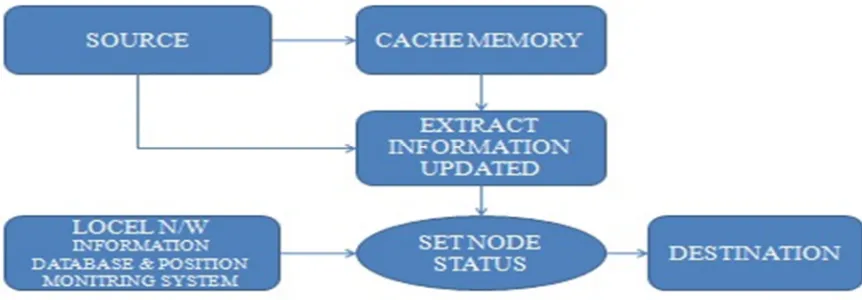
Source node to send the information for destination node in between transmission message dropping rate will be challenging for VANETs Application. So we using for IDTP protocol in vehicle network application. Then we use the part of IDTP is cache memory, extract information updated local network information database &position monitoring system, set node status positioning. Source to send the information
Source node to send information message from cache memory then cache information to store the data for storage section and to move data for extract information update port. This port to directly connected source node so the message will be transmitted in both ways then updated message transmitted in set node states region. This is to collect the information for local network database & position monitoring system states. Then collected information are to receive destination node.
A. Candidate Node Set Selection Mechanism
IDTP main objective is to use opportunistic routing to ensure VANET transmission reliability, while reducing the number of transmissions, and therefore, the selection of the candidate node set needs to ensure that the number of backup links can provide the required delivery rate. Seen from the estimation of link quality, each node can calculate the link transmission rate r(t) of all links between itself and all its neighbors. The candidate nodes can be selected by the link transmission rates of the links that are formed by the sending node to its neighbors. As shown in Figure 2, r1(t) and r2(t) are the transmission rates of the source node S to its two candidate relay nodes X and Y. Then, the probability that S sends data to the next hop successfully is 1 − (1 − r1(t))(1 − r2(t)). Here is how the candidate node set selection mechanism works. For node S, the current time t, the number of neighbor nodes is N. ri(t) (1≤ i ≤ N) is the transmission rate of the link that is formed by S to its neighbor node i, and di(t) (1≤ i ≤ N) represents the distance from the destination to node i. S(t) is the distance from the current node to the destination, and r is the required data delivery rate of a single link.
[image:4.612.93.524.539.689.2]The receiver oriented approaches are based on local timers, which differentiate the broadcast time of each node by setting different timeout. The duration of waiting time is tuned according to their local knowledge such as cardinality of neighbors that did (did not) receive the same message so far. Timeout differentiation resolves the broadcast storm problem. Sender oriented approaches achieve instant retransmissions. Sender dedicates one or more forwarders which are then able to retransmit immediately. This appears promising approach for warning delivery.
Technology (IJRASET)
The source sends the existing information database updated message to any receiver, here the receiver checks their connected sets which all are nearer to the accident, and then it performs location ranking where re transmissions takes place and the neighbor elimination is used for acknowledgement of the message.
B. Highly Dynamic Environment
The safety applications require an efficient data dissemination technique to broadcast the data to the vehicles on the road side environment. VANET safety applications include cooperative collision warning, intersection collision warning, cooperative driver assistance system, approaching emergency to vehicles etc., Also non-safety applications involve data transfer, traffic management applications, parking lot payment, and traffic information. The comfort applications include optimum route calculation with real time traffic data and applications for administration e.g. Vehicle identification also requires broadcasting.
C. Dynamic Topology Changes
Vehicular Adhoc Networks (VANETs) are dedicated to improve the safety and efficiency of transportation systems through vehicle to vehicle or vehicle to road side communications. VANETs exhibit dynamic topology and intermittent connectivity due to high vehicle mobility. These distinguished features declare a challenging question: how to detect on the fly vehicular networks such that we can explore mobility-assisted message dissemination and topology control in VANETs. As being closely related to network dynamics, vehicle mobility could be explored to uncover network structure. In this paper, we have observed that mobility of vehicle, rather than being random, shows temporal locality and spatial locality. First examine temporal locality using a campus trace, then measure temporal locality similarity between two vehicles based on the relative entropy of their location preferences. By further incorporating spatial locality similarity, we introduce a new metric, namely dual locality ratio(DLR), which represents the mobility correlation of vehicles.
D. Geographic Location and Link State Information
To Propose an opportunistic routing called Link state aware Geographic Opportunistic routing protocol (LSGO) which takes a combination of geographic location and the link state information as the forwarder selection mechanism. The protocol aims to ensure a highly dynamic network packet delivery rate and improve the reliability of data transmission. Besides, it also aims to reduce the number of transmissions (including retransmissions) and the transmission delay. Traditionally propose simple yet effective scheme, which can identify misbehaving forwarders that drop or modify packets. Extensive analysis and simulations have been conducted to verify the effectiveness and efficiency of the scheme. This schema effectively detect dropped packets from misbehaving users but dynamic changes of the topology in wireless sensor networks less communication process can be done wireless sensor networks.
IV. RESULTS AND DISCUSSION
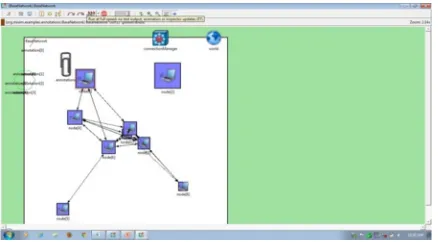
[image:5.612.198.417.534.655.2]The result shows the dynamic environment of vehicles mobility flow modeling diagram which imported in OMNET++. The output is proposed in how to transmitted the packets for source to destination in IDTP protocol.
Fig 4.1 transmission range between source to destination.
Technology (IJRASET)
Fig 4.2 packet dropping rate vs number of nodes.
V. CONCLUSION
New routing protocol for VANETs called An Improved Data Transmission Protocol [IDTP] for Vanets Using Link State Information which takes a combination of geographic location and the link state information as the forwarder selection mechanism. The protocol aims to ensure a highly dynamic network packet delivery rate and improve the reliability of data transmission. Besides, it also aims to reduce the number of transmissions and the transmission delay. IDTP uses an improved ETX mechanism to calculate the link transmission rate.
REFERENCES
[1] XuelianCai, Ying He, Chunchun Zhao, Lina Zhu and ChangleLi.,”LSGO: Link State aware Geographic Opportunistic routing protocol for VANETs” EURASIPJournal on Wireless Communications and Networking 2014, 2014:96
[2] Kuk-Hyun Cho and Min-Woo Ryu“A Survey of Greedy Routing Protocols for Vehicular Ad Hoc Networks” Dept. of Computer Science, Kwangwoon University, Seoul, 139-701, Accepted March 05, 2012; Published April 30, 2012
[3] AP Mazumdar, AS Sairam, TOAR: transmission-aware opportunistic ad hoc routing protocol. EURASIP. J. Wireless Networking 1, 1–19 (2013)
[4]Y. Zhuang, J. Pan, Y. Luo, and L. Cai, “Enhanced Perimeter Routing for Geographic Forwarding Protocols in Urban Vehicular Scenarios (GpsrJ+),” IEEE Journal on Selected Areas in Communications, vol. 29,no. 1, pp. 187–196, January 2011.
[5] Li Sun1,2, Pinyi Ren1* and Qinghe Du1, “Distributed source-relay selection scheme for vehicular relaying networks under eavesdropping attacks”EURASIPJournal on Wireless Communications 2014 2014:109.
[6] Z Wang, Y Chen, C Li, A novel cooperative opportunistic routing schemein mobile ad hoc networks. IEEE. J. Selected Areas Communication. 30(2), 289–296 (2012)
[7]RAM SHRINGAR RAW, SANJOY DAS, “Performance Comparison Of Position-Based Routing Protocols In Vehicle-To vehicle Communication” School of Computer & Systems Sciences Jawaharlal Nehru University New Delhi, India ISSN : 0975-5462 Vol. 3 No. 1 Jan 2011.