332
©IJRASET (UGC Approved Journal): All Rights are Reserved
Shape Based Object Detection in Digital Images
Jaspreet Kaur1, Parvinder Kaur2
1
Research Scholar, Assistant Professor 2,Computer Science and Engineering, SUSCET(Tangori)
Abstract: An effective and simple approach is presented for object detection. SIFT (Scale Invariant Feature Transformation) technique is used to extract the unique key points from the image. Image content is transformed into local feature coordinates that are invariant to rotation, scaling, translation and other imaging parameters. Because it extracts local features from the image so it is robust to clutter and occlusion. For a small object many features can be generated. BFOA (Bacterial Foraging Optimization Algorithm) is used to optimize the extracted features. The main motive to select Bacterial Foraging Algorithm is that it is not affected by the non-linearity and size of the problem. This algorithm has provided the best optimal solutions in many problems where most analytical methods have failed. Then selected features are classified with the help of SVM (Support Vector Machine). Support Vector Machine is a machine learning algorithm which is basically used for classification and regression challenges. It is mostly used for classification problems. Classification is done by finding the hyper-plane that differentiates the two classes very easily and accurately.
Keywords: Object detection, Feature extraction, Optimization, Support Vector Machine, Classification.
I. INTRODUCTION
The task of object detection is very challenging in computer vision. These challenges occur due to image clutter, transformations, inter-class similarity, intra-class variability and occlusion. It is a very important area in computer vision .Mostly objects are detected on the basis of their shape .Sometimes object detection is done on the basis of their color and texture and sometimes on the basis of their respective position with respect to the other objects. The aim of object detection is to identify all the instances of a predefined object from a familiar category such as humans, cats, cars or faces in a given image i.e. recognizing the category of a given object. Objects can be better detected with the hel p of their shape feature. Shape is an invariant feature to the lightning conditions. Color and texture can vary in some conditions .One can easily differentiate between the shapes of two objects without any additional information. Detection of objects based on shape still remains difficult .Due to the recent advances in shape based object detection proposed by Hui Wei et al. (2016) shape based object detection becoming more popular and attentive in computer vision field. Author applied graphical models to learn a shape representation and proposes a pipeline of shape-based object recognition. First, a Bayesian Network represents the shape knowledge of a type of object. Second, an evidence accumulation inference with Bayesian Network is developed to search for the region of interest which is most likely to contain an object in an image. Finally, a spatial pyramid matching approach is used to verify the hypothesis to identify objects and to refine object locations. However this approach is not pure for shape-based object detection and needs learning in confirmation of hypothesis.
[image:2.612.172.382.597.702.2]Our main contribution to this work is to overcome the problem of interference and noise and to detect the objects more accurately on the basis of their shapes. In this work an effective and simple approach is presented for object detection. SIFT (Scale Invariant Feature Transformation) technique is used to extract the unique key points from the image. Image content is transformed into local feature coordinates that are invariant to rotation, scaling, translation and other imaging parameters. Because it extracts local features from the image so it is robust to clutter and occlusion. For a small object many features can be generated. BFOA (Bacterial Foraging Optimization Algorithm) is used to optimize the extracted features.
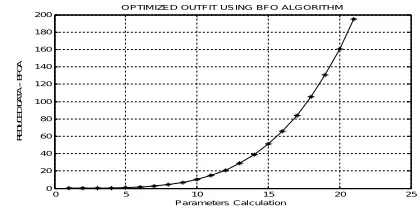
Figure 1: Instance Selection using BFOA
0 5 10 15 20 25
0 20 40 60 80 100 120 140 160 180 200 Parameters Calculation R E D U C E D D A T A -- B F O A
333
©IJRASET (UGC Approved Journal): All Rights are Reserved
The above figure shows that the graphical representation of the selected features based on bacterial foraging optimization approach. In this approach steps are:
A. Rotation Set in two phases ; (i) Swim and (ii) Tumble form
B. Eliminate the features
C. Dispersal form and
D. Reproduce the selected features
The main motive to select Bacterial Foraging Algorithm is that it is not affected by the non-linearity and size of the problem. This algorithm has provided the best optimal solutions in many problems where most analytical methods have failed.
Then selected features are classified with the help of SVM (Support Vector Machine). Support Vector Machine is a machine learning algorithm which is basically used for classification and regression challenges. It is mostly used for classification problems. Classification is done by finding the hyper-plane that differentiates the two classes very easily and accurately.
II. LITERATURESURVEY
Hui Wei et al. (2016) [1] proposed a shape-based object recognition pipeline and for shape representation graphical model is applied. For a type of object a Bayesian network is used to represent its shape knowledge. To search a region of interest in which object lies within an image an evidence accumulation is proposed with Bayesian network. Finally to detect objects and to identify object locations a spatial pyramid approach is used.
Pierre Sermanet et al. (2014) [2] To Classify, detect and localize the objects of interest in an image a sliding window approach is proposed which can also work on multi-scale framework. Convolution network is one which can efficiently implement a multi-scale framework. A deep learning paradigm which can detect the boundaries of an object of interest in an image on the basis of learning. It creates a bounding box around the object after detecting its boundaries. A single shared network is able to learn multiple tasks at a time
P.Shanmuga vadivu et al. (2016) [3] to detect the degree of incorrectness in the boundary information and to find the shape of the object a paradigm known as Fuzzy-Object-Shape is proposed. Object’s closeness to the well-known shapes is measured by the Fuzzy-Object-shape information and this information is extracted from the object of interest .The values treated as Feature Vector are calculated for each object and are known as fuzzy membership values .To find the degree of closeness between the input image and previously stored image in database a measure of likeness is presented.
Roberto ugolotti et al. (2013) [4] an evolutionary optimization, deformable based general paradigm is proposed. This framework is generally designed to handle the optimization problems in object detection using a particle swarm optimization and gives more accurate result as compared to the other state-of-the-art techniques and is more efficient.
J.R.R. Uijlings et al. (2013) [5] to overcome the problem of less capability of a single grouping algorithm to find all possible locations of the object in an image a selective search algorithm is proposed .this algorithm provides the advantages of two different techniques Exhaustive search and segmentation .Sampling process is carried out to sample the image structure which is hierarchical and all the possible locations of the object in an image are detected. In this algorithm not only single detection is considered but image structure is segmented at different levels to find all the possible object locations. This leads to a better and more accurate detection as compared to the other state-of-the-art techniques which only considered a single image condition.
Ali Vashee et al. (2016) [6] a HOG (Histogram of Oriented Gradients) based feature descriptor which is invariant to rotation is proposed. Scale variation of objects covering top-down searching technique uses this descriptor. The accuracy of the localization is enhanced by the HOG descriptor. The segments which are localized in an image contain frequencies of gradient orientation. These frequencies are considered by shape-based HOG descriptor to efficiently localize the objects in an image.
Chen Guodong et al. (2013) [10] presented a learning algorithm for model based object detection. The object’s shape is used as the most discriminative hint for its detection by biological vision system. So a shape based object detection method is employed which uses the shape fragment features. The method was tested on PASCAL data set and compared with Hough Transform. The outcomes reveal that the method is robust to image transformation and background clutter.
334
©IJRASET (UGC Approved Journal): All Rights are Reserved
Esned Ohn-Bar et al. (2017) [19] proposed a general framework which is not only efficient but operates on scale volumes of a deep feature pyramid. Significant multi-scale contextual information capturing, better localization, efficient performance of detection on the PASCAL VOC dataset and a Multi-View Highway Vehicles dataset are the main advantages of the proposed work.
III. EVALUATIONMETRIC
Performance of the proposed technique is evaluated with the state-of -the-art techniques on the basis of some parameters. Accuracy in the object detection is improved in proposed technique as compared to the other techniques. True positive rate, false negative rate and detection rate are the parameters on the basis of which the proposed work is evaluated with the existing techniques.
A. True-positive rate
The number of features which are correctly identified as positive for the feature matching of acquired image with the stored features in database is called True Positive (TP) feature.
B. False-Positive Rate
The Number of features which are incorrectly identified as positive features for the feature matching of acquired image with the stored features is called False –Positive Rate.
C. True-negative Rate
The number of features which are correctly identified as negative ones for the feature matching of acquired image with the stored features in database is called True Negative (TN) features.
D. False-negative rate
The number of features which are incorrectly identified as negative for the feature matching of acquired image with the stored features in database is called False Negative (FN) features.
E. Accuracy
The percentage of correctly classified features is known as accuracy.
F. Detection Rate
Detection Rate is the ratio of True positive features to the sum of true positive and false negative features.
IV. PROPOSEDALGORITHMFLOWCHART
The process includes the following main phases in object detection:
335
©IJRASET (UGC Approved Journal): All Rights are Reserved
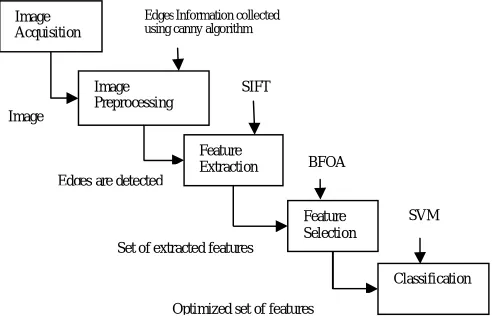
[image:5.612.201.447.127.290.2]Image acquisition is the first step in this image in which object of interest lies is acquired for further processing. The image is collected from the source and is stored in the different datasets from which it belong to .In this work different datasets are used like Apple logo , giraffe ,mugs etc. These are collected from the machine learning repository site.
Figure 2: Proposed Technique
B. Image pre-processing
The acquired image can contain noise, so to remove the noise and illumination pre-processing is required. Sometimes images can contain some unwanted portions which are not required during the object detection process .To remove the unwanted portions of the image is also a work of image pre-processing .Feature extraction techniques works with the fixed size images. So it is also an important phase of the process. Edges are detected using canny algorithm .The canny algorithm is based on the multiple values or properties and is able to detect multiple edges at a time from an image .after the pre-processing the acquired image may contain noise which can removed by canny algorithm .
C. Feature Extraction
Features are the key-points that lie on the objects and do not change under changes in image scale, noise and illumination. The feature extraction process initiates with selected set of data and some features are derived that are not only informative but also are non- redundant. Feature extraction process is also related to decrease the number of random variables that are under consideration. For the process of feature extraction Scale Invariant feature transform (SIFT) technique is used. First step is to extract the Key-points from a set of given images and all these features are then stored in a database. These features are used to match with the features of recognized object in new image and to find the correct object in new image.
D. Feature Selection
Features selection process returns a subset of the attributes those are extracted during the extraction process .This process keeps only the relevant attributes and all the irrelevant attributes are rejected without any loss of data. All the selected features are stored in an n-dimensional vector known as feature vector. Bacterial foraging optimization algorithm (BFOA) is used to optimize or select the relevant features. BFOA is a global optimization technique which can efficiently optimize and control the real-world problems occurring in many areas of applications.
E. Classification
Classification is the process of categorization or grouping of the selected features on the basis of their likelihood. Feature vector introduced in the feature selection process is given as input to this phase. Same type of features lies in one class. Support Vector Machine (SVM) learning model is used for classification in this work. Given a set of data points which belongs to one or the other of a number of classes and SVM training model will decide that new values belongs to which class.
V. RESULTS
The below figure (a) shows that the original image upload in the GUI user interface control too used (Axes).The original image size is <341x512x3 uint8> which is a three dimensional image.
Image Acquisition
Image Preprocessing Feature Extraction Feature Selection Classification Image
EdgesInformation collected using canny algorithm
Edges are detected
SIFT
BFOA
Set of extracted features
SVM
336
©IJRASET (UGC Approved Journal): All Rights are Reserved
(a) Uploaded Image (b) Gray Scale Image
Figure 3: Pre-Processing
The figure (b) shows that the gray scale image size is <341x512 uint8>. Gray Scale image is single in which the value if individual pixel is a single sample defining only a quality of light that is it carries only intensity data. The image is the sorting form also known as black and white image.
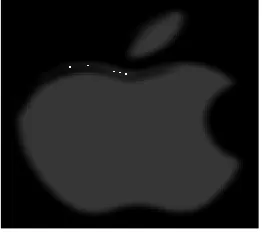
Figure 4: Edge Detection
The above figure shows that the edge detection, image using the canny edge detector. The edge detection is a smoothing a blurring of the image to reduce the noise. The gradient finding the edges should be marked where the gradients of the image have huge magnitudes. Only local features are maxima should be marked as edges. Double maximum value is threshold values edges are determined by threshold value.
(a) Binary Image (b) Inverted Binary Image
Figure 5: Binary Image and Inverse Binary Image
[image:6.612.241.372.547.663.2]The above figure shows that the binary image generates using the threshold methods. The output image is black and white replaces all pixels in the input image with a greater level with the maxima or minimum value or threshold value. The range is relative to the signal levels.
Figure 6: Feature Extraction
337
[image:7.612.186.432.366.476.2]©IJRASET (UGC Approved Journal): All Rights are Reserved
Figure 7: Shape Recognized Based on Object Image
The above figure shows that the shape recognizes based an object image. Some true positive detections within blue rectangles. For the best display, the green points are matched to the template on the top by utilizing Shape Context.
Figure 8: Comparison between proposed and existing work (Accuracy in Apple Logo)
The above figure shows that the comparisons between proposed and existing work (accuracy in apple logo). In accuracy in proposed work value is 0.90, 0.91, 0.917 and 0.92. In exiting work value is 0.86, 0.84, 0.885 and 0.89.
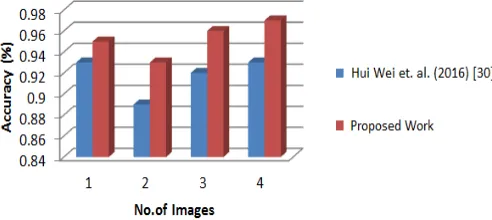
Figure 9: Comparison between proposed and existing work – (Accuracy in bottle logo)
The above figure shows that the comparisons between proposed and existing work (accuracy in bottle logo). In accuracy in proposed work value is 0.95, 0.93, 0.96 and 0.97. In existing work value is 0.93, 0.92, 0.92 and 0.93.
Figure 10: Comparison between proposed and existing work – (Accuracy in Giraffe logo)
338
©IJRASET (UGC Approved Journal): All Rights are Reserved
Figure 11 Comparison Between proposed and existing work – (Accuracy in Mug logo)
The above figure shows that the comparisons between proposed and existing work (accuracy in Mug logo). Inaccuracy in proposed work value is 0.70, 0.76, 0.78 and 0.89. In existing work value is 0.66, 0.65, 0.76 and 0.77.
VI. CONCLUSION
In this conclusion, we propose a structural representation of shapes using Support Vector Machine and a novel way of Indication Gathering Interpretation to pick up edge detection.Feature extraction works with fixed size images. So to remove the unwanted portion is also a work of image pre-processing. Feature extraction is a process of generating the attributes of the image. Feature selection is a process of selecting a most prominent features and removing the redundant features. In this process the feature vector is given as input and output the category of object. Different types of learning algorithms are used for classification (SVM).Shape recognizes based an object image. Some true positive detections within blue rectangles. For the best display, the green points are matched to the template on the top by utilizing Shape Context.
Our shape based detection realizes comparable results on well-known ETHZ shape classes and INRIA Horse dataset. However, our detection is not a pure shape matching for shape based object detection and it needs an interaction of statistical learning during verification of hypothesis.
VII. FUTURESCOPE
In future, we will focus on building a pure shape matching for shape-based object detection with our structural representation of shapes. The Fuzzy Logic classification algorithm will be implemented to classify the shape based object detection in different categories of the dataset like ETHZ and INRIA datasets and Fuzzy C-Means clustering using to divide the images into the cluster forms.
REFERENCES
[1] Wei, H., Yu, Q., & Yang, C. (2016). Shape-based object recognition via Evidence Accumulation Inference. Pattern Recognition Letters, 77, 42-49.
[2] Sermanet, P., Eigen, D., Zhang, X., Mathieu, M., Fergus, R., & LeCun, Y. (2013). Overfeat: Integrated recognition, localization and detection using convolutional networks. arXiv preprint arXiv:1312.6229.
[3] Shanmugavadivu, P., Sumathy, P., & Vadivel, A. (2016). FOSIR: Fuzzy-Object-Shape for Image Retrieval applications. Neurocomputing, 171, 719-735. [4] Ugolotti, R., Nashed, Y. S., Mesejo, P., Ivekovič, Š., Mussi, L., & Cagnoni, S. (2013). Particle swarm optimization and differential evolution for model-based
object detection. Applied Soft Computing, 13(6), 3092-3105.
[5] Uijlings, J. R., Van De Sande, K. E., Gevers, T., & Smeulders, A. W. (2013). Selective search for object recognition. International journal of computer vision, 104(2), 154-171.
[6] Vashaee, A., Jafari, R., Ziou, D., & Rashidi, M. M. (2016). Rotation invariant HOG for object localization in web images. Signal Processing, 125, 304-314. [7] E. Ohn-Bar, M. M. Trivedi,Learning to detect vehicles by clustering appearancepatterns, IEEE Trans. Intelligent Transportation Systems 16 (5) (2015) 2511–
2521.
[8] Fergus, R., Perona, P., & Zisserman, A. (2003, June). Object class recognition by unsupervised scale-invariant learning. In Computer Vision and Pattern Recognition, 2003. Proceedings. 2003 IEEE Computer Society Conference on (Vol. 2, pp. II-II). IEEE.
[9] Fung, Glenn M., and Olvi L. Mangasarian. "Multicategory proximal support vector machine classifiers." Machine learning 59, no. 1-2 (2005): 77-97. [10] Guodong, C., Xia, Z., Sun, R., Wang, Z., & Sun, L. (2013). A learning algorithm for model-based object detection. Sensor Review, 33(1), 25-39. [11] Halawani, A., & Li, H. (2016). 100 lines of code for shape-based object localization. Pattern Recognition, 60, 458-472.
[12] Huang, Feng-Cheng, Shi-Yu Huang, Ji-Wei Ker, and Yung-Chang Chen. "High-performance SIFT hardware accelerator for real-time image feature extraction." IEEE Transactions on Circuits and Systems for Video Technology 22, no. 3 (2012): 340-351.
[13] Karnan, M., and N. Krishnaraj. "A model to secure mobile devices using keystroke dynamics through soft computing techniques." International Journal of Soft Computing and Engineering 2, no. 3 (2012): 71-75.
339
©IJRASET (UGC Approved Journal): All Rights are Reserved
[15] Khurana, K., & Awasthi, R. (2013). Techniques for object recognition in images and multi-object detection. International Journal of Advanced Research in Computer Engineering & Technology (IJARCET), 2(4), 1383-1388
[16] Leibe, B., Leonardis, A., & Schiele, B. (2008). Robust object detection with interleaved categorization and segmentation. International journal of computer vision, 77(1-3), 259-289.
[17] Mikolajczyk, Krystian, and CordeliaSchmid. "Scale & affine invariant interest point detectors." International journal of computer vision 60, no. 1 (2004 [18] Mikolajczyk, Krystian, and CordeliaSchmid. "Indexing based on scale invariant interest points." In Computer Vision, 2001.ICCV 2001.Proceedings. Eighth
IEEE International Conference on, vol. 1, pp. 525-531. IEEE, 2001.
[19] Ohn-Bar, E., & Trivedi, M. M. (2017). Multi-scale volumes for deep object detection and localization. Pattern Recognition, 61, 557-572.