A Review on Optimization of Cutting Parameters
in Machining Using Predictive Models
M. Rajesh1, Dr. G. Naga Malleswara Rao2, Dr. B. Chandra Mohana Reddy3
1
Research Scholar, JNTUA, Anatapuram 2
Principal &Professor Dept of Mechanical Engineering, GATES Institute of Technology, Gooty, A.P 3
Assistant Professor Dept of Mechanical Engineering, JNTUA, Anatapuram, A.P
Abstract: This Paper is an attempt made to review the literature on optimization of cutting parameters in machining to develop predictive and optimization models for analyzing the influence of machining parameters on surface roughness and power consumption. The effect of cutting speed, feed and depth of cut will be studied during the turning of AISI 1045 steel using carbide cutting tools. The machining parameters leading to minimum power consumption and surface roughness as Response Surface Methodology, Support Vector Regression and Artificial Neural Networks will be used to develop the predictive models. Response Surface Methodology and Genetic Algorithms will be used to develop optimization models.
Keywords: Optimization, cutting parameters, predictive models, surface roughness, power consumption
I. INTRODUCTION
For selecting and implementing optimal machining conditions and the most suitable cutting tool has been felt over the last few decades. In machining, the speed and motion of the cutting tool is specified through several parameters. These parameters are selected for each operation based upon the work piece material, tool material, tool size, and more. Machining parameters that can affect the processes are: 1) Cutting speed - The speed of the work piece surface relative to the edge of the cutting tool during a cut, the cutting speed is measured in meter per minute, 2) Feed rate - The speed of the cutting tool's movement relative to the work piece as the tool makes a cut. The feed rate is measured in mm per revolution. 3) Depth of cut - The depth of the tool along the radius of the work piece as it makes a cut, as in a turning or boring operation
The surface roughness is widely used index of product quality in terms of various parameters such as corrosion resistance, tribological considerations, fatigue life improvement, precision fit of critical mating surfaces, etc. But the achievement of a predefined surface roughness below certain limit generally increases power consumption exponentially and decreases the productivity. The capability of a machine tool to produce a desired surface roughness with minimum power consumption depends on machining parameters, cutting phenomenon, work piece properties, cutting tool properties, etc. The first step towards reducing the power consumption and surface roughness in machining is to analyze the impact of machining parameters on power consumption and surface roughness.
A. Surface Roughness
Surface roughness most commonly refers to the variations in the height of the surface relative to a reference plane. It is measured either along a single line profile or along a set of parallel line profiles (surface maps). It is usually characterized by one of the two statistical height descriptors advocated by the American National Standards Institute (ANSI) and the International Standardization Organization (ISO). These are (1) Ra, CLA (centre-line average), or AA (arithmetic average) and (2) the standard deviation or variance (σ), Rq or root mean square (RMS). Two other statistical height descriptors are skewness (Sk) and kurtosis (K); these are rarely used. Another measure of surface roughness is an extreme-value height descriptor Rt (or Ry, Rmax, or maximum peak-to-valley height or simply P–V distance).
Fig 1. Surface roughness tester
These parameters are seen to be primarily concerned with the relative departure of the profile in the vertical direction only; they do not provide any information about the slopes, shapes, and sizes of the asperities or about the frequency and regularity of their occurrence. There are two methods used for measuring surface roughness. 1. Surface inspection by comparison method e.g. tough inspection, visual inspection, scratch inspection, microscopic inspection, visual inspection, surface photography, reflected light intensity etc. and 2. Direct instrument method e.g. light section method, Forster surface roughness tester, Profilograph, Tomlinson surface roughness meter, Taleyrsurf etc.
B. Power consumption
Energy efficiency and environment impact have become important benchmarks for assessing any industry both globally and domestically due to sustainability issues and manufacturing industry is no exception. The energy efficiency of machines tools is generally very low particularly during the discrete part manufacturing and users in the automotive industry demand more often an indication for new acquisitions of how much energy a machine tool will expectedly consume during operation. The factor energy efficiency is therefore important evaluation criterion for new investment in machinery and equipment in addition to the classical parameters accuracy, performance, cost and reliability. The large number of interrelated parameters (cutting speed, feed, depth of cut, tool geometry, work piece and cutting tool properties, etc.) that influence the power consumption during machining on a machine tool makes the development of an appropriate predictive model a very difficult task.
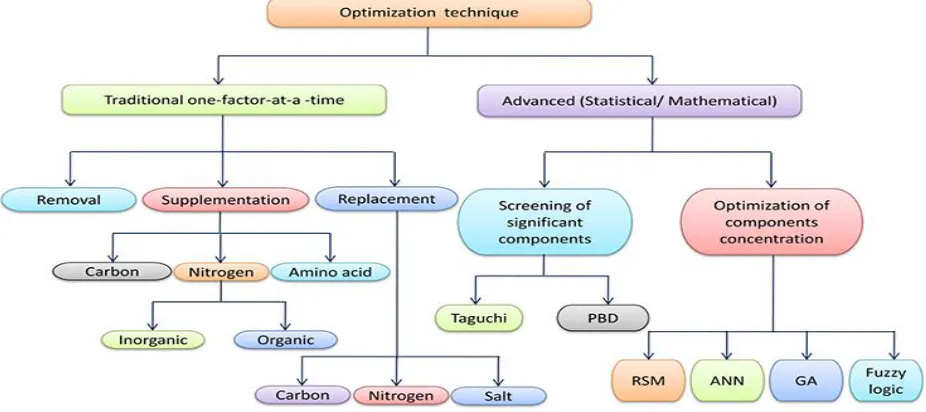
Fig 2. Different types of Optimization techniques
II. LITERATURE REVIEW
[image:3.612.76.539.435.641.2]machining operations accurately. Modeling can facilitate effective planning of machining operations to achieve optimum productivity, quality and cost.
A. Analytical modeling
The input-output relationships can be made by purely analytical models that are based solely on the fundamental theoretical physics of the machining process. Analytical modeling or science based modeling began to emerge in the 1940s. Geometric, analytical or mechanistic modeling methods form the basis of this approach. Analytical modeling was initiated largely by Merchant's physics-based modeling and analysis of the basic force system acting among the cutting tool, chip and workpiece in a machining process. In this approach predictions are made from the basic physical properties of the tool and workpiece materials together with the kinematics and dynamics of the process. Thus after the appropriate physical data is determined, the effect of changes in cutting conditions (e.g., tool geometry, cutting parameters, etc.) on machining performance (e.g., wear rate, geometric conformance, surface quality, etc.) can be predicted. The usual approach in analytical studies was to propose a model of chip formation from experimental observations and then to develop an approximate machining theory.
1) Numerical Modeling: Numerical modelling also known as computer based modelling began to emerge in the 1970s and was the watershed event in the advent of digital computer technology. Amongst the numerical modelling techniques, the finite-element methods (FEMs) are the most frequently used (van Luttervelt et al., 1998). The main objective of finite element studies is to derive a computational model for predicting machining performance measures like cutting force, temperature, temperature distribution, chip geometry, etc. under different cutting conditions. Fang and Fang (2007) used experimentally validated FE model to graphically depict the distributions of strain, strain rate, stress, and temperature. The results show that a large strain primarily exists in the secondary deformation region along the tool-chip interface and the machined surface. A large strain rate also exists in the primary and tertiary deformation regions. A large stress exists in the primary deformation region and on the round tool edge. The maximum temperature occurs on the round tool edge. Although finite element methods are capable of predicting cutting forces without assuming shear zone geometry or use of empirical coefficients, their accuracy is a strong function of the underlying material model, incorporation of dynamic effects and the available computational power (Kapoor et al., 1998). This approach is criticized as being not based on physics of machining. Computation time, sensitivity to material constitutive model and friction definitions, and instability problems with meshing are some of the drawbacks of finite element modelling.
Asiltürk and Neşeli (2012) developed a mathematic model for predicting surface roughness during CNC turning of AISI 304 austenitic stainless steel with coated carbide inserts. The model for the surface roughness as a function of cutting parameters was obtained using RSM. The adequacy of the developed mathematical model was proved by ANOVA. The influence of cutting speed, feed rate and depth of cut on the surface roughness was examined. The results indicated that the feed rate was the dominant factor affecting surface roughness.
Hessainia et al. (2013) developed a surface roughness model using RSM during hard turning of 42CrMo4 hardened steel with Al2O3/TiC mixed ceramic cutting tools. The combined effects of cutting parameters and tool vibration on surface roughness were investigated using ANOVA. The results indicated that the feed rate is the dominant factor affecting the surface roughness. A good agreement was observed between the predicted and the experimental surface roughness.
Makadia and Nanavati (2013) developed a mathematical prediction model of the surface roughness using RSM during tuning of AISI 410 steel with ceramic inserts. The developed prediction equation reveals that the feed is the main factor followed by the tool nose radius. The surface roughness was found to increase with the increase in the feed and it decreases with the increase in the tool nose radius. The verification experiments carried out to check the validity of the developed model predicted surface roughness within 6% error.
Bartarya and Choudhury (2014) analyzed the forces and surface finish produced during turning of hardened EN31 steel using uncoated cubic boron nitride inserts. ANOVA was applied to measure the goodness of fit of the measured data. The regression models developed for prediction of forces and surface roughness were found statistically significant. The most significant parameter affecting the forces was the depth of cut followed by feed.
Bhardwaj et al. (2014) developed a surface roughness prediction model using RSM during turning of AISI 1019 steel with coated carbide inserts. A quadratic model was developed in terms of feed, speed, depth of cut, and nose radius. A prediction model was developed by improving the normality, linearity and homogeneity of the data using a Box–Cox transformation. Confirmation experiments showed that the Box–Cox transformation has a strong potential to improve the prediction capability of empirical models. The results showed that the feed was the main influencing factor on the surface roughness while the depth of cut had no significant influence
3) Optimization Techniques used in Machining: A large number of optimization techniques have been developed by researchers to determine optimal cutting conditions for machining operations. Broadly, these may be classified as: (i) conventional optimization techniques and (ii) non-conventional optimization techniques
B. Conventional optimization techniques
These techniques are based on deterministic algorithms with specific rules for moving from one solution to the other. These algorithms have been successfully applied to many engineering design problems.
Chinchanikar and Choudhury (2013) used desirability function approach in RSM to determine optimum cutting conditions. It was found that the use of lower feed value, lower depth of cut and by limiting the cutting speed while turning 35 and 45 HRC AISI 4340 steel ensures minimum cutting forces, minimum surface roughness and better tool life.
Yalcin et al. (2013) used Taguchi method to determine the optimum machining parameters leading to minimum cutting force, surface roughness and temperature during milling of AISI 1050 steel. According to the signal to noise ratio a depth of cut of 1.25 mm, feed rate of 0.05 mm/teeth, cutting speed of 130 m/min, and wet cutting were the best parameters that minimize the cutting force, surface roughness and temperature values.
Campatelli et al. (2014) utilized RSM to analyze the effect of cutting speed, feed rate, radial and axial depth of cut on energy consumption during milling of carbon steel. The optimal values of the radial engagement and feed to minimize the specific energy related to the efficiency of the cutting were 1 mm and 0.12 mm/tooth respectively.
C. Non-conventional optimization techniques
Zain et al. (2012) used ANN coupled with GA to search for a set of optimal cutting condition points that lead to the minimum value of surface roughness. Three machining cutting conditions considered in this study were speed (v), feed (f) and radial rake angle (γ). The used approach reduced the surface roughness value compared to the experimental, regression, ANN, and response surface methods.
Yan and Li (2013) presented a multi-objective optimization method based on weighted grey relational analysis and RSM to optimize the cutting parameters during milling of medium carbon steel with carbide tools to achieve the minimum cutting energy, maximum material removal rate and minimum surface roughness. The results indicated that width of cut was the most influencing parameter followed by depth of cut, feed rate and spindle speed. The experimental results indicated that GRA coupled with RSM is very useful tool for multi-objective optimization of cutting parameters.
[image:6.612.44.575.502.730.2]An Nithyanandhan T. et al. have investigated the effects of process parameters on surface finish and material removal rate (MRR) to obtain the optimal setting of process parameters. And the analysis of Variance (ANOVA) is also used to analyze the influence of cutting parameters during machining. In this work, AISI 304 stainless steel work pieces are turned on conventional lathe by using tungsten carbide tool. The results revealed that the feed and nose radius is the most significant process parameters on work piece surface roughness. However, the depth of cut and feed are the significant factors on MRR. D. Philip Selvaraj et al. have studied the Taguchi optimization method was applied to find the optimal process parameters, which minimizes the surface roughness during the dry turning of AISI 304 Austenitic Stainless Steel. A Taguchi orthogonal array, the signal to noise (S/N) ratio and the analysis of variance (ANOVA) were used for the optimization of cutting parameters. ANOVA results shows that feed rate, cutting speed and depth of cut affects the surface roughness by 51.84%, 41.99% and 1.66% respectively. A confirmation experiment was also conducted and verified the effectiveness of the Taguchi optimization method. Samruddhi Rao et al. presented a detailed overview of Taguchi Method in terms of its evolution, concept, steps involved and its interdisciplinary applications. It could be concluded that this method with its perfect amalgamation of statistical and quality control techniques was one of the effective and efficient methods of its kind to highlight the benefits of designing quality into products upstream rather than inspecting out bad products downstream. It offers a quantitative solution to identify design factors to optimize quality and reduce cost. Also the application of this method is not confined to a particular domain but also to other fields like product and service sectors. It thus is a powerful method as compared to the other intuitive and more cumbersome methods encompassing a large number of fields in terms of application. Therefore, more studies need to be carried out to observe the influence of machining parameters on performance characteristics. A generalized relationship between the cutting parameters and the process performance is hard to model accurately mainly due to the nature of the complicated stochastic process mechanisms in machining. Machining is still an open field of research after more than last 100 years of research mainly because of the changes in machining technology, materials and the advancement in the modelling and optimization techniques as well as the advancements in computational technology.
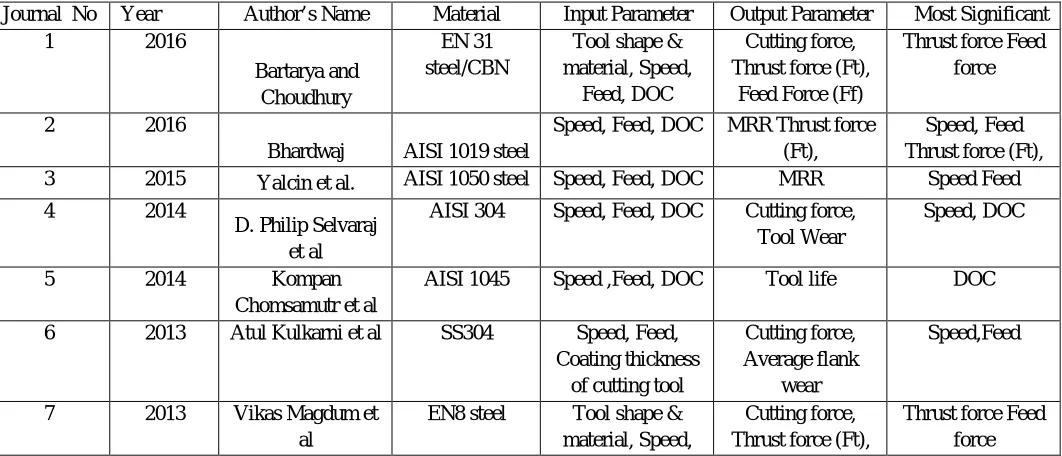
TABLE I: SUMMARY OF REVIEW PAPERS
Journal No Year Author’s Name Material Input Parameter Output Parameter Most Significant
1 2016
Bartarya and Choudhury
EN 31 steel/CBN
Tool shape & material, Speed,
Feed, DOC
Cutting force, Thrust force (Ft),
Feed Force (Ff)
Thrust force Feed force
2 2016
Bhardwaj AISI 1019 steel
Speed, Feed, DOC MRR Thrust force
(Ft),
Speed, Feed Thrust force (Ft),
3 2015 Yalcin et al. AISI 1050 steel Speed, Feed, DOC MRR Speed Feed
4 2014
D. Philip Selvaraj et al
AISI 304 Speed, Feed, DOC Cutting force,
Tool Wear
Speed, DOC
5 2014 Kompan
Chomsamutr et al
AISI 1045 Speed ,Feed, DOC Tool life DOC
6 2013 Atul Kulkarni et al SS304 Speed, Feed,
Coating thickness of cutting tool
Cutting force, Average flank
wear
Speed,Feed
7 2013 Vikas Magdum et
al
EN8 steel Tool shape &
material, Speed,
Cutting force, Thrust force (Ft),
III. CONCLUSION
From the above literature review observed that most of the researcher have taken input parameters (controllable factors): cutting speed, feed rate and depth of cut and only few researcher taken input parameter: nose radius, coating thickness of cutting tool, hardness, environment and output parameters: Cutting force, surface roughness, material removal rate (MRR), tool wear, average flank wear, power consumption and mach inability. Also find that for surface roughness the most significant parameters are speed, feed and nose radius and least significant parameter is DOC and for MRR the most significant parameters are DOC, feed and speed and least significant parameter is nose radius. The literature review reveals that researchers have focused on various predictive modelling and optimization techniques to determine optimal or near-optimal cutting conditions. Statistical regression analysis and artificial neural networks have been widely used modelling techniques in development of predictive models for machining. However, RSM is most widely used as it offers enormous information from even small number of experiment and even it is possible to analyze the influence of independent parameters on performance characteristics. The various authors have used Taguchi method, RSM, genetic algorithm, grey relation analysis, etc. as optimization techniques. Therefore, more studies need to be carried out to observe the influence of machining parameters on performance characteristics. Simultaneous optimization of surface finish and power consumption is also required so that product quality and sustainability are optimized simultaneously.
IV. ACKNOWLEDGEMENT
I would like to express my deep sense of gratitude to my guide, and teachers, friends for giving valuable time, precious guidance which helped us in completion of paper successfully.
REFERENCES
[1] Kant, G., Sangwan, K.S., 2015. Predictive modelling for power consumption in machining using artificial intelligence techniques. Procedia CIRP 26, 403–407. [2] Kant, G., Sangwan, K.S., 2015. Predictive modelling and optimization of machining parameters to minimize surface roughness using artificial neural network
coupled with genetic algorithm. Procedia CIRP 31, 448-453.
[3] Kant, G., Sangwan, K.S., 2015. Predictive modelling for energy consumption in machining using artificial neural network. Procedia CIRP 37, 205–210. [4] Kant, G., Sangwan, K.S., 2014. Prediction and optimization of machining parameters for minimizing power consumption and surface roughness in machining.
Journal of Cleaner Production 83, 151–164.
[5] Nithyanandhan T. et al “Optimization of Cutting Forces, Tool Wear and Surface Finish in Machining of AISI 304 Stainless Steel [6] Material Using Taguchi’s Method”, International Journal of Innovative Science, Engineering & Technology, Vol. 1 Issue 4, June
2014, page 488-493
[7] D. Philip Selvaraj et al “Optimization of surface roughness of AISI 304 austenitic stainless steel in dry turning operation usingTaguchi method”, Journal of Engineering Science and Technology Vol. 5, No. 3 (2010) page 293 – 301, © School of Engineering, Taylor’s University Colleg
[8] Samrudhi Rao et al “An Overview of Taguchi Method: Evolution, Concept and Interdisciplinary Applications”, InternationalJournal of Scientific & Engineering Research, Volume 4, Issue 10, October-2013, page 621-62
[9] Krishankant et al “Application of Taguchi Method for Optimizing Turning Process by the effects of Machining Parameters”,International Journal of Engineering and Advanced Technology (IJEAT)
[10] ISSN: 2249 – 8958, Volume-2, Issue-1, October 2012,page 263-27 Quazi T Z et al “a case study of Taguchi method in the optimization of turning parameters”, International Journal of EmergingTechnology and Advanced Engineering Website: www.ijetae.com (ISSN 2250-2459, ISO 9001:2008 Certified Journal, Volume 3,Issue
[11] Kompan Chomasmutr et al “Optimization Parameters of tool life Model Using the Taguchi Approach and Response Surface Methodology”, Ijcs Taguchi Method”, International Journal of Innovative Research in Advanced Engineering (IJIRAE) ISSN: 2349-2163,)Benardos, P.G., Vosniakos, G., 2003. Predicting surface roughness in machining : a review. Int. J. Mach. Tools Manuf. 43, 833–84
[12] Benardos, P.G., Vosniakos, G.C., 2002. Prediction of surface roughness in CNC face milling using neural networks and Taguchi ’ s design of experiments. Robot. Comput. Integr. Manuf. 18, 343–35
[13] Bhardwaj, B., Kumar, R., Singh, P.K., 2014. Surface roughness (Ra) prediction model for turning of AISI 1019 steel using response surface methodology and Box-Cox transformation. Proc. Inst. Mech. Eng. Part B J. Eng. Manuf. 228, 223–232.
Feed, DOC Feed Force (Ff)
8 2012 Kompan
Chomsamutr et al
AISI 1045 Speed, Feed, DOC Tool life Feed ,DOC
9 2012 Krishnakant et al EN24 steel Speed, Feed, DOC MRR Speed Feed
10 2011 Elso Kuljanic et al Titanium