Lancaster University Management School
Working Paper
2004/049
Simulating Entrepreneurial Learning: Assessing the Utility
of Experiential Learning Designs
Pittaway, Luke
Institute for Entrepreneurship and Enterprise Development
Lancaster University Management School
Lancaster LA1 4YX
UK
©Pittaway, Luke
All rights reserved. Short sections of text, not to exceed two paragraphs, may be quoted without explicit permission,
provided that full acknowledgement is given.
The LUMS Working Papers series can be accessed at http://www.lums.co.uk/publications/
Simulating Entrepreneurial Learning: Assessing the Utility of Experiential
Learning Designs
Abstract
Current research exploring entrepreneurial learning is explored in this paper to identify the key factors that are considered to be important. It looks at how these factors can be simulated in a student learning environment and highlights the role of emotional exposure, action-orientation and discontinuity. These features of learning are then mapped against those required to make experiential learning effective. An argument is made for the role of experiential learning when seeking to simulate contexts similar to those in which entrepreneurs learn. In the research that is carried out a conceptual framework is introduced that highlights a course design based on the factors identified. In the data analysis formal course assessments are reviewed and narrative coding based on sixty-four written student reflections is evaluated. The paper finds that it is possible to simulate certain aspects of entrepreneurial learning, such as emotional exposure, but not others. It also shows a range of learning benefits linked to experiential learning in this context. In conclusion the paper explains why entrepreneurship education can play an important role in encouraging management learning.
Submitted to:
Linda Birch
Editorial Assistant
Management Learning
School of Business and Management
Brunel University
Uxbridge
Middlesex
UB8 3PH
From:
Dr. Luke Pittaway
Lecturer in Entrepreneurship
Institute for Entrepreneurship and Enterprise Development (IEED)
Lancaster University Management School
Lancaster
LA1 4YX
Tel: 01524 593901
Simulating Entrepreneurial Learning: Assessing the Utility of Experiential
Learning Designs
Abstract
Current research exploring entrepreneurial learning is explored in this paper to identify
the key factors that are considered to be important. It looks at how these factors can be
simulated in a student learning environment and highlights the role of emotional exposure,
action-orientation and discontinuity. These features of learning are then mapped against
those required to make experiential learning effective. An argument is made for the role of
experiential learning when seeking to simulate contexts similar to those in which entrepreneurs
learn. In the research that is carried out a conceptual framework is introduced that highlights a
course design based on the factors identified. In the data analysis formal course assessments
are reviewed and narrative coding based on sixty-four written student reflections is evaluated.
The paper finds that it is possible to simulate certain aspects of entrepreneurial learning, such
as emotional exposure, but not others. It also shows a range of learning benefits linked to
experiential learning in this context. In conclusion the paper explains why entrepreneurship
education can play an important role in encouraging management learning.
Introduction
The purpose of the article is to explore student reflections on new venture planning
courses exploring how or whether they promote entrepreneurial learning. Such courses seek
to simulate learning in entrepreneurship by engaging in experiential learning and reflective
practice. Effective venture planning programmes build on the observation that people learn
from experience, especially where they are involved in solving problems (Burgoyne and
Hodgson, 1983; Davies and Easterby-Smith, 1984), and as such, they can be described as
evolving from the ‘experiential liberalist’ tradition of management education (Holman, 2000). A
venture planning course can be viewed as experiential because it asks students to develop a
business idea and work on practical plans to turn the idea into reality, the outcome of which is
the development of a comprehensive business plan.
The paper will explain the nature of entrepreneurial learning showing how it can be
venture planning as a form of entrepreneurship education will be introduced and explained.
During this part of the paper the author will make clear how simulated approaches to
problem-based learning can be used to create a learning environment that replicates important aspects
of entrepreneurial learning. This paper will introduce the ‘experiential liberalist’ view of
management education explaining how new venture planning fits within the philosophical basis
of this approach (Holman, 2000). The author will then introduce the research study conducted
exploring sixty-four student reflections on fifteen group venture planning projects. The paper
will evaluate how effective this form of educational approach is for simulating entrepreneurial
learning (McLoughlin and Thorpe, 1993).
Entrepreneurial learning
Seeking to understand how entrepreneurs learn has become a feature of academic
study in entrepreneurship and major contributions have been made to discussion by a range of
authors (Gibb, 1997; Deakins and Freel, 1998; Cope and Watts, 2000; Cope, 2003). Other
authors in management learning have also begun to explore organisational features of
learning in small firms (Penn et al., 1998; Anderson and Skinner, 1999). While these
approaches introduce a welcome new paradigm in entrepreneurship by applying philosophies
based on human action and reflection they can also be criticised for reproducing errors that
have occurred in previous paradigms. First, many of these studies lack an explicit assumption
about what is considered ‘entrepreneurial’ while making implicit assumptions. Secondly, the
term ‘entrepreneurial’ has been used interchangeably with small business owner with little
debate about the consequences of doing so. Finally, approaches in the management learning
domain have tended to treat small firms in a homogenous fashion. Asking the question; can
we find what makes organisational learning special in small firms?
Despite these criticisms the growth of study in this area is to be commended and
provides interesting new dimensions to the subject. Within the context of this paper the issues
are addressed by defining ‘entrepreneurial learning’ as: “learning that occurs during the
venture creation process”. This is a relatively narrow definition which is ‘fit for purpose’
learning and to explore how this learning may be linked to how ‘entrepreneurs’ learn. The
definition while depending heavily on the US assumption that ‘entrepreneurship’ is ‘venture
creation’ does avoid some of the criticisms highlighted.
Theoretical and empirical study to date has so far illustrated a number of important
features about ‘entrepreneurial’ learning, which can assist our understanding about how one
might simulated such learning in a student context. (1) The important role of financial and
emotional exposure (Cope, 2003). (2) That ‘entrepreneurs’ are action-orientated and learning
is experientially based (Rae and Carswell, 2000). (3) Entrepreneurs learn primarily through
‘learning by doing’ and reflection (Deakins and Freel, 1998; Cope and Watts, 2000). (4) That
episodes, crises and events are important mechanisms for creating seminal periods of
entrepreneurial learning (Cope, 2003). (5) Learning activities of entrepreneurs come from
reactive and proactive approaches to opportunities and problems (Young and Sexton, 1997).
(6) That routine and habitual learning during non-linear events also play a role (Costello,
1996). The next part of the paper explores how such entrepreneurial learning might be
simulated.
Simulating Entrepreneurial Learning
Simulating contexts for student learning that links to how entrepreneurs learn is
inherently difficult and simulations as methods to encourage management learning are
under-researched (Romme, 2003). It requires the creation of an uncertain and ambiguous context
which forces students to step outside taken-for-granted assumptions about the educational
process. In adding ambiguity and uncertainty to an educational process one replicates the
circumstances in which an ‘entrepreneur’ founds a business. This is because starting a
venture is a profoundly uncertain endeavour. Adding ambiguity into course design heightens
emotional exposure because students must work on entirely unfamiliar activities, for which
they have little previous experience, in conditions where group dynamics are essential but
uncontrollable (Mumford, 1996). Careful educational and tutorial designs are required to
counter this emotional exposure. One factor of entrepreneurial learning presented that cannot
when starting a business as this can only be experienced directly. The nearest approximation
one can achieve is to link student academic performance to ‘real’ project performance.
A great deal of the literature highlights the role of action-orientation and experientially
based learning (Rae and Carswell, 2000), which is also typical during the venture creation
process. Creating a simulated context for student learning requires some form of
project-based activity that is ‘hands-on’, experiential and requiring proactive behaviour (Young and
Sexton, 1997; Keegan and Turner, 2001). A student simulation would need to enable a
context whereby students ‘do’ something related to entrepreneurship and in ‘doing’ learn
experientially. As will be explained later, however, in the experiential liberalist view of
management education applied here it is not simply good enough to do, one must also reflect
on action, and change one’s future actions (Holman, 2000).
Creating a student learning environment that involves discontinuities, events or crises
as explained by many theories in ‘entrepreneurial’ learning is probably one of the more
problematic elements of a simulation (Cope, 2003). Discontinuities can be created within
programmes by asking students to meet particular objectives or challenges, which create
pressure in terms of timescale and which can be challenged by a learning coach, mentor or
tutor (Mumford, 1996; Marsick and O’Neil, 1999;). In such environments, routine learning can
occur by applying established knowledge to the problem at hand, ensuring this element is
included (Costello, 1996), while creating ‘critical’ moments whereby this taken-for-granted
knowledge is challenged, thrown-out or re-interpreted. These are not ‘real’ discontinuities in
the sense explained by Cope (2003), as students do not have financial exposure, but such
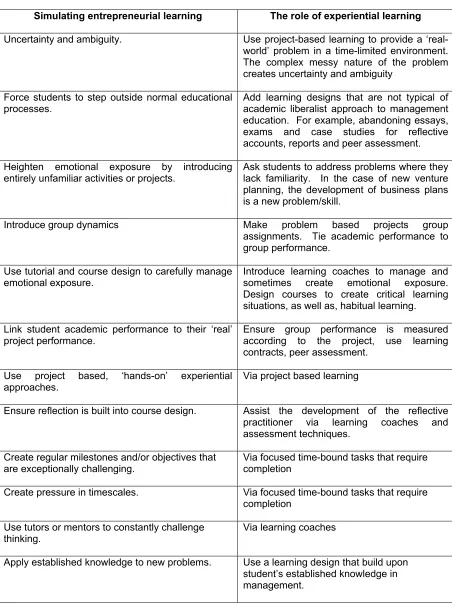
approaches do replicate the uncertainty and ambiguity associated with discontinuity. Table 1
draws together this analysis of the research into entrepreneurial learning and shows the key
features a simulation would require if it sought to promote entrepreneurial learning. The next
part of the paper explains how such a simulation can be described as experiential learning.
[Insert Table 1]
New Venture Planning as Experiential Learning
Entrepreneurship education has typically come in a number of forms ‘about’, ‘for’ and
liberalism’ category of management education. Courses tend to focus on explaining
‘entrepreneurship’ and ‘small business management’ using traditional techniques. Knowledge
is assumed to be objective and theoretical and the pedagogical aim is to acquire this
knowledge using lectures, seminars and case studies. The ‘for’ entrepreneurship type can be
likened to Holman’s ‘experiential vocationalism’ because approaches focus on the acquisition
of skills through learning by doing. These approaches typically lead to vocational based
methods including competence testing, portfolios of practice and the acquisition of technical
skills, pursuing direct vocational aims. The ‘practice in’ form can be associated with Holman’s
(2000) ‘experiential liberalism’. In this form knowledge is assumed to be more subjective and
experiential but remains linked to theoretical knowledge. Experiential processes such as
reflection, conceptualisation and action tend to be used via teaching methods, which include
for example, learning contracts, group work, action learning and self-development. The aim is
to link experiential and theoretical knowledge to interpersonal and technical skills1.
New venture planning courses can be found within all of the types outlined but it is with
the ‘practice in’ form within ‘experiential liberalism’ with which this paper is concerned. New
venture planning in this form, seeks to simulate ‘entrepreneurial learning’ by creating an
environment where such learning can take place. In doing so new venture planning tries to
replicate behaviour that is required in the difficult context of venture creation. Courses are
designed to be rooted in ‘real’ experience within a context, which aids learning through action,
reflection and re-conceptualisation. In this sense learning is understood to be a process of
reflection on action while examining messy complex problems (Schon, 1983). Courses
designed in this fashion ask students in groups to identify a new business idea, to research
and examine the idea in some detail undertaking marketing research, exploring operations
plans, writing financial forecasts and simulating investment decisions via engagement with
external ‘real’ investors. In some cases student teams may go on to found the business. An
appropriate simulation in this model of management education requires a problem-based
approach, utilising an experiential learning design, which includes ‘critical’ moments, action
Effective new venture planning courses can be linked closely to experiential learning.
Experiential learning often involves project-based learning that is closely linked to reflective
practices (DeFillippi, 2001). Project-based learning is defined as: “…the theory and practice of
utilizing real-world work assignments on time-limited projects to achieve mandated
performance objectives and to facilitate individual and collective learning” DeFillippi, 2001, p.
5. Learning through projects is associated with experiential learning because it assumes that
people learn more effectively when working on problems (Burgoyne and Hodgson, 1983;
Davies and Easterby-Smith, 1984). There are a number of features of this form of learning. (1)
Opportunities are created for students to learn from mistakes and grow personally in choices
and skills (McLoughlin and Thorpe, 1993; Mumford, 1994). (2) Project-based approaches are
used to encourage learning (Raelin, 1997). (3) Reflection on situations must occur to reassess
action (Burgoyne and Hodgson, 1983; Daudelin, 1996) through questioning insights (Smith,
1997). (4) Learning coaches are required to encourage learning from experience (Pedler,
1996). (5) The post-hoc examination of behaviour and implications for personal growth must
occur to reframe future behaviour (Marsick and O’Neil, 1999). (6) Group dynamics provide
important mechanisms for learning (McLoughlin and Thorpe, 1993). (7) Learning approaches
may include: learning coaches, reflection, critical reflection, teamwork, ‘real’ projects, a focus
on team processes, programmed knowledge and just in time learning (Marsick and O’Neil,
1999).
To be considered as a form of experiential learning new venture planning would need
to include many, if not all, of these elements. In Table 2 the author maps these requirements
against those needed to simulate entrepreneurial learning. The combination of these
elements shows how new venture planning can be designed to encourage entrepreneurial
learning.
[Insert Table 2]
In the following part of the paper a new venture planning course using these principles
will be introduced and reflective accounts from sixty-four students undergoing the course in
The Research
The purpose of the field research was to explore a number of themes identified in the
theoretical section of the paper. First, to explore whether it is possible to create a simulated
context for entrepreneurial learning (as outlined in Table 1) and second, to appreciate the
mechanisms that work when seeking to create this context (as outlined in Table 2).
The study focuses on the new venture planning course at Lancaster University
Management School and on the student cohort of 2003. 73 students completed the course,
working in fifteen teams. The data used in the study analyses written student reflections of
between 1500-2500 words, using narrative analysis and coding within the NVIVO qualitative
analysis software. The total data set is 671,000 characters. The use of student reflections as
a justifiable data source in management learning has been established and this study builds
on this approach (Case and Selvester, 2002).
The new venture planning course at Lancaster has been running since the early 1980s.
The design of the course has depended heavily on the tradition of management learning at
Lancaster. The following features of the course illustrate that it fits the criteria established in
Tables 1 and 2 that make it relevant for the purposes of this study. The course requires
students to work in teams to develop a business idea and to turn the idea into a fully
developed business proposition which is presented to local financial organisations. The task
presents a real-world problem, a need to develop an idea and to develop it sufficiently to
attract the attention of real investors. It is consequently complex requiring multi-disciplined
teams and messy but requiring the application of prior knowledge in varied management
disciplines.
The activity is also time-limited being carried out over a ten week period. As students
have not typically started a business before, or planned one, uncertainty and ambiguity are
embedded in the process. All prior models of education the students are familiar with are
ignored, there are no essays, no exams and it is usually the first time a student has been
assessed by the coursework method applied3. The business planning exercise is structured
providing weekly problem-based tasks for teams to carry out and these are presented weekly
and regularly challenge prior academic knowledge and experience by asking penetrating
questions based on their own business experience. The exercise requires students to apply
knowledge from other management disciplines4 to the problem of planning their venture. Time
pressures are created by the intensity of the course design5 and weekly tasks need to be
carried out. In this sense the new venture planning course meets all of the objectives required
to simulate an entrepreneurial learning context and meets the criteria identified that
establishes it as a form of experiential learning. Figure 1 highlights a model of new venture
planning.
[Insert Figure 1]
In the model presented a number of concepts are used that derive from experiential
learning theory (Kolb, 1984) and from action learning (Revans, 1982). In the context of this
paper they are used as descriptions of the learning activity undertaken within the course.
Kolb’s (1984) model, for example, provides four of the six concepts used. These include two
modes of grasping experience, which are concrete experience (CE) and abstract
conceptualisation (AC), and two forms of transforming experience, which are reflective
observation (RO) and active experimentation (AE). The final two concepts come from Revans’
(1982) approach to action learning and they include questioning insight (QI) and programmed
knowledge (PK).
In the context of this paper concrete experience is operationalised as the ‘actual’
experience of ‘doing’ something. For example, in venture planning students conduct market
research on their business concept, which informs their decisions about the business
operation and financial plan, they consequently learn about market research by doing it.
Abstract conceptualisation refers in this paper to grasping experience that uses knowledge
which has been abstracted from its context via theory or concepts. In the model this is
represented by lectures providing conceptual input into, for example, the value and role of
market research in business planning.
In the first transforming experience reflective observation, the model represents
student developmental points where they are forced through action and questioning insight to
developmental points where students are forced into new experiences from which they
generate concrete experience. For example, while many students have knowledge of financial
forecasting via abstract conceptualisation, a venture planning course is often the first time
such knowledge is required to be put into practice being embedded in prior decisions about
the business concept and having a fundamental impact on the overall level of convincingness
of the business proposition.
The concept of questioning insight, which is used extensively in action learning (Smith,
1997), is designed to encourage learners to discover how to pose fresh questions in conditions
of ignorance or uncertainty (Revans, 1982). It is operationalised here via the external
contribution of business owners who have concrete experience ‘doing’ or assessing venture
plans and via the assessment mechanisms employed. In the model outlined these external
contributors continually challenge the basis of the students’ taken for granted assumptions
about the proposition, leading them into reflective observation and transformative experience.
The final concept used is programmed knowledge (Smith, 1997). This is operationalised here
as the individual’s taken for granted knowledge, either that based on concrete experience or
abstract conceptualisation. In the case of new venture planning students typically arrive with a
volume of existing abstract conceptualisation from other management disciplines, which is
represented as programmed knowledge and external contributors have taken for granted
knowledge based on previous experience. Exploring the model presented in Figure 1 it is
possible to observe a number of learning loops within the course design, which incorporate
these different forms of learning. These are not all typical of Kolb’s learning cycle (Mainemelis
et al., 2002) or Burgoyne’s social learning cycle (Burgoyne, 1995)6 but they do represent how
the course design engages interaction between different forms of learning developing a
balanced approach. These loops include idea generation and initial market assessment;
market research; operations planning; financial forecasting; and, venture plan presentation
and final document. Given these learning loops it is not surprising that the course is
considered challenging by students and this is highlighted in the next part of the paper where
Empirical Results
Of the 73 students on the course 64 student reflections were analysed (87.7%). The
data represents 15 teams working through the venture planning programme. The businesses
researched included a range of business concepts with varying financial requirements. The
business concepts included for example: child care; data storage; novelty products; home
delivery services; physiotherapy centres; and, leisure complexes. Male to female balance of
the student group in 2003 was 71% (male) to 29% (female). The students’ who undertook the
course were doing majors in both functional (12) and general management (61). The overall
academic performance of the student cohort is typical of courses that have a group work
element. The minimum group mark was 57%, the maximum group mark was 74% and the
mean was 64.5% with a standard deviation of 4.8%. Individual marks mirror roughly the same
distribution.
[Insert Table 3]
The students evaluating the course over a 3 year period have consistently ranked it
above the school average on a number of dimensions as indicated in Table 3. Overall the
course was ranked above the average (0.10), as was the course content (0.17), the tutorials
and workshops (0.31), the level of understanding (0.59) and the learning environment (0.28).
Factors ranked below the average included lectures (-0.51) and the helpfulness of staff (-0.14).
Of those factors that can be consider significant (greater than the standard deviation) the level
of understanding was identified as a positive, while the value of the lectures was highlighted as
a negative. Interpreting formal evaluations is inherently difficult but two points can be made.
First, the evaluation of lectures is relatively misleading because, while including basic
introductory lectures, the course is principally problem-based rather than being lecture-based
and, therefore, the assessment of this factor is less relevant than it might be normally.
Secondly, key factors linked to ‘learning’ such as, level of understanding and learning
environment are consistently ranked more highly than the average in the formal assessment.
This finding highlights the question that influenced the development of this research, which is;
why is an experiential design leading to a significantly higher level of understanding amongst
explore the detailed empirical data from the student reflections, seeking to answer this
question, and analysing the extent to which an experiential course design can promote
‘entrepreneurial’ learning.
Overview of the Narrative Coding
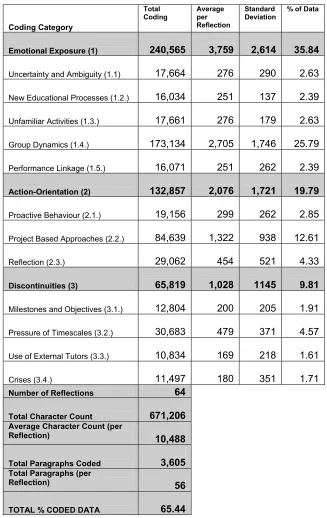
[Insert Table 4]
The data in Table 4 illustrate that emotional exposure (35.84%) created principally via
group dynamics (25.79%) plays a major role in creating an environment within which effective
student learning can take place in new venture planning. It is interesting to note that other
aspects of the design seeking to create emotional exposure had a relatively low impact
individually but a reasonably large one when combined (10.04%). Looking at this data it is
also possible to argue that action-orientation (19.79%) has been successfully created in the
course design. The role of experiential learning through project-based design is crucial when
enabling action-orientated behaviour to happen (12.61%), while reflective practice also plays
an important role (4.33%) encouraging learning to be consolidated. The data do illustrate the
difficulty of creating discontinuities in a student context (9.81%), which are thought to be
essential in entrepreneurial learning (Cope, 2003). It is clear from the data that only the
pressure created by difficult timescales (4.57%) played a major role, while clear milestones
(1.91%), external tutors (1.61%) and ‘real’ crises (1.71%) did not appear to have a significant
impact on student learning. In the next part of the paper the narrative data is explored in more
depth and examples are provided of the data that has been coded.
Creating and Managing Emotional Exposure
Creating uncertainty and ambiguity in the educational design was highlighted in Table
2 as an essential ingredient when seeking to simulate an entrepreneurial context. Examining
the student reflections highlights a number of points in the course design where such
ambiguity played a role. The complexity of coming up with a new business idea and gaining
agreement within a group caused uncertainty to arise from the beginning, as David states:
to research the ideas. When the team returned the situation was fairly problematic, the group
could not decide which idea was best”. Being able to agree on the initial idea proved
problematic for a number of groups and was often linked to group dynamics. Identifying ideas
also created ambiguity because of the fluidity of group membership, which was based on
negotiation and choice. For example, in this cohort two teams ended up with the same idea
creating competition even before the establishment of a ‘real’ venture, as Peter explains:
“There was a complication; we decided that we would use one of the hundreds of business
ideas generated with the first group when we formed the second. Unfortunately the original
group decided to use the same idea”. This role of idea generation in terms of simulating
entrepreneurial learning is further highlighted by James when he points out: “The failure of the
first idea… was a significant learning point in the process, and it proved that doing more
groundwork… would have been beneficial”. The failure, or crises caused, by the
abandonment of an initial idea and the need to sacrifice time shows how uncertainty carefully
embedded in experiential course design can lead to learning opportunities. Creating
uncertainty in the potential viability of certain propositions, as well as, encouraging a need to
act depending on circumstances, effectively mirrors how entrepreneurs learn when they learn
by doing (Deakins and Freel, 1998). Emotional exposure of this nature is best highlighted by
the following point from Tim: “I didn’t want to hand the project in, to let everyone read it, say it
wouldn’t make any money, which is true, but its one thing knowing this, another to be told it.”
This point highlights that in the process of action and adaptation to a particular problem the
student develops ‘ownership’ over the problem (Reynolds, 1997). Ownership over the
problem is directly linked to the creation of emotional exposure when (external) questioning
insight is applied because the student is forced to reflect on, or reassess something, for which
they have a great deal of belief in.
Further uncertainty and ambiguity was created by an unfamiliar course design but this
was viewed in relatively positive terms throughout the reflections and is supported by the
formal course assessment (see Table 3). For example, Emma argues: “This could have been
because we were free to explore our own ideas with fewer boundaries than in other academic
unrestrictive manner”. The nature of the course design and its relatively unstructured
approach to learning in the narrative data can explain why the students felt the learning
environment was beneficial, as highlighted by the formal course assessment (4.01). While
having this learning environment was considered beneficial it did have disadvantages, as
highlighted by Richard when he argues: “… this lack of regulation did create problems when
some members wanted to work and others did not”. Uncertainty when created consequently
requires students to take responsibility for their own learning and can cause problems in terms
of group dynamics. These problems themselves were viewed as part of the learning process
by many students such as Kirsty, who explains the issue: “Something as dynamic as a
business plan could not be taught in lectures as no two business plans are the same and there
are so many unexpected occurrences or problems that you learn from through making
decisions.” Interestingly, it can be highlighted from the data that as ambiguity forces
decision-making on the student teams they must take action and are ‘forced’ into a process whereby
they learn by doing. Ambiguity and uncertainty can be observed in this data, to be a function
of and prerequisite for, action orientated behaviour. The level of uncertainty does change as
the business plan is researched and the student teams increasingly reduce the level of
uncertainty in the proposition. What is interesting about this process is that it does simulate
the start-up process particularly where it begins to replace some uncertainty and risk,
associated with the early stage of ‘not knowing’, with more detailed information (Cope, 2003).
This issue was something highlighted by Margaret when she explains: “Our business was a
drop in children sessional nursery. But due to the drop in nature it was hard to forecast the
children that would use the service. There were no other companies like this that we could
find, so the obvious question that we kept asking and was asked by others was, “if its so good
why has no-one done it before”, our initial answer was “we don’t know! But in the end it
became clearer, that the sales are very hard to forecast so it is risky, it is expensive to set up
and rent in city centre locations is very costly, there are not huge amounts of money to be
made to justify the risk”. One can conclude that the role of uncertainty in course design plays
a crucial role in (1) simulating the early stages of the start-up process when the idea is
Recognising the need to make decisions and move on (Mumford, 1994). (3) Helping students
to be acquainted with the dynamic nature of entrepreneurial contexts (Young and Sexton,
1997).
As well as the uncertainty built into the course it is interesting to explore how the
students viewed an experiential design. Anthony for example states: “This course gave me
the opportunity to bring together a broad array of skills and ultimately enhance those skills by
allowing me to apply them in a working environment”, highlighting the role of the application of
theory in practice as a valuable contribution of this form of education (Burgoyne and Hodgson,
1983). This is a view that was highlighted extensively within the reflections. Why the
educational design was viewed positively is more difficult to explain but certain aspects can be
highlighted. For example, “The multi-faceted approach to learning facilitated by the course
has emphasised the interaction of various business functions, such as marketing, account and
finance and management science that occurs in the everyday running of a business”, which
emphasises the role of problem-based learning in bringing together disparate knowledge
(Raelin, 1997). While Philip highlights the role of the course in terms of challenging students
to take responsibility for learning (McLoughlin and Thorpe, 1993): “Whilst the theories
presented to us were useful learning points and helpful as basic guidelines, in reality each
situation is different and the theories don’t necessarily cover what is required. The academic
concepts received could be compared to stepping stones going part way across a lake with a
need to swim the rest of the way”. Not all of the views were positive, one major issue with a
dynamic learning design of this nature was that it made organisation and co-ordination difficult
to handle when students must also manage other courses, Jason highlights the point: “The
dynamic framework in which this course is set meant at times it was hard to coordinate a
group”. Having a new educational design can also provide difficulties for some students in
terms of stepping out of the expected routines of behaviour, as John highlights: “This did
identify Jim’s main problem and mine which was the inability at first to distinguish between an
academic and a more hands on course”.
The key points about an experiential design as a way of creating emotional exposure
practice by creating opportunities for students to learn from mistakes (McLoughlin and Thorpe,
1993). (2) Experiential learning of the venture planning type ensured that disparate functional
management expertise became inter-related and applied holistically. (3) Making sure that
students take responsibility for their own learning and (4) forcing them to step outside of their
expectations about how to learn (Keegan and Turner, 2001).
The final aspect of experiential designs that can create emotional exposure, as
identified in entrepreneurial learning, is the involvement of groups. As identified by the
overview of the data there is significant evidence in this data (25.79% of the entire data set)
about the role of group dynamics and further analysis will be carried out in subsequent
research. An initial overview of the data, however, can highlight some key issues relevant to
this paper. The first, which is suitably highlighted by Alan, is the importance of group
dynamics in terms of its contribution to learning: “…the actual process of working in a group,
which shapes all of the learning aspects of the project. The fact that the plan is made in a
group environment means that interaction and organisation are important and therefore the
process mimics a business like environment. Of course, I have been in work groups before,
but none have involved the level of commitment that was required for this course.” The point
shows that by raising the level of emotional exposure the group becomes akin to Revans’
(1971) ‘fellows in adversity’ because they are working upon a real venture, on project which is
intense, which cannot be easily separated into discrete chunks and that is linked closely to
their personal performance on a degree.
The role of integration between parts of the plan is highlighted as an issue by a large
number of students as illustrated by George: “In this course we were all required to know at all
times exactly what was happening in the market research and in the financial report as all the
decisions made would have a huge bearing on the rest of the parts of the business plan. In
this way our group most resembled an actual business”. The importance of being able to see
the business plan as a whole, rather than separating it into parts, was explained by many
students to be one of the key reasons that the group dynamics in this course differed from
others. This need to be continually involved in each section and understand how sections
experience in terms of learning was highlighted by Michelle’s comments: “I have worked in
groups before, but never on a project of this scale… However I found that being submerged in
such small groups was the most effective way of learning how to interact in such
circumstances and I have also learnt a variety of new skills, and academic insights; from
members of the group…” A further point raised in this data, as highlighted by Michelle, is that
problem-based design required submersion in the process, which also led to greater intensity
of learning than would normally be the case.
The approach to group dynamics in the course design consequently had a number of
implications in relation to the creation of emotional exposure. (1) The use of groups created a
dynamic learning environment where peer-to-peer learning could occur (Raelin, 1997). (2) As
a consequence of the problem-based nature of the project and the requirement for integration
between different parts of the plan; group dynamics were found to be more sophisticated than
in other contexts that the students had experienced before. (3) The involvement of groups
created an emotional content that replicated important elements of entrepreneurial learning
(Cope, 2003) because of the extended period over which the project was carried out and due
to the intensity of the process.
Assisting the Development of Action-Orientated Behaviour
As highlighted during earlier parts of the paper simulating entrepreneurial learning
requires the development of action-orientated behaviour by encouraging proactive activity,
reflection on experience and project-based work. In the previous section of the paper it was
identified from the data that the creation of emotional exposure and problem-based course
design acted as prerequisites to action-orientated behaviour. It was particularly evident from
the narrative coding that project-based design (12.61%) was the principal vehicle through
which action-orientated behaviour was created. The evidence supporting this point is rather
compelling and there is evidence in the data highlighting the role of proactive behaviour
(2.85%) and reflection (4.33%); in terms of enabling learning to occur.
Examining the role of problem-based design from the data a number of key themes
experience, which required action and consequently learning through action. This is a point
highlighted by Rose: “Developing my own business plan requires a lot more ‘hands on’ work
as opposed to a case study, and so provides a lot more personal experience rather than just
learning of how other people have done things.” Action required reflection and adaptation to
circumstances. The business planning process should not be considered to be a linear
process; it is iterative and requires changes to earlier elements as it progresses, changes
which are led by reflective practice. This is a point highlighted by Joe: “Upon reflection, our
actual strategy emerged in an incremental process where we examined current situations and
then changed to meet new demands…This incremental process suggests that learning is the
transformation of experience into knowledge, skills and attitudes and increases one’s
capability to take effective action in the future.” The role of a ‘real life’ problem was, therefore,
recognised as being essential to encouraging learning.
An important element of this ‘free reign’ in terms of responsibility and emotional
attachment to the project is made clear by Martin who argues: “Likewise, being able to choose
the business idea inspired commitment and the drive to make it a success. This is
considerably different from other group work where generic tasks are assigned to many
groups and the sole motivation is to achieve a certain mark. They generally do not allow you
to become fully enveloped in the assignment and take on a persona other than a student.”
The role of ‘persona’ and ‘emotional attachment’ is worth highlighting. It is this closeness to
reality that experiential problem-based course design encourages that enables students to
step outside their ‘reality’ as a student and become enveloped into a new ‘reality’ of somebody
starting a business for ‘real’. It was also evident from the data that this ‘learning by doing’ led
to unexpected consequences in terms of what the students took away from the course. For
example Fiona makes the following point: “There were countless things we learned as a team
that are not specifically taught elsewhere within the management school, examples include
things such as regulatory aspects involved in running a business and the processes involved
with buying a property for business use. These things are likely to be of practical benefit in the
The unexpected consequences of learning via problem-based approaches were not
only restricted to practical knowledge, as Gordon shows when discussing his personal
learning: “Sometimes there is a concern that you don’t retain enough of the knowledge
obtained within some of the courses but through my integration of all aspects of my business
studies degree scheme I have shown that I have retained enough to adequately draw up a
detailed business plan, and so this course has given me renewed confidence in my abilities.”
This increase in confidence is also supported by other forms of personal learning, for example
being more aware of ones strengths and weaknesses.
Finally, a problem-based design forced students to address aspects of the plan in a
practical way even where they lacked confidence or skills helping them to address specific
weaknesses, this is a view highlighted throughout the reflections but is most sensibly
illustrated by Linda: “My contribution to the project was predominantly focused on the financial
aspects. This was a great learning experience for me as I had had little experience previously
with financial aspects of business”.
As well as these unexpected consequences of learning, however, this form of
problem-based approach enabled students to develop the skill of business planning in its own right, this
is a point made by Jevern: “This course has undoubtedly given me the chance to learn a real
skill, namely, how to write a detailed business plan. It has been a very practical course and
has given me an experience that may prove very useful in the future.” The use of a
problem-based design consequently had a number of implications that were highlighted within the
student reflections. (1) Problem-based approaches encourage learning through experience.
(2) Enabling learning to develop incrementally through the venture creation process. (3)
Which creates emotional detachment from student ‘reality’ and helps develop an awareness of
the ‘entrepreneurial’ context through practice. (4) Leading to unexpected consequences of
learning and encouraging reflection.
The Role of Discontinuities and Crises in the Learning Process
The final element required to simulate entrepreneurial learning as outlined by the
this was the least successful element of the experiential design. Elements of the design used
to create discontinuity were milestones and objectives (1.91%), pressure of timescales
(4.57%), use of external tutors (1.61) and unexpected crises (1.71). It is evident from the
narrative data that the pressure of timescales did have an effect on the learning process.
When examining the details of the narrative data it is also possible to conclude that where
crises did occur, they had a profound impact on learning, but crises only happened in two of
the 15 groups. The impact of external tutors and milestones, however, was unexpectedly low.
When examining the narrative data in detail it is possible to highlight why the pressure
of timescales assisted the development of the simulation. On the whole this was not viewed
positively by students and had indirect effects on other courses in the curriculum. It did,
however, effectively simulate an entrepreneurial context and did encourage learning by doing
(Raelin, 1997). This is point highlighted by Stephen when he discusses the importance of time
pressures for his personal learning: “Although through my BBA degree I have undertaken a
large number of group projects, this has certainly been the most intense and challenging of all.
The amount of work that went into the report and presentation was immense and I have
therefore learnt just how vital a good group structure is.” The benefit of time pressures was
also highlighted by Alan when he argues: “I believe that we got a little bit complacent and led
ourselves to believe that we’d done most of the hard work. This wasn’t the case however, and
it became so that we had fallen behind other groups. This showed our lack of time
management skills and we had to put in a lot of hours to make up for our own neglect.” Alan’s
point is mirrored by many others who highlight learning benefits that were derived from being
put under some pressure to perform to a tight timescale. These included: the development of
time management skills; the effective management of group dynamics; effective delegation of
tasks; ensuring the creation of group milestones; a realisation of the commitment involved
when starting a business; the need to ‘make do’ with less than perfect information; and,
improving communication skills.
The downside of deliberately creating time pressures was also evident in the data. For
example, it is not unusual for serious group disputes to occur partly due to the pressure that is
well when she explains: “Indeed, if I had been told before this course began that I would be
required to work with 3 other people I had never met before, and produce a business plan of
over 160 pages to convince a panel of potential investors that our business idea was sound
and financially viable and adequately plan for the unexpected, within a timeframe of 10 weeks,
and with other academic commitments I would not have felt that it was possible.”, which
illustrates that the course design can have implications for the balance of activity in a student’s
portfolio. It is possible to argue that this also mirror’s ‘real’ life, as the challenges of
establishing a new venture can takeover all aspects of someone’s life.
As outlined the general data did not highlight extensive experience of crises but where
they did occur they do appear to have led to transformative learning. Two crises were
highlighted as being of particular importance, one where a group irrevocably fell out and
another where a group had to abandon the initial idea a 3rd of the way through the venture
planning process. Jill, Wendy and Mark highlight the issues that occurred in the first crisis and
how they impacted on learning. Jill explains: “Initially, the group appeared to be working quite
well; meetings had been arranged that fitted into the varying commitments of all the members
and everyone appeared to be getting on well. However, later on in the term, one of the group’s
members failed to have any contact with the others for a two-week period and had also failed
to produce a single piece of work for six weeks, despite agreeing to do so.”
Resolving the situation led to an unusually strong group dynamic and this element of
the learning process was highlighted by Mark: “I found it hard to be the figure head in such a
confrontational matter and speaking for less forth coming people but I have learnt that I should
not have been as aggressive and that we should have approached the matter a lot earlier on”,
while the implications for the group were highlighted by Wendy: “This event, for me,
represented a new beginning for the group. No longer were we spending our time worrying
about the other group member and could thus focus on getting the plan complete… A joint
sense of purpose and mutual commitment seemed to arise that was not obvious before and
communication between the group became far more effective.”
What is interesting about this data is how the crisis led to some key learning outcomes
deals with particular situations. Although there are clearly ethical issues associated with
deliberately designing courses that have ‘crises’ built in, it is clear from the data that such
crises do lead to learning through transformative experience. Creating pressure in course
design via group dynamics and pressures of timescale clearly does lead to crises arising, but
in terms of learning, these should not necessarily be viewed negatively.
In summary it is possible to make some conclusions about the role of discontinuities in
the design of experiential courses. (1) The pressure of timescales creates an intensity that
requires effective group dynamics; (2) leading to a range of learning benefits. (3) Mirroring the
‘real’ experience of the business taking over the person’s life. (3) Creating crises through
which transformative learning can occur. (4) Somewhat simulating an important aspect of
entrepreneurial learning.
Conclusions
As an academic ‘teaching’ entrepreneurship it is inevitable that people ask: ‘is this
something you can teach?’ The evidence in this paper illustrates that the concept of ‘teaching’
the subject may be misleading. It is possible to identify how entrepreneurs learn and the data
show it is possible to create experiential designs that simulate important aspects of
entrepreneurial learning. At this stage, our knowledge about entrepreneurial learning is
relatively weak and consequently our simulations are far from perfect. Even given our
relatively basic knowledge of entrepreneurial learning there are important aspects that cannot
be simulated, either for ethical reasons or because they are impractical. For example, creating
financial exposure, which is one of the prerequisites for entrepreneurial learning, would be
unethical in a student context and it is debateable whether it would be possible. Equally, the
deliberate creation of crises and discontinuities is clearly debateable on ethical grounds, and
rather difficult to do indirectly. The research does show a number of areas where simulating
entrepreneurial learning is possible and it does highlight the important role of experiential
learning in this process. The key findings show that the creation of emotional exposure,
particularly via groups undertaking time restricted problems, does effectively simulate
action-orientation and the course design was effective in assisting reflective practice. In conclusion
two important elements of the simulation (emotional exposure and action-orientated
behaviour) were achieved, while one (the creation of discontinuities) was not. One can
conclude from this study that it is possible to create learning contexts for students that mirror,
to a degree, the experience of entrepreneurs. Consequently, such approaches support new
approaches to management learning as educators begin to design curricula seeking to help
students develop the skills, confidence and ability to establish and manage their own
enterprises.
The role of experiential learning design was also proven as essential in this research.
The problem-based design encouraged adaptation; decision-making; linkage between
management theory and practice; learning through experience; and, the convergence of
disparate management knowledge. The group element encouraged social learning
(Burgoyne, 1995) and emotional commitment, which led to learning by doing (Cope and Watts,
2000). Overall it can be concluded the experiential design or ‘practice in’ entrepreneurship
was fundamental when trying to enable students to truly appreciate the context within which
entrepreneurship takes place.
These conclusions have a number of pedagogic and policy implications for
management learning. The role of ‘entrepreneurship’ or ‘enterprise’ education is becoming of
significant importance within many developed countries (e.g. in the UK via the National
Council for Graduate Entrepreneurship) and particularly within management education. The
study shows that more work needs to be carried out into how ‘entrepreneurs’ learn if educators
are to design effective programmes that provide a sophisticated approach to this form of
management learning. It also illustrates the important role of the interaction between theory
and practice. Without the students’ prior experience of other management education (e.g.
marketing; financial management) the learning experience would not have been as successful.
The research shows that management education can benefit from the use of experiential
learning designs and that entrepreneurship education can provide one route through which
such approaches can be more widely introduced.
References
Anderson, V. and Skinner, D. (1999) ‘Organisational Learning in Practice: How Do Small
Businesses Learn to Operate Internationally?’, Human Resource Development
International 2(3): 235-58.
Burgoyne, J. G. (1995) ‘Learning from Experience: From Individual Discovery to Meta-dialogue via the Evolution of Transitional Myths’, Personnel Review 24(6): 61-72.
Burgoyne, J. G. and Hodgson, V. E. (1983) ‘Natural Learning and Managerial Action: A Phenomenological Study in the Field Setting’, Journal of Management Studies 20(3): 387-99.
Case, P. and Selvester, K. (2002) ‘Watch Your Back: Reflections on Trust and Mistrust in Management Education, Management Learning 33(2): 231-47.
Cope, J. (2003) ‘Entrepreneurial Learning and Critical Reflection: Discontinuous Events as Triggers for ‘Higher-level’ Learning, Management Learning 34(4): 429-50.
Cope, J. and Watts, G. (2000) ‘Learning by Doing: An Exploration of Experience, Critical Incidents and Reflection in Entrepreneurial Learning’, International Journal of Entrepreneurial Behaviour and Research 6(3): 104-24.
Costello, N. (1996) ‘Learning and Routines in High-tech SMEs: Analysing Rich Case Study Material’, Journal of Economic Studies 30(2): 591-7.
Daudelin, M. W. (1996) ‘Learning from Experience through Reflection’, Organizational Dynamics 24(3): 36-48.
Davies, J. and Easterby-Smith, M. (1984) ‘Learning and the Development of Managerial Work Experiences’, Journal of Management Studies 21 (2): 169-84.
Deakins, D. and Freel, M. (1998) ‘Entrepreneurial Learning and the Growth Process in SMEs’, The Learning Organization 5 (3): 144-55.
DeFillipi, R. J. (2001) ‘Introduction: Project-based Learning, Reflective Practices and Learning Outcomes, Management Learning 32(1): 5-10.
Gibb, A. A. (1997) ‘Small Firms’ Training and Competitiveness: Building on the Small Business as a Learning Organisation’, International Small Business Journal 15(3): 13-29.
Holman, D. (2000) ‘Contemporary Models of Management Education in the UK’, Management Learning 31(2): 197-217.
Keegan, A. and Turner, J. R., (2001) ‘Quantity versus Quality in Project-based Learning Practices’, Management Learning 32(1): 77-98.
Kolb, D. (1984) Experiential Learning. Englewood Cliffs, NJ: Prentice-Hall.
Mainemelis, C., Boyatzis, R. E., and Kolb, D. A., (2002), ‘Learning Styles and Adaptive Flexibility: Testing Experiential Learning Theory’, Management Learning 33(1): 5-33.
Marsick, V. J. and O’Neil, J. (1999) The Many Faces of Action Learning, Management Learning 30(2): 159-76.
McLoughlin, R. and Thorpe, R. (1993) ‘Action Learning—A Paradigm in Emergence: The Problems Facing a Challenge to Traditional Management Education and Development, British Journal of Management 4(1): 19-27.
Mumford, A. (1994) ‘A Review of Action Learning Literature’, Management Bibliographies and Reviews 20(6/7): 2-16.
Mumford, A. (1996) ‘Effective Learners in Action Learning Sets’, Employee Counselling Today 8(6): 5-12.
Pedler, M. (1996) Action Learning for Managers. London: Lemos & Crane.
Penn, D. W., Ang’wa, W., Forster, R., Heydon, G. and Richardson, S. J. (1998) ‘Learning in Smaller Organisations’, The Learning Organisation 5(3): 128-37.
Rae, D. and Carswell, M. (2000) ‘Using a Life-story Approach in Researching Entrepreneurial Learning: The Development of a Conceptual Model and its Implications in the Design of Learning Experiences’, Education and Training 42 (4/5): 220-7.
Raelin, J. A. (1997) ‘A Model of Work-Based Learning’, Organization Science 8(6): 563-78. Revans, R. (1971) Developing Effective Managers: A New Approach to Business Education.
New York: Praeger.
Revans, R. W. (1982) The Origin and Growth of Action Learning. London: Chartwell Bratt. Reynolds, M. (1997) ‘Towards a Critical Management Pedagogy’, in J. Burgoyne and M.
Romme, G. L. (2003) ‘Learning Outcomes of Microworlds for Management Education’, Management Learning 34(1): 51-61.
Schon, D. A. (1983) The Reflective Practitioner. How Professionals Think in Action. New York: Basic Books.
Smith, P. A. C. (1997) ‘Q’ing Action Learning: More on Minding our P’s And Q’s’, Management Decision 35 (5): 365-72.
Table 1
Key features required when simulating entrepreneurial learning
Contributing Theorists Entrepreneurial
learning Key features required to simulate entrepreneurial learning
Cope (2003) Financial and
emotional exposure
Build in uncertainty and ambiguity. Force students to step outside normal educational processes. Heighten emotional exposure by introducing entirely unfamiliar activities or projects. Introduce group dynamics. Use tutorial and course design to carefully manage emotional exposure. Link student academic performance to their ‘real’ project performance.
Rae and Carswell (2000);
Young and Sexton (1997); Action-orientation and proactive behaviour
Use project-based, ‘hands-on’ experiential approaches. Ensure reflection is built into course design.
Deakins and Freel (1998); Cope (2003); Cope and Watts (2000);
Discontinuities, events, crises, failure.
Create regular milestones and/or objectives that are exceptionally challenging. Create pressure in timescales. Use tutors or mentors to constantly challenge thinking.
Costello, (1996) Constant learning,
habitual learning
Table 2
Features required when simulating entrepreneurial learning through experiential
learning
Simulating entrepreneurial learning The role of experiential learning
Uncertainty and ambiguity. Use project-based learning to provide a ‘real-world’ problem in a time-limited environment. The complex messy nature of the problem creates uncertainty and ambiguity
Force students to step outside normal educational
processes. Add learning designs that are not typical of academic liberalist approach to management education. For example, abandoning essays, exams and case studies for reflective accounts, reports and peer assessment.
Heighten emotional exposure by introducing
entirely unfamiliar activities or projects. Ask students to address problems where they lack familiarity. In the case of new venture planning, the development of business plans is a new problem/skill.
Introduce group dynamics Make problem based projects group
assignments. Tie academic performance to group performance.
Use tutorial and course design to carefully manage
emotional exposure. Introduce learning coaches to manage and sometimes create emotional exposure. Design courses to create critical learning situations, as well as, habitual learning.
Link student academic performance to their ‘real’
project performance. Ensure group performance is measured according to the project, use learning contracts, peer assessment.
Use project based, ‘hands-on’ experiential
approaches. Via project based learning
Ensure reflection is built into course design. Assist the development of the reflective practitioner via learning coaches and assessment techniques.
Create regular milestones and/or objectives that
are exceptionally challenging. Via focused time-bound tasks that require completion
Create pressure in timescales. Via focused time-bound tasks that require completion
Use tutors or mentors to constantly challenge
thinking. Via learning coaches
Table 3
Overview of Formal Course Assessment for Three Years (2001-2004)
Compared to Assessment for All Courses in the School
OVERALL MEAN
COURSE CONTENT
TUTORIALS /
WORKSHOPS LECTURES
HELPFULNESS OF STAFF
PRACTICAL APPLICATION
LEVEL OF UNDER-STANDING
LEARNING ENVIRONMENT
SAMPLE
SIZE REGISTRATIONS
%AGE WHO RESPONDED
All Courses 2001/2002 3.75 3.92 3.61 3.66 3.87 3.71 3.75 3.75 2275 N/A N/A
All Courses 2002/2003 3.71 3.86 3.56 3.59 3.77 3.68 3.77 3.71 3057 9036 33%
All Courses 2003/2004 3.72 3.85 3.59 3.62 3.80 3.67 3.74 3.73 6874 9578 72%
THREE YEAR AVERAGE ALL
COURSES 3.73 3.88 3.59 3.62 3.81 3.69 3.75 3.73 4069 9307 52%
New Venture Planning
2001/2002 3.78 4.16 3.48 3.28 3.52 3.56 4.4 4.08 25 64 39%
New Venture Planning
2002/2003 3.77 3.88 4.04 2.92 3.81 3.62 4.27 3.85 26 71 37%
New Venture Planning
2003/2004 3.92 4.1 4.16 3.14 3.7 3.89 4.37 4.11 63 88 72%
THREE YEAR AVERAGE for NEW
VENTURE PLANNING 3.83 4.05 3.89 3.11 3.68 3.69 4.35 4.01 38 74 49%
Difference 0.10 0.17 0.31 -0.51 -0.14 0.00 0.59 0.28
Standard Deviation for
All Courses (2003) 0.36 0.33 0.50 0.47 0.45 0.33 0.35 0.40
Table 4
Summary of Narrative Coding Examining Entrepreneurial Learning in
New Venture Planning
Coding Category
Total
Coding Average per Reflection
Standard
Deviation % of Data
Emotional Exposure (1) 240,565 3,759 2,614 35.84
Uncertainty and Ambiguity (1.1) 17,664 276 290 2.63
New Educational Processes (1.2.) 16,034 251 137 2.39
Unfamiliar Activities (1.3.) 17,661 276 179 2.63
Group Dynamics (1.4.) 173,134 2,705 1,746 25.79
Performance Linkage (1.5.) 16,071 251 262 2.39
Action-Orientation (2) 132,857 2,076 1,721
19.79
Proactive Behaviour (2.1.) 19,156 299 262 2.85
Project Based Approaches (2.2.) 84,639 1,322 938 12.61
Reflection (2.3.) 29,062 454 521
4.33
Discontinuities (3) 65,819 1,028 1145 9.81
Milestones and Objectives (3.1.) 12,804 200 205 1.91
Pressure of Timescales (3.2.) 30,683 479 371 4.57
Use of External Tutors (3.3.) 10,834 169 218 1.61
Crises (3.4.) 11,497 180 351 1.71
Number of Reflections 64
Total Character Count 671,206 Average Character Count (per
Reflection) 10,488
Total Paragraphs Coded 3,605
Total Paragraphs (per
Reflection) 56
Figure 1: A Model of New Venture Planning as Experiential Learning
RO Individual Written Reflection QI Academic Assessment QI CE/PK Learning Coaches or Tutors Venture Finance Experts RO AC CE Present Business Proposition QI CE AE Present and Revise Financial Forecasts Develop Financial Forecasts AC Financial Forecasting RO QI Present and Revise Operations Plan CE AE Develop Operations Plan RO AC Operations Planning QI Interpret Market Research CE AE Carrying Out Market ResearchCE RO
Figure 1: Key
AC – Abstract Conceptualisation AE – Active Experimentation CE – Concrete Experience PK – Programmed Knowledge QI – Questioning Insight RO – Reflective Observation