http://dx.doi.org/10.4236/health.2016.82018
The Influence of Exercise and Caffeine
on Cognitive Function in
College Students
Rachel J. Shulder, Eric E. Hall, Paul C. Miller
Department of Exercise Science, Elon University, Elon, USAReceived 16 December 2015; accepted 25 January 2016; published 28 January 2016
Copyright © 2016 by authors and Scientific Research Publishing Inc.
This work is licensed under the Creative Commons Attribution International License (CC BY). http://creativecommons.org/licenses/by/4.0/
Abstract
Exercise has widely been shown to improve cognition, potentially by making individuals more re-ceptive to sensory stimulation or inhibiting irrelevant information. Caffeine, one of the world’s most widely used stimulants, seems to have similar effects. It seems that both exercise and caffe-ine improve cognitive function separately, but little research has been done examining their com-bined effects. The purpose of this study was to examine the impact of caffeine and exercise, inde-pendently and combined, on cognitive function. 20 healthy college students completed the study. These participants were low caffeine consumers. Each participant came to the lab 5 times. During the first session, they completed a graded exercise test on a cycle ergometer to determine ventila-tory threshold (VT). The following four sessions were test sessions involving supplementation and exercise. During these, each participant engaged in 30 minutes of cycling (at 90% VT) or 30 mi-nutes of quiet reading after consuming either caffeine (at 4 mg/kg body weight) or a placebo. The Contingent Continuous Performance Task (CPT) and Wisconsin Card Sorting Task were used to measure cognitive function and were completed 5 minutes and 20 minutes after exercise or quiet reading. There were no significant differences found for any variables tested, for condition effect, time effect or condition*time interaction, except for a significant time effect on false alarms on the Contingent CPT (p = 0.017). This study may have been limited by multiple variables including the population, executive function measures, caffeine dosage, or exercise prescription. These findings point to the need for future research to understand the changes in cognition from exercise and caffeine in combination. Future research may include looking at exercise at different intensities, different dosages of caffeine, or looking at the long-term cognitive effects.
Keywords
1. Introduction
Exercise has widely been shown to improve cognition by making individuals more receptive to sensory stimula-tion or inhibiting irrelevant informastimula-tion. Changes include increased long-term and short-term memory, increased executive function and decreased reaction time [1][2]. Moderate steady-state exercise increases central nervous system arousal, which may make the individual more receptive to stimulation and increasing motor process speeds [2]. It is also possible that with limited resources (oxygen, neurotransmitters, etc.), resources are directed only to important brain centers, allowing us to focus on those tasks [3]. Pontifex, Hillman, Fernhall, Thompson, and Valentini [4] studied the effect of a 30-minute bout of running (at 60% - 70% VO2max) on working memory, an aspect of executive control, in 21 young adults. Reaction time and accuracy were measured, and the results indicated shorter reaction time both immediately after exercise and 30 minutes after completion of exercise. Reaction time was fastest after exercise during the tasks requiring increased working memory capacity. These results are consistent with a recent meta-analysis of the effect of acute exercise on cognitive performance [5].
In addition to exercise, caffeine is suggested to have positive effects on multiple aspects of cognition includ-ing vigilance, mental alertness, reaction time, visual selective attention, task switchinclud-ing, conflict monitorinclud-ing and response inhibition [6]-[8]. Caffeine is thought to cause these improvements by antagonizing adenosine recep-tors; it blocks the action of this inhibitory neurotransmitter by directly acting on both p and postsynaptic re-ceptors [8]. Caffeine antagonizes the adenosine receptors in dopamine-rich brain areas, resulting in increased wakefulness and motor activity. Childs and de Wit [7] investigated the effects of 0, 50, 150 or 450 mg caffeine on light, nondependent caffeine users (to rule out the possibility of caffeine’s effects being due to reversal of withdrawal). Forty minutes after ingestion, allowing time for plasma levels of caffeine to peak, participants completed tasks including attention, short-term memory and inhibition. Participants consuming caffeine in-creased the number of correct response and dein-creased reaction time, though memory was impaired. The re-searchers concluded caffeine has psychoactive effects, enhancing performance in consumers, dependent on dose and nature of the task.
Hogervorst and colleagues [9] provide one of the few studies which examined the combined effects of exer-cise and caffeine on measures of cognitive function. In this study, fifteen young male athletes were given a wa-ter placebo, a carbohydrate-electrolyte placebo, or carbohydrate-electrolyte solutions containing 150 mg, 225 mg or 320 mg caffeine. A cognitive battery, including attention, psychomotor speed, visual detection, and long- term memory tasks; was completed before and immediately after a 1-hour cycling bout. After exercise, all cog-nitive functions were improved in the participants who had consumed the beverages with 150 mg and 225 mg caffeine. This novel finding, showing the effects of caffeine on cognitive performance after exercise, demon-strated an improvement in complex cognitive functions, dependent on dose. A follow-up study showed similar improvement: better concentration, faster response speed and detection and improved scores on RVIP, Stroop and Visual Search tasks after caffeine ingestion and an exercise bout compared to placebo ingestion [10].
It seems that both exercise and caffeine improve cognitive function separately, but little research has been done examining their combined effects. The purpose of this research is to determine the effect that caffeine and aerobic exercise have on executive function in young adults. More specifically, this study looked at the effects of exercise + caffeine, exercise + no caffeine, no exercise + caffeine, no exercise + no caffeine on executive function. Based on previous research, it was hypothesized that performance would be the best during the exer-cise + caffeine session, and performance would be worst during the no exerexer-cise + no caffeine session.
2. Methods
2.1. Participants
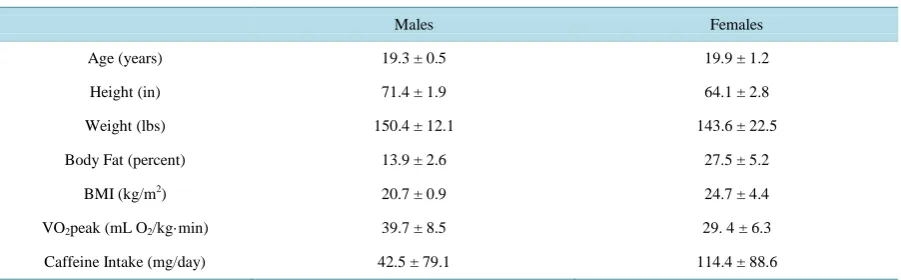
Twenty healthy undergraduate college students (16 females, 4 males) were recruited for this study. Recruitment of participants occurred through a posting on the university’s website as well as flyers posted in classrooms at the university. All participants reported they were in good health and free of any medical conditions or injuries that may be contraindications of aerobic exercise. All participants completed a caffeine intake log and a written informed consent form which was approved by the university’s Institutional Review Board. Participants were compensated with a $25 gift-card. See Table 1 for participant descriptive information.
2.2. Measures
Table 1. Participant characteristics (Means ± SD).
Males Females
Age (years) 19.3 ± 0.5 19.9 ± 1.2
Height (in) 71.4 ± 1.9 64.1 ± 2.8
Weight (lbs) 150.4 ± 12.1 143.6 ± 22.5
Body Fat (percent) 13.9 ± 2.6 27.5 ± 5.2
BMI (kg/m2) 20.7 ± 0.9 24.7 ± 4.4
VO2peak (mL O2/kg·min) 39.7 ± 8.5 29. 4 ± 6.3
Caffeine Intake (mg/day) 42.5 ± 79.1 114.4 ± 88.6
administered using Neuroscan’s STIM2 software (Compumedics Limited; Australia). The tests were projected onto a 17” computer screen in front of the participant. A 4-buttoned Compumedics Neuroscan-Stim System Switch Response Pad (Compumedics Limited; Australia) was used to record participant responses for each of the tasks.
A modified version of the Wisconsin Card Sort Task (WCST) was used in the present study. The WCST was designed to test abstract behavior and shift of set. It has been shown to be an effective measure of executive function, assessing multiple dimensions of cognition including cognitive processing speed, concept formation, inhibition capacity and cognitive flexibility [11].
The task consists of 64 stimulus cards and 4 base cards. The four base cards were always one red triangle, two yellow stars, three green crosses and four blue circles, displayed from left to right at the top of the screen. Each stimulus card had one of the four shapes (triangle, star, cross, or circle), colors (red, yellow, green, or blue) and number of objects (one, two, three, or four). The stimulus cards were displayed in the bottom right corner of the screen. The participant was told by the researcher to match the stimulus card to one of the four base cards by color, shape or number. Feedback was given as to whether the card matching was correct by a tone and the ap-pearance of the word “CORRECT” or “INCORRECT” at the top of the screen. Participants were unaware, but the computer changed the rule after ten cumulative correct placements of the cards. The test was completed after the participant successfully sorted 60 cards. The participants were allowed as long as was necessary to finish the task. Total errors from each trial were recorded as a measure of executive control. Total errors were calculated as the number of times a card was matched incorrectly based on the currently applicable rule.
The Contingent Continuous Performance Task (CPT) is an attentional task involving executive control com-ponents. To successfully complete the CPT task, inhibitory control, a part of executive control processes, must prevent mistakes [12]. The participant was presented with a series of letters flashed in the middle of the screen for 200 ms, with 1000 ms in between each letter. The instructions were to press the first button on the response pad when the target letter “T” was shown. The letter “S” always preceded the letter “T” but the display of “S” did not mean that the target letter “T” would necessarily follow. A lure occurred when the letter “S” was shown and the letter “T” did not follow. Twenty target letters and ten lures were presented in each trial of the task. Av-erage reaction time (RT) to each target letter was recorded. A false alarm (FA) was recorded anytime the partic-ipant pressed the button and the target letter “T” was not shown.
2.3. Procedures
long as possible. At the end of the trial, the breathing mask was taken off and the participant was told to contin-ue biking at 0 W. Expired gas data was used to determine VO2 peak and ventilatory threshold (VT). VT was de-termined in order to set individualized exercise intensity for each participant in the following sessions. VT is the point during graded exercise when ventilation rate increases exponentially while workload continues to increase linearly.
Sessions two through five measured cognitive function after one of four conditions: exercise + caffeine, exer-cise + no caffeine, no exerexer-cise + caffeine, no exerexer-cise + no caffeine. The order of sessions were randomly as-signed and counterbalanced so each participant took part in each of the conditions, and each session lasted eigh-ty to nineeigh-ty minutes total. Participants were told after the first session to arrive for each following session dressed in workout clothes and sneakers, ready to exercise if necessary, and ready with reading material of their choice if not asked to exercise. Participants were also asked to abstain from both caffeine and exercise for a minimum of 12 hours before testing sessions. Immediately on arriving to the lab for sessions two through five, the participant was given a colored capsule containing anhydrous caffeine (4 mg/kg body weight; NutraBio Pharmaceutical Grade Caffeine) or placebo (Arrowhead Mills Organic Brown Rice Powder). This study was double blind so the participants and first author were unaware of the contents of the capsules consumed. The capsules content was revealed upon completion of the study. Upon arriving to the laboratory for the second ses-sion, or first cognitive testing sesses-sion, participants were introduced to the cognitive tests and allowed to practice one trial each of WCST and CPT. Body composition (BMI and percentage body fat) was measured at the second session by bioelectrical impedance using a OMRON Fat Loss Monitor (OMRON Healthcare Inc; Bannockburn, Illinois).
After consuming the capsule at the start of each session, the participant was fitted with a heart rate monitor and was told to sit quietly for thirty minutes. They were allowed to read, or use a computer or other technology, but not allowed to leave the laboratory. Resting HR was recorded at the end of the thirty-minute delay. During sessions with exercise, the participant was seated on a SciFit recumbent bike (SCIFIT Systems Inc.; Tulsa, OK) and told to start pedaling. After a minute of warm-up at self-determined power, the power was increased to elicit 90%VT of the participant. Ten minutes into exercise, twenty minutes and thirty minutes (immediately before the end of exercise), HR was recorded to validate the participant was exercising at the proper intenisty. Water was offered every ten minutes but participants could choose whether or not they wanted to drink. After the exercise bout, the participant was told to dismount, offered additional water, and waited five minutes to complete the WCST and CPT. The WCST was always performed first, followed by the CPT. The participants then waited another fifteen minutes (for a total of twenty minutes post-exercise) and completed the WCST and CPT again.
During sessions with no exercise, the participants completed the same protocol, but instead of cycling for thirty minutes, they were simply asked to stay seated on the SciFit recumbent bike and quietly read for thirty minutes. The reading material was the participant’s choice. No music or technology was allowed during this thirty-minute session. After completing the thirty minutes, participants waited five minutes and completed the cognitive test battery. They then waited until twenty minutes post-exercise and completed the second round of the cognitive tests.
2.4. Statistical Analyses
To determine if there was a significant difference between the different conditions and over time for the depen-dent variables (cognitive function), a 4 (Condition: caffeine + exercise, caffeine + no exercise, exercise + no caffeine, no caffeine + no exercise) by 2 (Time: 5 min post, 20 min post) Repeated Measures General Linear Model (RM GLM) was performed. Separate RM GLM analyses were run for reaction time and false alarms from the Contingent CPT as well as for total errors from the WCST. A p value of <0.05 was used to determine if the condition, time or condition by time interaction were significant.
3. Results
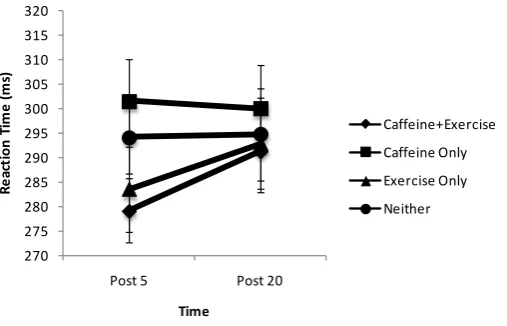
Figure 1. Reaction time for contingent CPT by condition*time.
For false alarms on the Contingent CPT a 4 (Condition) by 2 (Time) RM GLM did not reveal a significant condition effect [F(3,17) = 1.85, p= 0.176] or condition*time interaction [F(3,17) = 1.69, p= 0.206] but did re-veal a significant time effect [F(1,19) = 6.83, p= 0.017]. This suggests that on the second administration of the test (20 minutes post condition) participants performed better as indicated by fewer false alarms on the Contin-gent CPT (See Figure 2).
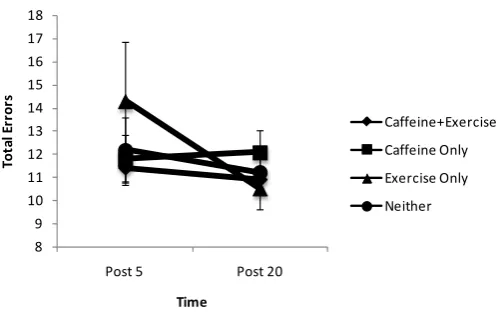
The RM GLM for total errors on the WCST did not show a significant condition [F(3,17) = 0.41, p= 0.752], time [F(1,19) = 2.25, p= 0.150] or condition*time interaction [F(3,17) = 1.09, p= 0.380]. These results demon-strate that there were no statistical differences in performance across the different conditions or over time on to-tal errors of the WCST (See Figure 3).
4. Discussion
The purpose of this study was to examine the effect of caffeine and aerobic exercise, together and separately on executive function. The current study failed to show significant differences between the four groups on any of the measures of cognitive function.
The current study showed no significant differences between conditions’ reaction times, in contrast to most research, which has shown that reaction time is faster after caffeine consumption or a bout of aerobic exercise. Previous studies have found reaction time to be faster following exercise Davranche and McMorris [1] [4]
[13]-[15] and caffeine consumption [7][11][16][17]. Crowe, Leicht, and Spinks [18] examined the effects of
caffeine consumption and anaerobic exercise, and found no differences in reaction time between groups which is consistent with the findings of the current study.
For the false alarms portion of the Contingent CPT, there was a significant time effect, but not an effect for condition. All conditions decreased from 5 minutes after exercise or quiet reading to 20 minutes after exercise or quiet reading, displaying a possible learning curve. The measurement of false alarms is a measure of selective inhibition because irrelevant stimuli must be inhibited in order to decrease the false alarms score. The lack of a condition effect in the current study is similar to other previous research which showed no differences in meas-ures of selective inhibition [13][19] In contrast to the results from the current study, several studies have shown an improvement between conditions after exercise [9] [20] [21] and Childs and de Wit [7] also saw an im-provement in inhibition following the consumption of caffeine. Hogervorst et al. [10] also found greater inhibi-tion in a group that received a combinainhibi-tion of caffeine and exercise.
Once again this study showed differences by condition or time on performance of the WCST as measured by total errors. The WCST is used to measure of executive function, specifically planning, set shifting, working memory and goal directed behavior [11]. In contrast to the findings of the current study, previous research has found improvements in executive function following exercise [4][22] and caffeine consumption [7][17]. How-ever, the findings of the current study are consistent with other studies which have not found a difference after caffeine consumption [11][16].
The current study does have some limitations. The findings of the current study were based on a small number of participants, potentially influencing the non-significant findings. Though the number of participants in the
270 275 280 285 290 295 300 305 310 315 320
Post 5 Post 20
Re
ac
tio
n
Ti
m
e (
m
s)
Time
Figure 2.False alarms for contingent CPT by condition*time.
Figure 3.Total errors for Wisconsin card sort task by condition*time.
current study is similar to many of the previous research studies, it is possible that some of the results in the current study would have been statistically significant with a larger sample size. Another limitation may have come been the dosages of caffeine and exercise that were prescribed to the participants. Previous research has used a wide variety of intensities of exercise and dosages of caffeine. This study attempted to normalize caffeine and exercise based on the individual, but a lower intensity of exercise or higher dose of caffeine may have been better to show the differences hypothesized. A final limitation may have been the measures of cog-nitive function utilized in the present study. While the Contingent CPT and WCST are valid and reliable tests of cognitive function, other measures of cognitive function might be more sensitive to the influence of exer-cise and caffeine.
5. Conclusion
In this current study, there were no significant differences found for the three variables tested-total errors on the WCST, and reaction time and false alarms on the Contingent CPT, for condition effect, time effect or condi-tion*time interaction, except for a significant time effect on false alarms on the Contingent CPT. There are many variables that may account for the variability in results seen in research studying at the effects of caffeine and exercise, individually and combined, on cognitive function. The lack of consistency points to the need for more research.
Acknowledgements
The authors would like to thank the Elon University Honors Program and Undergraduate Research Program for support which included funding for a Summer Undergraduate Research Experience.
0.00 0.20 0.40 0.60 0.80 1.00 1.20 1.40
Post 5 Post 20
Fal
se
A
lar
m
s
Time
Caffeine+Exercise Caffeine Only Exercise Only Neither
8 9 10 11 12 13 14 15 16 17 18
Post 5 Post 20
To
ta
l E
rr
or
s
Time
[image:6.595.188.440.268.425.2]References
[1] Davranche, K. and McMorris, T. (2009) Specific Effects of Acute Moderate Exercise on Cognitive Control. Brain and
Cognition, 69, 565-570. http://dx.doi.org/10.1016/j.bandc.2008.12.001
[2] Lambourne, K., Audiffren, M. and Tomporowski, P.D. (2010) Effects of Acute Exercise on Sensory and Executive Processing Tasks. Medicine & Science in Sports & Exercise, 42, 1396-1402.
http://dx.doi.org/10.1249/mss.0b013e3181cbee11
[3] Tomporowski, P.D. (2003) Effects of Acute Bouts of Exercise on Cognition. Acta Psychologica, 112, 297-324. http://dx.doi.org/10.1016/s0001-6918(02)00134-8
[4] Pontifex, M.B., Hillman, C.H., Fernhall, B., Thompson, K.M. and Valentini, T.A. (2009) The Effect of Acute Aerobic and Resistance Exercise on Working Memory. Medicine & Science in Sports & Exercise, 41, 927-934.
http://dx.doi.org/10.1249/MSS.0b013e3181907d69
[5] Chang, Y.K., Labban, J.D., Gapin, J.I. and Etnier, J.L. (2012) The Effects of Acute Exercise on Cognitive Performance: A Meta-Analytic Review. Brain Research, 1453, 87-101. http://dx.doi.org/10.1016/j.brainres.2012.02.068
[6] Brunyé, T.T., Mahoney, C.R., Lieberman, H.R. and Taylor, H.A. (2010) Caffeine Modulates Attention Network Func-tion. Brain and Cognition, 72, 181-188. http://dx.doi.org/10.1016/j.bandc.2009.07.013
[7] Childs, E. and De Wit, H. (2006) Subjective, Behavioral, and Physiological Effects of Acute Caffeine in Light, Non-dependent Caffeine Users. Psychopharmacology, 185, 514-523. http://dx.doi.org/10.1007/s00213-006-0341-3
[8] Fine, B.J., Kobrick, J.L., Lieberman, H.R., Marlowe, B., Riley, R.H. and Tharion, W.J. (1994) Effects of Caffeine or Diphenhydramine on Visual Vigilance. Psychopharmacology, 114, 233-238. http://dx.doi.org/10.1007/BF02244842 [9] Hogervorst, E.E., Riedel, W.J., Kovacs, E.E., Brouns, F.F. and Jolles, J.J. (1999) Caffeine Improves Cognitive
Perfor-mance after Strenuous Physical Exercise. International Journal of Sports Medicine, 20, 354-361. http://dx.doi.org/10.1055/s-2007-971144
[10] Hogervorst, E., Bandelow, S., Schmitt, J., Jentjens, R., Oliveira, M., Allgrove, J., Carter, T. and Gleeson, M. (2008) Caffeine Improves Physical and Cognitive Performance during Exhaustive Exercise. Medicine & Science in Sports &
Exercise, 40, 1841-1851. http://dx.doi.org/10.1249/MSS.0b013e31817bb8b7
[11] Adan, A. and Serra-Grabulosa, J.M. (2010) Effects of Caffeine and Glucose, Alone and Combined, on Cognitive Per-formance. Human Psychopharmacology, 25, 310-317. http://dx.doi.org/10.1002/hup.1115
[12] Smid, H.G., de Witte, M.R., Homminga, I. and van den Bosch, R.J. (2006) Sustained and Transient Attention in the Continuous Performance Test. Journal of Clinical and Experimental Neuropsychology, 28, 859-883.
http://dx.doi.org/10.1080/13803390591001025
[13] Davranche, K., Hall, B. and McMorris, T. (2009) Effect of Acute Exercise on Cognitive Control Required during an Eriksen Flanker Task. Journal of Sport & Exercise Psychology, 31, 628-639.
[14] Pesce, C., Capranica, L., Tessitore, A. and Figura, F. (2002) Focusing of Visual Attention under Submaximal Physical Load. International Journal of Sport Psychology, 1, 275-292. http://dx.doi.org/10.1080/1612197X.2003.9671719 [15] Pesce, C., Tessitore, A., Casella, R. and Capranica, L. (2007) Focusing of Visual Attention at Rest and during Physical
Exercise in Soccer Players. Journal of Sports Sciences, 25, 1259-1270. http://dx.doi.org/10.1080/02640410601040085 [16] Durlach, P.J. (1998) The Effects of a Low Dose of Caffeine on Cognitive Performance. Psychopharmacology, 140,
116-119. http://dx.doi.org/10.1007/s002130050746
[17] Giles, G.E., Mahoney, C.R., Brunyé, T.T., Gardony, A.L., Taylor, H.A. and Kanarek, R.B. (2012) Differential Cogni-tive Effects of Energy Drink Ingredients: Caffeine, Taurine and Glucose. Pharmacology Biochemistry and Behavior,
102, 569-577. http://dx.doi.org/10.1016/j.pbb.2012.07.004
[18] Crowe, M.J., Leicht, A.S. and Spinks, W.L. (2006) Physiological and Cognitive Responses to Caffeine during Re-peated, High-Intensity Exercise. International Journal of Sport Nutrition and Exercise Metabolism, 16, 528-544. [19] Hillman, C.H., Snook, E.M. and Jerome, G.J. (2003) Acute Cardiovascular Exercise and Executive Control Function.
International Journal of Psychophysiology, 48, 307-314. http://dx.doi.org/10.1016/s0167-8760(03)00080-1
[20] Lichtman, S. and Poser, E.G. (1983) The Effects of Exercise on Mood and Cognitive Functioning. Journal of
Psycho-somatic Research, 27, 43-52. http://dx.doi.org/10.1016/0022-3999(83)90108-3
[21] Sibley, B.A., Etnier, J.L. and Le Masurier, G.C. (2006) Effects of an Acute Bout of Exercise on Cognitive Aspects of Stroop Performance. Journal of Sport & Exercise Psychology, 28, 285-299.
[22] Tomporowski, P.D., Cureton, K., Armstrong, L.E., Kane, G.M., Sparling, P.B. and Millard-Stafford, M. (2005) Short- Term Effects of Aerobic Exercise on Executive Processes and Emotional Reactivity. International Journal of Sport