The application of natural language pragmatics in
human-computer interaction.
ELLIOT, Charles.
Available from Sheffield Hallam University Research Archive (SHURA) at:
http://shura.shu.ac.uk/19612/
This document is the author deposited version. You are advised to consult the publisher's version if you wish to cite from it.
Published version
ELLIOT, Charles. (1993). The application of natural language pragmatics in human-computer interaction. Doctoral, Sheffield Hallam University (United Kingdom)..
Copyright and re-use policy
c , rr,PH Hallam University Sheluen) na . . k ubrar
Haliamshi.e .justness
1 ■ v U D ier b iiv 't 8HD
1 0 1 923 2 3 9 0
Sheffield City Polytechnic Library
ProQuest Number: 10694493
All rights reserved
INFORMATION TO ALL USERS
The quality of this reproduction is dependent upon the quality of the copy submitted.
In the unlikely event that the author did not send a com plete manuscript and there are missing pages, these will be noted. Also, if material had to be removed,
a note will indicate the deletion.
uest
ProQuest 10694493
Published by ProQuest LLC(2017). Copyright of the Dissertation is held by the Author.
All rights reserved.
This work is protected against unauthorized copying under Title 17, United States C ode Microform Edition © ProQuest LLC.
ProQuest LLC.
789 East Eisenhower Parkway P.O. Box 1346
The Application of Natural
Language Pragmatics in
Human-Computer Interaction
Charles Elliot
B.A.hons., M.Phil., M.Sc.
A thesis submitted in partial fulfilment of the requirements of Sheffield Hallam University
for the degree of Doctor of Philosophy
February 1993
A '
Table of Contents
Page
Acknowledgem ents 6
Abstract 7
1. Introduction 8
1.0 Aims and Motivations 8
1.1 Methodology 10
1.2 Structure 11
2. The Natural Language Paradigm 14
2.0 Introduction 14
2.1 Against Natural Language Interaction 16
2.2 Natural Language Applications 18
2.3 Natural Language Pragmatics 21
2.4 The Cooperative Principle 23
2.5 Exploitation 26
2.6 Conversational Implicature 26
2.7 Mood Restrictions 27
2.8 Applying the Maxims to Non-NL HCI 27
3. User Errors 32
3.0 Introduction 32
3.1 The System Perspective 33
3.2 Error Classification 34
3.3 The Linguistic Classification of Error 38
3.5 Why Users Make Context Errors 3.6 The Pragmatics of Context Error 3.7 Context Error: Problem Solved?
42 43 44
4. User Models 48
4.0 Introduction 48
4.1 Realistic Models 51
4.2 How It Works versus How to Do It 53
4.3 State and Functional Models of A System 54
4.4 Modelling Users' Misconceptions 54
4.5 The User's Mental Model 57
4.6 Generating Possible Worlds 59
4.7 Conversational Implicature and Possible Worlds 62
5. User Support 64
5.0 Introduction 64
5.1 The Importance of Usability 65
5.2 Intrinsic Factors 66
5.3 State Oriented Feedback 67
5.4 Training 68
5.5 Documentation 68
5.6 On-line Support 70
5.7 Intelligent Help Systems 71
5.8 Examples of Intelligent Help Systems 74
5.9 The Design of an Intelligent Context Error Assistant 78
6. Implementation 8 6
6.0 Introduction 86
6.1 The UNIX® File System 87
6.2 The Simulation 87
6.3 UNIX® Error Classification 89
6.5 Error Analysis 6.6 Error Messages
6.7 The Program Modules
90 91 92
7. Evaluation 101
7.0 Introduction 101
7.1 Formal Methods 102
7.2 Experimental Methods 105
7.3 Observational Methods 107
7.4 Experimental Task 111
7.5 Subjects 111
7.6 Experimental Design 112
7.7 Results and Evaluation 113
7.8 Protocol Analysis 115
7.9 Methodology 116
7.10 Subjects 116
7.11 Results 117
7.12 Summary 127
7.13 Conclusions 128
8. Conclusion 132
8.0 Review 132
8.1 The UNIX® Experience 133
8.2 WIMPS Interfaces 142
8.3 Error Messages 144
8.4 Possible Further Developments 145
8.5 Concluding Remarks 146
R eferences 148
Appendices 165
Appendix A: Code Listings 166
Appendix B: Questionnaires 197
Appendix C: Task Specification 218
Appendix D: Startup Diagram 220
Appendix E: Target Diagram 222
Appendix F: Tutorial Material 224
Appendix G: Command List 227
Appendix H: Directory Structure Diagram 230
Appendix I: Experimental Logs 232
Appendix J: Protocol Logs 245
Appendix K: Commentaries 277
Acknowledgements
Abstract
The general aim of the work reported in this thesis is to investigate the viability of applying theories and principles from the field of natural language pragmatics to that of human-computer interaction. In pursuing this aim, the research falls broadly into three phases.
The first of these is the exploitation and adaptation of the Gricean Cooperative Principle, its maxims and inferential rules to situations of computer use which do not employ natural language as the medium of communication. The purpose of this endeavour is to provide a novel and revealing analysis of non natural language interaction and to establish principles for dialogue design, the application of which enhance the quality of communication between system and user in such situations.
The second phase concerns the application of the adapted Gricean principles to the design of a dialogue management system, intended to address some of the problems which other research has revealed users to experience in using the standard UNIX® shell interface. This second phase resulted in the production of the QDOS system, which is both a simulation of part of the UNIX® file system and an implementation of the proposed dialogue management system.
This software acts as the vehicle for all subsequent evaluative exercises constituting the third phase. This takes the form of an evaluation of the QDOS system and its theoretical underpinning, based on a two-condition experiment and a protocol analysis, involving a number of experimental subjects.
1. Introduction
1.0 Aims and Motivations
The general aim of the work described in this thesis is to investigate the relationship between natural language communication and that occurring in human-computer interaction (HCI). In particular, an attempt is made to demonstrate that certain aspects of natural language communication, namely the pragmatic factors in interpretation evident in descriptions of natural language communication, are applicable to the HCI context and that a comparative study provides insights into the processes involved in HCI, leading to conclusions of significance to issues relating to the usability of computer systems.
The aims of the project described here have been motivated by three basic factors. The first of these is the conviction that the study of natural language, especially natural language pragmatics, can provide valuable insights into some of the issues involved in the study of human-computer interaction. Although there has been a significant amount of research on natural language and its relation to human-computer interaction prior to that reported here, much of this work has concentrated either on lexical and syntactic factors or on the problems inherent in computerised natural language processing. One of the aims here has been to conduct some investigation into the application of pragmatic aspects of natural language theory to non-natural language forms of human-computer interaction.
computer usage which indicate similarities between certain situations which occur in human-computer interaction and human-human interaction, especially with regard to miscues, misconceptions and errors. It is also suggested that these cases, where the human-computer dialogue breaks down, provide a particularly interesting view of the communication process taking place between user and machine for the HCI practitioner, in that they often expose to scrutiny aspects of the process which would go unnoticed during 'normal', unbroken spells of dialogue. It is not safe to infer from an unbroken dialogue that all is well. Users may be being forced to compensate and compromise in all sorts of ways by an interface design which they find unnatural, awkward or inflexible. It is not that investigations of 'normal' usage are not designed to reveal such interface characteristics but it is suggested that such methods provide a less direct form of access to them.
The third motivational factor is admittedly a rather negative one but is just as important. In recent years, it has become increasingly common to see computer manufacturers and software companies converting their machines and applications to what is variously called the 'graphical', 'iconic', 'direct manipulation' or 'WIMP' user interface. W hether these terms denote the same thing is a non-trivial question and will not be addressed here but what is usually meant is an interface like that found on the Apple Macintosh computer. While the popularity of such a move is to some extent justified, there are a number of accompanying assumptions which are not at all tenable.
The worst of these, while admittedly anecdotal, is discernible, at least in the lay population and is that most of the main issues and problems in interface design have been solved or are solvable by the adoption of the graphical user interface (GUI). I know that I am far from alone in having struggled with a Macintosh Plus for months before many aspects of its usage revealed themselves.
the use of a tool, in the same way that someone might use an electric drill, and that (perhaps as a consequence) interaction with a computer is not in any way a communicative process like talking to another person or that all similarities between natural language use and computer use are absent in the GUI. Beside the fact that existing GUIs actually embody a number of non-graphical means of interaction to which the non-linguistic or ’tool' metaphor is inappropriate, computers differ from other devices in being non-dedicated or multi-purpose and are used now in a multitude of tasks, each with its own particular demands and requirements. It is unlikely, to say the least, that a single interface ’metaphor', such as that of the 'tool', is capable of providing suitable interaction facilities for all eventualities. Thus, one of the aims of this research has been to suggest how communicational issues concerning human-computer interaction cut across issues of interface style.
1.1 M ethodology
The basic methodology adopted in the research has been to try to analyse some form of communicative breakdown between computer and user by applying the theoretical constructs of natural language pragmatics. The resulting analysis then forms the basis for recommendations or requirements for certain facets of interface design. Both the design and the analysis are subjected to evaluation; the design by experimental methods and the analysis by observational means.
We hope to demonstrate that, in terms of pragmatics, there are many similarities (as well as some differences) between human-human and human-computer communication and that the exploitation of these similarities can significantly influence decisions concerning dialogue design in the human-computer interface. In particular, it will be shown that principles assumed to be guiding cooperative communication in contexts of natural language use may be adapted and applied in order to render the computer's participatory role in the human-computer dialogue similarly cooperative.
1.2 Structure
The thesis is divided into eight chapters, each dealing with a different aspect of the research. The literature survey is integrated into each chapter and its particular topic, rather than occupying its own section. Following this introductory chapter, Chapter 2 looks at natural language communication, its relation to human-computer interaction and some of the attempts that have been made to mould human-computer communication along the lines of that which occurs between humans through natural language. Some objections to this endeavour are considered and conclusions are drawn as to the circumstances and conditions which govern the applicability of the natural language paradigm to hum an-com puter interaction. The concept of natural language pragmatics is introduced, in particular, the theory of conversational implicature as constituting the underlying principles of communicative cooperation and the application of these principles to human-computer communication is considered.
analysed using the theoretical constructs discussed in Chapter 2. Conclusions are advanced for the implications that this analysis has for dialogue design.
Chapter 4 identifies the requirement of user modelling as a consequence of the need for the interface component to behave intelligently and
cooperatively. Classifications of user models are compared and desiderata
are presented for the user modelling enterprise. The notion of the user's Conceptual model is discussed and an informal approach to modelling user misconception concerning the device, based on a 'possible worlds' model of belief systems, is presented. The theoretical question of generating possible world models of user misconception is addressed.
Chapter 5 discusses issues of user support and the various methods employed to aid users in learning and utilising computer applications are considered. The importance of user support, as a factor of usability, is stressed and the relative effectiveness of various approaches to user support is estimated. The requirement for intelligence in the interface is identified and some examples of intelligent interface components are reviewed. The design of an intelligent interface component, based on the analysis of the previous two chapters is discussed.
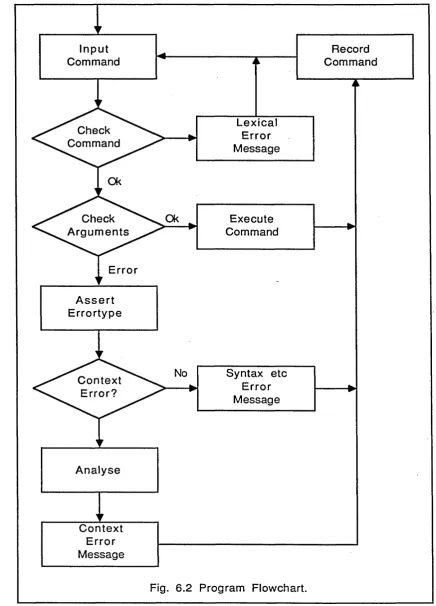
The implementation of a test bed, prototype interface, as part of a simulation of the UNIX® file system is described in Chapter 6. This simulation is used for evaluation purposes in the project. The processing which the user support component undertakes on user errors is explained, as are any deviations from the design. Some explanation of the actual code found in the appendices is included to enable the reader to refer easily to this if required.
2. The Natural Language Paradigm
This chapter looks at natural language communication, its relation to human-computer interaction and some of the attempts that have been made to make human-computer communication like that which occurs between humans through natural language. Some objections to this endeavour are considered and conclusions are drawn as to the circumstances and conditions which govern the applicability of the natural language paradigm to human-computer interaction. The concept of natural language pragmatics is introduced, in particular, the theory of Conversational Implicature as constituting the underlying principles of communicative cooperation and the application of these principles to human-computer communication is considered.
2.0 Introduction
human-computer interaction (HCI).
In the early days of computing, the medium of communication was restricted to numerically coded instructions. The difficulty of using this language and its error-prone nature led to the development of assembler mnemonics, these having the advantage of greater semantic significance for the human programmer. Assembly language is still in use, but has largely given way to high level languages whose formalisms, on the whole, are intended to make their functions more obvious and more powerful.
It is not difficult to detect in these changes the way in which the communicative media have become increasingly like natural language (NL). The use of control structures such as DO UNTIL, WHILE DO, BEGIN END, LET and so on are testimony to a tendency which is, perhaps, currently, taken farthest in the Hypertalk© programming language (Weiskamp & Shammus, 1988). However, high level languages are small, highly formalised and very restrictive when compared with natural languages and the question arises of whether this tendency could and should be taken to its logical conclusion by using natural language as a medium for HCI, both for programming and in more generalised contexts of computer use. The apparent attractiveness of this proposal lies in the fact that it is a medium of which the great majority of people already have an excellent grasp, whereas most other forms of interaction have to be painstakingly learned. Thus, should this goal be realised, anyone with an average grasp of a natural language could program or use a computer without training.
2.1 Against Natural Language Interaction
The adoption of NL as a paradigm for human-computer interaction has been opposed on various grounds. Hill (1983) argues against the adoption of NL as a programming language, mostly on the basis of its inherent ambiguity and imprecision and it must be admitted that little justification can be found for the introduction of such features into what is intended to be a precise activity. NL is also rather verbose compared to most programming languages and advantages of familiarity also have to be weighed against the loss of conciseness.
Green (1986) argues that interaction models using NL-like grammars are inferior to event driven models because they cannot be made to represent multi-threaded dialogues. Models of HCI need to be able to handle non-linear interactions because of the existence of multi-tasking systems which allow users to switch between tasks at any point, for example, by activating a window associated with a different process. A similar point is made by Buxton (1987) who states that the development of novel interaction media is stifled by the adherence to characterisations of HCI based on NL, rather than on task domains.
Other critics attack from a more philosophical point of view. Flores and Winograd (1986) pitch their critique at the prospects for natural language understanding and claim that the basic aim is misguided, in that human communicative abilities are unique to the species and that machines cannot, in principle, be imbued with such powers. Their arguments are based on a
rejection of what they call the rationalist tradition which, they insist, treats
language as a formal system; a view which they eschew in favour of an ethnomethodologically-based alternative which sees language as a product of the essentially social nature of humankind and our position in the evolutionary context.
foreseen. Also, the remarks only pertain to full NL processing, while it will be argued below that this all or nothing approach is unnecessary in the broader HCI context (Harris, 1983: p. 73). Besides, as Harris points out, in many HCI contexts, the semantic domain is restricted enough to rule out ambiguity.
The point made by Green is aimed at the representation of HCI using formal grammars and not specifically at NL interaction but the point can be taken to apply to any grammatically based NL interface. It should not be thought of as a general criticism, however. NL does not consist entirely (if at all!) of phrase structure rules and if one actually looks at NL usage, copious examples of interleaving dialogues and parallelism can be found. Non-segmental features such as intonation and stress can also be seen as parallel transmission channels and it has also been argued that phonemic assimilation is evidence for the non-seriality of NL (Edmondson, 1989).
2.2 Natural Language Applications
To start, some important distinctions must be made between the various types of application to which NL has been or might be put. (We will ignore the question of speech recognition and synthesis, since the success or failure of those ventures affects only the convenience with which NL input and output could be achieved. While this may influence decisions concerning the suitability of NL as a HCI medium, it is not at the heart of the issue being discussed here).
Firstly, there are those systems which are designed to 'understand' NL by mapping NL input onto some real world model. Winograd's SHRDLU (Winograd, 1972) embodies such an attempt. This kind of application is intended to mimic the human ability to provide a semantic interpretation to NL utterances or inscriptions. This is undoubtedly the most ambitious kind of application and such success as has been enjoyed relies to a large degree on tight restrictions on allowable syntactic and semantic domain. One ambition level down from this is the NL database query system, where the mapping occurs between NL and some formal database query language such as SQL (which itself embodies a certain amount of NL mimicry). LUNAR (Woods, 1972) is an example of this approach. Natural language is also implicated in the use of grammars and equivalent formalisms to model interactive processes in task analysis, in that these are intended to describe a
user's knowledge in terms of an interaction language (Green et al, 1988).
Such models trade on the notion of a user’s putative linguistic competence (Chomsky, 1965) and when applied to dialogue design, can be seen as imposing an NL like structure on interactive processes. At the simplest level, use may be made of NL lexicon and syntax to provide a degree of mapping between command function and NL semantics. Thus, the influence of NL on HCI may be viewed as operating on a continuum from the use of simple and fixed constructions and small domains towards full NL functionality (Harris, 1983).
important to consider types of usage if the relevance of NL to HCI is to be correctly assessed. The relative success of NL database query systems owes much to the inherent similarities between such interactions and a particular and restricted kind of everyday human communication (i.e. question and answer), while the use of a computer aided design (CAD) package, for example, bears little resemblance, at least on the surface, to anything remotely like human discourse. The futility of designing an NL interface to CAD software is left to the reader’s imagination. The point being made here resonates with Kammersgaard’s distinction between the ’dialogue partner’ and 'tool' perspectives of HCI (Kammersgaard, 1990). It is unrealistic to expect human-computer interaction to be best facilitated in all cases by the detailed mimicking of human-human communication.
The issue is also taken up by Buxton (1987), who stresses that forms of interaction other than NL are just as 'natural' and that a true 'natural language' system is only achieved when the language employed is suited to the task. However, decisions concerning the most suitable language for a
particular task domain must be made largely on an empirical rather than a
priori basis. It may be possible to rely on some metaphor taken from an existing manual system but such metaphors are not always available and in any case, this approach may be limiting, in that the potential benefits of task redesign in the computer context are lost. If Buxton’s remarks are intended to encourage research into alternative interaction 'languages’, then they are well taken. However, his sword is double edged, in that we must take his exhortations to include the investigation of all language types, including NL, and their relationship to task domains.
requires the use of a menu and dialogue boxes. This ambiguity is not accounted for by the failure of the designers to fully implement the object metaphor but is rather the failure of the metaphor to cover the full range of communicational phenomena inherent in kinds of interaction people have with computers and the tasks that are thereby undertaken (Sanford & Roach, 1988; p. 568).
The argument may be further elaborated by pointing out that it is not necessary to treat NL as an indivisible whole. Certain facets may be widely applicable in the context of HCI or applicable to certain task domains. The point again is that the application of NL to HCI is not necessarily an all or nothing proposition. The rationale behind NL interfaces is the familiarity of the interaction medium for the user. The issue of whether familiarity of particular NL characteristics can carry over to HCI or particular task domains within it effectively is one which should be addressed separately. As has been indicated above, advances have already been made in system usability merely by the exploitation of simple lexical and syntactic verisimilitude. Simply replacing obscure command language constructions such as R/TOOTH/,/TRUTH/ with the English equivalent: REPLACE ’TOOTH' with 'TRUTH', can improve users’ performance with a word
processor (Ledgard et al, 1980), although it must be said that this effect is
not as straightforward as it might seem (Landauer, 1990; p. 145).
2.3 Natural Language Pragmatics
It is not at all easy to give a precise and comprehensive definition of the term ’pragmatics' (Levinson, 1983) and no attempt will be made to provide one here. The term is used to refer to a number of phenomena, associated with natural language and communication in general, which share certain features but which also possess contrasting ones. It is the attempt to capture both the similarities and discrepancies under a single definition and the fact that such definitions tend to stray across the boundaries of other disciplines which gives rise to this difficulty. For example, deixis is a phenomenon which has certainly been studied under the rubric of pragmatics but is also central to truth-conditional semantics in that sentences containing deictic expressions cannot be assigned truth-conditions without knowledge of the referents involved in a particular context of utterance. 'I am the first man in the world to run a sub four minute mile’ can only be truly uttered by one person and it is necessary to know who uttered this sentence to decide its truth value. Thus the distinction between semantics and pragmatics can be blurred.
Also, certain kinds of pragmatic phenomena seem to be attached to particular lexical items. The conveying of contrast between the two conjuncts in the sentence 'I'm going out but I won't be long' is not captured in a truth-conditional account of meaning and so is ostensibly within the realm of pragmatics. However, pragmatic phenomena are by no means restricted to the effects of particular words and linguistic and non-linguistic context can determine the significance of a sentence by more than the reference of indexical expressions. Consider the following exchange:
A: 'Would you like a drink?' B: 'Is the Pope Catholic?'
Catholic?'". It is A's 'world knowledge' and belief that B is not being deliberately obtuse which B is relying for A to receive B's intended meaning.
While there is a strong sense that the kind of phenomena under discussion at least have a common relation to the notion of the interpretative process which operates on the raw material of semantic content, there seems to be no unifying principle which enables them to be treated homogeneously and perhaps, attempts to do so stifle rather than facilitate progress. For our purposes it is only necessary to note the kind of interpretations which take place and make use of some of the explanations which have been put forward for them, without having to justify their pragmatic credentials (whatever this turns out to mean) or arguing which theory best explains particular phenomena. For this reason, no attempt is made here to explain or justify the various theories and their place in pragmatics in general. For the most part, the theory of Conversational Implicature (Grice, 1975) will be alluded to in explanation of such pragmatic phenomena as reveal themselves, while it is acknowledged that the theories of speech acts, presupposition or discourse analysis may have as much to say about them.
Notwithstanding the disputes concerning the appropriateness of NL models of HCI, one point about which there seems to be little disagreement is that, given the dialogue partner perspective, the computer side of the communication ought to exhibit a degree of co-operation comparable to that which could be expected from a human being (Pinsky, 1983). This kind of co-operation is nicely captured in Grice's cooperative maxims
(ibid) which, because they are based on an idea of rational and maximally efficient co-operative communication, are purported to apply to
communication per se and not just to NL. If the intention then is to render
2.4 The Cooperative Principle
The Cooperative Principle is intended to embody rational considerations as guidelines for the effective and efficient use of language in conversation to further cooperative ends (Levinson 1983: p.101). It is expressed as follows:
The cooperative principle:
Make your contribution such as is required, at the stage at which it occurs, by the accepted purpose or direction of the talk exchange in which you are engaged.
The generalised cooperative principle is elaborated by reference to a set of maxims which a cooperative dialogue partner is expected and assumed to follow or exploit.
These are:
The maxim of Quality:
Try to make your contribution one that is true, do not say what you believe to be false and do not say that for which you lack evidence.
The maxim of Quantity:
Make your contribution as (but not more) informative as is required for the current purposes of the exchange.
The maxim of relevance:
Make your contribution relevant.
The maxim of Manner:
Avoid obscurity and ambiguity, be brief and orderly.
example that someone has six children or received a fine in court, we naturally infer an implicit ’only' and would consider such information misleading if we were to find out that the said person had in fact ten children or had also been imprisoned for eighteen months, although what we were actually told was true. On the other hand, the principles also guide us in what to say. They are guidelines for both encoding and decoding extra-literal content.
The idea also has some possible design implications in that it might be possible to adapt conversational maxims to non-NL HCI contexts for the purpose of producing guidelines for the dialogue. In conversation, people are naturally disposed, both in speaking and in listening, to use conversational maxims such as be brief, relevant, orderly and so on. If people were also inclined to expect the same ’rules’ to apply in the HCI context, then an interface which paid no heed to them would be inherently less usable than one which was in-tune with them. In reference to human-computer dialogues, conversational maxims probably constitute the most pertinent and accurate interpretation available of that much abused phrase ’user-friendly'. It should not be thought that this train of thought is in any sense original. Human-like cooperativeness is an oft expressed
desideratum in HCI. It is not that the goal has not been stated often enough but that there seems to have been precious little concrete progress in achieving it.
Quite understandably, these ideas have been investigated in the context of NL interfaces. For example, Allen (1983) uses utterance or utterance fragments to infer users’ travel plans. Users’ plans will inevitably involve such contextual features as times of train departures, platform numbers and so on. If there is a contextual obstacle to a plan, a feature which might block its execution such as a train cancellation or a change of platform, then this fact is supplied to the user.
passing a certain course in a certain year, the number with a grade higher than 50 and the number of referrals. If it happened that the course had not been run in that year, an uncooperative system might just give the answer ’O'. But by looking at the implications (they might actually be classified as presuppositions, implicatures or perhaps felicity conditions) of the users’ queries the behaviour of the system can be made more consistent with what might be expected from a human interlocutor.
In both of these examples, the general idea is that users’ NL input is interpreted as implying certain contextual features which are compared against the world as seen by the system. Any discrepancies must be negotiated for or with the user. In the case of NL interfaces, the procedure for interpretation can exactly follow the linguistic paradigm.
The procedure or ’rules’ for deriving such inferences or Gricean conversational implicatures runs as follows:
1) S has said that P.
2) I assume that S is cooperating.
3) For 1 and 2 to be true S must think that Q. 4) S knows that 3 is mutual knowledge.
5) S has not indicated that Q is false. 6) Therefore S intends me to think that Q.
2.5 Exploitation
One of the most interesting facets of Gricean implicature, as far as NL is concerned, is the way that the maxims may be flouted or exploited for communicative purposes. For example, irony or sarcasm can be achieved merely by saying something that one obviously believes to be false or something with such a consequence: if a teacher says ’good afternoon Smith' to a pupil arriving late for a morning class, the implication would not be that the teacher thinks it is past noon. While one of our aims may be that of making computers behave less literally, (Jerrams-Smith, 1985: Houghton, 1984: Lewis & Norman, 1987) interpreting sarcasm seems a little superfluous to a computer system except perhaps by way of research into the mechanisms of pragmatic inference.
2.6 Conventional Implicature
Grice states that certain implicatures stem from particular lexical items and expressions and these are termed conventional implicatures. Such items as but, even and yet have been suggested as giving rise to conventional implicature in that they possess a component over and above their truth-conditional contribution to a sentence. (Reichman, 1985) makes use of such structural elements in the analysis of discourse structure). For
example, but has the truth-conditional meaning of conjunction but also
signals contrast. These items are often used to convey an attitude on the part of the speaker towards the information being conveyed.
2.7 Mood Restrictions
Another way in which NL dialogues can differ from others is that the former may involve different declarative, interrogative and imperative sentence types. These are referred to under the grammatical classification
of mood and are closely connected to the ’speech acts' (Austin, 1962;
Searle, 1969) of assertion, question and request but are not tied strictly to these. For example, the question ’do you know the time?’ is not adequately dealt with as a speech act by responding to its interrogative form. Therefore, the answer 'yes’ would be considered uncooperative unless asked with the obvious intention of ascertaining whether someone who needed specifically to know the time knew it. Similarly, 'I wonder if you might tell me the time’ has the grammatical form of a declarative but also instantiates a request in speech act terms. Indirect speech acts are often involved in 'politeness conventions' in English.
In non-NL interaction, such variations are not applicable. As the name suggests, command languages are based on the view of the dialogue as a series of commands by the user, perhaps followed by a report of success or error by the system. Whether a user's intentions are signalled in one mood or another is of no account to the system and so have no functional role in the dialogue. Neither does there seem to be any cause to imbue direct manipulation or WIMP style interaction with this kind of subtlety of expression. Thus non-NL interaction should not require the kind of reasoning processes needed by NL interfaces which attempt to interpret indirect speech acts such as these in user input (but see Ehrich et. al.,
1986).
2.8 Applying the Maxims to Non-NL HCI
know me to be a competent native speaker of English, you will not tend to suspect that I do not understand the meaning of the words I have used but if I were not, then that would be conceivable. A much more radical scepticism would involve the possibility that I might be following an alternative cooperative convention or conversational maxim.
Let it not be thought that my utterance embodies an untruth. Having six 'O' levels entails having four. The reason that my utterance is misleading is that there is an expectation that I will follow a certain cooperative convention, the Quantity maxim in Grice's terms, which instructs me to say the 'strongest' thing I know to be true. This expectation is so deeply ingrained that, given the situation described, it is the last thing you would think of questioning, if you ever did at all. That is why it can seem like a matter of logical implication when it is not, which can be shown by the following:
(1) My brother has four 'O' levels, if not more. (2) *My brother has ten 'O' levels, if not eight.
If my utterance meant or logically entailed that my brother has ONLY four 'O' levels then (1) would be as anomalous as (2).
Suppose that you knew
a) that I knew the facts of the matter.
b) that I knew that you knew the facts of the matter.
It is highly likely that you would still assume that I was cooperating but you would be forced to make inferences about what I intended to convey in order to maintain this assumption. The relevant maxim would ensure that,
as well if universally adopted but would be less useful since the information conveyed would be less precise than in the case of the actual convention. The point of all this is to indicate that there are in fact a number of ways of reasoning about the intended meaning of an utterance if we are prepared to be a little perverse. Non-NL HCI may have its own pragmatics. When the literal content of an utterance is anomalous in some way, there are various ways of interpreting the situation:
i) Exploitation. ii) Misuse of terms.
iii) Alternative convention. iv) Factual Error.
v) Mendacity.
vi) Various combinations of i - v.
We will discount v since it is not relevant to our concerns. In human communication between native speakers it would be unusual to infer iii, ii or vi so that leaves i and iv.
If we apply this kind of reasoning to HCI, things are rather different. Firstly, we can assume that the prospective system knows all the relevant 'facts1, whereas you may not have known about my brother's 'O' levels. When interpreting users, although we will not be interested in v and i, we cannot assume that ii and iii and possibly vi will not occur. The 'language' of the interface may not be familiar to the user.
However, we still have a means of reasoning about the interaction. Any utterance with imperative force will carry the generalised implicature that the utterer believes the propositional content to be false (or have the felicity condition or presuppose that it is false), that the utterer has the authority to issue the request and that the 'requestee' is in a position to be able to accede to the request.
Hence the request to close the window indicates inter alia that the
it. For any particular request there may also be particularised implicatures arising from the nature of the requested activity. For example, In order to be able to buy a paper for someone the newsagent must be open and a suitable means of payment must be available. Particularised implicatures are those which are context specific and require world knowledge or knowledge of some domain in order to achieve a successful communicative transaction (Allen, 1983).
Interaction with computer applications involves the same kinds of restrictions and contextual factors in the successful management of human-computer dialogue. In the domain of a computer application, there may be many contextual factors determining the appropriateness of any particular instance of a user command or action. These restrictions may or may not be known to users, depending on their level of competence in that domain (and possibly other factors), just as one may not realise that the shops are closed when requesting someone else to buy a newspaper.
A requestee in possession of the facts would obviously apprise the requester of them rather than try to buy a newspaper (unless there happened to other means available). In this kind of case it would usually be adequate to merely give the information that the newsagent's shop was closed but there are circumstances, perhaps in the case of a foreign visitor, where it might be necessary to indicate the link between the buying of newspapers and newsagents' opening hours. When the requestee has reason to believe that the requester lacks domain knowledge, a cooperative response may involve the provision of any part of the domain information relevant to the anomalous request.
applications a version of what Kaplan (ibid) calls ’stonewalling'. The practice of dimming menu items when the context renders their selection inappropriate prevents users from making errors but is effectively a ’no comment’ strategy. The user is prevented from gaining any other information about that option except that it is not available. The precise details of how these ideas relate to concrete systems and live interaction are the subject of subsequent chapters but the general thrust of the argument may be evinced.
People who take all that is said to them in a literal fashion are judged to be pedantic or even obstructive and uncooperative. They also miss out on a large proportion of the expressive power of language. The literal content of an utterance is often only a cipher to the communicative action and the hearer may have to perform a significant amount of reasoning to appreciate the speakers intended message. Sarcasm is often wasted on children because they are allowed to be conversationally undisciplined with regard to conversational maxims and therefore do not always recognise their exploitation. Computer systems designed to date perform the role of pedant extremely well! It is no wonder that they are often difficult and frustrating to learn and use.
Interacting with computers is a relatively new activity, with its own particular characteristics. New methods of interaction, in the form of novel input and output devices and techniques, as well as general developments in computer science, constantly extend the scope and possibilities of the relationship between humans and machines. But humans are communicators
par excellence and have evolved and developed rich and complex communicative functions which are so ingrained in our behaviour that, from day to day, we are scarcely aware of them.
3. User Errors
This chapter is concerned with error situations in computer usage. It is suggested that an understanding of what is happening in such situations offers valuable insights into the general processes of human-computer communication. To this end, classifications of error are examined and a levelled linguistic classification is proposed. As part of this classification, the notion of context error is introduced and analysed using the theoretical constructs discussed in Chapter 2. Conclusions are advanced for the implications that this analysis has for dialogue design.
3.0 Introduction
The consideration of user error is an inevitable part of the process of designing computer systems, either from the point of view of attempting to minimise error commission or that of handling error when it occurs. To this end it is necessary to gain a good understanding of errors that can and do happen, together with their causes. Part of this understanding should be the realisation that errors are a function of the interaction between a user and a system and not the sole responsibility of the user (Booth, 1990b). Computer systems exist in order to serve the purposes of their users and not vice versa. The term 'user error1 is not well chosen in this respect as Lewis and Norman (1987) point out.
One would rather get things right and have done with it than have to deal with some anomalous situation but if, in so doing, a gross misconception is corrected then possibly the error was fortuitous and could conceivably prevent the commission of further and more serious errors. Making mistakes can be extremely effective in didactic terms and has its own rewards, as we hope to make clear.
3.1 The System Perspective
Any situation can be described in a number of ways. The book is on the table, the table is under the book, the book is not in the library and so on
ad nauseam. The description of a situation as an error is a particular view of it and is only valid in respect to certain other assumptions. Errors can be viewed both from a system perspective and a user perspective and it is important that this is acknowledged, since both the user's and the system's contribution to the anomalous situation are relevant to its characterisation. Where the results of a user action are not as expected, this is an error as far as the user is concerned but not so from a system point of view. User misinterpretations of error or system/user model mismatches are often the result of conflict between the user and the system perspective of a problematic situation. For example, the 'file not found' error message common in many operating systems can result from various kinds of error viewed from the user perspective; typographical, spelling, synonym, pluralisation, wrong directory, wrong pathname etc. An im portant
distinction within the user perspective is that between errors of competence
and those of perform ance (Chomsky, 1965). Performance errors result
from the incorrect implementation of a correct rule, whereas competence errors result from correct performance of an incorrect rule. As may be the case in any mismatch between system and user perspective on an error situation, although the error may be the same in system terms, the appropriate response obviously differs.
the system perspective that leads to interfaces which perform poorly (Lewis & Norman, 1987). However, even with the best intentions towards user-centered design, design considerations will never be just a matter of what is best for the user. Other pressures, of an economic or technical nature for example, dictate system design features. What is important is that where these pressures lead to a conflict of basic perspectives between user and system, mechanisms for bringing the two perspectives into line are incorporated into the interface.
3.2 Error Classification
The purpose of classifying phenomena is to improve the quality of information about it. So long as the classification relates to fundamental underlying similarities and causes, it aids in the formulation of responses to the phenomena in question; rationalising approaches towards it as opposed
to dealing with each event as it arises in an ad hoc manner (Booth, 1990b).
There are various ways in which errors can be classified. Some of these focus on the cause of the error in terms of its cognitive provenance. One such method starts by distinguishing between errors of intention and errors
of performance. Norman (1983) takes this line, calling the former mistakes
and the latter slips. Slips are held to be errors in carrying out a valid
'intention', while mistakes are errors in the 'intention'. Norman's
distinction between m istakes and slips is an important one, in that the
system responses appropriate for one are inappropriate for the other. By definition a slip does not require any correction in the user’s model, whereas a mistake does. Thus it is important to be able to distinguish between them so that appropriate system responses are generated. This
distinction corresponds to that between com petence and perform ance
alluded to above.
an invalid 'intention' and b) there must have been an 'intention' to form the invalid 'intention', which was carried out incorrectly owing to the slip. We apparently have an infinite regress of intentions here. Norman also classifies mode error as a slip. This entails that the 'intention' involved is valid, which further entails that the 'intention' is logically independent of the system state so that, in principle, the user may form a valid intention using a completely erroneous conceptual model of the system.
The problem lies in the concept of 'intention'. Statements of intention are inherently ambiguous. The claim that Oedipus wanted to marry his
mother is true in one (transparent or de re) sense and false in another
(opaque or de dicto) sense (Quine, 1960). While typing errors can easily be
classed as slips, if someone misnames a file in a delete command (for example, typing 'rm address' for 'rm addresses') it is not clear that a genuine distinction can really be maintained between the idea that this is a case of a valid intention to remove a file, combined with a slip in specifying the filename, and the idea that it is a case of a belief that the file was called something other than it was without appeal to some as yet unexplained notion of intention as the 'mental pointing finger'? All in all, while this classification enables Norman to draw up some useful design recommendations, it does not seem to constitute the basis for a coherent, consistent and comprehensive taxonomy of error (not that this is Norman's claim).
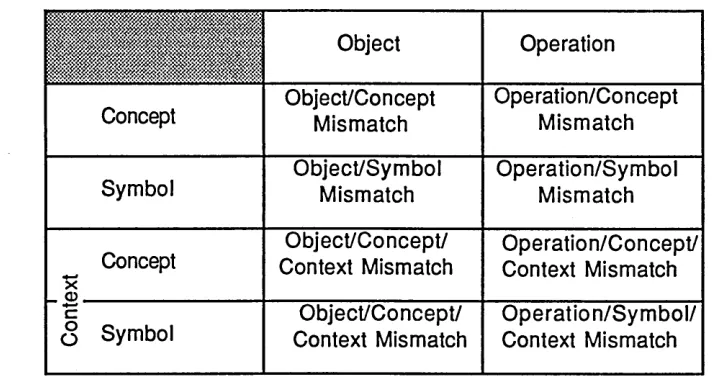
framework for discussion of between user and system communication problems. However, it suffers the problem that some dialogue failures can be classified in more than one category.
Object Operation
Concept Object/ConceptMismatch Operation/ConceptMismatch
Symbol Object/SymbolMismatch Operation/SymbolMismatch
Concept
X to
Object/Concept/
Context Mismatch Operation/Concept/Context Mismatch
c
o Symbol Context MismatchObject/Concept/ Operation/Symbol/Context Mismatch
fig. 3.1 Booth’s Classes of Mismatch following dialogue failure.
[image:40.612.93.452.79.268.2]classification.
It is also worth noting that the other two dialogue failures which are cited are both amenable to the linguistic classification scheme detailed below. The Macintosh is prone to request excessive numbers of disk swapping operations in order to find data or applications distributed over more than one disk. To the uninitiated, this can be interpreted as an error situation. Under the classification scheme advanced in this thesis, this would be categorised as a pragmatic error on the part of the system, detailed as a failure to comply with conversational maxims concerning brevity or conciseness and one answer to this might be to ensure compliance, perhaps by having the system supply an explanation for the apparently obtuse dialogue moves.
The other dialogue failure can be classified as semantic under this scheme, in that the two partners assign different meanings to an action sequence.The "eject" menu selection ejects the floppy disk from the drive, while leaving its icon and any associated windows dimmed on the monitor. A user's expectation that these items will be removed from the display by this command will therefore be disappointed. Of course, problem classification does not determine or even necessarily suggest problem solution, as in this case. The so-called 'desk top' metaphor is ambivalent here, in that there are two totally different methods for ejecting discs; one graphical and one command orientated. There is no obvious reason for attaching the icon and window removal functions to either. In fact, it would be more in keeping with the metaphor and more consistent with file deletion if dragging the disc to the wastebasket erased the disc.
way in order to highlight mismatches between the conceptual and
communicational components of a system. This framework has also been put to the task of error analysis (Davis, 1983a).
A task is composed of a number of sub-goals, each of which must be successfully completed to attain the overall goal. This is represented in
CLG by the conceptual component, containing the task and semantic levels.
These specify the tasks the user wishes to carry out (task) and the
conceptual commands and entities available on the computer (semantic). In
each level is a summary of the procedures available and the methods by
which these procedures can be sequenced to accomplish a particular goal.
The communication component specifies the available commands and the
syntax rules (syntax) and the actual interaction itself (interaction), complete
with prompts, user key presses and computer responses as the interaction proceeds.
Errors can be classified in terms of this characterisation of the interaction as conceptual, procedural, methodological, semantic, syntactic or lexical according to the level at which they are deemed to have their cause. This classification has the advantage that it addresses both the user and the system perspective of error. As it applies to command language interfaces, it also presents us with some familiar and well understood linguistic categories. However, being very similar to GOMS, it is likely that it suffers the same problems of excessive decom position and ambiguity.
3.3 The Linguistic Classification of Error
As the motivation for the present research comes from studies of error
in command line interfaces (Bradford et. al., 1990; Hanson et. al., 1984)
inappropriate. That is to say that while it is possible for the system to manifest an appropriate context for the command, the prevailing context is otherwise.
There are several points arising from this which suggest the adopted classification scheme. Firstly, these errors are defined in relation to a single command and therefore do not occur at the task or plan level. This means that procedural and methodological levels are irrelevant to their characterisation. However, in order to distinguish them from other command level errors, lexical, syntax and semantic types are defined. Secondly, the nature of these errors closely relates to the pragmatic aspects of meaning in natural language. A usable definition is that a phenomenon of linguistic meaning is semantic if it attaches to the sentence and pragmatic if it attaches to the utterance of the sentence. In fact, as we have already noted, in natural language some allegedly pragmatic phenomena do attach
to the form of words used (e.g. the verb to fail is seen to pragmatically
imply the notion of an attempt) but it can be argued that these are semantic phenomena and, in any case, the definition seems workable in the more restricted computer command language environment.
between system and user perspectives, the two can be brought more into line with each other so that the system can respond more appropriately.
3.4 E rro r C lassification Schem e Categories Lexical E rro r
Lexical error is essentially the use of a term which is not in the relevant lexicon. However, just as in natural languages, a command language system's vocabulary typically consists of closed and open sets. A closed set, members of which might be, among other things, the prepositions of the language, is (relatively) fixed for a language but the open set can shrink and grow as items are added or lost. Lexical items can also be seen as belonging to various grammatical categories such as verbs, nouns and so on. These distinctions are built into the system, as can be seen from the responses to lexical errors in closed and open set terms. An unrecognised command name (in UNIX® e.g. ly m yfile) results typically in a 'command unknown' type message, whereas an unrecognised filename typically results in a 'file not found’ type message. The system has an implicit representation of grammatical categories; it 'knows' (or its behaviour is consistent with the following of a rule that) file names are referring terms and belong to the open set. This is also evident from the actions that the system performs on receipt of a valid command. The upshot is that only command terms which are unmatched in the closed set are classed as lexical errors. Command terms in the syntactic position of those from the open set of referring terms but which are unmatched in the lexicon are designated as lacking referents and therefore fall into the class of pragmatic error.
Syntactic E rro r
the macro commands themselves are subject to their own syntax rules) and so there is no real problem in identifying them from the system perspective. Again, there is no one to one correspondence between user and system perspective with regard to these errors.
Semantic Error
The semantics of a command relate to its literal or logical sense or meaning. Semantic errors will therefore consist in the use of illogical (from the system perspective) combinations of command terms. The application of system operations or values to system objects to which they do not apply will be cases of semantic error, for example, attempting to list (Is) a file, make a file the current working directory or copy a file onto itself. These are equivalent to semantically anomalous sentences in natural language such as 'colourless green ideas sleep furiously' or 'the ball kicked the dog'. It is unlikely that this kind of error would arise through incorrect performance, since it would be quite unusual for the fairly random results of typing error to produce a lexically and syntactically correct command. Thus, these errors will almost always stem from a user misconception. However, that misconception may concern the logical or semantic constraints of the system and its language or the current arrangement of objects within it, in which case the error is contextual from the user perspective. For example, a misconception concerning the current working directory might lead a user into trying to list a directory 'X' with the command 'Is X'. The presence of a file called 'X' in the current working directory will entail the interpretation of the command as an illegal attempt
to apply the Is command to a file, even though a directory X exists
elsewhere in the system.
Pragmatic Error
From the system perspective, pragmatic or context errors are situations
confused with m ode error, where an ambiguous action or command produces unwanted or unexpected results. Editors often have two modes: one for performing editing tasks, such as deleting a character, and one for performing actions such as saving the file. A typical mode error is issuing a command, e.g. s for 'save' while in edit mode, thus inadvertently inserting an unwanted 's' character into the file. Mode error has no system perspective, not being detected as an error at all.
The linguistic equivalent of a context error is a well-formed, semantically unexceptional sentence uttered in an inappropriate context. For example, it would be pragmatically anomalous to say to someone 'would you please open the window?' when the only window is already open or if that person happened to be rendered incapable of complying by disablement. From the user perspective, context errors can result from slips (e.g. the mistyping of a filename will be seen by the system as a reference failure) or mismatches between the system and the user's conceptual model. In the studies of UNIX® use cited above, context errors accounted for a large proportion of the errors made by UNIX® users; this is one of the reasons why it is being studied in this project.
3.5 Why Users Make Context Errors
knowing that it is execute protected, since it may not be known that having execute permission is a precondition on the Is command.
In order to avoid making context errors, users have to acquire and maintain some kind of conceptual model of the system, aspects of which are constantly changing as a result of the interaction. A conceptual model must not only reflect current system states but also an understanding of how the user's own actions combine with the functionality of the application to produce new states. These two aspects of the conceptual model are here referred to as the state and fu n ctio n a l models reflecting transient and persistent system characteristics (Young, 1991). While experienced users will tend to have built up a better procedural model and their errors will relate mostly to lapses of attention and the novice's model may be inappropriate in both respects, the classification of users into novices and experts is overly simplistic. Competence will vary on a continuum across users and for users across system functionality (Carroll & McKendree,
1987).
3.6 The Pragmatics of Context Error
The relationship between user and computer can be viewed as that of dialogue partners. As the name implies, the command line interface assumes a dialogue form of command-response. In natural language, an utterance with imperative force involves certain general presuppositions, for example, that the speaker has the authority to issue it and that the addressee is able to carry it out. In addition, particular commands have specific presuppositions, for example, that the door indicated is closed at the time of the command to open it or that the addressee has immediate access to some requested object (Levinson, 1983). These presuppositions can be seen as particulars in the equations representing the reasoning about utterances, conducted in the light of general conversational maxims of cooperation.
clarification or correction strategy, either entering into a dialogue with the other person or interpreting the request in some way which makes it possible to conform with it. Any clarification dialogue will typically include an explanation of why the command could not be carried out, in terms of the preconditions which failed. This may then lead to a revised command. For example, the addressee might state that the door was already open and the reply might indicate that another door should be opened as well.
On the other hand, the addressee may attempt to rectify matters by acting in order to make the failed presuppositions true. For example, he might fetch a requested object, thus making true the presupposition of immediate availability involved in the command. Or he might interpret the command in an intelligent manner so as to fulfil the identifiable intention behind it. He may open the window in recognition of the intention of the request of improving the ventilation in the room.
It is important to recognise that where requests arise in areas in which little expertise is enjoyed by the one making the request, misconceptions concerning rules and procedures governing that area, as well as misconceptions about states of affairs, will lead to requests embodying unwarranted presuppositions. These general presuppositions attach to the abilities and powers of the dialogue partners rather than to the details of the request itself and concern what is possible in any circumstances. The similarity between this aspect of human-human communication and the phenom enon of context error in hum an-com puter interaction is demonstrable. UNIX® cannot move a non-existent file any more than I can play an eight note chord on a conventional guitar. It is suggested that the kind of dialogue that such situations engender is also similar and that this points to a particular kind of approach to dealing with context error.
3.7 Context Error: Problem Solved?
and it is only evaluated when the re tu rn key is pressed. In the WIMPS interaction style, it is possible in many cases to preclude the incidence of context error by 'ghosting out', hiding or removing menu items and icons which have no valid function in the current context or relate to non-existent 'objects'. To some, this may appear to be an adequate solution to the problem. However, this approach may be misguided for a number of reasons.
Firstly, this approach can only be adopted for menus and icons; simply disabling keys amounts to a 'do nothing' approach which suffers the second disadvantage which is that the approach constitutes a bar on exploration; context error may be caused by a lack of knowledge of the preconditions for an action and making the action impossible in certain circumstances does nothing to correct this. In this case, it treats the symptom and not the cause. This argument should not be confused with the positive effects on learning which have been achieved by preventing users from accessing advanced features of an application; the so-called 'training wheels' approach (Catrambone & Carroll, 1987). That approach does not relate to contextual features, in terms of system states, but removes options for the whole of a period of time. The 'ghosting' approach removes options on the basis of current system states during the course of a single interaction. The idea that is being promoted in this thesis is that the user’s ability to build and maintain a good mental model of a system is enhanced by the system's
support of users' exploration of the system in the pursuance of their prevailing goals and plans. This idea challenges the 'ghosting' approach but is neutral with regard to the 'training wheels' approach.
Thirdly, there is evidence to support the view that errors enhance the
conceptual model of a system. Frese et. al. (1991) found that error-based
training produced better non-speed performance and free recall than
error-avoidance training. Lastly, learning is an active process and is
enhanced by interactivity as opposed to factual presentation (Carroll & Mack, 1984: p. 292).