The effect of divided attention on false memory depends on how memory is tested
Stephen A. Dewhurst1 Christopher Barry2 Ellen R. Swannell1 Selina J. Holmes1 Gemma L. Bathurst1
1
Department of Psychology, Lancaster University 2
Department of Psychology, University of Essex
Running head: DIVIDED ATTENTION AND FALSE MEMORY
Address for correspondence: Dr Stephen A. Dewhurst Department of Psychology Lancaster University Lancaster LA1 4YF England
Email [email protected] Phone +44 (0)1524 593835
"This manuscript was accepted for publication in Memory & Cognition in June 2007. The copyright is held by Psychonomic Society
Three experiments investigated the effects of divided attention on false memory using the Deese-Roediger-McDermott (DRM) paradigm. In
Acknowledgement
The Deese-Roediger-McDermott (DRM) procedure (Deese, 1959; Roediger & McDermott, 1995) has been widely used to investigate false memories and memory distortions under controlled laboratory conditions. The procedure involves the presentation of lists of semantic associates of a word that is not itself presented (the critical lure). For example, participants hear words such as bed, rest, awake, tired, and dream, which are all associates of the critical lure sleep. Roediger and McDermott found that participants falsely recalled the critical lures with the same or higher probability as correctly recalling the words that were presented in middle of the lists. They also found that the critical lures were as likely as studied items to be judged as “old” in subsequent recognition tests. Moreover, the critical lures were recognized with high levels of confidence and were frequently categorized as “remember” responses, based on conscious recollection (Gardiner, 1988; Tulving, 1985), suggesting that participants had detailed (though illusory) recollections of encountering those items at study. These observations have been confirmed in many subsequent studies (see Roediger & Gallo, 2004, for a review).
response to the study lists. In subsequent tests of recall or recognition, participants make source monitoring errors and erroneously believe that the generated items were included in the study lists. The monitoring component is based on the source monitoring framework developed by Johnson and
colleagues (e.g., Johnson, Lindsay, & Hashtroudi, 1993).
The DRM illusion has proved to be a particularly robust phenomenon and persists (though in an attenuated form) even when participants are forewarned about the effects observed in previous studies (McDermott & Roediger, 1998). However, a number of encoding manipulations have been found to reduce the magnitude of the DRM illusion. For example, levels of false recall and false recognition are reduced when the DRM stimuli are presented in short rather than long lists (Robinson & Roediger, 1997), in random rather than blocked sequences (McDermott, 1996; Toglia, Neuschatz, & Goodwin, 1999), or when accompanied by a corresponding picture (Israel & Schacter, 1997). These findings suggest that the DRM illusion is reduced when encoding conditions restrict participants’ opportunity to generate semantic associates of the study items.
have produced conflicting results. For example, Pérez-Mata, Read, and Diges (2002) found that divided attention at study increased false recall, whereas Dewhurst, Barry, and Holmes (2005) found that divided attention at study reduced false recognition. Pérez-Mata et al. presented their participants with
DRM lists either under full attention conditions or whilst performing one of two concurrent tasks. In their first experiment, participants heard the DRM lists while monitoring a video clip for changes in perspective. In their second experiment, the DRM lists were presented visually and the secondary task required participants to distinguish between letters and digits presented on an audio tape by pressing one of two response keys. Both secondary tasks increased false recall relative to the full attention condition. Pérez-Mata et al. argued that dividing attention at study prevented participants from monitoring the status of the studied items and the associates generated in response to them, and thus reduced their ability to distinguish between studied items and critical lures at recall.
subjective experience of true and false recognition by asking participants to categorize their positive decisions as remember (R), know (K), or guess (G) responses (Gardiner, 1988; Tulving, 1985). Participants studied the
categorized lists with full attention or whilst performing articulatory
suppression (AS) or random number generation (RNG). Dewhurst et al. found that RNG (the more demanding of the two secondary tasks) significantly reduced both correct and false R responses relative to the full attention and AS conditions.
Dewhurst et al. (2005) argued that the contrast between their findings and those of Pérez-Mata et al. (2002) was due to the nature of the secondary tasks. Although the tasks used by Pérez-Mata et al. were sufficiently resource-demanding to prevent participants from monitoring the status of the study items, they were unlikely to prevent participants from generating the semantic associates in the first place, as acknowledged by Pérez-Mata et al. In contrast, the secondary tasks used by Dewhurst et al. (particularly RNG) were chosen specifically for their disruptive effects on the generation of semantic
A further difference between the above studies is that Dewhurst et al. (2005) measured recognition memory whereas Pérez-Mata et al. (2002) measured free recall. That the type of test is critical in determining the effects of divided attention on false memory is supported by the fact that Dewhurst et al. also presented their participants with tests of recall prior to the final
recognition test and, like Pérez-Mata et al., found that false recall increased with divided attention, a finding they again attributed to a criterion shift. This interpretation is supported by the fact that correct recall was significantly reduced both by RNG and by the monitoring tasks used by Pérez-Mata et al.
The reduction in false R responses reported by Dewhurst et al. (2005) is consistent with previous findings reported by Seamon, Luo, and Gallo (1998). Although the main focus of their study was on the effects of presentation duration on false recognition, they also found that the false recognition of critical lures was significantly reduced when participants had to retain a seven-digit number sequence during the presentation of the study lists. The number sequence was presented prior to the first DRM list and recall of the sequence was tested after the final list had been completed. Concurrent memory load therefore differs from the divided attention tasks used by
absent when manipulated in a within-groups design (Experiment 2). They suggested that the concurrent memory task was less taxing when the number of memory-load trials was reduced by half (as was done when switching from a between-groups to a within-groups design). Nevertheless, when the effect was present it was in the same direction as that reported by Dewhurst et al. in that both correct and false recognition were reduced.
In a later study, Seamon, Goodkind, Dumey, Dick, Aufseeser, Strickland, Woulfin, and Fung (2003) used a range of orienting tasks to manipulate the level of attention allocated to DRM lists. Two tasks (writing the words or writing the second letter of each word as they were presented) were designed to focus attention on the DRM lists while a third task (counting backwards in threes and writing the numbers in pace with the presentation of the DRM stimuli) was designed to divide attention. Both focused attention tasks reduced false memory relative to a control condition of simply listening to the words. In contrast, the divided attention task reduced correct recall and correct recognition but did not significantly affect false recall or false
recognition.
load), different tests of memory (recall or recognition), different experimental designs (between- or within-groups), and different study materials (DRM or categorized lists). The aim of the present study was to untangle the issue of how divided attention influences false memory by investigating the effects of digit-monitoring and RNG on false recall and false recognition. These
secondary tasks were chosen as they have been shown to produce significant effects on false memory and also because they require focused attention throughout the presentation of the study lists. A comparison of recall and recognition memory also allowed us to investigate whether the discrepancy between the findings of Dewhurst et al. (2005) and Pérez-Mata et al. (2002) was due to their use of different test procedures. We decided to use the DRM procedure in the present study as it consistently produces high levels of false recall and false recognition. We also chose to manipulate attention in a within-groups design owing to the wide individual variation in susceptibility to the DRM illusion.
six lists while performing RNG, six while performing the digit-monitoring task, and six with full attention. Participants were then tested either by free recall or by recognition memory.
The remember-know procedure (Gardiner, 1988; Tulving, 1985) was used in the recognition experiments in order to measure the subjective experience of false recognition. Using the category repetition procedure, Dewhurst et al. (2005) found that divided attention reduced false R responses but not false K responses, and suggested that RNG prevented the generated associates from reaching conscious awareness. Roediger and McDermott (1995) suggested that false K responses are caused by automatic spreading activation processes whereas false R responses are caused by failures to remember the source of generated associates that reached conscious
awareness. It is therefore possible that divided attention will selectively reduce false R responses in the DRM procedure.
Experiment 1 Method
Participants. A group of 48 undergraduate and postgraduate students
from Lancaster University participated in Experiment 1. All were native English speakers. They were tested individually and received a payment of £4 for their participation.
Stimuli. Stimuli consisted of 12 DRM lists rated by Stadler, Roediger,
critical lure. In order to increase the potential for false recall, 12 words from each list were presented at study and the three remaining items (all moderate associates of the critical lure) were counted as related intrusions if falsely recalled at test. The lists were divided into two sets of six, of which one was studied under divided attention conditions (RNG or digit monitoring) and the other with full attention.
Design. The participants were divided into two groups of 24. Each
group studied six DRM lists with full attention and six with divided attention. The type of secondary task was manipulated between groups, with one group performing RNG in the divided attention condition and the other performing digit monitoring. Order of study conditions was counterbalanced such that half the participants in each group studied the first six lists with full attention and half studied the first six lists with divided attention. Each list appeared in each condition for equal numbers of participants.
Procedure. The words were presented one at a time on Apple
Macintosh computers in descending order of associative strength. Each word
remained on the screen for 1 s with an interstimulus interval of 750ms. In the
control condition, participants were instructed to read the words silently in
preparation for a recall test. At the end of each list, participants counted down
aloud from 20 and were then given one minute to write down their responses.
Printed instructions at the top of each response sheet reminded participants to
write down only those words that they were confident had appeared in the list.
In the RNG condition, participants were additionally instructed to
generate numbers between 1 and 20 at a rate of one per second throughout the
presentation of the study lists. An electronic metronome was used to maintain
the timing. Participants were given 30 seconds of practise in this task prior to
the first list. They were instructed to use random sequences of numbers and to
avoid repeated or familiar sequences. Participants were asked to commence
the RNG 10 s before pressing the space bar to start the presentation of the
words and to continue generation until the full list was presented. The
importance of maintaining the speed and the randomness of their responses
throughout the presentation of the list was emphasised. At the end of each list
participants counted down from 20 before attempting to recall the words.
In the digit-monitoring condition, participants listened to a tape
recording of random letters and numbers presented at a rate of one item per
second. Participants were instructed to press the Q key if they heard a letter or
the P key if they heard a number. The tape was played for 10 s before the
words were presented and was maintained throughout each list. The tape was
then paused during the recall tests.
Results and Discussion.
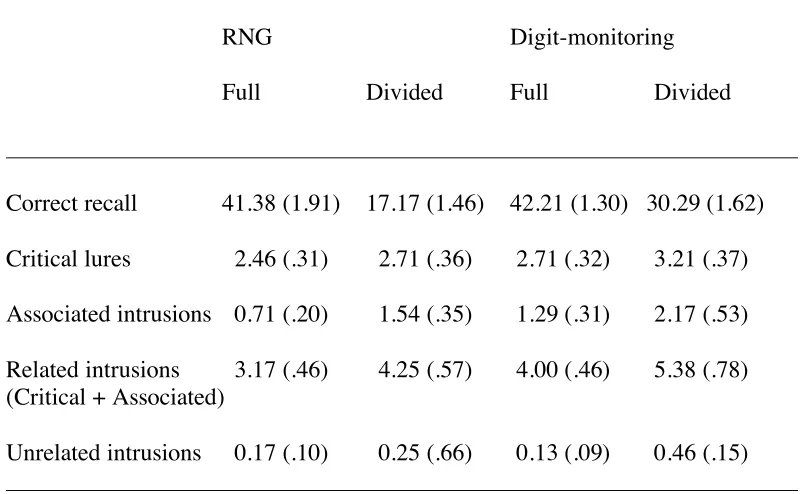
Table 1 shows the mean scores for the correct recall of studied items,
false recall of critical lures, false recall of other associated words, total related
intrusions (critical lures plus other associated words), and unrelated intrusions.
Associated intrusions consisted of words included the Stadler et al. (1999) lists
obvious associates of the critical lures (e.g. angry instead of anger). Statistical
analyses consisted of 2x2 mixed Analyses of Variance (ANOVA) with a
between-groups factor of type of Secondary Task (RNG versus monitoring)
and a within-groups factor of Attention (full versus divided). Alpha was set at
.05 for all analyses.
Table 1 about here.
The analysis of correct recall showed a significant main effect of
Attention, F (1,46) = 224.15, MSE = 34.93, with divided attention
significantly reducing correct recall. A significant main effect of Secondary
Task was also observed, F (1,46) = 13.59, MSE = 34.93, though this was
qualified by a significant interaction with Attention, F (1,46) = 25.95, MSE =
34.93. Pairwise comparisons showed that RNG reduced correct recall to a
greater degree than digit-monitoring, t (23) = 4.90, but the two groups did not
differ reliably in the full attention conditions.
As can be seen from Table 1, the effects of Group and Attention were
in the same direction for both the critical lures and the other associated words.
We therefore combined these scores and conducted the main analysis of false
recall on the total numbers of related intrusions (critical lures plus associated
words) in order to increase statistical power. This analysis produced a
significant main effect of Attention, F (1,46)= 9.13, MSE = 3.92, whereby
divided attention increased the numbers of related intrusions relative to full
attention condition. Related intrusions were not reliably influenced by the type
between Attention and type of Secondary task was not significant, F < 1,
indicating that false recall was increased by both RNG and digit-monitoring.
Divided attention also increased the false recall of unrelated items. An
intrusion was classed as unrelated if it had no obvious semantic association
with the overall list theme. Intrusions from previous lists were also classed as
unrelated. As these data were not evenly distributed they were analyzed in
separate Wilcoxon signed-ranks tests, one comparing each divided attention
condition with the corresponding full attention condition. The false recall of
unrelated words was significantly increased by both RNG, W = 3.32, and
digit-monitoring, W (23) = 1.88.
The findings of Experiment 1 are consistent with those of Pérez-Mata
et al. (2002) in showing that divided attention at study increases the false
recall of related words. This effect only reached statistical significance when
the critical lures and other associated intrusions were combined. However, this
is likely to be a power issue, as Pérez-Mata et al. found a significant increase
in false recall of the critical lures alone using much larger sample sizes.
Divided attention also led a to significant increase in the false recall of
unrelated items. It is therefore possible that the increase in false recall
represents a criterion effect. Despite being instructed not to guess, it is likely
that participants were aware that their recall performance was poorer in the
divided attention conditions and attempted to compensate by adopting a lower
The increase in false recall following divided attention at study
contrasts with the finding by Dewhurst et al. (2005) that divided attention
reduced false R responses. However, Dewhurst et al. used the category
repetition procedure to measure false recognition. It therefore remains to be
seen whether divided attention also reduces false R responses in the DRM
paradigm. Recognition memory was not measured in Experiment 1 as there is
evidence that recall tests can influence subsequent levels of false recognition
(e.g., Roediger, McDermott, Pisoni, & Gallo, 2004). Instead, the effects of
divided attention on false recognition were investigated separately in
Experiment 2.
Experiment 2
Method
The Method was the same as Experiment 1 with the following
modifications: A new group of 48 undergraduate and postgraduate students
from Lancaster University took part in the experiment. The participants again
studied six DRM lists with full attention and six in one of the two divided
attention conditions (24 of the participants performed RNG and the remaining
24 performed the digit-monitoring task). Recall of the lists was not tested in
Experiment 2. Instead, participants were asked to count down from 30 after
each list. Following the presentation of the final list, participants were given a
nonverbal distractor task (math problems) for 10 minutes and then received
The recognition test consisted of the 12 critical lures from Stadler et al.
(1999), 12 studied items (the strongest associates of each critical lure), and 12
unrelated lures taken from other DRM lists, presented one at a time on Apple
Macintosh computers. Participants were instructed to respond using the
number pad on the right hand side of the keyboard and to press 1 for an old
item and 2 for a new item. They were then instructed to indicate their
subjective experience by pressing the R, K, or G key. Instructions for R, K,
and G responses were taken from Dewhurst and Anderson (1999). Briefly,
participants were instructed to press R if they could consciously recollect
seeing the item in one of the study lists, K if the item felt familiar from the
study lists, and G if their previous response had been a guess.
Results and Discussion
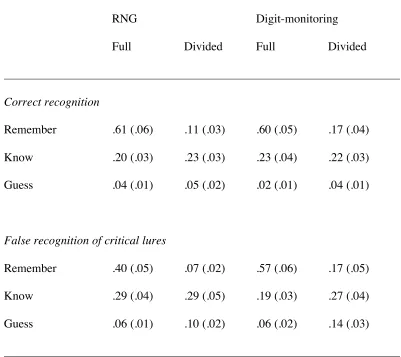
Table 2 shows the mean proportions of correct and false R, K, and G
responses as a function of attention. Correct and false R and K responses were
entered into separate mixed ANOVAs with a between-groups factor of Group
(Shadowing x RNG) and a within-groups factor of Attention (full versus
divided). G responses were not analyzed as they are typically made at chance
levels.
Table 2 about here.
Correct R responses showed a significant main effect of Attention, F
(1, 46) = 143.60, MSE = 1.99, whereby divided attention reduced R responses
relative to full attention. Neither the main effect of Group nor the interaction
responses to critical lures were also significantly reduced by divided attention,
F (1, 46) = 66.54, MSE = 2.10 and were higher for the digit-monitoring group
than the RNG group, F (1, 46) = 7.16, MSE = 2.10. The interaction between
Attention and Group was not significant, F < 1. The analysis of correct and
false K responses showed no significant main effects or interactions. False
alarms to unrelated lures were entered into a 2x2 (Group x Response Type)
mixed ANOVA which showed that they were more likely to be categorized as
K responses (.09) than as R responses (.03), F (1, 46) = 23.39, MSE = 1.17.
The main effect of Group and the interaction were not reliable.
The findings of Experiment 2 show that divided attention at study
reduces both correct and false R responses, and this was the case for both the
digit-monitoring and RNG groups. The reduction in correct R responses under
divided attention conditions is consistent with previous findings by Gardiner
and Parkin (1990). The reduction in false R responses is consistent with the
findings of Dewhurst et al. (2005) using the category repetition procedure.
One interpretation of the parallel reduction in correct and false R responses is
that it is simply a criterion effect. However, Dewhurst et al. argued against this
account on the grounds that the recognition test contained items from both full
and divided attention conditions in a random order. A criterion explanation
would have to explain why the participants constantly changed their decision
criterion during the course of the test when previous research has shown that
participants are reluctant or unable to do this (Morrell, Gaitan, & Wixted,
Dewhurst et al. (2005) argued that a critical factor in determining the
effect of divided attention on false memory is the nature of the secondary task.
They suggested that RNG reduces false recognition because it inhibits the
activation of semantic associates at study. In contrast, digit-monitoring does
not disrupt the activation of associates and should therefore have less of a
disruptive effect. However, Experiment 2 found that both secondary tasks
significantly reduced false R responses. False recall in Experiment 1 also
showed parallel effects of RNG and digit-monitoring. In order to compare the
effects of RNG and digit-monitoring we conducted Experiment 3, in which the
same participants studied the DRM lists under both of the divided attention
conditions. For completeness we investigated both recall and recognition
memory with separate groups of participants.
Experiment 3
Method
The Method was the same as Experiments 1 and 2 with the following
modifications: Participants were a new group of 51 undergraduates from
Lancaster University, of whom 27 took part in a recall study and 24 in a
recognition study. The participants in each study saw 18 DRM lists: six with
full attention, six with concurrent RNG, and six with concurrent digit
monitoring. The order in which the lists were presented was the same for all
participants, but the order of the study conditions was counterbalanced. Each
list was seen in each condition by equal numbers of participants. The recall
administered after each list. The recognition study followed the procedure
used in Experiment 2 and featured a recognition test consisting of 36 studied
items (2 from each list), the 18 critical lures, and 18 unrelated lures taken from
other DRM lists.
Results and Discussion
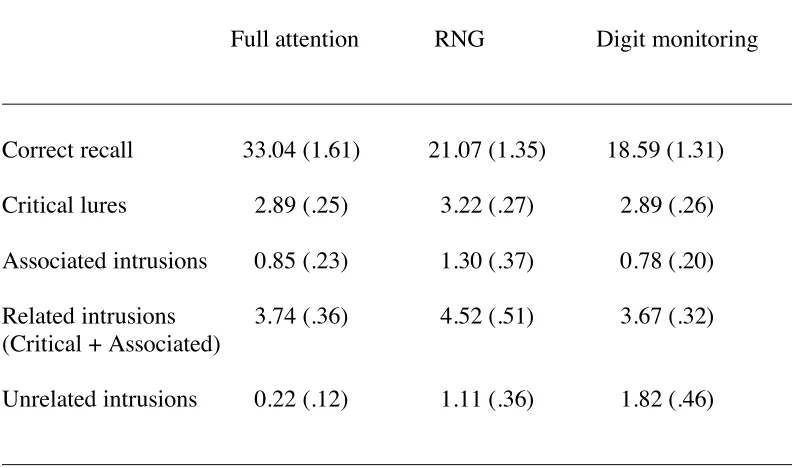
Recall. Table 3 shows the mean scores for the correct recall, false
recall of critical lures, false recall of other associated words, total related
intrusions (critical lures plus other associated words), and unrelated intrusions.
Numbers of correctly recalled items and related intrusions were analyzed in
separate one-way ANOVAs with a within-groups factor of Attention (full x
RNG x digit-monitoring). As in Experiment 1, related intrusions included the
critical lures and other associates of the studied items.
Table 3 about here.
The analysis of correct recall showed a significant main effect of
Attention, F (2,52) = 67.39, MSE = 23.90. Planned comparisons showed that
correct recall was significantly reduced by both RNG and digit monitoring, t
(26) = 8.99 and 10.86, respectively. The RNG and digit-monitoring conditions
did not differ significantly, t (26) = 1.87. In contrast, divided attention
significantly increased the false recall of related items, F (2,52) = 3.55, MSE =
1.69. Pairwise comparisons showed that RNG increased false recall relative to
both full attention and digit-monitoring, t (26) = 2.20 and 2.41, respectively.
The full attention and digit-monitoring conditions did not differ significantly, t
items. As these data were not evenly distributed they were entered into a
nonparametric one-way analysis of variance (Friedman). The main effect of
Attention was significant, Xr2 (2) = 16.94. It is clear from Table 3 that both
divided attention conditions led to considerably more unrelated intrusions than
the control condition.
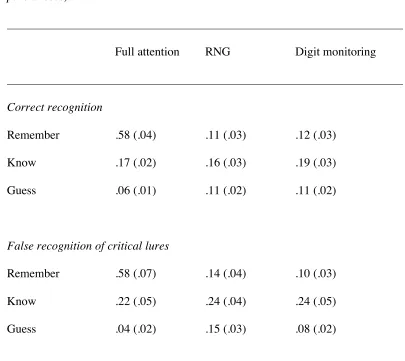
Recognition. Table 4 shows the mean proportions of correct and false
R, K, and G responses as a function of attention. The numbers of correct and
false R and K responses were also entered into separate one-way ANOVAs
with Attention as the within-groups factor. The analysis of correct R responses
showed a significant main effect of Attention, F (1,46) = 122.81, MSE = 2.02.
Planned comparisons showed that full attention led to more correct R
responses than both the RNG and digit-monitoring conditions, t (23) = 13.72
and 13.42, respectively. The RNG and digit-monitoring conditions did not
differ significantly, t (23) = 0.30. Correct K responses were not reliably
influenced by the manipulation of Attention, F < 1.
Table 4 about here.
Analysis of the false R responses to critical lures also showed a
significant main effect of Attention, F (1,46) = 48.94, MSE = 1.26. Planned
comparisons showed that full attention led to more false R responses than both
the RNG and digit-monitoring conditions, t (23) = 8.23 and 8.87, respectively.
The RNG and digit-monitoring conditions did not differ significantly, t (23) =
Experiment 2, the false recognition of unrelated lures was low and more likely
to be categorized as a K response (.14) than an R response (.03), t (23) = 3.98.
The results of Experiment 3 are broadly consistent with those of
Experiments 1 and 2. Dividing attention at study produced dissociable effects
in false memory by increasing the false recall of critical lures but reducing
their false recognition. However, the increase in false recall was only found in
the RNG condition. This supports the argument that the increase in false recall
with divided attention is a criterion effect, whereby participants adopt a lower
threshold for endorsing an item as old in the more difficult conditions. In
contrast to the effects of divided attention in false memory, the effects
observed in correct memory were parallel in that both correct recall and
correct recognition were reduced by divided attention.
General Discussion
The results of three experiments indicate that the critical factor in
determining the effect of divided attention on false memory is the manner in
which memory is tested. Both secondary tasks used in the present study (RNG
and digit-monitoring) produced dissociable effects in false memory by
increasing false recall and reducing false recognition. These findings confirm
those previously reported by Pérez-Mata et al. (2002) and Dewhurst et al.
(2005) and suggest that the dissociation in the effects of divided attention
reported in these studies reflects the use of different memory measures.
However, digit-monitoring did not increase false recall in Experiment 3 when
divided attention on false recall therefore appears to be less robust than the
effect on false recognition. Nevertheless, when the effect is present it is in the
opposite direction to that observed in recognition.
Pérez-Mata et al. (2002) suggested that divided attention at study
increases false recall because it prevents participants from monitoring the
status (externally presented or internally generated) of the studied items and
the critical lures. However, this account does not explain why divided
attention also increased the false recall of unrelated items, which are unlikely
to be generated in response to the DRM lists. We have argued that the increase
in false recall is the result of a criterion shift whereby participants realise that
their performance is impaired under divided attention conditions and attempt
to compensate by adopting a lower threshold for endorsing an item as old. The
increase in false recall of unrelated items in the divided attention conditions is
consistent with this account. A criterion account is also consistent with the
finding that digit-monitoring increased false recall in Experiment 1 when the
type of secondary task was manipulated between-groups but not in
Experiment 3 when participants took part in both secondary tasks. Feedback
from participants indicated that they found RNG the more demanding of the
two secondary tasks. They may therefore have adopted a lower criterion in the
RNG condition relative to the digit-monitoring condition.
The simultaneous reduction in correct and false R responses observed
in Experiments 2 and 3 could also be interpreted as a criterion effect. However
these studies contained items from both full and divided attention conditions
in a random order. As discussed above, previous research has shown that
participants are reluctant to change their decision criterion during the course of
a single recognition test (Morrell et al., 2002; Wixted & Stretch, 2000). In
contrast, the recall studies in Experiments 1 and 3 featured separate tests after
each study condition. Participants in these experiments therefore had the
opportunity to change their criterion in what they perceived as the more
difficult conditions.
The simultaneous reduction in correct and false R responses is more
likely due to the fact that both rely on semantic associations at study. For
example, correct R responses are enhanced by semantic relative to
phonological processing at study (Gardiner, 1988) and reduced by divided
attention (Gardiner & Parkin, 1990). Similarly, false R responses are enhanced
by encoding conditions that facilitate semantic associations, such as deep
versus shallow processing (Toglia et al., 1999) and explicit instructions to
generate associations to the study items (Dewhurst et al., 2005). Preventing
participants from making such associations by dividing attention therefore
prevents the processes that support both correct and false R responses (see
Dewhurst et al., 2005, for further discussion of this).
Parallel effects in correct and false memory have been reported in
other studies. For example, Thapar and McDermott (2001) found that both
correct and false recognition and correct and false recall were reduced by
intervals. Their findings are thus consistent with those of the present study
with the exception of the effects observed in false recall. In Thapar and
McDermott’s study, the same manipulations reduced performance on all
measures of memory, both correct and false. In contrast, divided attention in
the present study reduced correct recall and correct and false recognition but
increased false recall. If false recall is reduced by manipulations that inhibit
semantic processing (see also Toglia et al., 1999), it is somewhat surprising
that false recall should be increased by divided attention. This gives further
weight to our suggestion that the increase in false recall is a criterion effect.
Dewhurst et al. (2005) suggested that false recognition should be
reduced more by RNG than by digit-monitoring as the latter does not prevent
the generation of associates. However, Experiments 1 and 3 showed that the
two secondary tasks led to equivalent reductions in false R responses. These
findings suggest that any task that is sufficiently resource-demanding will
prevent the generation of associates and thereby reduce false recognition. This
is supported by the finding of Dewhurst et al. that articulatory suppression,
which places relatively low demands on cognitive resources, did not
significantly reduce false R responses relative to the full attention condition.
Seamon et al. (1998) also found that concurrent memory load did not reduce
false recognition (at least when attention was manipulated in a within-groups
design). Although concurrent memory load is cognitively demanding, it is
unlikely to divide attention throughout the presentation of the DRM lists and
It is also noteworthy that the effects of divided attention were observed
in R responses but not in K responses, which were unaffected by the
manipulation of attention. The same dissociation between R and K responses
was also reported by Dewhurst et al. (2005) and therefore appears to be a
robust finding. That false K responses were not reduced by divided attention is
consistent with the suggestion by Roediger and McDermott (1995) that
semantic associates can be activated implicitly without conscious awareness
(see McRae & Boisvert, 1998, and Thompson-Schill, Kurtz, & Gabrieli, 1998,
for evidence that spreading activation occurs automatically). The present
findings suggest that dividing attention at study does not prevent the implicit
generation of associates but may prevent such associations from reaching
conscious awareness. Although this is a circular argument, it is consistent with
previous findings that false K responses are observed when the activation of
associates does not reach conscious awareness, for example when study items
are presented at rapid presentation rates (Seamon et al., 1998).
The finding that false R responses are reduced by divided attention is
consistent with previous findings reported by Dewhurst et al. (2005) using the
category repetition procedure. The parallel effects of divided attention thus
suggest that the memory illusions produced by the DRM and category
repetition procedures share a common locus. We have argued that the false
memories produced by both procedures rely on the generation of associates at
encoding. Preventing such associative processes by asking participants to
procedures. The parallel effects of divided attention are, however, at odds with
the views of Smith, Gerkens, Pierce, and Choi (2002) regarding the origin of
the DRM and category repetition effects. They argued that false memories
produced by the DRM procedure are caused by associations made at encoding,
whereas false memories produced by the category repetition procedure are
caused by associations made at retrieval. This claim is based primarily on the
results of priming experiments, in which participants studied DRM and
categorized lists and were then given a stem completion task. Smith et al. found large priming effects with DRM lists, whereby participants frequently completed the word stems with critical lures, but no priming effects with categorised lists, relative to a baseline condition. In contrast, the DRM and categorized lists both produced high levels of false recall.
It is possible that the dissociations reported by Smith et al. (2002)
reflect differences in the associative structure of DRM and categorized lists.
Specifically, both the DRM illusion and priming in a stem completion task
rely on item-to-item associations. In contrast, the memory illusion caused by
categorized lists may rely more on superordinate-to-item associations, in that
category exemplars are more likely to be generated in response to the category
label than to other exemplars. If this is the case, categorized lists will lead to
false memories on the basis of superordinate-to-item associations (especially
when the categorized lists are preceded by the category label, as was the case
in the Dewhurst et al. study) but will not show priming effects due to the
DRM and the category repetition effects are caused by associations made at
encoding, with the former based on item-to-item associations and the latter on
superordinate-to-item associations. We are currently investigating this
possibility.
To summarize, the findings from the present study show that the effect
of divided attention on false memory depends on whether memory is tested by
recall or by recognition. Divided attention at study increased false recall but
reduced false recognition. In contrast, divided attention led to parallel
reductions in correct recall and recognition. These findings resolve the
inconsistencies observed in previous investigations of divided attention. We
have argued that the increase in false recall is a criterion effect whereby the
more difficult encoding conditions cause participants to lower their threshold
for endorsing an item as old. In contrast, the simultaneous reduction in correct
and false recognition occurs because both depend on the elaborative encoding
References
Deese, J. (1959). On the prediction of occurrence of particular verbal
intrusions in immediate recall. Journal of Experimental Psychology, 58,
17-22.
Dewhurst, S.A. (2001). Category repetition and false recognition:
Effects of instance frequency and category size. Journal of Memory &
Language, 44, 153-167.
Dewhurst, S.A., & Anderson, S.J. (1999). Effects of exact and
category repetition in true and false recognition memory. Memory &
Cognition, 27, 665-673.
Dewhurst, S.A., Barry, C., & Holmes, S.J. (2005). Exploring the false
recognition of category exemplars: Effects of divided attention and explicit
generation. European Journal of Cognitive Psychology, 17, 803-819.
Israel, L., & Schacter, D.L. (1997). Pictorial encoding reduces false recognition of semantic associates. Psychonomic Bulletin & Review, 4, 577-581.
Gardiner, J.M. (1988). Functional aspects of recollective experience. Memory & Cognition, 16, 309-313.
Gardiner, J.M. and Parkin, A.J. (1990). Attention and recollective experience in recognition memory. Memory & Cognition, 18, 579-583.
McDermott, K.B., & Roediger, H.L. III (1998). Attempting to avoid illusory memories: Robust false recognition of associates persists under conditions of explicit warnings and immediate testing. Journal of Memory & Language, 39, 508-520.
McRae, K., & Boisvert, S. (1998). Automatic semantic similarity priming. Journal of Experimental Psychology: Learning, Memory, & Cognition, 24, 558-572.
Morrell, H.E.R., Gaitan, S., & Wixted, J.T. (2002). On the nature of the decision axis in signal-detection-based models of recognition memory. Journal of Experimental Psychology: Learning, Memory, & Cognition, 28,
1095-1110.
Pérez-Mata, M.N., Read, J.D., & Diges, M. (2002). Effects of divided
attention and word concreteness on correct recall and false memory reports.
Memory, 10, 161-177.
Robinson, K.J., & Roediger, H.L., III. (1998). Associative processes in
false recall and false recognition. Psychological Science, 8, 231-237.
Roediger, H.L., III, & Gallo, D.A. (2004). Associative memory
illusions. In R.F. Pohl (Ed.), Cognitive Illusions: A handbook on fallacies and
biases in thinking, judgment, and memory. Oxford: Oxford University Press.
Roediger, H.L., III, & McDermott, K.B. (1995). Creating false
memories: Remembering words not presented in lists. Journal of
Roediger, H.L., III, McDermott, K.B., Pisoni, D.B., & Gallo, D.A.
(2004). Illusory recollection of voices. Memory, 12, 586-602.
Seamon, J.G., Goodkind, M.S., Dumey, A.D., Dick, E., Aufseeser,
M.S., Strickland, S.E., Woulfin, J.R., & Fung, N.S. (2003). “If I didn’t write it,
why would I remember it?” Effects of encoding, attention, and practice on
accurate and false memory. Memory & Cognition, 31, 445-457.
Seamon, J.G., Luo, C.R., & Gallo, D.A. (1998). Creating false
memories of words with or without recognition of list items: Evidence for
nonconscious processes. Psychological Science, 9, 20-26.
Seamon, J.G., Luo, C.R., Schlegel, S.E., Greene, S.E., & Goldenberg,
A.B. (2000). False memory for categorized pictures and words: The category
associates procedure for studying memory errors in children and adults.
Journal of Memory and Language, 42, 120-146.
Smith, S.M., Gerkens, D.R., Pierce, B.H., & Choi, H. (2002). The roles of associative responses at study and semantically guided recollection at test in false memory: the Kirkpatrick and Deese hypotheses. Journal of Memory & Language, 47, 436-447.
Stadler, M.A., Roediger, H.L., & McDermott, K.B. (1999). Norms for
word lists that create false memories. Memory & Cognition, 27, 494-500.
Thapar, A., & McDermott, K.B. (2001). False recall and false
recognition induced by presentation of associates: Effects of retention interval
Thompson-Schill, S.L., Kurtz, K.J., & Gabrieli, J.D.E. (1998). Effects
of semantic and associative relatedness on automatic priming. Journal of
Memory & Language, 38, 440-458.
Toglia, M.P., Neuschatz, J.S., & Goodwin, K.A. (1999). Recall
accuracy and illusory memories: When more is less. Memory, 7, 233, 256.
Tulving, E. (1985). Memory and consciousness. Canadian
Psychologist, 26, 1-12.
Table 1. Mean numbers of correctly recalled items, falsely recalled critical
lures, associated intrusions, related intrusions (critical lures plus associated
intrusions), and unrelated intrusions as a function of Attention in Experiment
1 (standard errors in parentheses).
RNG Digit-monitoring
Full Divided Full Divided
Correct recall 41.38 (1.91) 17.17 (1.46) 42.21 (1.30) 30.29 (1.62) Critical lures 2.46 (.31) 2.71 (.36) 2.71 (.32) 3.21 (.37) Associated intrusions 0.71 (.20) 1.54 (.35) 1.29 (.31) 2.17 (.53) Related intrusions 3.17 (.46) 4.25 (.57) 4.00 (.46) 5.38 (.78) (Critical + Associated)
Table 2. Mean proportions of correct and false remember, know, and guess
responses as a function of Attention in Experiment 2 (standard errors in
parentheses).
RNG Digit-monitoring
Full Divided Full Divided
Correct recognition
Remember .61 (.06) .11 (.03) .60 (.05) .17 (.04) Know .20 (.03) .23 (.03) .23 (.04) .22 (.03) Guess .04 (.01) .05 (.02) .02 (.01) .04 (.01)
False recognition of critical lures
Table 3. Mean numbers of correctly recalled items, falsely recalled critical
lures, associated intrusions, related intrusions (critical lures plus associated
intrusions), and unrelated intrusions as a function of Attention in Experiment
3 (standard errors in parentheses).
Full attention RNG Digit monitoring
Correct recall 33.04 (1.61) 21.07 (1.35) 18.59 (1.31) Critical lures 2.89 (.25) 3.22 (.27) 2.89 (.26) Associated intrusions 0.85 (.23) 1.30 (.37) 0.78 (.20) Related intrusions 3.74 (.36) 4.52 (.51) 3.67 (.32) (Critical + Associated)
Table 4. Mean proportions of correct and false remember, know, and guess
responses as a function of Attention in Experiment 3 (standard errors in
parentheses).
Full attention RNG Digit monitoring
Correct recognition
Remember .58 (.04) .11 (.03) .12 (.03) Know .17 (.02) .16 (.03) .19 (.03) Guess .06 (.01) .11 (.02) .11 (.02)
False recognition of critical lures