Journal of Chemical and Pharmaceutical Research, 2014, 6(5):2064-2068
Research Article
CODEN(USA) : JCPRC5
ISSN : 0975-7384
Research and design on the remote internet video training system
Yong Liu
School of Management, Chongqing Jiaotong University, Chongqing, China
_____________________________________________________________________________________________
ABSTRACT
In order to settle the deficiency of the traditional training system wildly used by colleges and universities, this paper offered another kind of remote training system which is based on the Internet. The system used the tradition software architecture named C/S, and analyzed the key standards of MPEG and H.26X. Also we analyzed the function of the proposed system and introduced the solution of them. In essence, the analysis and design presented in this paper provided a new method for remote education.
Keywords: Remote training system, Internet, C/S, MPEG, H.26X.
_____________________________________________________________________________________________
INTRODUCTION
With the highly development of the national economy and the policy of developing through science and technology, traditional pattern of education now is supplanting gradually by Internet and media based technologies. Currently it is common occurrence that new sense and methods of teaching and the emergence of technological teaching equipment. The importance of the information technology education can also be seen on the reference [1-5]. Practice links, however, are still wildly combined with the traditional way---field training, in which pattern students need to be present at the sites to learn skills or do some practice. The advantage of this method is that students can get directly experience and practice by themselves during the study. However, there are some insurmountable fatal weaknesses[6-7]. First of all, the number of practice bases and the limited practice time could not meet the demand of the students’ need. Secondly, the expenses and the difficulty of arrangement impede universities from carrying out this program. Thirdly, the deficiencies of the norms of managing and examining the internship may lead to the unguaranteed internship quality.
Based on those three main deficiencies, this thesis conceived a platform which is based on remote training system, via gathering images from practice sites by digital cameras, then transfer those images back to schoolyards through Internet. By this method, students could watch the videos on computers while getting the training. Meanwhile, the duplex transmission of audio could offer the opportunity for students who sit in the classrooms to communicate with staffs on the sites. This approach using live demonstration could make the students feel that they are personally on the scene. Besides, those videos and images could be stored as teaching materials, which would be convenient to easy to access. Clearly, this method could properly solve the problems mentioned above.
2. Technological plan of the remote video training system
2.1 MPEG Video Coding Technology
MPEG (Moving Picture Experts Group), established in 1988, is a expertise group for making Digital view/audio compression standards. So far they have proclaimed the MPEG-1, MPEG-2, MPEG-3, MPEG-4, MPEG-7 and MPEG-21 standards.
The MPEG-4 standard was issued in Nov. 1998, mainly including video phone, video e-mail, e-news, which now has already been widely used by palm media. MPEG-4 has the feature of the relatively low transfer rate, 4800~64000bps, and resolution ratio calls for only 176*144. By narrow bandwidth, frame reconstruction technique and compression and transmission of data, it could get images with the best quality and least amount data. MPEG-4 standards is based on model/object is the second generation of the compression technology. Adopting the features of human vision system, it works through outline and texture and supports for the interaction of visual content. Furthermore, it can be used in multimedia information applications transferring from broadcast model to content access, retrieval and operate. The standard put forward an important concept, Audio Visual Object (AVO), for content coding. Object means an entity which could be accessed and manipulated. The object could be divided into different kinds based on their texture, movement, shape, model and high-level semantic. Among the MPEG-4 standards, AV is no longer a framing structure but a series of AV scenes. Different AV scenes are made up of different AVO. AVO’s basic unit is the original AVO, which is a visual, audial or a/v unit. Original AVO can combine into compound AVO. MPEG-4 standard’s basic content is to code, organize, store and transmit AVO with high efficiency.
2.2 H.26X Series Video Coding Technique
This series is dominated by ITU, including H.261, H.262, H.263, H.264 standards[8][9].
H.264 is a digital video coding standard issued in March 2003 by a video group established by two international ITU-T and ISO. The biggest advantage of this standard is that it has a high data compression ratio while it can still provide high quality images. The conceptual design of the H.264 video coding structure can be divided into 2 levels: VCL (Video Coding Layer) and NAL (Network Abstraction Layer). VCL is mainly in charge of the compression of the high effective video coding. Based on hybrid coding of block, it also imports many new coding methods, such us 4*4 integer convert, displacement estimation with high-precision and multiply models, which are used to describe the video content effectively. NAL layer is in charge of the net adaptation. With the segmentation formation provided by the lower layers, NAL could encapsulate the data, including framing, determine the end of sequence end signal, logical channel signaling and utilize the timing information, etc. It packages and distributes data with proper methods and then it will accomplish the package and transmit video data in different network. Meanwhile, an interface based on grouping is defined between VCL and NAL, with which high efficiency coding and network-friendly could be fulfilled by VCL and NAL separately.
2.3 TCP and UDP Protocol
TCP (Transmission Control Protocol) is a connection-oriented, reliable communication protocol which is based on byte stream[9]. UDP (User Datagram Protocol) is a non-connection protocol, which offers the transmission service of transaction-oriented, easy and unreliable information[9][10].
TCP and UDP are all located in the transmission layer of the OSL model. When TCP starts to transmit data, it will establish and communication channel between the sender and the recipient. This channel adopts retransmission mechanism and congestion control mechanism to make sure that the data could be transmitted reliably. However, these features are not suitable for the real-time data transmission. When it finds out that there are data missing, the retransmission mechanism will retransmit the missing data packages, which will cost a certain time. This cannot meet the highly requirement of real-time video broadcast. When retransmission starts, the recipient needs to wait for the data, which will cause the delay and discontinuous. Even if no packages were missing, it will still cause delay due to the time consumed in the process of establishing the connection. UDP could fix the delay problem during the transmission, yet the lack of flow control and error control would also cause the delay problem.
2.4 C/S Structure
Figure 1. C/S structure
3. The system functional frame model
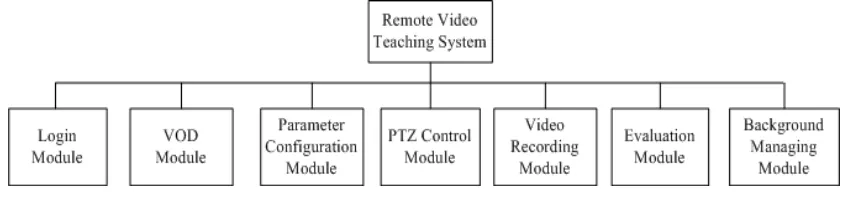
In order to meet the requirement of the remote video training system, the analysis and design of the system functional frame model is from the top downwards then decomposition. The top layers emphasize on the abstract generalizations of the whole system functions, while the bottom layers determine the division of the system function modules. The top layers’ functional framework is as following.
Figure 2. The top layers’ functional framework
Login Module: Identify user’s ID, permission and role. The system could offer different menu views and video resources based on different permission and role.
VOD Module: this module is the main composition of the system, including real-time videos, non-real-time videos and video resources research.
Parameter Configuration Module: parameter configuration module including remote configuration, local configuration, IP access setting and hard disk configuration.
PTZ Control Module: PTZ control includes location control, focusing, aperture and pictures setting. Gun camera cannot do the location control, while the dome camera can implement the comprehensive adjustment. Picture setting refers to the light, contrast, saturation and chroma configuration.
Video Recording Module: this module’s main function is to play the real-time video, including the setting of record time, the store address and packing time.
Evaluation Module: Examine the students’ learning outcome after watching the videos is the main function of this module, including quiz module, papers module and test module. The faculty could add or edit test questions on the test module, then assembling papers with those questions on the papers module.
Background managing module: this module is only available to the system administration. It could manage the system settings, mainly including user management, video storage management, log management.
4. The implementation of the system functions
The system development tool is Visual C++ 6.0; the database management system is Microsoft SQL Server 2000; the server operation system is Windows 2008 Server; the client operation system is Windows XP Pro SP2.
4.1 Real-time Video Module
When faculties organize the students to do the remote video training, first of all, system administration should add the video equipment which has already been setup on the sites to the system. When students log in, the system could automatically read the video list. Then students could choose the videos that they want to watch.
The mainly implementation procedure are as following.
Step1: The platform adopts the Class CtreeCtrl to create tree form equipment list. When click on the root, there will pop-up and dialog frame to add equipment.
Step 2: Add the remote equipment procedure. First of all, invoke the add equipment function in the SDK: LONG NET_DVR_Login_V30(char *sDeveceIP, WORD wDevecePort, char *sUserName, char *sPassword , LPNET_DVR_DEVICEINFO lpDeviceInfo); Return Value: -1 means failure, while other values mean the UserID. When the value is greater than 0, system will call the NET_DVR_GetDVRConfig( ) function to acquire the equipment configuration information.
Step 3: Gain video stream and broadcast. Add devices on a successful operation, that is good with a remote device to establish connection, you can accept the device via the network transmission of video streams. In the system platform selection training need to watch the video channel, double-click the channel to start watching. Preview function is as following: LONG NET_DVR_RealPlay_V30(LONG lLoginID, LPNET_DVR_CLIENTINFO lpClientInfo, fRealDataCallBack_V30 cbRealDataCallBack, void *pUserInfo, BOOL bBlocked)
Step 4: Achievement of the real-time function of video recording and capture. The process of the real-time video recording and capture must be operating during the process of preview. And the real-time video recording function is as following: BOOL NET_DVR_SaveRealData_V30(LONG lRealHandle, DWORD dwTransType, char *sFileName); The implement of video capture funciotn: BOOL NET_DVR_CapturePicture (LONG lRealHandle, char *sPicFileName); This function is used to capture the current BMP image during the process of decording. If the current resolution of the device is 2CIF, the format of the capture image is 4CIF.
Step 5: Voice intercom. This function is used to achieve audio sending and receiving between the client server and device, and after the successful process of registration equipment, the function that is named as ‘Video_Train_StartVoiceCom’ is called to start voice intercom module.
4.2 Non real-time Video On Demand Module
The non real-time video on demand module is mainly to show the video data that stored in the database server before the users eyes by some forms. The video data can be composed of the stored recording by real-time training and other valuable video information. When users access to the module, the system first retrieves the database and generate the tree derivation of the stored video data.
The management procedure of this module is shown in the Figure 3.
Figure 3. The management procedure of the module
keyword. Also the platform can inquire by the some condition, such as the category, time and other complex query conditions. If the data can not be fount in the video database, the system will pop up the feedback window and the users can complete and submit the feedback tables. According to the feedback tables, the administrators rich the video database by the increase of the corresponding video data.
CONCLUSION
Internet based remote video training system efficiently tackle the problems which could not be fixed properly, such as the lack of practice bases and the difficulties of arrangement. It is a newly application using video to carry out training system in teaching. It also provides a new method for remote education. Thus, it could be widely adopted and it could have a bright future.
Acknowledgments
This work was supported under the remote interactive video teaching system platform, a project by Education Commission of Chongqing Municipality, P.R. China (Grant No. 0831149 & 103211) and experimental teaching and research fund of Chongqing Jiaotong University, P.R. China(Grant No. SYJ200816).
REFERENCES
[1] Ruohone M. International Journal of Information Management 1991;11:126-143. [2] İsmail T, Caner A. Procedia - Social and Behavioral Sciences 2009;1:1825-1833.
[3] Grady, WM, Chan, R, Samotyj, MJ, Ferraro, RJ, Bierschenk, JL. IEEE Transactions on Power Systems
1992;7:709 – 717.
[4] Bengu, G, Swart, W. IEEE Transactions on Education 1996;39:415 -422. [5] Nigim, KA, DeLyser RR. IEEE Transactions on Education 2001;44:165 -169. [6] Xu DL, Li ZH, Wang J. Laboratory Research and Exploration 2010;29:116-119.
[7] Yu S, Wang MJ, Che HY. Educational Technology Research and Development 2005;54:88-101. [8] Puri A, Chen XM, Luthra A. Image Communication 2004;19:793-849.