Reflection on the Analytic Geometry Courses: The
GeoGebra Software and its Effect on Creative Thinking
Avni Yildiz
1, Serdal Baltaci
2,*, Betül Küçük Demir
31Ereğli Faculty of Education, Bülent Ecevit University,Turkey 2Faculty of Education, Ahi Evran University,Turkey 3Bayburt Faculty of Education, BayburtUniversity,Turkey
Copyright©2017 by authors, all rights reserved. Authors agree that this article remains permanently open access under the terms of the Creative Commons Attribution License 4.0 International License
Abstract
Creativity has a significant role in individuals’ lives. This research aims to examine the reflection of the learning process of analytic geometry concepts through GeoGebra software and its effect upon the development of preservice mathematics teachers’ creative thinking skills. This effect is expected to make a significant contribution to the literature with the examination of creativity and its dimensions as well as the determination of GeoGebra’s role. At this point, this study designed as a mixed method research. Vectors in R2 and R3 have been taught to the preservice mathematics teachers using the GeoGebra; moreover, at the beginning and at end of the implementation, the Torrance Creative Thinking Test (TCTT) has been conducted. The research group included a total of thirty preservice teachers. Research data has been collected through Torrance Creative Thinking Test Verbal A and Figural A forms, semi-structured interviews, worksheets and models created by the preservice teachers using the GeoGebra software. The qualitative and quantitative methods have been used for data analysis. Analyses have revealed that the use of the GeoGebra software has positive reflections on preservice teachers, and thus, a significant difference has been noted in favor of the post-test in all dimensions of creativity but one.Keywords
Analytic Geometry, Creativity, GeoGebra Dynamic Mathematics Software, Preservice Mathematics Teachers1. Introduction
Mathematics is considered as one of the tools through which an individual’s creativity is ascertained. Baki [1] suggests that an increase in imagination in terms of mathematics means the improvement of the path of intuition, creativity and exploring. In Turkey, the aim is to develop creative thinking skills at all levels of education starting
from elementary school to higher education [2]. There are various definitions regarding the concept of creativity in the literature. Being one of the touchstones with his studies concerning creativity, Torrance [3] defines creativity as the process of "sensing difficulties, problems, gaps in information, making guesses and hypotheses, testing these hypotheses; revising and restating them; and finally communicating the results”. Some researchers suggest that creativity in mathematics is generally related to the problem solving [4].
“originality”, “elaboration”, “resistance to premature closure” and “abstractness of titles”. Likely in Koray [15], it was detected significant difference between experimental and control groups aspect of creative thinking ability (total point) and sub dimensions of creative thinking (fIuency, flexibility, elaboration, originality). On the other hand, in Tekin Gürgen and Bilen [13] was carried out byapplying Torrance Creative Thinking Test Verbal form and determined positive effects for each sub-dimension (fluency, flexibility,originality) after the application. Park, Lee, and Hahn [16] found self-reported creativity to significantly correlate with all scores on the Torrance Tests of Creative Thinking (TCTT) except for fluency.
An effective and proper use of the dynamic geometry software (DGS) enables students to gain several skills such as exploration and creativity [17]. One of the DGS is the GeoGebra dynamic software that embodies the features of both the computer algebra systems (CAS) [18] and the ease of use and the aspects to be translated into several languages [19]. In addition, most of the analyticgeometry concepts like points, lines, circles, conic sections, and vectors on the plane can be visualized via the GeoGebra software [20]. Furthermore, visualization of three-dimensional objects has been much easier thanks to the 3D window of the GeoGebra [21]. Nevertheless, another significant research topic can be considered as how these facilities of GeoGebra software reflect on the development of elementary mathematics teachers’ creativity.
The researchers of this study have observed that preservice mathematics teachers who enrolled in primary school teaching department, as lecturing analytic geometry course for a long time, depended on the formerly learned patterns without questioning. Furthermore, they are determined to encounter difficulties during the learning process. Similarly, numerous studies have concluded that students have difficulties in learning the concepts of analytic geometry [22, 23, 24, 25]. Moreover, preservice teachers fail in constructing; that is in imagining some expressions [26]. Many researchers have stated that dynamic software is beneficial for eliminating these adverse conditions [27, 28]. Therefore, the authors investigate the effect of the GeoGebra software in both developing elementary school preservice mathematics teachers’ creativity and understandings of the analytic geometry concepts.
The literature revealed various studies conducted on analytic geometry and its dimensions such as success [29, 30] or comparison of using the computer-aided software in the teaching of analytic geometry concepts with the other methods [31, 32, 33]. However, the present study tries to reveal the role of the GeoGebra dynamic software in the process by scrutinizing elementary school mathematics preservice teachers’ learning processes. When studies were examined on this issue, it is found that creativity has been measured by the Torrance Creative Thinking Test (TCTT). TCTT also has significance in the literature for the direct
measurement of creativity [34]. Upon analyzing other tests that are based on creativity, it is revealed that “the a-c creative ability test” focuses only on measuring creativity, “Khatena-Torrance creative perception inventory” is used only for measuring someone’s own creativity perception, while others intended to measure creativity indirectly (quoted by [35]). On the other hand, there are numerous experimental studies in which TCTT is used to measure creativity [5, 36, 37, 38, 39]. Furthermore, the dimensions of the Torrance Creative Thinking Test are composed of fluency, flexibility and originality [36, 39, 40]. This research has examined the reflection of the learning process of the concepts regarding analyticgeometryby means of the GeoGebra dynamic software and its effect on the development of preservice mathematics teachers’ creative thinking skills. In accordance with the main objective, the following questions are presented:
1. How do the elementary school mathematics preservice teachers’ learning processes of analytic geometry concepts come true in the GeoGebra dynamic software-aided learning environment?
2. How do these processes affect the development of the elementary school mathematics preservice teachers’ creative thinking skills in all dimensions?
2. Methods
This following section covers the research model, design of the research, research group, data collection, and data analysis.
2.1. Research Model
This study used a mixed method that refers to the use of qualitative and quantitative research methods or paradigms together [41]. Creswell [41] puts great emphasis on the advantage of the mixed method in such a way that researchers carry out their studies in a sufficient way by taking into consideration both qualitative and quantitative aspects.
Quantitative dimension of the study is consisted of a pre-test and a post-test group for one week experimental research design. In order to find an answer to the qualitative dimension, the GeoGebra software-aided learning environments in analytic geometry classes have been instructed to the preservice teachers within elementary school mathematics education program and the reflections of this environment have been analyzed in detail.
2.2. Design of the Research
The design of the research takes place in two stages. These stages are as follows:
2.2.1. Preparation Stage
found to succeed in analytic geometry concepts when a well-organized learning environment is created. Therefore, worksheets that will affect the learning setting were initially prepared through analyzing various publications about creativity and analytical geometry. Worksheets include guidelines that require the use of the GeoGebra software by elementary school mathematics preservice teachers during the process of the discovery of the concepts related to the subjects. Following the assessments carried out by two domain experts, the required corrections have been made. Afterwards, the implementation process has been initiated considering the questions that will be posed by teachers. 2.2.2. Implementation Stage
At the initial phase of the implementation process, the TCTT has been applied to the preservice teachers. Then, two-person groups have been formed for the dynamic software-aided learning settings. While forming groups, harmony and level of success between the members of the group have been taken into account, and fifteen groups have been created. Also, another researcher has tested the learning setting and qualitative data collection tools by sustaining the curriculum on the same course at a different university for a week further. A pilot study has been performed after controlling the compatibility of the data collection tools. The tools have been applied to the preservice teachers.
The implementation has lasted a total of 9 weeks, and 9 worksheets have been used in this process. These courses included vectors on the plane and on space. Pre-service teachers have not been expected to use the GeoGebra proficiently with regard to the instructions available in worksheets about the use of software. The aim is to use the software as a tool so as to acquire the required information. For instance, preservice teachers are requested to create a vector on screen in order to explore the relationship between the start/end point and the coordinates of the vector for a better understanding of the definition of vector. Moreover, preservice teachers were also asked to take different several vectors on the screen with a view in order to realize that the vector is a change of location which represents sum of these vectors taken on the screen in line with the relationship between these vectors and their sum. In another worksheet, preservice teachers were asked to take two vectors and produce the cross product of these vectors so that they can determine the relationship between these two vectors and the cross product vector. Besides, it has been revealed that the area of a parallelogram that is composed of two vectors and the volume of the parallelepiped consisted of three vectors in space with the GeoGebra subsequently to understand the relationship between the two vectors and their cross product vector. A month after the implementation, the TCTT has been reapplied to the preservice teachers to seek answers for the research questions.
2.3. Research Group
The research has been carried out with preservice mathematics teachers who receive education at the department of elementary school mathematics. The sample consisted of 30 preservice teachers from the same class. Among the preservice teachers, 16 were female and 14 were male. They were selected amongst those who take analytic geometry course that was taught by one of the authors in a public university. Thus, this research used an experimental method without controlling any group as the courses in the elementary mathematics education department in Turkey are carried out as a single group due to the limited quota except for a few universities.
Taking courses on basic ICT skills at the first grade, the preservice mathematics teachers began interacting with the GeoGebra in two courses (General Mathematics, Geometry). At the second grade, the GeoGebra is used only for presentation by the researcher when needed in Calculus I course. In addition, they were asked to use the GeoGebra software in their exams or to answer the presented questions. Thus, all participants were trained in order to use the GeoGebra and to prepare activities by using it. Theyalready had the skills needed to construct the situations on the worksheets. Furthermore, their mathematics competency level was sufficient, and they had positive attitudes towards mathematics.
2.4. Data Collection Tools
The data collection tools employed in the study have been presented in accordance with the qualitative and quantitative methods as follows.
2.4.1. Quantitative Data Collection Tool
The Torrance Thinking Creative Test (TTCT) was first introduced in 1966 and has been used in 615 researches and more than 100 postgraduate theses [42] in order to measure individuals’ creativeness performance in 35 different cultures. The study has deployed the Torrance Thinking Creative Test (TTCT) as a quantitative data collection tool. The tool is composed of two equivalent forms including Verbal A and B and Figural A and B in which each form has subtests. Both forms of the TTCT test are appropriate at all levels of education from kindergarten to university. The Turkish adaptation of Figural and Verbal Forms of the TCTT were created by Aslan [43]. The following test forms were used in the present study.
Questions (subtest 6); preservice teachers list interesting and unusual questions of a cardboard box; (e) Supposing (subtest 7); they are asked to list all the consequences that an improbable situation may come true [44, 45]. Fluency, originality and flexibility characteristics were assessed via the TTCT Verbal A Form.
The TTCT-Figural is consisted of two parallel forms with three subtests: (a) compose a drawing; (b) finish a drawing; and (c) compose a different drawing parting from parallel lines [45]. Also, the TTCT Figural A Form includes 18 sub-dimensions: fluency,originality, elaboration (detailing), abstractness of titles, resistance to premature closure, creative strengths list (emotional expressiveness, storytelling articulateness, movement or action, expressiveness of titles, combining of incomplete shapes, synthesis of incomplete lines, unusual visualization, internal visualization, extending or breaking boundaries, humor, richness of imagery, colorfulness of imagery and fantasy).
A form of the TCTT was conducted to preservice teachers before and after the study. 5-6 minutes were given to participants for each activity in the verbal part of the TCTT, 10 minutes for each activity that includes shapes. The implementation of the TCTT and scoring each participant’s test lasted approximately 75-80 minutes. 2.4.2. Quantitative Data Collection Tool
Qualitative data include the interviews conducted with preservice teachers during the lessons, worksheets performed by groups and models prepared on the GeoGebra screen.
2.5. Data Analysis
The responses posed by elementary school mathematics preservice teachers to the TCTT Verbal – Figural A form were scored by the authors individually depending upon the principles by Torrance and Torrance Creative Thinking Test Verbal – Figural A guidelines and assessment booklet. The research data were analyzed through use of the SPSS 21.0 statistical package program. First, the study confirmed whether data provided the general requirements of the parametric tests. Normality was tested by performing skewness and kurtosis on the analysis of the data obtained in the study. Paired samples t-test was used for those between -1 and +1, while the study used non-parametric Wilcoxon test for the other activities.
Data printout and control obtained from interviews and worksheets were carried out. During writing the interview data on paper, each conversation was respectively written by interviewer- interviewee without making any correction. Then, the data analysis was finalized by bringing together all the analyses conducted by researchers independently and discussing on them. This is a significant requirement referenced in ensuring the validity of the research. In addition, codes were given to the preservice teachers as A,
researcher and T1, preservice teacher 1 ...etc.
3. Results
In this section, the quantitative and qualitative data obtained from the participants were discussed separately in order to clarify two research questions.
3.1. Reflection on Course Process
This section presents several reflections of the elementary school mathematics preservice teachers that obtained through analyzing their learning processes with reference to vectors in R2 and R3. This presentation is supported by excerpts from interviews, statements that preservice teachers wrote on worksheets and screenshots in the GeoGebra software. Besides, codes were given to the preservice teachers in each group as T1, T2, T3, .... T30.
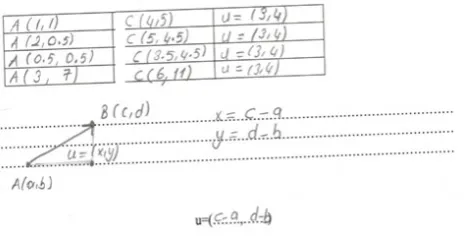
[image:4.595.317.552.422.541.2]Taking the research findings into account, elementary school mathematics preservice teachers conducted the process of exploring better via the GeoGebra. To illustrate, T11 and T12 preservice teachers, who considered a vector as the displacement of a point, have determined the coordinates of the vector emerging with the change of the places of the points they have taken on the GeoGebra screen. Then, this group has been noted to generalize this expression as mathematical. The data for this case are as follows:
Figure 1. A section of the worksheet about the determination of a vector
by T11 and T12 preservice teachers depending on its initial and endpoint
Some of the teachers, who learned the sum of the two vectors, had the opportunity to learn more about vectors together with the reasons. Illustratively, the data about T1 and T2 preservice teachers are as follows:
T1: We know the vector is a displacement. Therefore, let's add two vectors end to end. Look! How the place has changed.
T2: Yes. Total w vector has been achieved. Now, let’s take five vectors and observe them by adding these vectors end to end as stated in the worksheets.
Figure 2. A section about the finding of the sum of five vectors on the screen by T1 and T2 preservice teachers
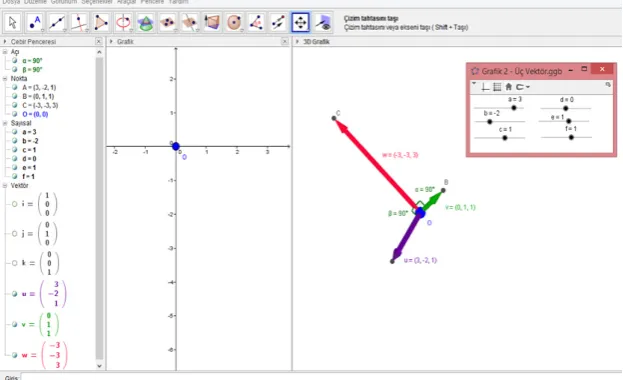
Elementary school mathematics preservice teachers have been reported to make a better observation about the fact that the product of two vectors is orthogonal to both of these vectors on the three-dimensional screen of the GeoGebra. During this process, preservice teachers have observed that inner products of two vectors of vector product were always zero thanks to the dynamic feature of the software via both algebra and three-dimensional screen by changing the points. The data on this result for T17 and T18 preservice teachers are as follows:
T17: By taking three pencils after observing this, we can show the third pencil orthogonal to the two pens. But, I think that observing them here will be better.
R: Well, what can we say for inner product?
T17: Inner products are always zero, which can be observed from algebra screen. This inner product does not change when we move the points.
T18: Inner products are always zero if two vectors are orthogonal.
Figure 3. Observations of T17-T18 preservice teachers about the vector product on both 2D and 3D screens
Later, the preservice teachers were asked to take the two vectors as parallel and intercept with each other, and to observe and interpret how the vector products of these vectors change. In this regard, most of the elementary school mathematics preservice teachers have been determined to make various assumptions at first, and then they have identified the vectors on the screen as parallel or intercepting. T23 and T24 preservice teachers’ responses are as follows:
R: How does vector product change when you get u and v vectors as parallel or intercept with each other?
T23: I think it does not change as the vector product will appear again on the three-dimension screen. Still, it will be better to observe it on the screen.
T24: Yes, I'm getting the coordinates of the vector u (2, -2.1) and the vector v (4, 4, 2). Yes, w vector becomes a zero vector. It disappears from the three-dimension screen. It was observed as the point on the two-dimensions and three dimensions.
[image:5.595.149.461.414.604.2]Figure 4. Examination of vector products by T23-T24 preservice teachers in the case of the vectors is parallel or coincident
It has also been revealed that the majority of the preservice teachers had difficulty in finding vector products of two vectors in the above processes. They have noted the nonexistence of toolbar which provides this directly in the GeoGebra software. The conversation between T21 and T22 preservice teachers is presented as follows:
T21: If there was a command or icon which finds vector product direct, we wouldn’t have been obliged to write the coordinates of the vector product on the input screen.
T22: I agree. We've written the definition of the vector of the vectorial product.
3.2. The Data Regarding the Torrance Creative Thinking Test
Table 1 depicts paired sample t-test results related to the mean of the Verbal and Figural forms pre- and post-test of the elementary school mathematics preservice teachers. Table 1. Paired Sample t-test Results Related to Preservice Teachers’ Creative Thinking Skills
Measurement N 𝑿𝑿� SS t p
Verbal pre 31 56.81 17.50 -7.065 .000 Verbal post 31 95.65 29.28
Figural pre 31 80.35 27.79 -8.509 .000
Figural post 31 139.32 36.17
Upon analyzing Table 1, this difference has been found to be statistically significant in the Verbal and FiguralForm A depending on the paired samples t-test results (p<.05). The research findings show that teaching analyticgeometry concepts via the GeoGebra dynamic software process has a positive and significant impact on creative thinking.
Considering the preconditions of the preservice teachers’ verbal fluency, verbal originality and verbal flexibility being the activities of verbal creativeness and activities of figural creativeness such as fluency, originality, elaboration (detailing), abstractness of titles, resistance to premature closure, creative strengths list (emotional expressiveness, storytelling articulateness, movement or action, expressiveness of titles, combining of incomplete shapes, synthesis of lines, unusual visualization, internal visualization, extending or breaking boundaries, humor,
richness of imagery, colorfulness of imagery and fantasy) scores, the data have been determined to be sporadic. In addition, skewness and kurtosis coefficients were taken into account in order to identify whether the data available in the preconditions distributed normally.
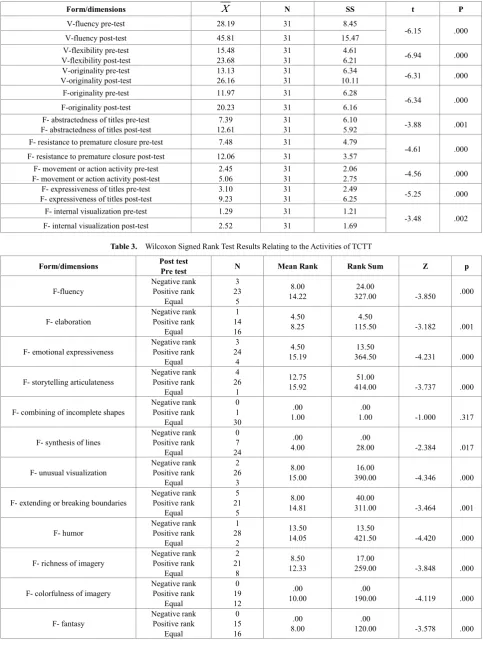
The mean scores obtained from each activity by the preservice teachers were calculated for the activities of verbal forms (fluency, flexibility, originality) and figural forms (originality, abstractness of titles, resistance to premature closure, movement or action, expressiveness of titles, internal visualization), all of which demonstrated normal distribution in the TCTT. The paired sample t-test was performed with the aim of determining whether there is a significant difference between the scores of pre- and post-test for each activity. Table 2 displays the findings related to pre- and post-test results of these activities, which are normally distributed.
As it can be observed in Table 2, the pre-test and post-test mean scores of preservice teachers related to verbal form fluency activity have been determined to be 28.19 and 45.81, respectively. A statistically significant difference between the mean scores of the preservice teachers has been identified in this activity (p= .00<.05). Likewise, a statistically significant difference between the mean scores of the preservice teachers in favor of the post-test has been noted in terms of the verbal forms of flexibility and originality.
Table 2. Paired Sample t-test Results Related to Pre-test - Post-test Mean Scores Obtained from Normally Distributed Activities
Form/dimensions N SS t P
V-fluency pre-test 28.19 31 8.45
-6.15 .000
V-fluency post-test 45.81 31 15.47
V-flexibility pre-test
V-flexibility post-test 15.48 23.68 31 31 4.61 6.21 -6.94 .000
V-originality pre-test
V-originality post-test 13.13 26.16 31 31 10.11 6.34 -6.31 .000
F-originality pre-test 11.97 31 6.28
-6.34 .000
F-originality post-test 20.23 31 6.16
F- abstractedness of titles pre-test
F- abstractedness of titles post-test 12.61 7.39 31 31 6.10 5.92 -3.88 .001
F- resistance to premature closure pre-test 7.48 31 4.79
-4.61 .000
F- resistance to premature closure post-test 12.06 31 3.57
F- movement or action activity pre-test
F- movement or action activity post-test 2.45 5.06 31 31 2.06 2.75 -4.56 .000
F- expressiveness of titles pre-test
F- expressiveness of titles post-test 3.10 9.23 31 31 2.49 6.25 -5.25 .000
F- internal visualization pre-test 1.29 31 1.21
-3.48 .002
[image:7.595.63.547.96.743.2]F- internal visualization post-test 2.52 31 1.69
Table 3. Wilcoxon Signed Rank Test Results Relating to the Activities of TCTT
Form/dimensions Post test Pre test N Mean Rank Rank Sum Z p
F-fluency Negative rank Positive rank Equal
3 23
5
8.00
14.22 327.00 24.00 -3.850 .000
F- elaboration Negative rank Positive rank Equal
1 14 16
4.50
8.25 115.50 4.50 -3.182 .001
F- emotional expressiveness Negative rank Positive rank Equal
3 24
4
4.50
15.19 364.50 13.50 -4.231 .000
F- storytelling articulateness Negative rank Positive rank Equal
4 26
1
12.75
15.92 414.00 51.00 -3.737 .000
F- combining of incomplete shapes Negative rank Positive rank Equal
0 1 30
.00
1.00 1.00 .00 -1.000 .317
F- synthesis of lines Negative rank Positive rank Equal
0 7 24
.00
4.00 28.00 .00 -2.384 .017
F- unusual visualization Negative rank Positive rank Equal
2 26
3
8.00
15.00 390.00 16.00 -4.346 .000
F- extending or breaking boundaries Negative rank Positive rank Equal
5 21
5
8.00
14.81 311.00 40.00 -3.464 .001
F- humor Negative rank Positive rank Equal
1 28
2
13.50
14.05 421.50 13.50 -4.420 .000
F- richness of imagery Negative rank Positive rank Equal
2 21
8
8.50
12.33 259.00 17.00 -3.848 .000
F- colorfulness of imagery Negative rank Positive rank Equal
0 19 12
.00
10.00 190.00 .00 -4.119 .000
F- fantasy Negative rank Positive rank Equal
0 15 16
.00
8.00 120.00 .00 -3.578 .000
The study used non-parametric Wilcoxon test for the figural forms of fluency, elaboration (detailing), emotional expressiveness, storytelling articulateness, combining of incomplete shapes, synthesis of lines, unusual visualization, extending or breaking boundaries, humor, richness of imagery, colorfulness of imagery and fantasy, which are not distributed normally. Table 3 presents Wilcoxon Signed Rank Test results relating to the activities of the TCTT.
As can be seen in Table 3, the figural form of fluency (z=-3.850; p=.00<.05) is significant by the effect of the difference between the pre-test and post-test results of the preservice teachers. Similarly, for the figural forms of elaboration (z=-3.182; p=.001<.05), emotional expressiveness (z=-4.231; p=.00<.05) and storytelling articulateness (z=- 3.737; p=.00<.05) a significant difference has been noted in favor of the post-test.
There was not any significant difference between the pre-test and post-test scores of the preservice teachers for the dimension of combining of incomplete shapes (z= -1.000; p=.317>.05). In other words, it is most likely that the results of the pre-test have similar features with the post-test results. With respect to synthesis of lines (z= -2.384; p=.017<.05), a significant difference has been pointed between the pre-test and post-test scores of the preservice teachers. In a similar manner, it was revealed that there was a significant difference between the pre-test and post-test scores of the preservice teachers in favor of the post-test regarding unusual visualization (z=-4.346; p=.000<.05), extending or breakingboundaries (z= -3.464; p=.001<.05), humor (z= -4.420; p=.00<.05), richness of imagery (z= -3.848; p=.00<.05), colorfulness of imagery (z= -4.119; p=.00<.05) and fantasy (z= -3.578; p=.00<.05).
4. Conclusion and Discussion
The research results have revealed that elementary school mathematics preservice teachers magnificently observed that vector of vector product is orthogonal to both of the vectors on the three-dimensional screen of GeoGebra. Furthermore, many scientists state that the 3D screen of GeoGebra software is useful [46, 47, 48, 49]. Parallel to the research results, Arcavi and Hadas [50] and Sheffield and Cruikshank [51] have indicated that dynamic software enables students to learn by experiencing through visualization, and hence students not only make observations but they also have the ability to measure, to make comparison and to change shapes. Most of the preservice teachers have been stated to try to uncover the reasons for the results. In fact, as mentioned by González and Herbst [52] and Santos-Trigo and Cristóbal-Escalante [53], all the processes above have been realized thanks to the sense of creativeness and making deductions via dynamic software. Besides, preservice teachers who follow the instructions available in worksheets prepared via GeoGebra software have been determined to make
mathematical generalizations. Similar results emerged in the study conducted by Santos-Trigo and Cristóbal-Escalante [53].
The findings related to TCTT have revealed that preservice teachers’ verbal and figural mean scores increase in favor of pre-test. A statistically significant difference has been noted between pre-test and post-test for both verbal form-A and figural form-A. It may be wise to emphasize that teaching through GeoGebra software has a positive and significant impact on creative thinking. Several studies have indicated the positive impact of daily life modeling activities, constructed with GeoGebra upon students’ creativity [20, 54]. Aktümen and Yildiz [55] conducted another study that questioned the projects designed via GeoGebra by preservice teachers may ensure the development of their creativity. In their studies, Liu [56] and Idris and Nor [57] have found that technology uncovers existing, creative thinking skills of students and facilitates their development. That GeoGebra software presents different screens together may cause such a situation like this. For example, the pre-service teachers can easily observe the vector product of the vectors by changing dynamically in the graphic screen.
Torrance Creative Thinking Test Verbal- FiguralForm-A has been examined for each activity, and no significant difference has been demonstrated between pre-test and post-test in terms of combining of incomplete shapes activity; whereas, in all other activities, a significant difference has been detected in favor of post-test. This is likely due to the fact that GeoGebra software does not have an effect on the activity called combining of incomplete shapes that is considered as an indicator of the ability to see relationships between unrelated elements. Otherwise, Edwards and Jones [22] have reported that GeoGebra software helps to create higher-order thinking skills. This case may derive from the use of worksheets for supporting each other in order to teach a subject in the course of analytical geometry. It is highly probable to point the relationship between them thanks to the GeoGebra software, if this case can be repeated with other independent subjects of analyticalgeometry.
education on elaboration activity of creativity. Briefly, given all the findings mentioned above, GeoGebra software is effective upon fluency, originality and elaboration activities of creativity. That GeoGebra is a dynamic software and the preservice teachers can use some of the instructions such as geometric locus and vector easily, can help these dimensions of creativity to be improved. In the study of Gorghiu, Puana ve Gorghiu [25] it was stated that the creativity of the pre-service students can be developed since some variations can be observed due to the altered shapes as different from the traditional methods. Continuous efforts are expected to be made in Turkey in order to improve the lack of these skills, so it is essential that GeoGebra software be included in the education process as an important tool.
Finally, there are several reasons why GeoGebra software-aided learning settings presented to elementary school mathematics preservice teachers during analytic geometry courses cause a significant difference in favor of post-test in all activities except for one. These are as follows: the ease of use, to reflect the change simultaneously carried out on a window to the other windows and visually presenting a rich content. Aslan [58] defines creativity as “the new and original, emerging as a product based on skill or does not turn into a product yet, including specific problem-solving processes, a cognitive process by which a person uses intelligence elements originally”. This provides preservice teachers with having a positive improvement in terms of dynamic mathematics software, which is an appropriate decision. Hohenwarter, Hohenwarter, Kreisler and Lavicza [59] have stated that teachers can observe students’ creativity by allowing them to work with GeoGebra and then teachers can shape their teaching methods. In this context, putting forth potentials and deficiencies of the GeoGebra software in a similar manner at certain special cases would make a significant contribution to the literature.
REFERENCES
[1] Baki, A. (2001). Bilişim teknolojisi ışığıaltında matematik eğitiminindeğerlendirilmesi [The assessment of mathematics education in the light of information technology].Milli Eğitim
Dergisi, 149, 26-31.
[2] Ozerbas, M.A. (2011). Yaratıcıdüşünmeöğrenmeortamının akademik başarı ve bilgilerin kalıcılığına etkisi [The effect of creative thinking teaching environment on academic achievement and retention of knowledge]. Journal of Gazi Education Faculty, 31(3), 675-705.
[3] Torrance, E. P. (1995). Why to fly? A philosophy of creativity. New Jersey: Norwood Ablex.
[4] Posamentier, A. S., Smith, B. S., & Stepelman, J. (2010). Teaching secondary mathematics: Techniques and enrichment units. (8th ed.). Columbus, Ohio: Merrill Prentice Hall.
[5] Tezci, E., & Dikici, A. (2003). Yaratıcıdüşünceyigeliştirme ve oluşturmacıöğretimtasarımı [Enhancing creative thinking and constructivist instructional design]. Fırat University Journal of Social Science, 13(1) 251-260.
[6] Barwise, J., & Etchemendy, J. (1998). Computers, visualization, and the nature of reasoning. In Terrell Ward Bynum & James Moor (eds.), The digital phoenix: How computers are changing philosophy (pp.93-116). Blackwell Publishers.
[7] Wurnig, O. (2008). Some problem solving examples of multiple solutions using CAS and DGS. In Proceeding of the 11th International Congress on Mathematical Education, Monterrey, Mexico.
[8] Gülel, G. (2006). Sınıf öğretmeni adaylarının yaratıcılık düzeylerinin çeşitli değişkenler açısından incelenmesi: Pamukkale Üniversitesi örneği [Examination of creativity levels of preservise primary teachers in terms of various variables: Pamukkale University sample]. (Unpublished Doctoral Thesis). Pamukkale University, Denizli.
[9] İşleyen, T., & Küçük, B. (2013). Öğretmen adaylarının yaratıcı düşünme düzeylerinin farklı değişkenler açısından incelenmesi [Examining prospective teachers' level of creative thinking in terms of different variables]. Mustafa Kemal Üniversitesi Sosyal Bilimler Enstitüsü Dergisi, 10(21), 199-208.
[10] Kaufman, J. C., & Baer, J. (2004). Sure, I’m creative—But not in math!: Self-reported creativity in diverse domains. Empirical Studies of the Arts, 22, 143-155.
[11] Kaufman, J. C. (2006). Self‐reported differences in creativity byethnicity and gender. Applied Cognitive Psychology, 20(8), 1065-1082.
[12] Özdemir, S. M., & Çakmak, A. (2008). The effect of drama education on prospective teachers' creativity. Online Submission, 1(1), 13-30.
[13] Tekin Gürgen, E., & Bilen, S. (2005). Müzik alan derslerinin müzik öğretmeni adaylarının yaratıcı düşünme becerileri üzerindeki etkileri [The effects of main courses of music on creative thinking abilities of music teacher candidates]. Gazi Üniversitesi Gazi Eğitim Fakültesi Dergisi, 25(3).
[14] Zabramski, S., Gkouskos, D., & Lind, M. (2011). A comparative evaluation of mouse, pen-and touch-input in computerized version of the Torrance tests of creative thinking. In Proceedings of the DESIRE'11 Conference-Creativity and Innovation in Design (pp. 383-386).
[15] Koray, Ö. (2004). Feneğitimindeyaratıcıdüşünmeyedayalı öğretmen adaylarının yaratıcılık düzeylerine etkisi [The influence of science education based on creative thinking on creativity of preservice teachers]. Kuram ve Uygulamada
Eğitim Yönetimi Dergisi, 10(4), 580-599.
[16] Park, M., Lee, J., & Hahn, D. (2002). Self-reported creativity, creativity, and intelligence. Poster presented at the American Psychological Association, Chicago.
(Unpublished Doctoral Thesis). Anadolu University, Eskisehir, Turkey.
[18] Hohenwarter, M., & Jones, K. (2007). Ways of linking geometry and algebra: The case of GeoGebra. Proceedings of British Society for Research into Learning Mathematics, 27(3). 126-131.
[19] Kutluca, T., & Zengin, Y. (2011). Matematik öğretiminde GeoGebra kullanımı hakkında öğrenci görüşlerinin değerlendirilmesi [Evaluation of views of students about using GeoGebra in teaching of mathematics]. Dicle University Journal of Ziya Gokalp Education Faculty, 17, 160-172.
[20] Dikovich, Lj. (2009). Applications GeoGebra into teaching some topics of mathematics at the college level. Computer Science and Information Systems, 6(2), 191-203.
[21] Yıldız, A., Baltacı, S., & Aktümen, M. (2012). İlköğretim matematik öğretmenadaylarının dinamik matematik yazılımı ile üç boyutlu cisim problemlerini çözme süreçleri [Elemantary mathematics teachers candidates’ processes of problem solving about three dimensional objects through dynamic mathematics software]. Kastamonu Education Journal.20(2), 591-604.
[22] Edwards, J. A., & Jones, K. (2006). Linking geometry and algebra with GeoGebra. Mathematics Teaching, 194, 28-30. [23] Baltacı, S. (2014). Dinamik matematik yazılımının geometrik
yer kavramının öğretiminde kullanılmasının bağlamsal öğrenmeboyutundan incelenmesi [An investigation of the use of dynamic mathematics software in teaching the concept of locus in terms of contextual learning] (Unpublished Doctoral Thesis). Karadeniz Technical University, Trabzon, Turkey. [24] Baltacı, S., Yıldız, A., Aytekin, C., & Kıymaz, Y. (2016).
Üstün yetenekli öğrencilere yönelik GeoGebra destekli etkinlik hazırlamak için yürütülentasarımtabanlıaraştırma sürecinden yansımalar [Reflection from a design based research preparing GeoGebra supported activities towards gifted students]. Journal of Mehmet Akif Ersoy Universty Education Faculty, 39, 70-90.
[25] Gorghiu, G., Puana, N., & Gorghiu L. M. (2009). Solving geometrical locus problems using dynamic interactive geometry applications. Research, Reflections and Innovations in Integrating ICT in Education, 2, 681-1231.
[26] Schumann, H. (2003). Computer aided treatment of 3D problems in analyticgeometry.The International Journal on Mathematics Education,35(1), 7-13.
[27] Frank, B. A. (2010). Conjecturing in dynamicgeometry: A model for conjecture-generation through maintaining dragging (Published Doctoral Thesis). University of New Hampshire, Durham. United Kingdom.
[28] Jahn, A. P. (2002). Locus" and "Trace" in Cabri geometry: Relationships between geometric and functional aspects in a study of transformations. Zentralblatt für Didaktik der Mathematik(ZDM),34(3), 78-84.
[29] Özerdem, E. (2007). Lisans düzeyinde analitik geometri dersindeki kavram yanılgılarının belirlenmesi ve giderilmesine yönelik bir araştırma [The misconceptions on the subject of analyticalgeometry and to find out a solution in licence degree] (Unpublished Doctoral Thesis). Dokuz Eylul Universty,İzmir,Turkey.
[30] Yemen, S. (2009). İlköğretim 8.sınıf analitik geometri oğretiminde teknoloji destekli öğretimin öğrencilerin başarısına ve tutumuna etkisi [The effect of technology assisted instruction on 8th grade students achievement and attitudes on analytical geometry instruction]. (Published Master Thesis). Dokuz EylülUniversity, Izmir, Turkey. [31] Gallou-Dumiel, E. (1989). Reflection, point symmetry and
logo. In C. A. Maher, G. A. Goldin & R. B. Davis (Eds.), Proceedings of the eleventh annual meeting (pp. 149-157). New Brunswick: Rutgers University.
[32] Işıksal, M., & Aşkar, P. (2005). The effect of spreadsheet and dynamicgeometry software on achievement and self-efficacy of 7th-grade students. EducationalResearch, 47(3), 333-350. [33] Kösa, T., & Karakuş, F. (2010). Using dynamic geometry
software Cabri 3d for teaching analyticgeometry.Procedia Social and Behavioral Sciences, 2, 1385-1389.
[34] Cropley, A. J. (2000). Defining and measuring creativity: Are creativity tests worth using? Roeper Review, 23(2), 72-79. [35] Uzunçarşılı, Ü. (1999). Psikoteknik ölçüm uygulamaları
tasarımı [Psychotechnical measurement applications design].
İstanbul: Marmara Üniversity Technical Education Faculty Puplication.
[36] Aqda, M. F., Hamidi, F., & Rahimi, M. (2011). The comparative effect of computer-aided instruction and traditional teaching on student’s creativity in math classes. Procedia Computer Science, 3(5), 266-270.
[37] Kıncal, R. Y., Avcu, Y. E., & Kartal, O. Y. (2016). The effects of creative thinking activities on learners' creative thinking skills and academic achievement. Journal of Theoretical Educational Science, 9(1), 15-37.
[38] Küçük Demir, B. (2014). Argümantasyon tabanlı bilim öğrenmeyaklaşımınınöğrencilerin matematik başarılarına ve yaratıcı düşünme becerilerine etkisi [The effect of the argumentation based science learning approach on students’ mathematical achievement and skills of creative thinking] (Unpublished Doctoral Thesis). Atatürk University, Erzurum, Turkey.
[39] Yaman, S., & Yalçın, N. (2004). Fen Bilgisi öğretiminde probleme dayalı öğrenme yaklaşımının yaratıcı düşünme becerisine etkisi [Effectiveness on creative thinking skills of problem based learning approach in science teaching].
İlkogretim Online, 4(1), 42–52.
[40] Eshrati Fard, A., Asgary, A., Sarami, G. R., & Zarekar, A. (2014). A comparative study of the effect of computer-based instruction and problem-solving instruction on the students’ creativity.Journal of Education and Training Studies, 2(2), 105-113.
[41] Creswell, J. W. (2008). Educational research: Planning, conducting and evaluating quantitative and qualitative research. USA: International Pearson Merril Prentice Hall. [42] Öztürk, S. K. (2007). Yaratıcı düşünmeye dayalı öğrenme
yaklaşımının öğrencilerin yaratıcı düşünme ve problem çözme becerilerine etkisi [The effect of the learning approach based on creative thinking upon the creative thinking and problem solving skills of students] (Unpublished Master Thesis). Eskişehir Osmangazi University,Eskişehir,Turkey. [43] Aslan, E. (1999). Adaptation of Torrance test of creative
[44] Torrance, E. P. (1969). Creativity. What research says to the teacher. Washington, DC: National Education Association. [45] Torrance, E. P. (1974). Norms technical manual: Torrance
tests of creative thinking. Lexington, Mass: Ginn and Co. [46] Baltaci, S., & Yildiz, A. (2015). GeoGebra 3D from the
perspectives of elementary pre-service mathematics teachers who are familiar with a number of software programs. Cypriot Journal of EducationalSciences, 10(1),12-17.
[47] Hohenwarter, M. (2013). GeoGebra 4.4–From desktops to tablets. Indagatio Didactica, 5(1). 8-18.
[48] Jares, J., & Pech, P. (2013). Exploring loci of points by DGS and CAS in teaching geometry. Electronic Journal of Matehematics & Technology, 7(2), 143-154.
[49] Richard, P. R., & Blossier, M. (2012). Instrumented modelling and preliminary conceptions in three-dimensional dynamicgeometry with GeoGebra-3D. In World Conference on E-Learning in Corporate, Government, Healthcare, and Higher Education, October, Montreal, Canada.
[50] Arcavi, A., & Hadas, N. (2000). Computer mediated learning: An example of an approach. International Journal of Computers for Mathematical Learning, 5, 25-45.
[51] Sheffield, L. J., & Cruikshank, D. E. (2004). Teaching and learning mathematics: Pre-kindergarten through middle school (5th ed.). New York: J. Wiley.
[52] González, G., & Herbst, P. G. (2009). Students’ conceptions of congruency through the use of dynamicgeometry software.
International Journal of Computers for Mathematical Learning, 14, 153-182.
[53] Santos-Trigo, M., & Cristóbal-Escalante, C. (2008). Emerging high school students´ problem solving trajectories based on the use of dynamic software. Journal ofComputers in Mathematics and Science Teaching, 27(3), 325-340. [54] Saha, R. A., Ayubb, A. F. M. & Tarmizi, R. A. (2010). The
effects of GeoGebra on mathematics achievement: Enlightening coordinate geometry learning. Procedia-Social and Behavioral Sciences, 8, 686–693.
[55] Aktümen, M., & Yıldız, A. (2016). GeoGebra as an artist’s paintbrush. Malaysian Online Journal of Educational Technology, 4(1), 17-31.
[56] Liu, M. (1998). The effect of hypermedia authoring on elementary school students, creative thinking. Journal of Educational Computing Research,9, 7-51.
[57] Idris, N., & Nor, N. M. (2010). Mathematical creativity: usage of technology.Procedia Social and Behavioral Sciences, 2, 1963–1967.
[58] Aslan, A. E. (2001). Kavram boyutunda yaratıcılık [Conceptual dimensions of creativity]. Türk Psikolojik
Danısma ve Rehberlik Dergisi, 16(2), 15-22.