PATTERN RECOGNITION FOR MANUFACTURING PROCESS VARIATION USING ENSEMBLED ARTIFICIAL NEURAL NETWORK
MUHAMMAD HAFIZZUDDIN BIN MD TENI
A project report submitted in partial fulfillment of the requirement for the award of the
Degree of Master of Mechanical Engineering
Faculty of Mechanical and Manufacturing Engineering Universiti Tun Hussein Onn Malaysia
v
ABSTRACT
ABSTRAK
vii CONTENTS TITLE DECLARATION DEDICATION ACKNOWLEDGEMENT ABSTRACT ABSTRAK CONTENTS LIST OF TABLES LIST OF FIGURES LIST OF APPENDICES
i ii iii iv v vi vii x xii xiv
CHAPTER 1 INTRODUCTION
1.1 Research background 1.2 Problem statement 1.3 Project objective 1.4 Project scopes
1 1 3 4 4
CHAPTER 2 LITERATURE REVIEW
2.1 Introduction
2.2 Process of variation 2.3 Quality engineering
2.4 Statistical process control (SPC) 2.5 Univariate Statistical Process Control (USPC)
2.5.1 Shewhart Control Chart 2.5.2 Control limits
2.5.3 Average run length
2.5.4 Individual control chart
2.6 Multivariate Statistical Process Control Chart
2.7 Pattern recognition in SPC 2.8 Artificial Neural Network
2.8.1 Generalized ANN model 2.8.2 Ensemble ANN model
2.9 Modelling of bivariate samples and pattern 2.9.1 Data generator
2.9.2 Bivariate pattern 2.10 ANN in pattern recognition 2.11 Research gap
17 18 20 21 22 23 24 25 26 28 30
CHAPTER 3 METHODOLOGY
3.1 Introduction
3.2 Project methodology
3.3 Modelling of bivariate process pattern 3.4 Data generator
3.5 Multivariate (Bivariate) process pattern 3.6 Input representation
3.6.1 Raw data based input representation 3.6.2 Featured based input representation 3.7 Pattern recognizer
3.8 Generalized ANN model 3.9 Synergistic ANN Recognizer
3.9.1 Framework oh Ensemble ANN Scheme
3.10 Recognizer training and testing 3.11 Matlab 2011a software
3.12 Case study
3.12.1 Specimens
ix
3.12.2 Variables selection 3.12.3 Result analysis 3.12.4 Performance measure 3.12.5 Summary
48 50 50 51 CHAPTER 4 RESULT AND DISCUSSION
4.1 Introduction 4.2 Variables selection 4.3 Data manipulator
4.4 Ensemble ANN scheme
4.5 Ensemble ANN scheme monitoring performance
4.6 Ensemble ANN scheme diagnosis performance
52 52 52 53 54 55
65
CHAPTER 5 CONCLUSION AND RECOMMENDATION
5.1 Introduction 5.2 Conclusions
5.3 Research contribution
5.4 Future work recommendations
67 67 67 68 68
LIST OF TABLES 3.1 3.2 3.3 3.4 4.1 4.2 4.3 4.4 4.5 4.6 4.7 4.8 4.9 4.10 4.11 4.12 4.13 4.14
Conditions of multivariate process mean shifts Parameters for training patterns
Target output for an ANN Case study of bivariate process
Summary of data manipulator characteristic for 50 data sets
Inspection result for ARL0, Normal Pattern (N (0, 0))
Outputs of the scheme for ARL0, Normal Pattern (N (0, 0))
Inspection result based on loading error case Outputs of the scheme for the loading error case Inspection result based on off-setting tool case Outputs of the scheme for the off-setting tool case
Inspection result based on pneumatic clamping problem case
Outputs of the scheme for the pneumatic clamping problem case
Performance of Ensemble-ANN scheme Rapid detection capability in mean shifts by Ensemble-ANN scheme
Diagnosis accuracy for loading error Diagnosis accuracy for off-setting tool Diagnosis accuracy for pneumatic clamping
xi
4.15
problem
Diagnosis performance of Ensemble-ANN scheme for each process
LIST OF FIGURES
2.1 2.2 2.3 2.4 2.5 2.6 2.7 2.8 2.9 2.10 2.11 2.12 2.13 2.14 2.15 3.1
Nine control chart patterns
Basic statistical process control tools specification
Control chart: (A) mean; (B) standard deviation. CL: center line, UCL: upper control limit, LCL: lower control limit.
An example of X-Bar Chart An example of R Chart
Control Chart Product Quality over Time Individual chart
Functional features of roller head Typical normal and abnormal patterns
Generalized-ANN architectures based on three layer MLP model
Comparison between Raw Data-Based and Feature-Based Input Representation A neural network ensemble
Patterns for normal (0, 0), 50% developed up-shift (1, 1) and fully developed up-up-shift (1, 1) Typical normal and abnormal patterns phase Advances in ANN-Based CCPR schemes Conceptual diagram of an ANN pattern
xiii
3.2
3.3
3.4
3.5 3.6 3.7 3.8
3.9
3.10 4.1
recognition scheme for MQC Overview of project methodology velocities
Pattern for Normal (0, 0), 50% developed up-shift (1, 1) and fully developed up-up-shift (1, 1) Generalized-ANN architectures based on three layer MLP model
Synergistic-ANN recognizer
Framework for the proposed scheme Machining process of ID1 and ID2 Manufacturing process of hard disc drive (HDD).
Loading error and offsetting tool lead the variation process
Process variation occurred in pneumatic clamp Frame work for the data manipulator
33
37
40
41 43 47 48
48
LIST OF APPENDICES
APPENDIX
A B C
D
E
F
G
H
TITLE
Gantt Chart Master Project I Gantt Chart Master Project II
Inspection result pneumatic problem with magnitude (1.0, 1.0)
Inspection result pneumatic problem with magnitude (1.5, 1.5)
Inspection result Loading Error with magnitude (1.5, 0.0)
Inspection result Loading Error with magnitude (1.0, 0.0)
Inspection result Off-setting tool with magnitude (0.0, 1.0)
Inspection result Off-setting tool with magnitude (0.0, 1.5)
PAGE
74 75 76
77
78
79
80
CHAPTER 1
INTRODUCTION
1.1 Research Background
In manufacturing, quality is defined as conformance to specification. Poor quality due to process variation is known as a major issue in manufacturing processes. Variation is a disparity between an actual measure of a product characteristic and its target value. Excessive variation that found outside the upper and lower acceptable limits for a product specification tend to lead product discard or salvage.
Any source of variation at any point of time in a process will fall into one of two classes:
1) "Common Causes" - sometimes referred to as non-assignable, normal sources of variation. It refers to many sources of variation that consistently acts on process. These types of causes produce a stable and repeatable distribution over time.
2) "Special Causes" - sometimes referred to as assignable sources of variation. It refers to any factor causing variation that affects only some of the process output. They are often intermittent and unpredictable.
manufacturing processes involve two (bivariate) or more correlated variables, whereby an appropriate procedure is required to monitor these variables simultaneously. These techniques are often referred as multivariate SPC (MSPC) procedures.
Multivariate SPC refers to a set of advanced techniques for the monitoring and control of the operating performance of batch and continuous processes. More specifically, multivariate SPC techniques reduce the information contained within all of the process variables down to two or three composite metrics through the application of statistical modeling. These composite metrics can be easily monitored in real time in order to benchmark process performance and highlight potential problems, thereupon providing a framework for continuous improvements of the process operation.
The most common process control technique is control charting. The traditional statistical process control (SPC) charting schemes were known to be effective in monitoring aspect but they are lack of diagnosis aspect. In contrast, SPC uses statistical tools to observe the performance of the production process in order to detect significant variations before they result in the production of a sub-standard article.
The most effective technique to solve diagnosis issue is interpretation of control chart patterns (CCPs) using pattern recognizer. This technique is useful to give information on the state of a process. Control charts pattern recognition is one of the most important tools in SPC to identify process problems. Unnatural patterns exhibited by such charts can be associated with certain assignable causes affecting the process.
3
process and product quality. Artificial Neural Network (ANN) learns to recognize patterns directly through a typical sample patterns during a training phase. ANN may provide required abilities to replace the human operator and also have the ability to identify an arbitrary. However, the existing ANN schemes were mainly utilized single isolated ANN model with raw data input representation. In this research, a combined ANN model, which is called an Ensemble-ANN, will be investigated for monitoring and diagnosing bivariate process pattern in making of Hard Disk Drive.
1.2 Problem Statement
Variation in manufacturing process is known to be a major source of poor quality products and variation control is essential in quality improvement. It becomes more difficult when involving two correlated variables (bivariate). The traditional statistical process control (SPC) charting schemes were known to be effective in monitoring aspect but they are lack of diagnosis aspect.
improving the quality control capability. The proposed model involves utilization of raw data and statistical features input representation technique. Representative pattern recognition scheme (framework and procedures), namely an Ensemble-ANN as a strategy of improvement. The intended scheme should be capable to identify the source variables of bivariate process variation rapidly and correctly with minimum false alarm.
1.3 PROJECT OBJECTIVES
The objectives of this project are:
i) To design an Ensemble ANN scheme for pattern recognition of bivariate process pattern classification.
ii) To validate the pattern recognition accuracy performance of the scheme.
1.4 PROJECT SCOPES
This research proposal project scope is listed as below:
i) Bivariate process variables are dependent to each other based on linear cross correlation (ρ).
ii) Three cases will be studies which are Loading Error, Off-setting Toll and Pneumatic Clamping Problem.
iii) In a statistically out-of-control condition, predictable bivariate process patterns are limited to sudden shifts (upward shift).
iv) Magnitudes of mean shifts in the source variables are limited within 3 standard deviations based on control limits of Shewhart control chart. v) The foundation modeling and simulation for bivariate correlated
CHAPTER 2
LITERATURE REVIEW
This chapter reviews the concept of SPC control chart monitoring and diagnosis. It were also review the investigation and development of previous multivariate statistical process control (MSPC) scheme in term of raw data-based input, statistical feature input representations and scheme improvement. In conclusion, explanation on why the design of synergistic ANN model recognizers was chosen to improve the monitoring-diagnostic capability was given.
2.1 Introduction
This is where statistical process control (SPC) comes in. For over 70 years, the manufacturing arena has benefited from the tools of SPC that have helped guide the decision-making process. In using control charts, samples of the products are drawn during the manufacturing process and sample statistics are then plotted on control charts (L. H. Chena & T. Y. Wang, 2004). In particular, the control chart has helped determine whether special-cause variation is present implying that action needs to be taken to either eliminate that cause if it has a detrimental effect on the process or to make it standard operating procedure if that cause has a beneficial effect on the process. If no special-cause variation is found to be present, SPC helps define the capability of the stable process to judge whether it is operating at an acceptable level.
Control charts, mostly in the form of X chart, are widely used as aids in maintaining quality and achieving the objective of detecting trends in quality variation before defective parts/products are actually produced. In any continuous manufacturing process, variations from the established standards are mainly of two types. One is assignable cause variation, such as those due to faulty manufacturing equipment or irresponsible personnel or defective material or a broken tool. The other one is normal chance variation, resulting from the inherent non-uniformities that exist in machines or operators or materials or processes.
7
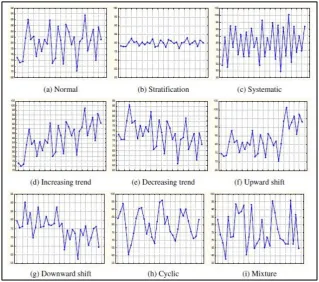
Figure 2.1: Nine control chart patterns
The patterns can be categorized as natural/normal and unnatural/abnormal process. The basic significance of a natural pattern is that it indicated a process under control. Unnatural patterns identified a process when it is out control. Natural causes are considered to be due to the inherent nature of normal process. Assignable causes are defined as abnormal shocks to the processes, which should be identified and eliminated as soon as possible. When an abnormal variation is signaled by the control chart, quality practitioners or engineers search for the assignable causes and take some necessary corrections and adjustments to bring the out-of-control process back to the in-control state (J. Yu, L. Xi & X. Zhou, 2009).
is to extend the univariate analysis by plotting a statistic that measures the overall deviations of the multivariate observations from the target (L. H. Chen & T. Y. Wang, 2004).
2.2 Process Variation
Process variation is the main course of quality problems, whether in business such as transactional or production processes. Process variation also can be defined as a major source of poor quality. Statistical process control (SPC) is one of the most effective tools of total quality management, which is used to monitor process variations and improve the quality of production. (M. Bag, S. K. Gauri & S. Chakraborty, 2011). Advances, variation reduction efforts as such process monitoring and diagnosis should be critically applied towards quality improvements (Masood. I & Hassan. A, 2009).
Variation occurs in all natural and man-made processes. Variation may be defined as any unwanted condition or as the difference between a current and a desired end-state. Both product performance and manufacturing processes exhibit variation. Wear and tear, vibration, machine breakdown, inconsistent raw material and lack of human operators’ skills are the common sources of variation in manufacturing process. To control and reduce the variation, the source of the variation must be identified. If variation cannot be measured, it is because the measurement systems are of insufficient precision and accuracy. Process variance reduces the capacity of the industries because processes become either under- or over-utilized. Process variance reduces the ability to detect potential problems and increases the difficulty of discovering the root cause of problems.
9
all of these costs can be eliminated by addressing the root cause; the focus of efforts should be on reducing variation in the process as opposed to reacting to the unfortunate outcomes of variation. Tools such as statistical experimental design, analysis, and statistical process control, can be used to improve process control and reduces variation, delivering impressive bottom line savings.
2.3 Quality Engineering
In the manufacturing environment, quality practitioners often need to simultaneously monitor not only one but many product or process characteristics (O. O. Atienza, L. C. Tang and B. Ang, 1998). Quality Engineering can be describe as discipline that deals with the analysis of a manufacturing system at all stages, to improve the quality of the production process and of its output. Quality engineering also known as “the branch of engineering which deals with the principles and practice of product and service quality assurance and quality control”. Absolutely, quality may be defined in many ways. Quality issues are now the concern of all organizations including the services and public sectors. Quality tools, techniques, concepts and methodologies have been enhanced, and integrated with other features to suit new challenges (A. Hassan, M. S. N. Baksh and A. M. Shaharoun, 2009).
Quality has become one of the most important consumer decision factors in the selection among competing products and services (Haridy & Wu, 2009). Therefore, process of control and improvement quality are keys factors leading to business success, growth and enhanced competitiveness. Quality engineering is the combination process of operational, managerial and engineering activities that a manufacturer uses to ensure that the quality characteristics of a product achieved the customer needs. Quality characteristics may be of several types (Montgomery, 2013):
1. Physical: depth, width, current, hardness 2. Sensory: colour, smell, taste
3. Time orientation: reliability, durability, serviceability
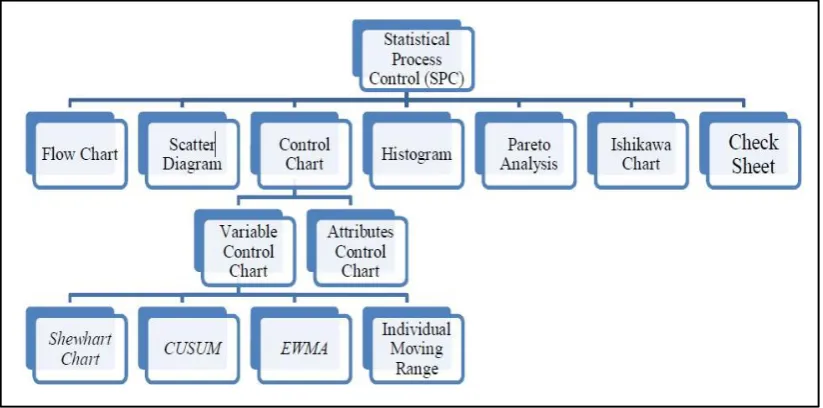
from unit to unit, or are at levels that match customer expectations. A major cause for this situation is variability. There is a certain amount of variability in every product; consequently, no two products are ever identical. Since variability can only be described in statistical terms, statistical analysis methods play as a central role in quality improvement methods. Statistical Process Control (SPC) is one of the most widely used tools for quality control and improvement in manufacturing industries. Statistical Process Control (SPC) charts have been used widely since Shewhart first introduces them in early 1930s. The primary application domain for SPC charts has been in process control and process improvement in manufacturing business (B. L MacCarthy and T. Wasusri, 2001). The diagram of basic SPC tools classification illustrates in Figure 2.2.
Figure 2.2: Basic statistical process control tools specification
2.4 Statistical Process Control (SPC)
11
the action relies on other skills. There are many ways to implement process control. There a seven basic tool as a control plan to monitor and control the manufacturing process. A control plan should be maintained that contains all pertinent information on each chart that is maintained, including:
i. Cause-and-effect diagram (also known as the "fishbone" or Ishikawa diagram)
ii. Check sheet iii. Control chart iv. Histogram v. Pareto chart vi. Scatter diagram
vii. Stratification (alternately, flow chart or run chart)
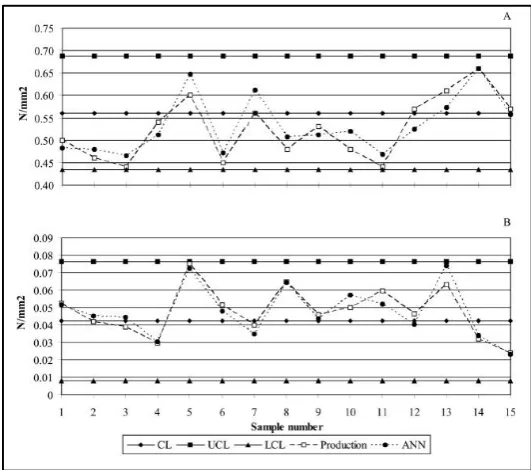
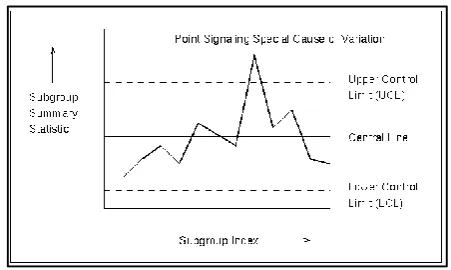
[image:22.595.185.451.483.718.2]One of the main tools used in statistical process control (SPC) is the control chart, also known as the Shewhart control chart, which consists of a center line and two lines drawn parallel to it. The center line represents the place where the characteristic measured should ideally be located and the parallel lines represent the control limits of the characteristic shown in Figure 2.3 (L.G. Esteban et al., 2009).
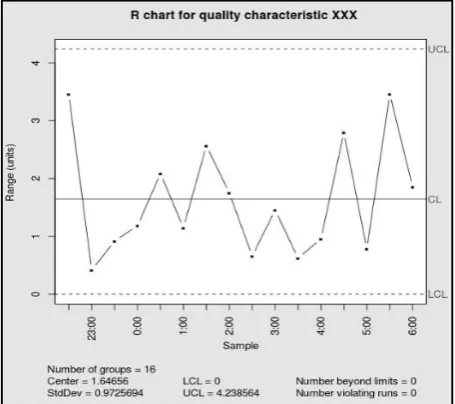
The most standard display actually contains two charts, one is called an X-bar chart in Figure 2.4 and the other is called an R chart as shown in Figure 2.5.
Figure 2.4: An example of X-Bar Chart
Figure 2.5: An example of R Chart
[image:23.595.205.433.397.599.2]13
within specification range of the product within samples. Thus, this latter chart is a chart of the variability of the process which mean the larger the variability, the larger the range. In addition to the center line, a typical chart includes two additional horizontal lines to represent the upper control limits (UCL) and lower control limits (LCL). If the line moves outside the upper or lower control limits or exhibits systematic patterns across consecutive samples, a quality problem may potentially exist. Upon the out of control is alarmed, the assignable causes for the abnormal process need to be identified and removed in order to bring the process back to normal. A stable production process is the key element of quality improvement. Depending on the number of process characteristics to be monitored, there are two basic types of control charts, Univariate Control Chart and Multivariate Control Chart.
2.5 Univariate Statistical Process Control (USPC)
Many manufactures use Univariate Statistical Process Control (USPC) in both their manufacturing and service operations. Automated data collection, low-cost computation, products and processes designed to facilitate measurement, demands for higher quality, lower cost, and increased reliability have accelerated the use of USPC (O. R. Mohana Rao et al., 2013). USPC is the monitoring and control of one quality necessary. In normal application this is usually practice by separating each quality characteristic and analysis their control chart independently (Masood, I & Hassan, A, 2010). However, in many situations the widespread use of USPC has caused a backlash as processes are frequently adjusted or shutdown when nothing is really wrong because estimates of the probability of false positives (Type I error) calculated based on USPC, were unrealistically low. USPC also takes little or no account of the multiple tests that are being performed or the correlation structure that may exist in the data (S. El-Din, Rashed & El-Khabeery, 2006).
traditional production setting. One of the reason for inadequacy of traditional methods is the numbers of variables. Since 1924, when Walter A. Shewhart presented the first sketch of a univariate control chart, univariate statistical process control (USPC) charts, mainly Shewhart charts, cumulative sum (CUSUM) control charts and exponentially weighted moving average (EWMA) control charts, have been widely used. They have received considerable attention in industry due to their ease of use by the production personnel and others with minimal statistical knowledge. However, a USPC chart can only chart one variable at a time, which mean that process engineers have to look at fifty control charts to monitor the process quality if there a fifty variables measured in the process. Furthermore those univariate charts do not take any possible correlation among variables into account. In modern manufacturing environments, the characteristic of variables of a multivariate process often are interrelated and form a correlated set. Since the variables do not behave independently, they must be treated together as a group and not separately. Monitoring of processes in which several related variables are of interest is collectively known as multivariate statistical process control (MSPC).
2.5.1 Shewhart Control Chart
[image:25.595.205.431.606.741.2]Shewhart charts also known as Control charts or process-behavior charts, in statistical process control are tools used to determine if a manufacturing or business process is in a state of statistical control. The Shewhart control chart certainly is not new, but its use in modern-day business and industry is of tremendous value (Montgomery 2013). These control charts are constructed by plotting product’s quality variable over time in sequence plot as shown in Figure 2.6.
15
A control chart contains a center line. In addition to the center line, a typical chart includes two additional horizontal lines to represent the upper control limits (UCL) and lower control limits (LCL). If the line moves outside the upper or lower control limits or exhibits systematic patterns across consecutive samples, a quality problem may potentially exist. Upon the out of control is alarmed, the assignable causes for the abnormal process need to be identified and removed in order to bring the
process back to normal. Let w be a sample statistic that measure some quality
characteristic of interest and suppose that the mean of w is μw and the standard deviation
of w is σw. Then the center line, upper control limit and lower control limit as shows in
equation (2.1).
UCL = μw + Lσw
Center Line = μw
UCL = μw – Lσw (2.1)
2.5.2 Control Limits
All the points will fall between the control limits if the process is in control. Any observations outside the limits, or systematic patterns within, suggest the introduction of a new source of variation, known as a special-cause variation. Since increased variation means increased quality costs, a control chart "signaling" the presence of a special-cause requires immediate investigation. To determine whether the process was in control when the preliminary samples were collected, plot the values of X-Bar and R from each sample on the charts and analyze the resulting display. If all points plot inside the control limits and no systematic pattern is evident, it can be conclude that the process was in control in the past, and the trial control limits are suitable for controlling current or future production. It is highly desirable to have 20–25 samples or subgroups of size n and typically n is between 3 and 5 to compute the trial control limits (Montgomery 2013). Surely it can be done by fewer data but the control limits are not as reliable.
when it is true) applied in Shewhart control chart means the process is concluded as out-of control when it is truly in-control. Same analog, the statistical Type II error β (failing to reject the null hypothesis when it is false) means the process is concluded as in control when it is truly false.
This makes the control limits very important decision aids. The control limits provide information about the process behavior and have no interrelated relationship to any specification targets or engineering tolerance. In practice, the process mean (and hence the center line) may not coincide with the specified value (or target) of the quality characteristic because the process design simply cannot deliver the process characteristic at the desired level.
2.5.3 Average Run Length
Another way to evaluate the decisions regarding sample size and sampling frequency is through the average run length (ARL) of the control chart. Essentially, the ARL is the average number of points that must be plotted before a point indicates an out-of-control condition. If the process observations are uncorrelated, then for any Shewhart control chart, the ARL can be calculated easily from equation 2.2:
ARL =
1𝑃
(2.2)
where p is the probability that any point exceeds the control limits. This equation can be used to evaluate the performance of the control chart. To illustrate, for the X-Bar chart with three-sigma limits, p = 0.0027 is the probability that a single point falls outside the limits when the process is in control. Therefore, the average run length of the chart when the process is in control (called ARL0) as equation (2.3):
ARL
0=
1 𝑃
=
1
0.0027
= 370
(2.3)
17
years. The reasons for this arise because the distribution of run length for a Shewhart control chart is a geometric distribution. Consequently, there are two concerns with ARL:
(i) The standard deviation of the run length is very large, and
(ii) The geometric distribution is much skewed, so the mean of the distribution (the ARL) is not necessarily a very typical value of the run length.
The proposed model outperforms the conventional multivariate control schemes in terms of ARL, and can accurately estimate the magnitude of the shift of each of the shifted variables in a real-time mode (J. Yu & L. Xi, 2009).
2.5.4 Individual Control Chart
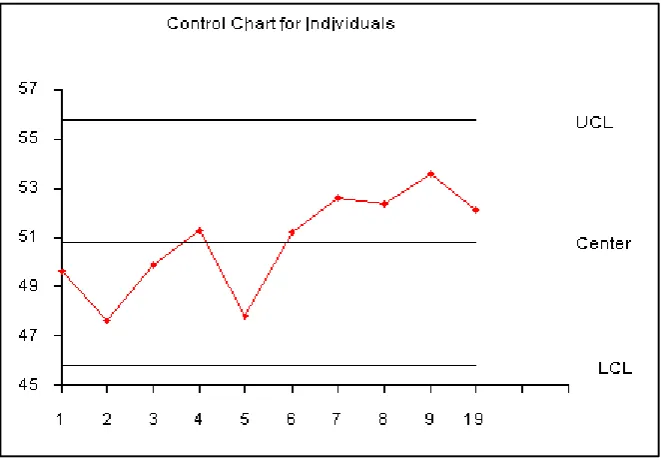
The individuals control chart examines variation in individual sample results over time as shown in Figure 2.7. While rational subgrouping does not apply, thought must be given to when the results were measured. If the process is in statistical control, the average on the individuals chart is our estimate of the population average. The average range was used to estimate the population standard deviation. For individual measurement, e.g., the sample size = 1, use the moving range of two successive observations to measure the process variability. The moving range is defined as in equation (2.4).
MR
i= x
i– x
i-1
(2.4)
This is the absolute value of the first difference (e.g., the difference between two consecutive data points) of the data. Analogous to the Shewhart control chart, one can plot both the data (which are the individuals) and the moving range. For the control chart for individual measurements, the lines plotted in equation (2.5):
UCL =
𝑥̅
+ 3
𝑀𝑅̅̅̅̅̅ 1.1.28UCL =
𝑥̅
- 3
𝑀𝑅̅̅̅̅̅1.1.28
(2.5)
[image:29.595.154.485.173.403.2]Keep in mind that either or both averages may be replaced by a standard or target, if available.
Figure 2.7: Individual chart
2.6 Multivariate Statistical Process Control (MSPC) Chart
19
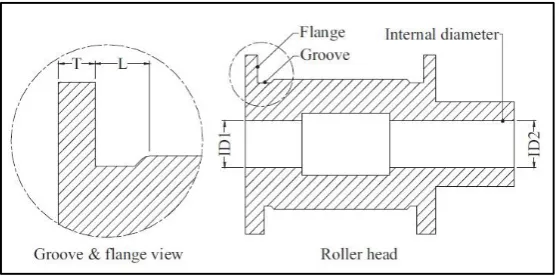
[image:30.595.180.460.174.312.2]process control is the quality control chart. For example found in Masood & Hassan (2013), suppose that a roller head has both an inner diameter (ID1) and inner diameter (ID2). These two dependent quality characteristics (multivariate) are needed for MSPC. Figure 2.8 shows illustration of the roller head.
Figure 2.8: Functional features of roller head.
Multivariate process control techniques were established by Hotelling in his 1947 pioneering paper. Hotelling applied multivariate process control methods to a bombsights problem (S. Bersimis, S. Psarakis & J. Panaretos, 2006). The Hotelling’s T2 control chart was applied for bombsight data during World War II. Jackson JE, 1991 stated that any multivariate process control procedure should fulfill four conditions:
1. Is the process in control?
2. An overall probability for the event ‘Procedure diagnoses an out-of-control state erroneously’ must be specified
3. The relationships among the variables–attributes should be taken into account
4. An answer to the question ‘If the process is out of control, what is the problem?’ should be available
1. Prevent process failures
2. Improve and optimize product quality and process 3. Reduce process costs
4. Increase overall equipment efficiency
In manufacturing, although the MSPC charts serve as well as fundamental tools for multivariate process control applications, their assumptions are challenged by many modern manufacturing environments. One good example is that autocorrelation in the measurement can result in too many out of control false alarm when standard control limits are used in application where the process is sampled frequently. Most multivariate control procedures require the observation vectors to be uncorrelated over time. Unfortunately, violations of this assumption can weaken the effectiveness of the overall control procedure. Ibrahim Masood & Adnan Hassan (2014) also agreed that they are merely unable to provide diagnosis information, which is greatly useful for a quality practitioner in finding the root cause error and solution for corrective action.
2.7 Pattern Recognition in SPC
21
class, determined by its class conditioned probability distribution. In order to build a classifier, these distributions must either be known ahead of time or must be learned from the data (R. Polikar, 2011). Control charts pattern recognition is one of the most important tools in statistical process control to identify process problems. Unnatural patterns exhibited by such charts can be associated with certain assignable causes affecting the process (N.V.N. Indra Kiran et al., 2010).
2.8 Artificial Neural Network (ANN)
Artificial Neural Network (ANN) or Neural Network (NN) has provide an exciting
alternative method for solving a variety of problems in different fields of science and
engineering. Artificial Neural Networks are relatively basic electronic models based
on the neural structure of the brain. The brain basically learns from experience. The
ANN is very useful because it have ability to learn and recognize. ANN can figure
out how to perform their function on their own and determine their function based
only upon sample inputs.
ANN learns to recognize patterns directly through a typical sample patterns
during a training phase. Neural nets may provide required abilities to replace the
human operator. Neural network also have the ability to identify an arbitrary (N.V.N.
Indra Kiran et al., 2010). Recently, many studies used ANNs in order to detect
patterns more effectively than the conventional approach and their aim is the
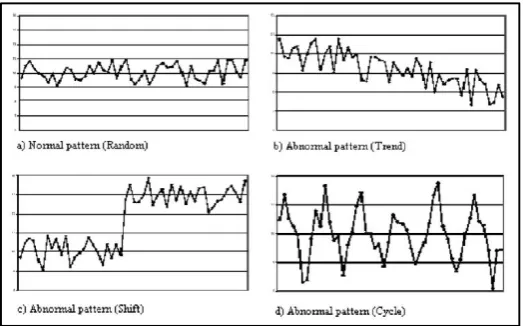
automatic diagnosis of the patterns such as that in Figure 2.9 (T.T. El-Midany et al.,
[image:32.595.189.451.567.730.2]2010).
In such studies, ANNs were trained in order to learn specific patterns using a
training set. ANNs have been successfully applied to interpret univariate SPC charts,
where ANNs have been applied to the pattern recognition task for identification of
the abnormal pattern and estimation of key parameters. Since then, several other
researchers have proposed various ANN-based SPC control chart pattern recognition.
In general, univariate SPC frameworks average run length, ARL0 ≥ 370, but MSPC
frameworks indicated ARL0 ≤ 200 (Masood, I & Hassan, A, 2013). This is so called
‘imbalanced monitoring’ will be effecting to the practitioner to make unnecessary
and corrective action due to wrong identification. On the diagnosis side, they are also
having a lack of accuracy in identifying the source (causable) variables especially when dealing small shifts. This is so called ‘lack of diagnosis’ would be more
difficult for practitioner in searching the root cause errors. They observed a good
correlation between predicted and the experimental values with the correlation
coefficient ranging between 0.92 and 0.99 (Yusuf Talal F et al., 2010).
2.8.1 Generalized ANN Model
An ANN consists of massively interconnected processing nodes known as neurons. It
receives the input from the external sources and combines them, performs generally a
nonlinear operation on the result and then outputs the final result. A commonly used
ANN model is a feed forward network which contains an input layer, some hidden
layers and an output layer. Each neuron in the network accepts a weighted set of
inputs and responds with an output (Shivakumar A et al., 2010). Figure 2.10 shows
the architecture generalized recognizers; raw data-based and generalized
23
[image:34.595.121.517.71.257.2](a) Raw Data-Based ANN (b) Feature-Based ANN
Figure 2.10: Generalized-ANN architectures based on three layer MLP model
Raw data-based input representation yields large dimensional input vectors,
computational efforts and time consuming for training ANN recognizer. In
addressing this issue, feature based input representation such as summary statistic
features, frequency count features, shape features and statistical features have been
proposed in developing univariate CCPR schemes. It involves features extraction
procedure as shown in Figure 2.11 to extract the properties of the samples (Masood, I
& Hassan, A, 2010).
Figure 2.11: Comparison between Raw Data-Based and Feature-Based Input
Representation
2.8.2 Ensemble ANN Model
The existing ANN schemes commonly main generalized based which is only single
ANN recognizer was applied. The generalization ability of ANNs can be improved
by combining several ANNs in redundant ensembles, where the member networks
are redundant in that each of them provides a solution to the same task, or task
[image:34.595.118.538.476.548.2](Sharkey, 1999). This approach is now formally known as an artificial neural
network ensemble. An ANN ensemble is a finite number of ANNs that are trained
for the identical purpose whose predictions are combined to generate a unique
output. ANN ensembles offer a number of advantages over a single ANN in that they
have the potential for improved generalization and increased stability (Sharkey,
1999). Ensemble methods have been successfully applied in various domains, such
as time series prediction, robotics, and medical diagnosis (Chang Shu and Donald H.
Burn, 2004). It has been shown to frequently generalize better than single ANN.
However, for ensemble to be effective, the component ANN in the ensemble must be
as accurate and diverse as possible. Figure 2.12 illustrates the basic framework of an
[image:35.595.182.457.318.515.2]ANN ensemble. Each ANN in the ensemble is first trained on the training examples.
Figure 2.12: A neural network ensemble.
2.9 Modelling of Bivariate Samples and Patterns
A large amount of bivariate correlated samples and data are required to perform
training and testing the ANN recognizer. Ideally, such samples should be selected
from industry in real process. Unfortunately, they are not economically and limited
therefore there is a need for modeling of process pattern for synthetically generating
69
REFERENCES
B. L MacCarthy and T. Wasusri. (2001). A Review Non-Standard of Statistical Process Control (SPC) Charts. International Journal of Quality & Reliability Management, Vol. 19 (3) pp. 295 – 320.
Chang Shu and Donald H. Burn. (2004). Artificial Neural Network Ensembles and Their Application in Pooled Flood Frequency Analysis. Water Resources Research, VOL. 40, (2004).
Chen, L.H. & Wang, T.Y. (2004). Artificial Neural Networks to Classify Mean Shifts from Multivariate X2 Chart Signals. Computers & Industrial Engineering. 47(2004), pp. 195-205.
Cheng, H.P., Cheng, C.S. (2009). Control Chart Pattern Recognition Using Wavelet Analysis and Neural Networks. Journal of Quality, 16(25), 311-321.
Guh, R.S. (2007). On-Line Identification and Quantification of Mean Shifts in Bivariate Processes Using A Neural Network-Based Approach. Quality and Reliability Engineering International.23 (2007), pp. 367-385.
Ibrahim Masood &Adnan Hassan. (2014). Bivariate Quality Control Using Two Stage Intelligence Monitoring Scheme. Expert System with Application 41 (2014) 7579 – 7595
Ibrahim Masood &Adnan Hassan. (2012). Pattern Recognition for Bivariate Process Mean Shifts Using Featured-Based Artificial Neural Network. The International Journal of Advanced Manufacturing Technology (2012).
Jackson JE. (1991). A User Guide to Principal Components. Wiley: New York.
Jian-bo Yu & Li-feng Xi. (2009). A Neural Network Ensemble-based Model for On-line Monitoring and Diagnosis of Out-of-control Signals in Multivariate Manufacturing Processes. Expert Systems with Applications. 36 (2009), pp. 909– 921.
Jianbo Yu, Li-feng Xi & Xiao Jun Zhou. (2009). Identifying Source(s) of Out of Control Signals in Multivariate Manufacturing Processes Using Selective Neural Network Ensemble. Department of Industrial Engineering and Management, Shanghai Jiaotong University, Shanghai 200240, PR China.
Kuang-Han Chen, Duane S. Boning and Roy E. Welsch. (2001). Multivariate Statistical Process Control and Signature Analysis Using Eigen factor Detection Methods. Statistics and Management, Sloan School of Management, Massachusetts Institute of Technology, Cambridge.
L.G. Esteban, F. García Fernández, P. de Palacios and M. Conde. (2009). Artificial Neural Networks in Variable Process Control: Application in Particleboard Manufacture. Investigación Agraria: Sistemas y Recursos Forestales 2009 18(1), pp. 92-100.
Long-Hui Chena, Tai-Yue Wang. (2002). Artificial Neural Networks to Classify Mean Shifts from Multivariate X2 Chart Signals. Computers & Industrial Engineering. 47 (2004), pp. 195–205.
Masood, I. & Hassan, A. (2009). Synergistic-ANN Recognizers for Monitoring and Diagnosis of Multivariate Process Shift Patterns. International Journal of Soft Computing and Pattern Recognition, 2 (9), pp. 336-355.
Masood, I. & Hassan, A. (2010). Improved Recognition of Multivariate Process Mean Shift Patterns Using Synergistic-ANN Recognizer. The 11th Asia Pacific Industrial Engineering and Management Systems Conference.7-10 December 2010: APIFM, (2010).
71
Monark Bag & Susanta Kumar Gauri & Shankar Chakraborty. (2012). An Expert System for Control Chart Pattern Recognition. International Journal Advanced Manufacturing Technology. (2012), 62 pp. 291–301.
M. A. Sharaf El-Din, H. I. Rashed and M. M. El-Khabeery. (2006). Statistical Process Control Charts Applied to Steelmaking Quality Improvement. Quality Technology & Quantitative Management Vol. 3, No. 4, pp. 473-491.
N.V.N. Indra Kiran, M.Pramila devi, G.Vijaya Lakshmi. (2010). Effective Control Chart Pattern Recognition Using Artificial Neural Networks. International Journal of Computer Science and Network Security, VOL.10 No.3, March 2010.
Orlando O. Atienza, Loon Ching Tang and Beng Wah Ang. (1998). Simultaneous Monitoring of Univariate and Multivariate SPC Information Using Box Plots. International Journal of Quality Science. Vol. 3 Iss 2 pp. 194 – 204.
O. Rama MohanaRao, K.VenkataSubbaiah, K.NarayanaRao, T.SrinivasaRao. (2013). Application of Univariate Statistical Process Control Charts for Improvement of Hot Metal Quality- A Case Study. International Journal of Engineering Research and Applications. Vol. 3, Issue 3, May-Jun 2013, pp. 635-641.
Robi Polikar Rowan (1997). Pattern Recognition, University Glassboro, New Jersey. Wiley Encyclopedia of Biomedical Engineering, Copyright & 2006 John Wiley & Sons, Inc.
Seref Sagiroglu, Erkan Besdok and Mehmet Erler. (2000). Control Chart Pattern Recognition Using Artificial Neural Networks. Turk J Elec Engin, VOL.8, NO.2, 2000.
Sharkey, A. J. C. (Ed.) (1999). Combining Artificial Neural Nets: Ensemble and Modular Multi-Net Systems, Springer-Verlag, New York. Perspectives in Neural Computing, Springer (April 15, 1999).
S. Bersimis J. Panaretos and S. Psarakis. (2006). Multivariate Statistical Process Control Charts and the Problem of Interpretation: A Short Overview and Some Applications in Industry. University of Piraeus, Department of Statistics and Insurance Science, Piraeus, Greece Athens University of Economic and Business, Department of Statistics, Athens, Greece.
T.T. El-Midany, M.A. El-Baz, M.S. Abd-Elwahed. (2010). A Proposed Framework for Control Chart Pattern Recognition in Multivariate Process Using Artificial Neural Networks. Expert Systems with Applications. 37 (2010), pp. 1035–1042.
Wen-Hai Chih & Dwayne A. Rollier. (1993). A Methodology of Pattern Recognition Schemes for Two Variables in SPC. International Journal of Quality & Reliability Management, Vol. 12 No. 3, (1995), pp. 86-107.