Journal of Chemical and Pharmaceutical Research, 2014, 6(5):1750-1755
Research Article
CODEN(USA) : JCPRC5
ISSN : 0975-7384
A study of the impact of collaborative problem-solving strategies on students’ performance
of simulation-based learning
Hsin-Ke Lu
1and Peng-Chun Lin
2*
1
Graduate Institute of Information Management, Chinese Culture University, Taiwan
2Institute of Information Management, Chinese Culture University, Taiwan
ABSTRACT
The continued development of the Internethas caused theconceptsof network infrastructureandsimple network troubleshootingtobecomeimportant teaching objectives of certaincollege curricula. However, the abstractnature of network conceptsand the high cost of equipment for network-related practice have become educational challengesfor teachers in therelevant fields. Therefore,simulationlearning andsimulationlearningsoftwarehave become major instructional toolstoassist teachers. Unfortunately,most simulationlearning softwareis individually manipulated, which maycause feelings ofisolationamong studentsduring the course oflearning. Therefore, in this study, aquasi-experimentalapproach was utilized toinvestigatehowteaching strategies for simulationlearning andfor integrating simulationlearning withcollaborativeproblem solving(CPS)impactedlearning outcomes.Assessments by one-wayanalysis of covariance revealed that the post-testscoreswere significantly better in the experimental groupthan inthe controlgroup, suggesting that the integratededucational activitieswere beneficialtostudents'learning.The resultsof this studycan serve as a referencefor teachersinrelevant fieldswith respect to designingeducational activities that canhelp studentslearnmore effectively andimprove students’ teamwork
abilities.
Keywords: simulation-based learning; Collaborative Problem Solving; Packet Tracer
INTRODUCTION
Due tothe rapid development of network technology, individuals’ Internetuserequirementsare increasing daily.Colleges and universities generally offer coursesthat teach basic network-related concepts. These coursesenhance students’ abilities to use network technology by enabling students to understand themode of operationof the Internetandallowing students to perform simpletroubleshooting. However, Internet-basedconcepts,such asthe principles underlyingvariouscommunication protocols and packet-forwarding processes, have always been a relatively abstract knowledge system.Thus,teaching inthis fieldhas long beenachallengefor instructors. In addition, themanagement ofnetwork devicesis a skill that must be masteredthrough hands-ontraining. In particular, providing learners withopportunities toconstructprocedural knowledgeandtrainin practical skills through hands-onactivities are extremely important educational tools in science,technology, engineeringand mathematics (STEM) fields.However, in actual educationalenvironments, due to various considerations, including time, spaceandfunding,it can be difficultfor colleges and universitiestoprovide students withadequate training inhands-onenvironments. Thus, the use of information technology to establish simulatedoperational environmentsplays anextremelyimportant roleinstrengtheningstudents’ learning of procedural knowledge[1].
______________________________________________________________________________
understandthesephenomena. Thus, simulation learning can safely and inexpensively providestudentswith environmentssimilarto real-life situations.As a result,students can learn about relevantissues throughan educational process involving exploration andconstant attempts at experimentation and can thereby acquire adeeperunderstandingofthe simulatedphenomenonthrough hands-onmanipulation [2]. Therefore, for educators, relevant software for simulationlearninghas becomean importanttool for providing teaching assistance. Many scholarshave previously proposed differentinstructional-design approaches for enhancing students'learning outcomesinthe information technology andnetwork fields,andresearch has proven that simulation-based learningcaneffectivelyimprove learningoutcomes[3][4].
However, in a simulatedlearningenvironment,most support toolsmainly allow for manipulation and learning only by an individuallearner.One such tool is "Think Tool," which wasdesigned by White (1993) and WhiteandFrederiksen (1998) to assiststudents in learning theabstract concepts of physicalmechanicsor to provide teachers with aneasy Java simulation(EJS) designenvironmentforthe design and production of computer-basedscientific simulations and animations[5][6]. However, the use of simulated learning environments that are manipulated by only an individuallearnermay generate relevantconcernsregardingisolatedlearning.Vygotsky(1978)believed thatlearning and developmentare not independent butare insteadmutually influential processes. Fromthe perspective of cognitive
elaborationtheory,learners canincorporate knowledgethroughcognitiverestructuringand masteryprocesses(such
assummarizing andrestating, among other processes) thatallow newly learned information to beretained in the
memoryandconnected with priorexperiences [7].A student who explains newly
learnedinformationtoothersmustorganize andinterpret the informationin question; thus, explanations to othersmay not only promote therefinement of theexplainer’s own perceptions but may alsoimprove the outcomes of cooperativelearning activities [8].Therefore, cooperative learningis a common teaching strategy in STEM fields.Roth and Roychoudury (1993)stated thatcooperative learningcan improvestudents' academicperformance, enhance comprehensionandproblem-solving abilities, andre-construct or alterthe conceptual frameworks of students’ knowledgethrough processes of communicationand discussion [9].
Therefore, in this study,a quasi-experimental approach was utilized to examinegroups of college studentswho were obtaining abasicintroduction to networkstoinvestigatewhetherthe use ofnetwork-simulation softwarecould enhancestudents'learning outcomes. Moreover, thequestion of whether an instructional design that integrated
networkeducational-simulation softwarewith collaborativeproblem-solving (CPS)strategies could further
improvestudents'learning outcomes was also explored.
LITERATURE REVIEW
Simulationlearning
As technology has advanced, theintegration of computer-basedinstruction methods into education hasbecome an
increasingly widespread trend. In particular, learning throughsimulation and manipulationplays
anextremelyimportant role in education in STEM fields.Bransford, Brown and Cocking (2000)noted that good learning outcomes can be achievedifstudentsconstructtheir ownunderstanding of scientific knowledge withinexisting knowledge frameworks [10]. To accomplishthis objective, students must proactively participate inandlearn from the educational process;interactivecomputer simulationsoftwarecanhelp to meetthisrequirement[11].During the course ofteaching in scientific education,dynamic andinteractivecomputer simulationscan improve students’learning outcomeswith respect to scientificphenomenathat aredifficult toobservein a real-world context.By enabling repeated manipulations or observations, the use ofsimulation softwarecanhelplearners acquire a deeperunderstanding
ofscientific phenomena and appropriately promote implementation, reflective competenceand
high-levelcognitionforthe relevant procedural knowledge.Studies have alsodetermined that virtualmanipulationsin software-based simulationenvironmentscan contribute toa greater understandingof domainknowledge [12][13].
From the perspective of teaching, the main purpose ofutilizing computer-based simulationand manipulation is to meet the needs of learners by providing opportunities topractice the solving ofreal-worldproblems[14].Students often cannot attempt to address these problems in real-world environments due tolimitations imposed by variousfactors, such as time, costandrisk;fortunately, these situationscan besuccessfully modeledthroughcomputer simulation[15]. Many studieshave utilizedsimulation-based software to assist with diverse aspects of scientific instruction, includingphysics experiments[16][17],molecular dynamics[18], and knowledge of circuits[19]; these studies havefound that the use of simulation software haspositive effectson all levels toenhancelearning.
______________________________________________________________________________
studieshave alsomentioned that the integration ofPacket Tracerinto teaching canenhance students' interest in learning andimprove learning outcomes[3][20][21].
Collaborative Problem Solving(CPS)strategies
In STEM fields,a great deal of knowledgemust belearnedthroughmanipulation andtheprocess of attempting to solve problems by troubleshooting.Therefore, thelearning of procedural knowledgeis extremely important. Proceduralknowledgerefers toknowledgeobtainedduringthe process of performing operationsand the ability toutilizeinformationtosolve problems.Frequently, certain types of activity are presumably necessary to indirectly derive procedural knowledgeby effectively practicinghowto approach problemsand what methodsto utilize. Procedural knowledge mainlyincludes the methods, techniques, strategies, procedures and steps ofsolving problems. Problem-solving strategiesare often applied in courses in relevant fields for theteachingandlearning
ofproceduralknowledge, and researchers have explored students' learning processesandlearning
outcomes[22-25].Problem solvingisawidely adoptedteaching strategy[19],and manystudies
haveexploredproblem-solving based teaching strategiesinvolving the useof technologies
[15][24-25].Numerousstudies havealso stated thatcooperative learningcaneffectively improvelearning performance for studentsof allages. Therefore,Nelson (1999)proposedCPS, which integratesthe two approaches of cooperativelearningandproblem-basedlearning.CPSencouragesstudents tolearn by doing andstresses the authenticity of thecollaborativelearning environment; in CPS,students become participants in active learning processes, with an emphasis onindependent thinking andproblem-solvingcapabilities[26]. In the CPSpedagogy, objectives include not only the development ofproblem-solving skills but also guidingthedevelopment of learners’ cooperation and communication abilities.Inaheterogeneousgroup, theabilities and perspectivesof an individualarelimited; thus, to find the appropriate solution for a problem, there must be cooperation among group members and even those with differing views[27][28].Therefore, for the experimental group ofthis study, in addition to usingPacket Tracerto assiststudents in learning basic networking concepts, CPSstrategy wasalso integrated into the instructional approach toinvestigatewhether this integrationcould enhancestudents'learning outcomes.
RESEARCH METHOD
This study useda quasi-experimentalapproachto investigatethe learning outcomes of universities’studentswhowere enrolled in asemester course that provided a basic competenceto networks.
1. Experimentaldesign
In this study, given the characteristics of the experimentalsetting, oneclass of studentswasrandomly designated as the experimental group, and anotherclass wasdesignated as the control group for comparison analysis. For both groups of students, the Packet Tracersimulatorandassessment questionnaire wereusedas an instructional setting to facilitatelearning. In theexperimental group, the baseline learning activitieswere integrated with activities
designedusingCPSstrategies; these CPS activitiesallowed students to communicate andlearnthrough
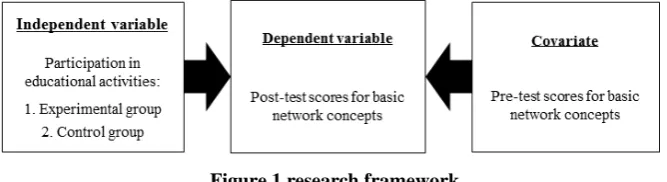
[image:3.595.149.483.534.625.2]groupdiscussions. A pre-test on the network competency was administered prior to the learningactivities,and a post-teston the networkcompetency was administered afterthecompletion of these activities. The research frameworkof thisstudy can be depicted asfollows (Figure 1):
Figure 1 research framework
Theindependent variablein this study was participation inlearning activities,the dependent variablewasthe post-testscoresof the experimentaland controlgroup studentson the "BasicNetworkConcept Inventory (BNCI)," and the covariate was the pre-testscores ofexperimentaland controlgroup students. The experimental designis presented in Table 1. G1 refers to experimental group students, whereas G2 refers to control group students; O1 and O3refer
tothe pre-testscores of the experimental and control group students, respectively, on the BNCI.The independent
variable was involvement in learning activities, whereX(CPS)represents theexperimental treatment of CPS; O2 and
O4refer tothe study’s dependent variable, the post-testscores of the experimental and control group students,
______________________________________________________________________________
Table1 The pre- and post-testquasi-experimental design
Group Pre-test Experimental treatment Post-test
Experimental group (G1) O1 X(CPS) O2
Control group (G2) O3 O4
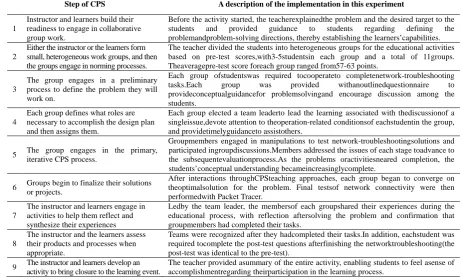
[image:4.595.72.536.276.556.2]The learningactivities involved the teacher’sdesign of networkscenariosfor troubleshooting in the Packet Tracersimulator.The students werethen requiredto determinethe problem andaddress obstacles to allowthenetworkto connect and work properly in thesimulation environment.Control group students were required tocomplete thelearning activities individually, whereas experimentalgroup students utilized cooperative learning to complete the learning activities in accordance with CPS pedagogy. The ninestepsof theCPSpedagogyandtheirimplementation in thisstudy are presented in Table 2. The resultingpre- and post-testscores of individualsonthe BNCIwere obtained in the same manner for students in both experimental groups.
Table 2 a mapping of ninesteps of CPS and implementations
Step of CPS A description of the implementation in this experiment
1
Instructor and learners build their readiness to engage in collaborative group work.
Before the activity started, the teacherexplainedthe problem and the desired target to the students and provided guidance to students regarding defining the problemandproblem-solving directions, thereby establishing the learners’capabilities.
2
Either the instructor or the learners form small, heterogeneous work groups, and then the groups engage in norming processes.
The teacher divided the students into heterogeneous groups for the educational activities based on pre-test scores,with3-5studentsin each group and a total of 11groups. Theaveragepre-test score foreach group ranged from57-63 points.
3
The group engages in a preliminary process to define the problem they will work on.
Each group ofstudentswas required tocooperateto completenetwork-troubleshooting
tasks.Each group was provided withanoutlinedquestionnaire to
provideconceptualguidancefor problemsolvingand encourage discussion among the students.
4
Each group defines what roles are necessary to accomplish the design plan and then assigns them.
Each group elected a team leaderto lead the learning associated with thediscussionof a singleissue,devote attention to theoperation-related conditionsof eachstudentin the group, and providetimelyguidanceto assistothers.
5 The group engages in the primary, iterative CPS process.
Groupmembers engaged in manipulations to test network-troubleshootingsolutions and participated ingroupdiscussions.Members addressed the issues of each stage toadvance to the subsequentevaluationprocess.As the problems oractivitiesneared completion, the students’conceptual understanding becameincreasinglycomplete.
6 Groups begin to finalize their solutions or projects.
After interactions throughCPSteaching approaches, each group began to converge on theoptimalsolution for the problem. Final testsof network connectivity were then performedwith Packet Tracer.
7
The instructor and learners engage in activities to help them reflect and synthesize their experiences
Ledby the team leader, the membersof each groupshared their experiences during the educational process, with reflection aftersolving the problem and confirmation that groupmembers had completed their tasks.
8
The instructor and the learners assess their products and processes when appropriate.
Teams were recognized after they hadcompleted their tasks.In addition, eachstudent was required tocomplete the post-test questions afterfinishing the networktroubleshooting(the post-test was identical to the pre-test).
9 The instructor and learners develop an activity to bring closure to the learning event.
The teacher provided asummary of the entire activity, enabling students to feel asense of accomplishmentregarding theirparticipation in the learning process.
2. Participants
The study participantswere72undergraduate students who were enrolled inthe course"An Introduction to Networks" offered by a university in northern Taiwan. The duration of thiscourse was 16 weeks, and thecurriculum objectiveswereto buildbasic network competenceand skill for troubleshooting. The 34 participantsin thecontrol groupincluded19 men(56%) and 15women(44%), whereas the 38 participantsin the experimental groupincluded21men (55%) and 17 women (45%).
3. Researchtools
The following research toolswere utilized in this study:
Packet Tracersimulationexercise: Thissimulation exercise was designed by teachers with over 10 yearsof network-related teaching experiencetoprovide instruction in networkconcepts.The major theme of the exercise wasnetworktroubleshooting. To complete the educational activities, studentswere required to identifyandsolvea problem in thesimulatorenvironment.
Outlinequestionnaire toguidethe simulation exercise: By providingan outline with
______________________________________________________________________________
Basic Network Concept Inventory: This inventory, which was designedby the courseinstructor, containsa total of10 multiple-choice and essayquestionscoveringbasic network concepts, including 5 questions on fundamental concepts and 5questionson troubleshootingconcepts.RESULTS
[image:5.595.76.540.236.286.2]In this study,pre-test and post-test measurements using the BNCIwere performed for the experimental andcontrolgroup students.Paired-samples t-tests were usedtoinvestigate therelationship betweenteaching with the Packet Tracersimulatorand learning outcomes.Theresulting analysisof the pre- and post-test scores of the controland experimental groupstudents is presentedin Table 3. The resultsindicated thatknowledge of basic network improved in both groups of studentsafter conducting the educational activities described above.
Table 3 ananalysisof pre- and post-test scores for controland experimental group students
Group Test NO. of students Mean score Standard deviation t p
Control group Pre-test 34 57.29 23.984 -2.719 p=.010 (<0.05)
Post-test 34 62.91 22.348
Experimental group Pre-test 38 57.63 20.898 -4.448 p=.000 (<0.001)
Post-test 38 69.21 18.914
Furthermore, the researchers usedanalysis of covariance to examinethe pre- and post-testdifferences between theexperimental and controlgroupof some subjects. First,the homogeneityof theregression coefficientswithinthe groups was examined. These tests resulted inanF-value of 2.054 and a p-value of 0.156, which didnot reach significance (>0.05). Therefore,the relationship between the covariate(pre-test scores) and thedependent variable(post-test scores) did notchangedue todifferingtreatment standardsassociated with the independent variable. Thus, the homogeneity assumption forthe regression coefficientsofvariableswithingroups was satisfied, and the subsequentanalysis of covariance was applicable.The results of independent-samples analysis of covariance afterexcludingthe impact of pre-testscores(the covariate) on post-testscores(the dependent variable) indicated that the impact of the independent variableon thedependent variablehad anF-value of 4.327 and a p-value of 0.041; this impact reachedthe threshold for significance (<0.05), indicating that participants’post-testscoresvarieddue to the differentteachingmethods used in the different experimental groups.Assuming that the homogeneityassumption forregressioncoefficients within groups holds, the covariance analysis process indicated thatthe adjustedmean post-testscoreswere69.02 for the experimental group and 62.75 for the control group after excludingthe impact of covariance on thedependentvariable and adjusting the actual post-test scores of each group based onthe corresponding pre-testscores. Thus, it was evident thatthe post-test scoresof theexperimental groupstudents were significantly better thanthe post-test scores ofthe control group students.
DISCUSSION AND CONCLUSION
Due tothe abstractnature ofbasicnetwork concepts, providing hands-on operations to learners to enable the construction of proceduralknowledgeandtrainactual implementationability is an important aspect oflearningrelevant skills.Acharacteristic of computer simulationlearningis that it allows for the concrete examination of phenomenathat are difficult to observe inreal environments.Moreover, guidanceand assistancefrom the simulation systemcan helpstudents understandthesephenomena.Therefore, this study used aquasi-experimental approach to investigate whether educational activities using network simulationsoftwarewerebeneficialtothe learning outcomes of collegestudentsenrolled ina course of basic networkconcepts. Furthermore, researchers divided the studentsinto an experimental group and a control groupto explore whether integrating network simulation-based learning tool with CPS teaching strategiescouldbetter enhancestudents'learning outcomes relative to the use of network simulation-based learning tool alone.
The results indicated that there were significant differences in thepre- and post-test scores of the control group students who completed the educational activitiesusing thenetwork simulation-based learning tool, indicating that the educational process involving thisnetwork simulation-based learning toolimprovedlearning outcomes for these students. This finding is consistent with the resultsof prior studies[3][4].The experimental group students who completed theeducational activitiesin which thenetwork simulation-based learning toolwas integrated with CPS teaching strategies also exhibited significantly differentpre- and post-test scores, indicating that the designof theseeducational activitiesalso improved students'learning outcomes.
______________________________________________________________________________
thaneducational activitiesthat only utilized network simulationas an instructional tool.
Therefore, the resultsof this studywill provideteachersin relevant fieldswith a referenceforteaching. The simpleapplication of networksimulation as an instructional toolcan enhancestudents’ learning outcomes. However, the simulatedlearning environment is manipulated by individuallearners; thus,the use of this environment may cause students to feela sense of isolation, and the learning process can be interrupted because students may not be able toobtainhelpwhen they encounter problems.To address this issue, the designed educationalactivitiesthat integrate simulation learning andcooperative learningcan achieve theobjectives ofteaching abstract conceptsandimproving students’ operational capabilities.Moreover, this design allows students toshare and discuss relevant topics with other studentsduring educational activities; this aspect of the integrated approach promotes theinternalization of knowledge and the development ofbetter teamwork skills, enhancing students’adaptability and competitiveness in society.
REFERENCE
[1] P. Doulai;.European Power Electronics and Drive Association, 2001.
[2] L. Carabaneanu;R. Trandfir;M.I.Mazilu;Ser. A, Research Reports 5, Tampere Polytechnic,2006,106-111.
[3] C. Goldstein;S. Leisten;K. Stark;A. Tickle;.Proc. Seventh Australasian Computing Education Conference
(ACE2005); 2005,.223-228.
[4] C. Yehezkel; M. Eliahu; M. Ronen; International Journal of Engineering Education;2009,25(2), 228–238 [5] B. White; Cognition and Instruction,1993, 10, 1-100.
[6] B.Y. White; J.R. Frederiksen;Cognition and Instruction,1998,16, 3-118. [7] L.S. Vygotsky;Mind in Society. Cambridge,1978.
[8] E.Jacob; Cooperative Learning in Context,1999.
[9] W. M. Roth; A.Roychoudhury;International Journal of Science Education, 1993, 15, 27-44.
[10] J.Bransford; A. Brown;R. Cocking;How People Learn: Brain, Mind, Experience, and School,2000, 3-23. [11] C.E Wieman; W.K. Adams; K.K. Perkins;Science,2008, 322, 682-683.
[12] Z.C.Zacharia;G. Olympiou;Learning and Instruction, 2011, 21(3), 317-331.
[13] Z.C.Zacharia;G. Olympiou;M. Papaevripidou;Journal of Research in Science Teaching, 2008, 45(9), 1021-1035. [14] D.Jonassen; Mindtools for critical thinking. Englewood Clifs,1996.
[15] J.R.Dennis; R.J. Kansky; Instructional computing: An acting guide for educators; 1984. [16] H.Pol; E. Harskamp; C.Suhre;International Journal of Science Education,2005, 27(4), 451-469. [17] K.Y.Yang; J.S. Heh;Journal of Science Education and Technology, 2007, 16(5), 451-461. [18] L. Stern;N. Barnea;S. Shauli; Journal of Science Education and Technology, 2008,17(4), 305-315. [19] H.C.Liu; I.H.Su;.British Journal of Educational Technology,2011, 42(4), 598-607.
[20] D.C.Frezzo;J.T.Behrens, R.J.Mislevy;P. West;K.E. DiCerbo; 2009 Fifth International Conference on Networking and Services, 2009.
[21] D.C.Frezzo; J.T.Behrens;R.J.Mislevy;Journal of Science Education and Technology, 2010, 19(2), 105-114. [22] R.M.Gagné;Educational Psychologist, 1980, 15(2), 84-92.
[23] R.M.Gagné;L.J. Briggs;Principles of instructional design (2nd ed.), 1979.
[24] S. Oh;D.H. Jonassen;Journal of Computer Assisted Learning, 2007, 23(2), 95-110.
[25] H.I. Stromso;P. Grottum;K.H. Lycke;Journal of Computer Assisted Learning, 2007, 23(3), 271-282. [26] L.M. Nelson; Instructional-design theoriesandmodels:A new paradigm of instructional theory.1999. [27] H. Mclellan;Educational Technology,1993, 33(3) , 5-9.