Journal of Chemical and Pharmaceutical Research, 2018, 10(12): 67-75
Research Article
CODEN(USA) : JCPRC5
ISSN: 0975-7384
67
Study of the Influence of the Hamma Outita Thermal Spring on the Quality of
Oued Hamma, Sidi Slimane, Morocco
Aitsi Salah
*, El Kharrim Khadija and Belghyti Driss
Laboratory of Agro-Physiology, Biotechnology, Environment and Quality, Faculty of Sciences, Ibn Tofail University, Kenitra, Morocco
____________________________________________________________________________
ABSTRACT
The river Hamma near the city Sidi Slimane, tributary of the river R'dom . It is fed by a set of freshwater sources
upstream in the Outita pre-Riparian ride. presents non-permanent flows during the three months February, March
and April of the year 2017. The descriptive analysis showed that the waters of the Oued are subjected to
physicochemical variations important after mixing with those of the source: enrichment with mineral salts
(chlorides and sulfates) and the increase of temperature, conductivity and total hardness of water.
Keywords: Source moulay yacoub hamma; Water; Oued hamma; Physico-chemical; Mineral; Sidi slimane; Morocco
_____________________________________________________________________________
INTRODUCTION
The Hamma river near the Sidi Slimane city (18 km) is a non-permanent watercourse. It is supplied by a set of
upstream freshwater sources.
The discharge of thermal waters from the Ain Hamma My Yacoub sidi slimane spring into the wadi could modify
the quality of the latter's water. The physico-chemical characteristics of thermal water are related to its underground
course, its depth for temperature and the mineral composition of the rocks. At depth, water can also be enriched with
gas (CO2, H2S) depending on the nature of the rock. Thermal waters have been the subject of several scientific
studies, including those of Hakam et al Duriez (Greece), Lkhdar et al., (Moulay yacoub), Zerouale et al (Eastern
Morocco) and Fekraoui (Algeria). They have particular physico-chemical characteristics that may undoubtedly
modify the quality of the receiving environment [1-8].
In this context, our study of the water quality of the Hamma wadi discharged by the Ain Hamma My Yacoub sidi
slimane spring is part of this study. A monitoring of physico-chemical parameters has been started at three water
points on the wadi and at the water level of these three sources. The main objective is on the one hand to study the
water quality of these three sources and on the other hand to evaluate the changes in the physico-chemical quality of
68
MATERIALS AND METHODS
Présentation Du Milieu D’étude
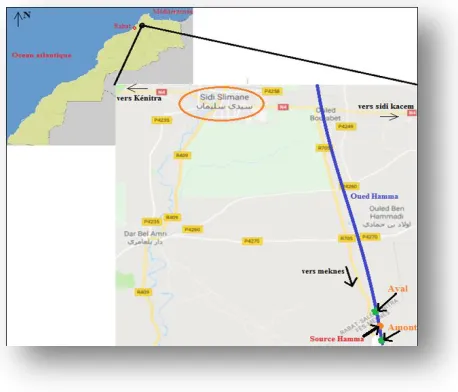
The city of Sidi Slimane is located on the Gharb plain, in north-west Morocco, and belongs to the
Rabat-Salé-Kénitra region.
The rivier El Hamma-Outita emerges on the outskirts of the pre-rifain mountain range, 12 km from the town of
Sidi Slimane, on the road that leads to Meknes, and is very close to the marabout of Sidi Moulay Yacoub, at the
bottom of the N-S cluse of Oued El Hamma, and its coordinates are Lambert, X=459,60, Y=392,7 and Z=120m,
[image:2.612.210.439.220.416.2]with a scale of 1/50000 from the map of El Kansera.
Figure 1. Geographic location of the study area
Sampling Sites
To assess the water quality of the wadi in the vicinity of the source, we chose two sampling sites on Hamma wadi:
one site (O-amont) before 3 km from the confluence zone with the spring water and another site (O-aval)
downstream from this zone. A third site (Source) was chosen at the water level of the Ain Hamma Outita spring.
Sampling and Analysis
The water sampling was carried out during the period February, March and April 2017, corresponding to the period
of significant wadi flow each year.
Some parameters are measured directly in situ by portable devices: the conductivity and salinity of the water (by a
portable conductivity meter of the Consort K912 type), the temperature (by a thermometer), and the hydrogen
potential (by a portable pH meter of the Hanna Hi 8519N type). The water samples are transported, in a cooler at a
low temperature ± 4°C, to the laboratory to analyze other major elements: Sulfates, Chlorides, TAC, Total Hardness,
Calcium, Magnesium, Potassium, Sodium, Nitrates, and Dry Residue. These elements are measured in the
laboratory according to approved protocols [9-16].
RESULTS AND DISCUSSION
69
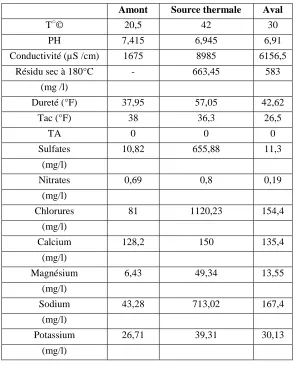
[image:3.612.159.454.100.465.2]The different results of the physico-chemical analyses are represented in the following Table 1.
Table 1. Results of analysis physicochemical
Amont Source thermale Aval
T○© 20,5 42 30
PH 7,415 6,945 6,91
Conductivité (µS /cm) 1675 8985 6156,5
Résidu sec à 180°C - 663,45 583
(mg /l)
Dureté (°F) 37,95 57,05 42,62
Tac (°F) 38 36,3 26,5
TA 0 0 0
Sulfates 10,82 655,88 11,3
(mg/l)
Nitrates 0,69 0,8 0,19
(mg/l)
Chlorures 81 1120,23 154,4
(mg/l)
Calcium 128,2 150 135,4
(mg/l)
Magnésium 6,43 49,34 13,55
(mg/l)
Sodium 43,28 713,02 167,4
(mg/l)
Potassium 26,71 39,31 30,13
(mg/l)
Descriptive Analysis of Results
The variation in the contents of different physico-chemical parameters of the water at three sites is represented in the
form of histograms, to facilitate comparison between these three sites and also to monitor the evolution of each
parameter at these three sites (Figure 1).
Temperature
The temperature values recorded in the downstream wadi are higher than those measured in the upstream wadi. This
difference could be explained by the direct discharge of water from the source (whose average temperature is around
70
Figure 2. Results of analysis physicochemical
Hydrogen potential
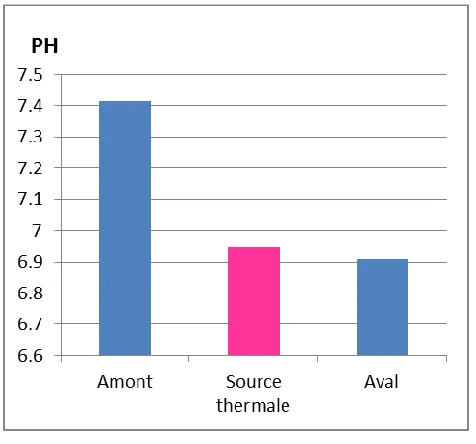
The pH measured during the study period does not show significant variations between stations.
Although this parameter is related to almost all water quality parameters and some authors have mentioned the
existence of seasonal fluctuations and/or spatial variations in pH values in streams [8,12]. The average values
recorded are almost the same and close to neutrality: 7.42 (upstream), 6.91 (source) and 6.94 (downstream) (Figure
3).
Figure 3. Hydrogen potential
Electrical conductivity
The conductivity values recorded in the downstream wadi waters are very high compared to those measured in the
upstream. These results could be explained on the one hand by the direct discharges from the highly mineralized
[image:4.612.188.426.406.628.2]71
conductivity of the water at the downstream site, and on the other hand, during the winter period, by the dilution of
[image:5.612.192.420.107.316.2]the water due to the return of the significant flow of the wadi [13] (Figure 4).
Figure 4. Electrical conductivity
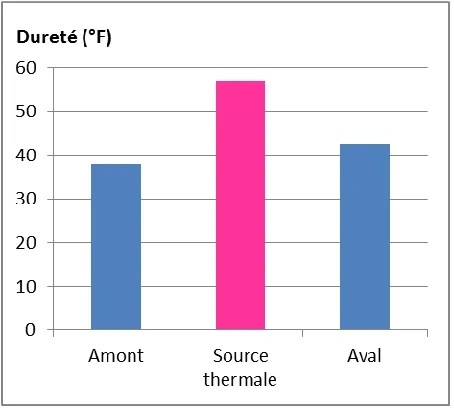
The total hardness
The total hardness of the downstream wadi waters is high compared to the upstream, and influenced by direct
discharge from the thermal spring, which has a significant value of the total hardness, (- upstream: 37.95 /- source:
57.05 /- downstream: 42.62). The hardness of groundwater is generally related to the nature of the sedimentary rocks
crossed and is mainly due to the presence of Calcium and Magnesium, soluble constituents of carbonate rocks,
especially limestone [14] (Figure 5).
Figure 5. The total hardness
Sulphates
For sulphates, the waters of the O-aval site are more charged with these elements than the headwaters. The spring
[image:5.612.193.420.432.642.2]72
downstream. The average values recorded are in the order of 311.83 mg/l for amount waters, 933.39 mg/l for
[image:6.612.193.419.107.298.2]O-aval and 1130.62 mg/l for Source waters, reflecting the regional geological nature [10] (Figure 6).
Figure 6. Sulphates
Chlorides
The waters of the wadi are more charged with chlorides and are influenced by the spring waters and by variations in
the flow rate of the wadi. The averages recorded for O-amount, Source and O-aval are 254.36, 523.11 and 356.77
mg cl - /l ions respectively. The evolution of chlorides over the study period is similar in appearance to that of
conductivity. This could be due to the regional geological nature [12] and the nature of the saline rocks at the source
[13].
Figure 7. Chloride
Calcium
The concentration obtained (Figure 7) upstream of the thermal spring is on average 128.2 mg/l, while the
concentration obtained from the thermal spring and its downstream are slightly higher (150 and 135.4 mg/l) (Figure
[image:6.612.193.421.411.621.2]73
Figure 8. Calcium
Magnesium
The concentrations of magnesium obtained in the upstream and downstream sites are low compared to
that of the thermal spring:
- The two upstream and downstream sites have successive values of 6.34 mg/l and 13.55 mg/l.
- Thermal Spring has a high value of 49.34mg/l (Figure 9).
Figure 9. Magnesium
Sodium
The sodium value recorded at the upstream site is low and does not exceed 43.28 mg/l, whereas at the downstream
site where Ain Hamma is discharged, the value reached is high at 167.4mg/l, due to the high mineralization of this
[image:7.612.195.420.387.608.2]74
Figure 10. Sodium
Potassium
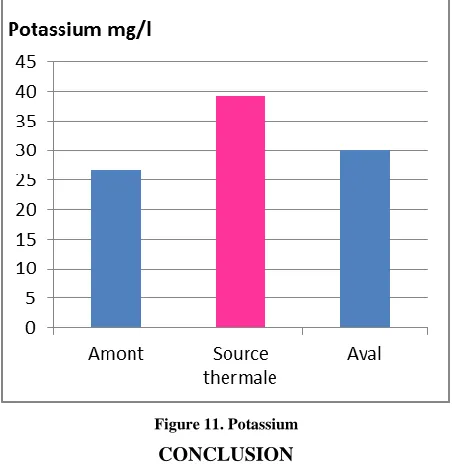
From the graph obtained, it can be seen that the Hamma Outita thermal spring has an influence on the potassium
load of oued by its discharges, because it has a high concentration downstream (26.71 mg/l) and upstream
(30.13mg/l), just after its mixing with the source which has a high value in this element (39.13mg/l) (Figure 11).
Figure 11. Potassium
CONCLUSION
The results obtained during our study made it possible to meet the objectives set out in the introduction and to draw
up a portrait of the physico-chemical and bacteriological quality of the waters of the Ain Hamma Moulay Idriss
spring and those of the section of the Khumane wadi located near the spring.
The waters of the thermal spring are highly mineralized and have very particular physico-chemical characteristics.
These waters enrich the waters of the Khumane wadi with minerals and modify the physico-chemical quality of the
[image:8.612.193.420.366.598.2]75
REFERENCES[1] H EL Haissoufi; S Berrada; M Merzouki; M Aabouch; L Bennani; M Benlemlih; M Idir; A Zanibou; Y
Bennis et A EL Ouali Lalami. Maroc Rev Microbiol Ind San et Environn. 2011, 37-68.
[2] J EL Addouli; A Chahlaoui; A Berrahou; A Chafi et A Ennabili. Revue AFN Maroc. 2009, 46-58.
[3] S Bricha; K Ounine; S Oulkheir; N EL Haloui et B Attarassi. Afrique Sci. 2007, 391-404.
[4] J Alibou. Regional Round Table in the Mediterranean Athens, Greece, December 2002, 10-111-139.
[5] A Chahlaoui; P Cugny; S Lek; A Zaid et M. RAMDANI. Bull Soc Hist Nat Toulouse. 1997, 133, 71-76.
[6] A Abdallaoui. Contribution to the study of the pollution of Moroccan rivers by heavy metals: case of
Boufekrane wadi. Postgraduate thesis, Moulay Ismaïl University, Meknes. 1990, 258.
[7] A Chahlaoui. Fac Sci Meknes Morocco. 1996, 234 .
[8] L Karrouch; A Chahlaoui. Biomatec Echo. 2009, 3, 6-17.
[9] L Karrouch et A Chahlaoui. 2nd International Symposium on Water and the Environment: Sidi Fredj les 30
et 31janvier. 2007, 224-235.
[10]J EL Addouli. State thesis Fac Sci Meknes. 2010, 168.
[11]A Aboulkacem. Fac Sci Meknes Morocco. 2007, 159.
[12]J El Addouli; A Chahlaoui; A Berrahou; A Chafi; A Ennabili et L Karrouch. Rev Microbiol Ind San and
Environn. 2009, 3, 56-75.
[13]L Karrouch. Fac Sci Meknes. 2010, 216.
[14]A Aboulkacem; A Chahlaoui; A Soulaymani; F Rhazi-Filali et D Benali. Rev Microbiol Ind San and
Environn. 2007, 10-22.
[15]A Ben Moussa; A Chahlaoui; R El Habib. Mersenne Publishing. 2011, 3, 1-17.