Journal of Chemical and Pharmaceutical Research, 2018, 10(10): 1-9
Research Article
CODEN(USA) : JCPRC5
ISSN : 0975-7384
1
Influence of PVP and PEO on Cloud Point of Poly (oxyethylene) 10 Oleyl
Ether (Brij-97): A Thermodynamic Approach
Balkrishna B Patil and Gunvant H Sonawane
*Department of Chemistry, KVPS Kisan Art’s Commerce and Science College, Parola, Dist. Jalgaon MS, India ____________________________________________________________________________
ABSTRACT
The cloud point (CP) temperature was investigated for aqueous solutions of poly(oxyethylene) 10-oleyl ether (Brij-97) and it’s mixture with polymer, poly vinyl pyrolidone (PVP) and poly ethylene oxide (PEO) at different concentrations. The cloud point of pure Brij-97 was found to be decreased with increasing concentration. At fixed concentration of surfactant, the CP of mixed system shows decreasing trends with increasing concentration of PVP and increases with increasing concentration of PEO. Considering the cloud point as threshold temperature of the solubility, the thermodynamic parameters of clouding process (∆G0Cl, ∆H0Cl and ∆S0Cl) has been evaluated using “Phase Separation Model”. The phase separation results from micelle-micelle interaction. It was found that the overall clouding process was endothermic and ∆S0Cl>∆H0Cl, indicating that the process of clouding was guided by both enthalpy and entropy.
Keywords: Brij-97; PVP; PEO; Cloud point; Phase separation model
_____________________________________________________________________________
INTRODUCTION
2
the hydrophilic (PEO) parts. Increasing the hydrophobicity decreases the CP whereas increasing the hydrophilicty increases the CP for nonionic surfactants with nonpolar chains of different structures [19]. Increasing length of the polyoxyethylene moiety has increased the hydrophile-lipophile balance (HLB) and thus CP values increases for nonionic surfactants [20,21]. The CP of nonionic surfactants is highly sensitive to the presence of additives in the system even at very low concentration [22]. Many researchers have investigated the effect of additives on the CP of ionic and nonionic surfactants [23-26].
In this study the results for the clouding phenomenon of aqueous solution of Brij-97 alone and its mixture with water soluble polymer PVP and PEO at different concentrations have been reported. The thermodynamic parameters of clouding have been evaluated with respect to interaction between nonionic surfactant and polymer.
EXPERIMENTAL SECTION
Materials
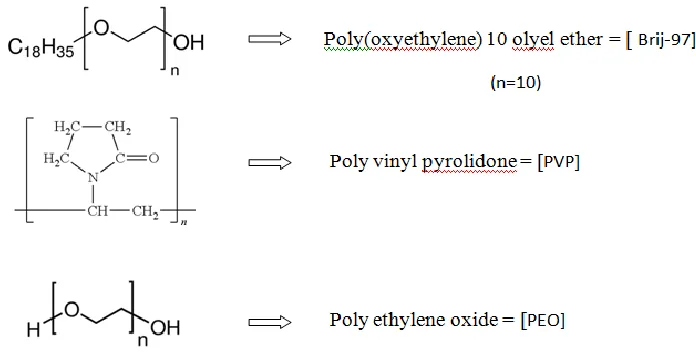
Non-ionic surfactant Poly(oxyethylene) 10 olyel ether (Brij-97) C18H35(OCH2CH2)nOH. (n=10) and polymer,
Poly vinyl pyrolidone (PVP) (Mole wt.40000) and Poly ethylene oxide (PEO) (Mole wt.100000) was obtained from
Sigma-Aldrich, USA (purity>99%) was used without further purification. Doubly distilled water with specific
conductance 2.4µScm-1 at 303.15K was used in the preparation of all solutions of different concentrations (Figure
[image:2.612.121.469.330.512.2]1).
Figure 1.Molecular structure of non-ionic surfactant (a) Brij-97 and additives polymers (b) PVP and (c) PEO
Methods
Cloud point temperatures of surfactant solution were determined by visual observation and the abrupt change in the
appearance of the surfactant solution, which occurs during the heating of the sample solutions. The cloud point (CP)
was determined by controlled heating of the sample solutions in thin glass tube immersed in beaker containing
water, the sample solution was stirred while being heated. The heating rate of sample was <1°C/min. The
reproducibility of the measurement was found to be within ± 0.2°C. The cloud point (CP) was determined by
controlled heating in well stirred surfactant solution as well as surfactant - PVP and surfactant - PEO mixture until it
clouded or got turbid. The turbid solution was then allowed to cool slowly while being stirred and the temperature
for the disappearance of turbidity was considered as the cloud point of the test solution. Heating and cooling was
3
RESULTS AND DISCUSSION
Cloud Points (CP) of Brij-97
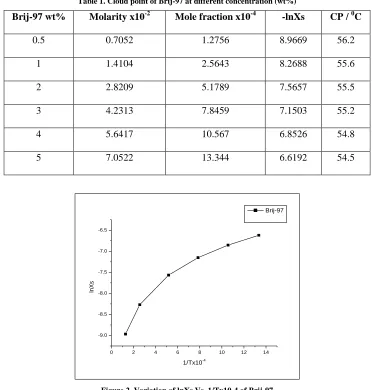
[image:3.612.119.492.230.620.2]The cloud point of Brij-97 pure nonionic surfactant at different concentrations in (wt%) are given in Table 1. The CP of Brij-97 is essentially constant over a wide range of concentration. The values of CP decreases from 56.2°C to 54.5°C with increase in concentration of surfactant from 0.5 to 5 wt%. As the concentration of surfactant solution increases the micellar molecular weight increases, as a result the aggregation number of micelle increases, hydrophobicity increases. When the solutions are heated sufficiently, the POE chains become dehydrated and the solubility of the surfactant decreases markedly and thus CP decreases (Figure 2).
Table 1. Cloud point of Brij-97 at different concentration (wt%)
Brij-97 wt% Molarity x10-2 Mole fraction x10-4 -lnXs CP / 0C
0.5 0.7052 1.2756 8.9669 56.2
1 1.4104 2.5643 8.2688 55.6
2 2.8209 5.1789 7.5657 55.5
3 4.2313 7.8459 7.1503 55.2
4 5.6417 10.567 6.8526 54.8
5 7.0522 13.344 6.6192 54.5
Figure 2. Variation of lnXs Vs. 1/Tx10-4 of Brij-97
Cloud Point (CP) of Brij-97 - PVP System
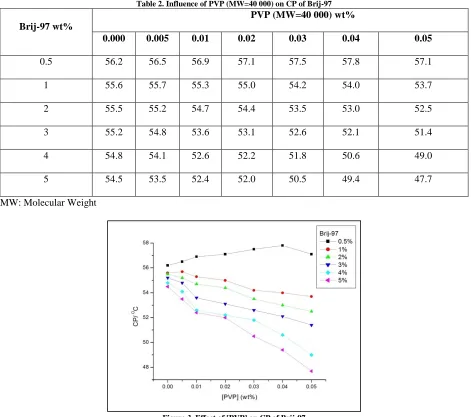
The influence of PVP (Mol.wt.40000) on the CP of Brij-97 at different concentration have been studied. The results are given in Table 2. These results indicating that the cloud point of surfactant polymer mixtures decreases with increasing concentration of surfactant. For 0.5 wt% of Brij-97 CP increases from 56.5 to 57.10C with increasing concentration of PVP from 0.005 to 0.05wt% of PVP. While for 1% to 5% of Brij-97 CP decreases considerably with increasing concentration of PVP from 0.005 to 0.5wt%. As the surfactant concentration increases in surfactant–
0 2 4 6 8 10 12 14
-9.0 -8.5 -8.0 -7.5 -7.0 -6.5
ln
Xs
1/Tx10-4
4
[image:4.612.72.543.142.559.2]polymer mixture, the size and hence molecular weight of micelle increases which increases the aggregation number and hydrophobicity of micelle. Due to increase in hydrophobicity of micelle with increase in concentration of surfactant in binary mixture of surfactant-polymer system, the cloud point of mixed system decreases. It has been observed that, with increase in concentration of PVP, at fixed concentration of surfactant the CP decreases, this is probably due to the increase in chain length of polyoxyethyle chain by the addition of polymer, with the exception of 0.5wt% of surfactant in which the CP increases with increase in concentration of PVP.
Table 2. Influence of PVP (MW=40 000) on CP of Brij-97
Brij-97 wt%
PVP (MW=40 000) wt%
0.000 0.005 0.01 0.02 0.03 0.04 0.05
0.5 56.2 56.5 56.9 57.1 57.5 57.8 57.1
1 55.6 55.7 55.3 55.0 54.2 54.0 53.7
2 55.5 55.2 54.7 54.4 53.5 53.0 52.5
3 55.2 54.8 53.6 53.1 52.6 52.1 51.4
4 54.8 54.1 52.6 52.2 51.8 50.6 49.0
5 54.5 53.5 52.4 52.0 50.5 49.4 47.7
MW: Molecular Weight
Figure 3.Effect of [PVP] on CP of Brij-97
It has been found that at low concentration of PVP below 0.005wt% did not have much effect on the CP of pure Brij-97 and it remain around 560C. The decrease in CP with addition of PVP in Brij-97 may be due to the formation of intra chain polymer-surfactant complex by incorporation of PVP in to Brij-97, which results in to the attraction of micelles and facilitates their collisions and thus lowering of CP. The influence of [PVP] on CP of Brij-97 is shown in Figure 3.
Cloud Point of Brij-97-PEO System
5
Table 3. Influence of PEO (MW=100 000) on CP of Brij-97
Brij-97 wt%
PEO (MW=100 000) wt%
0.0 0.005 0.01 0.02 0.03 0.04 0.05
0.5 56.2 62.5 63.0 64.5 65.0 65.5 66.0
1 55.6 58.0 58.5 59.0 59.5 60.0 61.0
2 55.5 53.5 54.0 54.0 55.0 55.5 56.0
3 55.2 51.5 52.0 52.5 53.0 53.5 54.5
4 54.8 44.5 45.0 46.5 47.5 48.5 51.0
5 54.5 42.5 43.0 43.5 44.0 45.5 46.5
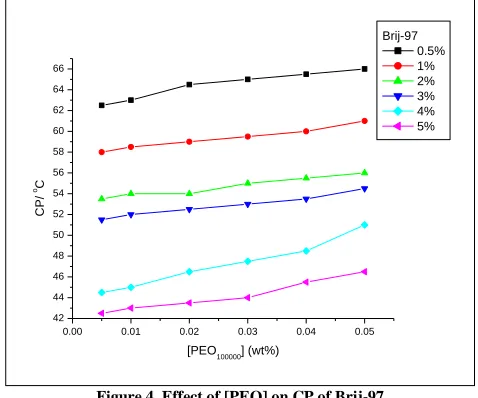
While increase in concentration of PEO with fixed concentration of surfactant, the CP of mixed system increases indicating that addition of PEO decreases the hydrophobicity of the solution, thereby aggregation takes place at higher temperature. The influence of [PEO] on CP of Brij-97 is shown in Figure 4.
Figure 4.Effect of [PEO] on CP of Brij-97
Thermodynamics of Clouding
All physicochemical processes are controlled energetically and the micelle formation of the surfactant molecules is
guided by the thermodynamic principles. Considering CP as the phase separation point, hence limit of solubility, the
thermodynamic parameters of clouding process such as standard free energy change (∆G0
Cl), standard enthalpy
change (∆H0
Cl) and standard entropy change (∆S0Cl) were calculated using the phase separation modelas given
below
∆G0
Cl =-RT lnXs (1)
0.00 0.01 0.02 0.03 0.04 0.05
42 44 46 48 50 52 54 56 58 60 62 64 66 C P/ oC
[PEO100000] (wt%)
[image:5.612.186.425.344.543.2]6
Where ‘Cl’ stands for clouding process and lnXs is the mole fraction of the solute. R is the gas contant (J.K-1.M-1.)
and T is the temperature in Kelvin.
from the slope of the linear plot of lnXs Vs 1/Tx10-4, the standard enthalpy change (∆H0Cl) for the clouding process
have been calculated.
d lnXs/dt=∆H0Cl/RT2 (2)
The standard entropy of micellization, ∆S0
Cl have been calculated from the following relationship
∆S0
Cl=(∆H0Cl -∆G0Cl)/T (3)
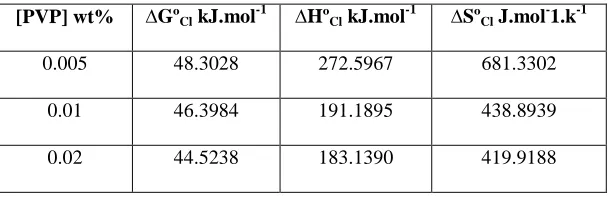
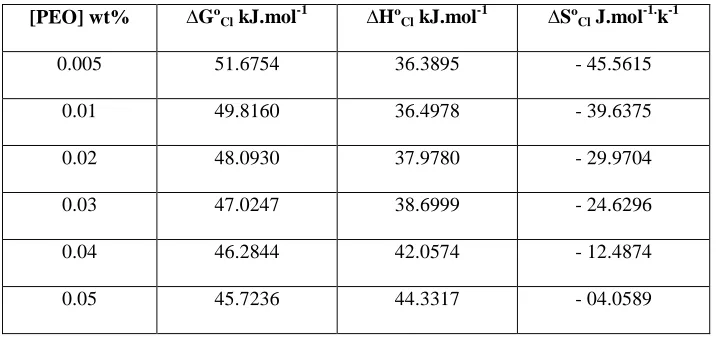
The thermodynamic parameters of Brij-97 and the mixed system are given in Table 4 and Tables 5 and 6
respectively. ∆G0
Cl of Brij-97 decreased with increase in additive polymer concentration, these positive values of
∆G0
Cl indicates that the clouding process proceeds non-spontaneously. Also the positive values of ∆H0Cl indicates
[image:6.612.87.523.342.509.2]that disruption of water structure around the hydrophobic alkyl tails of Brij-97.
Table 4. Thermodynamic parameter of cloud point of Pure Brij-97
[Brij-97] wt% ∆GºCl kJ.mol-1 ∆HºCl kJ.mol-1 ∆SºCl J.mol-1.k-1
0.5 24.5421
55.5229
94.0936
1 22.5902 100.2212
2 20.6631 106.1181
3 19.5107 109.7264
4 18.6585 112.4600
5 18.0230 114.5035
The study showed that, ∆H0
Cl >∆G0Cl indicating that overall clouding process is endothermic and also ∆S0Cl > ∆H0Cl
indicates that the process of clouding is guided by both enthalpy and entropy [27,28]. The present work supports the
probable interactions between Brij-97 with PVP and PEO.
Table 5. Thermodynamic parameters of Brij-97 in presence of PVP (MW=40 000)
[PVP] wt% ∆GºCl kJ.mol-1 ∆HºCl kJ.mol-1 ∆SºCl J.mol-1.k-1
0.005 48.3028 272.5967 681.3302
0.01 46.3984 191.1895 438.8939
[image:6.612.155.459.617.716.2]7
0.03 43.4635 162.5977 360.4665
0.04 42.7114 128.1937 258.4108
[image:7.612.128.487.199.369.2]0.05 42.1358 93.8619 155.4914
Table 6. Thermodynamic parameters of Brij-97 in presence of PEO (MW=100 000)
[PEO] wt% ∆GºCl kJ.mol-1 ∆HºCl kJ.mol-1 ∆SºCl J.mol-1.k-1
0.005 51.6754 36.3895 - 45.5615
0.01 49.8160 36.4978 - 39.6375
0.02 48.0930 37.9780 - 29.9704
0.03 47.0247 38.6999 - 24.6296
0.04 46.2844 42.0574 - 12.4874
0.05 45.7236 44.3317 - 04.0589
CONCLUSION
The separation of two phases is due to the sharp increase in the number of the micelles aggregate and the decrease in
intermicellar repulsion. This decrease results from the decreased hydration of the oxyethylene oxygen in the POE
hydrophilic group with increase in temperature [29]. The CP of pure Brij-97 as well as mixed system of Brij-97-
PVP and Brij-97- PEO was found to decrease with increase in concentration of Brij-97 at fixed concentration of
polymers, probably due to increasing aggregation number, molecular weight of micelle and hence hydrophobicity
with increase in concentration of surfactant.
For mixed system of Brij-97-PVP, keeping the concentration of surfactant constant, it was observed that CP
decreases with increasing concentration of polymer, this is probably due to the fact that as polymer PVP
concentration increases the solubility of surfactant in water decreases, hydrophobicity increases due to association of
water molecule. Also PVP can incorporate Brij-97 monomers and form intra-chain polymer-surfactant complex.
This results in the attraction of micelles and facilitates their collision and lowering the CP.
However, in case of Brij-97-PEO mixed system, the CP increases with increase in concentration of polymer PEO,
8
solvation power of water, thus increasing solubility of surfactant.This increases the micelle-micelle repulsion and
makes the micelle more hydrophilic (i.e. decreases the hydrophobicity). This indicates that the influence of an
additive on the clod point depends on how it affects the inter micellar interactions.
The interactions in between Brij-97 with PVP indicate thermodynamic parameters of clouding process ∆H0Cl,
∆S0Cl and ∆G0Cl are positive; the process becomes spontaneous at high temperature. But in case of Brij-97 with
PEO indicates thermodynamic parameters in clouding process ∆H0Cl and ∆G0Cl are positive and ∆S0Cl is negative
indicates that clouding process non-spontaneous. The overall clouding process was found to be endothermic i.e.
∆S0Cl > ∆H0Cl.
ACKNOWLEDGEMENT
The authors are thankful to Principal and Head Department of Chemistry, KVPS Kisan Arts Commerce and Science
College, Parola, Dist. Jalgaon for providing laboratory facilities.
REFERENCES
[1] SP Maulik, S Ghosh. J Mol Liq. 1997, 72(1), 145-161. [2] S Ghosh, SP Moulik. Indian J Chem. 1999, 38, 10-16.
[3] Geng Wang, Gerd Olofsson. J Phys Chem. 1995, 99(15), 5588-5596. [4] P Mdyneux. Brit Polym J. 1984, 2(2), 157-158.
[5] AD Kakuste, MS Borse, GH Sonawane. Tenside Surf Det. 2015, 52(1), 62-66.
[6] R Lopez-Esparza, MA Guedeau-Boudeville, Y Gambin, C Rodriguez-Beas, A Maldonado. J Colloid Interface Sci. 2006, 300(1), 105-110.
[7] Huijing Liu, Mingtan Hai. J Chem Eng Data. 2010, 55(1), 354-357.
[8] C Rufier, A Collet, M Viguier, J Oberdisse, S Mora. Macromolecules. 2009, 42(14), 5226-5235. [9] TS Banipal, K Harjinder, PK Banipal, AK Sood. J Surfactants Deterg. 2014, 17(6), 1181-1191. [10]B Mandal, SP Mouli, S Ghosh. Colloid Polym Sci. 2014, 292(10), 2485-2495.
[11]B Haldar, A Chakrabarty, A Mallick, MC Mandal, P Das, N Chattopadhyay. Langmuir. 2006, 22(8), 3514-3520.
[12]M Alibrahim. Tenside Surf Det. 2005, 42(5), 295-298.
[13]J Dey, N Sultana, S Kumar, VK Aswal, S Choudhury, K Ismail. RSC Adv. 2015, 5, 74744-74752. [14]S Mall, G Buckton, DA Rawlins. J Pharm Sci. 1996, 85, 75-78.
[15]CO Rangel-Yagui, A Pessoa Jr., D Blankschtein. Braz J Pharm Sci. 2004, 21, 531-544. [16]K Toerne, R Rogers, R von Wandruska. Langmuir. 2000, 16(5), 2141-2144.
[17]AZ Naqvi, K Suraiya, Kabir-ud-Din. J Solution Chem. 2011, 40, 643-65. [18]Chai Jin-Ling, Mu Jian-Hai. Colliod J. 2002, 64(5), 550-555.
[19]PD Huiber, DO Shah, AR Katritzky. J Colloid Interface Sci. 1997, 193,132-136. [20]H Schott. Colloids Surf A. 2001, 186, 129-136.
[21]C Batigoc, H Akbas. Fluid Phase Equilib. 2011, 303, 91-95.
[22]RK Mahajan, KK Vohra, N Kaur, VK Aswal. J Surfact Deterg. 2008, 11, 243-250. [23]M Alauddin, T Pravin, T Begum. J Appl Sci. 2009, 9(12), 2301-2306.
[24]L Jing-Liang, B Dong-Shun, C Bing-Hung. Colloids Surf A : Physicochem Eng Aspects. 2009, 346, 237-243.
[25]M Katarzyna, C Gerard, S Jan. J Colloid Interface Sci. 2004, 269, 466-471. [26]JA Molina-Bolivar, JM Hierrezuelo, CC Ruiz. J Chem Thermodyn. 2013, 57, 59-66. [27]C Batigoc, H Akbas. J Mol Liq. 2017, 231, 509-513.
9
[29]MJ Rosen. Surfactants and Interfacial Phenomena, A John Wiley & Sons Inc. Publication, New Jersey,