N A N O E X P R E S S
Open Access
Fabrication and NO
2
gas sensing performance of
TeO
2
-core/CuO-shell heterostructure nanorod
sensors
Sunghoon Park
1, Soohyun Kim
1, Gun-Joo Sun
1, Wan In Lee
2, Kyoung Kook Kim
3and Chongmu Lee
1*Abstract
TeO2-nanostructured sensors are seldom reported compared to other metal oxide semiconductor materials such as ZnO, In2O3, TiO2, Ga2O3, etc. TeO2/CuO core-shell nanorods were fabricated by thermal evaporation of Te powder followed by sputter deposition of CuO. Scanning electron microscopy and X-ray diffraction showed that each nanorod consisted of a single crystal TeO2core and a polycrystalline CuO shell with a thickness of approximately 7 nm. The TeO2/CuO core-shell one-dimensional (1D) nanostructures exhibited a bamboo leaf-like morphology. The core-shell nanorods were 100 to 300 nm in diameter and up to 30μm in length. The multiple networked TeO2/CuO core-shell nanorod sensor showed responses of 142% to 425% to 0.5- to 10-ppm NO2at 150°C. These responses were stronger than or comparable to those of many other metal oxide nanostructures, suggesting that TeO2is also a promising sensor material. The responses of the core-shell nanorods were 1.2 to 2.1 times higher than those of pristine TeO2 nanorods over the same NO2concentration range. The underlying mechanism for the enhanced NO2sensing properties of the core-shell nanorod sensor can be explained by the potential barrier-controlled carrier transport mechanism.
Keywords:TeO2nanorods; CuO shells; Gas sensors; Response; NO2
PACS:61.46. + w; 07.07.Df; 73.22.-f
Background
In recent years, one-dimensional (1D) nanostructure-based sensors attracted considerable attention owing to their high surface-to-volume ratios [1-5]. Considerable effort has been made to develop 1D nanostructured gas sensors with good sensing performances, but further improvements in the sensitivity of 1D nanostructured sensors are needed. The fabrication of heterostructures [6-8] is a promising technique to improve the sensitiv-ity of the 1D nanostructured sensors. The improved sensing performance of the heterostructured 1D sensors has been attributed to a range of factors including increased potential barriers at the interface of the heterostructure
[9,10], modulated depletion layer [11,12], band bending due to equilibration of the Fermi energy levels [13], synergistic surface reactions [14], etc.
Paratellurite (α-TeO2) is a metal oxide semiconductor with a distorted rutile structure [15]. TeO2has applica-tions in optical storage, laser devices and gas sensors, dosimeters, modulators, and deflectors owing to its unique properties such as high refractive index and high optical nonlinearity [16]. TeO2-nanostructured sensors have attracted less attention compared to other metal oxide semiconductor materials such as ZnO, In2O3, TiO2, Ga2O3, etc. In 2007, Liu et al. [17] synthe-sized TeO2nanowires that were sensitive to NO2, NH3, and H2S gases. According to their results, TeO21D nano-structures are promising for producing low power con-sumption gas sensors. The incorporation of a surface
* Correspondence:[email protected] 1
Department of Materials Science and Engineering, Inha University, 253 Yonghyun-dong, Nam-gu, Incheon 402-751, Republic of Korea Full list of author information is available at the end of the article
decoration or heterostructure formation technique can im-prove their sensing performance further. In this regard, a recent study reported the sensing properties of Pt-doped TeO2 nanorods [16]. On the other hand, this paper reports the synthesis of TeO2-core/CuO-shell nanorods and the sensing properties of multiple net-worked TeO2-core/CuO-shell nanorod gas sensors to-ward NO2 gas. The underlying mechanism for the enhanced sensing performance of the core-shell nanorod sensors is also discussed.
Methods
TeO2/CuO core-shell nanorods were synthesized using a two-step process: thermal evaporation of Te powder followed by sputter deposition of CuO. TeO2 nanorods were synthesized on a p-type Si (100) substrate in a quartz tube furnace by thermal evaporation of Te pow-der at 400°C in air without a metal catalyst or the supply of other gas. The thermal evaporation process was con-ducted at room temperature for 1 h and the furnace was cooled to room temperature. Subsequently, the TeO2 nanorods were coated with a thin CuO layer by sputter-ing a CuO target by radio frequency (RF) magnetron sputtering from a CuO target. The base and working pressure was 5.0 × 10⁻⁶ Torr and 2.0 × 10⁻² Torr, re-spectively, and the N2 gas flow rate was 20 cm3/min throughout the evaporation process. The RF sputtering power and sputtering time were 100 W and 20 min, respectively.
The structure and morphology of the nanorod samples were characterized by scanning electron microscopy (SEM, Hitachi S-4200, Billerica, MA, USA), transmission electron microscopy (TEM, Philips CM-200, Eindhoven, the Netherlands), and selected area electron diffraction. X-ray diffraction (XRD, Philips X’pert MRD, Eindhoven, the Netherlands) patterns were performed using Cu Kα
radiation (0.15406 nm). Energy-dispersive X-ray spec-troscopy (EDS) was carried out to examine the elemental composition of the coshell nanorod samples. The re-sistance of multiple networked pristine TeO2 nanorod and TeO2/CuO core-shell nanorod sensors were mea-sured using a Keithley source meter-2612 at a source voltage of 10 V at 150°C and 50% RH. The 50% relative humidity might be somewhat high for sensing tests. A flow-through technique was used to test the gas sensing properties. NO2gas diluted with synthetic air at different ratios was injected into the testing tube at a constant flow rate of 200 cm3/min. The detailed procedures for sensor fabrication and the sensing test are reported else-where [18].
Results and discussion
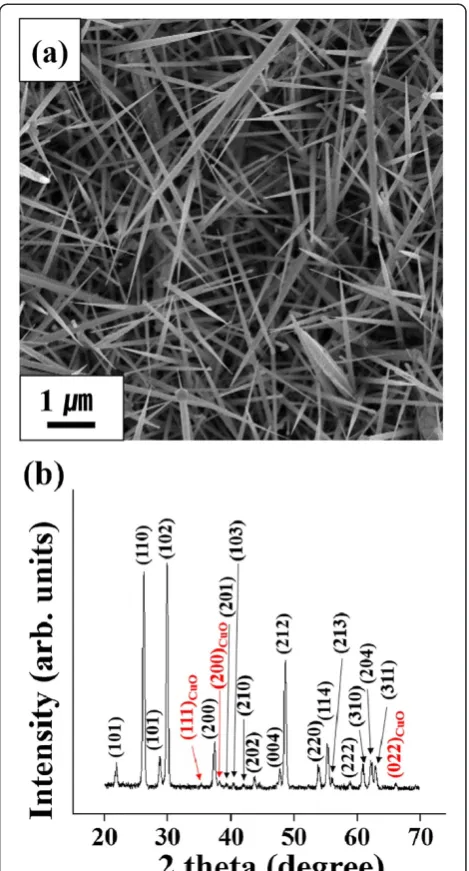
Figure 1a shows a SEM image of the TeO2/CuO core-shell nanorods prepared by thermal evaporation followed
by sputtering. Each 1D nanostructure exhibited a rod-like morphology with a sharp tip, i.e. a bamboo leaf-rod-like morphology. The core-shell nanorods were 100 to 300 nm in diameter and up to 30 μm in length. XRD was performed to determine the crystal structures of the core-shell nanorods. The XRD patterns of the TeO2/CuO core-shell nanorods showed that the TeO2 cores were crystalline, whereas the CuO shells were polycrystalline (Figure 1b). Most of the XRD peaks of the TeO2/CuO core-shell nanorods were assigned to be the reflections of primitive tetragonal-structured
[image:2.595.305.540.88.524.2]type TeO2. In addition, three small reflection peaks were assigned to the 111, 200, and 022 reflections of monoclinic-structured CuO with lattice constants of a= 0.4689 nm, b = 0.342 nm, c = 0.513 nm, and β= 99.57° (JCPDS No. 89–5899).
The low-magnification TEM image of a typical core-shell nanorod showed that the nanorod had a uniform diameter along its length direction (Figure 2a). TEM re-vealed a shell width of approximately 7 nm. A close examination of the high-resolution TEM (HRTEM) image (Figure 2b) shows a fringe pattern in the core re-gion (the lower darker rere-gion), suggesting it to be a sin-gle crystal. The clear spots in the corresponding selected area electron diffraction (SAED) pattern were assigned to the primitive tetragonal structured TeO2 with lattice constants of a= 0.4810 nm and c= 0.7613 (JCPDS No. 78–1713) (Figure 2c). On the other hand, the halo-like concentric ring pattern might be due to the polycrystalline CuO shell. The line-scanning EDS concentration profile along the diameter of a typical core-shell nanorod (Figure 2d) revealed a higher Te concentration in the center region and a higher Cu concentration in both edge regions of the nanorod, confirming the TeO2-core/CuO-shell structure.
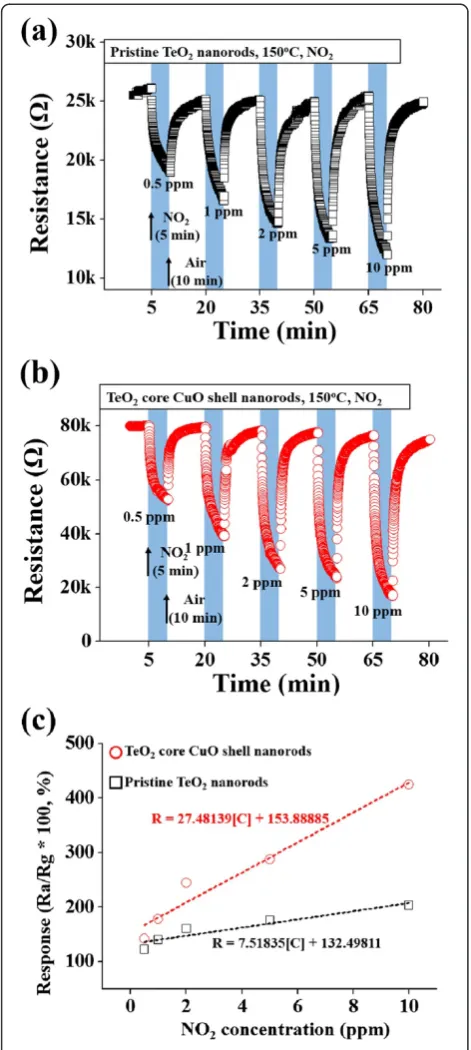
Figure 3a,b shows the dynamic electrical responses of pristine TeO2nanorods and TeO2/CuO core-shell nano-rods, respectively, to NO2at 150°C under 50% RH. The sensors were exposed to successive pulses of 0.5- to 10-ppm NO2gas. The relative response of the p-type TeO2/ CuO nanorod sensors is defined as Ra/Rg for NO2, whereRaand Rgare the electrical resistances in the
sen-sors in air and target gas, respectively. In all cases, the resistance returned to its original value after the NO2 gas flow was switched off, confirming the reversibility of the gas absorption and desorption processes. The pris-tine TeO2nanorods showed responses of approximately 123% to 203% to NO2 at 0.5 to 10 ppm (Table 1). In contrast, the TeO2/CuO core-shell nanorods showed 1.2- to 2.1-fold stronger responses to NO2than pristine TeO2nanorod sensors at the same concentrations.
[image:3.595.59.538.417.703.2]Figure 3c compares the response to NO2gas between pristine TeO2nanorods and TeO2/CuO core-shell nano-rods in the NO2 concentration range below 10 ppm. The response of an oxide semiconductor sensor can be expressed as R = A [C]n+ B, where A and B, n, and [C] are constants, exponent, and target gas concentration, respectively [19]. Data fitting gave R = 7.52 [C] + 132.5 and R = 27.48 [C] + 153.9 for the pristine TeO2nanorod
Figure 2TEM images, diffraction pattern, and profile of TeO2/CuO core-shell nanorods. (a)Low-magnification TEM image,(b)high-resolution
and TeO2-core/CuO-shell nanorod sensors, respectively. The coshell nanorod sensor showed stronger re-sponse and higher increasing rate in rere-sponse to NO2
gas at lower concentrations than the pristine nanorod sensor.
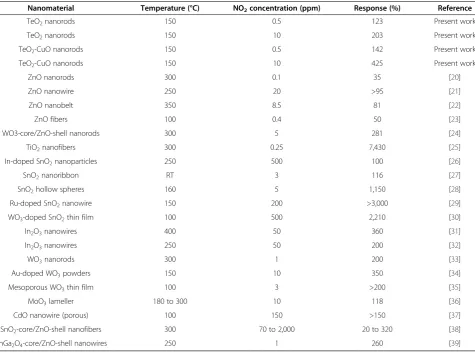
Table 2 lists the responses of the multiple networked pristine TeO2 nanorod sensor to NO2 gas along with those of other reported nanomaterial sensors. Overall, the sensing properties of the TeO2/CuO core-shell nanorod sensor fabricated in this study were comparable to those of other competing nanomaterials (Table 2), but the sensing test conditions such as operating temperature, gas concentration, etc. were different [20-31]. It should be noted that the NO2 concentration and the test temperature used in this study were mostly lower than those elsewhere. The responses of pristine TeO2 nano-rods and TeO2-CuO nanorods to NO2measured in this study were stronger than those of other metal oxides such as ZnO fibers, ZnO fibre mats, mesoporous WO3 thin film, and CdO nanowire measured at temperatures lower than 150°C. The response of WO3-doped SnO2 thin film was stronger to 500 ppm of NO2 than those of pristine TeO2nanorods and TeO2-CuO nanorods to 10 ppm of NO2, but it should be noted that the former response was obtained to a far higher concentration of NO2. TiO2 nanofibers, SnO2 hollow spheres, and Ru-doped SnO2 nanowire showed stronger responses to NO2 than those of pristine TeO2 nanorods and TeO2 -CuO nanorods, but their operation temperatures of the former were higher than 150°C. Pristine TeO2nanorods and TeO2-CuO nanorods showed stronger responses than other metal oxide nanostructures except the above-mentioned nanomaterials.
[image:4.595.56.292.88.614.2]Figure 4a shows the responses of the pristine TeO2 nanorod and TeO2/CuO core-shell nanorod sensors to NO2 gas as a function of the operating time. The optimum operation temperature of TeO2/CuO core-shell nanorod sensor was 150°C, whereas that of the pristine TeO2 nanorod sensor was 175°C. This result reveals that encapsulation of TeO2 nanorods with a CuO thin film resulted in a 25°C decrease in operation temperature. Figure 4b exhibits the selectivity of the pristine and Bi2O3 nanoparticle-decorated In2O3 nano-rod sensors to NO2 gas over other gases. The sensors Figure 3Responses of the pristine TeO2nanorod and TeO2/
CuO core-shell nanorod gas sensors.Dynamic responses of(a)
[image:4.595.304.539.113.208.2]the pristine TeO2nanorod and(b)TeO2/CuO core-shell nanorod gas sensors to NO2at 150°C.(c)Responses of the pristine TeO2 nanorod and core-shell nanorod gas sensors as a function of NO2 gas concentration.
Table 1 Responses of the TeO2/CuO nanorod sensor to NO2gas at different concentrations at 150°C
Response (Ra/Rg, %)
NO2concentration Pristine TeO2nanorod TeO2/CuO nanorod
showed the highest response to ethanol among different gases at the same concentration of 200 ppm at 150°C.
The underlying mechanism of the enhanced TeO2/ CuO core-shell nanorods can be explained using a barrier-controlled carrier transport mechanism [9,10]. Potential barriers form at three places in the multiple networked TeO2/CuO core-shell nanorod sensor: at the core-shell interface, the shell grain boundary [40], and the nanorod-nanorod contact. First, the potential bar-rier at core-shell interface is due to the high density of interface states in the TeO2-CuO interfacial region. The carriers near the interface are trapped by interface states, so that a depletion layer forms over the TeO2 core region near the interface to the CuO shell region near the interface. In addition to depletion layer forma-tion, a potential barrier is created at the core-shell inter-face due to the carrier trapping as shown in Figure 5a [41]. The potential barrier is drawn in the negative energy direction, i.e. the downward direction in Figure 5a because the carriers trapped in the interface are mostly holes
[image:5.595.62.538.110.464.2]residing in p-type TeO2core and the p-type CuO shell in the vicinity of the core-shell interface. The other two po-tential barriers that should be overcome by carriers on their pathways before they reach the electrode of the sen-sor are at the CuO-CuO homojunction, where two nanorods contact each other (Figure 5b) and at the grain boundary in the polycrystalline CuO shell layers (Figure 5a). The contributions of these two potential barriers might be smaller than that of the potential bar-rier at the TeO2-CuO interface because of much smaller numbers of grain boundaries and nanorod-nanorod con-tacts compared to that of the core-shell interfaces. Each nanorod has a core-shell interface, whereas a CuO shell contains a small number of grain boundaries because it is as thin as approximately 7 nm and the possibility of two nanorods contacting each other in a multiple networked nanorod sensor is generally quite low. Carrier transport is facilitated or restrained because of these energy barriers by adsorption and desorption of gas molecules, resulting in a larger change in resistance, i.e., an enhanced response
Table 2 Comparison of the responses of the TeO2/CuO core-shell nanorod sensor with those of other oxide 1D nanostructure sensors
Nanomaterial Temperature (°C) NO2concentration (ppm) Response (%) Reference
TeO2nanorods 150 0.5 123 Present work
TeO2nanorods 150 10 203 Present work
TeO2-CuO nanorods 150 0.5 142 Present work
TeO2-CuO nanorods 150 10 425 Present work
ZnO nanorods 300 0.1 35 [20] ZnO nanowire 250 20 >95 [21] ZnO nanobelt 350 8.5 81 [22] ZnO fibers 100 0.4 50 [23] WO3-core/ZnO-shell nanorods 300 5 281 [24] TiO2nanofibers 300 0.25 7,430 [25]
In-doped SnO2nanoparticles 250 500 100 [26]
SnO2nanoribbon RT 3 116 [27]
SnO2hollow spheres 160 5 1,150 [28]
Ru-doped SnO2nanowire 150 200 >3,000 [29]
WO3-doped SnO2thin film 100 500 2,210 [30]
In2O3nanowires 400 50 360 [31]
In2O3nanowires 250 50 200 [32]
WO3nanorods 300 1 200 [33]
Au-doped WO3powders 150 10 350 [34]
Mesoporous WO3thin film 100 3 >200 [35]
MoO3lameller 180 to 300 10 118 [36]
CdO nanowire (porous) 100 150 >150 [37] SnO2-core/ZnO-shell nanofibers 300 70 to 2,000 20 to 320 [38]
of the core-shell nanorod sensor to NO2 gas. In other words, the heights of the potential barriers are modulated at the three places, resulting in enhanced response of the sensor to the gas.
Conclusions
TeO2/CuO core-shell nanorods were synthesized using a two-step process: the synthesis of TeO2nanorods by thermal evaporation of Te powder and sputter depos-ition of CuO. The cores and shells of the nanorods were single crystal TeO2 and polycrystalline CuO, re-spectively. The responses of the TeO2nanorods to NO2 were improved approximately 2.1- to 2.1-fold at NO2 concentrations of 0.5 to 10 by coating them with CuO. The responses of the core-shell nanorods to NO2 gas were also comparable or superior to those of the other
metal oxide semiconductor nanostructured sensors re-ported previously. The enhanced response of the TeO2/ CuO core-shell nanorods to NO2 gas may be due to modulation of the heights of the potential barriers formed at three different places in the multiple net-worked 1D nanostructure sensor: the TeO2 core-CuO shell interface, the CuO-CuO homojunction at the con-tact of two core-shell nanorods, and the grain boundar-ies in the polycrystalline CuO shell layers.
Competing interests
[image:6.595.57.297.87.440.2]The authors declare that they have no competing interests.
[image:6.595.304.539.90.495.2]Figure 5Schematic energy diagram showing three different potential barriers.Schematic energy diagram showing three different potential barriers formed in the multiple networked TeO2/ CuO core-shell nanorod sensor:(a)one at a TeO2/CuO core-shell interface and another at a polycrystalline CuO shell grain boundary and(b)the third at a nanorod-nanorod contact.
Authors’contributions
All the authors contributed equally to the paper. All authors read and approved the final manuscript.
Acknowledgements
This study was supported by the 2010 Core Research Program through the National Research Foundation of Korea (NRF) funded by the Ministry of Education, Science and Technology.
Author details
1Department of Materials Science and Engineering, Inha University, 253
Yonghyun-dong, Nam-gu, Incheon 402-751, Republic of Korea.2Department
of Chemistry, Inha University, 253 Yonghyun-dong, Nam-gu, Incheon 402-751, Republic of Korea.3Department of Nanooptical Engineering, Korea
Polytechnic University, 2121 Jeongwangdong, Shiheung-city, Gyeonggido 429-793, Republic of Korea.
Received: 26 August 2014 Accepted: 14 November 2014 Published: 27 November 2014
References
1. Tippins HH:Optical absorption and photoconductivity in the band edge ofβ-Ga2O3.Phys Rev A1965,140:316–319.
2. Yamazoe N:New approaches for improving semiconductor gas sensors. Sens Actuators B1991,5:7–19.
3. Gundiah G, Govindaraj A, Rao CNR:Nanowires, nanobelts and related nanostructures of Ga2O3.Chem Phys Lett2002,351:189–194.
4. Zhang HZ, Kong YC, Wang YZ, Du X, Bai ZG, Wang JJ, Yu DP, Ding Y, Hang QL, Feng SQ:Ga2O3nanowires prepared by physical evaporation. Sol State Comm1999,9:677–682.
5. Kim BC, Sun KT, Park KS, Im KJ, Noh T, Sung MY, Kim S, Nahm S, Choi YN, Park SS:β-Ga2O3nanowires synthesized from milled GaN powders. Appl Phys Lett2002,80:479–481.
6. Yan C, Le BH, Kang DJ:Ultrasensitive single crystalline TeO2nanowire
based hydrogen gas sensors.J Mater Chem A2014,2:5394–5398. 7. Sanchez-Castillo MA, Couto C, Kim WB, Dumesic JA:Gold-nanotube
membranes for the oxidation of CO at gas-water interfaces.Angew Chem Int Ed2004,43:1140–1142.
8. Jagerszki G, Giurskisanyi RE, Hoefler L, Pretsch E:Hybridization-modulated ion fluxes through peptide-nucleic-acid-functionalized Gold nanotubes. A new approach to quantitative label-free DNA analysis.Nano Lett2007,
7(6):1609–1612.
9. Wang W, Li Z, Zheng W, Huang H, Wang C, Sun J:Cr2O3-sensitized ZnO
electrospun nanofibers based ethanol detectors.Sens Actuators B2010,
143:754–758.
10. Sun P, Sun Y, Ma J, You L, Lu G, Fu W, Li M, Yang H:Synthesis of novel SnO2/ZnSnO3core-shell microspheres and their gas sensing properties. Sens Actuators B2011,155:606–611.
11. Wang L, Kang Y, Wang Y, Zhu B, Zhang S, Huang W:CuO nanoparticle decorated ZnO nanorod sensor for low-temperature H2S detection. Mater Sci Eng C2012,32:2079–2085.
12. Liu Y, Zhu G, Chen J, Xu H, Shen X, Yuan A:Co3O4/ZnO nanocomposites
for gas-sensing applications.Appl Surf Sci2013,265:379–384. 13. Kusior A, Radecka M, Rekas M, Lubecka M, Zakrzewska K, Reszka A:
Sensitization of gas sensing properties in TiO2/SnO2nanocomposites. Procedia Eng2012,47:1073–1076.
14. De Lacy Costello BPJ, Ewen RJ, Ratcliffe NM, Sivanand PS:Thick film organic vapour sensors based on binary mixtures of metal oxides.Sens Actuators B2003,92:59–166.
15. Kim ID, Rothschild A, Lee BH, Kim DY, Jo SM, Tuller HL:Ultrasensitive chemiresistors based on electrospun TiO2nanofibers.Nano Lett2006,
6:2009–2013.
16. Jin C, Park S, Kim H, Lee C:Enhanced gas sensing properties of Pt-loaded TeO2nanorods.Bull Kor Chem Soc2012,33:1851–1855.
17. Li YJ, Li KM, Wang CY, Kuo CI, Chen LJ:Low-temperature electrodeposited Co-doped ZnO nanorods with enhanced ethanol and CO sensing properties.Sens Actuators B2012,161:734–739.
18. Jin C, Park S, Kim H, Lee C:Ultrasensitive multiple networked Ga2O3-core/
ZnO-shell nanorods gas sensors.Sens Actuators B2012,161:223–228. 19. Williams DE:Solid State Gas Sensors.Bristol: Hilger; 1987.
20. Oh E, Choi HY, Jung SH, Cho S, Kim JC, Lee KH, Kang SW, Kim J, Yun JY, Jeong SH:High-performance NO2gas sensor based on ZnO nanorod
grown by ultrasonic irradiation.Sens Actuators B2009,141:239–243. 21. Ahn MW, Park KS, Hoe JH, Park JG, Kim DW, Choi KJ, Lee JH, Hong SH:Gas
sensing properties of defect-controlled ZnO-nanowire gas sensor. Appl Phys Lett2008,93:263103.
22. Sadek AZ, Choopun S, Wlodarski W, Ippolito SJ, Kalantar-zadeh K:
Characterization of ZnO nanobelt-based gas sensor for H2, NO2, and
hydrocarbon sensing.IEEE Sens J2007,7:919–924.
23. Baratto C, Sberveglieri G, Onischuk A, Caruso B, Stasio SD:Low temperature selective NO2sensors by nanostructured fibres of ZnO.Sens Actuators B
2004,100:261–265.
24. Ahn S, Park S, Ko H, Lee C:Enhanced NO2gas sensing properties of WO3
nanorods encapsulated with ZnO.Appl Phys A2012,108:53–58. 25. Landau O, Rothschild A, Zussman E:Processing-microstructure-properties
correlation of ultrasensitive gas sensors produced by electrospinning. Chem Mater2009,21:9–11.
26. Kaur J, Kumar R, Bhatnagar MC:Effect of indium-doped SnO2
nanoparticles on NO2gas sensing properties.Sens Actuators B2007,
126:478–484.
27. Law M, Kind H, Messer B, Kim F, Yang P:Photochemical sensing of NO2
with SnO2nanoribbon nanosensors at room temperature.Angew Chem Int Ed2002,41:2405–2408.
28. Zhang J, Wang S, Wang Y, Wang Y, Zhu B, Xia H, Guo X, Zhang S, Huang W, Wu S:NO2sensing performance of SnO2hollow-sphere sensor.Sens Actuators B2009,135:610–617.
29. Ramgir NS, Mulla IS, Vijayamohanan KP:A room temperature nitric oxide sensor actualized from Ru-doped SnO2nanowires.Sens Actuators B2005,
107:708–715.
30. Kaur J, Roy SC, Bhatnagar MC:Highly sensitive SnO2thin film NO2gas
sensor operating at low temperature.Sens Actuators B2007,
123:1090–1095.
31. Vomiero A, Bianchi S, Comini E, Faglia G, Ferroni M, Sberveglieri G:
Controlled growth and sensing properties of In2O3nanowires. Cryst Growth Des2007,7:2500–2504.
32. Xu P, Cheng Z, Pan Q, Xu J, Xiang Q, Yu W, Chu Y:High aspect ratio In2O3
nanowires: synthesis, mechanism and NO2gas-sensing properties. Sens Actuators B2008,130:802–808.
33. Liu Z, Miyauchi M, Yamazaki T, Shen Y:Facile synthesis and NO2gas
sensing of tungsten oxdie nanorods assembled microspheres. Sens Actuators B2009,140:514–519.
34. Xia H, Wang Y, Kong F, Wang S, Zhu B, Guo X, Zhang J, Wu S:Au-doped WO3-based sensor for NO2detection at low operating temperature. Sens Actuators B2008,134:133–139.
35. Teoh LG, Hon YM, Shieh J, Lai WH, Hon MH:Sensitivity properties of a novel NO2gas sensor based on mesoporous WO3thin film. Sens Actuators B2003,96:219–225.
36. Rahmani MB, Keshmiri S, Yu J, Sadek A, Al-Moafi A, Latham K, Li Y, Wlodarsk W, Kalantar-Zadeh K:Gas sensing properties of thermally evaporated lamellar MoO3.Sens Actuators B2010,145:13–19.
37. Guo Z, Li M, Liu J:Highly porous CdO nanowires: preparation based on hydroxy-and carbonate-containing cadmium compound precursor nanowires, gas sensing and optical properties.Nanotechnology2008,
19:245611.
38. Choi SW, Park JY, Kim SS:Synthesis of SnO2-ZnO core-shell nanofibers via
a novel two-step process and their gas sensing properties. Nanotechnology2009,20:465603–465608.
39. Chen IC, Lin SS, Lin TJ, Hsu CL, Hsueh TJ, Shieh TY:The assessment for sensitivity of a NO2gas sensor with ZnGa2O4/ZnO core-shell
nanowires-a novel nanowires-appronanowires-ach.Sensors2010,10:3057–3072.
40. Xu C, Tamaki J, Miura N, Yamazoe N:Grain size effect on gas sensitivity of porous SnO2-based elements.Sens Actuators B1991,3:147–155.
41. Park S, Ko H, Kim S, Lee C:Role of the interfaces in multiple networked one-dimensional core–shell nanostructured gas sensors.ACS Appl Mater Interfaces2014,6:9595–9600.
doi:10.1186/1556-276X-9-638
Cite this article as:Parket al.:Fabrication and NO2gas sensing