BIROn - Birkbeck Institutional Research Online
Irving, J. and Rattan, Amarpreet (2016) Parking functions, tree depth and
factorizations of the full cycle into transpositions.
In:
FPSAC 2016
-Proceedings of the 28th International Conference on Formal Power Series
and Algebraic Combinatorics, 4-8 Jul 2016, Vancouver, Canada.
Downloaded from:
Usage Guidelines:
Please refer to usage guidelines at
or alternatively
Parking functions, tree depth and
factorizations of the full cycle into
transpositions
John Irving
1†and Amarpreet Rattan
2‡1
Department of Mathematics & Computing Science, St. Mary’s University, Halifax, NS, Canada, B3H 3C3 2
Department of Economics, Mathematics and Statistics, Birkbeck, University of London, Malet Street, London, WC1E 7HX, UK
received 16-11-2015,revised 27-04-2016,accepted 12-02-2016.
Abstract.Consider the setFnof factorizations of the full cycle(0 1 2· · ·n) ∈ S{0,1,...,n}intontranspositions.
Write any such factorization(a1b1)· · ·(anbn)with allai< bito define itsloweranduppersequences(a1, . . . , an)
and(b1, . . . , bn), respectively. Remarkably, any factorization can be uniquely recovered from its lower (or upper)
sequence. In fact, Biane (2002) showed that the simple map sending a factorization to its lower sequence is a bijection fromFnto the setPnof parking functions of lengthn. Reversing this map to recover the factorization (and, hence,
upper sequence) corresponding to a given lower sequence is nontrivial.
In this paper we investigate several interesting properties of full cycle factorizations with respect to their upper and lower sequences. In particular, we show that area statistics on upper / lower sequences correspond with inversion / non-inversion statistics on labelled trees. Our study centres around a natural bivariate generalization of the well-studied tree inversion enumerator of Mallows and Riordan.
R´esum´e.Consid´erons l’ensemble des factorisations minimales du cycle complet canonique dans le groupe sym´etrique surn+ 1symboles. En 2002, Biane a trouv´e une bijection remarquablement simple de cet ensemble `a l’ensemble des fonctions parking de longueurn; la bijection mappe une factorisation `a la s´equence compos´ee de la plus petite ´el´ement de chaque transposition. Ainsi, il est absolument trivial `a trouver l’image d’un factorisation sous cette fonction, mais inverser cette fonction n´ecessite beaucoup plus travail. Par ailleurs, en ce qui concerne les fonctions parking, la plus grande ´el´ement de chaque transposition semble contenir aucune information. Nous montrons, cependant, que la s´equence de la plus grande ´el´ement de chaque transposition est int´eressante aussi. Notamment, les statistiques d’area naturelle sur cette s´equence et la fonction parking correspondent ensemble `a deux statistiques naturelles sur les arbres: le nombre inversion (ce qui est bien connu) et le nombre non-inversion. Cela nous permet de pr´esenter une fonction g´en´eratrice bivari´ee, qui est une g´en´eralisation naturelle de la fonction g´en´eratrice inversion univari´ee pour les arbres de Mallows et Riordan. Nous donnons aussi quelques r´esultants alli´ers.
Keywords:parking functions, tree inversions, minimal factorizations
†Email:[email protected] ‡Email:[email protected]
1
Introduction: Trees and parking functions
This is an extended abstract, with many proofs omitted. For a more complete exposition, see Irving and Rattan (2016).
LetTn be the set of labelled rooted trees with vertex set[n] := {0,1, . . . , n} and root 0. Ifi, jare vertices ofT ∈ Tnandiis on the unique path fromjto the root, then we sayjis andescendantofi, or equivalentlyiis anancestorofj. Ifjis a descendent ofi, then the pair(i, j)aninversionofT ifi > j and anon-inversionifj > i. Letinv(T)be the number of inversions of the treeT and, forn≥ 0, let In(q)be theinversion enumeratordefined by
In(q) = X
T∈Tn
qinv(T).
The first few series forIn(q)are
I0(q) = 1,
I1(q) = 1,
I2(q) = 2 +q,
I3(q) = 6 + 6q+ 3q2+q3.
Cayley’s famous counting formula for labelled trees onnvertices asserts thatIn(1) =|Tn|= (n+1)n−1.
LetPnbe the set ofparking functionsof lengthn, that is, sequences(a1, a2, . . . , an)∈[n−1]nwhose
non-decreasing rearrangement(r1, r2, . . . , rn)satisfiesri ≤i−1. Konheim and Weiss (1966) proved
that|Pn|= (n+ 1)n−1, establishing the henceforth well-studied equality|Pn|=|Tn|.
It is convenient to view parking functions as labelled Dyck paths,i.e. lattice paths beginning at the origin and remaining weakly below the liney = x. One computes the non-decreasing rearrangement r1 ≤ r2 ≤ · · · ≤ rn of a given parking function(a1, a2, . . . , an) ∈ Pn, and draws a path whosej-th
horizontal step is at heightrj. All horizontal steps at heightjare then labelled with the set{i:ai=j},
with labels at the same height increasing from left to right.
Theareaof a parking functionp= (a1, . . . , an)is defined byarea(p) := n2
−Pa
i. Equivalently,
area(p)is the area betweeny =xand the Dyck path associated withp, not counting thenhalf-squares along the diagonal. The parking functionarea enumeratorsare then defined by
Pn(q) = X
p∈Pn
qarea(p), (1)
forn ≥1. The first fewPn(q)are easily seen to agree withIn(q). Indeed, it was originally shown by
Kreweras (1980) that these two series are equal for alln.
Parking functions and tree inversions are connected to a number of other combinatorial objects; see Haglund (2008) for an extensive treatment of the connection between parking functions to representation theory and algebraic geometry, and Gessel (1995, 1980) and Sokal (2009) for the connections between parking functions, tree inversions, the Tutte polynomial and Lagrange inversion.
A variant of parking functions that will prove convenient later in our development are the “suites ma-jeures” of Kreweras (1980). An integer sequenceq = (b1, . . . , bn)is a major sequence provided its
is a major sequence if and only if itscomplementqˆ= (n−b1, . . . , n−bn)is a parking function. We
denote the set of all major sequences of lengthnbyMn.
As with parking functions, major sequences of lengthn ≥ 1 can be viewed as labelled Dyck paths beginning at the origin and ending at(n, n), while remaining abovey=x. Theareaofq= (b1, . . . , bn)∈ Mnis defined byarea(q) :=Pibi− n+12
, which is again the area (disregarding half-squres) bounded betweeny =xand the associated path. Note thatarea(ˆq) = n2
−P
i(n−bi) = area(q), so the area
enumerators of parking functions and major sequences coincide.
2
Refinement of the inversion enumerator
The inversion enumerator for trees can be refined in the following natural manner. Lettingninv(T)denote the number of non-inversions in a treeT ∈ Tn, we define
In(q, t) = X
T∈Tn
qinv(T)tninv(T).
The first few values ofIn(q, t)are shown below:
I0(q, t) = 1,
I1(q, t) =t,
I2(q, t) =t2+t3+t2q,
I3(q, t) =t6+ 2t5q+ 2t4q2+t3q3+t5+t4q+t3q2+ 3t4+ 3t3q+t3.
Notice thatninv(T)is independent frominv(T)in the sense that trees with the same number of inversions can have a different numbers of non-inversions. However,ninv(T)andinv(T)are related via a third tree statistic, which we now define.
Letdep(i)be the distance from vertexiofT ∈ Tnto the root. Then thetotal depthofT is defined by
tdep(T) =P
i∈Tdep(i). Equivalently,tdep(T)is simply the number of ordered pairs(i, j)of vertices
ofT such thatiis an ancestor ofj. Since every such pair is either an inversion or non-inversion ofT, but not both, we havetdep(T) = inv(T) + ninv(T). Thus
In(q, q) = X
T∈Tn
qtdep(T). (2)
Now consider the exponential generating series
I(q, t, x) =X
n≥0
In(q, t)
xn
n!
for our refined inversion enumerators. Upon decomposing a tree into a set of trees by removing its root, and carefully accounting for (non-)inversions, one is led to the functional equation
I(q, t, x) = exp t
∞
X
m=1
(tm−1+tm−2q+· · ·+qm−1)Im−1(q, t)
xm
m!
!
We omit the proof of (3), as this is a straightforward generalization of the analogous equation forI(q,1, x), which has been exposited elsewhere (see Mallows and Riordan (1968) or Gessel (1995), for instance). Note that the asymmetry betweenqandtis due to trees inTn always having 0 as a root, so every tree in Tnhas at leastnnon-inversions. Also observe that settingt=qin (3) yields
I(q, q, x) = exp q
∞
X
m=1
(mqm−1)Im−1(q, q)
xm
m!
!
= exp (qxI(q, q, qx)),
which is immediate from (2) and the exponential formula (see Stanley (1999)).
3
Minimal factorizations of full cycles into transpositions
LetS[n] denote the symmetric group on then+ 1symbols[n], and let Cn denote the subset ofS[n]
consisting of allfull cycles(that is, cycles of lengthn+ 1). The canonical full cycle(0 1 · · ·n) ∈ Cn
will be specifically denoted by σn. We further adopt the conventions that permutations are multiplied
left-to-right and transpositions are always written in the form(a b)witha < b.
It is well known that any full cycleα∈ Cncan be decomposed intontranspositions but no fewer. Ac-cordingly, a sequence(t1, . . . , tn)of transpositions satisfyingt1· · ·tn =α(or, informally, the expression
t1· · ·tnitself) is called aminimal factorizationofα. We writeFαfor the set of such factorizations. For
example, we have
F(0 1 2)={(0 1)(0 2),(0 2)(1 2),(1 2)(0 1)}.
D´enes (1959) employed a simple correspondence between minimal factorizations and labelled trees to show that|Fα|=|Tn+1|= (n+ 1)n−1for anyα∈ Cn. Since we also have|Pn|=|Tn+1|, we anticipate
a direct connection between minimal factorizations and parking functions.
To describe the connection, let us first define for anyα∈ Cnthe following functions fromFαtoNn:
Lα: (a1b1)· · ·(an bn)7→(a1, . . . , an)
Uα: (a1b1)· · ·(an bn)7→(b1, . . . , bn)
We refer toLα(f)andUα(f)as thelowerandupper sequencesoff ∈ Fα, respectively.
In the caseα=σn= (0 1 · · ·n), Biane (2002) showed thatLσnis a bijection from minimal factoriza-tions of the canonical full cycle to parking funcfactoriza-tions of lengthn. More generally, it transpires thatLα(f)
is a parking function andUα(f)a major sequence for allf ∈ Fα, with these mappings being bijective for
precisely2n−1full cyclesα∈S
[n]. More precisely we have the following result, whose proof we omit
in this extended abstract.
Theorem 3.1 Letα= (0i1i2· · · in)be any full cycle inS[n]. For everyf ∈ Fα, we haveLα(f)∈ Pn andUα(f)∈ Mn. Moreover,Lα(respectively,Uα) is a bijection betweenFαandPn(resp.Mn) if and only if(0, i1, i2, . . . , in)is unimodal.(i)
From this point on we shall consider only factorizations of the canonical full cycleσn = (0 1 2· · ·n).
As such, we simplify the notation introduced above by writingFn in place ofFσnandL(f)instead of
Lσn(f)forf ∈ Fn(likewise forU(f)).
(i)Recall that a sequence(c
4
The main result
Define thelowerandupper areaof a factorizationf = (a1b1)· · ·(anbn)∈ Fnby
AL(f) = n
2
−
n X
i=1
ai and AU(f) = n X
i=1
bi− n
2
,
respectively. Written in terms of the area statistic on parking functions and major sequences, we have simplyAL(f) = area(L(f))andAU(f) = area(U(f)) +n. Thus the area between the two Dyck paths
associated L(f)andU(f), including thensquares along the diagonal, is exactlyAL(f) +AU(f) = P
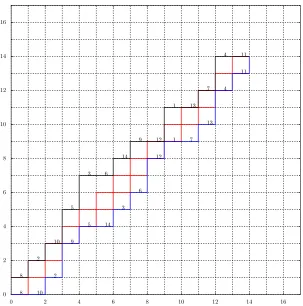
i(bi−ai). See Figure 1 for an example.
0 2 4 6 8 10 12 14 16
0 2 4 6 8 10 12 14 16
8 10 2
9
5 14
3 6
12
1 7
13 4
11
8 2
10 5
3 6
14
9 12
1 13 7
[image:6.612.141.444.267.573.2]4 11
Fig. 1:The factorizationf= (9 11)(1 2)(5 7)(12 14)(4 5)(6 7)(9 12)(0 1)(3 9)(0 3)(13 14)(8 9)(10 11)(4 8)∈ F14, presented as two labelled Dyck paths. The lower (blue) path corresponds with the parking functionL(f)and
the upper (black) path with the major sequenceU(f). The lower areaAL(f) = 7is the number of whole squares
between the blue path and the liney=x. The upper areaAU(f) = 22consists of the 8 entire squares above the line
Now define the factorization area enumerators by
Fn(q, t) = X
f∈Fn
tAU(f)qAL(f) (4)
forn≥1andF0(q, t) = 1, and let
F(q, t, x) =X
n≥0
Fn(q, t)
xn
n!.
be their generating series. One can quickly verify that the first few values ofFn(q, t)are
F0(q, t) = 1
F1(q, t) =t
F2(q, t) =qt2+t3+t2,
which agree with the refined tree inversion enumeratorsIn(q, t). Unsurprisingly, this is not a coincidence:
Theorem 4.1 (Main Theorem) We have
F(q, t, x) = exp t
∞
X
m=1
(tm−1+tm−2q+· · ·+qm−1)Fm−1(q, t)
xm m!
!
.
Comparing with (3), we conclude thatF(q, t, x)andI(q, t, x)must coincide, as they agree on the initial terms and satisfy the same recurrence. Thus we have:
Corollary 4.2 The number of treesT∈ Tnwithiinversions andjnon-inversions is equal to the number of factorizationsf ∈ Fn withAL(f) = iandAU(f) = j. In particular, the number of treesT ∈ Tn of total depthkis equal to the number of factorizations(a1b1)· · ·(anbn) ∈ Fn with total difference P
i(bi−ai) =k.
The proof of Theorem 4.1 comes via a series of lemmas and is outlined in Section 5, below. An alternative bijective proof will be given in Irving and Rattan (2016).
5
Proof of the main result
There are two main stages to the proof of Theorem 4.1. The first is Theorem 5.1, which gives the expo-nential decomposition of factorizations into connected structures, while preserving the relevant statistics, and the second, given in Theorem 5.5, shows how the connected structures decompose in the necessary way.
Specifically, the relevant connected structures are as follows. LetFnˆ be the subset ofFnwhose mem-bers contain the transposition(0n). SetFnˆ (q, t)to be the analogous generating series to the one in (4); that is,
ˆ
Fn(q, t) = X
f∈Fˆn
tAU(f)qAL(f).
Further setFˆ(q, t, x) =P
n≥1Fˆn(q, t)x
n
n!. The following theorem brings us part of the way to proving
Theorem 5.1 The generating seriesF(q, t, x)andFˆ(q, t, x)satisfy
F(q, t, x) = expFˆ(q, t, x).
Theorem 5.1 follows from Lemma 5.4 below, but we need to show some lemmas first.
Lemma 5.2 Iff ∈Fnthen no two transpositions inf cross; that is,f does not have two transpositions
(a b)and(c d)witha≤c < b≤d.
The previous lemma can be seen fairly quickly from the standard presentation of a minimal factorization ofσnas trees embedded in the plane, a construction originally due to Moszkowski (1989).
Briefly, every factorization of the full cycle(0 1 · · ·n)can be represented as anedge-labelled vertex-rooted planar tree, with one distinguished vertex, where the vertices are otherwise unlabelled, and the edge labels around each vertex increase cyclically clockwise with a unique descent. A more thorough description of this is found in Irving (2009) and Bousquet-M´elou and Schaeffer (2000), which gives an account of the more general setting of factorizations of permutations with more than one cycle, or (Irving, 2005, Section 2.4) for an account of the specific case full cycle factorization.
While this construction does not give us the requisite correspondence between factorizations and trees proving Theorem 4.1 or 5.1, it does help us prove the various lemmas we need (namely, Lemmas 5.2, 5.3 and 5.4).
Lemma 5.3 Supposef ∈ Fn, and let(0 c1),(0 c2), . . . ,(0 cr)be the transpositions containing zero, and appearing inf in that order. Then c1 < c2 < · · · < cr. Further, suppose that cr appears in transpositions with the elementsd1 < d2 < · · · < dt, andais the largest index withda < cr. Then
(d1 cr),(d2 cr), . . . ,(da cr)appear inf in that order and all occur after the transposition(0 cr), and
(crda+1), . . . ,(crdt)all occur before(0cr)and appear in that order.
Finally, from these two lemmas we obtain the following key result, which provides what is needed to prove Theorem 5.1.
Lemma 5.4 Letn >1andf = ((a1b1), . . . ,(anbn))∈ Fn. Then there is some (non-empty) sequence of indices1≤i1< i2<· · ·< ik≤nwith the following properties:
1. aik = 0,bi1 =nandbij =aij−1, for2 ≤j ≤k, and for every other transposition(aj bj)∈ f
there is an index1≤t≤ksuch that
ait ≤aj< bj ≤bit;
2. for each1 ≤ t ≤ k there arebit −ait transpositions (aj bj)(including (ait bit)itself) in f
satisfying Condition (1);
3. for each1≤t≤kthe product of all transpositions satisfying Condition (2), including(aitbit), in
We will not give a proof of Lemma 5.4 in this abstract, but we will give an example illustrating the key concepts of Lemmas 5.3 and 5.4. Consider the following memberf ∈ F14:
(9 11) 1 (1 2) 2 (5 7) 3 (12 14) 4 (4 5) 5 (6 7) 6 (9 12) 7 (0 1) 8 (3 9) 9 (0 3) 10 (13 14) 11 (8 9) 12 (10 11) 13 (4 8) 14 .
Two transpositions contain the symbol 0 and they appear in the order stated in Lemma 5.3. Furthermore, the indices(i1, . . . , ik)in Lemma 5.4.1 are(4,7,9,10), or are the transpositions given in blue. Focussing
on the transposition(3 9), according to Lemma 5.4.2 there are five other transpositions in the factorization whose elements are contained between 3 and 9. Those transpositions are in positions3,5,6,12,14(the red transpositions). The product of these transpositions (including the transposition(3 9)) in the order given is(3 4 · · ·9), as claimed in Lemma 5.4.3. Notice that this is also the example given in Figure 1. The condition in Lemma 5.4.3 has a nice graphical interpretation when looking at the two lattice paths given by the lower and upper sequences of a factorization. Looking at Figure 1, the transpositions3,5,6,9,12,14
correspond to a region fully enclosed by the two lattice paths. That is, the upper and lower paths meet at the endpoints given by the coordinates(3,3)and(9,9).
Thus, in light of Theorem 5.1, what remains is to show the following theorem.
Theorem 5.5 The generating seriesFˆ(q, t, x)satisfies
ˆ
F(q, t, x) =t
∞
X
m=1
(tm−1+tm−2q+· · ·+qm−1)Fm−1(q, t)
xm
m!.
To prove Theorem 5.5, it suffices to show there exists a bijection
Γ : ˆFn → {(k,Fn−1) :k∈[n−1]}, (5)
where for f ∈ Fnˆ we have AU(f) = AU(Γ(f)) +k + 1 and AL(f) = AL(Γ(f)) +n−k −
1. Thus, the contributions of f and Γ(f)to their respective generating series are tAU(f)qAL(f) and
(tk+1qn−k−1)tAU(Γ(f))qAL(Γ(f)).
Note one consequence of the existence of a bijection (5): the number of minimal factorizations ofσn
with(0n)as a transposition isnn−1. We first need a lemma.
Lemma 5.6 Suppose thatf = (α1, . . . , αn) ∈ Fn. Then there is a unique indexˆ ksuch that αk =
(0n). Furthermore, for everyi < k, no transpositionαi contains the symbolnand for everyi > kno transpositionαicontains the symbol 0.
The proof of Lemma 5.6 is relatively simple. The uniqueness ofkis clear as the factorization ofσnwould
otherwise fail to be minimal, as argued in at the beginning of Section 3. The second and third claims are covered by Lemma 5.3 withcr=nthere.
Thus, if we defineFn,kˆ as the set off ∈ Fnˆ with(0 n)as thekth transposition, we see thatFnˆ =
˙
∪1≤k≤nFn,kˆ .
Define a functionφ: ˆFn →Fnˆ by the following rules. Setf = (α1, . . . , αn)∈Fnˆ . Iff ∈Fn,kˆ for
k≤n−1, then define
whereα¯n = (i−1j−1)ifαn = (i j). Notice from Lemma 5.6 thati6= 0, soi−1≥0. Iff ∈Fn,nˆ
thenαn= (0n)and define
φ(f) = (αn,α¯1, . . . ,α¯n−1)
whereα¯k = (i+ 1j+ 1)ifαk = (i j)for1 ≤k ≤n−1. By Lemma 5.6 for eachαk = (i j)with
1≤k≤n−1, we see thatj6=n, soj+ 1≤n. We callφtheforwards rotation operator.
Though the forwards rotation operator clearly cyclically rotates the element (0 n)to the right, it is of course necessary to verify that it preserves factorizations of theσn. After verifying that the forwards
rotation operation is well-defined, it’s not difficult to see that it has a well-defined inverseβ, thebackwards rotation operator. The details proving the above properties of the rotation operators are omitted here. Whence we obtain the following lemma.
Lemma 5.7 The functionsφandβare well-defined functions and are both bijective fromFn,kˆ toFn,kˆ +1 (whereFn,kˆ +1is defined asFn,ˆ 1fork=n) for all1≤k≤n.
The following example shows the forwards rotation operator working on a factorization. Letf = (1 2),(0 1),(0 3),(0 4)∈Fˆ4,4. Then
φ(f) = (0 4),(2 3),(1 2),(1 4)
φ2(f) = (0 3),(0 4),(2 3),(1 2)
φ3(f) = (0 1),(0 3),(0 4),(2 3)
φ4(f) = (1 2),(0 1),(0 3),(0 4).
Now define a functionγ : ˆFn,n → Fn−1byγ((α1, . . . , αn)) = (α1, . . . , αn−1). The functionγ is
clearly bijective and well-defined. Finally defineΓ : ˆFn → {(k,Fn−1) :k∈[n−1]}by iff ∈Fˆn,n−k
thenΓ(f) = (k, γ◦φk(f)). It follows the functionΓis a bijection fromFnˆ → {(k,Fn−1) :k∈[n−1]}.
Given a factorizationf ∈Fˆn, it is a straightforward exercise to relate the upper and lower areas of both
φ(f)andγ(f)to the upper and lower areas off. Thus, for anyf ∈Fn,nˆ −kit follows that
AU(Γ(f)) =AU(f)−k−1 and AL(Γ(f)) =AL(f) +k−n+ 1,
showing that the functionΓhas the requisite properties to satisfy the conditions in (5).
6
Generalizations
For a labelled treeT and a pair(i, j)of nonnegative integers, letHi,j(T)denote the number of vertices
v∈Twhich haveidescendants smaller thanvandjdescendants larger thanv. Up to now we have been concerned with the distribution of the pair
(inv(T),ninv(T)) =X
i,j
(i, j)Hi,j(T)
and its relation to natural statistics on parking functions and minimal factorizations. More generally, it is fruitful to investigate the full matrix statisticH(T) = [Hi,j(T)]and its analogues for other “tree-like”
First consider the vector inv(T) = (P
jHi,j(T))i≥0 of row sums of H(T). It is known that the
distribution ofinv(T)over trees coincides with the distribution of a natural statistic on parking functions. In particular, Shin (2008) defines thejumpstatistic on parking functions and gives a simple bijectionζ:
Tn→ Pnsatisfyinginv(T) =jump(ζ(T)). Note that the sum of the entries ofinv(T)is simplyinv(T), and it is clear from the definition ofjump(p)that its entries sum toarea(p). One can similarly consider the vectorninv(T)of column sums ofH(T), and it can be shown that the joint statistic(inv(T),ninv(T))over all treesT ∈ Tn is equidistributed with a natural refinement of(AL(f), AU(f))over all factorizations
f ∈ Fn.
Next consider the vectorhook(T) = (hookk(T))k≥0consisting of the antidiagonal sumshookk(T) := P
i+j=kHi,j(T). Note thathookk(T)is the number of vertices ofThaving exactlykdescendants (that
is, havinghook lengthk) and the total depth ofTis thereforetdep(T) =P
kk·hookk(T). As indicated
in Corollary 4.2, the distribution of total depth over labelled trees matches that of total difference over minimal factorizations. More generally, it transpires that the distribution ofhook(T)forT ∈ Tnmatches that of thedifference indexdiff(f)forf ∈ Fn, where thek-th entry ofdiff(f)is the number of factors
(a b)off havingb−a= k. A similar result appears in Goulden and Yong (2002), although there the authors compute transposition differences circularly, replacingb−awithmin{b−a, n+ 1 +a−b}, which has the effect of disguising the connection with hook lengths. It is interesting to note that hook length formulae for labelled trees due to Chen et al. (2009) immediately yield the curious identities
X
f∈Fn
Y
i
1
bi−ai
=n! and X
f∈Fn
Y
i
1 (bi−ai)2
=(n+ 2)! 2n+1 ,
where both sums extend over all factorizationsf = (a1b1)· · ·(anbn)∈ Fn.
It is natural to investigate analogues of hook length and total depth for other tree-like objects. For parking functions, the analogue of hook length is somewhat convoluted and we do not describe it here. Instead we discuss a more specialized statistic that mates with total depth.
Letp= (a1, . . . , an)be a parking function and consider its associated labelled Dyck pathP. Imagine
a ball starting at the point(0,0)and moving east until it encounters a vertical step ofP, at which time it “bounces” north and continues until it encounters the liney =x, where it “bounces” east until it hitsP, etc. The ball continues to bounce betweenP andy=xuntil it stops at(n, n). If0 =i1<· · ·< ik =n
are the (integer)x-coordinates where the ball intersectsy=x, then we set
bounce(p) =X
j
(n−ij).
For example, the parking functionp= (9,1,5,12,4,6,9,0,3,0,13,8,10,4)corresponds with the lower path in Figure 1. The bounce indices(i1, . . . , ik)are(0,2,3,4,6,8,9,11,12,13,14), givingbounce(p) =
14 + 12 + 11 + 10 + 8 + 6 + 5 + 3 + 2 + 1 + 0 = 72.
Computing the bounce of small parking functions suggests the following theorem, which indeed holds true in general. We omit the proof here.
Theorem 6.1 The following objects are equinumerous: (1) parking functionsp∈ Pnwithbounce(p) =
k, (2) treesT ∈ Tn of total depthk, and (3) minimal factorizations(a1b1)· · ·(anbn) ∈ Fn with total differenceP
Bounce was originally defined by Haglund Haglund (2003) to provide a combinatorial interpretation of the(q, t)-Catalan numbers and the Hilbert series of the space of diagonal harmonics. An extensive treatment of this connection can be found in Haglund (2008). Interestingly, it is clear from algebraic considerations that the joint distribution of bounce and area is symmetric over Dyck paths of a given length; however, no combinatorial proof of this symmetry is known.
Finally, we note that a number of the above results can be generalized to obtain analogous correspon-dences betweenk-cacti,k-parking functions (see Yan (1997)), and minimal factorizations of a full cycle into cycles of lengthk.
References
P. Biane. Parking functions of types A and B. Electron. J. Combin., 9, 2002.
M. Bousquet-M´elou and G. Schaeffer. Enumeration of planar constellations. Adv. in Appl. Math., pages 337–368, 2000.
W. Y. C. Chen, O. X. Q. Gao, and P. L. Guo. Hook length formulas for trees by Han’s expansion. arXiv:math.CO/0903.3342, 2009.
J. D´enes. The representation of a permutation as the product of a minimal number of transpositions and its connection with the theory of graphs.Publ. Math. Inst. Hungar. Acad. Sci., 4:63–70, 1959.
I. Gessel. A noncommutative generalization andq-analog of the lagrange inversion formula.Trans. Amer. Math. Soc., pages 455–482, 1980.
I. Gessel and B. Sagan. The tutte polynomial of a graph, depth-first search, and simplicial complex partitions.Electronic J. Combinatorics, 3(2), 1996.
I. M. Gessel. Enumerative applications of a decomposition for graphs and digraphs.Discrete Math., pages 257–271, 1995.
I. Goulden and D. M. Jackson. Transitive factorisations into transpositions and holomorphic mappings on the sphere.Proc. AMS, 125(1):51–60, January 1997.
I. P. Goulden and D. M. Jackson. The combinatorial relationship between trees, cacti and certain connec-tion coefficients for the symmetric group. European J. Combin., 13(5):357–365, 1992. ISSN 0195-6698.
I. P. Goulden and A. Yong. Tree-like properties of factorizations.J. Combin. Theory. Ser. A, 98:106–117, 2002.
J. Haglund. Conjectured statistics for theq, t-Catalan numbers.Adv. Math., 175(2), 2003.
J. Haglund. The q, t-Catalan Numbers and the Space of Diagonal Harmonics: With an Appendix on the Combinatorics of Macdonald Polynomials, volume 41 of University Lecture Series. American Mathematical Society, 2008.
J. Irving. Minimal transitive factorizations of permutations into cycles. Canad. J. Math., pages 1092– 1117, 2009.
J. Irving and A. Rattan. Factorizations of the full cycle into transpositions, tree inversions and tree depth. forthcoming, 2016.
A. G. Konheim and B. Weiss. An occupancy discipline and applications. SIAM J. Applied Math., 14: 1266–1274, 1966.
G. Kreweras. Une famille de polynˆomes ayant plusiers propri´et´es ´enumeratives. Periodica Math. Hung., 11:309–320, 1980.
C. Mallows and J. Riordan. The inversion enumerator for labeled trees.Bull. Amer. Math. Soc., 74:92–94, 1968.
P. Moszkowski. A solution to a problem of d´enes: a bijection between trees and factorizations of cyclic permutations.European J. Combinatorics, 10:13–16, 1989.
H. Shin. A new bijection between forests and parking functions. arXiv:math.CO/0810.0427, 2008.
A. Sokal. A ridiculously simple and explicit implicit function theorem. arXiv:math-cv/0902.0069, 2009.
R. P. Stanley.Enumerative Combinatorics, volume 2. Cambridge University Press, 1999.
C. H. Yan. Generalized tree inversions andk-parking functions. J. Combin. Theory. Ser. A, 79:268–280, 1997.