N A N O R E V I E W
Nanofluids Research: Key Issues
Liqiu Wang•Jing Fan
Received: 12 April 2010 / Accepted: 5 May 2010 / Published online: 22 May 2010
The Author(s) 2010. This article is published with open access at Springerlink.com
Abstract Nanofluids are a new class of fluids engineered by dispersing nanometer-size structures (particles, fibers, tubes, droplets) in base fluids. The very essence of nano-fluids research and development is to enhance fluid mac-roscopic and megascale properties such as thermal conductivity through manipulating microscopic physics (structures, properties and activities). Therefore, the suc-cess of nanofluid technology depends very much on how well we can address issues like effective means of micro-scale manipulation, interplays among physics at different scales and optimization of microscale physics for the optimal megascale properties. In this work, we take heat-conduction nanofluids as examples to review methodolo-gies available to effectively tackle these key but difficult problems and identify the future research needs as well. The reviewed techniques include nanofluids synthesis through liquid-phase chemical reactions in continuous-flow microfluidic microreactors, scaling-up by the volume averaging and constructal design with the constructal the-ory. The identified areas of future research contain microfluidic nanofluids, thermal waves and constructal nanofluids.
Keywords NanofluidsKey issues Microfluidic nanofluidsThermal waves Constructal nanofluids
Introduction
Nanofluids, fluid suspensions of nanometer-sized particles, have recently been demonstrated to have thermal con-ductivities far superior to that of the liquid alone [1–4]. This and their other distinctive features offer unprece-dented potential for many applications in various fields including energy, bio and pharmaceutical industry, and chemical, electronic, environmental, material, medical and thermal engineering [1–17]. State-of-the-art expositions of major advances on the synthesis, characterization and application of nanofluids are available, for example, in [1– 3,16–19].
Nanofluids are research challenges of rare potential but daunting difficulty. The potential comes from both scien-tific and practical opportunities in many fields. The diffi-culty reflects the issues related to multiscales. Nanofluids involve at least four relevant scales: the molecular scale, the microscale, the macroscale and the megascale. The molecular scale is characterized by the mean free path between molecular collisions, the microscale by the smallest scale at which the law of continuum mechanics apply, the macroscale by the smallest scale at which a set of averaged properties of concern can be defined and the megascale by the length scale corresponding to the domain of interest [20, 21]. By their very nature, research and engineering practice in nanofluids are to enhance fluid macroscale and megascale properties through manipulating microscale physics (structures, properties and activities). Therefore, interest should focus on addressing questions like: (1) how to effectively manipulate at microscale, (2) what are the interplays among physics at different scales and (3) how to optimize microscale physics for the optimal megascale properties. In this work, we summarize meth-odologies available to effectively address these central L. Wang (&)J. Fan
Department of Mechanical Engineering, The University of Hong Kong, Pokfulam Road, Hong Kong, China
problems and identify the future research needs by taking heat-conduction nanofluids as examples.
Microscale Manipulation
The ability to manipulate at microscale depends very much on nanofluids synthesis techniques. Nanofluids have been synthesized by either a two-step approach that first gener-ates nanoparticles and subsequently disperses them into base fluids [1–3,15–18] or a one-stepphysicalmethod that simultaneously makes and disperses the nanoparticles into base fluids [22–26]. An advantage of the two-step method is that the inert gas condensation technique has already been scaled up to commercial nano-powder production [27]. Because of this and the ease with which the particle concentration and size distribution can be manipulated, most of the experimental investigations have used the two-step method [1–3, 15–18]. A deficiency of the two-step technique is particles’ agglomeration during storage and dispersion in the base fluids, as a result of their high sur-face-to-volume ratio. Such agglomerates, in most cases, negate the unique properties associated with nanoparticles and nanofluids [1–3,15–18]. Changing the nanofluids’ PH value, adding surfactants or a suitable surface activator, or using ultrasonic or microwave vibration have been used with the two-step method to prevent nanoparticles from agglomerating [1–3,15–18]. However, typically it is rare to maintain so-synthesized nanofluids in a homogeneous sta-ble state for more that 24 h [2].
To prevent oxidation of metallic particles, a one-step technique is preferable for synthesizing nanofluids con-taining metal particles. The one-step physical method developed in [22, 23] involves nanoparticle source evap-oration and direct condensation and dispersion into a flowing base fluid in a vacuum chamber. The method has been successfully used to synthesize nanofluids of Cu particles in ethylene glycol with small copper nanoparticles (about 10 nm) and high thermal conductivity enhancement (about 40% at the particle volume concentration of 0.3%) [23]. Another one-stepphysicalmethod (the submerged arc nanoparticle synthesis system; SANSS) has also been used to synthesize nanofluids of TiO2 particles in deionized water [24], CuO particles in deionized water [25] and Cu particles in the mixture of deionized water and ethylene
glycol [26]. With the SANSS, the nanofluids are generated by vaporizing the solid material by the submerged arc and condensing into the base liquid in a vacuum chamber. Although these one-step physical methods are capable of synthesizing nanofluids with different nanostructures, they would be difficult to scale-up mainly because of their high cost and their demand for a vacuum.
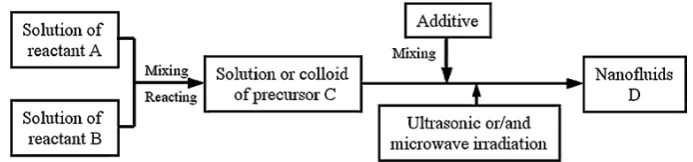
In addition to the challenge of how to effectively pre-vent nanoparticles from agglomerating or aggregating, the key issue in either of these two approaches is the lack of effective means for synthesizing nanofluids with control-lable microstructures due to either the limitation of avail-able nanoparticle powers in the two-step method or the limitation of the system used in the single-step physical method. In an attempt to develop more effective tech-niques, a one-step chemical solution method has been recently developed [16,28–32]. The strength of the solu-tion chemistry for synthesizing nanofluids lies in its ability to manipulate atoms and molecules in the liquid phase, thereby providing a powerful arsenal for synthesis of tailor-designed nanofluids using a bottom-up approach [16,28]. Figure1 shows the flow chart of the chemical solution method (CSM) [16,28]. The reaction between Reactants A (e.g., Cu2?) and B (e.g., OH-) in the liquid phase yields the solution or colloid containing the precursor C (e.g., Cu(OH)2). The additives (e.g., ammonium citrate or
ce-tyltrimethyl ammonium bromide) are then added into the solution/colloid. Finally, the solution/colloid of the pre-cursor C transforms into nanofluid D (e.g., CuO-particles-in-water) under ultrasonic or/and microwave irradiation.
Precursor C normally exists in the form of solution or colloid and is not, in general, the nanoparticle in the nanofluid D. Its solution or colloid can directly transform into the required nanofluids with the help of additives and external fields such as ultrasonic and microwave irradia-tion. Both the additives and the external fields are used to prevent nanoparticles from agglomeration and growth and thus control nanofluid microstructures.
The method has been successfully applied to produce nine kinds of nanofluids in Fig.2 [16,28–32]. The nano-fluids synthesized by this method have both higher con-ductivity enhancement and better stability than those produced by the other methods. This method is distin-guished from the others also by its controllability. The nanofluid microstructure can be varied and manipulated by
[image:2.595.203.550.633.714.2]adjusting synthesis parameters such as temperature, acid-ity, ultrasonic and microwave irradiation, types and con-centrations of reactants and additives, and the order in which the additives are added to the solution [16,28].
Problems with the CSM come mainly from the macro-scale batchreactors where reactions take place:
• The CSM uses a bottom-up approach to generate nanoparticles through chemical reactions in the liquid phase, and thereby it has the potential to manipulate atoms and molecules. However, the difficulty of controlling the microscale while operating at the macroscale is insuperable.
• Mixing in a macro-scale batch reactor is usually achieved by stirring. In this case, the fluid entity is broken into fragments by circular motion. The last part of mixing takes place based on molecular diffusion. In the diffusion process, the mixing timetdepends on the diffusion pathdin the form oft d2/D, whereDis the diffusion coefficient. Therefore, if the diffusion path becomes smaller, the mixing time becomes shorter. However, it is very difficult to make small-sized fragments by conventional stirring in solution phase. At the macroscale, therefore, mixing time is usually much larger than reaction time. The reaction rate is normally determined by the mixing time and is usually very low (reaction time: minutes–hours). Moreover, the longer mixing time and lack of effective ways to accurately control mixing also lead to poor product selectivity of competitive reactions either in parallel or in consecutive, thereby leading to poor quality of synthesized nanofluids that could contain some unde-sired side products.
• Generally, the heat generation rate in reaction increases in proportion to the reactor volume. Because the heat of reaction is removed through the wall of the reactor, the wall-surface-area/reactor-volume ratio, which decreases with the increasing reactor size, plays a crucial role.
Therefore, heat removal capacity is also a key issue for highly exothermic and extremely fast reactions in macroreactors.
• Because of high labor and work-up demand, a batch-model operation is not commercially economical. The repeatability of nanofluids’ structures is also poor with the batch-model operation.
To resolve these critical issues, the batch-based mac-roreactors in the CSM can be replaced by continuous-flow microfluidic microreactors, for example, those in Fig.3 [16,33–35]. This allows a continuous and scalable (simply by numbering-up) synthesis of high-quality nanofluids with a more accurate and effective control over particle micro-structures such as the size, distribution and shape. Mic-roreactors exhibit numerous practical advantages, including safety, easy modulation and numbering-up for industrial production, when compared with traditional macroreactors. It is also advantageous that the reactions can be controlled more accurately through efficient mixing, enhanced reaction/product selectivity and effective mass and heat transfer, due to short diffusion paths and high surface-to-volume ratios at the microscale. Running the one-step chemical process in a continuous mode would not only increase its commercial viability, but also improve its repeatability significantly. Growth of nanoparticles directly in the base fluids through chemical reactions enables us to manipulate atoms and molecules in the liquid phase, thereby providing a powerful arsenal for synthesis of tailor-designed nanofluids using a bottom-up approach [16].
Mixing has a decisive influence on the heat transfer, mass transfer, yield and selectivity of a reaction. Shrinking the reactor size to the microscale reduces the diffusion length between the reactant fluids, thus enhancing the mixing by molecular diffusion. The mixing by convection at the microscale is, however, weak because typically flow in microchannels is laminar with Reynolds numbers well below the threshold for turbulence. Transverse secondary
Fig. 2 TEM/SEM images of
some nanoparticles from ‘‘drying’’ samples of nanofluids synthesized by the chemical solution method [16,28–32] (a
[image:3.595.153.538.54.229.2]flows—which arise as a result of centrifugal effects expe-rienced by fluids traveling along a curved trajectory and continuously expand interfacial area between reagent streams through stretching, folding and breakup pro-cesses—offer an attractive possibility of providing enhanced mixing in an easily fabricated planar format by simply introducing curvature to the flow path. Expansion vortices or direct collision of slit fluid streams can also be generated by manipulating the geometrical structure of curved channels, and hence further enhance the mixing. Figure3shows three types of microreactors that are made of planar and smooth-walled curved microchannels on the one hand and have a rapid laminar-flow mixing on the other hand.
All three kinds of microreactors consist of several units of curved microchannels connected in series (three, four and five, respectively, in Fig.3a–c for illustration and example). The unit in Fig.3a–c is the spiral microchannel having an inlet and outlet spiral connected by a central S-shaped channel, the modified Tesla structure containing two modified Tesla microchannels in opposite directions and the semicircular arc involving an abrupt width increase over the last quarter, respectively. These microreactors can have a very rapid mixing between reactant fluids due to both the short diffusion length and the centrifugal-force-driven transverse secondary flow in curved microchannels [36–41]. The mixing is also further enhanced by the direct collision of slit fluid streams in the Tesla structure (Fig.3b) and by the expansion vortices that arise in the horizontal plane due to an abrupt increase in the channel width (Fig.3c) [42,43].
The centrifugal-force-driven transverse secondary flow becomes stronger following increases in the channel cur-vature ratiordefined byr=w/R(wandRare the channel width and the curvature radius, respectively) and the Dean number defined by De¼Repffiffiffir (Re is the Reynolds number) [36–38]. The mixing performance thus becomes better as the Re increases for all three microreactors in Fig.3, with consequently all working well as high-Re (Re
[100) reactors. The first two types of microreactors (Fig.3a, b) also work well as the low-Re (Re\10) and the intermediate-Re (10\ Re \100) reactors [39, 40, 43], respectively, due to a very high curvature ratio r used in the inner region of spiral microchannels in Fig.3a and the fluid-stream direct collision in Fig.3b.
In this microfluidic approach for nanofluids synthesis, solutions of the two reagents are injected as steady streams into a microfluidic channel at initial point (s=0) where the reaction between them starts (t=0). Here,sandtare the distance and time, respectively. As their mixture flows at a constant velocityv, the reaction time islinearlyrelated to the spatial distance by t=s/v. Interactions of multiple chemical reactions in time could thus be controlled simply by varying flow velocities and by creating a network of converging and diverging channels for carrying reaction mixtures. Therefore, this approach offers simple means for controlling many chemical reactions, including when each reaction starts, for how long each reaction evolves before it is separated or combined with other reactions, and when each reaction is quenched.
Droplets and slugs formed within microfluidic channels can also serve as microreactors in the CSM for nanofluids (a) (b)
(c)
Fig. 3 Three kinds of microfluidic reactors (athree spiral-microchannel units;b
[image:4.595.203.544.59.310.2]synthesis. Figures4 and5illustrate two such microfluidic systems [16]. In the first type (Fig.4), discrete droplets are formed at the T-junction and are encapsulated by a dis-persing liquid that wets the microchannel. These droplets form the dispersed phase in which the reaction between Reactants A (e.g., phosphoric acid H3PO4) and B (e.g.,
cerium nitrate Ce(NO3)3) occurs in the liquid phase. After
separating the dispersing liquid in the separator, we can obtain nanofluids (e.g., suspensions of cerium phosphate (CePO4) nanofibers in water, Fig.2a). In the second type
(Fig.5), liquid slugs are separated by discrete gas bubbles
generated at the T-junction of microfluidic channels. Reactions occur within the slugs that form the continuous phase. The nanofluids are collected after separating the gas bubbles in the separator. The first type differs from the second type in that reagents in droplets do not come into contact with the microchannel wall.
The additional advantage of compartmentalizing reac-tions in droplets or slugs of femoliter to microliter includes the enhanced mixing from the internal recirculation within the droplets or slugs [43–46] and enhanced controllability of reactions due to the simplicity and accuracy in manip-ulating microfluidic droplets, bubbles and slugs in various ways [43–47]. For example, the ability to split and fuse individual droplets improves simplicity with which the reagent volume and concentrations can be controlled precisely.
Figure6a shows the photos of some microfluidic Cu2O
nanofluids 24 h after their preparation [34], with the enhanced stability, highly monodispersed particles and reduced particle size compared with those synthesized by the CSM [31]. The particle shape can also be designed with this type of synthesis method. Figure 6b illustrates some flower-shaped Cu2O particles that are difficult to form by
the other methods [34].
Therefore, microstructures of microfluidic nanofluids (the nanofluids synthesized through liquid-phase chemical reactions in microfluidic systems) can be precisely con-trolled by reagent fluid properties, system geometrical properties and fluid dynamical parameters such as flow rates. Intensified future effort is required to define the potential of this promising synthesis technique against an important target of controlling reactions accurately with a rapid and precise mixing. Specifically, the research focus should be on the correlations between nanofluids micro-structures and controlling parameters of fluid physical/ chemical/dynamical properties and microfluidic geometri-cal features.
Macroscale Heat Conduction
A relatively intensified effort has been made on deter-mining nanofluid thermal conductivity from experiments, particularly for the nanofluids with spherical nanoparticles or nanotubes. While the data from these experiments have enabled some trends to be identified, there is still no con-sensus on the effects of some parameters such as particle size, shape, distribution and additives in the nanofluids [1– 3,15–19,28,29]. There also exist wide discrepancies and inconsistencies in the reported conductivity data due to a limited understanding of the precise nature of heat con-duction in nanofluids, the poor microstructure character-ization and the unavailability of nanofluids with various (a)
(b)
Fig. 4 Nanofluids’ synthesis by compartmentalizing chemical reac-tions in microfluidic droplets:a microfluidic system;bmicrofluidic droplets
(a)
(b)
[image:5.595.53.289.61.297.2] [image:5.595.53.287.506.677.2]microstructures [1–3,15–19, 28, 29]. In many cases, the microstructural parameters were not measured by the experimenters themselves but rather taken from the powder manufacturers’ nominal information. To reconcile these discrepancies and inconsistencies and to lay the founda-tions for better and more efficient designs of nanofluids, it is essential to generate nanofluids of various microstruc-tures, characterize their microstructures by state-of-the-art instrumentation and develop precise heat-conduction model for nanofluids [16,28].
Suggestedmicroscopicreasons for experimental finding of significant conductivity enhancement include the nano-particle Brownian motion effect [48–53], the liquid layer-ing effect at the liquid–particle interface [54–59], and the nanoparticle cluster/aggregate effect [60,61]. As generally accepted [1–3, 15–19, 62–67], however, no conclusive explanation is available. Often, the explanation by one research group is confronted by others. There is also a lack of agreement between experimental results and between theoretical models. The fact that the conductivity enhancement comes from the presence of nanoparticles has
directed research efforts nearly exclusively toward thermal transport at nanoscale. The classical heat conduction equation has beenpostulatedas the macroscale model but without adequate justification. Thermal conductivity is a macroscale phenomenological characterization of heat conduction and the conductivity measurements are not performed at the nanoscale, but rather at the macroscale. Therefore, interest should focus not only on what happens at the nanoscale but also on how the presence of nano-particles affects the heat transport at macroscale.
In an attempt to isolate the mechanism responsible for the significant enhancement of thermal conductivity, a macroscale heat conduction model in nanofluids has been recently developed from first principles [16, 20, 28, 68]. The model was obtained by scaling-up a microscale model for heat conduction in nanoparticles and in base fluids. The approach for scaling-up is the volume averaging with help of multiscale theorems [20,69]. The microscale model for the heat conduction in the nanoparticles and in the base fluids comes from the first law of thermodynamics and the Fourier law of heat conduction. The result shows that the
Fig. 6 Microfluidic Cu2O particles-in-water nanofluids 24 h after their preparation [34]:
astable nanofluid samples;b
[image:6.595.205.547.57.434.2]presence of nanoparticles leads to a dual-phase-lagging heat conduction in nanofluids at macroscale with a poten-tial of higher thermal conductivity. Here, we first summa-rize the development of this theory, then examine the macroscale manifestation of microscale physics, and finally identify the future research needs.
Microscale Heat-Conduction Models
The microscale model for heat conduction in nanofluids is well known. It consists of the field equation and the con-stitutive equation. The field equation comes from the first law of thermodynamics. The commonly used constitutive equation is the Fourier law of heat conduction for the relation between the temperature gradientrTand the heat flux density vectorq[70].
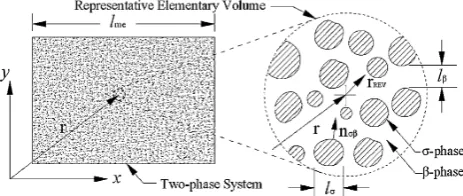
Consider heat conduction in nanofluids with the base fluid and the nanoparticle denoted by b- and r-phases, respectively. By the first law of thermodynamics and the Fourier law of heat conduction, we have the microscale model for heat conduction in nanofluids (Fig.7)
ðqcÞboTb
ot ¼ r ðkbrTbÞ; in theb-phase ð1Þ ðqcÞroTr
ot ¼ r ðkrrTrÞ; in ther-phase ð2Þ Tb¼Tr; at theb-rinterfaceAbr ð3Þ
nbrkbrTb¼nbrkrrTr; at theb-rinterfaceAbr ð4Þ
Here, T is the temperature. q, c and k are the density, specific heat and thermal conductivity, respectively. Sub-scriptsb andrrefer to the b- andr-phases, respectively. Abr represents the area of the b–r interface; nbr is the outward-directed surface normal from theb-phase toward ther-phase, andnbr= -nrb(Fig.7).
Macroscale Heat-Conduction Models
A macroscale model equivalent to the microscale behavior can be readily obtained by the method of volume averaging
[20, 69]. Consider a representative elementary volume (REV) in Fig.7, the smallest differential volume resulting in statistically meaningful local average properties. Aver-aging Eqs.1–4 over REV and applying the multiscale theorems [20] yield the macroscale model of heat con-duction [16,20,28,68]:
cb
o Tb b
ot ¼ r Kbb r Tb
b
þKbr rh iTr r
n o
þhat h iTr r Tb b
; ð5Þ
and
croh iTr r
ot ¼ r Krr rh iTr
rþK
rb r Tb b
n o
hat h iTr r Tb b
; ð6Þ
where Tb
b
¼ 1 Vb
Z
Vb
TbdV; ð7Þ
and
Tr
h ir¼ 1 Vr
Z
Vr
TrdV: ð8Þ
Vb and Vr are the volumes of b- and r-phases in REV, respectively. cb=(1 -u)(qc)b and cr=u(qc)r are the
b-phase and r-phase effective thermal capacities, respectively. u is the volume fraction of the r—phase defined by u=Vr/VREV (VREVis the volume of REV). h
and at come from modeling of the interfacial flux and are the film heat transfer coefficient and the interfacial area per unit volume, respectively [16,20,68].Kbb,Krr, Kbr and Krb are the effective thermal conductivity tensors, and the coupled thermal conductivity tensors are equal
Kbr¼Krb: ð9Þ
When the system is isotropic and the physical properties of the two phases are constant, Eqs.5and6reduce to
cb
o Tb b
ot ¼kbbD Tb
b
þkbrDh iTr rþhat h iTr r Tb b
ð10Þ and
croh iTr r
ot ¼krrDh iTr
rþk
rbD Tb bhat h iTr r Tb b
ð11Þ wherekbbandkrrare the effective thermal conductivities of the b- andr-phases, respectively, and kbr =krb is the cross effective thermal conductivity of the two phases.
[image:7.595.54.286.598.696.2]Thermal Waves
Rewrite Eqs.10and11in their operator form
cbootkbbDþhat kbrDhat
kbrDhat crootkrrDþhat
Tb b
Tr
h ir
¼0: ð12Þ We then obtain an uncoupled form by evaluating the operator determinant such that
cb
o
otkbbDþhat
cr
o
otkrrDþhat
kbrDþhat2
i Ti
h ii¼0
ð13Þ
where the indexican take bor r. Its explicit form reads, after dividing byhat(cb?cr)
oh iTi i
ot þsq o2h iTi i
ot2 ¼aDh iTi
i
þasT
o ot Dh iTi
i
þa
k Fðr;tÞ þsq oFðr;tÞ
ot
ð14Þ
where
sq¼
cbcr
hatðcbþcrÞ
; sT¼
cbkrrþcrkbb
hatðkbbþkrrþ2kbrÞ ;
k¼kbbþkrrþ2kbr; a¼
kbbþkrrþ2kbr cbþcr ;
Fðr; tÞ þsq
oFðr; tÞ ot ¼
k2
brkbbkrr
hat
D2h iTi i:
ð15Þ This can be regarded as a dual-phase-lagging (DPL) heat-conduction equation with ðk2
brkbbkrrÞ
. ðhavÞ
D2h iTi i
as the DPL source-related termFðr; tÞ þsqoFð
r;tÞ
ot and with sqandsTas the phase lags of the heat flux and the temperature
gradient, respectively [68,71]. Here,Fðr;tÞis the volumetric heat source. k, qc and a are the effective thermal conductivity, capacity and diffusivity of nanofluids, respectively. The dual-phase-lagging heat-conduction equation originates from the first law of thermodynamics and the dual-phase-lagging constitutive relation of heat flux density [68, 71]. It is developed in examining energy transport involving high-rate heating in which the non-equilibrium thermodynamic transition and the microstruc-tural effect become important associated with a shortening of the response time [68, 71]. Therefore, the presence of nanoparticles shifts the Fourier heat conduction in the base fluid into the dual-phase-lagging heat conduction in nanofluids at the macroscale. This finding is significant because all results regarding dual-phase-lagging heat conduction can thus be applied to study heat conduction in nanofluids.
The presence of nanoparticles gives rise to variations of thermal capacity, conductivity and diffusivity, which are given by, in terms of ratios over those of the base fluid,
qc
ðqcÞb¼ ð1uÞ þu ðqcÞr
ðqcÞb; ð16Þ
k kb
¼kbbþkrrþ2kbr kb
; ð17Þ
a ab
¼ k kb
ðqcÞb
qc : ð18Þ
Therefore, qc/(qc)b depends only on the volume fraction of nanoparticles and the nanoparticle–fluid capacity ratio. However, bothk/kbanda/abare affected by the geometry, property and dynamic process of nanoparticle–fluid interfaces. This dependency causes the most difficulty because it is the least precisely known feature of a nanofluid. The future research effort should thus focus on ðkbbþkrrþ2kbrÞkb to develop predicting models of
thermal conductivity for nanofluids. Consider
sT sq
¼1þc 2
bkrrþc2rkbb2cbcrkbr cbcrðkbbþkrrþ2kbrÞ
: ð19Þ
It can be large, equal or smaller than 1 depending on the sign of c2
bkrrþc2rkbb2cbcrkbr. Therefore, by the
condition for the existence of thermal waves that requires
sT/sq\1 [68, 72], we may have thermal waves in
nanofluid heat conduction when
c2
bkrrþc2rkbb2cbcrkbr¼ cb
ffiffiffiffiffiffiffi krr
p
cr ffiffiffiffiffiffiffikbb
p
2
þ2cbcrð
ffiffiffiffiffiffiffiffiffiffiffiffiffi kbbkrr
p
kbrÞ\0:
ð20Þ A necessary (but not sufficient) condition for Eq.20is kbr[pffiffiffiffiffiffiffiffiffiffiffiffiffikbbkrr. Note also that for heat conduction in
nanofluids, there is a time-dependent source termFðr;tÞin the dual-phase-lagging heat conduction (Eqs.14 and 15). Therefore, the resonance can also occur. These thermal waves and possibly resonance are believed to be the driving force for the conductivity enhancement. When kbr=0 so thatsT/sqis always larger than 1, thermal waves
and resonance would not appear. The coupled conductive terms in Eqs.10 and 11 are thus responsible for thermal waves and resonance in nanofluid heat conduction. It is also interesting to note that although eachsqandsTishat dependent, the ratio sT/sqis not. Therefore, the evaluation
of sT/sqwill be much simpler thansqorsT.
wave theory can explain this since the conductivity enhancement k/kb equals to (kbb ?2kbr?krr)/kb (Eq.17), which are strongly affected by nanofluids microstructures and interfacial properties/processes of nanoparticle–fluid interfaces.
Therefore, the molecular physics and the microscale physics (interactions between nanoparticles and base flu-ids at the microscale in particular) manifest themselves as heat diffusion and thermal waves at the macroscale, respectively. Their overall macroscopic manifestation shifts the Fourier heat conduction in the base fluid into the dual-phase-lagging heat conduction in nanofluids. When
sT/sq\1, thermal waves dominant and Eq.14 is of a
hyperbolic type [68]. When sT/sqC1, however, heat
diffusion dominants and Eq.14 is parabolic [68]. Depending on factors like material properties of nano-particles and base fluids, nanonano-particles’ geometrical structure and their distribution in the base fluids, and interfacial properties and dynamic processes on particle– fluid interfaces, the heat diffusion and thermal waves may either enhance or counteract each other. Consequently, the heat conduction may be enhanced or weakened by the presence of nanoparticles. Table1 lists the conductivity ratiok/kbfrom experiments. Here,kandkbare the thermal
conductivity of the nanofluid and the base fluid, respec-tively. It shows that: (1) the interaction between the heat diffusion and the thermal waves can either upgrade or downgrade fluid conductivity by the presence of higher-conductivity nanoparticles, and (2) extraordinary water conductivity enhancement (up to 153%) can be achievable by the presence of lower-conductivity oil droplets due to strong thermal waves. The reported strong thermal con-ductivity enhancement beyond that from the higher value of suspended nanoparticles in [23, 75–79] is also the evidence of such thermal waves.
The immediate and intensive efforts should thus focus on: (1) solving the three closure problems in [16] ana-lytically and numerically for unit cells with various microscale physics to find the correlation between the microscale physics and the nanofluid macroscale proper-ties (effective thermal conductivity, effective thermal diffusivity, phase lag of the heat flux sqand phase lag of
the temperature gradient sT); (2) studying the
dual-phase-lagging heat conduction equation Eq.14 analytically and numerically for various nanofluids systems to find prop-erties of thermal waves and how they interact with the heat diffusion. Focused experiments in these areas are also in great demand for experimentally confirming the ana-lytical/numerical findings. Such studies, together with the development of microfluidic nanofluids should lead to methodologies of controlling nanofluids macroscale properties through manipulating their microscale physics, a significant step forward toward creating nanofluids by design.
[image:9.595.51.289.529.714.2]The first of Type-(1) work has recently been made in [80, 81], showing that the macroscale model works very well and uncovering some important features regarding the model itself and the microstructure–conductivity correlation. For nanofluids consisting of in-line arrays of perfectly dispersed two-dimensional circular, square or hollow particles, for example, the heat conduction is diffusion-dominant so that the effective thermal conduc-tivity can be predicted adequately by the mixture rule with the effect of particle shape and particle–fluid con-ductivity ratio incorporated into its empirical parameter [80]. Thermal waves appear more likely at smaller par-ticle–fluid conductivity ratio and lower particle volume fraction, a result that agrees with the experimentally observed significant conductivity enhancement in the oil-in-water emulsion [28, 74]. The computed thermal con-ductivity predicts some experimental data in the literature very well and shows the sensitivity to the surface-to-volume ratio [80]. The simulation results in [81] show that the radius of gyration and the non-dimensional par-ticle–fluid interfacial area are two important parameters in characterizing the geometrical structure of nanoparti-cles. A non-uniform particle size is found to be unfa-vorable for the conductivity enhancement, while particle aggregation benefits the enhancement especially when the radius of gyration of aggregates is large [81]. Without considering the interfacial thermal resistance, larger non-dimensional particle–fluid interfacial area between the base fluid and the nanoparticles is also desirable for enhancing thermal conductivity [81]. The nanofluids with nanoparticles of connected cross-shape show a much higher (lower) effective thermal conductivity when par-ticle–fluid conductivity ratio is larger (smaller) than 1 [81].
Table 1 Measured conductivity ratio k/kb of some nanofluids (k: nanofluid thermal conductivity;kb: base-fluid thermal conductivity)
Nanofluids k/kb
CePO4nanofibers in water [28,32] 0.67–1.54 Cu2O spherical particles in water [31] 0.83–1.24 Cu2O octahedral particles in water [31] 0.89–1.24 CuS/Cu2S hollow spherical particles in water [30] 0.85–1.18 CuS/Cu2S core–shell spherical particles in water [30] 0.82–1.21 1 vol% Alumina nanorods (80910 nm) in water [67] 0.92–1.18
1 vol% Alumina nanorods (80910 nm) in Polyalphaolefins lubricant (PAO)?surfactant [67]
0.91–1.10
0.001 vol% Gold nanoparticles (20–30 nm) in water [67]
0.91–1.11
0.86 vol% Mn–Zn ferrite (12.9 nm) in water [67] 0.92–1.09
Corn oil droplets in water [74] 0.755–2.39
Megascale Optimization
In the field of nanofluid heat conduction, efforts have been nearly exclusively on correlating thermal conductivity of nanofluids with their microscale physics, as a fundamental step of searching for optimal thermal conductivity [1–3,16– 19]. The attention to system megascale properties has been very limited. However, practical applications of nanofluids as the heat-conduction fluids often have a different ultimate aim such as minimization of system highest temperature and minimization of system overall thermal resistance. Therefore, interest should focus not only on optimizing nanofluid macroscale properties but also on designing nanofluids for the best system performance at megascale.
By its very nature, the microstructural optimization for the best system performance at the megascale fits well into the inverse problem in mathematics and the downscaling problem in multiscale science [20]. Both are of funda-mental importance but daunting difficulty with no effective method available to resolve them at present. By following the constructal theory [82–84], a constructal approach has been recently developed in [16,85–88], which converts the inverse problem into a forward one by first specifying a type of microstructures and then optimizing system per-formance with respect to the available freedom within the specified type of microstructures and enables us to find the constructal microstructure (the best for the optimal system performance within the specified type of microstructures). The approach has also been applied to make a constructal design for some fundamental heat conduction systems of nanofluids with two pre-specified types of microstructures: (1) dispersed configuration in which nanoparticles are well dispersed in the base fluid [85,86], and (2) tree configu-ration in which nanoparticles form tree structures in the base fluid as high-conductivity channels for the heat flow [87, 88]. The former is commonly used in the nanofluid field; the latter is mostly found in nature for its small flow resistance. The constructal nanofluids that maximize the system performance are not necessarily the ones with uniformly dispersed particles in base fluids [85, 86]. The constructal nanofluids with the tree configuration can nor-mally offer significantly smaller constructal overall resis-tance than the dispersed configuration [87]. The constructal nanofluids with the tree configuration have also some universal features of independent of: (1) some details of specified tree configuration, (2) fluid and particle properties and (3) particle overall volume fraction [88].
Therefore, the future effort is in great demand to con-struct nanofluids with respect to available freedoms for various systems of practical applications. Such studies will inspire the development of microfluidic nanofluids through constantly providing information regarding new nanofluids required.
Concluding Remarks
Nanofluids are a very important area of emerging tech-nology and are playing an increasingly important role in the continuing advances of nanotechnology and biotech-nology worldwide. They have enormously exciting poten-tial applications and may revolutionize the field of heat transfer. With powerful microfluidic technology, scaling-up techniques, thermal-wave theory and constructal theory, research and engineering practice in nanofluids is entering a new era. On one side is great opportunity because these technologies empower us to address the central questions of nanofluid research and development such as effective means of microscale manipulation, interplays among physics at different scales and optimization of microscale physics for the optimal megascale properties. On the other side is greater challenge than ever before due to the diffi-culty related to scales and scaling.
Conventional synthesis approaches have not been sat-isfactory because of their inadequacies in engineering microstructures of nanofluids. Recently-developed one-step chemical solution method (CSM) takes advantage of the ability of manipulating atoms and molecules through chemical reactions in the liquid phase. However, the dif-ficulty of controlling the microscale while operating at the macroscale is insuperable. By replacing batch-based mac-roreactors in the CSM by continuous-flow microfluidic microreactors of microchannels, droplets and slugs, a novel microfluidic one-step CSM is proposed for effective syn-thesis of high-quality nanofluids with controllable micro-structures. Future research is in great demand to define the potential of this promising synthesis technique against an important target of controlling reactions accurately with a rapid and precise mixing. The success of this technology may change the way nanofluids are synthesized and applied and should also lead to progress both in creating nanofluids by design and in producing nanofluids economically at a commercial scale.
geometrical structure and their distribution in the base fluids, and interfacial properties and dynamic processes on particle-fluid interfaces, the heat diffusion and thermal waves may either enhance or counteract each other. Consequently, the heat conduction may be enhanced or weakened by the presence of nanoparticles. Focused efforts are required to find the correlation between the microscale physics and macroscale properties based on the three closures and to detail properties of thermal waves and how they interact with the heat diffusion.
Practical applications of nanofluids are always with an ultimate megascale goal to which nanofluid research must pay attention. The microstructural optimization for the best system performance is however a very difficult, unresolved problem of inverse type. A constructal approach is thus proposed, which is based on the constructal theory, con-verts the inverse problem into a forward one by first specifying a type of microstructures and then optimizing system performance with respect to the available freedom within the specified type of microstructures, and enables us to find the constructal microstructure (the best for the optimal system performance within the specified type of microstructures). Such a constructal design shows, for example, that the march toward uniformly dispersed par-ticles in base fluids not necessarily leads to an optimal megascale performance depending on systems that use nanofluids. Our focus of future research and development should thus be not only on nanofluids themselves but also on their systems and ultimate goals. The march toward micro and nano scales must also be with the sobering reminder that useful devices are always be macroscopic and that larger and larger numbers of small-scale compo-nents must be assembled and connected by flows that keep them alive. Clearly, an intensive effort is in great demand toconstructnanofluids with respect to available freedoms for various systems of practical applications.
Acknowledgments The financial support from the Research Grants Council of Hong Kong (GRF718009 and GRF717508) is gratefully acknowledged.
Open Access This article is distributed under the terms of the Creative Commons Attribution Noncommercial License which per-mits any noncommercial use, distribution, and reproduction in any medium, provided the original author(s) and source are credited.
References
1. S. Choi, Z. Zhang, P. Keblinski, Nanofluids, inEncyclopedia of
Nanoscience and Nanotechnology, ed. by H. Nalwa 6, 757
(American Scientific Publishers, New York, 2004) 2. G. Peterson, C. Li, Adv. Heat Transf.39, 257 (2006)
3. S. Das, S. Choi, W. Yu, T. Pradeep, Nanofluids Science and
Technology(Wiley, New Jersey, 2008)
4. D. Wen, Y. Ding, R. Williams, Chem. Eng.771, 32 (2005) 5. M. Pileni, Adv. Funct. Mater.11, 323 (2001)
6. D. Wasan, A. Nikolov, Nature423, 156 (2003) 7. J. Gorman, Sci. News163, 292 (2003)
8. H. Chen, Y. Ding, Y. He, C. Tan, Chem. Phys. Lett.444, 333 (2007)
9. L. Zhang, Y. Jiang, Y. Ding, M. Povey, D. York, J. Nanopart. Res.9, 479 (2007)
10. A. Pomogailo, N. Kestelman, Metallopolymer Nanocomposites
(Springer, Berlin, 2005)
11. G. Dice, S. Mujumdar, A. Elezzabi, Appl. Phys. Lett.86, 131105 (2005)
12. X. Duan, Y. Huan, Y. Cui, J. Wang, C. Lieber, Nature409, 241 (2001)
13. X. Duan, Y. Huang, R. Agarwal, C. Lieber, Nature421, 66 (2003) 14. D. Tzou, Int. J. Heat Mass Transf.51, 2967 (2008)
15. J. Eastman, S. Phillpot, S. Choi, P. Keblinski, Annu. Rev. Mater. Res.34, 219 (2004)
16. L.Q. Wang, M. Quintard, Nanofluids of the future,in Advances in
Transport Phenomena 2009, 179 (Springer, New York, 2009)
17. C. Sobhan, G. Peterson,Microscale and Nanoscale Heat
Trans-fer: Fundamentals and Engineering Applications (CRC Press,
Boca Raton, 2008)
18. S. Choi, J. Heat Transf.131, 033106 (2009)
19. J. Fan, L.Q. Wang, J. Heat Transfer (submitted, ‘‘Review of heat conduction in nanofluids’’ 2010)
20. L.Q. Wang, M. Xu, X. Wei, Adv. Chem. Eng.34, 175 (2008) 21. L.Q. Wang, Trans. Porous Media39, 1 (2000)
22. S. Choi, J. Eastman, Enhanced heat transfer using nanofluids, United States Patent, US 6221275 B1 (2001)
23. J. Eastman, S. Choi, S. Li, W. Yu, L. Thompson, Appl. Phys. Lett.78, 718 (2001)
24. H. Chang, T. Tsung, L. Chen, Y. Yang, H. Lin, C. Lin, C. Jwo, Int. J. Adv. Manuf. Tech.26, 552 (2005)
25. C. Lo, T. Tsung, L. Chen, C. Su, H. Lin, J. Nanopart. Res.7, 313 (2005)
26. C. Lo, T. Tsung, L. Chen, J. Cryst. Growth277, 636 (2005) 27. J. Romano, J. Parker, Q. Ford, Adv. Powder Metall. Particulate
Mat.2, 12 (1997)
28. L.Q. Wang, X.H. Wei, J. Heat Transf.131, 033102 (2009) 29. D. Wu, H. Zhu, L. Wang, L. Liu, Curr. Nanosci.5, 103 (2009) 30. X.H. Wei, T.T. Kong, H.T. Zhu, L.Q. Wang, Int. J. Heat Mass
Transf.53, 1841 (2010)
31. X.H. Wei, H.T. Zhu, T.T. Kong, L.Q. Wang, Int. J. Heat Mass Transf.52, 4371 (2009)
32. X.H. Wei, H.T. Zhu, L.Q. Wang, J. Thermophys. Heat Transf.23, 219 (2009)
33. X.H. Wei, L.Q. Wang, Particuology. (2010). doi: 10.1016/j.partic.2010.03.001
34. X.H. Wei, L.Q. Wang, J. Thermophys. Heat Transf. 24, 445 (2010)
35. Y.X. Zhang, W. Jiang, L.Q. Wang, Micro. Nanofluidics. (2010). doi:10.1007/s10404-010-0586-3
36. L.Q. Wang, F. Liu, Int. J. Heat Mass Transf.50, 881 (2007) 37. L.Q. Wang, T.L. Yang, Adv. Heat Transf.38, 203 (2004) 38. L.Q. Wang, K. Cheng, Phys. Fluids8, 1553 (1996) 39. A. Sudarsan, V. Ugaz, Lab Chip6, 74 (2006) 40. C. Hong, J. Choi, C. Ahn, Lab Chip4, 109 (2004)
41. A. Sudarsan, V. Ugaz, Proc. Natl. Acad. Sci. USA 103, 7228 (2006)
42. N. Alleborn, K. Nandakumar, H. Raszillier, F. Durst, J. Fluid Mech.330, 169 (1997)
43. N. Nguyen,Micromixers: Fundamentals, Design and Fabrication
(William-Andrew Publishing, Norwich, 2008)
45. Y.X. Zhang, L.Q. Wang, Nanosc. Microsc. Thermophys. Eng.13, 228 (2009)
46. Y.X. Zhang, J. Fan, L.Q. Wang, Curr. Nanosci.5, 519 (2009) 47. L.Q. Wang, Y.X. Zhang, L. Cheng, Chaos Solitons Fractals39,
1530 (2009)
48. J. Koo, C. Kleinstreuer, J. Nanopart. Res.6, 577 (2004) 49. S. Jang, S. Choi, Appl. Phys. Lett.84, 4316 (2004)
50. P. Bhattacharya, S. Saha, A. Yadav, P. Phelan, R. Prasher, J. Appl. Phys.95, 6492 (2004)
51. R. Prasher, P. Bhattacharya, P. Phelan, Phys. Rev. Lett. 94, 025901 (2005)
52. R. Prasher, P. Bhattacharya, P. Phelan, J. Heat Transf.128, 588 (2006)
53. W. Yu, S. Choi, J. Nanopart. Res.5, 167 (2003) 54. W. Yu, S. Choi, J. Nanopart. Res.6, 355 (2004)
55. L. Xue, P. Keblinski, S. Phillpot, S. Choi, J. Eastman, Int. J. Heat Mass Transf.47, 4277 (2004)
56. H. Xie, M. Fujii, X. Zhang, Int. J. Heat Mass Transf.48, 2926 (2005)
57. Y. Ren, H. Xie, A. Cai, J. Phys. D38, 3958 (2005)
58. K. Leong, C. Yang, S. Murshed, J. Nanopart. Res.8, 245 (2006) 59. B. Wang, L. Zhou, X. Peng, Int. J. Heat Mass Transf.46, 2665
(2003)
60. R. Prasher, P. Phelan, P. Bhattacharya, Nano Lett.6, 1529 (2006) 61. R. Rusconi, E. Rodari, R. Piazza, Appl. Phys. Lett.89, 261916
(2006)
62. S. Putnam, D. Cahill, P. Braun, Z. Ge, R. Shimmin, J. Appl. Phys.
99, 084308 (2006)
63. J. Eapen, W. Williams, J. Buongiorno, L. Hu, S. Yip, Phys. Rev. Lett.99, 095901 (2007)
64. S. Das, S. Choi, H. Patel, Heat Transfer Eng.27, 3 (2006) 65. P. Keblinski, R. Prasher, J. Eapen, J. Nanopart. Res.10, 1089
(2008)
66. S. Murshed, J. Nanopart. Res.11, 511 (2009)
67. J. Buongiorno, D. Venerus, N. Prabhat, T. McKrell, J. Townsend, R. Christianson, Y. Tolmachev, P. Keblinski, L. Hu, J. Alvarado, I. Bang, S. Bishnoi, M. Bonetti, F. Botz, A. Cecere, Y. Chang, G. Chen, H. Chen, S. Chung, M. Chyu, S. Das, R. Di Paola, Y. Ding,
F. Dubois, G. Dzido, J. Eapen, W. Escher, D. Funfschilling, Q. Galand, J. Gao, P. Gharagozloo, K. Goodson, J. Gutierrez, H. Hong, M. Horton, K. Hwang, C. Iorio, S. Jang, A. Jarzebski, Y. Jiang, L. Jin, S. Kabelac, A. Kamath, M. Kedzierski, L. Kieng, C. Kim, J. Kim, S. Kim, S. Lee, K. Leong, I. Manna, B. Michel, R. Ni, H. Patel, J. Philip, D. Poulikakos, C. Reynaud, R. Savino, P. Singh, P. Song, T. Sundararajan, E. Timofeeva, T. Tritcak, A. Turanov, S. Van Vaerenbergh, D. Wen, S. Witharana, C. Yang, W. Yeh, X. Zhao, S. Zhou, J. Appl. Phys.106, 094312 (2009) 68. L.Q. Wang, X.S. Zhou, X.H. Wei, Heat Conduction:
Mathe-matical Models and Analytical Solutions(Springer, Heidelberg,
2008)
69. L.Q. Wang, Trans. Porous Media39, 1 (2000) 70. L.Q. Wang, Int. J. Heat Mass Transf.37, 2627 (1994)
71. D. Tzou, Macro-to Microscale Heat Transfer: The Lagging
Behavior(Taylor & Francis, Washington, 1997)
72. M.T. Xu, L.Q. Wang, Int. J. Heat Mass Transf.45, 1055 (2002) 73. S. Lee, S. Choi, S. Li, J. Eastman, J. Heat Transf.121, 280 (1999) 74. X.H. Wei, L.Q. Wang, Curr. Nanosci.5, 527 (2009)
75. T. Hong, H. Yang, C. Choi, J. Appl. Phys.97, 064311 (2005) 76. M. Chopkar, P. Das, I. Manna, Scripta Mat.55, 549 (2006) 77. H. Kang, S. Kim, J. Oh, Exp. Heat Trans.19, 181 (2006) 78. S. Jana, A. Salehi-Khojin, W. Zhong, Thermochim. Acta462, 45
(2007)
79. S. Shaikh, K. Lafdi, R. Ponnappan, J. Appl. Phys.101, 064302 (2007)
80. J. Fan, L. Q. Wang,NANO(in press, ‘‘Microstructural effects on macroscale thermal properties in nanofluids’’, 2010)
81. J. Fan, L.Q. Wang, J. Phys. D43, 165501 (2010)
82. A. Bejan, S. Lorente, Design with Constructal Theory(Wiley, New Jersey, 2008)
83. A. Reis, App. Mech. Rev.59, 269 (2006)
84. A. Bejan, S. Lorente, J. App. Phys.100, 041301 (2007) 85. C. Bai, L.Q. Wang, J. Heat Transf.131, 112402 (2009) 86. C. Bai, L.Q. Wang, NANO5, 39 (2010)
87. C. Bai, L.Q. Wang, J. Heat Transf.131, 052404 (2010) 88. J. Fan, L.Q. Wang, Int. J. Heat Mass Transf. (submitted,
![Fig. 2 TEM/SEM images ofCePOCuCusome nanoparticles from‘‘drying’’ samples of nanofluidssynthesized by the chemicalsolution method [16, 28–32] (a4 nanofibers; b octahedral2O nanoparticles; c N-vinylcaprolactam polymer-nanoparticles; d spherical Fe3O4nanoparticles; e elliptic Cunanorods; f needle-like CuOnanoparticles; g hollow CuSnanoparticles; h hollow andwrinkled Cu2O nanoparticles; i2O(core)/CuS(shell)nanoparticles)](https://thumb-us.123doks.com/thumbv2/123dok_us/8846170.933064/3.595.153.538.54.229/ofcepocucusome-nanouidssynthesized-chemicalsolution-vinylcaprolactam-nanoparticles-cuonanoparticles-cusnanoparticles-nanoparticles.webp)


![Fig. 6 Microfluidic Cu2Oparticles-in-water nanofluids24 h after their preparation [34]:a stable nanofluid samples; bSEM images of flower-shapedCu2O particles](https://thumb-us.123doks.com/thumbv2/123dok_us/8846170.933064/6.595.205.547.57.434/microuidic-oparticles-nanouids-preparation-nanouid-samples-shapedcu-particles.webp)