© 2016, IRJET | Impact Factor value: 4.45 | ISO 9001:2008 Certified Journal
| Page 2103
“STUDY ON INTERNAL CURING OF STEEL FIBER REINFORCED
CONCRETE USING SUPER ABSORBENT POLYMER”
MOHAMMED NASEEM FAIROZ KUNDGOL
1, VINAYAK VIJAPUR
2,
1M.Tech (Structural Engineering) Student, Department of Civil Engineering Government Engineering College, Haveri
Karnataka, india
2Assistant professor, Department of Civil Engineering Government Engineering College, Haveri Karnataka, India
---***---Abstract –
The demand of construction of high
strength concrete in the field of civil engineering is
growing and it is gathering the interest during last
couple of years. The curing of concrete structures in an
effective manner is very essential to make sure that
concrete structures meet intended performance and
durability. Non self curing or external curing may not
provide the desired performance of concrete due to
extreme low permeability. In order to overcome of such
draw back the intention is shifted to advanced
technology i.e internal curing or self curing of concrete
which can achieve the desired intended performance of
High Performance Concrete (HPC). In the method
internal curing water is available throughout matrix
which will enhance the rate of hydration of cement due
to presence of additional internal water which is not
part of mixing. The internal curing technology can be
achieved by using Super Absorbent Polymer (SAP) where
SAP will act like internal water reservoirs and supply
water to concrete ‘from internal to external’ surface.
Super Absorbent Polymers (SAP) is a group of polymeric
materials that have the ability to absorb and retain a
significant amount of liquid from their surroundings
within their structures without dissolving. In this study it
is experimentally examined about the influence of SAP on
the mechanical properties such as compressive strength,
split tensile strength, flexural strength, shear strength
and impact strength of self curing concrete by varying
the SAP’s addition ranges from 0.1% to 0.4% by weight
of cement with 2% steel fibers by volume of concrete as
constant for all mixes and compared with normal
conventional cured steel fiber reinforced concrete i.e.
water-curing after a period of 28 days
.
Key words:
SAP(Super absorbent polymer),Hooked
end steel fibers, Compressive strength, Flexural
strength, Split tensile strength, Shear strength and
Impact strength,Workabilty tests.
1. INTRODUCTION
Concrete plays very vital role as it is principally used material in the field of constructions of civil engineering. Therefore, it grasps attention for improving mechanical properties of concrete. Curing of concrete in proper manner is necessary to achieve high strength and durability with intended performance. The external curing method is used to achieve this which is a conventional curing technique. High performance concrete (HPC) has low water~to~cement (w/c) ratio (i.e below or equal to 0.4%) and it is essential to enhance strength and durability of concrete. It will also lead to self desiccation of concrete due to cement hydration process and it causes change in volume which is called as Autogeneous Shrinkage of concrete. Internal curing (IC) of concrete with help of small properly distributed water reservoirs may be able to solve this problem. Internal curing of concrete is an advanced technique in which additional moisture is provided to concrete structure and which leads to effectual hydration process of cement and hence, results in reduced ‘self-desiccation’ of concrete. For providing additional moisture in concrete during internal curing agents are introduced.
The various objectives of present study are
1. To produce M30 grade of concrete using super absorbent polymer as an internal curing agent in Self curing technique and to study the characteristics of self curing concrete with addition of steel fibers ( i.e 2% by volume of concrete). 2. To preserve water dissipate that occurs during non
self curing due to water evaporation from external or outer surface of concrete.
3. To study the effect of internal curing of water at different dosages of SAPs and with constant adding up of 2 %( two percent) of steel fibers by volume fraction on the workability of Self curing Concrete and the workability is measured by various methods namely a) slump. Cone test, b) compaction. Factor test, c) Vee-Bee consistometer and d) flow table test.
4. The objective is also to promote the rate of hydration of cement using SAP to achieve higher strengths.
© 2016, IRJET | Impact Factor value: 4.45 | ISO 9001:2008 Certified Journal
| Page 2104
weight/mass of Cement on mechanical properties ofconcrete i.e compressive strength, Split tensile strength, Flexural strength, shear strength and impact strength.
6. To study the mechanical properties of non-self curing concrete (i.e water curing) and self curing concrete with addition of SAP ranges from 0% to 0.4 % by weight of cement.
7. To analyse the effect of addition of SAP on mechanical properties of internal curing concrete and to find at which optimum dosage value of SAP the strengths are maximum.
2
. MATERIALS AND METHODOLOGYCement
-Ordinary Portland cement of Jyoti 53 Grade was used for casting all the specimens. It was tested as per IS 12269-1987 recommendation. Cement properties are tabulated below.Properties Results Permissible limits as per IS 12269-1987
Fineness of
cement 7.5% It should not be more than 11% (i.e >11%)
Normal
consistency 34 It should be less than 34 %( i.e <34%)
Specific
gravity 3.15
Setting time of cement
a) Initial 45 minutes should not be less than ½ an hour i.e 30
minutes
b) Final 345
minutes should not more than 10 hours i.e 600 minutes
Table1 properties of cement
Fine Aggregate (FA)-
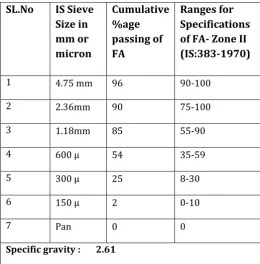
Naturally available river sand as per IS 383-1970 of Zone- II is utilized. Specific gravity of FA is determined as per the method confirming to IS 2386 and results gained comply with the code specifications. The sieve analysis and specific gravity of fine aggregates are listed under Table.SL.No
IS Sieve
Size in
mm or
micron
Cumulative
%age
passing of
FA
Ranges for
Specifications
of FA- Zone II
(IS:383-1970)
1 4.75 mm 96 90-100
2 2.36mm 90 75-100
3 1.18mm 85 55-90
4 600 µ 54 35-59
5 300 µ 25 8-30
6 150 µ 2 0-10
7 Pan 0 0
[image:2.595.308.569.109.374.2]Specific gravity : 2.61
Table 2 sieve analysis and specific gravity of FA
Coarse Aggregate (CA)
-
Locally available angular crushed aggregates as per IS 383-1970 is used in this experimental work of study. Specific gravity of coarse aggregate is determined using the method confirming to Indian Standard 2386 and results are tabulated in table.Shape of aggregate Angular crushed
Specific gravity of aggregate 2.70
Size of aggregates Passing through 20 mm down size
Table 3 properties of CA
© 2016, IRJET | Impact Factor value: 4.45 | ISO 9001:2008 Certified Journal
| Page 2105
SL.No.
Parameter
Values
1 Size 1.00 mm (dia)
2 Length 35 mm
3 Aspect ratio 35
4 Tensile strength 1167 Mpa
[image:3.595.39.287.101.242.2]5 Density 7850 kg/m3
Table 4 physical properties of steel fiber
Super Absorbent Polymer (SAP)-
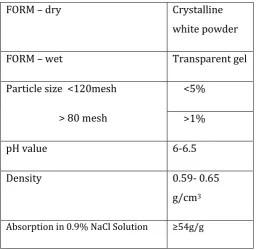
Usually SAPs are added at rate of 0% to 0.6% by weight of cement. The SAPs materials are covalently cross-linked compounds. SAPs are non-toxic and non-corrosive materials which have capacity of absorption of water up to 250-300 times of its own weight. SAPs are negatively charged carboxylic group and positively charged acrylate compound which attracts water and they, exhibit behaviour of shrinking and swelling when subjected to drying and water respectively. The specific different properties of SAP are tabulated under table.FORM – dry
Crystalline
white powder
FORM – wet
Transparent gel
Particle size <120mesh
> 80 mesh
<5%
>1%
pH value
6-6.5
Density
0.59- 0.65
g/cm
3 [image:3.595.306.560.203.340.2]Absorption in 0.9% NaCl Solution ≥54g/g
Table 5 properties of super absorbent polymer
Water-
The purpose of use of water is for both mixing and curing and it shall be clean and free from the any of the detrimental materials such as acidic compounds, alkaline, salt substances, sugar compounds, organic materials or other substances that may be harmful to concrete structure.Potable water which is used for drinking purpose is in general suitable in mixing and for curing of concrete.
Super plasticizer
- Conplast SP430 is a kind of Sulphonated Napthalene Polymers and it is available in the market in the form of liquid bearing brownish color & which is instantly forms dispersion in water. The properties of super plasticizer SP430 are tabulated in table.Specific gravity
1.220 -to- 1.225 at 300
0Celsius
Contents of Chloride Nill to IS: 456-2000
Air Entrainment
addition of 1% of air is
entrained
Table 6 properties of super plasticizer
3
.
MIX DESIGN FOR M30 GRADE OF CONCRETE
-Mix Design is a one of the process by means of which suitable ingredients in the concrete are selected and in order to determine their relative quantity with object of producing concrete possessing minimum desirable properties like workability in fresh state minimum desirable strength and durability in hardened state. Mix proportion obtained by after mix design is tabulated below.Water (in kg)
Cement (in kg)
FA (in kg)
CA (in kg)
Super plasticizer
(in kg) 157.72 394.3 671.81 1235.52 3.15
[image:3.595.34.291.416.666.2]0.40 (1) (1.70) (3.13) (0.8% of cement) Table 7 Mix proportion
4. RESULTS AND DISCUSSIONS
4.1
Workability test results
Slump test results
[image:3.595.304.563.474.594.2]© 2016, IRJET | Impact Factor value: 4.45 | ISO 9001:2008 Certified Journal
| Page 2106
Table 8 slump test results for addition of SAPCompaction factor test results
Table 9 mentioned below, represents the test results of compaction factor for addition of different percentages of super absorbent polymer ranges from 0.1% to 0.4% by weight of cement
.
% Addition of super
absorbent polymer
Compaction
factor
water curing 0.78
self curing (0.1% SAP) 0.82
self curing (0.2% SAP) 0.85
self curing (0.3% SAP) 0.89
[image:4.595.311.557.209.363.2]self curing (0.4% SAP) 0.86
Table 9 slump test results for addition of SAP
Vee-Bee Consistometer test results
Table 10 mentioned below, represents the test results for Vee-Bee consistometer for addition of different percentages of super absorbent polymer ranges from 0.1% to 0.4% by weight of cement.
% Addition of super
absorbent polymer
Vee-Bee time
(sec)
water curing 38
self curing (0.1% SAP) 36 self curing (0.2% SAP) 33
self curing (0.3% SAP)
30self curing (0.4% SAP)
32Table 10 Vee-Bee test results for addition of SAP
Flow table test results
Table 11 mentioned below, represents the test results of Flow table for addition of various percentages of super absorbent polymer ranges from 0.1% to 0.4% by weight of cement.
% Addition of super
absorbent polymer
Flow test (%)
water curing 24
self curing (0.1% SAP) 31.6
self curing (0.2% SAP) 38
self curing (0.3% SAP) 47
self curing (0.4% SAP) 41
[image:4.595.42.278.381.528.2]Table 11 slump test results for addition of SAP
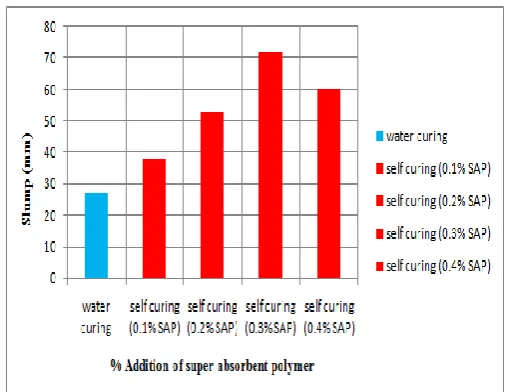
Fig 1 Variation of slump values
% Addition of super
absorbent polymer
Slump
(mm)
water curing 27
self curing (0.1% SAP) 38
self curing (0.2% SAP) 53
self curing (0.3% SAP) 72
[image:4.595.306.559.399.595.2]© 2016, IRJET | Impact Factor value: 4.45 | ISO 9001:2008 Certified Journal
| Page 2107
Fig 2 Variation of compaction factor valuesFig 3 Variation of Vee-Bee test values
Fig 4 Variation of flow test values
4.2 Strength test results
Compressive strength test results
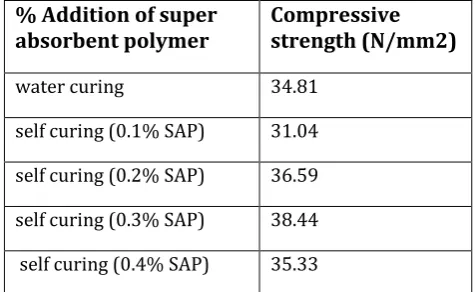
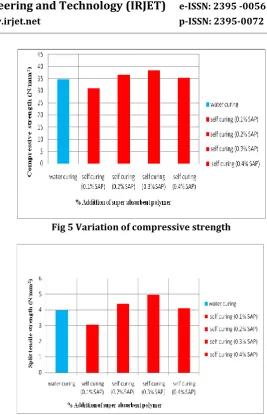
Table 12 mentioned below, represents the compressive strength values for addition of different percentage of super absorbent polymer from 0.1% to 0.4 % by weight of cement.
% Addition of super
absorbent polymer
Compressive
strength (N/mm2)
water curing 34.81
self curing (0.1% SAP) 31.04
self curing (0.2% SAP) 36.59
self curing (0.3% SAP) 38.44
[image:5.595.306.544.111.257.2]self curing (0.4% SAP) 35.33
Table 12 compressive test results for addition of SAP
Split tensile strength test results
Table 13 mentioned below, represents the values of split tensile for addition of different percentage of super absorbent polymer from 0.1%age to 0.4%age by mass of cement.
% Addition of super
absorbent polymer
Split tensile
strength(N/mm
2)
water curing 3.98
self curing (0.1% SAP) 3.04
self curing (0.2% SAP) 4.39
self curing (0.3% SAP) 4.97
self curing (0.4% SAP) 4.1
Table 13 split tensile test results for addition of SAP
Flexural strength test results
Table 14 mentioned below, represents the values of flexural strength for addition of various percentage of super absorbent polymer from 0.1%age to 0.4%age by mass of cement.
% Addition of super
absorbent polymer flexural strength(N/mm2)
water curing 5.33
self curing (0.1% SAP) 4.6
self curing (0.2% SAP) 5.8
self curing (0.3% SAP) 6.47
self curing (0.4% SAP) 5.27
© 2016, IRJET | Impact Factor value: 4.45 | ISO 9001:2008 Certified Journal
| Page 2108
Shear strength test results
Table 15 mentioned below, represents the values of shear strength for addition of various percentages of super absorbent polymers from 0.1%age to 0.4%age by mass of cement.
% Addition of super
absorbent polymer
Shear
strength(N/mm
2)
water curing 8.43
self curing (0.1% SAP) 7.13
self curing (0.2% SAP) 9.44
self curing (0.3% SAP) 10.28
self curing (0.4% SAP) 8.24
Table 15 shear strength test results for addition of SAP
Impact strength test results
Table 16 mentioned below, represents the values of impact strength for initial crack and final failure for addition of different percentages of super absorbent polymer from 0.1% to 0.4 % by weight of cement.
% Addition of super
absorbent polymer
strength
Impact
for initial
crack(N-m)
Impact
strength
for final
failure(N-m)
water curing 899.07 961.31
self curing (0.1% SAP) 615.52 670.85
self curing (0.2% SAP) 968.23 1023.56
self curing (0.3% SAP) 1203.37 1237.95
[image:6.595.39.281.172.323.2]self curing (0.4% SAP) 975.15 1030.47 Table 16 impact strength test results for addition of SAP
Fig 5 Variation of compressive strength
[image:6.595.36.287.441.615.2]Fig 6 Variation of split tensile strength
[image:6.595.309.561.497.667.2]© 2016, IRJET | Impact Factor value: 4.45 | ISO 9001:2008 Certified Journal
| Page 2109
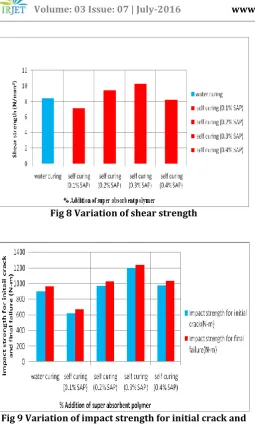
Fig 8 Variation of shear strengthFig 9 Variation of impact strength for initial crack and final failure
5. OBSERVATIONS AND DISCUSSIONS
An experimental work study was performed on steel fiber. Reinforced concrete using super absorbent polymer as an internal curing agent and accordingly following points of observation were made
1. It is observed that the workability tests conducted using slump cone, compaction factor, and flow table, the test result values increase as the percentage addition of super absorbent polymer increases from 0.1% to 0.3% by weight of cement in the Steel Fiber Reinforced Concrete And for addition of Super Absorbent Polymer beyond 0.3% by weight of cement workability test values decrease. Thus the highest workability is obtained at an optimum dosage 0.3% of Super Absorbent Polymer. This is due to the reason that adding up of 0.3% by mass of cement of Super Absorbent Polymer may result in uniform distribution of all the particles in concrete mix and addition of higher percentage of Super
Absorbent Polymer i.e more than optimum dosage may result into non-uniform distribution hence, segregation in the concrete.
2. Vice-versa in vee-bee consistometer test time goes on decreasing as the percentage addition of super absorbent polymer increases from 0.1% to 0.3% by weight of cement in the Steel Fiber Reinforced Concrete Further addition of Super Absorbent Polymer beyond 0.3% by mass of cement (more than optimum value of SAP) leads to increase in time due to fact of uneven distribution of SAP particles in concrete.
3. As per experimental study, it is found that the compressive strength value for 0.1% addition of Super Absorbent Polymer in Steel Fiber Reinforced Concrete is lesser compare to water cured Steel Fiber Reinforced Concrete. This is due to fact that the dosage of 0.1% of Super Absorbent Polymer is less effective in self curing of Steel Fiber Reinforced Concrete thus it shifts attention to increase the percentage addition of Super Absorbent Polymer in the steel fiber reinforced concrete.
4. It is further observed that at 0.2% & 0.3% addition of Super Absorbent Polymer by weight of cement shows increase in the compressive strength of Steel Fiber Reinforced Concrete & at 0.4% addition of Super Absorbent Polymer by weight of cement shows gradually decrease in compressive strength of Steel Fiber Reinforced Concrete Thus, the value of compressive strength is higher at an optimum dosage of 0.3% of Super Absorbent Polymer by weight of cement. This is due to fact that, the additional internal water may be available throughout the matrix in self curing of steel fiber reinforced concrete at dosage of 0.2% and 0.3% of Super Absorbent Polymer which will result in increase in rate of hydration of cement.
5. It is noted that, the compressive strength at 0.1% addition of Super Absorbent Polymer in steel fiber reinforced concrete is decreased by 10.83% after 28 days in comparison with water cured steel fiber reinforced concrete. And also noted that, the compressive strength for 0.2%, 0.3% and 0.4% addition of Super Absorbent Polymer in steel fiber reinforced concrete is increased by 5.11%, 10.43% and 1.49% respectively after a period of 28 days compare to water cured steel fiber reinforced concrete.
6. It is observed that the split tensile strength value for 0.1% addition of Super Absorbent Polymer in Steel Fiber Reinforced Concrete is lesser compare to water cured Steel Fiber Reinforced Concrete. This is due to fact that the dosage of 0.1% of Super Absorbent Polymer is less effective in self curing of Steel Fiber Reinforced Concrete.
© 2016, IRJET | Impact Factor value: 4.45 | ISO 9001:2008 Certified Journal
| Page 2110
shows increase in the split tensile strength of SteelFiber Reinforced Concrete & at 0.4% addition of Super Absorbent Polymer by weight of cement shows gradually decrease in split tensile strength of steel fiber reinforced concrete. Thus, the value of split tensile strength is higher at an optimum dosage of 0.3% of Super Absorbent Polymer by weight of cement. This is due to fact that, the additional internal water may be available throughout the matrix in self curing of steel fiber reinforced concrete at dosage of 0.2% and 0.3% of Super Absorbent Polymer which will result in increase in rate of hydration of cement.
8. It is noted that, the split tensile strength at 0.1% addition of Super Absorbent Polymer in steel fiber reinforced concrete is decreased by 23.62% after 28 days in comparison with water cured steel fiber reinforced concrete. And also noted that, the split tensile strength for 0.2%, 0.3% and 0.4% addition of Super Absorbent Polymer in steel fiber reinforced concrete is increased by 10.30%, 24.87% and 3.02% respectively after a period of 28 days compare to water cured steel fiber reinforced concrete. 9. It is practically noted that the flexural strength value
for 0.1% addition of Super Absorbent Polymer in Steel. Fiber .Reinforced .Concrete is lesser compare to water cured Steel. Fiber Reinforced Concrete this is due to fact that the dosage of 0.1% of Super Absorbent Polymer is less effective in self curing of Steel Fiber Reinforced Concrete.
10. It is further observed that at 0.2% & 0.3% addition of Super Absorbent Polymer by weight of cement shows raise in the flexural strength of Steel Fiber Reinforced Concrete & at 0.4% addition of Super Absorbent Polymer by weight of cement shows gradually decrease in flexural strength of Steel. Fiber Reinforced Concrete. Thus, the value of flexural strength is higher at an optimum dosage of 0.3% of Super Absorbent Polymer by weight of cement. This is due to fact that, the additional internal water may be available throughout the matrix in self curing of steel fiber reinforced concrete at dosage of 0.2% and 0.3% of Super Absorbent Polymer which will result in increase in rate of hydration of cement.
11. It is noted that, the flexural strength at 0.1% addition of Super Absorbent Polymer in steel fiber reinforced concrete is decreased by 13.70% after 28 days in comparison with water cured steel fiber reinforced concrete. And also noted that, the flexural strength for 0.2%, 0.3% and 0.4% addition of Super Absorbent Polymer in steel fiber reinforced concrete is increased by 8.82%, 21.39% and 3.75% respectively after a period of 28 days compare to water cured steel fiber reinforced concrete. 12. It is observed that the shear strength value for 0.1%
addition of Super Absorbent Polymer in steel fiber reinforced concrete is lesser compare to water cured
Steel Fiber Reinforced Concrete. This is due to fact that the dosage of 0.1% of Super Absorbent Polymer is less effective in self curing of Steel Fiber Reinforced Concrete.
13. It is further observed that at 0.2% & 0.3% addition of Super Absorbent Polymer by weight of cement shows increase in the shear strength of Steel Fiber Reinforced Concrete & at 0.4% addition of Super Absorbent Polymer by weight of cement shows gradually decrease in shear strength of Steel Fiber Reinforced Concrete. Thus, the value of shear strength is higher at an optimum dosage of 0.3% of Super Absorbent Polymer by weight of cement. This is due to fact that, the additional internal water may be available throughout the matrix in self curing of steel fiber reinforced concrete at dosage of 0.2% and 0.3% of Super Absorbent Polymer which will result in increase in rate of hydration of cement.
14. It is noted that, the shear strength at 0.1% and 0.4% addition of Super Absorbent Polymer in steel fiber reinforced concrete is decreased by 13.70% and 2.25% respectively after 28 days in comparison with water cured steel fiber reinforced concrete. And also noted that, the shear strength for 0.2% and 0.3% addition of Super Absorbent Polymer in steel fiber reinforced concrete is increased by 9.85%% and 23.01% respectively after a period of 28 days compare to water cured steel fiber reinforced concrete.
15. It is observed that the impact strengths of initial crack and final failure for 0.1% addition of Super Absorbent Polymer in Steel Fiber Reinforced Concrete is lesser compare to water cured Steel Fiber Reinforced Concrete. This is due to fact that the dosage of 0.1% of Super Absorbent Polymer is less effective in self curing of Steel. Fiber .Reinforced .Concrete.
16. It is further observed that initial crack and final failure at 0.2% & 0.3% addition of Super Absorbent Polymer by weight of cement shows increase in the impact strength of Steel Fiber Reinforced Concrete & at 0.4% addition of Super Absorbent Polymer by weight of cement shows gradually decrease in impact strength of Steel Fiber Reinforced Concrete. Thus, the value of impact strength is higher at an optimum dosage of 0.3% of Super Absorbent Polymer by weight of cement. This is due to fact that, the additional internal water may be available throughout the matrix in self curing of Steel Fiber Reinforced Concrete at dosage of 0.2% and 0.3% of Super Absorbent Polymer which will result in increase in rate of hydration of cement.
© 2016, IRJET | Impact Factor value: 4.45 | ISO 9001:2008 Certified Journal
| Page 2111
reinforced concrete. And also noted that, the impactstrength of initial crack for 0.2%, 0.3% and 0.4% addition of Super Absorbent Polymer in steel fiber reinforced concrete is increased by 7.69%, 33.85% and 8.46% respectively after a period of 28 days compare to water cured steel fiber reinforced concrete and final failure for 0.2%, 0.3% and 0.4% addition of Super Absorbent Polymer in steel fiber reinforced concrete is increased by 6.48%, 28.78% and 7.19% respectively after a period of 28 days compare to water cured steel fiber reinforced concrete.
6. CONCLUSIONS
An experimental work study was carried on “steel fiber reinforced concrete using Super Absorbent Polymer” and based on observations of investigations; the conclusions are drawn as under
1. The workability of Steel. Fiber .Reinforced .Concrete is higher at an optimum dosage of 0.3% of Super Absorbent Polymer.
2. The compressive strength of Steel. Fiber .Reinforced. Concrete has increased with increase in various percentage dosages of addition of Super Absorbent Polymer. The compressive strength of Steel. Fiber .Reinforced .Concrete is maximum at an optimum dosage of 0.3% of Super Absorbent Polymer by weight of cement.
3. The split tensile strength of Steel. Fiber .Reinforced Concrete has increased with increase in various percentage dosages of addition of Super Absorbent Polymer. The split tensile strength of Steel. Fiber. Reinforced .Concrete is maximum at an optimum dosage of 0.3% of Super Absorbent Polymer by weight of cement.
4. The flexural strength of Steel. Fiber .Reinforced .Concrete has increased with increase in various percentage dosages of addition of Super Absorbent Polymer. The flexural strength of Steel. Fiber
.Reinforced .Concrete is maximum at an optimum
dosage of 0.3% of Super Absorbent Polymer by weight of cement.
5. The shear strength of Steel. Fiber .Reinforced Concrete has increased with increase in various percentage dosages of addition of Super Absorbent Polymer. The shear strength of Steel. Fiber Reinforced .Concrete is maximum at an optimum dosage of 0.3% of Super Absorbent Polymer by weight of cement.
6. The impact strength of Steel. Fiber .Reinforced Concrete has increased with increase in various percentage dosages of addition of Super Absorbent Polymer. The impact strength of Steel. Fiber Reinforced .Concrete is maximum at an optimum
dosage of 0.3% of Super Absorbent Polymer by weight of cement.
7.
REFERENCES
[1]. Amal Francis k, Jino john “Experimental investigation on mechanical properties of self curing concrete” International Journal of Emerging Trends in Engineering and Development ISSN 2249-6149, Issue 3 volume 2 (March 2013).
[2].M Manoj Kumar, D Maruthachalam, “Experimental investigation on self curing concrete” International Journal of Advanced Scientific and Technical Research ISSN 2249-9954. Issue 3 volumes 2, March-April 2013. [3].O Mejlhede Jensen, “Use of super absorbent
polymer in concrete” Concrete international (2013).
[4].R. Aarthi1, R. Venkatakrishnaiah, “Strength Behaviour of Self-Curing Fly Ash Concrete using Steel Fiber” International Journal of Advanced Research in Civil, Structural, Environmental and Infrastructure Engineering and Developing, ISSN_NO: 2320-723X.Vivek Hareendran et al, (2014).
[5].Vivek Hareendran, V. Poornima and G. Velrajkumar “Experimental investigation on strength aspects of internal curing of concrete by using super absorbent polymer” International Journal of Advanced Structures and Geotechnical Engineering ISSN 2319-5347, No. 02, Vol. 03 April 2014.
[6].Abhishek Singh Deshmukh, Dr. Rajiv Chandak, “Compressive strength study of self-curing concrete and Conventional concrete” Global Journal of Engineering Science and Research [Deshmukh, 2(9): September 2015] ISSN 2348 – 8034 Impact Factor- 3.155.
[7].Abhishek Singh Deshmukh, Dr. Rajiv Chandak, “Split tensile strength study of self-curing concrete and Conventional concrete”IJSRD International Journal for Scientific Research & Development Vol. 3, Issue 07, 2015 ISSN (online): 2321-0613. [8].Anoop KT, Sunilla George, “Strength behaviour of nylon fiber concrete with self curing agent” International Journal of Computer & Mathematical Sciences IJCMS ISSN 2347 – 8527 Volume 4, Issue 5 May 2015.
© 2016, IRJET | Impact Factor value: 4.45 | ISO 9001:2008 Certified Journal
| Page 2112
[10]. El-Dieb A.S. "Self-curing concrete “Waterretention, hydration and moisture transport", Construction and Building Materials vol-21, 2007, PP.1282–1287.
[11]. Kenneth Sequeira, B.H.V Pai, “Effect of small percentage additions of super absorbent polymer on mechanical properties of concrete” International Journal of Scientific & Engineering Research, Volume 6, Issue 6, June-2015 683 ISSN 2229-5518.
[12]. Moayyad Al-Nasra, Mohammad Daoudb and Taher M. Abu-Lebdeh, “The use of SAP as water blocker in concrete structures” American Journal of Engineering & Applied Science (2015) [13]. Srinivasa Rao, P.Rama Mohan Rao and P.
Jagadeesh “Experimental evaluation of strength properties of steel fibre reinforced concrete”Asian Journal of Civil Engineering (BHRC) vol. 17, no. 4(2016) pages 487-494.
[14]. Ganamanikarnika N (2015), “An experimental investigation on self healing of high performance concrete” National Conference on Research Advances in Communication, Computation, Electrical Science and Structures (NCRACCESS-2015).
[15]. Shibin C ,Haroon, v. Sreevidya, R. Venkatasubramani “Strength studies on self curing High Performance Fibre Reinforced Concrete (HPFRC)” International Journal of Advanced Structures and Geotechnical Engineering ISSN 2319-5347, Vol. 04, No. 03, July 2015.
[16]. Surya M C, Arya Krishna, Bincy Paul“Internal curing of high performance concrete” International Journal of Engineering Research-Online Volume 3, Issue 5 (Sept-Oct 2015) ISSN 2321-7758.
[17]. Stella Evangeline, “Self Curing Concrete and Its Inherent properties”Int. Journal of Engineering Research and Applications www.ijera.com ISSN: 2248-9622, Vol. 4, Issue 8( Version 7), August 2014, pp.66-71.
[18]. Vivek, Bhavana B Dr. Prema Kumar W.P. Dr.Prathap Kumar M.T, “Experimental Investigation on Properties of Self-Compacting and Self-Curing Concrete with Silica Fume and Light Weight Aggregates” International Journal of Engineering Research & Technology (IJERT) ISSN: 2278-4 Vol. 4 Issue 06, June-2015.
[19]. Dejian Shen, Xudong Wang, Dabao Cheng, Jinyang Zhang, Guoqing Jiang “Effect of internal curing with super absorbent polymers on autogenousshrinkage of concrete at early age” Construction and Building Materials 106 (2016) 512–522 (November 2015).
[20]. Dejian Shen , Tao Wang, Ying Chen, Mingliang Wang, Guoqing Jiang “Effect of
internal curing with super absorbent polymers on the relative humidity of early-age concrete” Construction and Building Materials 99 (2015) 246–253 (July 2015).
BIOGRAPHIES