GE-International Journal of Management Research
Vol. 4, Issue 1, Jan 2016 IF- 4.316 ISSN: (2321-1709)© Associated Asia Research Foundation (AARF)
Website: www.aarf.asia Email : [email protected] , [email protected]SERVICE QUALITY (SQ): A REVIEW OF EXPERIENCES OF
E-SERVICE USERS
Dr.SM Mariyam Fatima
Associate Professor School of Commerce
Graphic Era Hill University, Dehradun
ABSTRACT
business has become very important in all the countries. Even in India the volume of e-business is growing continuously. In such a scenario it is the responsibility of the online providers of goods and services that they must take care of the service quality in online transactions (e-SQ). Whereas, e-commerce refers to online transactions only, e-business is a wider term encompassing e-commerce and e-SQ. Thus, e-SQ has become a very critical factor in e-business. In Indian context, e-commerce in itself is a big issue to be handled efficiently and effectively because of many problems related to connectivity etc..
It is, therefore, logical that the concept of e-SQ should be studied in the correct perspective. In this paper an attempt has been made to trace the concept of e-SQ through review of literature and test its status in Indian context by means of a survey carried out for the purpose. In this process, the other issues related to e-business have also been discussed. Finally the process of analysis leads to reconstruction of a model for e-business in general and e-SQ in particular. This model has been names as ‘Three-R model of e-SQ’. It has been conceptualized in view of the situation prevalent in India.
1. Introduction:
e-SQ is comparatively a new phenomenon in Indian business being carried out through internet. We are, perhaps, limited to e-Commerce only whereas globally this phenomenon of e-business has moved through various stages like business‘, Commerce‘ and ‗e-Service‘ (Zeithamal et.al.). This transition comprises of different stages which shall be defined later.
Since e-Commerce is getting more and more popular in India and not only the younger population but all the sections of population use e-Commerce for one transaction or the other. From railway tickets to sophisticated electronic gadgets we use the e-mode to carry out the transactions. Thus, it is not only the e-transaction or e-commerce which is relevant but it is rather more important to experience the feedback about the quality of e-Service. Normally the issue of service quality in India, is discussed with reference to physical transactions related to goods and services but with the expansion of e-Services it is very important to evaluate the service quality of electronic transaction (e-SQ) as well.
Therefore, in this paper an attempt has been made to evaluate the e-SQ with the help of real life experiences of some consumers spread across Uttrakhand (India).
2. Organization of the paper:
In the first part of this paper the conceptual understanding of e-SQ has been enumerated on the basis of references available in contemporary literature. Though, technically it is a part of review of the literature but in this process the main focus has been on elaboration of the concept of e-SQ along with its contemporary usage in India. In the second part, the experiences of 30 consumers identified on the basis of snowball sampling have been enumerated with reference to trends and issues involved. Finally, conclusive remarks have been given. Of course, the methodology employed to write this research paper is being given below.
3. Methodology:
The methodology employed for this paper is akin to exploratory research based on the secondary data as well as on the primary data. Whereas, the secondary information has been extensively used to understand, discuss and enumerate the various dimensions of e-SQ, and the primary data has been used to elicit the trends based on the experiences of the selected consumers.
3.1 Universe and the Sample:
All these consumers had transacted e-business in different categories of goods and services. These goods and services included:-
a. Purchase of electronic gadgets.
b. Purchase of Medicines.
c. Astrological consultations.
d. Medical services, and
e. Purchase of cosmetics.
Thus, it appears to be a good sample representing a diverse range of goods and services.
Profile of the Sample:
i. Total number is that of 30 consumers selected through snowball sampling.
ii. The division of sample between the two towns of Dehradun and Haldwani was 20:10 i.e.,20 was from Dehradun and 10 from Haldwani.
iii. Out of the total consumers about 70 per cent, i.e., 20 to be precise were males and about 30 per cent i.e., 10 were females.
iv. Most of the consumers in the sample were below the age of 35 years, i.e., 18, and 12 consumers were above the cut-off age of 35 years, but no consumer was above the age of 55years.
v. Methodology employed for the purpose was face-to-face interaction structured on the select parameters of service quality which were as follows:
a. Convenience of information or Readiness of websites and the relevant information for the transaction or Ease of Use(EOU);
i. Process involved in purchase and problems if any.
ii. Time taken in the payment process.
iii. Satisfaction with delivery time and mode of delivery
b. Reliability in terms of Quality of products or services.
Tool Used:
Information gathered from these structured informal interviews with the respondents was used to identify the trends of e-SQ with the help of percentage analysis, diagrammatic presentation and modeling of conclusions related to e-business in a micro universe in Indian context.
3.2. Operational definitions:
The major terms used in this paper are e-business, e-commerce and e-service quality (e-SQ). These terms have been discussed at length in the literature available on the subject but for the purpose of this paper the meaning of these and the other terms is as follows:
e-Business refers to the entire range of business activities being carried on through internet.
e-Commerce refers to the transaction, i,e., the sale/ purchase of some goods or services through internet.
e-SQ refers to the experience or satisfaction coupled with post -purchase response and repurchase in case of internet transactions.
Readiness of information or websites refers to web-convenience or the ‗ease of use‘ (EOU) or ‗usability‘. In other words and simple language it denotes user friendliness of websites in various dimensions thereof.
Reliability1 refers to good quality of goods and services so that the consumers could rely upon the same being provided by online providers as per the specifications claimed on the websites.
Responsiveness2 refers to post-purchase satisfaction derived by e-consumers as a result of reliable service.
Period of collection of information:
The information used for the paper was collected in the months of February and March 2015.
1 The term ‘reliability’ has been used by Zeithmal, Parasuraman and Malhotra (2000,2002 )in the process of
developing e-SERVQUAL.
2
3.3. Limitations:
The study is confined to the specific individual experiences based on the e-commerce transactions by a heterogeneous group of 30 consumers only. It may or may not refer to the experience of the majority of consumers.
The sample is small and it does not comprise the professional buyers, trade buyers or research students i.e., it refers to the opinion of online consumers only. On one hand the sample is small and on other it has been taken from two towns only. Thus, these may be considered to be the limitations of this study. Barring these fundamental limitation the study brings out interesting results on the experience of e-commerce transactions.
4. Review of literature/concept of e-SQ
The concepts of ‗e-SQ‘ and ‗Ease of Use‘ (EOU) have been used with regard to web delivery, website service quality or web convenience. It does not refer to the satisfaction derived by a consumer after buying the product online and after using it. In the initial literature related to the quality of service in the physical transactions, SERVQUAL developed by (Parasuraman A. Z., 1988) was used. It denotes the distance between customers, expectations and service quality using a multi-item model known as the SERVQUAL. It has five items in it, i.e., tangibility, reliability, responsiveness, assurance and empathy. Thus, initially the SERVQUAL was used for evaluating the service quality derived from e-commerce transactions as well. It has been used to measure web based service (Kuo, 2003) and for internet retail (Kaynama S A, 2000) and also for electronic banking (Zhu, 2002). Thus, most of the research focussed around SERVQUAL by rephrasing the contents of the original scale. Later, it was felt that e-transactions and physical transactions are different because in e-transactions one interacts with technology and in physical transactions the interaction is with service personnel (Parasuraman, 2000). In view of the complexity of e-business transactions, Ease of Use (EOU) was considered to be an important factor. Further, the customers who are not very familiar with technology find these transactions very difficult and as a result they shy away from using this online service. Over the period of time and after knowing about the difficulties faced by the online consumers, Ease of Use (EOU) became an important factor in the earlier researches (Davis, 1989; Davis R. P., 1989). (Lociacono, 2000) established a scale called WEBQUAL with 12 dimensions: informational fit to task, interaction, trust, response time, design, intuitiveness, visual appeal, innovativeness, flow (emotional appeal), integrated communication, business processes, and substitutability.‖3
But WEBQUAL technically does not include fulfillment as a dimension, therefore, it was found to be incapable of capturing the service quality. Later,
3
―Zeithaml, Parasuraman, and Malhotra (2000, 2002) developed e-SERVQUAL for measuring e-service quality through a three-stage process using exploratory focus groups and two phases of empirical data collection and analysis. This process produced seven dimensions—efficiency, reliability, fulfillment, privacy, responsiveness, compensation, and contact—that form a core service scale and a recovery service scale. Four dimensions— efficiency, reliability, fulfillment, and privacy—form the core e-SERVQUAL scale that is used to measure the customers ‗perceptions of service quality delivered by online retailers.‖4
The first formal definition of website service quality or e-SQ was provided by Zeithaml, Parasuraman and Malhotra (2000)5. e-SQ is thus, related to convenience and facilities etc. related to web service. Though, directly it does not refer to service quality with regard to the product but it provides sufficient inputs about various elements related to web service. Zeithaml et.al.(2000)refer to five attributes of e-SQ. These are;
i. Information availability and content,
ii. Ease of Use,
iii. Privacy/ Security,
iv. Graphic style, and
v. Fulfillment.
In this study ‗information‘ refers to the convenience provided by the websites in searching information related to product, to be able to compare the products, to make a selection and the time involved in placing an order. In a nutshell, information availability and content refer to quality of websites. The second parameter the ease of use or EOU denotes user friendly nature of the website with regard to technology. It is an important feature for many customers who are not very internet savvy. The third parameter has two components different from each other but closely linked as well i.e., privacy and security. So far as privacy is concerned, it refers to protection of personal information of buyers and not sharing it with others and if at all it is shared ‗voluntary informed consent‘ must be there. Security is related to the safety from the risk of fraud and misuse of credit cards as well as the related financial risk. Graphic style, the fourth component has been used to denote ―color, layout, print size and type, number of photographs, graphics and animations‖. The fifth component fulfillment is very close to the fulfillment of traditional service quality. It denotes customer satisfaction and intention to repurchase. It includes, ―on time and accurate delivery, accurate product representation and other fulfillment issues‖.
4
Ibid,p.366.
5
Thus, e-SQ, as understood in the western literature has five parameters, out of which the maximum relate to the quality and friendliness of website and one relates to the concerns of customers and the last one relates to the product. Accordingly, in the available literature, the basic concern is not the product, quality of product or the ease of carrying out transactions (including mobile friendliness, internet connectivity, support from payment gateways, and financial security etc.). In Indian context, e-SQ needs to be different and all of these parameters need to be reframed. In other words, if one discusses e-SQ in Indian context it must include the following;
1 Quality of product or service leading to satisfaction of consumers.
2 Readiness or Ease of Use (EOU) ;
2.1 User Friendly Websites,
2.2 Internet Connectivity,
2.3 Fast and secure financial transaction,
2.4 Mobile friendliness.
3 Responsiveness or Post-purchase customer service
In India, the greatest fear gripping the consumers relates to the quality of products or services, because many unsatisfied consumers keep telling others and the tall claims never match the actual realizations, so this acts as the first deterrent.
Similarly, websites are not easy to open and it is difficult to complete the transaction in one sitting even extending to 30 minutes odd. By the time one completes the entries in all the fields and proceeds to make payment, the internet connectivity breaks. If however, the same transaction is performed on a mobile phone, it becomes even more difficult. Here, exceptionally difficult or almost impossible e-booking of Tatkaal railway tickets is not being referred to. But, the reference is to the other common transactions.
There exist some websites which have gained reputation of providing the products without any difference in its quality, like e-Bay, amazon, flipkart etc., but many infomercials, internet and TV advertisements refer to such products and websites which have earned a bad name for e-service.
secure financial transactions, mobile friendliness and of course reliable post-purchase customer service’.
5. Observations, Analysis and Interpretation of the responses:
Observations
As explained earlier in all 30 respondents were identified for the purpose of this study. All of them had the first hand experience of online shopping either for goods or for services. Thus, under the circumstances this was the snowball sample identified for the purpose. The sample size was restricted in view of the constraints of time and resources. The responses which emerged exhibit the mixed feelings regarding the satisfaction after carrying out the online transaction. The items of shopping also varied (as enumerated earlier).
In order to assess the level of satisfaction of these consumers, informal interview method with a definite structure of questions was used. The observations are reported as below:-
Table1
Readiness /Ease of Use (EOU)
Parameters Total No. Of Respondents
(N=30)
No. of Unsatisfied Respondents
No. of Satisfied Respondents
Percentage of Unsatisfied Respondents
Percentage of Satisfied Respondents
Internet Connectivity
30 27 03 90 10
Mobile Friendliness
30 28 02 93.33 6.67
Speed of Financial Transactions
30 24 06 80 20
Web Sites Friendliness
30 26 04 86.66 13.33
Performance of Delivery Vehicles
5.1. Readiness or Ease of Use(EOU)
In this category, almost all the respondents gave a similar answer that ease of use or user friendliness was very poor. The following reasons were cited by them;
5.1.1. The first and the most important complaint related to the poor connectivity of the internet connection. Only 03 respondents who had done the online shopping from their office/ workplace where high- speed broadband connectivity existed did not have any such problems. But they also admitted that while working from any other place the connectivity is a problem.
5.1.2. All the respondents in the sample agreed that baring some exceptions it is difficult to complete an online transaction on a mobile phone, irrespective of the quality of the phone/ internet connection.
5.1.3. The next important difficulty faced by most of the respondents related to inordinate delay in obtaining the OTP from the bank. In between, many a times, the session expires and the respondents had to carry out the exercise afresh.
5.1.4. As reported that by the respondents most of them reported the websites were not user friendly. It was difficult to find the desired information and many a time the case sensitiveness was found to be so high that even a comma or a dash invalidated the command, rendering it into a frustrating exercise for those who were not the experts in handling these operations. Similarly, there were problems related to uploading of different pages inside the websites.
Table 2
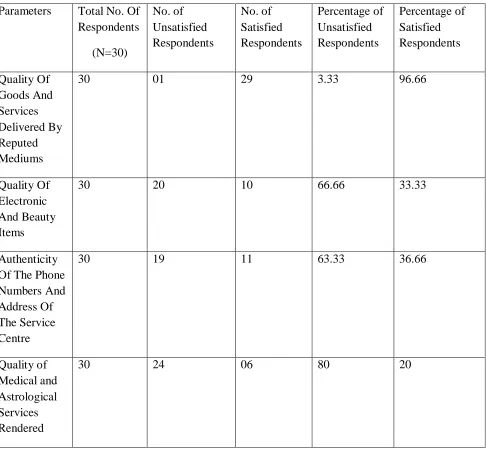
Reliability
(Actual Quality of Products Or Services Vs. Promised/ Claimed Quality)
Parameters Total No. Of Respondents (N=30) No. of Unsatisfied Respondents No. of Satisfied Respondents Percentage of Unsatisfied Respondents Percentage of Satisfied Respondents Quality Of Goods And Services Delivered By Reputed Mediums
30 01 29 3.33 96.66
Quality Of Electronic And Beauty Items
30 20 10 66.66 33.33
Authenticity Of The Phone Numbers And Address Of The Service Centre
30 19 11 63.33 36.66
Quality of Medical and Astrological Services Rendered
30 24 06 80 20
5.2.1. The electronic items and the range of beauty care products were of a very inferior quality.
5.2.2. The address of the service centers and the telephone numbers were incorrect.
5.2.3. In case of services, the level of consumer satisfaction was far below the expectations. In the case of medical services the support service was found to be a major hurdle which is a must in this type of transaction because there exist many questions and doubts in the minds of patients and these are never answered in one -way e-counseling leaving them dissatisfied. Moreover, as one size may not fit all, one generic set of medical prescription cannot help each and every patient.
Table 3
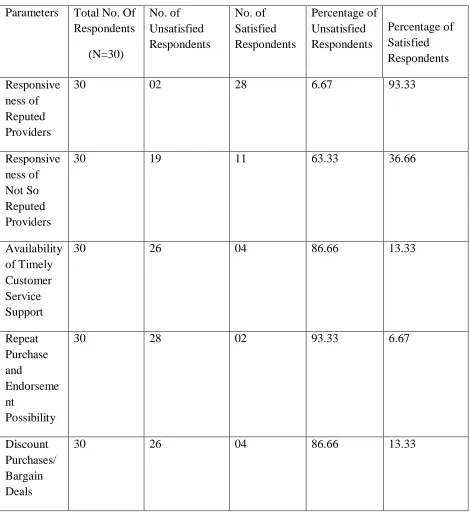
Responsiveness
(Post-Purchase Customer Service)
Parameters Total No. Of Respondents
(N=30)
No. of Unsatisfied Respondents
No. of Satisfied Respondents
Percentage of Unsatisfied Respondents
Percentage of Satisfied Respondents
Responsive ness of Reputed Providers
30 02 28 6.67 93.33
Responsive ness of Not So Reputed Providers
30 19 11 63.33 36.66
Availability of Timely Customer Service Support
30 26 04 86.66 13.33
Repeat Purchase and
Endorseme nt
Possibility
30 28 02 93.33 6.67
Discount Purchases/ Bargain Deals
5.3. Responsiveness of the providers and post-purchase response or customer service refers to satisfaction or fulfillment derived by the consumer-respondents. It converted them either into goodwill carrier agents of e-service or otherwise depending upon their level of satisfaction.
5.3.1. In case of online purchases made from the reputed provider channels like eBay, flipkart, amazon, etc., were found to contain minor weaknesses only restricting to fulfillment or satisfaction. In this category the problems were not so significant but they existed, e.g., not getting the hands free/ ear- piece with the mobile phone or the facility of service centers not being in the town of residence of the respondent. Similarly, against the claim of a book, a booklet containing seminar proceedings and full papers was sent to the respondent.
5.3.2. In case of purchases made from the not so popular websites, it was found that the telephone numbers and addresses as given in the information booklet were found to be incorrect. It resulted in a frustrating experience for the buyers.
5.3.3. In case of services purchased online, the clash of timing for the respondents as well for the provider created a situation wherein post purchase help could not be taken, e.g., representative of e-service provider wanted the respondents to speak to them during the hours of work in their busy schedules. On the other, when the respondents were comparatively free, the representatives of the providers were not available.
5.3.4. Tendency to re-use, re-order or to suggest the products to their friends or relatives was non-existent.
5.3.5. The respondents barring those who ordered the items from reputed providers had fewer grievances and they not only repurchased but they were inclined to spread a good word about such experiences. However, the prime satisfying agent for such buyers was not the satisfaction of having made an excellent deal rather it was limited to the feeling of paying less in case of online transactions.
5.3.6. The e-buyers of the younger age group in this small sample were found to be comparatively most satisfied and ready to re-order the products or services online.
Analysis and Interpretation
‘Readiness To Use’ or ‘Ease Of Use’
If one observes carefully one does find that ‗ease of use‘ or ‗readiness to use‘ did not exist in many respects. It may be due to inefficiency of the Information Service Provider (ISP)6 who is the link between the company and the end- users, i.e., the consumers. As a result, inefficiency on part of the ISP lead to difficulty of use to the users. The problems related to websites or the issue of web -convenience is largely a product of the designing of the websites.
It has been found in most of the cases that the websites are not mobile friendly. So a large number of transactions are postponed to those moments when a laptop or a desktop is available and it is connected to the broadband landline (fixed) connection.
Similarly, for the Indian consumers of e-service, internet- connectivity is a big problem because mobile connectivity and connectivity through a dongle is very poor and one cannot rely on these in the moments of purchase process or during a banking transaction.
Payment gateways and/ or banks also acts in a very conservative manner so as to check the misuse or fraud related to transfer of funds and it results in inconvenience and frustration for the e-consumers. This problem is so grave that rarely does a user perform banking transactions on a mobile phone or from a cyber- café. The transactions related to internet banking are considered safe and secure only from highly secured official connections. Users are advised to clear the history and to type the address afresh in the address bar. All these act as deterrents for e-business.
Thus, even a cursory analysis of the responses leads one to conclude that ease of use or the circumstances leading to ‗readiness to use‘ in e-mode for carrying out transactions are not conducive. Thus, it can be inferred that ‗ease of use‘ or ‗readiness to use‘ must be taken care of, if e-business has be promoted. Further, the non- existence of this comfort results in poor level of satisfaction for the users or in other words it adversely impact the e-SQ.
Reliability (Quality of the Product)
Quality of the product or service is one of the most important considerations for repeat purchases and expansion of e-business. In Indian context, quality of product or service is a matter of great concern contrary to the other countries where e-business is more common. Thus, they concentrate and debate the issue of web convenience, whereas we are constrained to focus on reliability in terms of the quality of goods and services. It is absolutely impossible, even to think of e-SQ in the absence of reliability with regard to the quality of products and services.
Responsiveness (Post -Purchase Services)
Post- purchase services or after- sales services are considered to be the vital components of marketing even in the case of offline transactions. It needs to be reiterated that in Indian context the emergence of service centers and toll- free numbers has caused a lot of inconvenience to the common consumers and their degree of satisfaction has been adversely affected. One finds even greater extensions of these trends in case of online transactions. In the interview based survey designed and carried out for the purpose confirms the same trends. Most of the consumers in the sample had problems in getting the post- purchase support. As reported in observations some of the consumers were surprised to find that all the numbers, including the toll -free number, as well as the address of the local service center were incorrect and actually these did not exist. Proper post- purchase response or responsiveness adds to the element of reliability and its absence leads to loss of trust.
Suggestions-The ‘Three-R Model’ of e-SQ
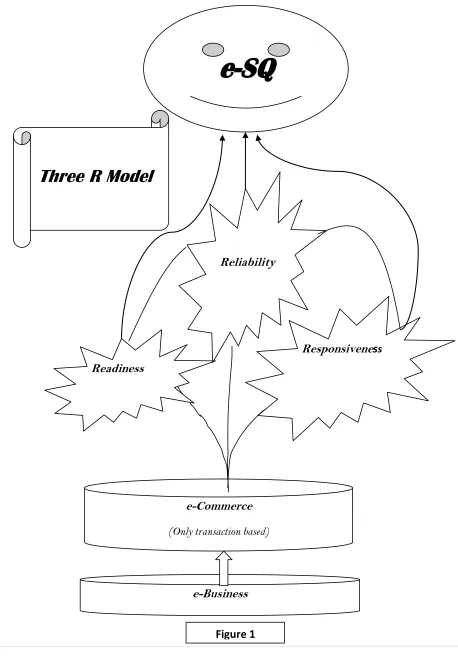
Taking the cues from the literature available and the earlier researches, two terms, i.e., ‗reliability‘ and ‗responsiveness‘ have been taken but the analysis is based on the results obtained from this survey. The analysis carried out is strictly restricted to the prevailing Indian context. Thus, by grouping and regrouping different factors the researcher has been able to arrive at the ‘Three-R Model’ to ensure e-SQ.
e-Business
(Comprising entire gamut of e-business) e-Commerce
(Only transaction based)
Responsiveness
Reliability
Readiness
e-SQ
[image:16.612.77.535.31.700.2]Three R Model
As shown in the diagram, SQ is the outcome and the very basis of commerce and e-business. In the absence of good quality electronic service the entire exercise is rendered futile. In India, we commonly find the incidents of duping the consumers in the name of online shopping. All this never leads to e-SQ, and e-commerce as well as e-business get into disrepute.
The international online companies like eBay, amazon, flipkart etc.,have a high reputation for rendering quality and ensuring e-SQ. But, on the other, in India many grade -2 and grade-3 providers exist who are acting as the negative elements for the e-business. It adversely affects the confidence of online buyers. There are some other factors like poor connectivity, difficulty in making payments through debit and credit cards and at times even with the electronic banking coupled with the careless and dictating attitude of courier companies act as deterrents for e-business. Thus, e-SQ remains an elusive concept, but ultimate purpose of e-business is ‗service- quality‘ and we must take initiatives to ensure it.
The following concrete suggestions are being offered to ensure the healthy growth of e-business and the resultant e-SQ. These are as follows;
1. Web Sites must be made exceptionally user friendly.
2. Internet connectivity needs to be upgraded (fixed line/ mobile/ data card).
3. The process of payment must be made quicker and secure through all the mediums (debit card/ credit cards/ Internet banking/mobile banking).
4. Strict legal provisions must be ensured to punish the foul players in the name of online trading through advertisements, infomercials, or through teleshopping.
5. The quality of product is the core element of e-service and it is the sincere duty of online providers to ensure it under all the circumstances.
6. Attitude of delivery vehicles needs to be corrected and they should be made a responsible link of e-business.
7. Post –purchase service is an essential component and it must be made empathetic.
The above suggestions are a few broad based corrective measures which must be ensured by the online companies and the government.
6. Conclusion:
lapses occurring either unknowingly or knowingly adversely impact the e-SQ. It negatively influences e-business. It appears to be a newer concept in Indian context but without ensuring e-SQ the real and lasting success of e-business cannot be achieved.
Acknowledgement:
The researcher most sincerely acknowledges the knowledge base on e-SQ available in existing literature. All the researchers, whose researches, ideas and comments which have been quoted or referred to are gratefully acknowledged. Further, co-operation from the respondents and advice of the peers is also gratefully acknowledged.
References
Ahmad, S. (2002). Service Failures and Customer Defection: A Closer Look at Online Shopping Experiences. Managing Service Quality, 12 (No 1), 19-29.
Bai, B. R. (2008). The Impact of Website Quality on Customer Satisfaction and Purchase Intentions:Evidence from Chinese Online Visitor. International Journal of Hospitality Management, 27, 391-402.
Caruana, A. a. (2010). How Corporate Reputation, Quality, and Value Influence Online Loyalty.
Journal of Business Research, 63, 1103-111-.
Davis, F. D. (1989, September). Perceived Usefulness, Perceived Ease of Use, and User Acceptance of Information Technology. MIS Quarterly , 319-340.
Davis, R. P. (1989). User Acceptance of Computer Technology: A Comparison of Two Theoretical Models. Management Science, 35 (8), 982-1003.
Gounaris, S. a. (2003). Assessing Service Quality on the Web: Evidence From Business-to-Consumer Portals. Journal of Services Marketing, 17 (No 5), 529-548.
Graham D. April, S. P. (2008). Evaluating Service Quality Dimensions within e-Commerce SMEs.
Electronic Journal Information Systems Evaluation, 11 ( 3), 109-124.
Gwo-Guang Lee, H.-F. L. (2005). Customer perceptions of e-service quality in online shopping.
International Journal of Retail & Distribution Management, 33 (No. 2), 161-176.
Jun, M. Z. (2004). Customers´ Perceptions of Online Retailing Service Quality and their Satisfaction.
International Journal of Quality & Reliability Management, 21 (No 8), 817-840.
Kaynama S A, B. C. (2000). A proposal to assess the service quality of online travel agencies: an exploratory study. Journal of Professional Services Marketing, 21 (No 1), 63-88.
Kim, J. B. (2009). The Role of Etail Quality, E-Satisfaction and E-Trust in Online Loyalty. Journal of
Kuo, Y. (2003). A study on service quality of virtual community web sites. Total Quality
Management, 14 (No 4), 461-73.
Lociacono, E. R. (2000). WebQual: A Web Site Quality Instument. Worcester Polytechnic Institute.
M. Soledad Janita, F. J. (2013). Exploring Service Quality Dimensions in B2B e-Marketplaces.
Journal of Electronic Commerce Research, 14 (NO 4), 363-386.
Madu, C. a. (2003). E-Quality in an Integrated Enterprise. The TQM Magazine, 15 (No 3), pp. 127-136.
Mark Springer, C. K. (2010). Measuring the Quality of E-Business Services.
Palmer, J. (2002). Web Site Usability, Design, and Performance Metric. Information Systems
Research, 13, 151-167.
Parasuraman, A. a. (2000). The impact of technology on the quality-value-loyalty chain: a research agenda. Journal of the Academy of Marketing Science, 28 (No 1), 168-74.
Parasuraman, A. Z. (1988). SERVQUAL: A multiple-item scale for measuring consumer perceptions of service quality. Journal of Retailing, 64 (1), 12-40.
Samar I. Swaid, R. T. (2009). Measuring the Quality of E-Service: Scale Development And Initial Validation. Journal of Electronic Commerce Research, 10 (No1), 13-28.
Segars, A. H. (1993, December). Re-Examining Perceived Ease of Use and Usefulness: A Confirmatory Factor Analysis. MIS Quarterly , 517-525.
Szymanski, D. M. (2000). e-Satisfaction: An Initial Examination. Journal of Retailing, 76 (3), 309-322.
Valarie A. Zeithaml, A. P. (2002). Service Quality Delivery Through Web Sites:A Critical Review of Extant Knowledge. Journal of the Academy of Marketing Science, Volume 30 (No. 4), 362-375.
Zhu, F. W. (2002). IT-based services and service quality in consumer banking. International Journal