Citation:
Zulu, SL and Muleya, F (2017) Exploring student perceptions on sustainability considerations in construction procurement decisions in Zambia. In: Joint CIB W099 and TG59 International Safety, Health, and People in Construction Conference. Department of Built Environment Central University of Technology, Free State. ISBN 978-1-920508-78-4
Link to Leeds Beckett Repository record:
http://eprints.leedsbeckett.ac.uk/5721/
Document Version: Book Section
The aim of the Leeds Beckett Repository is to provide open access to our research, as required by funder policies and permitted by publishers and copyright law.
The Leeds Beckett repository holds a wide range of publications, each of which has been checked for copyright and the relevant embargo period has been applied by the Research Services team.
We operate on a standard take-down policy. If you are the author or publisher of an output and you would like it removed from the repository, please contact us and we will investigate on a case-by-case basis.
1
EXPLORING STUDENT PERCEPTIONS ON
SUSTAINABILITY CONSIDERATIONS IN
PROCUREMENT DECISIONS IN ZAMBIA
S Zulu1 and F Muleya2
1School of the Built Environment & Engineering, Leeds Beckett University, Leeds, LS2 8AG, UK
2 School of the Built Environment, Copperbelt University, Kitwe Zambia
ABSTRACT
This paper investigated the perceptions of students on sustainability considerations in procurement decisions in Zambia. The Zambian construction industry is currently thriving with significant infrastructure projects as one of the major source of construction activities. It is important, however, that as the construction industry take strides to increase output, the need for a sustainable approach should be considered. The aim of the paper was therefore to explore the perceptions on sustainability matters associated with procurement decisions in the construction industry. The paper was seeking to investigate the potential influence of sustainability in procurement decision making as procurement is seen as key to construction performance improvement. It is considered that one of the measures that can help influence the sustainability agenda is education and training.As such the study was based on a survey of 121 students from all the five programmes offered in the university offering various courses in the built environment and engineering schools. Results indicate that; in all cases students on the different courses, with exception of students on the planning course, viewed the sustainability as an economic problem. Further students on different programmes perceived the factors under discussion differently which is a critical factor that requires urgent attention. Results further indicated that there is need to incorporate sustainability related matters during the training of students because they are the future leaders of the construction industry. The study recommends that sustainability must be taught to university students as part of the curriculum in order to produce graduates that that will have the correct perception and importance of sustainability
Keywords: Procurement, sustainability, decision making, developing countries, contracting
INTRODUCTION
Sustainable construction is seen as a key part of the global sustainability agenda. This is more so that the construction industry is seen as a major contributor to greenhouse gas emissions. This study focuses on the role procurement plays in driving the sustainability agenda in the construction industry with a particular focus on the Zambian construction industry. The Zambian construction industry has, over the last 10 years,
2
seen a steady increase in construction activity in various sectors including infrastructure, housing and retail. It is therefore important that the sustainability agenda is promoted in the Zambian construction industry. Procurement is seen as a key driver for performance improvement. It is therefore fitting to evaluate the perception of sustainability issues within this context.
The role of education and training, in particular universities in driving the sustainability agenda is acknowledged and has been a subject of research by many. As such the study is based on a survey of university students undertaking various built environment courses. Its primary focus was to explore students perceptions on the extent to which various sustainability concerns would influence procurement decisions. While there have been many studies on students perceptions towards sustainability issues, this study contributes to the wider body of knowledge as it places students sustainability perceptions in a specific procurement context. The implications of the findings on built environment education are considered.
LITERATURE REVIEW
This study as indicated above focuses on students’ perceptions. It is considered that these are the decision makers of tomorrow and therefore it is important that they graduate with the right knowledge for tomorrow. The role of institutions of higher learning in driving the sustainability agenda has been a subject of many studies. Some have, for example argued that universities train leaders of tomorrow and therefore have an influence on future decision makers. As such universities can have a significant part to play in creating a sustainable environment (Cortese 2003); Kalpana et al 2013). It can be argued that one of the catalyst for the need to take seriously sustainable development was the World Commission on Environment and development’s (or Brudtland’s) report which defined sustainable development as ‘development that meets the needs of the current generation without compromising the ability of future generations to meet their own needs’ (WCED 1987). It is generally accepted that this definition is broad and encompasses three strands, namely environmental, social and economic sustainability (Zwinkle et al, 2014; Zeegers and Clark, 2014). The role of universities therefore in influencing thought on sustainability is key and institutions of higher learning should take appropriate steps in doing so. The need for incorporating sustainability in university courses, including built environment courses, has been a subject of many studies (Andamon and Iyer-Raniga, 2013; Ramirez, 2006).
3
consciousness after taking the course in comparison to pre-course enrolment. Clark and Zeegers (2015) also found that, while the pre-course perception was largely an environ-centric view of sustainability, there was evidence that there was a shift towards a more holistic perception of sustainability including social and economic sustainability. However, they found that the environ-centric view was still the predominant view.
Others have used universities’ sustainability initiatives as case studies to examine the students perception towards sustainability (Sammalisto and Lindhqvist, 2008; Bantanur et al, 2015; Kalpana et al, 2013; Abd-Razak et al, 2012; Emanuel and Adams, 2011). The perception of students towards their knowledge of sustainability issues has also seen a significant number of studies. Nicolaou and Conlon (2012) examined the level of knowledge and understanding of final year engineering students in three Irish higher education institutions, while Tan et al (2016) focused on perception of quantity surveying students. Similar studies have been undertaken in various contexts including: perception of Civil engineering students in the USA (Watson et al (2013) students at a UK institution (Kagawa, 2011); comparison of students perception between students in Australia and Singapore (Iyer-Ranga et al (2010), students on a chemical engineering course (Carew and Mitchell, 2002), interior design students (Stark and Park, 2016), apparel and textile undergraduates (Hiller Connell and Kozar (2012); retail sector (Reiter and Kozar, 2016) and many others.
This study contributes to this body of knowledge and considers the perception of built environment and engineering students at a higher education institution in Zambia. While many of the studies reviewed take a somewhat general context of sustainability, this study focuses on seeking to explore students’ perceptions of the impact that sustainability plays in influencing decision making in the construction industry. In particular it focuses on the sustainability influences on procurement decision making
As the construction industry world-wide strives to be more sustainable, it is argued that one of the key target areas should be the procurement process. Indeed procurement is seen as key to performance improvement in the construction industry (Ofori, 2002). Construction procurement is a wide term that includes all processes required for the acquisition of a constructed facility. Belfit et al (2011) defined procurement as the ‘acquisition of goods and services’ which could include anything from office supplies, materials acquisition to the services of contractors and subcontractors. The generic procurement process can generally be represented as including six step. Viz: verification of need; assessment of need; development of procurement strategy; project delivery; and post project review (Construction Excellence, 2004). One can argue therefore that procurement decisions in each of these steps can take into consideration sustainability. Thus procurement can be seen to be the key driver for sustainable construction (Ruparathanan and Hewage 2013).
4
of the importance of environmental sustainability. Similarly Tamosaitien et al (2014) argued that previous research on supply chain management focused on quality, cost, flexibility and delivery as the key considerations in supplier selection.
Sustainable procurement is generally taken as the consideration of sustainability parameters in procurement decisions. Walker and Philips (2009) defined sustainable procurements as ‘the pursuit of sustainable development objectives through the purchasing and supply processes and involves balancing the environmental, social and economic objectives’ (p41). There are many other terms used in research that pattern to elements of sustainable procurement such as, green procurement (Testa et al, 2012); green supply chains (Srivastava, 2007) Green purchasing (Khidir, 2010); sustainable purchasing(M) environmental supply chain (Miemczyk, 2012) etc. Brammer and Walker (2011) referred to sustainable procurement as the act of integrating environmental, economic and social dimensions within the procurement process. Sanches et al (2014, p1) considered green procurement as the ‘process of applying environmental considerations to planning, contracting and monitoring the project delivery including using environmental criteria in contractor selection’. It is argued therefore that sustainable procurement should take into consideration the triple bottom-line- environmental, social and economic dimensions of sustainability (Gopalakrishnan et al, 2012). Adetunji et al (2008) in describing sustainable supply chain management argue that it is important that sustainability issues are considered in the supply chain processes.
One of the limitations of the traditional procurement criteria is the lack of consideration of environmental or societal implications (Walker and Hampson, 2008). This study considers the perception of university students on the extent to which sustainability issues are considered in procurement decisions in the Zambian construction industry. A review of literature suggests a number of studies that have looked at the ranking of procurement criteria. Zimmer et al (2016) identified key criteria under 3 headings: environmental, economic and social dimensions. Huang and Keskar (2007) identified and developed a hierarchy of supplier selection factors which they grouped under reliability, responsiveness, flexibility, cost and financial, assets and infrastructure, safety and environment. Similarly Shaik and Abdu-Kader (2011) developed a framework for green supplier selection. Ageron et al (2011) in their study evaluated a 17-item supplier selection criteria which include among others environmental related factors. Their results demonstrated that quality and price constituted the 2 most important criteria for supplier selection and that sustainability was one of the least concerns in supplier selection. This study took a similar approach and identified procurement related factors based on the three dimensions of sustainability: environment, economics and social dimensions. Considering that this was an exploratory study, the items used where loosely defined so that students could easily understand their contexts.
METHODOLOGY
5
using questionnaire, similar to many other studies on student perceptions (Abd Razak et al, 2012; Hanson-Rasmussen et al, 2014; Stark et al, 2016), was deemed the most approach as the researchers were able to seek responses from a relatively large sample size. In addition, comparable studies (such as Zimmer et al, 2016) on procurement selection criteria have used the survey methodology to get responses from a broader sample. The study was based on a purposive sample of students as the intention was to gather views of students from different disciplines. Tangco (2007) suggests that purposive sampling is effective when one wants to capture views on a certain cultural domain with knowledge experts represented in the sample. This approach ensured that students from different years of study and courses were represented in the study. The focus of the study was on students in their third, fourth and fifth year within a department offering degree courses in architecture, building, quantity surveying, civil engineering, planning and real estate.
Results and Discussion
The following section explains the results obtained from the questionnaire survey. Sample demographic data, sustainability perspectives and perceptions of students on sustainability influences on procurement decisions are discussed.
Sample demography
The first part of the questionnaire included questions that provided profile data of the sample. Table 1 shows the demographic make-up of the sample based on year of study [Year 3= 41%; Year 4= 27%; Year 5 = 32%). Students at the case study institution take a five year degree course. Table 2 shows the different courses taken by the sample students. The study was based on a purposeful sampling approach and as can be observed, the sample included students from all six courses offered by the department. This demographic data is used in the next sections to examine whether their perceptions towards sustainability in general is influenced by the level and type of knowledge gained. The level of knowledge and understanding is deemed to be reflected by the year of study, while the type of knowledge acquired is reflected by the course undertaken.
Table 1: Sample Demography- Year of study
Year n Percentage
Year 3 49 41% Year 4 33 27% Year 5 39 32% Total 121 100%
Table 2: Sample Demography- Course
Course n Percentage BSc Architecture 22 18% BSc Building 26 22% BSc Civil Engineering 16 13% BSc Quantity Surveying 11 9% BSc Planning 25 21% BSc Real Estate 21 17% Total 121 100%
Sustainability conceptualisation
6
sustainability should be construed as a scientific (environmental), economic or social problems. The rating was based on a five point Likert scale (1=strongly disagree to 5 strongly agree).
The data that the predominant context of sustainability was the economic context. I.e. that sustainability should be looked at as an economic problem. Students from “year three” and “year four” placed a high score on the economic context of sustainability followed by the social context. On the other hand “year 5” students scored the social context highest followed by the economic context. In all three cases the environmental context was ranked the lowest. The data in table 2 also shows that in all cases students on the different courses, with exception of students on the planning course, viewed the sustainability as an economic problem. Students on the planning course considered sustainability primarily as a social concern. However architecture students considered the environmental and economic contexts as most important.
Table 3: Comparison of perception of triple bottom line based on year of study
All
Year of study Course Sustainability
Dimension
Year 3
Year 4
Year
5 Arch Bldg Civil QS Plng RE Environmental 3.2333 3.21 3.15 3.28 3.5 3.8 3.4 3.1 2.8 2.7 Economic 4 4.19 4.18 3.62 3.5 4.4 4.2 3.7 4 4.1 Social 3.6612 3.69 3.55 3.77 3.1 3.6 4 3.5 4.3 3.4
All 3.63 3.70 3.63 3.56 3.36 3.93 3.84 3.45 3.73 3.35
It is important also to note that the data does not suggest that students do not perceive the environmental context as unimportant, but that it reflects the relative ranking with which they see the context of the problem. Such perceptions can have an impact on the design of solutions to deal with the sustainability question.
Procurement decision factors
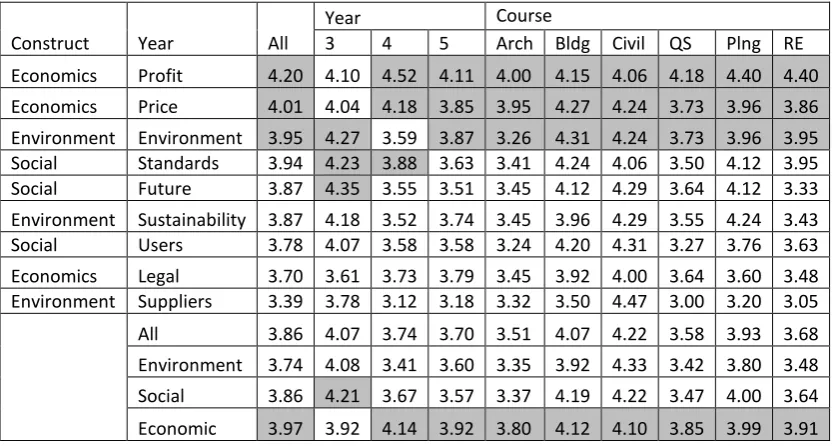
This section considers the perceptions of students on factors that can impact on procurement decisions. Students were asked to rate nine statements with respect to the extent to which they perceived that they would influence them when making procurement choices. These factors were derived from the three sustainability dimensions which are presented in table 3, 4 and 5 as key constructs. It is important to note that the data here is specific to perceptions of the influence of the nine sustainability factors on procurement choices. This is different from many other studies on student perceptions on sustainability issues. Table 3 provides a summary of the statements that students were asked to rate on a 5-point Likert scale (1=strongly disagree to 5 strongly agree).
7
greatest influence on procurement decisions by the students, with an average score of 3.97 (social= 3.86 & environmental= 3.74). This is consistent with Ageron et al’s (2011) findings that quality and cost took precedence over sustainability considerations when making procurement choices.
[image:8.595.109.523.306.465.2]An interesting observation is made in table 5 in relation to differences in perceptions between students from different courses. The economic dimension is seen as a dominant construct amongst Architecture, quantity surveying and Real estate management students. The aggregate scores per construct for the social dimension is highest from students on the Building and Planning courses. However the environmental consideration is seen to be a major factor amongst civil engineering students. One can argue that this is possibly a reflection of the content type of the different courses and the expected types of projects/work they would be involved with once they graduate.
Table 3: Procurement constructs, statements and coding
Construct Statement Code
Economics Profitability would be a major determining factor Profit
Economics Price would be a major determining factor Price
Environment The impact on the environment would be a major concern Environment
Social Meeting Industry standards on sustainability Standards
Social I would be concerned about its impact on future generations Future Environment Sustainability concerns would be a major factor Sustainability Social I would be concerned about the impact on immediate users Users
Economics Meeting minimal legal requirements Legal
Environment
Only suppliers/contractors who have a documented sustainability
policy should be involved Suppliers
Table 4: Comparison of procurement decision factors based on year of study of course
Construct Year All
Year Course
3 4 5 Arch Bldg Civil QS Plng RE Economics Profit 4.20 4.10 4.52 4.11 4.00 4.15 4.06 4.18 4.40 4.40 Economics Price 4.01 4.04 4.18 3.85 3.95 4.27 4.24 3.73 3.96 3.86 Environment Environment 3.95 4.27 3.59 3.87 3.26 4.31 4.24 3.73 3.96 3.95 Social Standards 3.94 4.23 3.88 3.63 3.41 4.24 4.06 3.50 4.12 3.95 Social Future 3.87 4.35 3.55 3.51 3.45 4.12 4.29 3.64 4.12 3.33 Environment Sustainability 3.87 4.18 3.52 3.74 3.45 3.96 4.29 3.55 4.24 3.43 Social Users 3.78 4.07 3.58 3.58 3.24 4.20 4.31 3.27 3.76 3.63 Economics Legal 3.70 3.61 3.73 3.79 3.45 3.92 4.00 3.64 3.60 3.48 Environment Suppliers 3.39 3.78 3.12 3.18 3.32 3.50 4.47 3.00 3.20 3.05
All 3.86 4.07 3.74 3.70 3.51 4.07 4.22 3.58 3.93 3.68 Environment 3.74 4.08 3.41 3.60 3.35 3.92 4.33 3.42 3.80 3.48 Social 3.86 4.21 3.67 3.57 3.37 4.19 4.22 3.47 4.00 3.64
Economic 3.97 3.92 4.14 3.92 3.80 4.12 4.10 3.85 3.99 3.91
[image:8.595.108.526.508.731.2]8
The primary focus of the study was to examine the extent to which sustainability is perceived as a key influencing factor in procurement decisions. The study provides a specific dimension to the understating of sustainability issues by students as it focused on the influence of sustainability factors on procurement decision making. Procurement is seen as a key driver for performance improvement in general and attainment of acceptable sustainability standards. It is argued in this paper that it is important that education institutions of higher learning should take a key role in influencing decision makers of the future. The three sustainability dimensions were considered and it is clear that the students’ perceived the economic dimensions as the key most important factor in procurement decision making and that they would see environmental concerns as of a lesser influence. In examining the context of sustainability, the predominant context of the sustainability problem is seen to be as an economic dimension. While the findings in this study can appear to be inconsisted with many other studies that have examined student’s perception on sustainability where the environmental consideration is usually the primary context of sustainability, it is considered here that the type of questioning could have an impact on the answers given by the students. Of primary concern in this study was the context to which they saw sustainability as a problem. This is an important context as may be different from studies that have looked, for example, on students understanding of causes of global warming. Whilst the study does not pursue the question as to the reasons for the perceptions, it can be argued that the cultural or local setting can have an important factor in considering differences in perceptions. It is therefore recommended that student perception related studies should seek to examine the degree to which the cultural/social-economic setting of a sample would have an influence of the sustainability perception studies. The level of knowledge and understanding is deemed to be reflected by the year of study, while the type of knowledge acquired is reflected by the course undertaken. The study recommends that sustainability must be taught to university students as part of the curriculum in order to produce graduates that that will have the correct perception and importance of sustainability
REFERENCES
Abd Razak, M., Utaberta, N., & Handryant, A. N. (2012). A study of students’ perception on sustainability of campus design: A case study of four research universities campus in Malaysia. Research Journal of Environmental and Earth Sciences, 4(6), 646-657.
Adetunji, I., Price, A.D.F. And Fleming, P., 2008. Achieving sustainability in the construction supply chain. Proceedings of the ICE -Engineering Sustainability, 161 (3), pp. 161 – 172
Ageron, B., Gunasekaran, A., & Spalanzani, A. (2012). Sustainable supply management: An empirical study. International Journal of Production Economics, 140(1), 168-182.
9
Belfit, R. J., Sexton, M., Schweber, L., & Handcock, B. (2011). Sustainable Procurement: Challenges for Construction Practice. In TSBE EngD Conference (pp. 1-9).
Brammer, S., & Walker, H. (2011). Sustainable procurement in the public sector: an international comparative study. International Journal of Operations & Production Management, 31(4), 452-476.
Carew, A. L., & Mitchell, C. A. (2002). Characterizing undergraduate engineering students' understanding of sustainability. European journal of engineering education, 27(4), 349-361.
Clark, I. F., & Zeegers, Y. (2015). Challenging students' perceptions of sustainability using an Earth Systems Science approach. Journal of Geography in Higher Education, 39(2), 260-274.
Construction Excellence (2004) Procurement [Internet]
http://constructingexcellence.org.uk/wp-content/uploads/2015/03/procurement.pdf [accessed 23/03/2017]
Cortese, A. D. (2003). The critical role of higher education in creating a sustainable future. Planning for higher education, 31(3), 15-22.
Dagiliūtė, R., & Niaura, A. (2014). Changes of Students’ Environmental Perceptions after the Environmental Science and Biology Courses: VMU Case. Procedia-Social and Behavioral Sciences, 141, 325-330.
Emanuel, R., & Adams, J. N. (2011). College students' perceptions of campus sustainability. International Journal of Sustainability in Higher Education, 12(1), 79-92.
Gopalakrishnan, K., Yusuf, Y. Y., Musa, A., Abubakar, T., & Ambursa, H. M. (2012). Sustainable supply chain management: A case study of British Aerospace (BAe) Systems. International Journal of Production Economics, 140(1), 193-203. Hanson-Rasmussen, N., Lauver, K., & Lester, S. (2014). Business Student Perceptions
of Environmental Sustainability: Examining the Job Search Implications. Journal of Managerial Issues, 26(2), 174.
Hiller Connell, K. Y., & Kozar, J. M. (2012). Sustainability knowledge and behaviors of apparel and textile undergraduates. International Journal of Sustainability in Higher Education, 13(4), 394-407.
Huang, S. H., & Keskar, H. (2007). Comprehensive and configurable metrics for supplier selection. International journal of production economics, 105(2), 510-523.
Iyer-Raniga, U., Arcari, P., & Wong, J. (2010, September). Education for sustainability in the built environment: what are students telling us?. In Egbu, C. Proceedings of 26th Annual ARCOM Conference, Leeds, UK (pp. 1-10).
Kagawa, F. (2007). Dissonance in students' perceptions of sustainable development and sustainability: Implications for curriculum change. International Journal of Sustainability in Higher Education, 8(3), 317-338.
Kalpana, K., Rajkumar, A. D., & Rita, S. A Study On ‘Students Awareness, Attitude And Behaviour Towards Energy Conservation’. I J A B E R, Vol. 11, No. 2, (2013): 241-250
Khalil, D., Ramzy, O., & Mostafa, R. (2013). Perception towards sustainable development concept: Egyptian students' perspective. Sustainability Accounting, Management and Policy Journal, 4(3), 307-327.
10
Miemczyk, J., Johnsen, T. E., & Macquet, M. (2012). Sustainable purchasing and supply management: a structured literature review of definitions and measures at the dyad, chain and network levels. Supply Chain Management: An International Journal, 17(5), 478-496.
Nicolaou, I., & Conlon, E. (2012). What do final year engineering students know about sustainable development? European Journal of Engineering Education, 37(3), 267-277.
Ofori, G. (2000). Greening the construction supply chain in Singapore. European Journal of Purchasing & Supply Management, 6(3), 195-206.
Ramirez, M. (2006). Sustainability in the education of industrial designers: the case for Australia. International Journal of Sustainability in Higher Education, 7(2), 189-202.
Reiter, L., & Kozar, J. (2016). Chinese Students’ Knowledge of Environmentally and Socially Sustainable Apparel and Sustainable Purchase Intentions. International Journal of Marketing Studies, 8(3), 12.
Sammalisto, K., & Lindhqvist, T. (2008). Integration of sustainability in higher education: a study with international perspectives. Innovative Higher Education, 32(4), 221-233.
Sanchez, A., Lehtiranta, L., D. Hampson, K., & Kenley, R. (2014). Evaluation framework for green procurement in road construction. Smart and Sustainable Built Environment, 3(2), 153-169.
Shaik, M., & Abdul-Kader, W. (2011). Green supplier selection generic framework: a multi-attribute utility theory approach. International Journal of Sustainable Engineering, 4(01), 37-56.
Srivastava, S. K. (2007). Green supply‐chain management: a state‐of‐the‐art literature review. International journal of management reviews, 9(1), 53-80.
Stark, J., Stark, J., Park, J. G. P., & Park, J. G. P. (2016). Interior design student’s perceptions of sustainability. International Journal of Sustainability in Higher Education, 17(3), 361-377.
Tamošaitien, J., Zavadskas, E. K., Liou, J. J., & Tzeng, G. H. (2014). Selecting Suppliers in Green Supply Chain Management.
Tan, A., Udeaja, C. E., Babatunde, S., & Ekundayo, D. (2016). Sustainable
development in a construction related curriculum-quantity surveying students’ perspective. International Journal of Strategic Property Management.
Testa, F., Iraldo, F., Frey, M., & Daddi, T. (2012). What factors influence the uptake of GPP (green public procurement) practices? New evidence from an Italian survey. Ecological Economics, 82, 88-96.
Tongco, M. D. C. (2007). Purposive sampling as a tool for informant selection. Ethnobotany Research & Applications 5:147-158
Walker, D., & Hampson, K. (Eds.). (2008). Procurement strategies: A relationship-based approach. John Wiley & Sons.
Walker, H., & Phillips, W. (2008). Sustainable procurement: emerging issues. International Journal of Procurement Management, 2(1), 41-61.
Walker, H., Di Sisto, L., & McBain, D. (2008). Drivers and barriers to environmental supply chain management practices: Lessons from the public and private sectors. Journal of purchasing and supply management, 14(1), 69-85. Watson, M. K., Noyes, C., & Rodgers, M. O. (2013). Student perceptions of
sustainability education in civil and environmental engineering at the Georgia Institute of Technology. Journal of Professional Issues in Engineering
11
Zeegers, Y., & Francis Clark, I. (2014). Students' perceptions of education for sustainable development. International Journal of Sustainability in Higher Education, 15(2), 242-253.
Zimmer, K., Fröhling, M., & Schultmann, F. (2016). Sustainable supplier
management–a review of models supporting sustainable supplier selection, monitoring and development. International Journal of Production Research, 54(5), 1412-1442.