Volume 2012, Article ID 605687,17pages doi:10.1155/2012/605687
Research Article
The Nonlinear Analysis of Perturbation Solution
for a Parabolic Differential System
Victor F. Dailyudenko
United Institute of Informatics Problems of the National Academy of Sciences of Belarus, Surganov Street 6, 220012, Minsk, Belarus
Correspondence should be addressed to Victor F. Dailyudenko,[email protected]
Received 9 April 2012; Revised 19 June 2012; Accepted 30 July 2012
Academic Editor: Yuri Latushkin
Copyrightq2012 Victor F. Dailyudenko. This is an open access article distributed under the Creative Commons Attribution License, which permits unrestricted use, distribution, and reproduction in any medium, provided the original work is properly cited.
By investigation of perturbation solution for nonlinear reaction-diffusion system, we derive related differential model for perturbations that involves weak nonlinearities up to third order. For a first time, this model is shown to result in derivation of the system for amplitude distribution by means of nonlinear integration on orthogonal basis in spatial region. The obtained time-dependent systemTDS contains all possible functional relations between the modes of wave train under consideration along with delayed relations, and after numerical simulation it provides some conclusions concerning the natural frequency of the investigated self-organization process in active medium. The related matrix and modulo operations which substantiate the derivation of the TDS are also considered.
1. Introduction
Though the linearized analysis of differential systems is used widely for exploration of stability problems and has been developed for a long time1–6, additional investigations of nonlinearities occurring in corresponding analytical models provide an opportunity to obtain important information that is impossible to find restricting with the use of linearizations only. So, in the present work, in difference from6, we also take into consideration nonlinear terms of the second order and even higher onesand show that such exploration allows us to consider the amplitude distribution of the modes constituting the wave train and, moreover, to obtain some estimations for temporal changes of such distribution.
As a result of numerous experimental and theoretical investigations, it was shown that self-organization patterns described by reaction-diffusion systems of differential equations
propagating in active mediae.g., spiral waves8,9,11–13. Such periodic wave train can have any period or frequencywithin a certain range, and to each period corresponds a particular wavelengthor phase velocity 8–10. So, representation of the wave train through normal modes1is suitable both from experimental and theoretical viewpointsyet allowing us an opportunity to link approaches of linear analysis with considerations of different levels of nonlinearities, and we also use expansion through the orthogonal basis in spatial range along with unique spatiotemporal functional dependence at derivation of propagation solution with supposition of weak nonlinearity.
For a first time, we develop the approach of nonlinearities integration taking into consideration all possible cases of mode coincidence that provides us with complete set of functional relations between the modes of wave train and, moreover, reveals delayed dependencies on related modes with lower order. As a result, we obtain exact expressions of time-dependent system TDS describing amplitude distributions over investigated frequency regionthis region can also be represented by means of related wavelength range. The importance of Goldstone mode is also shown at description of amplitudes pertaining to every separate mode. The numerical implementations show the validity of derived mathematical models and allow us to deduce some conclusions concerning temporal evolution of the autowave process and its natural frequency. The obtained results proved to be useful for development of the control methods with respect to investigated self-organizing structures.
2. Derivation of Time-Dependent System for Square Nonlinearities
Let us consider the nonlinear system of reaction-diffusion equations of FitzHugh-Nagumo
FHNtype that can be written as follows3,7,8,10,11:
∂u ∂t u−
u3
3 −vD1Δu, ∂v
∂t ε
u−γvβD2Δv,
2.1
whereuandvare kinetic variables characterizing the dynamical systemusually propagation and recovery ones,D1,2-diffusion coefficients for related variables,Δ-Laplacian,εis a small
positive parameter that defines relation of temporal scales for kinetic variables, β and γ determine excitability of the medium. Introduce the perturbations x1, x2 from stationary
state of2.1, namely,
uu0x1, vv0x2. 2.2
Considering2.1and2.2, we have the exact model consisting of nonlinear equations for perturbationshere the stationary stateu0, v0is determined analogously1,6,14
∂x1
∂t −
x13
3 −u0x1
21−u 02
x1−x2D1Δx1,
∂x2
∂t ε
x1−γx2
D2Δx2.
Let us suppose thatx1,2are small enough and apply the normal modes representation
as follows:
x1
x2
M
m0
C1,2meωmtcosk
mr, 2.4
where eigen wavenumberkm πm/l, 0 ≤ r ≤ l. This decomposition is similar to Fourier
series expansion, but on one variablekm, while ωm fkmdetermines a dispersion curve
and instability dependence, in general essentially nonlinear.
At linearized analysis of 2.1 see1,6, 14, it is impossible to expressC1,2m from related equations since it disappears at dispersion curve determination. Here, we show that nonlinear consideration allows us to overcome this shortage. From2.3-2.4, we obtain the following equation describing the amplitude distribution:
M
m0
C1mfmcoskmru0σM2
1 3σM
30, 2.5
where
σM M
m0
C1mcoskmr, 2.6
coefficients which provide the temporal dependence are written as
C1mC1meωmt. 2.7
Here ωm ωm iωm, while ωm and ωm describe damping i.e., stability properties
and oscillation processes, respectively. In 2.5, the dependence fm on spatiotemporal
parameters provides complete information about linear operators involved by system2.1, it is expressed as follows:
fmμmωm ε
ωmγεD2km2
, 2.8
where μm D1km2 − 1 u02. In turn, σM2 and σM3 express nonlinearities on C1m
and provide all functional relations that arise at cross-modal interactions, such nonlinear interactions are studied in many applications 3,4,15. It is worth noting that2.5 itself is not sufficient for determination ofC1m, m0,1,2, . . . , M, as well as for dispersion curves
derivation, but we show below that by using some integral transforms we can obtain a system with complete solvability. Such system will be also numerically proved inSection 4.
coincidence with our supposition concerning small perturbations. So, we introduce the more general form of2.5as follows:
M
m0
Amfmcoskmrε2u0ςM2ε3
3ςM
30, 2.9
where
ςM M
m0
Amcoskmr, 2.10
AmAmeωmt, 2.11
and Am is also a constant amplitude which pertains to the mth mode but it is suitable to
different levels of nonlinearities. Evidently, in2.5we have that atε2 ε3 1,Am ≡ C1m,
while at ε2 ε3 0, the completely linear case on levels of deviation from stationary
state takes place. This case was considered in 6, 14 and, in spite of its linearization on perturbation levels, it yet allows us the nonlinear dependence ofωmonkmreflecting related
frequency and dispersion curves. In this work, we suppose thatεican be in general arbitrary
but small for weak nonlinearities that is used in some examples at numerical simulations. In this paper, we confirm that admission of weak nonlinearities is significant since it allows us to apply variety of developed linear analytical methodswhich were also proved experimentally for centuriesto investigation of nonlinear phenomena and derivation of new functional relations. Really, linear analysis methods can be considered as background for investigation of nonlinear phenomena, including application of matrix theory, integration and differentiation methods, and also spectral approaches e.g., Fourier integral and series expansion. In particular, estimation of power spectrum is used widely in related modeling
16, for example, for analysis of spiral waves 7, 13 thereby reflecting some important features of investigated processes which are essential for resonant control 13,17–19. So, we also use expansion on orthogonal basis for description of functional spatiotemporal dependencies characterizing the propagating kinetic variable.
Fourier integral transform is also widely used for reduction of complexity of partial differential equations 5,7, but it is suitable mostly for a single pulse propagation e.g., soliton-like solution often followed by extrapolation of solution in spatial region 5. But self-organization processes described by a system of reaction-diffusion equations are characterized by continuous periodic radiation represented by related wave trains, so expansion in a series is more useful than representation by integral transform. Another reason in favor of series representation is that we consider the process in restricted spatial region, in such a case that the eigenvalue spectrum is of discrete structure as it was shown in1.
Similarly to methods couched in monograph1, we use integration over all range of r ∈0, lfor derivation of TDS from2.9. In this work, we consider quadratic nonlinearities involved byςM2followed by some generalizations to cubic nonlinearities through related
At such operations, we use the filtering properties which result from orthogonality of spatial functionssee the appendix for detailsand obtain from expression2.9the following equations forAndetermination:
Anfnε2u0
Dn/2B−nBn
0, 2.12
whereDn/2determines the delayed functional dependence for an even component and can
be written as follows:
Dn/2 ηn 2
An/2
2
, 2.13
where the digital functionηnis determined in accordance withA.5. The sumsB−nand Bn consist of terms which remain as nonzero ones after integration due to fulfillment of
conditions|ki−kj|knandkikj kn, respectively, those are determined by means of the
expressions:
B−n
M−n
i0
AiAni,
Bn
s
i0
AiAn−i,
2.14
where index boundary is determined accordinglyA.6.
Evidently, bothB−nandBnrepresent just the terms describing the mode interactions; the sumB−nis constructed by constant range of indices n, and inBnthe range of indices is
n−2iand decreases by two samples for every subsequent pair of terms.
Equation 2.12 form the system at n 1,2, . . . , M, while forn 0 the following equation is valid, it is derived analogously above ones:
A0f0ε2u0
2
A20B 0 −
2
0. 2.15
Derivation of TDS2.12–2.15allows us an opportunity to considerM1independent equations instead of one nonlinear equation 2.9 and thereby increases its solvability for determination of M 1 complex variables An. The representation of related functional
3. Matrix Representations and Modulo Operations Involved by
Nonlinear Integration Procedure
Regarding representation of quadratic nonlinearities described by2.9, the following matrix is useful: ΛM AiAj, where i, j 1,2, . . . , M. Here, we do not include the spatial
dependence explicitly, but it can be easily represented with related indices accordingly2.10, and one can conclude that then diagonal elements of ΛM form the dependenceDn/2 in
2.12, while relevant pairs of mixed multiplications constituteB−nandBn. Evidently,ΛM
can be obtained by direct multiplication of the following matrices:
ΛMQM⊗QMT, 3.1
whereQMconsists of equal elements in its columns, that is,
QM
⎛ ⎜ ⎜ ⎜ ⎝
A1 A2 · · · AM
A1 A2 · · · AM · · · · A1 A2 · · · AM
⎞ ⎟ ⎟ ⎟
⎠. 3.2
As it follows from the structure ofΛM, elements with equal difference of indices formingB−n
constitute a pair of lateral diagonals inΛM, and by neglecting symmetric repetitions, one can
conclude that the triangle matrix representing equal index differences can be obtained from
3.1as follows:
Qlr
⎛ ⎜ ⎜ ⎜ ⎜ ⎜ ⎝
A1AM A1AM−1 · · · A1A3 A1A2
0 A2AM · · · A2A4 A2A3 · · · ·
0 0 · · · AM−2AM AM−2AM−1
0 0 · · · 0 AM−1AM
⎞ ⎟ ⎟ ⎟ ⎟ ⎟ ⎠
−
−→
⎛ ⎜ ⎜ ⎜ ⎜ ⎜ ⎝
M−1 M−2 · · · 2 1 0 M−2 · · · 2 1
· · · ·
0 0 · · · 2 1
0 0 · · · 0 1
⎞ ⎟ ⎟ ⎟ ⎟ ⎟ ⎠,
3.3
where the matrixQlris constructed so that every last column is just the upper first lateral
diagonal in ΛM i.e., in reverse order. In turn, the sign of transformation−−→− represents
the transition to index difference within a pair of elements inQlr. On the other hand, the
QleftandQright, taking into account only terms upper the diagonal ofΛMfor every pair of
products as follows:
Qleft
⎛ ⎜ ⎜ ⎜ ⎜ ⎜ ⎝
1 1 · · · 1 1
0 2 · · · 2 2
· · · ·
0 0 · · · M−2 M−2 0 0 · · · 0 M−1
⎞ ⎟ ⎟ ⎟ ⎟ ⎟
⎠, 3.4
Qright
⎛ ⎜ ⎜ ⎜ ⎜ ⎜ ⎝
2 3 · · · M−1 M 0 3 · · · M−1 M · · · ·
0 0 · · · M−1 M
0 0 · · · 0 M
⎞ ⎟ ⎟ ⎟ ⎟ ⎟
⎠, 3.5
and thusQ− Qright−Qleftprovides index difference for every product in its lateral diagonals.
In turn, consideration ofQ Qright Qleftfor exploration of elements with equal sum of
indicesmakes sense only ifQi,j ≤ M, that is, for every “cross” diagonal in the upper
halfi.e., subtriangleofQ. As a result of consideration with respect to3.3–3.5, one can
conclude that with increase ofnin2.12by one sample, the quantity of elementsproducts inB−ndecreases by one, while that inBnincreases by one only ifnincreases by two samples it can be shown by counting the number of terms in “cross” diagonals in the upper half of Q, with those diagonals involving equal sums of indices.
On the other hand, for investigation of mixed products properties especially for higher-order nonlinearitiesthe following scheme is useful. We consider the string{Am}
M m1
and take multiplication of everyAi byAj ati < j it is said to be string by string scheme
SBS, then all resulting terms can be obtained by consideration of corresponding rows in
3.4and3.5, with each pair of those containing equal number of nonzero terms.
For investigation of cubic nonlinearities, we cannot restrict our analysis to one-step matrix multiplication as for quadratic case since the more complicated tensor structure is formed; it can be represented through M square matrices which result from direct multiplication of ΛM ⊗ shsQM, where shs· means the s-step cyclic shift of matrix
regarding columns in our consideration; that is, if for QM the number of a column is
1 ≤ k ≤ M, then forshsQ
Mit isks k⊕s, where the shift indexs 1,2, . . . , M, and
the modulo operation is defined similarly to20as follows:
k⊕s
ks−M, ifks > M,
ks, ifks≤M. 3.6
Thus, the columns ofshsQ
Mcan be obtained by the adding operation of indices
accordingly3.6, and therefore we have the following expressions:
sh1QindM
⎛ ⎜ ⎜ ⎝
2 3 · · · M−1 M 1
2 3 · · · M−1 M 1
· · · ·
2 3 · · · M−1 M 1
⎞ ⎟ ⎟ ⎠,
sh2QindM
⎛ ⎜ ⎜ ⎝
3 4 · · · M 1 2
3 4 · · · M 1 2
· · · ·
3 4 · · · M 1 2
⎞ ⎟ ⎟ ⎠,
3.7
and so on, in3.7we show only indices ofAi, similarly to3.3, and hence we imply the
spatiotemporal dependence2.10-2.11in the represented record. Evidently,shMQ
M
QM. It is worth noting that a single line of cubic elementsA3i forms byQM⊗ΛMin its main
diagonal, while mixed products including square terms such asAiA2j also form due to this
operation, namely,MM−1terms after excluding cubic ones. The restM−1multiplications result in 2MM−1mixed square terms, those constitute two lateral diagonals and the main one as it can be shown with 3.1 and 3.7; therefore, we obtain 3MM−1 such terms altogether.
Alternatively, the process of matrix product derivation for cubic nonlinearities can be represented throughMsuccessive one-step direct multiplications of ΛM by the square
matrix consisting of similar elements, that is, As, where s 1,2, . . . , M. As a result, we
have one cubic term and 3M− 1 mixed square terms at every multiplication, namely,
M−1 diagonal terms and 2M −1 in related row and column forming two crossing lines, threefold recurrence also takes place in this scheme for the previously considered mixed square terms. At such consideration, the resulting the previous matrix preserves its symmetry that allows us to make additional conclusions which are necessary for derivation of correct expressions describing nonlinear integration analogously 2.12 derivation. It should be noted that new mixed terms such as AiAjAk, where i /j /k appear between
the main diagonal and the row which involve square terms, and the common quantity of new mixed terms obtained at every multiplication decreases in accordance with the series
1/2M−1M−2,1/2M−2M−3, . . . ,1. It can be shown using analytical approaches similarly to 3.3–3.5 and 3.7. As for terms involving square and cubic powers, their common quantity formed afterMmultiplication can be represented through the following matrix that contains original terms onlyi.e., without recurrence; it is obtained similarly to the previously mentioned SBS scheme and is of the following form:
Q2−3com
⎛ ⎜ ⎜ ⎜ ⎜ ⎝
13 1,22 1,32 · · · 1, M2
2,12 23 2,32 · · · 2, M2 · · · ·
M,12 M,22 M,32 · · · M3
⎞ ⎟ ⎟ ⎟ ⎟
⎠, 3.8
where13corresponds toA
1cosk1r 3
,1,22−A
1cosk1r A2cosk2r 2
4. Generalization to Nonlinearities of the Third Order
along with Numerical Simulation
Comparison of 3.8 with results of above considerations provides us with opportunity to derive the correct form ofMm1Am coskmr
3
for subsequent nonlinear integration, and thus we obtain from2.9the following expression considering cubic nonlinearitiesalong with those of lower order toofor amplitude distributionanalogously TDS2.12:
Anfnε2u0
2A0AnB
n ε3 ⎧ ⎪ ⎪ ⎨ ⎪ ⎪ ⎩ 1 4
A3n
η1n
3 An/3 3 1 2 ⎡ ⎢ ⎢ ⎣ An
M
i1 i /n
A2i 1 2
M
i1 i /lk
A2iAlk
M
i1,j2 i<j<lp
AiAjAlp
⎤ ⎥ ⎥ ⎦ A0
A0AnB
n
⎫ ⎪ ⎬ ⎪ ⎭0,
4.1
wherelk, lpdetermine index relations between equation numbernand current index values
i, jfor every successive sum; the total quantity of the sums for each term in4.1that contains lk, lpequals the upper value of k and P, respectively, andlk, lpare determined in accordance
with the following expressions:
lk
n−2i, ifk1, 2i±n, ifk2,
lp ⎧ ⎪ ⎪ ⎨ ⎪ ⎪ ⎩
n±ij, ifp1, n±i−j, ifp2,
ij−n, ifp3.
4.2
In turn, the step function η1n is expressed as follows similarly to the above-defined
functionηn:
η1n
1, ifn3m,
0, otherwise, 4.3
where n, m 1,2, . . . , M, and terms describing square nonlinearities are determined analogously above the considered ones
BnDn/2
M−n
i1
AiAni s
i1
It is worth noting that in 4.1 the Goldstone mode A0 makes additional functional
dependence and provides an opportunity to take into account the form of square nonlinearities in the third-order one that is expressed in the last term of4.1. Thus, this mode takes particular influence on the process that is in good coincidence with results obtained in
21, where it was shown that the Goldstone mode is really of great significance in nonlinear models of wave propagation.
Evidently, the system of4.1provides additional delayed functional dependencies and cross-modal interactions, as well as it includes estimation of the total energy of the process. Investigation of the cubic nonlinearity is of great importance for self-organization phenomena modeling because the presence of cubic nonlinearityor that of higher orderin a related differential equation is the necessary condition of a self-organization phenomenon origin. This fact was proved in 1 by means of comprehensive analysis of related phase curves and singular points and has many confirmations among mathematical models describing self-organization phenomena of various physical nature see e.g., nonlinear Schrodinger equation, Ginsburg-Landau model, etc.1–3,7.
In the present work, we reveal influence of cubic nonlinearity itself on the investigated process, for this aim we reduce the general TDS 4.1 to the system where cross-modal relations and delayed dependencies are neglected and therefore obtain the following reduced model:
fnε43A2n0. 4.5
Considering2.8and2.11and dividing4.5into real and imagine parts, one can write the expressions for related trigonometric functions as follows:
cos2ωnt− 4αd
ε3An2
μmωmεnγn
,
sin2ωnt−
4αdωn
ε3An2
1−εn,
4.6
where characteristics fornth mode are as follows:
γnωnγεD2 kn2,
εn ε
ω2nγn 2,
4.7
and dissipative term displays the temporal dependence and simultaneously reflects changes with the mode order asαd e−2ωmt. After some transformations, we obtain from4.6the
expression for amplitude estimation of the form
An2
!
αd
ε3
4
"
μnωnεnγn
2
ω2
At numerical simulations, we use the dispersion and dissipation dependencies obtained before for linearized analysis of2.1, namely,see6
ωn
1 2
"
4ε−μn−γε
2
,
ωm−μmγε
2 .
4.9
So, based on fundamental results and considerations obtained by leading authors in the field of spiral waves modeling8,10,11, we also suggest for numerical considerations thatD11,
D20. The parameters of excitation are chosen to be asγ0.5 andβ0.7, while propagating
kinetic variable at stationary state is determined asu0 −1.03286,14and temporal scale
parametersε0.02, ε30.01, l100.
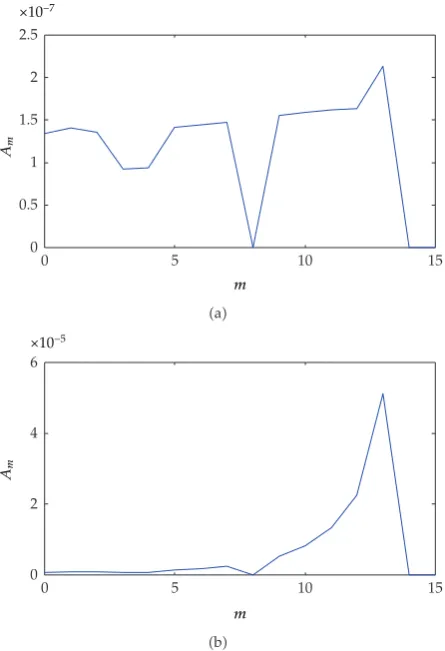
Results of numerical calculations of dependence 4.8 are shown in Figure 1; they show that the cubic nonlinearity described previously provides the growth of amplitude; this growth attains its peak in the region of modes with maximal order which simultaneously possess temporally oscillating property, as well as lend the system with maximal temporal stability. This allows us to conclude that the natural frequency of investigated autowave process is located within the modes of the largest wavenumber where frequencyand phase velocityis minimal at high stabilityboth convective and temporal6that confirms the conjecture deduced in6,14from linearized analysis. This is also in good coincidence with results obtained after numerical simulations of spiral wave evolution 11, 19, where the natural frequency was shown to be of very small order of magnitude that is characteristic of biological active media. At the same time, it is worth noting that experimental detection of such low frequency can cause some problems since such signals are of low propagating ability.
5. Evaluation of Obtained Results Regarding General
Solvability of the Model
In this section, we also consider the conservative approach that is a paradigm of classic physics of wave processes based on Maxwell equations 5 and explore the problem of solvability of the above-obtained TDS. In a case of direct integration of TDS4.1or2.12on some large enough temporal periodT∗similarly to1, one should take into consideration
that related temporal functionseωmtare essentially nonorthogonal. In other words, the order
properties which are intrinsic due to orthogonality are lost here, in difference from spatial functions, due to nonlinearity of dispersion dependenceωk. For example, for conservative systems whereωm 0 and using related operations of multiplication and integration as
above, we obtain for a term of TDS the following expression:
#T∗/2
−T∗/2
AΣeiωσtdt AΣ
ωσ
sin
πωσ ω∗
0 5 10 15 0
0.5 1 1.5 2 2.5
m
Am
×10−7
a
0 5 10 15
0 2 4 6
m
Am
×10−5
[image:12.600.189.412.97.423.2]b
Figure 1: The dependencies of the amplitude levelAmon the mode order reflecting the influence of cubic
nonlinearity on the self-organization process evolution,acorresponds tot 5,bis related tot50, thus the obtained curves represent an asymptotic estimation of amplitude distribution.
where the variableωσ includes all frequencies involved by related eigenvalues of the term,
that is,
ωσ ωn1ωn2· · ·ωnσ, 5.2
and similarlyAΣincludes amplitude values related to the term as follows:
AΣAn1An2· · ·AnΣ. 5.3
Evidently, operation of exact integration5.1leads to transformation of TDS into a system of transcendental equations which is cumbersome both for analytical and numerical analyses; the similar result is obtained also for systems with dissipation. So, in this paper we use some approximation concerning orthogonality in temporal region, namely, we suppose that there exists such small enough ω∗ 2π/T∗ that for every eigenvalueωn ∼ qnω∗ is valid,
0 5 10 15 5
10 15 20
m
[image:13.600.189.410.98.267.2]Am
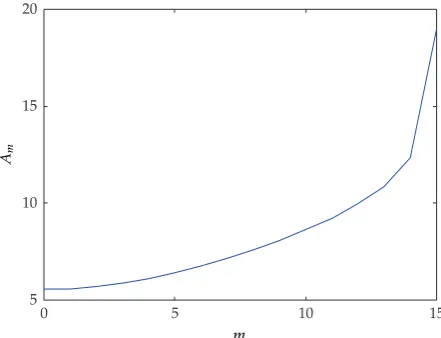
Figure 2: The dependence of the amplitude distribution for conservative system confirms reliable growth for initial modes.
only, but below we show its applicability also for dissipative ones, but the order of such quasiorthogonality is quite different in comparison with regular orthogonality of spatial functions. For conservative systems consideration, the normal mode analysis is reduced to representation of perturbations as follows:x1 ∼
M
m0Bmeiϕmt, whereϕm ωnt−kr, and
from4.8atωm 0 we have dependence shown inFigure 2, it confirms that the amplitude
level increases with the mode order, but the accuracy of conservative approach is restricted with “long-wave” consideration only5. On the other hand, obtained dependence complies with the conjecture concerning natural frequency couched previously.
Taking into account the above quasiorthogonal approximation, we have for dissipative system that provides more exact consideration than conservative one
#T∗
0
Andt An
ωn
exp
2πωn ω∗
−1
∼
−An
ωn,
5.4
because exp2πiωn/ω∗∼1 and|ωn|> ω∗, ωn <0. Therefore, similarly to5.4, one can
obtain from the TDS2.12the following system:
fnAn
ωn ε2u0
$
ηn 2ωn/2
An/2
2
M−n
i0
AiAni
ωiωni s
i0
AiAn−i
ωiωn−i
%
0. 5.5
If we take TDS2.12at some fixedt0e.g.,t00, similarly to determination of coefficients in
22, then the obtained equation along with5.5forms the system with sufficient solvability for derivation of|An|.
For estimation of obtained results, it is worth noting that in the present work we considered the behavior of the nonlinear system near its stationaryfixedpoint that is similar to approaches developed in1,3. But, in difference from1, where the linearized operator for nonlinear Brusselator was analysed followed by bifurcation and instability analysis
preferably near the stationary state, the aim of our work is to derive the nonlinear system
train. The derived TDS also includes information about instabilitiesexpressed throughωm,
as well as dispersion dependencyωm, but detailed analysis of those is beyond the frames
of our workthat leads to transcendental equations, while such analysis for linearized case of reaction-diffusion equations was implemented in our previous papers see6,14. The considered FHN system contains the essential information about physical processes in the active media under investigation and allows the derivation of models of various physical structures, such as spiral waves and three-dimensional scrolls as it was shown in7,8,11.
As to limitation that arises from exponential representation, it is worth noting that it cannot really catch all features of physical behavior, but only near the stationary state. Nevertheless, in accordance with conclusions proved in the monograph 1 where such representation is also used, it should be noted that the system with self-organization tends to stationary stateor nearly thatwith elapsing the time, so the method developed allows essential properties of the system. Moreover, the method developed in this paper includes features of spatiotemporal nonlinear interactions as one can conclude from2.9.
In some works, the decomposition in spatial region is also used through the multiple time series23. Then, several authors showed that such approachexposing also nonadiabatic phenomenaresults in locking effect which arises from the interaction of the large-scale envelope of the kinetic variable with the small scale underlying the spatial periodic solution considered also in 24, 25. At the same time, the main difference of our method is that the derived TDS does not include a spatial dependence in an explicit form due to the nonlinear integration in spatial region which gives the TDS for amplitudes
|An|determination and simultaneously retains the temporal dependence. So, the previously
mentioned locking effect cannot appear in our model since the lack of explicit spatial dependence and nonlinear interaction between different modes exposes through including different constant levels of amplitudes pertained to every separate mode and related temporal dependencies. Due to nonlinearities involved, the amplitude distribution describes the self-organization structure under investigation.
The main aim of the present paper is investigation of self-organization phenomena in nonlinear systems namely, the model that can describe spiral waves. In accordance with the theorem proved in1, such phenomena can take place only in the systems which are described by equations with nonlinearity not less than third order, so FHN model fits for such investigation. Again, the method developed in this paper is designated for the systems describing spiral waves distribution, so more simple models might fail for modeling such self-organization phenomenaas a rule, those model a wave front of plane form25, and thus those were not considered, though application of the method developed is also possible for them.
The system with four spatiotemporal parameters is possible for three-dimensional consideration. But we considered radial wave propagation only since the spiral wavefar enough from the center where it is usually measured in biological systemscan be regarded as usual pacemaker followed by a target wave and angular changes can be neglected. Nevertheless, if we use also angular considerations, the sense of the method does not change.
6. Conclusions
opportunity to increase the accuracy of dispersion relation. The related matrix and modulo operations are also considered; those confirm validity of TDS derivation method.
The derived model allows us to find the mode with maximal amplitude that is important for resonance control of the related self-organization process 13, 17. Again, exploration of this mode explains why the natural frequency of investigated synergetic process is of small levelpreferably in biological systems that are modeled with reaction-diffusion equations 3 and determines the measured frequency at which the wave train propagates. So, the derived mathematical models in this paper can be applicable to exploration of nonlinear processes of different physical nature.
Appendix
Filtering Properties at Nonlinear Integration on Orthogonal Basis
For linear terms, this operation is similar to that used in Fourier series consideration and yet widely applied in digital signal processing
#l
0
cosknr
&M
m0
Amfm coskmr
'
dr l
2Anfn, A.1
whereA.1is valid forn1,2, . . . , M.
For integration ofςM2, let us rewrite it with separation of Goldstone terms as follows:
ςM2A202A0
M
m1
Am coskmr
&M
m1
Amcoskmr
'2
, A.2
where, in turn, considering mixed multiplications which describe cross-modal interactions, one can write
&M
m1
Amcoskmr
'2
M
m1
Amcoskmr
2
2
M
i,j1 i /j
AiAjcoskir coskjr, A.3
and integration similarly toA.1yields the following expressions for nonlinear terms:
#l
0
cosknr
&M
m1
Amcoskmr
'2
drl
⎡ ⎢ ⎢ ⎣ηn
& An/2 2 '2 1 2 ⎛ ⎜ ⎜ ⎝
M−n
i1 n<M
AiAin s
j1 n>2
AjAn−j
⎞ ⎟ ⎟ ⎠ ⎤ ⎥ ⎥ ⎦, A.4
whereηnindicates that the consideration is implemented for the even coefficient
ηn
1, ifn2m,
and the bound for the sum with change of contracting range is expressed as follows:
s(n 2
)
r−1, A.6
where·rmeans rounding to∞, and for the second term ofA.2the following is valid:
2A0
#l
0
cosknr
&M
m1
Amcoskmr
'
drA0An, A.7
while integration of the first term of A.2 provides zero. So, A.4 and A.7 contain all nonzero terms which remain after nonlinear second-order considerations with subsequent integration, those terms appear only if the following is valid concerningA.3:|i±j| n, on one hand, and m/2 n, on the other hand. Let us note that A.4–A.7 is valid for n 1,2, . . . , M, and the related expression forn 0 is derived analogously. It differs only with some coefficients.
References
1 G. Nicolis and I. Prigogine, Self-Organization in Nonequilibrium Systems, Wiley-Interscience, New York, NY, USA, 1977.
2 R. A. Barrio and C. Varea, “Non-Linear Systems,” Physica A, vol. 372, no. 2, pp. 210–223, 2006.
3 M. C. Cross and P. C. Hohenberg, “Pattern formation outside of equilibrium,” Reviews of Modern
Physics, vol. 65, no. 3, pp. 851–1107, 1993.
4 M. Hirota, T. Tatsuno, and Z. Yoshida, “Resonance between continuous spectra: secular behavior of Alfv´en waves in a flowing plasma,” Physics of Plasmas, vol. 12, no. 1, p. 012107, 11, 2005.
5 R. K. Dodd, J. C. Eilbeck, J. D. Gibbon, and H. C. Morris, Solitons and Nonlinear Wave E quations, Academic Press, London, UK, 1982.
6 V. F. Dailyudenko, “Instabilities on normal modes of perturbation solution for a nonlinear single-diffusive system,” International Journal of Nonlinear Science, vol. 11, no. 2, pp. 143–152, 2011.
7 H. Mori and Y. Kuramoto, Dissipative Structures and Chaos, Springer-Verlag, New York, NY, USA, 1998.
8 A. T. Winfree, “Alternative stable rotors in an excitable medium,” Physica D, vol. 49, no. 1-2, pp. 125– 140, 1991.
9 M. Bar and L. Brusch, “Breakup of spiral waves caused by radial dynamics: Eckhause and finite wavenumber instabilities,” New Journal of Physics, vol. 6, pp. 1–22, 2004.
10 J. J. Tyson and J. P. Keener, “Spiral waves in a model of myocardium,” Physica D, vol. 29, no. 1-2, pp. 215–222, 1987.
11 H. Sakaguchi and T. Fujimoto, “Forced entrainment and elimination of spiral waves for the FitzHugh-Nagumo equation,” Progress of Theoretical Physics, vol. 108, no. 2, pp. 241–252, 2002.
12 B. Sandstede and A. Scheel, “Absolute versus convective instability of spiral waves,” Physical Review
E. Statistical, Nonlinear, and Soft Matter Physics, vol. 62, no. 6, part A, pp. 7708–7714, 2000.
13 H. Zhang, B. Hu, and G. Hu, “Suppression of spiral waves and spatiotemporal chaos by generating target waves in excitable media,” Physical Review E, vol. 68, no. 2, part 2, p. 026134, 2003.
14 V. F. Dailyudenko, “Analytical models of instabilities on normal modes of perturbation solution for a parabolic single-diffusive system,” Advances and Applications in Mathematical Sciences, vol. 8, no. 2, pp. 141–166, 2011.
15 H. Ji, J. Qiu, K. Zhu, and A. Badel, “Two-mode vibration control of a beam using nonlinear synchronized switching damping based on maximization of converted energy,” Journal of Sound and
Vibration, vol. 329, no. 14, pp. 2751–2767, 2010.
17 A. P. Munuzuri, M. Gomez-Gesteira, V. Perez-Munuzuri, V. V. Krinsky, and V. Peres-Villar, “Parametric resonance of a vortex in an active medium,” Physical Review E, vol. 50, no. 5, pp. 4258– 4261, 1994.
18 S. A. Vysotsky, R. V. Cheremin, and A. Loskutov, “Suppression of spatio-temporal chaos in simple models of re-entrant fibrillations,” Journal of Physics, vol. 23, pp. 202–209, 2005.
19 K. Martinez, A. L. Lin, R. Kharrazian, X. Sailer, and H. L. Swinney, “Resonance in periodically inhibited reaction-diffusion systems,” Physica D, vol. 168-169, pp. 1–9, 2002.
20 V. F. Dailyudenko, “The integrated and local estimations of instability for a class of autonomous delay systems,” Chaos, Solitons & Fractals, vol. 30, no. 3, pp. 759–768, 2006.
21 E. Simbawa, P. C. Matthews, and S. M. Cox, “Nikolaevskiy equation with dispersion,” Physical Review
E, vol. 81, no. 3, pp. 036220.1–03622011, 2010.
22 A. N. Tikhonov and A. A. Samarsky, Equations of Mathematical Physics, Nauka, Moscow, Russia, 1977.
23 D. Bensimon, B. I. Shraiman, and V. Croquette, “Nonadiabatic effect in convection,” Physical Review
A, vol. 38, no. 10, pp. 5461–5464, 1988.
24 M. G. Clerc, C. Falcon, and E. Tirapegui, “Additive noise induced front propagation,” Physical Review
Letters, vol. 94, no. 14, p. 148302, 2005.
Submit your manuscripts at
http://www.hindawi.com
Hindawi Publishing Corporation
http://www.hindawi.com Volume 2014
Mathematics
Journal ofHindawi Publishing Corporation
http://www.hindawi.com Volume 2014
in Engineering
Hindawi Publishing Corporation http://www.hindawi.com
Differential Equations International Journal of
Volume 2014
Applied MathematicsJournal of
Hindawi Publishing Corporation
http://www.hindawi.com Volume 2014
Probability and Statistics
Hindawi Publishing Corporation
http://www.hindawi.com Volume 2014
Journal of
Hindawi Publishing Corporation
http://www.hindawi.com Volume 2014
Mathematical PhysicsAdvances in
Complex Analysis
Journal ofHindawi Publishing Corporation
http://www.hindawi.com Volume 2014
Optimization
Journal ofHindawi Publishing Corporation
http://www.hindawi.com Volume 2014
Combinatorics
Hindawi Publishing Corporation
http://www.hindawi.com Volume 2014 International Journal of
Hindawi Publishing Corporation
http://www.hindawi.com Volume 2014 Operations Research
Journal of
Hindawi Publishing Corporation
http://www.hindawi.com Volume 2014
Function Spaces
Abstract and Applied Analysis Hindawi Publishing Corporation
http://www.hindawi.com Volume 2014
International Journal of Mathematics and Mathematical Sciences
Hindawi Publishing Corporation http://www.hindawi.com Volume 2014
The Scientific
World Journal
Hindawi Publishing Corporation
http://www.hindawi.com Volume 2014
Hindawi Publishing Corporation
http://www.hindawi.com Volume 2014
Algebra
Discrete Dynamics in Nature and Society
Hindawi Publishing Corporation
http://www.hindawi.com Volume 2014
Hindawi Publishing Corporation
http://www.hindawi.com Volume 2014
Decision Sciences
Discrete Mathematics
Journal ofHindawi Publishing Corporation
http://www.hindawi.com Volume 2014
Hindawi Publishing Corporation
http://www.hindawi.com Volume 2014