CONTINUOUS NEIGHBOR DISCOVERY IN ASYNCHRONOUS SENSOR
NETWORKS
Devbrat Khare Dr. Deepak Arora
Department of Computer Science & Engineering Department of Computer Science & Engineering Amity University Amity University
Lucknow,India Lucknow,India
ABSTRACT
In most sensor systems the hubs are static. By and by, hub network is liable to changes due to interruptions in remote correspondence, transmission force changes, or loss of synchronization between neighboring hubs. Henceforth, even after a sensor is mindful of its prompt neighbors, it should constantly keep up its view, a procedure we call ceaseless neighbor revelation. In remote sensor system to make solid way integration and bundle trade will take additional time furthermore require more power. Two systems are dissected here to decrease time and keep up force utilization. One of the systems is Continuous Neighbor Discovery, It will discover neighbor hub furthermore persistently keep up a prompt neighbor hub view. Another is Link Assessment Method, It considers probabilistic assurance of crash free parcel trade. Every sensor utilizing a straightforward convention as a part of a direction push to lessen power utilization without expanding the time needed to recognize concealed sensors. In this study we recognize contiguous breakthrough amid sensor system introduction and consistent contiguous disclosure. We concentrate on the recent and perspective it as a joint assignment of the considerable number of hubs in every joined fragment.
Index Terms— Sensor network, Neighbour discovery mechanisms, network life time, delay, static nodes, sensor activity, ndprotocol, ndpmodel, hidden link analysis
I.INTRODUCTION
A remote or wireless sensor system (WSN) comprises of spatially dispersed self-ruling sensors to screen physical or ecological conditions, for example, temperature, sound, vibration, weight, movement or contaminations and to helpfully go their information through the system to a fundamental area. The more present day systems are bi-directional, additionally empowering control of sensor movement. The WSN is assembled of "hubs" – from a couple to a few hundreds or even thousands, where every hub is joined with one (or once in a while a few) sensors. In the sensor system model
the zone of enthusiasm for giving proficient correspondence every sensor hub need to recognize their prompt neighbors[1]. A unique neighbor revelation plan ought to be utilized when the sensor systems with low and unpredictable activity. This paper principally breaks down the current neighbor disclosure plan and assets, for example, vitality, memory, computational pace and interchanges transmission capacity of WSN.
Remote sensor systems are "specially appointed" systems, which implies that the topology of the system is not arranged, but rather must be chosen by the system
hubs themselves[2]. Numerous major inquiries
concerning remote impromptu systems stay unanswered. Among the inquiries considered in this exposition are: To what degree is "layered systems administration" agreeable for sensor systems? Is booking or controversy a superior approach to control medium access in sensor systems? With what force ought to hubs in the system transmit? Will hubs focus their neighbors, and provided that this is true, how?
The sensor system contains expansive number of sensor hubs. These sensor hubs may be associated with one another within a system by any cross section [1]. These sensor hubs can sense different occasions delicately. A portion of the sensor hubs go about as switches and portals to communicate the text or the record starting with one specific sensor hub then onto the next sensor hub. To pass the information there will be high utilization of data transfer capacity, vitality and even power.
alluded to as persistent neighbor revelation. In such a case, the sensor can't correspond with the door and is in this manner exceptionally restricted in performing its undertakings. The quick environment ought to be distinguished at the earliest opportunity with a specific end goal to build up a way to the
door and add to the operation of the system. Subsequently, in this state, more broad vitality utilization is legitimized. Interestingly, nonstop neighbor revelation is carried out when the detector is as of now functional [1,2]. At the point when the detector performs nonstop neighbor revelation, it is now mindful of a large portion of its prompt contiguous and can hence perform it together with these contiguous so as to expend less vitality. Interestingly, starting contiguous disclosure must be executed by every sensor independently.
Presently we need to examine how the hubs are being found by Continuous neighbor Discovery .In starting when the detector are in intial state , we consider that all the hubs exhibit within a system are dynamic[4]. Presently this detector hub will hunt down some other detector hub which is dynamic. In the event that any detector hub is dynamic at that amount of time, the first detector hub more than once transmits information to the following dynamic sensor hub. The other detector hub answers back by sending the acknowledge bundle to the previous detector hubs and in this two way route correspondence between the detector hubs is being built up[5].
APPLICATION
NETWORK INFRASTRUCTURE
SENSOR NETWORK
[image:2.595.322.556.81.426.2]
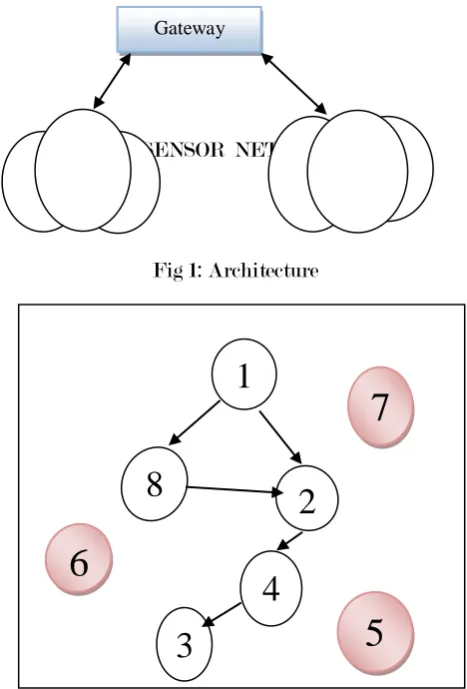
Fig 1: Architecture
Fig 2 : Flow of data at origin state and Standard states
Detector hubs must be recognized by alternate hubs by utilizing the joint undertaking of the considerable number of hubs[5,6]. On the off chance that there is a detector hub An and a detector hub 3, then the contiguous of 1 can be identified by 2 with the assistance of 6 and 4. Here 1 will be a source from where we are attempting to send the information to the destination hub 3. To do these there exist two ways, which is 16243 and the way 1243. This is the introductory revelation, it will demonstrate just the course from source to destination[6]. Here orange shading hubs speak to the hubs that are far from the system or the dead hubs. Also, dim shading hubs are the dynamic hubs.
II. LITERATURE REVIEW
While numerous papers have been composed on the best way to minimize vitality utilization in sensor systems, has not very many treated Express Between the postponement and vitality parity[6]. To the best of our
Gateway
1
7
8
2
6
4
5
insight, our work is the first to propose the designation of diverse wake-up Frequencies hubs to as per your part in the bundle sending procedure. Having respect to: the vitality dormancy tradeoff has been widely concentrated on, as in sensor systems, and in different remote
systems. In this segment, we present related works, and contrast their models and results and our own. In S-MAC convention parcel idleness created by intermittent dozing of moderate hubs is minimized by synchronizing wake-up calendars neighbor hubs. The obligation cycles of all hubs are equivalent and predefined[4,7]. The convention is not proposed to ensure an upper bound on end-to-end delay, however to minimize vitality utilization in the
hubs. Another paper proposes that minimize
postponement utilizing exceptional arranging of the hubs wake up periods. This paper expands another work by the same creators, where the hubs are composed in a unidirectional tree.
In [8,10] the creators address the exchange off in the middle of postponement and vitality in sensor systems from an alternate point of view. They are searching for an ideal directing way from a source hub to the door, dry season inactivity is minimized and vitality costs are not "too enormous." In their system model, sensors haphazardly exchanging in the middle of rest and dynamic modes. Two options are considered when a concentrated worldwide improvement methodology and a conveyed methodology. Vitality productivity can be accomplished in different ways. Case in point, vitality mindful directing When a steering way considering the vitality costs what's more, the sensor's accessible vitality. In the quantity of bounces along the sending way considered while recalling that transmission between close hubs are more vitality productive, regardless of the possibility that the subsequent course is longer[9].
The creators utilize a arbitrary system model to demonstrate the vitality idleness throughput habit and to locate the ideal transmission power for hubs in an impromptu system. As effectively said, we don't understand the directing issues in our work. The plan proposed in [11], and numerous others may be utilized for this reason. In [9,10], the tradeoff in the middle of vitality and inactivity is researched utilizing probabilistic processing. The bundles are not sent on predefined courses, as they are in our model, however are sent rather to all neighbors in dynamic mode. Subsequently, the system thickness and the obligation cycle ought to be sufficiently high to guarantee that every parcel will at last achieve its destination[11]. A probabilistic investigation discovers the segment of time every hub is obliged to be in a dynamic state with a specific end goal to guarantee that the parcel is conveyed to the door on time. This model varies from our own in
that our model does not utilize flooding and expect that hubs are mindful of their neighbor's obligation cycles.
The tradeoff in the middle of vitality and inertness all in all remote systems was likewise mulled over in an alternate connection. For sample, and explore this tradeoff when a system called "tweak scaling" is utilized. The creators base their work on the perception that, in numerous coding plans, the transmission of a parcel obliges a littler measure of vitality on the off chance that it keeps going longer. Two calculations are proposed: a disconnected from the net calculation that finds an ideal arrangement, and an on-line calculation that approximates the ideal arrangement. This methodology is taken further in [9,11]. The creators manage more broad setting, expecting that every parcel may have an alternate due date and number of bits. In , this issue is summed up by considering a total tree with parcels steered along the tree to the root. The expense is distinctive for every hub due to the diverse measures of information to be sent. The bundle ought to be conveyed to the sink inside of a restricted time period. The creators propose a logged off calculation for an ideal arrangement whose running time unpredictability is obscure, and an estimate calculation with pseudo-polynomial running time that needs to know the system topology. The primary model is concentrated on in, where a sensor picks one of the entryways while considering the vitality effectiveness of the steering, vitality assets of the middle sensors, and burden adjusting. The same model is moreover considered in [12],where the creators propose a few calculations for savvy entryway situation keeping in mind the end goal to lessen inactivity and spare vitality.
III.PROPOSEDWORK
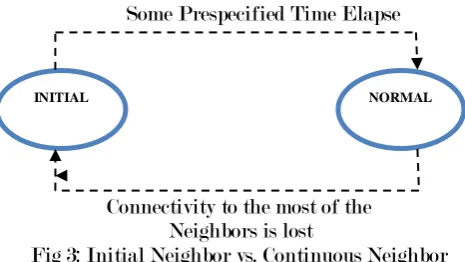
Hence, distinguishing new connections and hubs in sensor systems must be considered as a progressing procedure. In the
disclosure is performed when the sensor is as of now operational. This is a long haul transform, whose enhancement is significant for expanding system lifetime[9,12]. Conversely, starting neighbor disclosure must be executed by every sensor independently.
Some Prespecified Time Elapse
[image:4.595.43.276.148.279.2]
Connectivity to the most of the Neighbors is lost
Fig 3: Initial Neighbor vs. Continuous Neighbor Discovery
In this segment, we present the offbeat neighbor revelation issue, give its comparing hypothetical detailing, and create important assessment measurements for portable sensor systems[12,13]. For the advantage of the perused, we first present the basic neighbor disclosure issue, and later sum up the plan to portray the nonstop neighbor revelation issue. Versatile hubs in sensor arranges consistently move in space. Because of such movement, the system topology changes over the long run, hubs inside of correspondence reach may move more distant separated, and hubs outside the correspondence extent draw nearer to one another[13]. The neighbor revelation issue is one in which every portable hub stays informed concerning every single other hub inside of its correspondence range. This data changes over the long haul and a neighbor disclosure convention is utilized to persistently redesign it. The nonconcurring neighbor revelation issue is regularly experienced in versatile systems, where the portable hubs finding one another are not so much synchronized with one another[10,13]r. Here we are utilizing two principle revelation calculations in particular initial one is beginning disclosure and second is persistent disclosure. Those are clarified as underneath.
Initial neighbor discovery:
Starting neighbor disclosure is generally carried out or executed when the detector has no idea about the frame of its quick environment. In such a case, the sensor can't correspond with the door and is hence exceptionally restricted in performing its assignments[4]. The prompt environment ought to be recognized as quickly as time permits keeping in mind the end goal to set up a way to the door and add to the operation of the system. Thus, in this state, more broad vitality utilization is supported. Interestingly, constant neighbor revelation is generally
carried out or executed when the detector is performing [13]. This is a long haul handle, whose streamlining is significant for expanding system lifetime.
Continuous neighbor discovery:
At the point when detector is carried out or executed nonstop contiguous disclosure, it is mindful of the vast majority of its quick neighbors and can accordingly executed with it with these contiguous to expend less vitality[14]. Conversely, starting neighbor disclosure must be run by every detector independently. In a ceaseless neighbor revelation we are identifying every last bit of its neighboring hubs and selecting the most brief way for exchanging the record or the information.
IV. EFFECTUATION MODULES
Client-Servers
Recognizing all concealed associates within the segment and external segment
contiguous Discover Frame
Client – Server
It registering is disseminated access. host acknowledges demands for information from customer and returns the outcome to the customer[14,15]. By isolating information from the reckoning handling, the register server's preparing capacities can be advanced. Regularly customers and servers convey more than a PC organize on discrete equipment, yet both customer and server may dwell in the same framework[7].
Recognizing all concealed associates within the segment and external segment
This plan is summoned when another hub is found by one of the section hubs. The finding hub emerges an uncommon SYNC text to all fragment individuals, requesting that they wake up and intermittently telecast a group of text. This SYNC text is conveyed over the known remote connections of the portion[13,14]. Therefore, it is ensured to be gotten by every section hub. By having all the hubs wake up .very nearly in the meantime. for a brief time, we can guarantee that each remote connection between the portion's individuals will be identified. An irregular wake-up methodology is utilized to minimize the likelihood of rehashing crashes between the texts of hubs in an identical manner. Hypothetically, some other
plan might be utilized, at that portion hubs facilitate their wake-up periods to counteract impacts and accelerate the revelation of concealed hubs. As a time interval amid which each hub awakens limited, and the text Communication time is considerably limited in duration, the likelihood that two neighboring hubs will be dynamic in the meantime[15].
The finding hub issues a unique SYNC text to all portion individuals, requesting that they wake up and occasionally show a pack of ―Hi‖ text. This SYNC message is appropriated over the known remote connections of the portion. In this manner, it is ensured to be gotten by every fragment hub[13,15]. By having all the hubs wake up .practically in the meantime. for a brief time, we can guarantee that each remote connection between the portion's individuals will be identified.
An irregular awake methodology is utilized to belittle the likelihood of rehashing impacts among the ―Hi‖ text of hubs in the same portion[9]. Hypothetically, some other plan may be utilized, where section hubs facilitate their awake interval to anticipate impacts and accelerate the revelation of shrouded hubs. Since the time interval amid which each hub awakens is less , and the ―Hi‖ communicational time is considerably limited in duration , the likelihood that two adjacent hubs will be dynamic in the meantime[12].
The finding hub issues an exceptional SYNC message to all section individuals, requesting that they wake up and occasionally show a bundle of ―Hi‖ messages[12,15]. This SYNC message is circulated over the known remote connections of the section. Therefore, it is ensured to be gotten by every fragment hub. By having all the hubs wake up .just about in the meantime. for a brief time, we can guarantee that each remote connection between the portion's individuals will be identified[15].
contiguous Discover Frame
Neighbor Discovery is contemplated for general specially appointed remote systems. A hub chooses haphazardly when to start the transmission of a message[15,17]. In the event the text does not collapse into some other text , the hub is thought to be found. The objective is to Indus how the text communication recurrence, and the span of the neighbor disclosureopertaion.
Beginning Discovery Algorithm
INPUT: Sum of nodes with origin IP , terminus IP .
OUTPUT: observes the path from origin to terminus.
Input the no of nodes and provide the terminus address.
infix the origin nodes into the revelation tabular array database.
Find nearest node to the origin node and recruit it into the revelation tabular form , for next procedure assume it as origin node.
Detect the closest node to already discovered neighbor.
Repetition all the above strides till all hubs are determined.
Detect tabular array is currently bearing the passage of closest node to the origin to terminus. Utilizing these passages the information is exchanged from origin to terminus.
Continuous Neighbor Discovery Algorithm
INPUT: : Sum of nodes with origin IP , terminus IP OUTPUT: observes the path from origin to terminus
Input the no of nodes and provide the terminus address
infix the origin nodes into the revelation tabular array database.
Find nearest node to the origin node and recruit it into the revelation tabular form , for next procedure assume it as origin node.
If hub is lives go to 3rd step.
Detect tabular array is currently bearing the passage of closest node to the origin to terminus. Utilizing these passages the information is exchanged from origin to terminus.
Detect tabular array is the database kept up to stay communicated relating the conterminous.
V. COMPARISON
have given the vitality for every node, after eventually when the vitality finishes then that node is considered as a dead node and information is exchanged through staying dynamic nodes[18]. After some measure of time all the hubs will pass on, and there is no system is available to exchange the information. Be that as it may, in certifiable application the sensor system continues changing, means hubs may included or erased from the system. Henceforth we are considering the system as a dynamic sensor system[6,20]. Where we are considering the quantity of nodes and positions of the nodes are continues evolving frequently. We consider the criteria:
Number of hubs may increments in sensor system.
Number of hubs may diminishes in sensor system.
Energy level is altered.
The accompanying are the inconveniences of existing framework :
nah intimations about frame of quick environment.
grievous activity.
Is a hanker procedure.
Greater cost of vitality
overwhelm of this consequences we are present the ensuant schemes:
Removing dead hubs is stayed away from
estimated administration duration and information measure.
Traffic is insured and the procedure is stiller.
effective utilization of vitality and duration.
The quantity of hubs in a system may reversed.
VI. RESULT
A quality yield is one, which meets the necessities of the end client and presents the data plainly. In any
framework aftereffects of handling are conveyed to the clients and to other framework through yields. In yield plan it is resolved how the data is to be dislodged for quick need furthermore the printed copy yield [18]. It is the most vital and direct source data to the client. Effective and clever yield configuration enhances the framework's relationship to help client choice making.
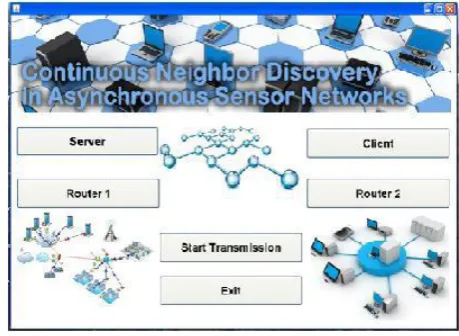
Fig 4. Segmented protrude
This is landing page of our venture, it comprises in catches, for example, server, client, router1,router2,start transmission and way out catch. On clicking every catch it performs diverse activity as indicated in next pages[20].
Fig 5: Modify the network by contributing stochastic number of hubs in router2
[image:6.595.319.549.172.340.2]Fig 6: Continuous uncovering route in modify network
When we tap on show exchange course it will seek the base way from source hub to destination hub and demonstrate the base course.
VII. CONCLUSION
We uncovered another issue in remote sensor systems, alluded to as uninterrupted ceaseless conterminous revelation. We contend that consistent conterminous revelation is critical regardless of the fact that the sensor hubs are dynamic. In the event that the hubs in an associated fragment cooperate on this errand, shrouded hubs are ensured to be distinguished inside of a sure likelihood P and a sure duration T, with decreased exhausted on the location. We demonstrated that our plan functions admirably if each hub associated with a portion gauges the in-fragment level of its conceivable shrouded neighbors. We then exhibited a constant neighbor revelation calculation that decides the recurrence with which each hub recruits the text duration. We reenacted a detector system to examine our calculations and demonstrated that when the concealed hubs are consistently circulated in the zone.
REFERENCE
[1]Reuven Cohen and Boris Kapchits, Continuous Neighbor Discovery in Asynchronous Sensor Networks IEEE/ACM transactions on networking, vol. 19, no. 1, feb 2011.
[2] S. Vasudevan, J. Kurose, and D. Towsley, On
neighbor discovery in wireless networks with directional antennas,. in INFOCOM, vol. 4, 2005, pp. 2502.2512.
[3] R. Madan and S. Lall, .An energy-optimal algorithm for neighbor discovery in wireless sensor networks,. Mob. Netw. Appl., vol. 11, no. 3, pp. 317.326, 2006.
[4] M. J. McGlynn and S. A. Borbash, .Birthday protocols for low energy deployment and flexible neighbor discovery in ad hoc wirelessnetworks,. in MobiHoc: Proceedings of the 2nd ACM International Symposium on Mobile Ad Hoc Networking and Computing. New York, NY,USA: ACM Press, 2001, pp. 137.145.
[5] D. Baker and A. Ephremides, .The architectural organization of a mobile radio network via a distributed algorithm,. in IEEE Transactions on Communications, vol. 29, Nov. 1981, pp. 694.1701.
[6] A. Keshavarzian and E. Uysal-Biyikoglu, .Energy-effcient link assessment in wireless sensor networks,. in INFOCOM, 2004.
[7] G. Alonso, E. Kranakis, R. Wattenhofer, and P. Widmayer, .Probabilistic protocols for node discovery in ad-hoc, single broadcast channel networks,. in IPDPS, 2003, p. 218.
[8] E. B. Hamida, G. Chelius, and E. Fleury, .Revisiting neighbor discovery with interferences consideration,. in PE-WASUN, 2006, pp. 74.81.
[9] S. A. Borbash, .Design considerations in wireless sensor networks,. Ph.D. dissertation, ISR, August 2004.
[10] Infrastructure-based routing in wireless mobile adhoc networks Computer Communications Volume 25, Issue 3, 15 February 2002, Pages 210-224 Ahmed Safwat, Hossam Hassanein
[11] K. Sohrabi, J. Gao, V. Ailawadhi, and G.J. Pottie, Protocols for self-organization of a wireless sensor network,., IEEE Personal Communications, vol. 7, no. 5, pp. 16-27, Oct. 2000.
[12] S. Vasudevan, J. Kurose, and D. Towsley, .On neighbor discovery in wireless networks with directional antennas,. In INFOCOM, vol. 4, 2005, pp. 2502.2512.
[13] R. Madan and S. Lall, .An energy-optimal algorithm for neighbor discovery in wireless sensor networks,. Mob. Network. Appl., vol. 11, no. 3, pp. 317.326, 2006.
[15] M. Haenggi, Opportunities and challenges in wireless sensor networks, in: M. Ilyas, I. Mahgoub (Eds.), Handbook of Sensor Networks: Compact Wireless and Wired Sensing Systems, CRC Press, Florida, 2004, pp. 1.1–1.14
[16] I.F. Akyildiz, W. Su, Y. Sankarasubramaniam, E. Cayirci, Wireless sensor networks: a survey, Elsevier Comput. Net-work 38 (4) (2002) 393–422
[17] M. J. McGlynn and S. A. Borbash, .Birthday protocols for low energy deployment and flexible neighbor discovery in
[18] D. Baker and A. Ephremides, .The architectural organization of a mobile radio network via a distributed algorithm,. in IEEE Transactions on Communications, vol. 29, Nov. 1981, pp. 1694.1701
. [19] A. Keshavarzian and E. Uysal-Biyikoglu, .Energy-effcient link assessment in wireless sensor networks,. in INFOCOM, 2004.
[20] E. B. Hamida, G. Chelius, and E. Fleury, .Revisiting neighbor discovery with interferences