Review
Pacing in congestive heart failure
Jayne A Morris-Thurgood and Michael P Frenneaux
University of Wales College of Medicine, Cardiff, UK
Abstract
Despite the major advances in medical drug therapy, heart failure remains a syndrome associated with high mortality and morbidity. Biventricular or left ventricular (LV) short atrioventricular (AV) delay pacing is being tested in congestive heart failure patients with left bundle branch block. The aim is to resynchronise the dyscoordinate LV contraction. A number of studies are underway, but it is clear that while some patients respond remarkably, this is highly variable. Accurate identification of patients likely to benefit will be crucial. The mechanism of benefit is unclear. A greater understanding of the physiological consequences of pacing will be necessary to accurately identify these patients.
Keywords:bundle branch block, haemodynamics, heart failure, pacing Received: 9 June 2000
Revisions requested: 18 July 2000 Revisions received: 3 August 2000 Accepted: 14 August 2000 Published: 11 October 2000
Curr Control Trials Cardiovasc Med2000, 1:107–114
The electronic version of this article can be found online at http://cvm.controlled-trials.com/content/1/2/107
© Current Controlled Trials Ltd
(Print ISSN 1468-6708; Online 1468-6694)
AV = atrioventricular; CHF = congestive heart failure; ICD = implantable cardioverter defibrillator; LBBB = left bundle branch block; LVEDP = left ventricular end diastolic pressure; MR = mitral regurgitation; RV = right ventricular; TR = tricuspid regurgitation.
Introduction
During the past two decades there have been major advances in the pharmacological treatment of chronic heart failure. Despite this, severe heart failure remains a syndrome associated with very high mortality, profound reduction in quality of life, and frequent hospitalisation. Cardiac transplantation can be an extremely effective therapy in such cases, but its provision is severely rationed by the lack of available donor organs. This rationing will remain unless xenotransplantation becomes a reality. Other cardiac surgical interventions including revasculari-sation, dynamic cardiomyoplasty and myocardial reduction surgery have been employed, but are currently of unproven value. It is in this context that pacemaker therapy
is currently being intensively evaluated as a therapy for such patients.
Short atrioventricular delay right-sided pacing
Initial interest in the role of pacing as a potential treatment for congestive heart failure (CHF) focused on prolonging diastolic filling time by reducing or abolishing presystolic AV valve regurgitation.
Rutishauser et alfirst reported the phenomenon of presys-tolic AV valve regurgitation in patients with CHF and com-plete heart block [1]. It became apparent with the advent of Doppler echocardiography that such presystolic regur-gitation of the mitral and/or tricuspid valves is common in
commentary
review
reports
patients with first-degree AV or complete heart block [2–4]. Presystolic regurgitation has also been reported in CHF patients with normal AV conduction times if left ven-tricular end diastolic pressure (LVEDP) is markedly increased [5,6]. The AV pressure gradient, when LVEDP is high and the conduction time is prolonged, is thought to reverse before the onset of ventricular systole. Although this promotes valve closure, there is incomplete closure, resulting in valvular regurgitation and reduced ventricular filling time. In the context of a ventricle that is abnormally stiff (and therefore highly dependent on filling time, espe-cially on exercise), this can have considerable adverse haemodynamic consequences. The presence of interven-tricular conduction prolongation (wide QRS complex) further shortens the left ventricular filling period [7].
Hochleitner et alfirst reported beneficial effects from dual-chamber short AV delay (100 ms) pacing in patients on a transplantation waiting list, but did not establish the mech-anism of benefit [8]. Brecker et al subsequently reported improved exercise capacity and haemodynamics in 12 CHF patients with short AV delay pacing. Pacing with a short AV interval eliminated the presystolic component of AV valve regurgitation and increased ventricular diastolic filling times [5]. These observations were supported by smaller uncontrolled studies [9,10]. Since then, further reports of unselected patients have shown no overall short- or medium-term benefits; while individual patients have improved, others have deteriorated [11–13].
These mixed results may be explained by the fact that bene-fits from the reduction in presystolic AV valve regurgitation may be offset by the electromechanical dyssynchrony of right ventricular (RV) pacing. Right-sided pacing results in paradoxical motion of the interventricular septum (as seen in left bundle branch block [LBBB]). This may adversely affect LV performance as it may reduce LV diastolic filling time, result in dyssynchronous (and inefficient) LV contraction and reverse the normal base–apex activation sequence.
In a study of patients with coronary heart disease but without CHF, Betocchi et aldemonstrated that right-sided AV sequential pacing caused an upward shift in the LV diastolic pressure–volume relation. There was also a reduction in LV peak filling rate, an increase in the time constant of isovolumic relaxation (tau), and a reduction in cardiac index [14]. Rosenqvist et alused radionuclide ven-triculography to assess exercise responses in 12 patients without CHF. Cardiac output measured on exercise (with similar heart rates) was higher during atria pacing than during either dual chamber pacing or ventricular pacing. Paradoxical septal motion was apparent during ventricular pacing and dual chamber pacing, with a 25% impairment of regional septal ejection fraction [15]. There is, therefore, clear evidence that RV pacing impairs both systolic and diastolic function of the LV in patients without CHF.
Attempts to normalise the base–apex electromechanical sequence have produced conflicting results. Several studies in normal dogs and in patients without CHF have suggested that pacing from the RV outflow tract or inter-ventricular septum may be superior to RV apical pacing [16–19]. Both acute haemodynamic and long-term studies in patients with CHF, however, have not shown any benefit [13,20,21].
Further evidence against RV pacing for CHF comes from the observation that it results in an increase in plasma nor-epinephrine levels [22] (a powerful adverse prognostic marker in CHF [23]).
The response to right-sided AV sequential pacing in CHF may depend on a balance between beneficial alleviation of presystolic mitral regurgitation (MR) and tricuspid regurgi-tation (TR) (in those patients with AV conduction delay and elevated LVEDP), and adverse consequences of dys-synchrony of left ventricular contraction and filling. Consis-tent with this, Nishimura et al reported that benefit was confined to those patients with presystolic MR and pro-longed AV conduction, whereas other patients showed a worsening of haemodynamics [10]. It has been sug-gested, on this basis, that the decision to implant such a pacemaker should be based on the haemodynamic response to an acute pacing study [24]. However, enthu-siasm for right-sided short AV delay pacing as a treatment for CHF has waned.
Biventricular and left ventricular pacing
commentary
review
reports
primary research
The long-term results of the ‘Resynchronisation for Heart Failure’ (In Sync) Trial were recently reported. This was an open study of biventricular pacing in patients with med-ically refractory NYHA III/IV heart failure with QRS dura-tion >150 ms and left ventricular ejecdura-tion fracdura-tion < 35%. The predetermined end points were 6 min walk distance, NYHA functional class and quality of life at 1, 3, 6 and 12 months versus baseline. There were significant improvements in all three parameters at each time point when compared with baseline [31].
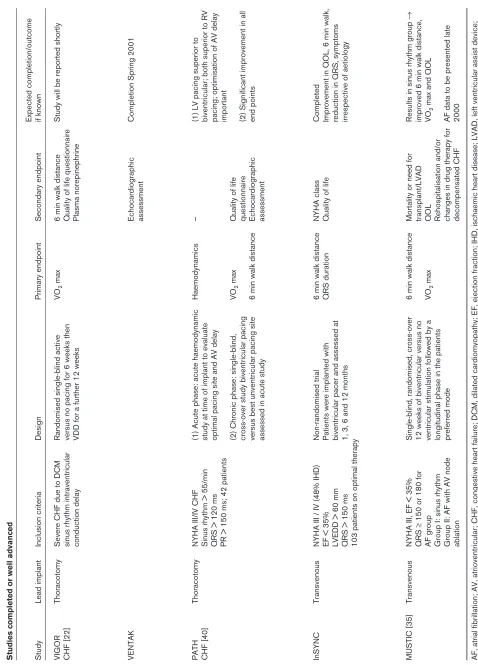
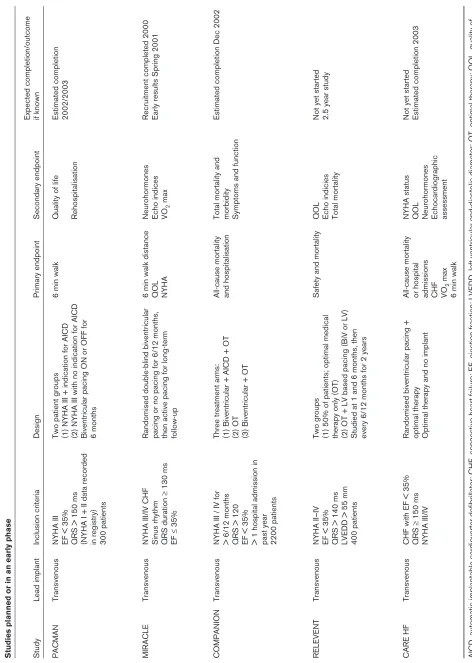
Several randomised and non-randomised studies of biventricular pacing are currently in progress or planned. Table 1 summarises the design (and where available results) of studies that are either completed or due to finish soon, whereas Table 2 lists the studies that have yet to commence or are in the early phases. Most of these studies are now assessing clinically important end points such as exercise capacity and quality of life in patients with severe CHF and LBBB. The Multisite Stim-ulation in Cardiomyopathy (MUSTIC) study [32] is the first single-blind, randomised, cross-over study of ventric-ular resynchronisation therapy in CHF. The cross-over design enabled patients to act as their own control, being paced for 3 months in each mode (ie biventricu-lar/no ventricular stimulation). The MUSTIC study con-tained two patient groups: one in sinus rhythm and one in atrial fibrillation post-atrioventricular nodal ablation. This is based on the previous demonstration that, among patients with CHF and poorly controlled atrial fibrillation, AV nodal ablation and right ventricular pacing can result in symptomatic improvement [33,34]. The inclusion crite-ria for all patients were NYHA class III or IV, an ejection fraction < 35% and significant ventricular conduction delay. The results of the sinus rhythm group have now been reported [35–37]. Biventricular pacing significantly improved both primary end points (VO2 max and 6 min walk distance). There were significant improvements in quality of life (Minnesota questionnaire) and also in rehospitalisation (both prespecified secondary end points). At the end of the cross-over phase, 86% of patients chose (blind) biventricular pacing as their pre-ferred mode for the longitudinal phase. Although further studies will need to address the question of mortality benefit, the availability of a non-pharmacological treat-ment that improves exercise capacity and quality of life would be a major advance. The quality-of-life issue is par-ticularly pertinent as the baseline data in MUSTIC con-firms the profound impairment of quality of life in NYHA class III and IV heart failure. The only concern is that some deaths occurred very soon after changes in pace-maker programming (ie soon after the cross-over from atria pacing to biventricular pacing or at the onset of biventricular pacing), raising the possibility that patients’ biventricular pacing may be arrhythmogenic, perhaps because of the presence of two ventricular activation
wave fronts. The timing of these few early deaths in a small subset may be a chance finding but requires clarifi-cation. One study has conversely shown a reduction in ventricular ectopic activity by biventricular pacing [38].
Preliminary results from the acute and chronic phases of the Pacing Therapies for Congestive Heart Failure (PATH-CHF) study have also been reported recently. The acute results emphasised the importance of optimising AV delay, and showed that LV pacing was superior to both RV pacing and biventricular pacing [39]. In the chronic study, significant improvements in VO2 max, quality of life, 6 minute walk distance, NYHA class and ejection fraction were observed, with a progressive increment of benefit over the first 6 months. This benefit remained stable between 6 and 12 months [40].
Results of VIGOR CHF will be reported shortly. Patients with severe CHF due to dilated cardiomyopathy in sinus rhythm with intraventricular conduction delay underwent biventricular pacemaker insertion at thoracotomy. A single-blind, cross-over phase of biventricular pacing or no ventricular stimulation (6 weeks in each phase) fol-lowed by a 12 week longitudinal paced phase is present. The primary end point is the measurement of VO2 max. Many patients with CHF meet the criteria for an implantable cardioverter defibrillator (ICD) [41]. Patients in VENTAK CHF with severe drug refractory CHF, a QRS duration >120 ms and indications for ICD implan-tation will undergo implanimplan-tation of a biventricular pace-maker/ICD. The study is otherwise similar to VIGOR CHF [22]. The end points of the two studies are the same except that antitachycardia and defibrillator effi-cacy and safety are included as additional secondary end points. The feasibility of combined trans-venous biventricular pacing/automatic implantable cardioverter defibrillator implantation has recently been reported [42], leading to the addition of an ICD/pacing limb to the MUSTIC study.
There are several studies in the ‘design and recruitment’ stage, some of which now address the issue of mortality and healthcare cost issues; for example, Cardiac Resyn-chronisation in Heart Failure (CARE-HF). This study aims to assess mortality in a controlled patient group by ran-domising patients to biventricular pacing and optimal therapy, or optimal therapy alone. All-cause mortality and hospital admissions for decompensated CHF will be eval-uated together with an assessment of a 6 minute walk dis-tance and VO2max. The second end points of this study will be NYHA status, mortality, quality of life, neurohor-mone levels and echocardiographic indices.
Table 1 Studies completed or well advanced
Expected completion/outcome
Study
Lead implant
Inclusion criteria
Design
Primary endpoint
Secondary endpoint
if known
VIGOR
Thoracotomy
Severe CHF due to DCM
Randomised single-blind active
VO
2
max
6 min walk distance
Study will be reported shortly
CHF [22]
sinus rhythm intraventricular
versus no pacing for 6 weeks then
Quality of life questionnaire
conduction delay
VDD for a further 12 weeks
Plasma norepinephrine
VENTAK
Echocardiographic
Completion Spring 2001
assessment
PATH
Thoracotomy
NYHA III/IV CHF
(1) Acute phase: acute haemodynamic
Haemodynamics
–
(1) LV pacing superior to
CHF [40]
Sinus rhythm > 55/min
study at time of implant to evaluate
biventricular; both superior to RV
QRS > 120 ms
optimal pacing site and AV delay
pacing; optimisation of AV delay
PR > 150 ms; 42 patients
important
(2) Chronic phase: single-blind,
VO
2
max
Quality of life
cross-over study biventricular pacing
questionnaire
(2) Significant improvement in all
versus best unventricular pacing site
6 min walk distance
Echocardiographic
end points
assessed in acute study
assessment
InSYNC
Transvenous
NYHA III / IV (48% IHD)
Non-randomised trial
6 min walk distance
NYHA class
Completed
EF < 35%
Patients were implanted with
QRS duration
Quality of life
Improvement in QOL, 6 min walk,
LVEDD > 60 mm
biventricular pacer and assessed at
reduction in QRS, symptoms
QRS > 150 ms
1, 3, 6 and 12 months
irrespective of aetiology
103 patients on optimal therapy
MUSTIC [35]
Transvenous
NYHA III, EF < 35%
Single-blind, randomised, cross-over
6 min walk distance
Mortality or need for
Results i
n sinus rhythm group
→
QRS
≥
150 or 180 for
12 weeks of biventricular versus no
transplant/LVAD
improved 6 min walk distance,
AF group
ventricular stimulation followed by a
VO
2
max
QOL
VO
2
max and QOL
Group I: sinus rhythm
longitudinal phase in the patients
Rehospitalisation and/or
Group II: AF with AV node
preferred mode
changes in drug therapy for
AF data to be presented late
ablation
decompensated CHF
2000
AF, atrial fibrillation; AV, atrioventricular; CHF, congestive heart failure; DCM, dilated cardiomyopathy; EF, ejection fractio
n; IHD, ischaemic heart disease; LVAD, left ventricular assist device;
commentary
review
reports
[image:5.612.71.543.82.745.2]primary research
Table 2 Studies planned or in an early phase
Expected completion/outcome
Study
Lead implant
Inclusion criteria
Design
Primary endpoint
Secondary endpoint
if known
PACMAN
Transvenous
NYHA III
Two patient groups
6 min walk
Quality of life
Estimated completion
EF < 35%
(1) NYHA III + indication for AICD
2002/2003
QRS > 150 ms
(2) NYHA III with no indication for AICD
Rehospitalisation
(NYHA I + II data recorded
Biventricular pacing ON or OFF for
in registry)
6 months
300 patients
MIRACLE
Transvenous
NYHA III/IV CHF
Randomised double-blind biventricular
6 min walk distance
Neurohormones
Recruitment completed 2
000
Sinus rhythm
pacing or no pacing for 6/12 months,
QOL
Echo indices
Early results Spring 2001
QRS duration
≥
130 ms
then active pacing for long-term
NYHA
VO
2
max
EF
≤
35%
follow-up
COMPANION
Transvenous
NYHA III / IV for
Three treatment arms:
All-cause mortality
Total mortality and
Estimated completion Dec 200
2
> 6/12 months
(1) Biventricular + AICD + OT
and hospitalisation
morbidity
QRS > 120
(2) OT
Symptoms and function
EF < 35%
(3) Biventricular + OT
> 1 hospital admission in past year 2200 patients
RELEVENT
Transvenous
NYHA II–IV
Two groups
Safety and mortality
QOL
Not yet started
EF < 35%
(1) 50% of patients; optimal medical
Echo indicies
2.5 year study
QRS > 140 ms
therapy only (OT)
Total mortality
LVEDD > 55 mm
(2) OT + LV based pacing (BiV or LV)
400 patients
Studied at 1 and 6 months, then every 6/12 months for 2 years
CARE HF
Transvenous
CHF with EF < 35%
Randomised biventricular pacing +
All-cause mortality
NYHA status
Not yet started
QRS
≥
150 ms
optimal therapy
or hospital
QOL
Estimated completion 2003
NYHA III/IV
Optimal therapy and no implant
admissions
Neurohormones
CHF
Echocardiographic
VO
2
max
assessment
6 min walk
AICD, automatic implantable cardioverter defibrillator; CHF, congestive heart failure; EF, ejection fraction; LVEDD, left ventr
icular end-diastolic diameter; OT, optimal therapy; QOL, quality of
The future
We are at a crucial point with this series of large clinical trials in the adoption or otherwise of pacing for the treat-ment of severe CHF.
Current philosophy on the use of pacing in CHF assumes that the mechanism of benefit arises from resynchronisa-tion of ventricular contracresynchronisa-tion in patients with LBBB. The major studies are therefore evaluating biventricular pacing in severe CHF associated with LBBB. The evidence in support of this mechanism is far from conclusive.
If the mechanism of benefit was due to a resynchronisation of both ventricles, then biventricular pacing (in which syn-chronous depolarisation occurs together with a narrowing of the QRS complex) would be expected to be superior to LV pacing (which is associated with a much broader QRS complex). In acute haemodynamic studies, however, LV pacing has been shown to be either equal to [29] or supe-rior to [21,39,43,44] biventricular pacing. We are not aware of any study showing the converse. Kass et al
reported that patients with the greatest QRS prolongation showed the greatest acute haemodynamic benefit, but there was no relationship between QRS narrowing associ-ated with pacing and acute haemodynamic improvement. LV pacing was specifically superior to biventricular pacing despite a much broader paced QRS complex. It is certainly true that analysis of pressure–volume loops suggested that the mechanism of benefit was an improvement in LV con-tractile function, with no significant change in LV diastolic compliance [21]. Varma et al, in a recent study, assessed the impact of different pacing sites on LV coordination using LV pressure–dimension loops in patients with CHF and LBBB. Dyssynchrony of intraventricular conduction results in a low ‘cycle efficiency’, yet there was no consis-tency regarding the optimal pacing chamber or site to improve cycle efficiency [45]. This group conversely observed that LV pacing provided greater overall acute haemodynamic benefit than biventricular pacing [44]. Kerwin et alrecently showed that biventricular pacing did not improve intraventricular dyssynchrony, but did improve interventricular dyssynchrony [46].
The mechanism(s) of acute haemodynamic benefit from biventricular pacing is therefore not understood. Although Kass et aldid not find evidence to support it, the possibil-ity of an improvement in diastolic filling cannot be excluded. Right ventricular pacing clearly worsens dias-tolic filling [14], so the converse with LV pacing is cer-tainly possible. CHF patients with high LVEDPs have marked diastolic ventricular interaction; that is, the filling of the LV is constrained by the RV and by the pericardium [47]. Our preliminary data suggests that, by permitting the LV to fill before the RV, LV pacing may improve filling in these patients with diastolic ventricular interaction, whether or not they have underlying LBBB [48,49].
All of these factors serve to emphasise the need to under-stand the effects of pacing on pathophysiology, in order to design optimally larger clinical trials. It is unlikely, given the non-uniform nature of the pathophysiology and the multi-ple potential effects of pacing (reduction in presystolic MR, recoordination of intraventricular versus interventricu-lar contraction sequence with improvement in both con-tractile and diastolic function), that a ‘one size fits all’ strategy is optimal. It is possible that benefit may not be confined to patients with LBBB, nor necessarily that all such patients will benefit. Furthermore, LV pacing may be superior to biventricular pacing. Previous experience of a dichotomy between symptomatic and prognostic effects with positive inotropic agents in CHF should sound a note of caution. Encouraging preliminary data in this regard suggest that the improvement in myocardial contractile performance with biventricular pacing is associated with a fall in myocardial O2 consumption [50]. Furthermore, whereas RV pacing increases plasma norepinephrine, biventricular pacing is associated with a reduction [22].
We strive to practice ‘evidence based medicine’. We must, however, remember that simply by virtue of their size, large ‘clinical trials’ will not always provide the answers for indi-vidual patients. Unless such studies are directed by a sound understanding of pathophysiology, of its non-unifor-mity, and of the effects of therapy on this pathophysiology, the wrong questions may be asked in the wrong patients. This may lead to inappropriate therapy for some patients and missed therapeutic opportunities for others.
Acknowledgement
The authors are both supported by the British Heart Foundation.
References
1. Rutishauser W, Wirz P, Gander M, Luthy E: Atriogenic diastolic
reflux in patients with atrioventricular block. Circulation1966, 34: 807–817.
2. Rokey R, Murphy DJ Jr, Nielsen AP, Abinader EG, Huhta JC, Quinones
MA: Detection of diastolic atrioventricular valvular regurgitation by pulsed Doppler echocardiography and its association with com-plete heart block. Am J Cardiol1986, 57:692–694.
3. Panidis IP, Ross J, Munley B, Nestico P, Mintz GS: Diastolic mitral
regurgitation in patients with atrioventricular conduction abnor-malities: a common finding by Doppler echocardiography. J Am
Coll Cardiol1986, 7:768–774.
4. Schnittger I, Appleton CP, Hatle LK, Popp RL: Diastolic mitral and
tricuspid regurgitation by Doppler echocardiography in patients with atrioventricular block: new insight into the mechanism of atri-oventricular valve closure. J Am Coll Cardiol1988, 11:83–88.
5. Brecker SJ, Xiao HB, Sparrow J, Gibson DG: Effects of
dual-chamber pacing with short atrioventricular delay in dilated car-diomyopathy. Lancet1992, 340:1308–1312.
6. Ishikawa T, Kimura K, Nihei T, Usui T, Kashiwagi M, Ishii M:
Relation-ship between diastolic mitral regurgitation and PQ intervals or cardiac function in patients implanted with DDD pacemakers.
Pacing Clin Electrophysiol1991, 14 (part 2):1797–1802.
7. Xiao HB, Lee CH, Gibson DG: Effect of left bundle branch block on
diastolic function in dilated cardiomyopathy. Br Heart J1991, 66: 443–447.
8. Hochleitner M, Hortnagl H, Ng CK, Hortnagl H, Gschnitzer F,
Zech-mann W: Usefulness of physiologic dual-chamber pacing in
drug-resistant idiopathic dilated cardiomyopathy. Am J Cardiol 1990,
9. Guardigli G, Ansani L, Percoco GF, Toselli T, Spisani P, Braggion G,
Antonioli GE: AV delay optimization and management of DDD
paced patients with dilated cardiomyopathy. Pacing Clin
Electro-physiol1994, 17 (part 2):1984–1988.
10. Nishimura RA, Hayes DL, Holmes DR Jr, Tajik AJ: Mechanism of
hemodynamic improvement by dual-chamber pacing for severe left ventricular dysfunction: an acute Doppler and catheterization hemodynamic study. J Am Coll Cardiol1995, 25:281–288.
11. Innes D, Leitch JW, Fletcher PJ: VDD pacing at short atrioventricular
intervals does not improve cardiac output in patients with dilated heart failure. Pacing Clin Electrophysiol1994, 17 (part 1):959–965. 12. Linde C, Gadler F, Edner M, Nordlander R, Rosenqvist M, Ryden L: Results of atrioventricular synchronous pacing with optimized delay in patients with severe congestive heart failure. Am J Cardiol
1995, 75:919–923.
13. Gold MR, Feliciano Z, Gottlieb SS, Fisher ML: Dual-chamber pacing
with a short atrioventricular delay in congestive heart failure: a randomized study. J Am Coll Cardiol1995, 26:967–973.
14. Betocchi S, Piscione F, Villari B, Pace L, Ciarmiello A, Perrone-Filardi
P, Salvatore C, Salvatore M, Chiariello M: Effects of induced
asyn-chrony on left ventricular diastolic function in patients with coro-nary artery disease. J Am Coll Cardiol1993, 21:1124–1131. 15. Rosenqvist M, Isaaz K, Botvinick EH, Dae MW, Cockrell J, Abbott JA,
Schiller NB, Griffin JC: Relative importance of activation sequence
compared to atrioventricular synchrony in left ventricular function.
Am J Cardiol1991, 67:148–156.
16. Cowell R, Morris-Thurgood J, Ilsley C, Paul V: Septal short
atrioven-tricular delay pacing: additional hemodynamic improvements in heart failure. Pacing Clin Electrophysiol 1994, 17 (part 2):1980– 1983.
17. Ishikawa T, Sumita S, Kikuchi M, Kosuge M, Sugano T, Shigemasa T,
Endo T, Kuji N, Kimura K, Tochikubo O, Ishii M: Hemodynamic
effects of right ventricular outflow pacing. J Cardiol1997, 30:125– 130.
18. Buckingham TA, Candinas R, Schlapfer J, Aebischer N, Jeanrenaud X,
Landolt J, Kappenberger L: Acute hemodynamic effects of
atrioven-tricular pacing at differing sites in the right ventricle individually and simultaneously. Pacing Clin Electrophysiol1997, 20 (part 1): 909–915.
19. Grover M, Glantz SA: Endocardial pacing site affects left
ventricu-lar end-diastolic volume and performance in the intact anes-thetized dog. Circ Res1983, 53:72–85.
20. Gold MR, Shorofsky SR, Metcalf MD, Feliciano Z, Fisher ML, Gottlieb SS: The acute hemodynamic effects of right ventricular septal pacing in patients with congestive heart failure secondary to ischemic or idiopathic dilated cardiomyopathy. Am J Cardiol1997,
79:679–681.
21. Kass DA, Chen CH, Curry C, Talbot M, Berger R, Fetics B, Nevo E: Improved left ventricular mechanics from acute VDD pacing in patients with dilated cardiomyopathy and ventricular conduction delay. Circulation1999, 99:1567–1573.
22. Saxon LA, Boehmer JP, Hummel J, Kacet S, De Marco T, Naccarelli G,
Daoud E: Biventricular pacing in patients with congestive heart
failure: two prospective randomized trials. The VIGOR CHF and VENTAK CHF investigators. Am J Cardiol1999, 83:120D–123D. 23. Cohn JN, Johnson GR, Shabetai R, Loeb H, Tristani F, Rector T, Smith
R, Fletcher R: Ejection fraction, peak exercise oxygen
consump-tion, cardiothoracic ratio, ventricular arrhythmias, and plasma nor-epinephrine as determinants of prognosis in heart failure. The V-HeFT VA Cooperative Studies Group. Circulation 1993, 87 (suppl):V15–V16.
24. Sack S, Franz R, Dagres N, Oldenburg O, Herrmann J, Golles A, Erbel R: Can right-sided atrioventricular sequential pacing provide benefit for selected patients with severe congestive heart failure?
Am J Cardiol1999, 83:124D–129D.
25. Aaronson KD, Schwartz JS, Chen TM, Wong KL, Goin JE, Mancini DM: Development and prospective validation of a clinical index to predict survival in ambulatory patients referred for cardiac trans-plant evaluation. Circulation1997, 95:2660–2667.
26. Cazeau S, Ritter P, Bakdach S, Lazarus A, Limousin M, Henao L,
Mundler O, Daubert JC, Mugica J: Four chamber pacing in dilated
cardiomyopathy. Pacing Clin Electrophysiol 1994, 17 (part 2): 1974–1979.
27. Bakker PF, Meijburg H, de Jonge N, van Mechelen R, Wittkamp F,
Mower M, Thomas A. Beneficial effects of biventricular pacing in
congestive heart failure [abstract]. Pacing Clin Electrophysiol
1994, 17:820.
28. Cazeau S, Ritter P, Lazarus A, Gras D, Backdach H, Mundler O,
Mugica J: Multisite pacing for end-stage heart failure: early
experi-ence. Pacing Clin Electrophysiol1996, 19 (part 2):1748–1757.
29. Blanc JJ, Etienne Y, Gilard M, Mansourati J, Munier S, Boschat J,
Benditt DG, Lurie KG: Evaluation of different ventricular pacing
sites in patients with severe heart failure: results of an acute hemodynamic study. Circulation1999, 96:3273–3277.
30. Leclercq C, Cazeau S, Le Breton H, Ritter P, Mabo Pgras D, Pavin D,
Lazarus A, Daubert JC: Acute hemodynamic effects of biventricular
ddd pacing in patients with end-stage heart failure. J Am Coll
Cardiol1998, 32:1825–1831.
31. Gras D, Ritter P, Lazarus A, Bizet C, Mabo P, Bucknall C, Tang ASL,
Luttikhuis HO, Kirstein-Pedersen A: Long-term outcome of
advanced heart failure patients with cardiac resynchronization therapy [abstract]. Pacing Clin Electrophysiol 2000, 23 (part II): 658.
32. Daubert C, Linde D, Cazeau S, Sutton R, Kappenberger L, Bailteul C: On behalf of the MUSTIC (Multisite Stimulation in Cardiomyopa-thy) study [abstract]. Arch Mal Coeur Vaiss1998, 91:154. 33. Brignole M, Menozzi C, Gianfranchi L, Musso G, Mureddu R, Bottoni
N, Lolli G: Assessment of atrioventricular junction ablation and
VVIR pacemaker versus pharmacological treatment in patients with heart failure and chronic atrial fibrillation: a randomized, con-trolled study. Circulation1998, 98:953–960.
34. Twidale N, McDonald T, Nave K, Seal A: Comparison of the effects
of AV nodal ablation versus AV nodal modification in patients with congestive heart failure and uncontrolled atrial fibrillation. Pacing
Clin Electrophysiol1998, 21 (part 1):641–651.
35. Ritter P, Gras D, Daubert C: Implant success rate of the
transve-nous left ventricular lead in the MUSTIC trial [abstract]. Pacing
Clin Electrophysiol2000, 23 (part II):580.
36. Ritter P, Gras D, Paul V, Daubert J, and investigators of the MUSTIC
study: Acute electrical performances of the left ventricular leads
implanted in the controlled MUSTIC trial. Europace2000, 1 (suppl
D):30–33.
37. Cazeau S, and investigators of the MUSTIC study: The MUSTIC
Study, clinical results of the crossover study. Europace 2000, 1 (suppl D):30–34.
38. Walker S, Levy T, Rex S, Brant S, Allen J, Paul V: Biventricular pacing
decreases ventricular arrhythmia. Europace 2000, 1 (suppl D): 163–164.
39. Auricchio A, Stellbrink C, Sack S, Block M, Vogt J, Bakker P, Mortensen
P, Klein H: The Pacing Therapies for Congestive Heart Failure
(PATH-CHF) study: rationale, design, and endpoints of a prospective randomized multicenter study. Am J Cardiol1999, 83:130D–135D. 40. Salo R, Auricchio A, Sack S, Kloss M, Kirkels H, Stellbrink C, Bocker
D, Vogt J, Bakker P, Potty P, Pochet T: Chronic benefit index (CBI)
summarizes PATH CHF chronic results [abstract]. Pacing Clin
Electrophysiol2000, 23 (part II):681.
41. Stellbrink C, Auricchio A, Diem B, Breithardt OA, Kloss M, Schondube
FA, Klein H, Messmer BJ, Hanrath P: Potential benefit of
biventricu-lar pacing in patients with congestive heart failure and ventricubiventricu-lar tachyarrhythmia. Am J Cardiol1999, 83:143D–150D.
42. Walker S, Levy T, Rex S, Brant S, Paul V: Preliminary results with
the simultaneous use of implantable cardioverter defibrillators and permanent biventricular pacemakers: implications for device interaction and development. Pacing Clin Electrophysiol2000, 23: 365–372.
43. Auricchio A, Stellbrink C, Block Msack S, Vogt J, Bakker P, Klein H,
Kramer A, Ding J, Salo R, Tockman B, Pochet T, Spinelli J: Effect of
pacing chamber and atrioventricular delay on acute systolic func-tion of paced patients with congestive heart failure. The Pacing Therapies for Congestive Heart Failure Study Group. The Guidant Congestive Heart Failure Research Group. Circulation1999, 99: 2993–3001.
44. Varma C, O’Callaghan P, New C, Meara M, McKenna W, Rowland E,
Brucker S: Which is the optimal site of pacing for heart failure?
Europace2000, 1 (suppl D):31–32.
45. Varma C, Callaghan P, New C, Meara M, Itnatkava K, Rowland E,
McKenna W, Brucker S: Does acute multisite pacing for heart
failure improve ventricular coordination? [Abstract]. Circulation
1999, 100:I-515.
46. Kerwin WF, Botvinick EH, O’Connell JW, Merrick SH, DeMarco T,
Chatterjee K, Scheibly K, Saxon LA: Ventricular contraction
abnor-malities in dilated cardiomyopathy: effect of biventricular pacing to correct interventricular dyssynchrony. J Am Coll Cardiol2000,
35:1221–1227.
commentary
review
reports
47. Atherton JJ, Moore TD, Lele SS, Thomson HL, Galbraith AJ, Belenkie I,
Tyberg JV, Frenneaux MP: Diastolic ventricular interaction in
chronic heart failure. Lancet1997, 349:1720–1724.
48. Morris-Thurgood J, Turner M, Nightingale A, Mumford C, Masani N,
Frenneaux M: Normal QRS duration should not be a
contraindica-tion to pacing for heart failure [abstract]. Europace2000, 1 (suppl
D):156/1.
49. Morris-Thurgood J, Turner M, Nightingale A, Mumford C, Masani N,
Frenneaux M: Is wedge pressure a predictor for success when
pacing patients for heart failure? [abstract]. Europace 2000, 1 (suppl D):156/5.
50. Nelson G, Berger R, Fetics B, Talbot M, Kass D: Left and
biventricu-lar resynchronization pacing in patients with dilated cardiomyopa-thy and intraventricular conduction delay achieves systolic benefit at reduced energetic cost. Europace2000, 1 (suppl D):212.
Authors’ affiliation: Department of Cardiology, Wales Heart Research Institute, University of Wales College of Medicine, Cardiff, UK