JULY-AUG, 2014. VOL-II/XIII www.srjis.com Page 1768
A STUDY OF FACTOR PATTERN IN ORDER TO DISCUSS THE CLUSTER IN
WHICH THE DIFFERENT ASPECTS OF CHEMISTRY FALL.
B. P. Singh, Ph. D.Associate Professor,MLRS PG College of Education,Charkhi Dadri(Bhiwani) Haryana
The present study was concerned with the investigation of factor pattern in order to discuss the clusters in which the different aspects of achievement in Chemistry fall at senior secondary level. Researcher constructed 18 achievement tests in Chemistry. Authentic scores obtained from reliable and valid objective type tests were taken into items and distributed over the whole course to get factors which were obtained after first reiteration. Orthogonal rotation had to be carried out and Turnstone’s method of Extended Vectors was used, as it leads to the simple structure. Only the first five factors were taken for rotation. The obtained results indicate that the fundamental abilities essential for learning Chemistry are: (a) Conceptual and Visual Perception (b) Deductive Reasoning (c) Mechanism and nomenclature (d) Numerical (e) Inference.
Keywords: Factors, Learning, Chemistry, Senior Secondary.
INTRODUCTION: There is a need to show balance between the aspirations of parents and abilities of their wards. Every parent is interested to enroll the ward in science stream to make him a good doctor, engineer or technocrat. His ward can be a good student only when he/she possesses requisite mental abilities required for the success of science courses. There are some specific cognitive abilities essential for each subject of science and technology. Some structure of intellect abilities have found related with Physics (Ignatz 1982, Spero 1974), Mathematics (Peterson 1965,Chauhan 1984), Biology (Chhikara 1984). Ptrich, PaulR(1990) found that self efficacy and intrinsic value were positively related to cognitive engagement and performance. Kember, David(2003) found that a student adopting a surface approach does not seek understanding and, therefore, relies upon memorization. GWO-Hshiang Tzen (2007) carried out
Scholarly Research Journal's is licensed Based on a work at www.srjis.com 4.194, 2013 SJIF© SRJIS 2014
SRJIS/BIMONTHLY/ B.P. SINGH (1768-1772)
JULY-AUG, 2014. VOL-II/XIII www.srjis.com Page 1769 a research on evaluating intertwined effect in e-learning programs. A novel hybrid MCDM Model based on factor analysis. Hilde Brand H.P (2011) conducted a research on a factorial study of introversion- extroversion and it was found that previous research suggested that Jung’s theory of psychological types could be best examined by factorial method.
A review of studies carried out in the field of factor analysis reveals that no systematic attempt has been made to assess the cognitive abilities in Chemistry. Since there is paucity of such studies, it is appropriate to investigate factor pattern in order to discuss the clusters in which the different aspects of achievement in Chemistry fall.
OBJECTIVE OF THE STUDY
1. To construct 18 objective type achievement tests for assessing the achievement in different
aspects of Chemistry at Senior Secondary level.
2. To find out the correlations between the achievements in different aspects and to apply factor
analysis in order to extract common factor.
3. To interpret the factors and study the factor-pattern in order to discuss the clusters in which the different aspects of achievements in Chemistry fall.
METHOD OF STUDY AND PROCEDURE
Researcher constructed 18 achievement tests covering entire curriculum of senior secondary. These tests were standardized; correlation matrix among them was obtained from reliable, valid objective items. Factors were found out by Centric Method. Orthogonal simple structure was not possible. Oblique rotation had to carried out and Thurston’s method of extended vector was used. SAMPLE: Sampling was done on two occasions. Try out test was administered to about 75 students out of theses 69 were selected at random to get data about each individual item. Sample of 250 students was taken finally.
INSTRUMENTATION: The researcher constructed 18 achievement tests for assessing achievements in different aspects of Chemistry. The purpose was to find out the inter correlations of the scores in different aspects for the factor analysis.
ANALYSIS OF DATA
Investigator decided to use the Centric method for factor analysis of the correlation matrix. Factor analysis was stopped after fifth factor after first reiteration as the loading of the sixth factor fell short of Guilford and Lacey’s Criterion. To give meaning and fixity to factor pattern
SRJIS/BIMONTHLY/ B.P. SINGH (1768-1772)
[image:3.612.64.531.129.490.2]JULY-AUG, 2014. VOL-II/XIII www.srjis.com Page 1770 structure was not possible. Oblique rotation had to be carried out and Turnstone’s method of extended vectors was used, as it leads to simple structure.
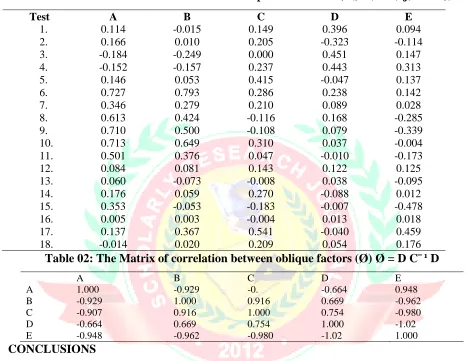
Table 01: Rotated Factor Matrix with Unexpended Vectors (V₁) V₁ = E₁aj₁ or Cᴧ₀₁
Test A B C D E
1. 0.114 -0.015 0.149 0.396 0.094
2. 0.166 0.010 0.205 -0.323 -0.114
3. -0.184 -0.249 0.000 0.451 0.147
4. -0.152 -0.157 0.237 0.443 0.313
5. 0.146 0.053 0.415 -0.047 0.137
6. 0.727 0.793 0.286 0.238 0.142
7. 0.346 0.279 0.210 0.089 0.028
8. 0.613 0.424 -0.116 0.168 -0.285
9. 0.710 0.500 -0.108 0.079 -0.339
10. 0.713 0.649 0.310 0.037 -0.004
11. 0.501 0.376 0.047 -0.010 -0.173
12. 0.084 0.081 0.143 0.122 0.125
13. 0.060 -0.073 -0.008 0.038 -0.095
14. 0.176 0.059 0.270 -0.088 0.012
15. 0.353 -0.053 -0.183 -0.007 -0.478
16. 0.005 0.003 -0.004 0.013 0.018
17. 0.137 0.367 0.541 -0.040 0.459
18. -0.014 0.020 0.209 0.054 0.176
Table 02: The Matrix of correlation between oblique factors (Ø) Ø = D C¯¹ D
A B C D E
A 1.000 -0.929 -0. -0.664 0.948
B -0.929 1.000 0.916 0.669 -0.962
C -0.907 0.916 1.000 0.754 -0.980
D -0.664 0.669 0.754 1.000 -1.02
E -0.948 -0.962 -0.980 -1.02 1.000
CONCLUSIONS
From the table 01, it is clear that test no 6, 10,9,8,11,15 and 7 are of conceptual nature. These seven tests relate to fundamental nature of Chemistry. This factor has highest loading on test no 6 (0.727), 10(0.713) and 9(0.710). These three tests require achievement in Chemistry; only then the students can differentiate between the related terms, facts, laws, principles, constitution of various compounds, properties, structures and figures. We may call “Factor A” a “Conceptual and Visual Perception Factor”. This factor has high correlation with factor E as discrimination requires a lot of judicious bent of mind.
SRJIS/BIMONTHLY/ B.P. SINGH (1768-1772)
JULY-AUG, 2014. VOL-II/XIII www.srjis.com Page 1771 reasoning is required to understand Chemistry. Similarly from table 02 Factor B has high correlation with factor C (Mechanism and Nomenclature) and D (Numerical Factor). Keeping in mind the above observations, Factor B is called “Deductive Reasoning” as it involves the
application of established facts and principle already learnt to apply in new situations.
Factor C has 0.541 loading on test no 17 (Mechanism aspect) as per table 01. This test measures the ability to know various steps involved in completing a reaction. This factor has 0.415 loading on test no 5 (Nomenclature aspect). This test is purported to measure the abilities to see whether the examinee is able to express the symbolic formula into word. Organic and inorganic chemistry can be understood only when a student is well aware with the IUPAC nomenclature as well as trivial name. This factor has appreciable correlations with Factor B (Deductive Reasoning) and D
(Numerical Factor). Mechanism of a reaction depends upon deductive reasoning as well as it involves mathematical calculations. Hence, this Factor C may be called as “Mechanism and Nomenclature factor”.
It is evident from table 01 that loading on test no 3(0.451), 4(0.443) and 1(0.396) for factor D shows mathematical manipulation for balancing of equations, writing of electronic configuration and in solving numerical. Factor D has appreciable correlation with factor B (Deductive Reasoning) and Factor C (Mechanism and Nomenclature) as per table 02. These factors B and C involve mathematical calculation. Hence, in light of above studies, it is reasonable to regard “Factor D” as a “Numerical Factor”.
From table 01, it is clear that factor E has 0.459 loading for test no 17(Mechanism Aspect) and 0.313 loading for test no 4 (Configuration Aspect). If a student knows about the electronic configuration of the element, he can easily interpret its valency, oxidation state, reactivity and stability. Similarly the mechanism of reaction also determines its reactivity. Factor E has correlation with Factor A (Conceptual and Visual Perception)as per table 02. It is reasonable to call Factor E as an “Inference Factor”.
REFERENCES
Anastasi, Anne: Differential Psychology (3rd.ed) New York; Macmilan, 1958. Anastasi, A: Psychological Testing, New York; Macmillan, 1968.
SRJIS/BIMONTHLY/ B.P. SINGH (1768-1772)
JULY-AUG, 2014. VOL-II/XIII www.srjis.com Page 1772 Comrey, Andrew, L: A first course in factor anaylsis, New York and London: Academic Press,
Inc. 1973.
Fruchter, B: Introduction to factor anaylsis, New York: Van Reinhold, 1954.
Guilford, J.P. : Psycholmetric Method (2nd. ed) Bombay and New Delhi: Tata Mc Graw-Hi11, Co. Ltd., 1954.
Garret, Henry E: Statistics in psychology and education, Bombay; Vakil Peffer and Simons Pvt. Ltd., 1969.
Guildford J.P.: Fundamental Statistics in Psychology and education (4th. Ed.) New York: Mc Graw- Hill Book Co., 1965.
GWO-Hshiung Tzeng (2007). Evaluating intertwined effects in e-learning programs. A novel
hyprid MCDM model based on factor analysis and DEMATEL; Science Direct; volume 32, Issue 4, May 2007.
H.P. HILDERBRAND (2011). A Factorial study of introversion- extraversion. British Journal of Psychology, Volume 49, Issue 1.
John, Mcleod (1968). Dyslexia in young children. A Factorial study with special reference to the Illinois test of psycholinguistic abilities, IREC, University of Illinois.
New York: Mc Graw-Hill Book Co., 1965. Indian Educational Review, NCERT, Oct. 1982.
Thorndike, R.L., and Egen, E; Measurement and evaluation in psychology and education