611
ANT-COLONY-ALGORITHM-SIMULATED-ANNEALING-ALGORITHM-BASED OPTIMIZATION APPROACH FOR
MCM INTERCONNECT TEST
1CHEN LEI
, Guilin University of Electronic Technology, P.R. China
E-mail: [email protected]
ABSTRACT
In this paper, a novel optimization approach based on ant colony algorithm (ACA) and simulated annealing algorithm (SA) is presented for the Multi-chip Module (MCM) interconnect test generation problem. In order to apply ACA into the interconnect test, the pheromone updating rule and state transition rule is designed by combing the characteristics of MCM interconnect test generation. By using the method, the ideal searching direction of global optimal solution could be found as soon as possible, while the shortcomings of high initial temperature required and slow convergence speed of SA were also overcame. ACA generates the initial candidate test vectors in this approach. In order to get the best test vector with the high fault coverage, SA is employed to evolve the candidates generated by ACA. The international standard MCM benchmark circuit was used to verify the approach. After comparing with not only the evolutionary algorithms, but also the deterministic algorithms, the simulation results indicate that this optimization approach can achieve high fault coverage, compact test set and short execution time.
Keywords: Ant Colony Algorithm (ACA), Simulated Annealing Algorithm (SA), Multi-chip Module (MCM)
1.
INTRODUCTIONWith rapid development of Multi-layer Printed Circuit Boards (MPCB), very large scale integration
(VLSI) and Multi-chip Module (MCM),
interconnect test technology has become a bottleneck in the application of these circuits. The high reliability of MCM is due to the welded and interconnected bare integrated circuit chips under high density and small dimension condition [1]. So, to study on new methods of interconnect test generation to acquire better test set is significant.
We consider the following classes of faults in MCM interconnect test [2]:
(1) Two-Net AND-type Short. If the drivers are such that a ‘0’ dominates, then the resultant logic value is an AND of the logic values on the individual nets.
(2) Two-Net OR-type Short. If the drivers are such that a ‘1’ dominates, then the resultant logic value is an OR of the logic values on the individual nets.
(3) Single-Net Faults. These are stuck-at-one, stuck-at-zero, and open faults on single nets.
The fault model allows for single or multiple occurrences of either two-net faults and for
single-net faults with deterministic behavior. The logic value on the net can also be non-deterministic or undefined. This behavior is not included in this fault model and not considered in the remainder of this paper.
Ant colony algorithm (ACA) [3, 4, and 5] is a population-based, self-adaptive search optimization technique. It is attached importance because it has general convergence similar to Genetic method, faster convergence velocity and small computational cost.
612 simulator is used to update the fault list of the circuit. The process is iterated until all faults are detected. By using this scheme, the ideal searching direction of global optimal solution could be found as soon as possible and the convergence speed of ACA was also improved, while the shortcomings of high initial temperature required and slow convergence speed of SA were also overcame. Simulation results of experiments on the international standard MCM circuit prove that the scheme is able to achieve very good performances, comparing with other algorithms.
The article is organized as follows. Section 2 focuses on descriptions of prior studies on the interconnect test generation. Section 3 is dedicated to the study of a hybrid optimization scheme for MCM test generation, which is based on the ACA and SA. Section 4 provides an overview of results on a set of standard test problems and comparisons of those by using the well-known deterministic algorithms and evolutionary algorithms. Section 5 briefly summarizes the simulation results and indicates directions for further research.
2.
LITERATURE REVIEWVarious deterministic interconnecting algorithms have been studied during recent years. We describe the performance of some representative algorithms as follows. For Counting Sequence Algorithm (CSA) [8] , log2N vectors are optimal for detecting all shorts in a circuit of N nets, while Modified Counting
Sequence Algorithm (MCSA)
needs
log
2(
N
+
2
)
[9] vectors for testing allfaults. In order to make the fault coverage rate equal to 100%, True/Compliment Algorithm (T/CA) generate 2log2(N+2) test vectors[2]; Walking One’s Algorithm (WOA) is a very common test approach for interconnect testing, whose test set length is N [2]. But these algorithms belong to the deterministic algorithms, and most of them can not achieve high fault coverage, compact test set and short execution time.
3.
ACA-SA-BASED HYBRID OPTIMIZATION APPROACHInformally, the proposed optimization
approach for the MCM interconnects test generation works as follows: ant algorithm is utilized to generate an initial population of individual test vectors. First, the initial population is generated randomly in this paper. Each ant gains a complete test vector by choosing the input value of each net according to a probabilistic state transition rule. Once all ants have completed their tours, the pheromone-updating rule is applied to compute the pheromone of ants. After the ACA-based optimization is completed, the best ants are selected and evolved by SA. When the evolutionary operation is completed, the best individual is selected and added to the test set. Then an interconnect fault simulator is used to update the fault list of the circuit. The process is I. Y
II. N
Generate the initial test vectors by using ant colony algorithm
End
Evaluate fitness of candidates utilizing fault simulator
Evolve populations of candidates by usingsimulated
annealing algorithm Start
Add the best candidate into the testvector set
All faults are detected?
613 iterated until all faults are detected. The whole process of the generation scheme is illustrated in Fig.1.
3.1 Ant Colony Algorithm
Informally, ACA used in MCM interconnecting test generation works as follows: Each ant generates a complete test vector by choosing the input value of each net, i.e. 0 or 1, according to a probabilistic state transition rule. Then an ant represents a test vector. Once all ants have completed their tours, the pheromone-updating rule is applied. In the following we discuss the state transition rule and pheromone-updating rule of ACA for MCM interconnect test.
The state transition rule for interconnecting test works as follows: Once all ants have built their tours, the value of the net is updated on all edges according to Eq. 1, i.e. the value of test vector will be changed form 0 to 1 or form 1 to 0:
=
>
otherwise
threshold
i
i
k
1
0
)
(
k
(
)
τ
γ
(1)Where _ ( )
_
vector faul k
threshold
all faul
= ,
vector_faul(k) is the number of faults from net k (k
∈ [1,2 …n]), n is the total number of ants;
all_faul means the total number of the tested circuit.
0 means that ifτk(i) is bigger than threshold,the
value of No. i net will be same; 1 means that if )
(i
k
τ is less than threshold, the value of No. i net
will be reversed, i.e. the input value of the net will be changed form 0 to 1 or form 1 to 0.
The pheromone-updating rule is intended to allocate a greater amount of pheromone to candidates that can detect more faults. After building a test vector of the test generation set, pheromone is updated on all nets by applying the pheromone-updating rule of Eq.2.
k k
k
i
ρ
τ
i
τ
τ
(
)
=
1(
−
)
⋅
(
−
)1
+
∆
(2)Where
( )
_
( )
_
( )
k
tested
fault k
i
all
fault k
τ
∆
=
,ρ
is the pheromone decay parameter, i∈ [1,2 …n])
is the number of nets, tested_fault(k) is the number
of faults which can be detected by ant k (k∈ [1,2
…m]), all_fault(k) means the total number of the
tested circuit when ant k is generating a test vector.
[image:3.612.95.517.535.632.2]Table 1. Simulation Results Of MCM Interconnect Test Compared With Other Algorithms
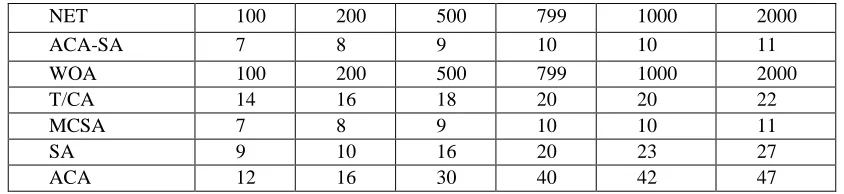
Table 2. Simulation Results Of Different Net Number Compared With Other Algorithms
3.2 Simulated Annealing Algorithm
In the process of SA, the algorithm accepts not only better neighboring solutions but also worse those with a certain probability. The probability of accepting a worse solution is large at higher temperatures. As the temperature T declines, the probability of accepting worse solutions decreases
as well. The annealing process first raises the system temperature to a sufficiently high level so that the system can search for all possible configurations. The temperature is then maintained at each level in next some steps, thereafter it gradually decreases until the desired configuration or the given low-temperature is attained. Because
Algorithms WOA T/CA MCS
A
SA AC
A
ACA-SA
execution time[s] 8 5 9 18 24 11
test set length 799 20 10 20 40 10
NET 100 200 500 799 1000 2000
ACA-SA 7 8 9 10 10 11
WOA 100 200 500 799 1000 2000
T/CA 14 16 18 20 20 22
MCSA 7 8 9 10 10 11
SA 9 10 16 20 23 27
614 of the strategy of Metropolis sampling, the algorithm can permit the existence of some ‘bad’ results, which prevents the system producing a local optimal result and instead approach a global optimal point. However, a long time is required to reach a status balance in every step of simulated annealing. And SA can only find a single result and is unsuitable for cases where more than one optimal answer exists. As a result, the SA algorithm is generally employed together with other intelligent algorithms.
The optimization process of SA for MCM interconnect test generation algorithm can be described as the following steps:
Step 1: Set the initial value of the artificial temperature as T0 and the internal number of iteration times as N. Then the initial solution can be obtained by using ACA.
Step 2. Each temperature T repeats as follows process:
Step 2.1 Generate the new solution from the current solution;
Step 2.2 calculate the △E, difference of the
evaluation function between the new and current
solution, and compute exp (-△E/kT) through the
criteria;
Step 2.3 a random floating number δ can be
derived from the uniform distribution in [0, 1];
Step 2.4 if exp (- △ E/kT)≥δ, the new solution is
accepted as the current solution, otherwise ignored;
Step 2.5 n, the iteration steps, is incremented. The procedures continued from Step 2.1 when n
≤N and from Step 3 when n>N;
Step 3. Reduced temperature T by setting T= r*T, where r is the temperature coefficient;
Step 4. The system performs the annealing process. When T decreases to preset threshold, the current solution is the final result and the algorithm terminates to an end; otherwise, the algorithm transfer Step 2.
An interconnecting circuit fault simulator is used to evaluate the fitness of each candidate. After the evolutionary operation is completed, the best individual evolved is selected and added to the test vector set. At the same time, the fault simulator is employed to update the fault list and to drop the detected faults.
4.
SIMULATION RESULTSThe ACA-SA-based optimization approach was implemented by using the interconnecting circuit fault simulator, which was written in C++ language. By using the ACA-SA-based test vector generator on a PIV1.6 computer with 128 MB memory, test vectors are generated for the mcc1-75 MCM interconnecting circuit provided by the MCNC group, which contains 799 nets and 320399 faults.
Given that the fault coverage rate of all algorithms is equal to 100%, results in the following tables are averaged over ten runs.
In all experiments of the following sections, the parameters of SA are set to the following values:
T0=50, N=20, r=0.75, Tend=0.1, where N is the
internal number of iteration times, T0 is the initial
value of the artificial temperature, r is the temperature coefficient, Tend is the temperature threshold.
The parameters of ACA are set to the following
values:
ρ
=0.78, m=10,τ
0= (n)-1, where n isthe number of interconnecting nets, m is the number of ants. These values were obtained by a preliminary optimization phase, where the experimental optimal values of the parameters were largely independent of the problem.
Test results compared with other algorithms are shown in Table 1. In the Table 1, the parameters of ACA are set the same as ACA-SA. In the Table 1, the parameters of SA are set as follows. Here we set the internal number of iteration times equal to 60, the initial value of the artificial temperature 50, the temperature coefficient 0.95, and the temperature threshold 0.05.
Results in Table 1 demonstrate that test set length of ACA-SA is only 1.3% that of WOA, 25% that of ACA, 50% that of SA, 50% that of T/CA, equal to that of MCSA. And the execution time of ACA-SA and MCSA is 11.0s and 9.0s respectively. The results indicate that the performance of the scheme in execution time, test set length and fault coverage is comparable to other interconnect generation algorithms.
Furthermore, test vectors are generated for the circuits with different net number by using different algorithms. Results in Table 2 show that the hybrid scheme can also achieve good performances.
Therefore, comparing with other algorithms, the
615 performances in execution time, fault coverage rate and test set length.
5.
CONCLUSIONSIn this paper, a new optimization scheme based on ACA and SA is developed for the MCM interconnect test generation problem. ACA generates the initial candidate vectors by utilizing the pheromone updating rule and state transition rule. Then SA evolves the candidates generated by ACA. A fault simulator is employed to compute the fitness of each candidate vector. The best individual is selected and added to the test set. Then the simulator is used to update the fault list of the tested circuit. The process is iterated until all faults are detected.
The international standard MCM benchmark circuit provided by the MCNC group was used to verify the approach. The results of simulation experiments, which compare to the results of standard simulated annealing algorithm and ant algorithm, show that the proposed scheme can achieve higher fault coverage and more compact test sets. At the same time, simulation results of this approach are compared with other deterministic interconnecting algorithms. Simulation results indicate that the optimization approach is able to achieve very good performances in execution time and fault coverage.
REFRENCES:
[1] Doane D A, Franzon P D., Multichip Module Technologies and Alternatives: the Basics, Brooks Publishing Company (New York, 1995), pp. 1-85.
[2] Najmi Jarwalw and Chi W. Yau, “A New framework for analyzing test generation and diagnosis algorithms for wiring interconnects,” Proceedings of International Test Conference, (1989), pp.63-70.
[3] Schoonderwoerd R., Holland O., Bruten J., “Ant-based Load Balancing in Telecommunications Networks,” Adaptive Behavior, vol. 5, issue 2, (1997), pp.169~207. [4] Dorigo M., Gambarddella L. M., “Ant Colony
System: A Cooperative Learning Approach to the Traveling Salesman Problem,” IEEE Trans. Evol. Comp, vol. 1, (1997), pp.53~56.
[5] Stutzle T, Hoos HH: MAX-MIN ant system and local search for the traveling salesman problem. IEEE Int’l Conf. on Evolutionary Computation. Indianapolis, (1997), p. 309~314.
[6] L. Wang , “Intelligent Optimization Algorithms with Application ,” Beijing Tsinghua University Press, 2001.
[7] S. Kirkpatrick, C. D. Gelatt, and M. P. Vecchi,
“Optimization by simulated annealing,”
Science, 1983, vol. 220, pp. 671-689.
[8] W.K.Kautz, “Testing of faults in wiring interconnects,” IEEE Transaction on Computer, Vol C-23, No.4, (1974), pp.358-363.