THE IMPACT OF GAMES ON LEARNING OF NUMERACY IN
MATHEMATICS
Usha A. Borkar
Assistant Professor,Gujarat Research Society’s HansrajJivandas College of Education
The objective of the study was to teach the topic of Numeracy in Mathematics to Standard Two level students through Games and study its effect on academic achievement. The sample for the study consisted of 29 girls and 39 boys studying in Maharashtra State Board located in North Mumbai.Pre test posttest single group design was followed for the study. There was considerable improvement in the academic achievement of the students in the selected topic while learning through games. There was no difference in the academic achievement of the girls and boys.
Key Words: Mathematics, Numeracy, Academic achievement, and Games
INTRODUCTION
Mathematics is the science of measurement, quantity and magnitude. It is the numerical and
calculation part of man’s life and knowledge. It helps man to give exact interpretation to his
ideas and conclusions. It deals with quantitative facts and relationships as well as with problems involving space and form. It also deals with relationship between magnitudes. It enables man to study various phenomena in space and establish various relationships among them. It is also called the science of logical reasoning. In it, we approach everything with a question mark in our mind; the results are developed through a process of reasoning.
The importance of mathematics in day-to-day life and as a school subject is undisputed.
Today’s children are tomorrow’s citizens. As a child, s/he should learn mathematics, so that
as a citizen s/he can be successful in his daily activities.
Globally education authorities are placing increasing emphasis on the development of literacy and numeracy in primary schools. This study reports on research designed to assist teachers to improve the numeracy of their students by making the use of mathematics games a more focused aspect of the teaching and learning experience in mathematics. Classroom experience and anecdotal evidence suggest that games are often used without really focusing on the
having ‘fun’. The present study involves the use of game on Numeracy andthe impact on the
children’s learning when using the game.
The use of mathematics games is often cited as an effective strategy for teaching mathematics. However, the researchers were unsure whether games are being used as supplementary activities for children who finish their ‘real’ work early, as busy work, or used with a real purpose. Although children may be having ‘fun’, the belief is that this is not
sufficient reason for their inclusion in a mathematics program.
Literature Review
While it may be assumed that the use of games in the teaching of mathematics has been researched, a brief literature review revealed that surprisingly little empirical research into the use of games has been carried out. Often teachers assume that the use of games is an effective teaching tool. This may not be the case (Bragg, 2006).
Many researchers have presented the use of games as a beneficial tool in the mathematics classroom (Bragg, 2006; Booker, 2000; Gough, 1999; Ainly, 1990). Also numerous researchers assert that games should not just be restricted to practice and that they can be an effective vehicle for teaching new concepts to children (Bright, Harvey & Wheeler, 1985, Kamii& De Clark, 1985; Thomas & Grows, 1984; Burnett, 1992; Booker, 2000)
Clearly, what is important is the structure of the games used (Ainley, 1990; Badham, 1997) and the literature does highlight that if this structure is not provided learning does not always take place (Onslow, 1990; Burnett, 1992).
Objectives
The main objectives of the study were as follows:
1. To find out the level of achievement of Standard IIpupils in mathematics in the topic of Numeracy.
2. To teach the topic of Numeracy in mathematics to the Standard II through Numeracy games.
3. To find out the level of achievement of the Standard II pupils in mathematics, in the topic of Numeracy after teaching through Numeracy games.
4. To compare the pre-test and post test levels of achievement of the Standard II pupils in the topic of Numeracy in mathematics.
Action Hypothesis
Sample
The sample consisted of 39 girls and 29 boys studying in Standard II of Maharashtra State Board school situated in North Mumbai.
Tools
Parallel tests of achievement on the topic of numeracy were used for the pre test and posttest. Researcher made achievement test was used to measure the academic achievement level of the pupils in the topic of Numeracy in Mathematics. The content area was restricted to the four basic operations in Mathematics.
[image:3.595.68.524.254.492.2]Table 1 provides details with respect to the type of questions that were included in the achievement test.
Table 1
Type of Questions
Sr. No
Question Type Number of Questions Marks
1 Multiple Choice 5 5
2 Fill in the Blanks 5 5
3 True or False 5 5
4 Matching Type 5 5
5 Life Oriented 5 5
Total 25 25
In all, there were 25 questions in the test paper in the achievement test. The maximum marks a pupil could score is 25 and the minimum is 0. Parallel tests of achievement were prepared.
The researcher developed a practice game on numeracy involving mental computation that, at its simplest level, deals with addition of numbers from 1 to 15. This can be extended to include subtraction, multiplication, division, fractions, square and cube roots, square numbers and cubic numbers. In this study the researcher did not go beyond the four operations when playing the game.
Methodology
through the Numeracy games for a period of two months. At the end of two months the pupils were once again tested (post test). The marks obtained by the pupils in the pre test and posttest was subjected to statistical analysis.
Analysis and Interpretation
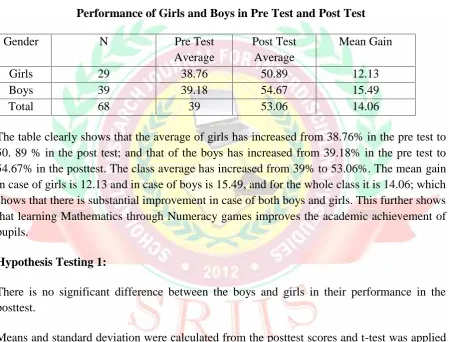
The performance of the pupils in the pre test and on the posttest was compared. The class average of the girls and the boys in pre test and posttest was calculated (Table 2)
Table 2
Performance of Girls and Boys in Pre Test and Post Test
Gender N Pre Test
Average
Post Test Average
Mean Gain
Girls 29 38.76 50.89 12.13
Boys 39 39.18 54.67 15.49
Total 68 39 53.06 14.06
The table clearly shows that the average of girls has increased from 38.76% in the pre test to 50. 89 % in the post test; and that of the boys has increased from 39.18% in the pre test to 54.67% in the posttest. The class average has increased from 39% to 53.06%. The mean gain in case of girls is 12.13 and in case of boys is 15.49, and for the whole class it is 14.06; which shows that there is substantial improvement in case of both boys and girls. This further shows that learning Mathematics through Numeracy games improves the academic achievement of pupils.
Hypothesis Testing 1:
There is no significant difference between the boys and girls in their performance in the posttest.
[image:4.595.76.526.231.573.2]Means and standard deviation were calculated from the posttest scores and t-test was applied to verify the hypothesis.
Table 3
Means, S.D.s and t- value for the Posttest Scores
Gender N Mean SD t-value
Girls 29 50.89 20.95
0.79
The t-value calculated was less than the theoretical value at 0.05 level. Hence the null hypothesis was accepted at 0.05 level of significance.
There is no significant difference between girls and boys in the posttest scores. This shows that both the boys and girls have performed equally in spite of the fact that the mean value of boys is higher than that of boys.
This further shows that both the boys and girls have benefitted equally through this work.
[image:5.595.67.527.245.486.2]Hypothesis Testing 2: There is no significant difference between the pre test and poat test scores of the pupils.
Table 4
Means, S.D.s and t- value for the Pretest scores and Posttest Scores
Test N Mean SD t-value
Pre Test 68 39 3.36
28.12
Post Test 68 53.06 2.53
Since the t- value obtained was greater that the table value at 0.05 level of significance, the null hypothesis was rejected.
The higher mean value in the posttest showed that the performance of the pupils in the post test was better that that in the pre test.
This shows that Numeracy games have helped the pupils to learn Mathematics better. The academic achievement of the pupils has improved better than at the initial level. This further shows that learning through Numeracy games is a better and easier way of learning Mathematics.
Conclusions:
The present study shows clearly that learning Mathematics through Games has resulted in improved academic achievement and in better understanding of Mathematics. The study also showed that there is no gender difference; both the girls and boys have benefitted equally by learning Mathematics through games.This research has helped to show that, given the right conditions, games can achieve an increase in basic fact skills in a stimulating and enjoyable environment.
children's mathematics education: international perspectives (pp. 84-91). Hillsdale, NJ: Erlbaum.
Asplin, P. (2003). An investigation into the effectiveness of Numero in learning mental mathematics in Year 6 Unpublished honours thesis, Curtin University, Perth, Australia.
Badham, V. (1997).Mathematical games for older primary students. Reflections, 22(1), 17-21.l
Booker, G. (2000).Instructional games in the teaching and learning of mathematics. In H. Forgasz, T. Jones, G. Leder, J. Lynch, K. Maguire & C. Pearn (Eds.), Mathematics: Making connections (pp. 77- 82). Brunswick, Victoria: The Mathematical Association of Victoria.
Bragg, L. A. (2006). The impact of mathematical games on learning, attitudes, and behaviours.Unpublished doctoral thesis, La Trobe University, Bundoora, Australia.
Bright, G. W., Harvey, J. G., & Wheeler, M. M. (1985). Learning and mathematics games.Journal for Research in Mathematics Education, Monograph Number 1, 1-189.
Burnett, L. (1992). Using instructional games to construct number understanding and skills. In M. Horne & M. Supple (Eds.), Mathematics: Meeting the challenge (pp. 223-228). Melbourne: The Mathematical Association of Victoria.
Gough J. (1999). Playing mathematical games: when is a game not a game ?Australian Primary Mathematics Classroom, 4(2), 12-15.
Harvey, J. G., & Bright, G. W. (1985). Basic math games. Palo Alto, California: Dale Seymour Publications.
Kamii, C. K., &DeClark, G. (1985). Young children reinvent arithmetic: Implications of Piaget's theory. New York: Teachers College Press.
Kemmis, S., &McTaggart, R., Eds. (1988). The action research planner, third edition. Victoria: Deakin University.
Miles, M.B., &Huberman, M.A. (1994). Qualitative data analysis.Thousand Oaks, CA: Sage. Onslow, B. (1990). Overcoming conceptual obstacles: The qualified use of a game. School Science andMathematics, 90(7), 581-592.
Thomas, W. E., &Grouws, D. A. (1984). Inducing cognitive growth in concrete-operational college students. School Science and Mathematics, 84(3), 233-243.