ISSN: 1992-8645 www.jatit.org E-ISSN: 1817-3195
MULTI-METHOD INTEGRATED ON SOC ESTIMATION OF
LI-ION BATTERY
1 FENG JIN, 2HE YONG-LING
1 Assoc. Prof., Beijing University of Aeronautics and Astronautics, Beijing, China ;
Guilin University of Aerospace Technology, Guilin, China
2Professor, Beijing University of Aeronautics and Astronautics, Beijing, China
E-mail: [email protected], [email protected]
ABSTRACT
The Li-ion battery is studied base on its equivalent circuit model. The discrete state space equation is established using Ah counting method and OCV method. The filtering algorithm is set up under the noisy environments according to the principle of extended Kalman filter and simulated. The simulation results showed that the integrated of three algorithms could very well remove the environments noise, so the accurate estimate of Li-ion battery SOC value can be gained.
Keywords:Li-ion battery, SOC estimation, Ah counting method, OCV method; EKF
1. INTRODUCTION
State of charge (SOC) is defined as the ratio between the stored energy available and the energy available in a fully charged state. SOC estimation correctly can not only avoid the danger of over-charging or over-discharging which may damage the battery but also provide the strategy for vehicle control to use the battery energy reasonable. So that the electric vehicles (EV) can control and predict the driving range effectively and ultimately achieve the purpose of energy saving, environmental protection, and to extend the life of the battery pack.
SOC value can’t be measured directly. But it can be estimated by some physical characteristics like terminal voltage, current, temperature etc. combinating with battery external characteristic and working status. The estimation precision is influenced by voltage, charge-discharge rate, power, temperature, cycle life, internal resistance, the internal pressure, self-discharge rate, etc. Environmental noise can’t be ignored.
The main method of battery SOC estimation includes discharge experiment method, ampere-hour (Ah) counting method, open circuit voltage (OCV) method, load voltage method, electrochemical impedance spectrum method, the internal resistance method, the linear model method, neural network method and Kalman filter(KF) method. The discharge experiment method is the most reliable method, however battery should be stop working for experiment. So
it is only suitable for cell maintenance. The OCV method is very accurate, but it needs a rest time to estimate the SOC and thus cannot be used in real time. Ah counting method is a kind of open-loop test, which is simple and easy to utilize. It can be used in real time, however it is so sensitive to external interference that an initial value error and accumulated error will increases by time. Load voltage method, electrochemical impedance spectrum method, the internal resistance method is only suitable for low SOC estimation because it is too sensitive to environment noise. The neural network method and KF method requires a suitable battery math model, it is difficult to determine the internal parameters [1-4].
In this study, the Li-ion battery is for research. The battery equivalent circuit model was set up. According to the equivalent model, the state-space equations are used to describe the system performance. And then, three method, Ah counting method, OCV method, extended Kalman filter (EKF) method, are integrated to be a kind of new algorithm which is used to estimate the battery SOC in noisy environments. Finally, the simulation is conducted for verification.
1. PROPOSED APPROACH
1.1 AH Counting Method
a “black box”, by integuating the current flows into and out of the battery, the change of the battery charge can be gained. So it is unnecessary to consider the battery internal state of the change or other factors. In this case, at every instant of time, the SOC would be equal to:
0
0
0
( ) ( )k ( ) tk
t
i t
SOC t SOC t dt
C
η
= +
∫
(1)Where SOC(t0) is supposed the initial state of
charge, SOC(tk) is SOC at tk times, i(t) is the battery current, η is the efficiency of charge or discharge, C0 is the battery rated capacity.
As the equation (1) shows, the initial condition for the SOC can’t be determined from the integration of the current, therefore, SOC(t0) should be confirmed using other method. The other disadvantage is that the measurement of the current can be affected by noisy enviroment. When the current signal is sampled, thereby introducing discretization errors [3].
1.2. OCV Method
The open circuit voltage is defined as the voltage measured at the battery terminals when no load is applied and all internal processes are completely relaxed. It is equal to the electromotive force of the battery under the conditions of long standing. Meanwhile, the electromotive force of the battery has a relatively fixed functional relationship with SOC, so it can be estimated based on the open-circuit voltage.
( )
ocv
U =f SOC (2) Where Uocv is open circuit voltage.
The functional relationship of the Uocv–SOC is obtained by measuring the open-circuit voltage at each SOC. The relationship cannot be exactly the same for every battery. Thus, the use of the relationship among batteries may cause an unacceptable error in the SOC estimation [1].
1.3. EKF Method
KF is an optimal recursive data processing algorithm. It is applied to the linear system with the noise statistical properties been known. Using recursive iterative algorithm and having no requirement in system signal’ stability and time invariance, KF is the most efficient and effective method to many problems. After linearization, KF is also used to recursive calculation to nonlinear systems. This method is also known as the EKF.
As far as Li-ion battery is concerned, EKF algorithm can not only give the amended SOC , but also to reflect the confidence of the estimated value. So, it has high application value for the situation that electric vehicles have changing current in actual operation. And the inconsistencies between single cell in the battery pack also can be forecasted early. In practical application, the Li-ion battery pack is always taken as a complete dynamic system, SOC is used as one of the system state variables. Then, error caused by system noise and measurement can be effective suppressed through updating the system state parameters based on the error between measured value and estimated value[4-7].
2. STATE-SPACE EQUATION
ESTABLISHED
2.1. Battery Model Design
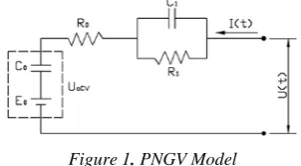
The best equivalent circuit model should be the simplest still capable of capturing all the relevant dynamics of the Li-ion battery system for the purposes of SOC estimation. The United States proposed equivalent circuit model of battery in the Partnership for a New Generation of Vehicles (PNGV) in 2001 named PNGV model as shown in Figure 1. It describes the internal resistance with ohmic resistance R0, the changes of electromotive
[image:2.612.349.500.511.594.2]force with C0, battery polarization with R1, C1. The model has clear physical meaning and higher accuracy. It has good applicability to many work condition. Equation of state space could also be derived for analysis and application. So this model is now commonly used.
Figure 1. PNGV Model
ISSN: 1992-8645 www.jatit.org E-ISSN: 1817-3195
Figure 2. HPPC test profile
Figure 3. HPPC Voltage Response Curve
2.2. State-space equations
Using Kirchoff’s current law and the definition of ideal capacitor, the differential equation is:
1 1
1 1 1
( )
c c
dU U I t
dt = −R C + C (3)
ocv
U describes the battery open circuit voltage according to OCV method, then the system output could be written as:
1 0
( ) ocv C ( )
U t =U −U −I t R (4) Setting [ ( ) 1( )]
T C
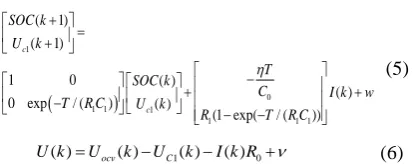
X= SOC k U k as state variables, and using Ah counting method, discrete state space equation could be written as:
( )
1
0
1 1 1
1 1 1
( 1)
( 1)
1 0 ( )
( )
0 exp / ( ) ( )
(1 exp( / ( ))
c
c
SOC k
U k
T SOC k
C I k w T R C U k
R T R C
η +
=
+
−
+ +
−
− −
(5)
1 0
( ) ocv( ) C( ) ( )
U k =U k −U k −I k R +ν (6) Where T is sampling time, w is the input noise, v is the measurement noise.
3. THE INTEGRATED ALGORITHM
ESTABLISHMENT BASED ON PNGV
MODEL
3.1. Linearization Of The Parameters Of The
State-Space Equation
According to the state equation as above equation (5), coefficient matrix could be written as follow:
(
1 1)
1 0
0 exp / ( )
k
A
T R C
= −
,
0 1(1 exp( / ( 1 1)) k
T C B
R T R C
η
−
=
− −
,
In the measurement equation as shown in equation (6) ,Uocv( )k , which is fitted by SOC data
from experiment, is a nonlinear function. So it needs to be linearization. Using the last iteration results as basis point, Uocv is conducted Taylor
series expansion along it. Taking the linear part, the coefficient of measurement equation could be obtained [5]:
(
)
1
( | 1)
( ) ( ) ( )
1
k
c
soc soc k k
U k U k U k
C
X SOC U
f SOC
SOC = −
∂ ∂ ∂
= =
∂ ∂ ∂
∂
= −
∂
Where SOCk|k-1 is one of the estimation of the state variable.
3.2. The Integrated Algorithm Establishment
The integrated algorithm consists of three steps. The first step: using OCV method to determine the initial state variable. The second step: using EKF method to make the state variable converge to the true value. The third step: using Ah counting method to estimate the follow up state variable. According to the three steps, a set of equations can be obtained to achieve the algorithm. This set of equations combine two categories, one of which is the time update, which predicts the state variable and error covariance, and the other is the measurement update, which calibrate the state variable and error covariance.
1) Time update
1 1
k k k k k
X A X B u
∧
[image:3.612.90.297.497.581.2]1 1
T
k k k
k k
P
−=
A P A
− (8)Where Xk k 1
∧
− is the predict value of state
variable at k-1 step to k step. Pk k−1 is the predict
of error covariance at k-1 step to k step. Pk−1 is
the error covariance.
The two time update equations update the state variable and the predict error covariance from k-1 step to k step.
2) Measurement update
1
1 ( 1 )
T T
k k k k k k k k k
K =P −C C P −C +R − (9)
1 ( ) ( )
k k
k k
X X K U k U k
∧ ∧ ∧
−
= + −
(10)
1
( )
k k k k k
P = −I K C P − (11)
Where Kkis the gain, Rk is the independent,
zero-mean, Gaussian noise processes of covariance matrix. Xk
∧
is the estimate value at k step. U k( )is the measured value. Uk
∧
is estimate value of measurement.
The measurement update equations compare measured value U(k) with predicted value. The difference is used to correct the state estimations and covariance estimations. Through times of iteration, the estimation matches the real quantities [5][10].
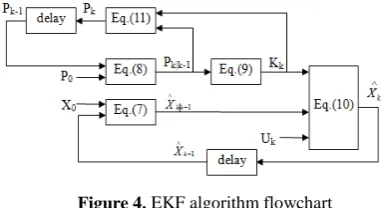
[image:4.612.346.500.260.370.2]The EKF algorithm iterative process for Li-ion battery SOC is shown in Figure 4:
Figure 4. EKF algorithm flowchart
According to the iterative calculation process above, if the initial values including state variable X0 , covariance P0 and the measured value Uk are imported to system. The iterative process can constantly revises the estimate value according to measured values. Then, through continuous
feedback correction like “prediction-validation-prediction”, the estimated
value tends to match the real quantities.
4. EXPERIMENT AND SIMULATION
ANALYSIS
To verify the algorithm, pulse discharge current is applied to the Li-ion battery pack as excitation. The initial SOC is 100%, the pulse amplitude Id = 20A, the pulse duration is 20S. At the end of the pulse, 60s data sampling is continue. The collected data, which is used to estimate the state variable, is the measurement value of system output. The SOC estimate model is set up according to Equation 7 to 11 as well as the flowchart shown in Figure 4. The simulation results are shown in Figure 5.
0 20 40 60 80
0.94 0.96 0.98 1
time(s)
SO
C
Figure 5. Result Of SOC Estimate Simulation
As we can see in Figure 5, the SOC estimate value through EKF algorithm simulation in the noise environment is 0.9911, at end of the 20s discharge duration. Meanwhile the SOC value according to theoretical calculation is 0.9926. Therefore, the error between simulation and theoretical calculation is only 0.15%. Although SOC value has a short wave after discharge stopping, it finally can be recovered to the estimation state though 40s duration. The results show that the EKF algorithm this paper proposed, which can eliminate the environment noise and measurement error, is fitted for Li-ion battery SOC estimation of electric vehicle.
5. CONCLUSION
[image:4.612.96.290.494.598.2]ISSN: 1992-8645 www.jatit.org E-ISSN: 1817-3195
the accurate estimate of Li-ion battery SOC value can be gained.
ACKNOWLEDGMENTS
The authors gratefully acknowledge the support of the Beijing University of Aeronautics and Astronautics and the Guilin University of Aerospace Technology. The work is supported by the project of the Guilin University of Aerospace Technology under Grant No. X12Z002 and the project of featured program construction and curriculum integration of Guangxi high school under Grant No.GXTSZY125.
REFERENCES
[1] Seongjun Lee, Jonghoon Kim, Jaemoon Lee, B.H.Cho. State-of-charge and capacity estimation of lithium-ion battery using a new open-circuit voltage versus state-of-charge. Journal of Power Sources 185(2008)1367-1373
[2] Raffaele Bornatico, Andrea Storti, Leonardo Mandrioli, Annalisa Zappavigna, Yann Guezennec, Giorgio Rizzoni. NIMH Battery Characterization and State-of-Charge Estimation for HEV Applications. In proceedings of IMECE2007 (2007 ASME International Mechanical Engineering Congress and Exposition)
[3] LIN Chengtao, CHEN Quanshi, WANG Junping, HUANG Wenhua, WANG Yanchao. Improved Ah counting method for state of charge estimation of electric vehicle batteries. Journal of Tsinghua University (Sci &Tech), 2006, Vol.46,No.2:247-251
[4] Hongwen He, Rui Xiong, Xiaowei Zhang, Fengchun Sun, and JinXin Fan. State-of-Charge Estimation of the Lithium-Ion Battery Using an Adaptive Extended Kalman Filter Based on an Improved Thevenin Model. IEEE TRANSACTIONS ON VEHICULAR TECHNOLOGY, VOL. 60, NO. 4, MAY 2011:1461-1469
[5] Yu chang-guan. Modern control theory and applications(second edition). Harbin: Harbin Institute of Technology Press. 2007.10 . [6] Jaemoon Lee, Oanyong Nam, B.H.Cho.
Li-ion battery SOC estimation method based on the reduced order extended Kalman filtering. Journal of Power Sources 174(2007)9-15
[7] XIA Chao-ying, ZHANG Shu,SUN Hong-tao. A strategy of estimating state of charge base on extened Kalman filter. Chinese Journal of Power Sources
[8] Feng Jin, He Yong-ling: The method research of parameter identification of Li-ion battery base on least square method Advanced
Material Research. Vols. 490-495(2012):3854-3858
[9] Wei Xuezhe, Sun Zechang, Tian Jiaqing: Parameter identification and state estimation of li-ion power battery in hybrid electric vehicle. Journal of Tongji University (Natural Science). 2008.36(2): p.231~235 .