3523
A FRAMEWORK OF IMPROVING BUSINESS PRCOESS
EXECUTION USING SOCIAL ARTIFACTS
1ABDULLAH AL-BARAKATI1, 1AHMED BARNAWI1, 1FUAD BAJABER1, 1ABDULLAH
ALMALAIS1, 1SEYED BUHARI1, 2RADWA EL SHAWI
1King Abdulaziz University, Faculty of Computing and IT, Jeddah, Saudi Arabia
2Princess Nora bint Abdul Rahman University, Riyadh, Saudi Arabia
E-mail: 1{aaalbarakati, ambarnawi, fbajaber, aalmalaise, mibuhari} @kau.edu.sa, 2[email protected]
ABSTRACT
A growing number of enterprises are seeking for socializing their business processes (BP) and capitalizing on Web 2.0 technologies and solutions in order to improve communication and content sharing among their stakeholders. To this end, it becomes crucial for enterprises to design social-based business process techniques (i.e., a process, language and tool) to transform its BPs into social BPs. This article discusses a set of methods that guide the transformation based on the socialization goals of the enterprise. The approach uses social relations that connect tasks/persons/machines together. These relations are the basis of developing specialized networks that capture the interactions during business process execution and are used to recommend corrective actions when conflicts on resources occur. The approach relies on three flows known as control, communication, and navigation. The control flow connects tasks together with respect to a certain business logic. The communication flow captures the messages exchanged between persons/machines when they perform tasks of processes. Finally, the navigation flow captures the interactions between specialized networks that offer solutions to exceptions. A validating scenario is used to show the effectiveness of the proposed methods.
Keywords: Business Process, Social Process, Process Compliance, modelling, social BP
1. INTRODUCTION
There are no doubts that the Web is now the platform of choice when conducting online business. Launched in the 90s as a simple tool for users to browse Web applications, the Web now is a dynamic and robust platform upon which organizations run their business and people engage in activities. These activities take different shapes ranging from posting notes to exchanging messages and lately sharing personal experiences with strangers. Accessibility, ease-of-use, and reliability are some of the salient features behind the Web adoption.
Although the research community continues to look into the Web from a technical perspective, a social perspective has emerged lately following Web 2.0 technologies releases that are also strengthening the open and dynamic nature of the Web. There is a growing interest in examining how to make the social Web an integral part of applications related to for instance, learning [1], healthcare [2], and commerce [3]. Injecting social elements like collegiality and friendship into online
applications could enhance user experiences with these applications. Many enterprises are recognizing the crucial need of Web 2.0: “enterprise spending on Web 2.0 technologies will grow strongly over the next five years, reaching $4.6 billion globally by 2013, with social networking, Mashups, and RSS capturing the greatest share" [4]. The social Web lets people be proactive by contributing to online content (e.g., Wikis), seeking others assistance (e.g., crowdsourcing), and alerting people (e.g., tweets).
3524 categories: managed and unmanaged. The former requires a central orchestration of all process tasks to carry out, which eases monitoring and responding to exceptions. Contrarily the latter requires a decentralized orchestration of all process tasks to carry out, which complexities monitoring and even worsen the compliance management process [42,43,44].
According to Gartner, ``many large companies are embracing internal social networks, but for the most part, they’re not getting much from them’’ [5]. In addition to inadequate leadership and technology overemphasis as the most cited reasons, we consider another reason that undermines these networks adoption, which is lack of tangible benefits that show the value-added of these networks to enterprises’ operations. Enterprises are still not sure about the return-on-investment of Web 2.0 technologies (Seshadri, 2009), although expenses on these technologies are skyrocketing and reached $4.6 billion globally by 2013 [2]. With this large amount of investment enterprises need to be coached on how their applications should effectively exploit Web 2.0 technologies so that relevant information about markets’ trends, consumers’ habits, suppliers’ strategies, to cite just a few can be drawn.
In practice, social Web platforms share some common characteristics such as:
Open: the social Web is not restricted to any category of users or organizations. The expectations of Web 2.0 applications use are different but they are available for all.
Scalable: the social Web has featured a phenomenal growth since the release of the first Web 2.0 applications. This growth puts pressure on the IT infrastructure supporting these applications.
Ubiquitous: the social Web is taking advantage of the mobile computing development giving users the opportunity to use Web 2.0 applications anywhere and anytime.
Diversity: the social Web features a rich unstructured content (on top of structured) and supports different content formats such as text, video, audio, and/or image.
Loose control: the social Web does not impose restrictions on who can join, what can be posted, what can be shared, etc. In principle, the social enterprise should
not restrict itself to social relations between persons, only Other components of the enterprise could be connected together as well using appropriate relations. Kajan et al. discuss social tasks and social machines [7], Burégio et al. discuss social machines as well [8], and Badia discusses social databases [9]. With the support of other peers, any component of the enterprise can be able to compose networks based on which social queries can be performed [10]. Supporting our thoughts that today’s objects can be socialized, Tan et al. state that “Currently, most social networks connect people or groups who expose similar interests or features. In the near future, we expect that such networks will connect other entities, such as software components, Web-based services, data resources, and workflows. More importantly, the interactions among people and nonhuman artifacts have significantly enhanced data scientists' productivity” [11]. In general, many of the available Web 2.0 technologies have started in the open Web such as, e.g., blogs, social networks, Wiki systems, and have since been customized within enterprises’ contexts to accommodate their specific needs and requirements. However, far too often enterprises decide to try specific technologies without having a clear idea of why they are doing so.
In this article, we present a set of methods that guide the transformation based on the socialization goals of the enterprise. The approach uses social relations that connect tasks/persons/machines together. These relations are the basis of developing specialized networks that capture the interactions during business process execution and are used to recommend corrective actions when conflicts on resources occur. The approach relies on three flows known as control, communication, and navigation. The control flow connects tasks together with respect to a certain business logic. The communication flow captures the messages exchanged between persons/machines when they perform tasks of processes. Finally, the navigation flow captures the interactions between specialized networks that offer solutions to exceptions.
2. SOCIAL SOFTWARE
3525 note “the huge gap between business process management technologies, usage patterns, and workflows on the one hand, and social computing as it is known today” [12]. Examining this blend could help fill in this gap. In the literature, there is no agreement on specific or standard definition of social software. Warr states that “social software includes a large number of tools used for online communication, e.g., instant messaging, text chat, internet fora, weblogs, Wikis, social network services, social guides, social bookmarking, social citations, social libraries, and virtual worlds” [13]. For Schmidt and Nurcan, social software supports productivity raising the level and scope of interactions because of the sue of computers and networks [14]. Erol et al. note that social software’s roots can be traced back to the 40s and add that “impressive results are created without a central plan or organization. Instead, social software uses a self-organization and bottom-up approach where interaction is coordinated by the “collective intelligence” of the individuals; the latter does not necessarily know each other and are a priori not organized in a hierarchy. Furthermore, social software follows a rather egalitarian approach; decisions are not made by small elites but by combining a multitude of inputs from different users” [15]. For Liptchinsky et al., social software “fosters collaboration of individuals who work across time, space, cultural, and organizational boundaries” [16]. People engage in conversations and transactions so that common deliverables are produced promptly and with minimum of conflicts. Finally, Bruno et al. identify the four characteristics of social software [17]: (i) weak ties are spontaneously established contacts creating new views on problems and allowing competency combination, (ii) social production breaks with the paradigm of centralized a priori planning of production and promotes unforeseen and innovative contributors and contributions, (iii) egalitarianism abolishes hierarchical structures, merges the roles of contributors and consumers, and introduces a culture of trust, and (iv) mutual service provisioning changes the cooperation model from a client-server model to a model based on exchanging services.
The blend of social software with business processes is reported through- out the literature. In [18], Rito Silva et al. describe the AGILIPO project that embeds social software features into business process tools. Business processes are incomplete by nature and thus, human assistance is always required. The AGILIPO modeling and execution
environment includes three roles namely executor, modeler, and developer that stakeholders take over. Executor conducts business process execution either by making use of specified activities or by creating generic activities whenever the specified activities are not sufficient. Modeler changes the business process model by specifying new non-automated activities. Finally, developer may consider automating the non-automated activities. To foster collaboration among these stakeholders, social software features such as tagging, versioning, comments, and rating are adopted [49]. In [19], Brambilla et al. propose a specific notation to design social business processes. Social networking helps organizations harness the value of information relations and weak ties without compromising the consolidated business practices that are found in conventional business process management solutions. Despite these benefits there is a lack of appropriate notations to reflect social aspects on business process models. Brambilla et al.’s notation includes a set of event and task types like broadcast, posting, and invitation to activity. In [20], Koschmider et al. show how social networks help enhance trust among users. Two networks are built upon a set of business processes and recommendations. The first network provides an organizational view of business processes by suggesting for instance, the average distance between performers who participated in existing business processes and those who are now participating in developing business processes. The second network shows the relations among modelers who use the recommendation system to build the business process model. In [21], Grim-Yefsah et al. reveal the existence of informal networks that people at work rely on to conduct their business. These networks co-exist perfectly with regular networks where formal relations like supervision are reported. Grim-Yefsah et al. discuss how the “official” executor of a task seeks informally help from other persons in the organization known as contributors. The help takes different forms like asking for advices or confirming a technical detail. The contributors are contacted because of their tacit knowledge that cannot be shared nor transmitted easily. The informal networks are here to back the work of regular networks.
3526 established contracts are detected so that corrective actions are taken. The monitoring is not limited to the status of a process, but, also, includes consumers' requirements reported in contracts' clauses. Comuzzi et al., also, consider business-network evolution in terms of new/previous contracts that are introduced/updated or dropped, or new/old partners that join/leave the network. Requirement monitoring spans over multiple interrelated contracts between partners. Contracts that establish collaboration between partners might not be sufficient to track the processes since the contracts are established prior to execution. As a result, a proactive monitoring approach is required at run time.
The aforementioned initiatives on social-software blend with business processes focus particularly on how social relations are reflected on business processes. However, a good number of questions remain unanswered like what social relations are appropriate for the particular context of companies, how business processes are adjusted in response to these relations, and what value- added these relations offer to companies, are left unanswered. Our proposed methods and framework are designed to apply social-based techniques to improve the various aspects of business process management and execution. The proposed methods contribute towards significantly improving the efficiency and quality of business processes in the context of business enterprises.
3. TYPES OF BUSINESS PROCESSES
In principle, business process management (BPM) is inspired by the fact that every product or a service is the result of a set of tasks executed by organization members in raw inputs to produce the product that is of value to the customer. Therefore, a business process is described as a set of tasks that are executed in coordination with various technical and organizational aspects. In particular, each business process should have a goal, e.g., issuing permission, and it might interact with different organizations in order to fulfil this goal.
In practice, on the design phase of a business process, business process models are usually developed by business analysts or a process designer with the goal to collect and organize the business requirements, facilitate a common understanding of business processes, enable interaction and communication among business analysts and IT experts, specify opportunities for
process improvement and act as the base knowledge for executing business processes. In particular, the design of a business process model plays the role of creating the process schema. However, in reality, many business processes are executed without any pre-defined schema.
[image:4.612.315.520.382.551.2]Ideally, the execution of a business process is orchestrated via a central process engine. In particular, the responsibility of that engine is to guarantee a faithful execution of the processes. That is, tasks within the process are executed within the same order as indicated in the process model; tasks are assigned to exactly the roles that are indicated in the process model, etc. Unfortunately, the existence of a central execution engine is rare. Most of organizations have their processes enacted unmanaged. Yet, these processes are supported by IT Systems for their individual steps. For instance, in the execution of a single process, there might be a customer relationship management (CRM) system to store clients' data and other tailored ERP systems to support other steps/tasks of the same process instance.
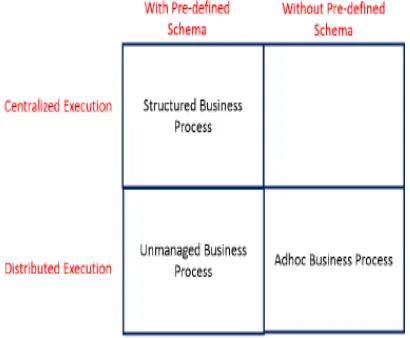
Figure 1: Categories of Business Process
In principle, business processes can be classified according to their design and execution strategies into the following categories (Figure 1):
Structured Business Process: represents the business process which have a pre-defined schema (business process model) and are executed using central process execution engine.
3527
Unmanaged Business Process: the processes of this categories lie in the middle between the structured and adhoc business process. In particular, this category represents the business process which have a pre-defined schema but their execution is achieved by multiple system without any central execution management entity.
4. BUSINESS PROCESS LIFE CYCLE
In general, the ideal situation to enact a business process is to have a dedicated execution engine that guarantees that process execution strictly follows the process model. However, in most of real world scenarios, there is no such execution engine. There are many reasons for not having such an engine. First, the maturity of the organization has not reached that level where all or most of the processes are well known and well configured. The second reason is the size of the organization. Small to medium organizations are not willing to invest in the purchase of process execution software as it represents an overhead of their investments. Third reason is the lack of process awareness in the organization. That is, the administration starting from top-level management down to the operational level is not aware of the notion of the process. Each role as only a local view on what they are doing without a global view on an end-to-end product. Nevertheless, the lack of automated process support does not imply the lack of IT-Systems support at all. Still, it could be the case that individual tasks or activities are supported by IT-Systems or social tools and the flow among these systems is hard-coded within applications. This will be our starting point. That is, we will investigate how the emerging technologies and platforms of the social web can be capitalized so that they can effectively contribute to the overall unmanaged business process life cycle.
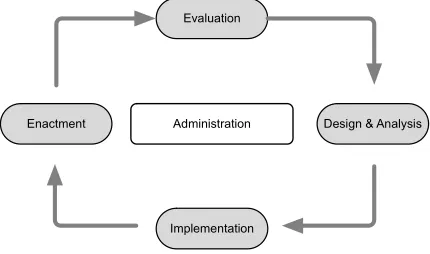
As illustrated in Figure 2, there are four basic phases in the business process lifecycle. To help clarify the results of these phases we establish an analogy with database design. The “Design & Analysis” phase is mainly concerned with the design-time aspects of business process models. One major activity in that phase is to identify and model business processes. The design of a process model is similar to designing the conceptual, ER-schema, model of a database. In this phase, for business processes, all tasks contributing to the business process are identified. Also, the execution ordering, control flow, as well as data flow among
[image:5.612.314.529.296.423.2]these tasks is modeled. Moreover, the organizational aspect might be modeled. For instance, assignment of certain tasks to roles within the organization can be modeled at this phase. The implementation phase is concerned with the transformation of the conceptual process model to notation ready for execution. This is similar to the translation of a conceptual data scheme to, e.g., the relational representation of a specific DBMS. As in the database domain, there might be more than one notation and language for the modeling and the implementation. Thus, the transformation depends on both the source and target notation. In the enactment phase, a business process is put into production. That is, instances of the business process can be created to represent different cases.
Figure 2: Business Process Life Cycle
The last phase in the lifecycle is the evaluation phase. In this phase, post execution analysis is performed. One example of such analysis is performance analysis. Measures like average execution time, bottlenecks, and workload are indicated. The purpose of such evaluation is to see whether processes perform as expected and if there are any deficiencies to avoid them in future. The outcome of that phase might lead to a new cycle where the process model is enhanced and follow up phases are revisited.
In principle, social software provides a good opportunity for integrating all stakeholders into the business process life-cycle and provides new chances for a more flexible and effective design of business processes. For example, the modelling of business processes can particularly profit from exploiting social software methods by alleviating the need of integrating process knowledge from the various stakeholders. Furthermore, the implementation and deployment phase of the business process lifecycle may profit from social software by gathering valuable information for continuous process improvement
Administration Design & Analysis
Implementation Enactment
3528 from a larger set of sources than before. Furthermore, the use of social software also requires new considerations about digital identity and reputation in business processes.
5. SOCIAL BUSINESS PROCESS
COMPLIANCE
Business processes are a means to explicitly describe the operational activities of a company. As they are built to realize business goals, they are best place to enforce internal controls [23]. To this end, numerous research efforts in the business process management community have been spent to establish approaches to enhance the business process management life cycle with compliance-specific phases. In general, compliance requirements are about ensuring integrity of data and activities during the business operations [40, 41]. Thus, in accordance to business processes, compliance is related to enforcing control over business activities, their execution ordering, their timing, business artifacts (data elements) and human performers of the activities. Moreover, compliance support must be ensured during the lifetime of a business process [24]. At process design time, compliance requirements maybe verified against process models [47, 48]. Moreover, in case of non-compliance, process models have to be adapted to be sure that compliance requirements are enforced. At the time of process implementation and deployment, mappings from process design models to executables must respect the enforcement of compliance requirements specified at the design time. The execution of a process instance might take several days or even longer. Thus, it is very likely that exceptions occur, especially if the processes are not orchestrated by a central engine. In this case, adherence to compliance must be monitored. In case of violations, respective administrators must be instantly notified to take corrective actions. At the evaluation phase, auditors are capable of extracting evidences on the compliance state of the organization. In principle, business process compliance techniques can be according to the business process aspects addressed in their life cycle. While this proposal aims at monitoring compliance status at runtime and in a post execution step, compliance checking techniques at process design time will be briefly discussed as well.
Compliance support at process design-time had received a respective amount of research.
Control flow, data flow and resource aspects were addressed in this category. Taking business contract as the source of compliance requirements, Governatori et. al. [25] verified compliance requirements, in the form of sequences of actions taken by the business partners, against business processes. In [26, 27] Milosevic et. al. adopted an approach of compliance-driven business process development. In their approach, compliance requirements are enforced at process design time. That is, compliance experts take part in the development of new business process models. Other approaches for compliance by design include [28, 29], where process design is driven by business rules. Kuster et. al. [30] point out that business objects and their life cycles should drive the modeling of business processes. A process model should manipulate a business object as describes by its life cycle.
The above approaches follow a compliance-driven business process design. There are other approaches that check for compliance in a post design step, but before configuration and deployment. In [31], a static compliance checking approach via model checking was proposed. Namiri and Stojanovic [32] follow a similar approach for reducing compliance checking into a model checking problem. In principle. the various approaches discussed so far were concerned with control/data flow aspects of business process models. Security and human resource perspective was also addressed. In [33], Wolter and Schaad presented an approach to model task authorization constraints, e.g., separation of duty, by extending the business process model and notation BPMN. In [34], Wolter et. al. show how model checking techniques can be used to verify processes against authorization constraints. With the introduction of BPEL4People [35], the human task aware extension of BPEL, Mendling et. al. [36] showed various approaches to model separation of duty constraints within a BPEL4People process.
In practice, for the sake for enriching the business process life cycle with tagging information, several types of tags that cover various details can be utilized as follows [37]:
Social tag: it represents the interactions where a process analyst specifies which persons affiliated or not with the organization during the design/execution of BPs.
3529 design/execution of a business process. Such tag can be used to reflect the satisfaction level with the resources in terms of performance, reliability, and availability.
Location tag: it captures an information about where the design/execution of a BP takes place. Examples of locations could be at work, outside the office, shopping mall, etc. This tag suggests options on where a BP can be designed/executed.
Temporal tag: it is used to capture information about when the execution of a business process takes place. Examples include during business hours, after business hours, etc.
6. VALIDATION SCENARIO
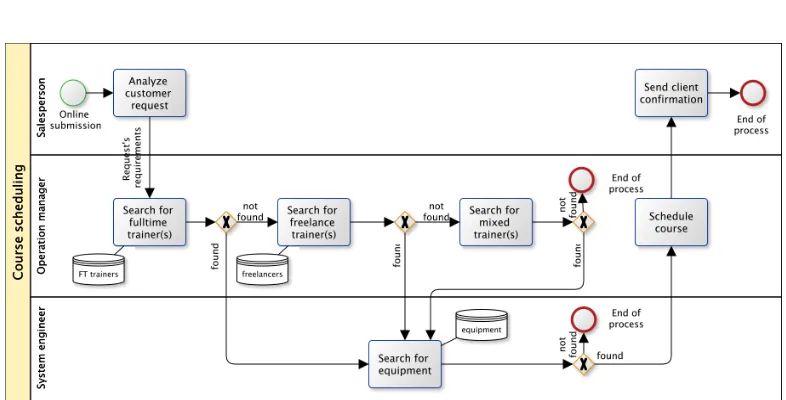
Our validating scenario refers to a multi-national company that manages training centers in different cities of the world, which means different regulations and constraints. A center's main business is to offer courses to different clienteles ranging from high-school students to senior citizens. We focus on course scheduling BP whose representation in Business Process Model and Notation (BPMN [38]) is given in Fig. 3. This is a core BP model that all centers adopt when developing their own course scheduling BPs in response to the countries' regulations and constraints in which the centers are located. For the needs of the current work, we provide a common description of the core BP model prior
to analyzing it from a variant perspective and then a compliance perspective. This second perspective is specialized into local, i.e., confined into the borders of a center, and global, i.e., crosses all the centers.
Course scheduling BP is triggered when a salesperson receives an online request from a customer for a certain course. Initially, the salesperson defines the course's requirements such as level (e.g., beginning and advanced), date, and venue. Afterwards, she sends the request to the operation manager who identifies fulltime trainers for the course. The operation manager can, also, contact freelancers, if fulltime trainers are unavailable or do not satisfy the course's requirements. Upon trainer identification, the request is sent to the system engineer who ensures equipment availability (e.g., projector) for the
course. Finally, the course is scheduled and then, communicated to the customer.
From a variant perspective center_i in country_i has been struggling with the limited commitment of freelancers on different occasions and hence, has decided to deal with fulltime trainers, only. As a result, the search for freelance and/or mixed trainer(s) is dropped from the core BP model and course cancelation is an option if there is not any fulltime trainer available. In parallel, center_j in country_j has decided that all courses would need the director's approval prior to confirm them. Thus, an approval task is added to the core BP model.
In practice, in a collaborative environment where organizations' branches are willing to cooperate together, useful process data (i.e., process events) is shared among them (using a shared repository for example). From a compliance perspective, the company has set-up guards in order to ensure the efficiency of course scheduling. Examples of guards include trainer search should be completed within 5 working days, any trainer should have certain certificates for teaching a course, and fulltime trainers' weekly loads should not exceed 40 hours.
While these guard-based compliance rules are defined over the core BP model and hence, ensure a global compliance, the centers may have their particular compliance rules. center_i extends the trainer search task to 10 working days due to the lack of qualified trainers in the country, and center_j states that the weekly load should not exceed 30 hours due to some local labor laws of the country. Assuming that center_i knows that a trainer, who works for center_j is about to breach the 30 hours maximum load, center_i will inform center_j of the case so that center_j takes the necessary measures like identifying replacements. Business log for the load and social log to look for a substitute.
7. CONCLUSION
3530 collaboration, and content sharing among business actors during BP execution. We proposed a set of methods that assist enterprises to socialize their BPs. In principle, social business processes can be adopted through the incorporation of social interactions into existing BPs. In addition, this adoption can be effectively utilized to meet some requirements and to achieve a set of goals. According to Faci et al. [39], agility of today's enterprises should not be confined to the organizational borders of the enterprise. Additional vital aspects of the enterprise that need to be crucially considered include re-engineering business processes, adjusting the practices of those executing these processes, and revisiting the kinds of resources that can be utilized by business processes during the execution time. As a future work, we plan to propose an evaluation approach to check the impact of socialization on the BP model quality. We also envisage to put in place a versioning approach to support the management of multiple version of a BP. Indeed, we intent to create one or many social version(s) of a BP, according to the enterprise requirements. The versioning approach serves to maintain the original BP along with its social versions.
ACKNOWLEDGMENT
This work was supported by King Abdulaziz City for Science and Technology (KACST) Project AT 35-20.
REFRENCES:
[1] U. Cress, C. Held, and J. Kimmerle. The Collective Knowledge of Social Tags: Direct and Indirect Influences on Navigation, Learning, and Information Processing. Computers & Education, 60(1), 2013.
[2] M. C. Domingo. Managing Healthcare Through Social Networks. Computer, 43(7), July 2010. [3] Z. Maamar, N. Faci, S. Kouadri Mostefaoui, and
F. Akhter. Towards a Framework for Weaving Social Networks Into Mobile Commerce. International Journal of Systems and Service-Oriented Engineering, 2(3), 2011.
[4] S. Drupad. Enterprise Web 2.0 Worth $4.6 Billion in 2013, Visited September 2012. Searchviews, 21 April 2008, www.searchviews.com/index.php/archives/2008 /04/enterprise-web-20-worth-46-billion-in-2013.php.
[5] Gartner Report ,
http://www.infoworld.com/d/applications/gartne
r-social-business-software-efforts-largely-unsuccessful-now-211813. Last accessed on 10/6/2017
[6]http://www.searchviews.com/index.php/archives/ 2008/04/enterprise-web-20-worth-46-billion-in-2013. Last accessed on 10/6/2017
[7] E. Kajan, N. Faci, Z. Maamar, A. Loo, A. Pljaskovic, and Q. Z. Sheng. The Network-based Business Process, IEEE Internet Computing, 2014
[8] V. A. Burégio, S. L. Meira, N. S. Rosa, and V. C. Garcia. Moving Towards Relationship-aware Applications and Services: A Social Machine-oriented Approach, in the Proceedings of the 17th IEEE International EDOC Conference Workshops (EDOCW 2013), Vancouver, BC, Canada, 2013.
[9] A. Badia, Databases as Social Entities, IEEE Intelligent Systems, 27(5), September-October 2012.
[10] J. Montemayor and C. P. Diehl. Social Query: Looking for Social Signals from Online Artifacts, Johns Hopkins APL Technical Digest, 30(1), 2011.
[11] W. Tan, M. B. Blake, I. Saleh, and S. Dustdar. Social-Network-Sourced Big Data Analytics, IEEE Internet Computing, 17(5), September/October 2013.
[12] Dustdar, S. and Bhattacharya, K. (May/June 2011). The Social Compute Unit. IEEE Internet Computing, 15(3).
[13] Warr, W. (2008). Social Software: Fun and Games, or Business Tools? Journal of Information Science, 34(4).
[14] Schmidt, R. and Nurcan, S. (2008). BPM and Social Software. Proceedings of the First Workshop on Business Process Management and Social Software (BPMS2’2008), Milan, Italy.
[15] Erol, S., Granitzer, M., Happ, S., Jantunen, S., Jennings, B., Koschmider, A., Nurcan, S., Rossi, D., Schmidt, R., and Johannesson, P. (October-November 2010). Combining BPM and Social Software Contradiction or Chance. Journal of Software Maintenance and Evolution: Research and Practice, 22(6-7). [16] Liptchinsky et al., 2012] Liptchinsky, V.,
3531 Information Systems Engineering (CAiSE’2012), Gdansk, Poland.
[17] Bruno, G., Dengler, F., Jennings, B., Khalaf, R., Nurcan, S., Prilla, M., Sarini, M., Schmidt, R., and Silva, R. (2011). Key Challenges for Enabling Agile BPM with Social Software. Journal of Software Maintenance and Evolution: Research and Practice, 23(10). [18] Rito Silva, A., Meziani, R., Magalh˜aes, R.,
Martinho, D., Aguiar, A., and Flores, N. (2010). AGILIPO: Embedding Social Software Features into Business Process Tools. In Proceedings of the Third International Workshop on the Business Process Model and Notation (BPMN’2010), Ulm, Germany.
[19] Brambilla, M., Fraternali, P., and Vaca, C. (2011). A Notation for supporting Social Business Process Modeling. In Proceedings of the Fourth Workshop on Business Process Management and Social Software (BPMS2’2011) held in conjunction with The Seventh International Conference on Business Process Management (BPM’2011), Lucerne, Switzerland.
[20] Koschmider, A., Song, M., and Reijers, H. (2010). Social Software for Modeling Business Processes. Journal of Information Technology, 25(3).
[21] Grim-Yefsah, M., Rosenthal-Sabroux, C., and Thion, V. (2011). Using Information of an Informal Network to Evaluate Business Process Robustness. In Proceedings of the International Conference on Knowledge Management and Information Sharing (KMIS’2011), Paris, France.
[22] M. Comuzzi, J. Vonk, and P. W. P. J. Grefen, Measures and Mechanisms for Process Monitoring in Evolving Business Networks, Data Knowledge Engineering,
vol. 71(1), 2012.
[23] Shazia Wasim Sadiq, Guido Governatori, and Kioumars Namiri. Modeling Control Objectives for Business Process Compliance. In BPM 2007, pages 149–164.
[24] Linh Thao Ly, Kevin Go"ser, Stefanie Rinderle-Ma, and Peter Dadam. Compliance of Semantic Constraints: A Requirements Analysis for Process Management Systems. In Proceedings of the 1st International Workshop on Governance, Risk and Compliance: Applications in Information Systems (GRCIS’08), pages 16–30. CEUR-WS.org, June 2008.
[25] Guido Governatori, Zoran Milosevic, and Shazia Sadiq. Compliance checking between business processes and business contracts. In EDOC, pages 221–232, 2006.
[26] Zoran Milosevic, Shazia Wasim Sadiq, and Maria E. Orlowska. Towards a methodology for deriving contract-compliant business processes. In BPM, 2006.
[27] Zoran Milosevic, Shazia Wasim Sadiq, and Maria E. Orlowska. Translating business contract into compliant business processes. In EDOC, pages 211–220, 2006.
[28] S. Goedertier and J. Vanthienen. Compliant and Flexible Business Processes with Business Rules. In the 7th Workshop on Business Process Modeling, pages 94–104, 2006.
[29] S. Goedertier and J. Vanthienen. Designing Compliant Business Processes with Obligations and Permissions, Proceedings of the 2nd Workshop on Business Processes Design (BPD’06), 2006.
[30] Jochen Malte Küster, Ksenia Ryndina, and Harald Gall. Generation of Business Process Models for Object Life Cycle Compliance. InBPM 2007, pages 165–181.
[31] Y. Lui, S. Müller, and K. Xu. A static compliance-checking framework for business process models. IBM SYSTEMS JOURNAL, 46(2):335–362, 2007.
[32] Kioumars Namiri and Nenad Stojanovic. Pattern-Based Design and Validation of Business Process Compliance. In OTM Conferences (1), pages 59–76, 2007.
[33] Christian Wolter and Andreas Schaad. Modeling of Task-Based Authorization Constraints in BPMN. In BPM, pages 64–79, 2007.
[34] Christian Wolter, Philip Miseldine, and Christoph Meinel. Verification of business process entailment constraints using spin. In ESSoS, pages 1–15, 2009.
[35] Ashish Agrawal, Mike Amend, Manoj Das, Mark Ford, Chris Keller, Matthias Kloppmann, Dieter König, Frank Leymann, Ralf Müller, Gerhard Pfau, Karsten Plösser, Ravi Rangaswamy, Alan Rickayzen, Michael Rowley, Patrick Schmidt, Ivana Trickovic, Alex Yiu, and Matthias Zeller. WS-BPEL Extension for People (BPEL4People), Version 1.0. 2007. [36] Jan Mendling, Karsten Ploesser, and Mark
3532 [37] Z. Maamar, N. C. Narendra, E. Kajan, A.
Pljaskovic, and M. Boukhebouze. Using Tags for Business Process Enrichment. In ICIST, 2014.
[38] Object Management Group (OMG). Business Process Model and Notation. http://www.omg.org/spec/BPMN/2.0.2/. [39] N. Faci, Z. Maamar, E. Kajan, and D.
Benslimane. Research Roadmap for the Enterprise 2.0 - Issues and Solutions. Scientific Publications of the State University of Novi Pazar Series A: Applied Mathematics, Informatics and Mechanics, 2014
[40] Pascalau, E., Awad, A., Sakr, S., & Weske, M. (2010, September). On maintaining consistency of process model variants. In International Conference on Business Process Management (pp. 289-300). Springer Berlin Heidelberg. [41] Awad, Ahmed, and Sherif Sakr. "On efficient
processing of BPMN-Q queries." Computers in Industry 63.9 (2012): 867-881.
[42] Maamar, Z., Faci, N., Sellami, M., Boukadi, K., Yahya, F., Barnawi, A., & Sakr, S. (2017). On business process monitoring using cross-flow coordination. Service Oriented Computing and Applications, 11(2), 203-215.
[43] Maamar, Z., Faci, N., Sakr, S., Boukhebouze, M., & Barnawi, A. (2016). Network-based social coordination of business processes. Information Systems, 58, 56-74.
[44] Barnawi, A., Awad, A., Elgammal, A., El Shawi, R., Almalaise, A., & Sakr, S. (2015). Runtime self-monitoring approach of business process compliance in cloud environments. Cluster Computing, 18(4), 1503-1526.
[45] Maamar, Z., Faci, N., Kajan, E., Sakr, S., Mohamed, B., & Barnawi, A. (2015). How to Make Business Processes “Socialize”?. EAI Endorsed Transactions on Industrial Networks and Intelligent Systems, 15(5).
[46] Maamar, Z., Sakr, S., & Barnawi, A. (2015, June). A framework of enriching business processes life-cycle with tagging information. In Australasian Database Conference (pp. 309-313). Springer International Publishing.
[47] Barnawi, A., Awad, A., Elgammal, A., El Shawi, R., Almalaise, A., & Sakr, S. (2015). BP-MaaS: A Runtime Compliance-Monitoring System for Business Processes. In BPM (Demos) (pp. 25-29)
[48] Awad, A., Barnawi, A., Elgammal, A., Elshawi, R., Almalaise, A., & Sakr, S. (2015, April). Runtime detection of business process
compliance violations: an approach based on anti patterns. In Proceedings of the 30th Annual ACM Symposium on Applied Computing (pp. 1203-1210). ACM.
[49] Maamar, Z., Sakr, S., Faci, N., Boukhebouze, M., & Barnawi, A. (2015). SUPER: social-based business process management framework. In Service-Oriented Computing-ICSOC 2014 Workshops (pp. 413-417). Springer International Publishing
3533