ORIGINAL RESEARCH ARTICLE
DOES SLEEP HABITS AFFECT THE LEARNING OF SCHOOL CHILDREN?
1
Renato Mendes dos Santos,
2Katrine Bezerra Cavalcanti,
3Aline Silva Belísio,
4João dos Santos
Pereira Braga Neto and
5Fernando Ferraz do Nascimento
1
Psycologist, MD, Postgraduate Program in Health and Community. Federal University of Piauí, Teresina - Brazil
2
Biologist, PhD, Federal University of Piauí.Department of Medicine.Picos - Piauí, Brazil
3
Biologist, PhD, University Center FACEX. Natal, Brazil
4
Medical Course, Amazonas State University, Brazil
5
Statistical, PhD, Federal University of Piauí, Teresina - Brazil
ARTICLE INFO ABSTRACT
Background: Learning difficulty is relevant in childhood and it is associated with many factors. Since sleep is vitally important for child development and it is one of the a little unknown factors, when combined with learning difficulty and development of children with specific functional disorder treated at Specialist Educational Service Rooms - SESR, however, not many people know about the factors associated with learning difficulty and sleep habits within a generic sample of children attending school supporting rooms. To characterize the cognitive profile and sleeping habits of 7 to 12 year-old-children. The list of associated factors of 70 children of elementary school with some kind of specific functional disorder (Dyslexia / Dysorthographia / Dysgraphia / Dyscalculia / Disorder Attention Deficit (with or without hyperactivity) - 16 schools: 04 schools in the east side, 04 schools in the north side, 03 schools in the southeast side and 05 schools in the south side. Sleep characteristics were evaluated by questionnaire sleep habits and cognitive profile through psychological tests SDT - School Development Test and CNRT - Child Nonverbal Reasoning Test. The data of the answers of the children were checked and tabulated using SPSS -Statistical Package for Social Sciences program. In evaluated children, the determinants showed a lower level in relation to school performance test. The nonverbal test was negatively associated and did not detect correlations between sleep variables and test result scores. Sleep is not the main factor associated with learning difficulty and that there is no association between sleep habits and cognitive assessment of children enrolled in the Specialized Educational Service Rooms –SESR.
Copyright © 2018, 1Renato Mendes dos Santos et al. This is an open access article distributed under the Creative Commons Attribution License, which permits unrestricted use, distribution, and reproduction in any medium, provided the original work is properly cited.
INTRODUCTION
This study focuses on learning difficulties, a phenomenon that is still considered one of the most discussed and questioned problems in the educational system. Although the school is a place of learning and training, it has been excluded from the stage of the student who cannot learn which makes breeding of
school failure (Dazzani et al., 2014).There is a correlation in
the complexity of these difficulties, called school failure, that part of the historical dimensions, political, socioeconomic and
*Corresponding author: Renato Mendes dos Santos
Psycologist, MD, Federal University of Piauí, Department of Medicine. Picos - Piauí, Brazil
institutional ideological and pedagogical practices articulated the concepts that underlie the processes and actions that take place the practices of the school day by day (Patto, 1999). Each case of school failure can only be understood if we consider the contingencies of the educational process in which
it occurred by itself (Cohen, 2006).Another reflection on the
causes of school failure are located in "three orders:
sociological, psychological and pedagogical." (Travi et al.,
2009).These factors would be within the general school failure category - repetition, dropout, learning disabilities, illiteracy, etc. also constitute in interpretations of what occurs in the school space (Charlot, 2000). Although few studies in the area of the impact of learning disabilities associated with sleep
ISSN: 2230-9926
International Journal of Development Research
Vol. 08, Issue, 09, pp.23019-23025, September,2018
Article History:
Received 02nd June, 2018
Received in revised form 20th July, 2018
Accepted 28th August, 2018
Published online 30th September,2018
Key Words:
Learning difficulty, Sleep, Educational service, Health.
Citation: Renato Mendes dos Santos, Katrine Bezerra Cavalcanti, Aline Silva Belísio, João dos Santos Pereira Braga Neto and Fernando Ferraz do
Nascimento. 2018. “Does sleep habits affect the learning of school children ?”, International Journal of Development Research, 8, (09), 23019-23025.
disorders is significant. In Brazil, in child population, 29.4% of children have a diagnosis of insomnia and 14.5% of excessive
daytime sleepiness (Belisio, 2008; Louzada et al., 2004). Sleep
disorders, if left untreated, can compromise the performance of children, leading to total abandonment of studies, especially the health impairment. Thus, sleep disturbances may compromise the quality of school life and it is related to the consolidation of learning and memory, as well as having an important role in controlling the restorative processes
(Carskadon et al 2005; Belisio, 2008). In Brazil, children who
are supported by the Law of Guidelines and Bases - LDB 9394/96 from Ministry of Education, with various school needs, are entitled to specialized care. Special school Attendance rooms should attend exclusively to children with intellectual disabilities, physical disabilities neuromotor and pervasive developmental disorders. In scientific environment, when we associate sleep and its disorders to school failure there are few significant actions that compromise this relationship and need identification and systematization. In this context, it is relevant to improve knowledge about learning disabilities and their relationship to the quality of sleep, its characteristics, causes, consequences and make a comparison for understanding learning difficulties. According to this situation, this study of integrative review is to describe the relationship in the children afflicted with learning difficulties, wher sleep disorders are the determining factor of these difficulties.
MATERIALS AND METHODS
Study design and participants
This was a prospective study whose sample consisted of 70 children, who were diagnosed with specific functional disorders, such as dyslexia, dysgraphia, dyscalculia and attention deficit disorder, with or without hyperactivity. The sample was selected among children enrolled in public school located in Teresina, Piauí, Brazil, who were invited to participate in this research.
Inclusion and exclusion criteria
Children aged between 7 and 12 years, both male and female who were regularly enrolled in public schools at any time of day, with learning difficulties, presenting some specific functional disorder, such as dyslexia, dysgraphia, dyscalculia and attention deficit disorder, with or without hyperactivity, presenting difficulty to start sleep, and those who have had a consent form signed by parents or guardians, were included in the study. The study excluded children who presented having any health problems and / or physical or mental disability with proven diagnosis, incomplete answered questionnaires and no permission by parents and / or guardians were excluded from the study.
Data collection: According to the Educational Establishment
Relations of the Municipal Education and Culture - SEMEC / PI - 2015 through the Division of Inclusive Education, the city of Teresina, PI has 77 schools released by MEC, in urban and rural areas, able to meet demand for children with special educational needs, among these, 62 schools there are students in Multifunction Resource Rooms with the Specialized Educational Service project t-SES. Children were organized into groups and schedules agreed with the school, regardless of sex, but according to the age stipulated, prior assessment of the
record of each child, conducted through interviews with the teacher and analysis of the presented learning difficulties. Children were distributed into groups in different schedules, which means that it will not interfere in the regular activities of the classroom. The application of TDE tests (School Performance Test) (Stein, 1994) was done individually with prior explanation for all and free time for implementation of the proposed questions. The NCRT (Nonverbal Children's Reasoning Test) (Pasquali, 2005) was applied in groups, after the first test, with stipulated time of 25 minutes applied to all listed children each one from the SES room that were participating in the research. A questionnaire was used to make the characterization subjectively of the general habits of the children sleep. It used an adapted version with 21 questions of
the questionnaire (Wey 2001;Owens et al., 2000;Lima, 2006),
to which were added some information about the child's behavior at bedtime, type of school, and marital status, educational level, occupation, time and parents' working time. Parents or guardians completed the questionnaire with information relating to children's sleep habits. The exact result of the sample size (n = 335) allowed to estimate the parameter with tolerable margin of error of 4.5% and a confidence level of 95%, in the finite population of children enrolled in schools.
The proportions when it is unable to predict the possible value for p, p = 0.50 admit, therefore, so it will have the largest sample size, which means, p and q equal to 0.50 it is the value that maximizes the sample size (Bolfarine and Bussab, 2005). After determining the size of the final sample that was investigated, the criteria for inclusion / exclusion was applied in 335 children. Based on the total number of schools distributed only in urban areas, as one of the inclusion criteria, with a total of 335 students determined after the sample size calculation of the total amount and who were enrolled, it was decided to make a selection and use of cluster sampling. The cluster sampling is a technique that exploits the existence of groups (clusters) in the population. These groups adequately represent the total population in relation to the measured characteristic and well characterized sample planning conglomerates, as the sample unit contains more than one population element (Bolfarine and Bussab, 2005). This sampling procedure is appropriate when you can divide the population into a large number of small subpopulations. Therefore, it was possible to make a comparison of areas through city mapping, as the municipal schools meet this demand, in areas of the capital. The cluster sampling is suitable when the groups that make up the population are very similar to each other, so there is no big difference between studying subjects in one or in another group (Bolfarine and Bussab, 2005). After the distribution and the draw made impartially, we came to the final result of schools in four zones: 04 schools in east, 04 schools in the north, 03 schools in the south-east and 05 schools in the south, according to the data of the Municipal Department. There was a presentation in all selected schools, divided in stages in different areas, with the direction, coordination and pedagogical teachers responsible for SES room, in which the project was presented. The purpose of the talk was to see the facilities, identify children who participated in the study and the schedule for the implementation of research in schools.
Statistical analysis
square test with Yates correction and Fisher exact test for differences between averages of unpaired samples was used, assuming a significance level of 0.05. Contingency coefficients were calculated and the correlation coefficient for two quantitative variables with respect to TDE and TNVRI tests (Pasquali, 2005 and Siegel, 2008). To assess the responses of parents / guardians to the general habit of questionnaires (housing, parental characteristics, information on health sleep, co-sleeping, bedroom-shared and rituals of bedtime) and economic status, schedules, schedule and working hours, the bedtime to waking up, time in bed, the irregularity during bedtime and waking up time (calculated from the standard deviation of the time to go to bed and getting up) napping of the children and behaviors related to
psychological tests we used chi-square test (χ2) and Fisher
exact.
Ethical aspects
Ethical aspects this study was approved by the Ethics in Research Involving Human Subjects Committee at the Federal University of Piauí, Brazil, registry number 1238933, on Sep 25, 2015. All participants signed the informed consent form.
RESULTS
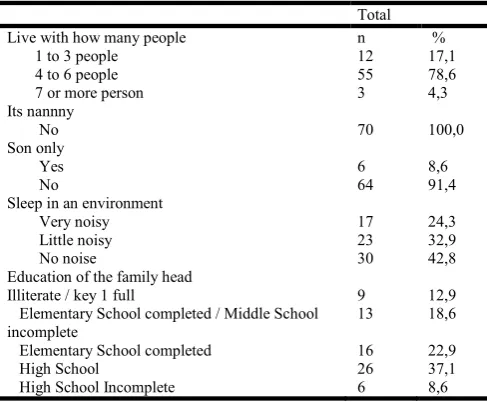
The results will be presented in three stages; the first one is about the methodological procedures for the implementation of the research. Then, a characterization of the habits and sleep patterns of the general population of children served will be made to the SES Rooms, and in sequence, the characterization related to the following social factors associated with the type of school, family socioeconomic factor, schedules, scheme, rituals and duration of the sleeping schedule of the families. (Tables 1 and 2). Regarding the School Performance Test - SPT, all 70 children, after data tabulation and conference levels, according to the test scores, showed inferior response, in other words, 100%, that means they showed deficits in basic skills of reading, writing and arithmetic, as final correction. Although the test has been used to check the school level of each child in the most different grades, a low level in three items simultaneously (reading, writing and arithmetic) was verified. Confirming then that the cognitive level of children who have some kind of specific functional disorder, presented general difficulties in implementing the initial skills of the teaching-learning process. Regarding the Child’s Nonverbal Reasoning Test - CNRT, instrument used to assess the degree of fluid intelligence, in other words, cognitive measures that depend a little of the school learning, presented the results to the following values: 61.4% have Intellectual Disability, 18.6% had borderline deficiency and 11.4% Medium Low, in other words, as the test purpose is to evaluate the factors: abstract analogical reasoning (Factor 1), concrete analogical reasoning (Factor 2), and the General Factor of analogical reasoning, although composed of discrete elements, requiring from the child only the ability to perceive differences or similarities in each phase, the results show that children who have a specific functional disorder have difficulty with the assimilation of contents and achievement of tasks, namely, it was found significant influence of variable specific functional disorder in relation to execution of activities evaluated in the test (Table 3). According to the characteristics and housing and parental education (Table 4) none of the children had babysitter 100%, no one is an only child 91.4%, and only 42.8% slept in a room without noise, and lived in an
[image:3.595.316.549.144.195.2]environment with 4 to 6 people 78.6%. Regarding the characteristics of the family head, only 37.1% had completed high school. Despite the higher value in relation to completion of studies show the completion of high school, low educational level was observed at all levels.
Table 1. Participants by zones
Area searched n %
South 25 35,7
North 17 24,3
East 16 22,9
[image:3.595.311.555.237.336.2]Southeast 12 17,1
Table 2. Economic Classification of children from the general population (n= 70)
n %
Economic Classification
Class A1 0 0
Class A2 0 0
Class B1 0 0
Class B2 0 0
Class C1 4 5,72
Class C2 29 41,43
Class D 37 52,85
Class E 0 0
Table 3. Results corresponding to Psychological Tests
n %
SPT
Less than 70 100
CNRT
Intellectual disability 43 61,4 Borderline deficiency 13 18,6
Lower average 8 11,4
Normal or Medium 4 5,7
Middle Upper 1 1,4
Definitely Superior 1 1,4
Table 4. Living conditions and parental education feature
Total
Live with how many people n %
1 to 3 people 12 17,1
4 to 6 people 55 78,6
7 or more person 3 4,3
Its nannny
No 70 100,0
Son only
Yes 6 8,6
No 64 91,4
Sleep in an environment
Very noisy 17 24,3
Little noisy 23 32,9
No noise 30 42,8
Education of the family head
Illiterate / key 1 full 9 12,9
Elementary School completed / Middle School incomplete
13 18,6
Elementary School completed 16 22,9
High School 26 37,1
High School Incomplete 6 8,6
[image:3.595.323.544.367.466.2] [image:3.595.312.556.497.698.2]Table 5. CNRT General Factor: Factors Associated to Health Problem
Intellectual
disabilities
Borderline deficiency
Medium inferior
Normal or Medium
Medium higher
Total p-valor
n % n % n % n % n % N %
Present healf problem 0,273*
Yes 24 50 7 63,6 3 75 4 80 0 0 38 54,3
No 24 50 4 36,4 1 25 1 20 2 100 32 45,7
Use some medicine 0,248*
Yes 24 50 4 36,4 1 25 4 80 0 0 33 47,1
No 24 50 7 63,6 3 75 1 20 2 100 37 52,9
Makes medical treatment 0,085*
Yes 30 62,5 9 81,8 1 25 2 40 0 0 42 60
No 18 37,5 2 18,2 3 75 3 60 2 100 28 40
Drink coffee 0,867*
Every day 30 62,5 7 63,6 4 100 3 60 1 50 45 64,3
Some times 6 12,5 2 18,2 0 0 1 20 0 0 9 12,9
Never 12 25 2 18,2 0 0 1 20 1 50 16 22,9
Drink tea 0,319*
Every day 6 12,5 3 27,3 0 0 1 20 0 0 10 14,3
Some times 15 31,3 0 0 2 50 0 0 1 50 18 25,7
Never 27 56,3 8 72,7 2 50 4 80 1 50 42 60
Drink soda 0,034*
Every day 22 45,8 6 54,5 1 25 2 40 0 0 31 44,3
Some times 23 47,9 1 9,1 3 75 3 60 1 50 31 44,3
Never 3 6,3 4 36,4 0 0 0 0 1 50 8 11,4
Drink chocolate 0,858*
Every day 21 43,8 6 54,5 3 75 3 60 1 50 34 48,6
Some times 16 33,3 3 27,3 1 25 2 40 1 50 23 32,9
Never 11 22,9 2 18,2 0 0 0 0 0 0 13 18,6
Tabela 6. TNVRI General Factor: factors associated with sleep problem
Intellectual
disabilities
Borderline deficiency
Average Average normal
Lower overall higher
Total p-valor
n % n % n % n % n % n %
It presents some sleep problem 0,440
Yes 25 52,1 5 45,5 2 50 1 20 0 0 33 47,1
No 23 47,9 6 54,5 2 50 5 80 2 100 37 52,9
Usually gnash their teeth during sleep 0,832
Yes 23 47,9 5 45,5 2 50 1 20 1 50 32 45,7
No 25 52,1 6 54,5 2 50 4 80 1 50 38 54,3
Usually move a lot during sleep 0,575
Yes 40 83,3 11 100 3 75 4 80 2 100 60 85,7
No 8 16,7 0 0 1 25 1 20 0 0 10 14,3
He speaks often sleeping 0,518
Yes 30 62,5 9 81,8 2 50 2 40 1 0,5 44 62,9
No 18 37,5 2 18,2 2 50 3 60 1 50 26 37,1
Usually snore 0,550
Yes 25 52,1 7 63,6 2 50 2 40 0 0 36 51,4
No 23 47,9 4 36,4 2 50 3 60 2 100 34 48,6
Usually sleepwalking 0,714
Yes 16 33,3 2 18,2 1 25 1 20 0 0 20 28,6
No 32 66,7 9 81,8 3 75 4 80 2 100 50 71,4
Usually hitting the head during sleep 0,285
Yes 18 37,5 7 63,6 2 50 1 20 0 0 28 40
No 30 62,5 4 36,4 2 50 4 80 2 100 42 60
Usually kick the legs during sleep 0,989
Yes 25 52,1 6 54,5 2 50 2 40 1 50 36 51,4
No 23 47,9 5 45,5 2 50 3 60 1 50 34 48,6
Usually screaming sleeping 0,389
Yes 24 50 3 27,3 1 25 2 40 0 0 30 42,9
No 24 50 8 72,7 3 75 3 60 2 100 40 57,1
Do you have difficulty falling asleep at night 0,305
Never 17 35,4 6 54,5 3 75 3 60 2 100 31 44,3
Some times 19 39,6 1 9,1 1 25 1 20 0 0 22 31,4
Ever 12 25 4 36,4 0 0 1 20 0 0 17 24,3
You feel very sleepy during the day 0,935
Never 22 45,8 5 45,5 3 75 2 40 1 50 33 47,1
Some times 18 37,5 3 27,3 1 25 2 40 1 50 25 35,7
Ever 8 16,7 3 27,3 0 0 1 20 0 0 12 17,1
Wake up in the night and have difficulty falling back to sleep 0,714
Never 23 47,9 8 72,7 3 75 2 40 2 100 38 54,3
Some times 16 33,3 2 18,2 1 25 2 40 0 0 21 30
Ever 9 18,8 1 9,1 0 0 1 20 0 0 11 15,7
Usually has nightmares 0,230
Never 24 50 10 90,9 3 75 4 80 2 100 43 61,4
Some times 15 31,3 1 9,1 0 0 1 20 0 0 17 24,3
Ever 9 18,8 0 0 1 25 0 0 0 0 10 14,3
Often wake up with a sense of suffocation 0,451
Never 28 58,3 10 90,9 3 75 4 80 2 100 47 67,1
Some times 14 29,2 1 9,1 1 25 0 0 0 0 16 22,9
presented in CNRT test, according to the test significance level
(χ2; p<0.05) and Fisher's Exact Test (Siegel, 1998;Siegel and
Castellan, 2008), in other words, we cannot associate any of the above causes and associated factors and related to school failure. It is worth mentioning in relation to food intake and a few drinks, the issues such as: coffee every day 64.3%, sometimes drinking tea 25.7%, taking chocolate every day 48.6% even though having high scores when analyzed
according to the test level of significance (χ2; p<0.05) and
Fisher's exact test, when made the crossing in relation to the cognitive test, it has not been proven any significant relationship. Among the factors associated with health problems, the Question taking soda every day and sometimes had value 44.33%, respectively, with p value 0.034, that is,
when analyzed according to the test level of significance (χ2;
p<0.05) and Fisher's exact test showed a significant relationship. What can we conclude with this associate, isolated factor, is that eating habits, specifically the act of taking soda, knowing that it is a product that has a great amount of sugar in its composition, and does not contain good nutrients to support the growth and cognitive development of children, only alerts us to the need of the families of the children realize how this food is harmful, and in the medium term, may be harmful to children's health.
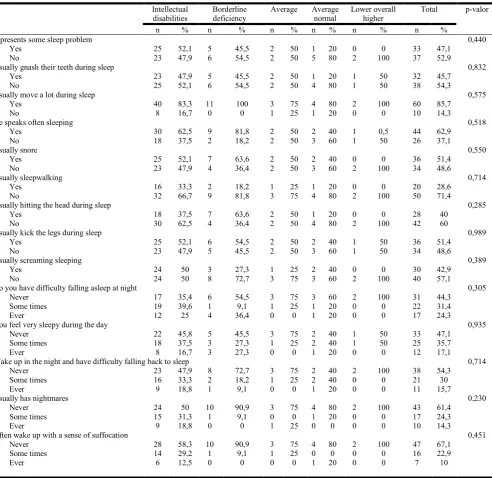
Regarding the factors associated with sleep habits and made junction with the general factor of CNRT test (Table 6), also
when analyzed according to the test level of significance (χ2;
p<0.05) and Fisher's exact Test, children did not have sleep problems 52.9% and behaviors: grinding teeth 54.3%, did not prevail; 85.7% said they usually move during sleep; 62.9% speaks sleeping; 51.4% snore; 28.6% go asleep; 60.0% did not hit his head when sleeping; 51.4% kick the legs during sleep; 42.9% usually cry; 44.3% have difficulty falling asleep at night; 47.1% feel very sleepy during the day; 54.3% never wake up in the night and have difficulty falling back to sleep; 61.4% usually never have nightmares and 67.1% reported that they never wake up with a sensation of suffocation, in other words, all behaviors were reported by those in charge of the children and when it was done the crossing with CNRT test ,and analyzed with statistical reference, none of the behaviors mentioned above, the most outstanding parent responses according with the table, had a significant relationship with cognitive performance of children attended at the SES rooms. Leading us to conclude that these factors are not directly responsible for school failure of children with specific functional disorders.
DISCUSSION
This study aimed to verify the influence of factors associated with learning difficulties such as: type of school, economic factors, parental work, schedules, health, about their sleep habits and sleep cycle and wakefulness of children with specific functional disorders that are met in the halls of Educational Service Specialist - ESS, relating to cognitive performance through psychological tests and TDE CNRT. All children assessed are from Elementary School of the municipal institutions of the city of Teresina - PI. It was observed that the amount of people in the house varies from 04 to 06 people and that percentage of children performing the co-sleeping with parents and other siblings. This may be due to the low economic level (C1, C2 and D). In this family context, children end up sharing the bedroom and living with many people in a small environment, making it difficult to carry out
some rituals of bedtime, and consequently, good sleep
hygiene, similar to what happens in China (Li et al., 2008).
However, beyond the economic influence in China (Li et al.,
2008) and Japan (Oka et al., 2008), some reasons for its
realization differ from the present study. In these countries these behaviors are the result of cultural influence, where the same environment may have multiple functions, and population growth. Despite being a peculiar behavior of these countries, which often are the result of cultural influence, where the same environment may have multiple functions, and population growth, we can confront such behavior of these countries, as a reality, though not an exclusive reality of the northeast and of Brazil, the large amount of children and no family planning, remains a factor influencing this situation. According to (Jenni and Carskadon, 2007), the rituals of bedtime are usually performed to facilitate the transition from wakefulness to sleep. These rituals, even in children with low economic income, such as: drinking milk, going to the bathroom before bedtime, sleeping with parents, telling stories before bedtime, it was realized that these rituals, when associated with students with a specific functional disorder and which are accompanied in rooms ESA, do not show significant relationship with the results of cognitive tests. As expected, children in public schools, which are met in the rooms of ESA, go to bed and wake up later, depending on the shift (morning or afternoon), which are served in the rooms, where we testify that not only the usage of electronics (computer, video game and / or TV), and demonstrate a shorter duration of sleep and less time in bed during the week on weekdays and wake up
late on weekdays and weekend (Li et al. 2007; Belísio, 2008).
Children with working parents, where the man is the worker outside the home, is not contrary to the expected, or parents with less education may have less liberal attitude towards sleep schedules of the children, and end modifying negatively the sleep schedules. Mothers staying at home, have small influence in relation to the standardized schedule of the children.
not show any influence in relation to the sleep cycle and wakefulness that age and can make a characterization of co-sleeping, shared room and time rituals sleeping children according to the type of school and the job of their parents, even so, no significant relationship was not found. From the results, it is suggested that the associated social factors (type of school, work, schedule, scheme and duration of the parents' job, cognitive performance and family relationships) influence sleep and wakefulness cycle of children in early childhood education. Thus, it is clear that the work, schedule, scheme and duration of work, negatively impact the health and sleep families, thus confirming the study (Belísio, 2008), may have an impact on sleep cycle and wakefulness of the children, specifically, though when made the crossing in relation to CNRT test showed no relevant significance in relation to cognitive performance of students. Therefore it is essential to pay attention to the socio-economic context of the families of kindergarten and elementary public school students, their peculiarities and especially activities developed in parallel to formal education in the Educational Service Specialist Rooms – ESSR.
In reference to the cognitive performance, as measured by test our hypothesis that children with a specific functional disorder present a different pattern of sleep, with an influencer made possible, but it was not confirmed. Finally, it is considered important to mention that although our findings may not indicate causal relationships between motor activity and sleep, the existence of correlations between these variables shows the importance of further studies on the subject, so that you can understand the Sleep role in healthy children and in the future to understand these relationships in hyperactive children, which could contribute to the understanding of the disorder and its etiology, as well as the search for better quality of life for patients and their families. However, further investigations are needed to better assess the factors associated with school failure and the influence of sleep habits on the cognitive performance of children enrolled in the Specialized Educational Service Rooms - SESR.
Limitations
Among the limitations of our study IT is the non-concern of parents in relation to knowledge of the activities that are being developed with the children in the EEA area. We confirm that sleep is one of the least important factors for the activities and emphasized in the rooms. The limitation was considering the low education of students and motor activity of children for a short time. Finally, it is a convenience sample of selected schools, however, attending children of socioeconomic and similar cultural conditions, and because of the time of research, it was not feasible to map all children, both rural and urban. In future studies, it would be interesting to make a general map and if there are areas of influence in relation to cognitive performance and sleep. Although there is no reason to believe that the characteristics of children served in the rooms in the urban area, is extremely different from the others.
Conclusion
According to the general characterization of sleep habits and the influence of different social factors associated with learning difficulty on cognitive assessment of children seen in the Educational Service Specialist Rooms ESSR, the fundamental education in municipal schools in Teresina - PI,
can be concluded that: factors associated with learning difficulties such as economic status, type of school, parents' work schedules, health, duration and sleep scheme, has no direct interference with sleep habits. In addition, children do not have a systematic monitoring of parents with regard to compliance schedules and orientation of school activities at home (both siblings and parents) which could contribute to such low levels the results on school performance. All children who have some specific functional disorder despite being attended in the Specialized Educational Service Rooms - SESR presented a cognitive level much lower than expected, related to tests of reading, writing and cognitive skills, and all classified at a lower level in the Academic Performance Test (APT), although it had no direct interference with sleep habits. The cognitive performance of children, presented in the Child Nonverbal Reasoning Test (CNRT) also had no significant relationship with sleep habits and sleep schedules, but further investigations are needed to evaluate the effect of this factor.
Acknowledgments
The authors are grateful to all individuals who participated in this study.
Conflict of interest: None.
Funding: This research received no specific grant from any funding agency in the public, commercial, or not-for-profit sectors.
REFERENCES
Acebo C, Sadeh A, Seifer R, et al. 2005. Sleep/wake patterns
derived from activity monitoring and maternal report is
healthy 1- to 5- year-old children. Sleep 28(12): 1568–
1577.
Adams KM 2000. Practical and ethical issues pertaining to test
revisions. Psychol Assess 12(3): 281–286.
Anacleto TS 2001. Sleep/wake cycle and motor activity in children 8 to 10 years. And response inhibition in children. Perceptual and Motor Skills 93:213–229.
Araújo DF, Soares SC and Almondes KM 2013. Relation between sleep and visuospatial skills in students from a
public school. Psychol 18(1): 109–116.
Associação Nacional de Empresas de Pesquisa – ABEP 2015. Critério de Classificação Econômica Brasil. Available in: <http://www.abep.org> Access in March 18, 2017.
Bolfarine H and BussabWO. 2005. Elementos de Amostragem.
Porto Alegre: Bookman.
Borbély AA and Achermann P. 1999. Sleep homeostasis and
models of sleep regulation. J Biol Rhythms 14(6): 559–570.
Brazil. National Education Committee on Human Rights, 2006. National education plan for human rights. Brasilia: Special Secretariat of Human Rights, education ministry, justice ministry, UNESCO.
Bussab WO and Moretin PA. 2005. Estatística Básica (8 ed).
São Paulo: Saraiva.
CEPA, Applied Psychology Center Editor 2001. Manual Progressive Matrices of Raven - general scale. Shows a, b, c, d and e (2. Ed., F. Fields, trans. & Adaptation). Rio de Janeiro, RJ: author.
Chariot B 2000. Da relação com o saber – Elementos para
Cohen RHP. 2004. O traumático encontro com os outros da
educação: a família, a escola e o Estado. Psicologia em
Revista 10(16): 256–269.
Conover WJ. 1980. Practical nonparametric statistics (3rd
edition). New York: John Wiley and Sons.
Creswell JW 2010. Projeto de pesquisa: Métodos qualitativos,
quantitativos e mistos. Porto Alegre: Artmed.
Dazzani MVM, Cunha EO, Luttigards PM, et al. 2014. Queixa
escolar: uma revisão crítica da produção científica
nacional. Psicol Esc Educ 18(3): 421–428.
Fallone G, Acebo C, Arnedt JT, et al. 2001. Effects of acute
sleep restriction on behavior, sustained attention, and
response inhibition in children. Percept Mot Skills 93(1):
213–229.
Fallone G, Acebo C, Arnedt JT, et al. 2001. Effects of acute
sleep restriction on behavior, sustained attention, and
response inhibition in children. Percept Mot Skills 93(1):
213–229.
Jenni OG and Carskadon MA. 2005. Normal human sleep at different ages: lnfants to adolescents. In: srs basics of sleep guide, pp. 11-19. Westchester, Illinois: sleep research society.
Li S, Jin X,Wu S, et al. 2007. The impact of media use on
sleep patterns and sleep disorders among school-aged
children in China. Sleep 30(3): 361–367.
Louzada F, Orsoni A, Mello L, et al. 1996. Longitudinal study
of the sleep-wake cycle in children living on the same
school schedules. Biol Rhythm Res 27(3): 390–397.
Marques N and Menna-Barreto L 2003. Cronobiologia:
Princípios e Aplicações (3 ed). São Paulo: Edusp.
MEC, 2009. Operational Guidelines for specialized education in basic education, special education mode. Brasília: MEC.
Menna-Barreto L, Isola A, Louzada F, et al. 1996. Becoming
circadian: a one-year study of the sleep-wake cycle in
children. Braz J Med Biol Res 29(1): 125–129.
Ministério da Educação (Brasil) 2001. Diretrizes nacionais
para a educação especial na educação básica / Secretaria
de Educação Especial. MEC: SEESP.
Owens JA,Spirito A and McGuinn M 2000. The Children's Sleep Habits Questionnaire (CSHQ): psychometric properties of a survey instrument for school-aged children.
Sleep 23(8): 1043–1051.
Pasquali L 2007. Teoria de Resposta ao Item: Teoria,
procedimentos e aplicações. Brasília: LabPAM.
Pasquali L. 2005. Teste de inteligência não verbal (TNVR):
Manual de instruções. São Paulo: Vetor.
Patto MHS 1997. Para uma crítica da razão psicométrica.
Psicologia USP 8(1): 47–62.
Patto MHS 2010. A produção do fracasso escolar: histórias de
submissão e rebeldia (3 ed). São Paulo: Casa do Psicólogo.
SEMEC - Municipal Department of Education and Culture. Special Education Division 2015. Teresina / PI.
Senado Federal 2005. Lei de Diretrizes e Bases da Educação
Nacional. Brasília.
Siegel JM 2009. Sleep viewed as a state of adaptive inactivity.
Nat Rev Neurosci 10(10): 747–753.
Siegel S and Castellan NJ 2008. Estatística não paramétrica
para ciências do comportamento (2 ed). Porto Alegre:
Artmed.
Silva TA, Carvalho LBC, Silva L, et al. 2005. Sleep habits and
starting time to school in brazilian children. Arq
Neuropsiquiatr 63(2B):402–406.
Smith C and Strinck L 2001. Dificuldades de aprendizagem da
a-z: Guia completo para educadores e pais. Porto Alegre:
Artmed.
Test International Commission 2000. Guidelines for the use of tests (Portuguese version published by the Brazilian Institute of psychological evaluation).
Travi MGG, Oliveira-Menegotto LM and Santos GA 2009 A
escola contemporânea diante do fracasso escolar. Rev
Psicopedagogia 26(81): 425–434.
Walker MP and Stickgold R 2006. Sleep, memory, and plasticity. Annual Rev Psychol 57:139–166.
Webb WB and Agnew HW Jr 1970. Sleep state characteristics
of long and short sleepers. Science 168(3927):146–147.
Weiss MLL 2012. Psicopedagogia Clínica – Uma visão
diagnóstica dos problemas de aprendizagem escolar (14
ed). Rio de Janeiro: Lamparina.
Wey, D. 2001 Cycle Wake / Sleeping Children: Transition From Early Childhood Education For Elementary School. Masters dissertation. Sao Paulo: USP.