Full Length Research Article
DESTRUCTION OF WEEDS GROWN IN POTS USING THE HOT FOAM METHOD
*Ferhat Kup and Ramazan Saglam
Department of Agricultural Machinery, Faculty of Agriculture, Osmanbey Campus, Harran University,
Sanliurfa, Turkey
ARTICLE INFO ABSTRACT
Generally, weed control is conducted in the form of hoeing or chemical control. Hoeingis difficult and performed using manpower; on the other hand, chemical control has harmful effects on the environment. In this study, the hot foam application was employed as a method for weed control. For this method, first a hot foam machine with a digital indicator was produced. Wild oats (Avena fatua), English ryegrass (Lolium perenne), and wild clover (Medicago sativa) were separately planted in three control pots and in three hot foam application pots. For each plant, comparisons were made in terms of the average number of weeds (blades), weight per 15 weeds (gram), and length (mm). As a result of hot foam applications performed on English ryegrass, the number of plants decreased by 78%, the length decreased by 45%, and its weight decreased by 68%. In the wild oats, an 89% decrease was achieved in the number of weeds as a result of the hot foam application. In the wild clover, a 92% decrease was achieved in the number of weeds. As a result, the hot foam application proved to be successful in destroying weeds for all three plants.
Copyright © 2015 Ferhat Kup and Ramazan Saglam. This is an open access article distributed under the Creative Commons Attribution License, which permits unrestricted use, distribution, and reproduction in any medium, provided the original work is properly cited.
INTRODUCTION
Weeds play have an effect on the spread of some diseases or pests by accommodating them (Er and Inan, 1987). Özer (1993) compared the causes of product loss in cultivated plants, and concluded that the product loss caused by weeds was higher than other factors. The most widely used method of weed control throughout the is chemical control due to reasons such as ease of use, rapid display of effects, and the lack of an effective organic herbicide. However, the importance of alternative and environmentally friendly weed control methods has increased, especially in recent years due to the long-term damages caused by chemical control on the ecologic balance. The second method is the manual or mechanical removal of weeds. However, manual removal increases the cost of labor, and it becomes more difficult to find qualified laborers if the area is vast. For these reasons, new methods have begun to be developed worldwide for weed control, especially in organic agriculture. In his study, Ascard (1990) stated that production through completely natural means and by eliminating the use of chemicals, that is to say, practicing organic agriculture, has become more and more important; however, chemical
*Corresponding author: Ferhat Kup,
Department of Agricultural Machinery, Faculty of Agriculture, Osmanbey Campus, Harran University, Sanliurfa, Turkey.
pesticides are preferred due to the ease of use. Today, possible alternative methods in relation to the use of chemical pesticides are constantly investigated for sustainable agriculture. One of the research areas is thermal weed control. The first research studies on thermal weed control were conducted in the United States in the 1940s until the mid-1960s. Some of the researchers investigated the thermal impact on weeds that can be observed in products such as peanuts, cotton, beans, clover, and maize (Hansen and
Gleason, 1965). The study of Kerpauskas et al. (2009)
emphasized that thermal weed control performed via wet water steam was an ecological application in onion cultivation and that the most important criterion that should be kept in mind in thermal weed control methods was the thermal stress observed in the main plant during the application. Parish (1990) stated that weed control trials in sugar beets via electrical contact machine yielded a 40% success rate, compared to a 60% success rate for chemical control; and yet, this method was advantageous ecologically and economically. Studies on weed control methods such as infrared radiation (IR), hot water, steam, foam, electrical energy, microwave radiation, ultraviolet radiation, and lasers have increased in
recent years (Ascard et al., 2007). In this study, the hot foam
application for weed control, which is an alternative control method, was conducted and the necessary data were obtained.
ISSN: 2230-9926
International Journal of Development Research
Vol. 5, Issue, 01, pp. 2904-2908, January,2015
International Journal of
DEVELOPMENT RESEARCH
Article History:
Received 11th October, 2014 Received in revised form 20th November, 2014 Accepted 02nd December, 2014 Published online 26th January, 2015
Key words:
Alternative control, Hot foam, Weed.
The study was conducted in two stages. First, a hot foam machine was prepared, and in the second stage, wild oats
(A. fatua), English ryegrass (L. perenne), and wild clover
(M. sativa) were planted in pots, so that there were
control pots and three application pots for each, and the results of the applications were compared at the conclusion of the study.
MATERIALS AND METHODS
Designing the Hot Foam Machine with a Digital Indicator
A black pipe with a caliber of 12 mm through which the foam would flow was used for the system. The pipe was then clad with a 2500 watt ceramic resistance, which was prepared based on special order. An appropriate material was sought to ensure electrical and heat insulation of the resistance, and was determined that Teflon would be the best material for this purpose. However, it was observed that Teflon was not an economically feasible choice, and Teflon producers would accept orders of only up to 400 -500 items. Therefore, aerated concrete, which would provide both electricity and heat insulation, was purchased and processed in the lathe until it reached the correct caliber and dimensions, which was then mounted on the system. The aerated concrete was c
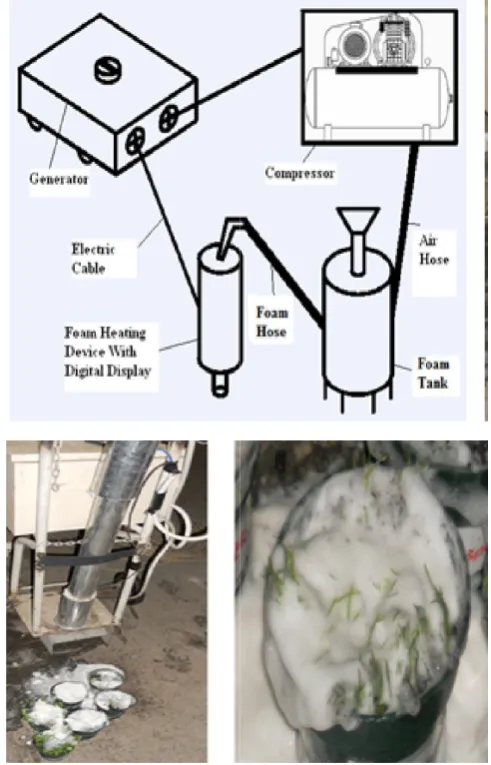
[image:2.595.310.556.170.553.2]glass wool again for electric and heat insulation. The upper portion was closed with an aluminum pipe. The schematic display of the system is given in (Fig. 1).
Fig. 1. Schematic display of hot foam heating system
The system is a heating circuit that works with a 220 Volt alternative current. The heating circuit was prepared with start and stop buttons, a contractor, and a thermocouple.
start button is pressed, the contractor closes its open contacts and the energy that passes over the contractor warms the heater via the thermocouple. The thermocouple adjusts the desired calorific value. When the adjusted calorific value is obtained, the thermostat opens the circuit, and when the heat drops under the adjusted calorific value, the t
the circuit and turns on the heater again.
Preparation and Application of the Foam Machine
A digitally-controlled system was prepared in order to apply the specially-prepared organic foam at the desired temperatures. Other related parts (compressor, generator, and foam tank) were mounted on the cart that was prepared. The First, a hot foam machine was prepared, and in the second stage, wild oats
), and wild clover ) were planted in pots, so that there were three
ion pots for each, and the results of the applications were compared at the conclusion of the
Designing the Hot Foam Machine with a Digital Indicator
A black pipe with a caliber of 12 mm through which the foam would flow was used for the system. The pipe was then clad with a 2500 watt ceramic resistance, which was prepared based on special order. An appropriate material was sought to and heat insulation of the resistance, and it was determined that Teflon would be the best material for this purpose. However, it was observed that Teflon was not an economically feasible choice, and Teflon producers would 500 items. Therefore, aerated concrete, which would provide both electricity and heat insulation, was purchased and processed in the lathe until it reached the correct caliber and dimensions, which was then mounted on the system. The aerated concrete was clad with glass wool again for electric and heat insulation. The upper portion was closed with an aluminum pipe. The schematic
Fig. 1. Schematic display of hot foam heating system
circuit that works with a 220 Volt alternative current. The heating circuit was prepared with start and stop buttons, a contractor, and a thermocouple. When the start button is pressed, the contractor closes its open contacts r the contractor warms the heater via the thermocouple. The thermocouple adjusts the desired calorific value. When the adjusted calorific value is obtained, the thermostat opens the circuit, and when the heat drops under the adjusted calorific value, the thermostat closes
Preparation and Application of the Foam Machine
controlled system was prepared in order to apply prepared organic foam at the desired temperatures. Other related parts (compressor, generator, and foam tank) were mounted on the cart that was prepared. The
application was employed on wild oats (
ryegrass (L. perenne), and wild clover (
three control pots and three hot foam application pots. The trial was conducted by planting an equal number of plants in the pots. Hot foam was applied
[image:2.595.39.289.390.561.2]emergence of plants, and the development of plants was observed after each application. The integrated system that was prepared and the application to the weeds are shown in (Fig.2).
Fig. 2. Illustrations of the integrated system and the
RESULTS
Data Obtained from the Plants in Pots as a Result of Hot Foam Applications and Analyses of the Data
Wild oats (A. fatua), English ryegrass (
clover (M. sativa) were planted each in three
three hot foam application pots. Hot foam was applied three times in accordance with the growth period of the plants. The hot foam application pots and control pots are shown in (Fig. 3, 4, and 5).
As can be seen in the figures above, the w
at very high rates as a result of the hot foam application. most significant reason for this is that the control is easier when the hot foam application is performed in the pot, and the target is precisely identified.
d on wild oats (A. fatua), English
wild clover (M. sativa), each in
three control pots and three hot foam application pots. The trial was conducted by planting an equal number of plants in the pots. Hot foam was applied once a week with the emergence of plants, and the development of plants was observed after each application. The integrated system that was prepared and the application to the weeds are shown in
Fig. 2. Illustrations of the integrated system and the application
Data Obtained from the Plants in Pots as a Result of Hot Foam Applications and Analyses of the Data
), English ryegrass (L. perenne), and wild
) were planted each in three control pots and ot foam application pots. Hot foam was applied three times in accordance with the growth period of the plants. The hot foam application pots and control pots are shown in
Fig. 3. State of the control pot, and the state of the application pot after the hot-foam application for English ryegrass (L. perenne)
Fig. 4. State of the control pot, and the state of the application pot after the hot-foam application for wild oats (A. fatua)
Fig. 5. State of the control pot, and the state of the application pot after the hot-foam application for wild clover (M. sativa)
The number of weeds, average weight (kg), and average length (mm) of the plants in the pots were measured for the scientific demonstration of the data obtained as a result of the applications. A precise scale with digital indicator and a digital caliper was used for this purpose. Hence, in the determination of weed destruction rates (%), the results of the control procedure were based on the method used. The following equivalence was used for the determination of percentages:
Rate (%) = ((CV–MV)/CV) ×100 (1)
Rate (%): Weed destruction rate after application
CV: Average number of weeds after control
MV: The number of weeds after application
Data Obtained from English Ryegrass (L. perenne) and Analyses
For English ryegrass (L. perenne), three pots were planted for
[image:3.595.308.562.273.418.2]the control application and three pots for the hot foam application. The hot foam application was performed three times in accordance with the growth stage of the plant. As a result, the average mechanical properties were determined. The average mechanical properties obtained are given in Table 1.
For English ryegrass (L. perenne), as can be seen in Table 1,
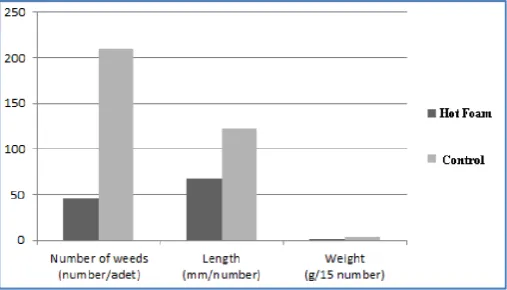
the data regarding the number of weeds, the average length, and weight were collected and compared. Results were specified as the change in percentage. The average length, the average number of weeds, and the average weight properties observed in the hot foam applications and control pots in Table 1 are shown in the (Fig.6).
Fig. 6. Comparison of the average mechanical properties obtained after the applications
As it is seen in Table 1, the average number of weeds in the control pots was 209. This value is the result of natural growth without any applications in the pots. On the other hand, the number of weeds that grew in the pots that were planted under the same circumstances and rates but subjected to hot foam application was 46. Considering the values obtained from both applications, the weed destruction rate of hot foam application was78% compared to the control application. Moreover, the weeds remaining after the hot foam application wilted to a significant extent.
[image:3.595.41.291.352.459.2]Overall, the high weed destruction rate demonstrates that the hot foam application proved to be successful as a method of weed control. That is to say, the hot foam application can be implemented successfully as an alternative weed control method. The mechanical properties of weeds were compared in order to demonstrate the results of the control procedure and the hot foam application more precisely.
Table 1. The mechanical properties obtained as a result of the hot foam application on English ryegrass (L. perenne)
Hot Foam Control
Number of Weeds (Number/pot)
Average Length (mm/number)
Average Weight (g/15 number)
Number of Weeds (Number/pot)
Average Length (mm/number)
Average Weight (g/15 number)
Replicates 47 72.4 1.3 197 118.9 4.5
52 68.7 1.5 208 127.6 3
38 62.3 1.2 222 121.8 4.5
Average Value 46 67.8 1.3 209 122.8 4
Rate (%) 78 45 68 0 0 0
[image:3.595.52.549.685.768.2]The average length (mm) and weight per 15 weeds (g) were examined as mechanical properties. While the average length was 122.8 mm in the control pots, it was67.8 mm in the hot foam application pots. Taking the average length obtained in the control pots as the main criterion, the hot foam application proved to achieve a 45% decrease on average. The weight per 15 weeds was 4 grams in the control pots, whereas it was 1.3 grams in the hot foam application pots. Taking the average weight obtained in the control pots as the main criterion, the hot foam application proved to achieve a 68% decrease on average.
Data Obtained from Wild Oats (A. fatua) and Analyses
For wild oats (A. fatua), threepots were used for control
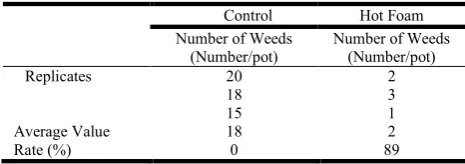
[image:4.595.322.543.129.210.2] [image:4.595.45.278.313.395.2]procedure and threepots for the hot foam application. The hot foam application was performed three times in accordance with the growth stage of the plant. The average number of weeds per pot was determined. The results are given in Table 2.
Table 2. Data obtained from applications on wild oats (A. fatua)
Control Hot Foam Number of Weeds
(Number/pot)
Number of Weeds (Number/pot)
Replicates 20 2
18 3
15 1
Average Value 18 2
Rate (%) 0 89
As can be seen in Table 2, the average number of wild oats
(A. fatua) was 18 in the control pots. This value is the result of
natural growth without any application to the pots. On the
other hand, the number of wildoats (A. fatua) that grew in the
pots that were planted under the same circumstances and rates but subjected to the hot foam application was two. Considering the values obtained from both applications, the weed destruction rate of the hot foam application was89% compared to the control procedure. The high weed destruction rate attained demonstrates that the hot foam application proved
to be a very successful control method for wild oats (A. fatua)
That is to say, the hot foam application can be implemented
successfully as an alternative control method for wild oats
(A. fatua).
Data Obtained from Wild Clover (M. sativa) and Analyses
For wild clover (M. sativa), three pots were used for the
control procedure and three pots for the hot foam application. The hot foam application was performed three times in accordance with the growth stage of the plant. As a result, the average mechanical properties were determined. The average mechanical properties obtained are given in Table 3. As can be
seen in Table 3, the average number of wild clover (M. sativa)
was 52 in the control pots. This value is the result of natural growth without any application in the pot. On the other hand,
the number of wild clover (M. sativa) that grew in the pots that
were planted under the same circumstances and rates but subjected to the hot foam application was be four. Considering the values obtained from both applications, the weed destruction rate of the hot foam application was92% compared to the control pots. The high weed destruction rate attained demonstrates that the hot foam application proved to be very
successful as a control method for wild clover (M. sativa).
That is to say, the hot foam application can be implemented successfully as an alternative control method for wild clover
(M. sativa).
Table 3. Data obtained from the applications on wild clover (M. sativa)
Control Hot Foam Number of Weeds
(Number/pot)
Number of Weeds (Number/pot)
Replicates 48 3
56 4
51 4
Average Value 52 4
Rate (%) 0 92
DISCUSSION
The machine built for the application was first in its kind; therefore several challenges were faced during the applications. An attempt will be made to eliminate these challenges in future studies on this subject. The system supplies energy from a generator that works on benzene. It was designed in this form for practical reasons. However, energy can be supplied from the accumulator of the tractor, or from alternative energy resources. Hot foam also can be heated by using solar energy. Hot foam flows through the pipe through a linear route. This causes some adversities in terms of reaching a certain temperature while the foam travels from the inlet towards the outlet. The desired heat can only be achieved with a very high temperature. In order to regulate this, the pipe can be designed in a helical form. In this way, a circular flow will be attained rather than linear, which will maximize the foam’s contact with the heat and make the flow last longer.
The trials of the hot foam machine in the pot environment resulted in remarkable success. The system can emerge as an alternative to chemical control with certain developments. In this study, a hot foam machine was designed as an alternative weed control method. Reviewing the domestic and international literature, we could not find any publications on weed control using the hot foam method. Therefore, the machine designed in this study is unprecedented in this field. The hot foam machine is available for use as an alternative method for weed control. The system can be retouched with some arrangements and additions and launched in the market for the use of farmers, especially those engaged in organic agriculture.
REFERENCES
Ascard, J., Hatcher, P.E., Melander, B. and Upadhyaya, M.K. 2007. Thermal weed control. pp. 155-176. In. Upadhyaya, M.K. (ed.). Non-Chemical Weed Management Principles, Concepts and Technology. ISBN-13: 978 1 84593 290 9, CAB International
Ascard, J. 1990. Weed control in ecological vegetable farming. In A. Granstedt. Proceedings of the Ecological Agriculture, Nordiske Jordbrugs forskeres Forening, Seminar, 166, 178-184
Er, C. and Inan, H. 1987. The impact of weed competition on
sugar beet yield quality. Sugar Journal, 121,8-20
Second Annual Symposium on the Use of Flame in
Agriculture. Natural Gas Producers Association and
National LP-Gas Association, pp. 11–12.
Kerpauskas, P., Sirvydas, P., Vasinauskiene, R.and
Tamosiunas, A. 2009. Influence of thermal effect durate n
on yield. Agronomy Research 7 (Special Issue 1):
323-327.
Ozer, Z. 1993. Why weed science.1. Herbology Congress, Adana.1-7
Parish, S., 1990. A review of non-chemical weed control
techniques. Biological Agriculture and Horticulture,
Vol.7, 117-137.