Multiple Criteria Decision Analysis for Assessing the Value of
New Medical Technologies
Researching, developing and applying a new value framework for the purpose
of Health Technology Assessment
Aris Nikolaos Angelis
A thesis submitted to the Department of Social Policy of the London
School of Economics for the degree of Doctor of Philosophy, London,
Declaration of Authorship
I certify that the thesis I have presented for examination for the Social Policy PhD degree of the London School of Economics and Political Science is solely my own work other than where I have clearly indicated that it is the work of others (in which case the extent of any work carried out jointly by me and any other person is clearly identified in it – see ‘Statement of conjoint work’).
The copyright of this thesis rests with the author. Quotation from it is permitted, provided that full acknowledgement is made. This thesis may not be reproduced without my prior written consent.
I warrant that this authorisation does not, to the best of my belief, infringe the rights of any third party.
Statement of Conjoint Work
Part of the work presented in Chapters 3-7 of this thesis has been published or is currently under review in peer review academic journals1, co-authored with Prof Panos Kanavos from London School of Economics (London, UK), Dr Ansgar Lange from London School of Economics (London, UK), Prof Gilberto Montibeller from Loughborough University (Loughborough, UK) and Dr Daniel Hochhauser from University College London Hospital (London, UK). For the published aspects of this work, I conceived the studies, designed the studies, collected the data, analysed the data, interpreted the findings and drafted the papers. I confirm that I am fully responsible for the entirety of the work presented in this doctoral thesis other than where I have cited the relevant work of others.
Chapter 3 has been published with Prof Panos Kanavos as co-author: Angelis A, Kanavos P (2016). Value-Based Assessment of New Medical Technologies: Towards A Robust Methodological Framework for the Application of Multiple Criteria Decision Analysis in the Context of Health Technology Assessment. PharmacoEconomics May; 34(5):435-46 (Supplied in Appendix to Published Articles). I devised the study, wrote the first draft, contributed to subsequent drafts, and am the guarantor. Panos Kanavos supervised the study, provided methodological guidance, and contributed to the published manuscript version.
Chapter 4 has been published with Dr Ansgar Lange and Prof Panos Kanavos as co-authors: Angelis A, Lange A, Kanavos P (2017). Using health technology assessment to assess the value of new medicines: Results of a systematic review and expert consultation across eight European countries. European Journal of Health Economics. In press; DOI: 10.1007/s10198-017-0871-0. I devised the study, collected the data, analysed the data, wrote the first draft, contributed to subsequent drafts, and am the guarantor. Ansgar Lange contributed to the published manuscript version. Panos Kanavos supervised the study, provided methodological guidance, and contributed to the published manuscript version.
Chapter 5 has been published with Prof Panos Kanavos as co-author: Angelis A, Kanavos P (2017). Multiple Criteria Decision Analysis (MCDA) for Evaluating New Medicines in Health Technology Assessment and Beyond: the Advance Value Framework. Social Science
1Chapter 7 has been submitted for peer review and it is single-authored by myself as: Angelis A.
& Medicine. In press; doi.org/10.1016/j.socscimed.2017.06.024. I devised the study, collected the data, analysed the data, wrote the first draft, contributed to subsequent drafts, and am the guarantor. Panos Kanavos supervised the study, provided methodological guidance, and contributed to the published manuscript version.
Other Relevant Work
During my PhD, I co-authored a number of peer-reviewed publications, which, although highly relevant to the work presented here, did not directly contribute to the empirical chapters of my thesis. These are listed below:
Angelis A, Kanavos P (2016). A Critique to ASCO’s Value Assessment Framework for Cancer Treatments: Putting Methodological Robustness First. Journal of Clinical Oncology. August; 34(24): 2935-2936 (Supplied in Appendix to Published Articles)
Angelis A, Kanavos P, Montibeller G (2016). Resource Allocation and Priority Setting in Healthcare: A Multi-criteria Decision Analysis Problem of Value? Global Policy. In press; DOI: 10.1111/1758-5899.12387 (Supplied in Appendix to Published Articles)
Tervonen T, Naci H, van Valkenhoef G, Ades AE, Angelis A, Hillege HL, Postmus D (2015). Applying Multiple Criteria Decision Analysis to Comparative Benefit-Risk
Assessment: Choosing Among Statins in Primary Prevention. Medical Decision Making 35 (7). 859-871. ISSN 1552-681X (Supplied in Appendix to Published Articles)
Acknowledgements
I would like to acknowledge that the research activities of the thesis have been carried out under the auspices of Advance-HTA, an FP-7 research project that has received funding from the European Commission, DG Research (Grant agreement no: 305983) and led by the London School of Economics (LSE). The views represented in this thesis do not necessarily reflect the views of the European Commission. Parts of this thesis have been submitted to the European Commission as deliverable of Work Package 2 of the Advance-HTA project.
I would like to express my gratitude to my PhD supervisor Prof Panos Kanavos (LSE) for providing me with the intellectual freedom and academic support to pursue my research interests and for his enthusiasm, encouragement, guidance, and feedback throughout the four years of my PhD. I am also thankful to my second PhD supervisor Prof Alistair McGuire (LSE) for his valuable feedback throughout the years.
I would like to specially thank Dr Matteo Galizzi (LSE) and Dr Monica Oliveira (University of Lisbon) for acting as my PhD viva examiners, thorough reviewing my thesis and providing me with rigorous feedback and ways of improving my work.
I am particularly grateful to Prof Gilberto Montibeller (Loughborough University) for teaching me decision analysis skills and providing me with fundamental theoretical direction; I would like to acknowledge his input in Chapters 4 and 6 where he provided valuable feedback in earlier versions. I would like to offer my special thanks to Prof Larry Phillips (LSE) and Prof Carlos Bana e Costa (University of Lisbon) for sharing with me their long expertise in the decision sciences field; I would like to acknowledge their valuable and constructive feedback for Chapters 6 and 7. I would also like to thank the partners of Advance-HTA consortium for their contributions in Work Package 2, including their views and opinions during the meetings of the consortium; I would like to acknowledge helpful comments and suggestions for Chapters 4, and 5.
I am grateful to the following experts for reviewing the results of Chapter 4 (systematic literature review) and providing critical feedback that shaped the content of the Chapter: Karl Arnberg (TLV), Karen Brigham (University Paris Est), Agnese Cangini (AIFA), Guillaume Dedet (World Health Organisation), Jaime Espin (Andalusian School of Public Health), Mathilde Grande (HAS), Kinga Grzywacz (AOTMiT), Patrick Jeurissen (Dutch Ministry of Health, Welfare and Sport & Radboud University Nijmegen Medical Centre), Douglas Lundin (TLV), Armando Magrelli (National Centre for Rare Diseases, Istituto Superiore di Sanità), Dimitra Panteli (Berlin University of Technology), Dominique Polton (National Health Insurance Fund ), Pierluigi Russo (AIFA), Annalisa Sammarco (AIFA), Pedro Serrano (Canary Islands Foundation for Research and Health), Giovanni Tafuri (AIFA & EMA) and Anna Zawada (AOTMiT).
I would like to acknowledge the feedback that has been received from the participants at the HTAi conference in Oslo (June 2015), the YoungOR19 conference of the OR Society in Birmingham (September 2015) and the PPRI conference of the WHO Collaborating Centre for Pharmaceutical Pricing and Reimbursement Policies in Vienna (October 2015); I am grateful for all comments and suggestions received. I would also like to thank the participants of the Advance-HTA dissemination and capacity building workshops in Mexico City (November 2014), Santiago (September 2015), and Warsaw (September 2014 and 2015), for providing constructive comments and their perspectives on the development of the value tree and the value framework, which helped shaping the content of Chapter 6.
I would like to thank the participants of the decision conference that attended a one-day workshop at London School of Economics (LSE) and whose preferences were elicited acting as the basis of the analysis for Chapter 6: Keith Abrams (University of Leicester), Stuart Barber (Beating Bowel Cancer), Andres Freiberg (NICE International), Rob Glynne-Jones (Mount Vernon Hospital), Burrinder Grewal, Daniel Hochhauser (UCL Hospital), Barbara Moss, Elena Nicod (LSE), Mark Ross, Caroline Rudisill (LSE), David Taylor (UCL), Sotiris Vandoros (King’s College London), John Wright (LSE). I would like to acknowledge Daniel Hochhauser (UCL Hospital) for his valuable clinical insight and his contribution to the manuscript submitted for publication that formed part of Chapter 6.
Douglas Lundin for helping to organise the workshop. I would like to acknowledge Mark Linch (UCL Hospital) for his valuable clinical insight and his contribution to the manuscript submitted for publication that formed part of Chapter 7.
Special thanks go out to my old friends Dr Kyriakoulis Resvanis (Imperial College London) and Dr Themistocles Resvanis (Massachusetts Institute of Technology) for their help and thoughts in preparation of this manuscript and for the many long and fruitful discussions. Thanks also go out to my friends and flatmates Kaf, Koulis, Jimmy and Grafas for putting up with me and making sure that there was never a mundane moment.
Last but not least I would like to thank my parents and family for their continuous support.
Abstract
methodologies focus on a limited number of value dimensions, despite the fact that the value of new medicines is multi-dimensional in nature. Explicit elicitation of social value trade-offs is not possible and decision-makers may adopt intuitive or heuristic modes for simplification purposes, based on ad hoc procedures that might lead to arbitrary decisions.
Objectives: The objective of the present thesis is to develop and empirically test a methodological framework that can be used to assess the overall value of new medical technologies by explicitly capturing multiple aspects of value while allowing for their trade-offs, through the incorporation of decision-makers’ preferences in a structured and transparent way. The research hypothesis is that Multiple Criteria Decision Analysis (MCDA) can provide a methodological option for the evaluation of new medicines in the context of Health Technology Assessment (HTA), to support decision-making and contribute to more efficient resource allocation.
group of evaluators participated from the Swedish Dental and Pharmaceutical Benefits Agency (TLV), thereby adopting the TLV decision-making perspective.
Policy Implications: The value scores produced from the MCDA process reflect a more comprehensive benefit metric that embeds the preferences of stakeholders and decisions-makers across a number of explicit evaluation criteria. The incorporation of alternative treatments’ purchasing costs can then be used to derive incremental cost value ratios based on which the treatments can be ranked on ‘value-for-money’ grounds, reflecting their incremental cost relative to incremental value.
Conclusion: The MCDA value framework developed can aid HTA decision-makers by allowing them to explicitly consider multiple criteria and their relative importance, enabling them to understand and incorporate their own preferences and value trade-offs in a constructed and transparent way. It can be turned into a flexible decision tool for resource allocation purposes in the coverage of new medicines by payers but could also be adapted for other decision-making contexts along their development, regulation and use.
Table of contents
DECLARATION OF AUTHORSHIP ... 2
STATEMENT OF CONJOINT WORK ... 3
OTHER RELEVANT WORK ... 5
ABSTRACT ... 8
LIST OF CHAPTERS ... 13
LIST OF FIGURES ... 14
LIST OF TABLES ... 15
LIST OF BOXES ... 16
LIST OF ABBREVIATIONS ... 17
CHAPTER 1 – INTRODUCTION TO HEALTH TECHNOLOGY ASSESSMENT, THESIS RESEARCH QUESTIONS AND OVERVIEW ... 21
1.1INTRODUCTION AND THE NEED FOR IMPROVING THE WAY WE MEASURE THE VALUE OF HEALTH CARE INTERVENTIONS .... 21
1.2RESEARCH QUESTIONS AND THESIS OVERVIEW ... 33
1.3CONCLUSION... 43
CHAPTER 2 – CURRENT METHODS OF VALUE ASSESSMENT OF MEDICAL TECHNOLOGIES ... 45
2.1CURRENT METHODS OF VALUE ASSESSMENT IN HEALTH TECHNOLOGY ASSESSMENT ... 45
2.2LIMITATIONS OF CURRENT VALUE ASSESSMENT APPROACHES ... 49
2.3SUMMARY OF GAPS IN THE LITERATURE AND LIKELY WAYS FORWARD ... 52
2.4CONCLUSION... 54
CHAPTER 3 – PAPER 1 ... 56
CONCEPTUAL FRAMEWORK: TOWARDS A ROBUST METHODOLOGICAL FRAMEWORK FOR THE APPLICATION OF MULTIPLE CRITERIA DECISION ANALYSIS IN THE CONTEXT OF HEALTH TECHNOLOGY ASSESSMENT ... 56
SUMMARY ... 56
3.1INTRODUCTION ... 56
3.2AMETHODOLOGICAL PROCESS APPLYING MCDAPRINCIPLES IN HTA AND VALUE ASSESSMENT OF MEDICAL TECHNOLOGIES ... 59
3.3MODEL-BUILDING AND THE CONSTRUCTION OF A VALUE TREE:PROPERTIES TO ENSURE A ROBUST MCDAMODEL ... 69
3.4.‘INCREMENTAL’VERSUS ‘CLEAN SLATE’MCDAAPPROACHES AND LINK TO POLICY MAKING... 73
3.5CONCLUSION... 75
CHAPTER 4 – PAPER 2 ... 76
EVALUATION CRITERIA AND DECISION-MAKING PRACTICES IN HEALTH TECHNOLOGY ASSESSMENT: A SYSTEMATIC REVIEW AND EXPERT CONSULTATION ACROSS 8 EU COUNTRIES ... 76
SUMMARY ... 77
4.1BACKGROUND ... 77
4.3RESULTS ... 86
4.4DISCUSSION ... 117
4.5CONCLUSION... 120
CHAPTER 5 – PAPER 3 ... 121
METHODOLOGICAL FRAMEWORK: A MULTIPLE CRITERIA DECISION ANALYSIS VALUE MEASUREMENT MODEL AND TECHNIQUES FOR THE EVALUATION OF NEW MEDICINES IN HEALTH TECHNOLOGY ASSESSMENT ... 121
SUMMARY ... 121
5.1BACKGROUND ... 122
5.2THEORETICAL FOUNDATIONS ... 124
5.3METHODS ... 127
5.4RESULTS –THE ADVANCE VALUE TREE ... 132
5.5DISCUSSION -THE ADVANCE VALUE FRAMEWORK ... 149
5.6CONCLUSION... 155
CHAPTER 6 – PAPER 4 ... 159
APPLICATION OF THE MCDA VALUE FRAMEWORK: A SIMULATION EXERCISE ON METASTATIC COLORECTAL CANCER WITH MULTIPLE STAKEHOLDERS IN THE ENGLISH SETTINGS ... 159
SUMMARY ... 159
6.1BACKGROUND ... 160
6.2METHODS ... 161
6.3.RESULTS ... 175
6.4DISCUSSION ... 188
6.5CONCLUSION... 191
CHAPTER 7 – PAPER 5 ... 193
APPLICATION OF THE MCDA VALUE FRAMEWORK: A CASE STUDY ON METASTATIC PROSTATE CANCER WITH THE SWEDISH DENTAL AND PHARMACEUTICAL BENEFITS AGENCY TLV ... 193
SUMMARY ... 193
7.1BACKGROUND ... 194
7.2METHODS ... 196
7.3RESULTS ... 209
7.4DISCUSSION ... 216
7.5CONCLUSION... 218
8.1KEY CONCLUSIONS ... 219
8.2POLICY IMPLICATIONS ... 227
8.3LIMITATIONS ... 233
8.4FUTURE RESEARCH DIRECTIONS ... 241
APPENDIX TO CHAPTER 2 ... 278
APPENDIX TO CHAPTER 5 ... 279
APPENDIX TO CHAPTER 6 ... 280
APPENDIX TO CHAPTER 7 ... 304
APPENDIX TO PUBLISHED ARTICLES ... 319
List of Chapters
Chapter 1 – Introduction to Health Technology Assessment, Thesis Research Questions
and Overview
Chapter 2 – Current Methods of Value Assessment of Medical Technologies
Chapter 3 – Conceptual Framework: Towards a Robust Methodological Framework for
Chapter 4 – Evaluation Criteria and Decision-Making Practices in Health Technology
Assessment: a Systematic Review and Expert Consultation across 8 EU Countries
Chapter 5 – Methodological Framework: a Multiple Criteria Decision Analysis Value
Measurement Model and Techniques for the Evaluation of New Medicines in Health Technology Assessment
Chapter 6 – Application of the MCDA Value Framework: a Simulation Exercise on
Metastatic Colorectal Cancer with Multiple Stakeholders in the English Settings
Chapter 7 – Application of the MCDA Value Framework:a Case Study on Metastatic Prostate Cancer with the Swedish Dental and Pharmaceutical Benefits Agency TLV
Chapter 8 – Conclusions, Policy Implications, Limitations and Future Research Directions
List of Figures
Figure 3.1: Value function for scoring the performance of alternative options
Figure 3.2: Multiple criteria decision analysis (MCDA) methodological process in the
context of health technology assessment
Figure 3.3: Value tree hierarchies and data sources using a multiple criteria decision analysis
(MCDA) process for value assessment
Figure 4.1: Main components and sub-components of the analytical framework applied
Figure 5.1: The five-stage criteria selection process for structuring the value tree as part of
a top-down ‘value-focused thinking’ approach.
Figure 5.2: The generic value tree for new medicines Advance Value Tree
Figure 6.1: Preliminary value tree for metastatic colorectal cancer (pre-workshop)
Figure 6.2: Final Value Tree for metastatic colorectal cancer (post-workshop)
Figure 6.3: Stacked bar plot of treatments’ overall weighted preference value (WPV) scores
across all attributes
Figure 6.4: Criteria weights histogram
Figure 6.5: Cost benefit plot of overall weighted preference value (WPV) scores versus
costs
Figure 7.1: Preliminary value tree for metastatic prostate cancer (pre-workshop)
Figure 7.2: Final value tree for metastatic prostate cancer (post-workshop)
Figure 7.3: Stacked bar plot of treatments’ overall weighted preference value (WPV) scores
across all attributes
Figure 7.4: Criteria weights stacked bar
Figure 7.5: Cost benefit plot of overall weighted preference value (WPV) scores versus
costs
Figure 8.1: Differences between cost effectiveness analysis (CEA) and multiple criteria
decision analysis (MCDA) in decision-making
Figure 8.2: Proposed roadmap to MCDA application and implementation
List of Tables
Table 3.1: Different methodological approaches for selecting objectives and criteria
Table 4.1: Responsibilities and structure of national HTA agencies
Table 4.2: Evidence and evaluation criteria considered in HTAs
Table 4.3: HTA methods and techniques applied
Table 4.4: HTA outcomes and implementation
Table 5.1: Value dimensions considered as evaluation criteria among the study group of
Table 5.2: Comparison of the Advance Value Framework with other value frameworks
Table 6.1: Attributes definition and sources of evidence
Table 6.2: Pre-workshop attribute reference levels and basis of selection
Table 6.3: List of decision conference participants
Table 6.4: Changes in the definitions of the attribute reference levels, pre- and post-
workshop
Table 6.5: Post-workshop attribute reference levels and basis of selection
Table 6.6: Options performance across the criteria attributes
Table 6.7: Overall weighted preference value (WPV) scores, partial preference value
scores, relative weights, costs and cost per unit of value
Table 7.1: Attributes definition and sources of evidence
Table 7.2: Pre-workshop attribute reference levels and basis of selection
Table 7.3: Options performance across the criteria attributes
Table 7.4: Overall weighted preference value (WPV) scores, partial preference value
scores, relative weights, costs and cost per unit of value
List of Boxes
List of Abbreviations
AEs Adverse Events
AIFA Agenzia Italiana del Farmaco (Italy)
AMNOG Gesetz zur Neuordnung des Arzneimittelmarktes in der gesetzlichen Krankenversicherung (Germany)
AOTMiT Agency for Health Technology Assessment and Tariff System (Poland)
ASMR Amélioration du Service Médical Rendu (HAS/ France)
ATC Anatomical Therapeutic Chemical
BNF British National Formulary
BoD Burden of Disease
BSC Best Supportive Care
CBA Cost Benefit Analysis
CEA Cost Effectiveness Analysis
CED Coverage with Evidence Development
CEESP Commission for Economic Evaluation and Public Health (France)
CEPS Economic Committee for Health Products (France)
CPR Pricing and Reimbursement Committee (Italy)
CUA Cost Utility Analysis
DA Decision Analysis
DH Department of Health
EBM Evidence Based Medicine
ECOG Eastern Cooperative Oncology Group
EGFR Epidermal Growth Factor Receptor
EMA European Medicines Agency
EOL End of Life
EPAR European Public Assessment Report
ERG Evidence Review Group (NICE/ England)
EU European Union
EUnetHTA European network for Health Technology Assessment
FOLFIRI Folinic acid, (5-)Fluorouracil and Irinotecan
FOLFOX Folinic acid, fluorouracil and oxaliplatin
FP7 Seventh Research Framework Programme
G-BA Federal Joint Committee (Germany)
HAS Haute Autorité de Santé (France)
HRQOL Health Related Quality of Life
HTA Health Technology Assessment
ICER Incremental Cost Effectiveness Ratio
ICP Interministerial Committee for Pricing (Spain)
ICVR Incremental Cost Value Ratio
INN Innovation Level
IQWiG Institut für Qualität und Wirtschaftlichkeit im Gesundheitswesen (Germany)
ISCIII Instituto de Salud Carlos III (Spain)
ISP Intérêt de Santé Publique (France)
KRAS v-Ki-ras2 Kirsten rat sarcoma viral oncogene homolog
LYG Life-years gained
MACBETH Measuring Attractiveness by a Categorical Based Evaluation Technique
MAUT Multi-Attribute Utility Theory
MAVT Multi-Attribute Value Theory
MCDA Multiple Criteria Decision Analysis
mCRC Metastatic Colorectal Cancer
mCRPC Metastatic Castrate-Resistant Prostate Cancer
MEA Managed Entry Agreement
MoH Ministry of Health
NICE National Institute for Health and Care Excellence (England)
NHS National Health Service
NMTs New Medical Technologies
ORR Objective Response Rate
OS Overall Survival
QALY Quality Adjusted Life Year
R&D Research and Development
RCT Randomised Control Trial
RedETS Red de Agencias de Evaluación de Tecnologías Sanitarias y Prestaciones del Sistema Nacional de Salud (Spanish HTA network)
RoA Route of Administration
SAF Safety Profile
ScVJs Scientific Value Judgments
SESCS Servicio de Evaluación y Planificación Canarias (Spain)
SMR Service Médical Rendu (HAS/ France)
SOC Socioeconomic Impact
SoVJ Social Value Judgement
SPC Summary of Product Characteristics
SMAA Stochastic Multi-Criteria Acceptability Analysis
SWF Social Welfare Function
TA Technology Appraisal
THE Therapeutic Impact
TLV Tandvårds- och Läkemedelsförmånsverket (Sweden)
VA Value Assessment
VBA Value Based Assessment
VBP Value Based Pricing
WHO World Health Organisation
WPV Weighted Preference Value
WTP Willingness to Pay
Chapter 1 – Introduction to Health Technology Assessment, Thesis
Research Questions and Overview
1.1 Introduction and the case for improving the way we measure the value of health
care interventions
of different factors and objectives need to be balanced through the involvement of a range of stakeholders, ii) the importance of the decision outcomes, as they have a dramatic impact on human health, and iii) the ethical and social responsibilities behind the provision of health care which traditionally has been perceived as a government duty, given that health on its own is regarded as a public good or even a human right.
1.1.1 Resource Allocation Methods in the National Health Service
The need for priority setting in health care had not always been realised; its acknowledgement came following a lengthy and incrementally evolving process characterised by the interplay of scientific advancements, culture changes and politics. However, the process of priority setting in the last 20 years has remained unchanged. The example of the British National Health Service (NHS) provides an insightful case study. Nowadays, priority setting takes place across all levels of the organisational hierarchy of the health care system: the central government decides the overall budget of the NHS, commissioners and providers determine their purchases among alternative services and interventions, and clinicians allocate their time and resources 10. A similar decision context was evident in the 1990s. As Klein described in 1993, “micro-decisions about priority setting are constrained by macro-decisions about resource allocation taken at superior levels in the organisational hierarchy” 11(p. 309), according to an almost identical landscape where cabinet decided on the NHS budget, Department of Health decided the priority targets, and purchasers decided on services 11.
The decision-making tool used for budget distribution has not changed either. Quality Adjusted Life Year (QALY), which is calculated by multiplying the value of each health state by the respective length of time of each state, provides in a single common summary measure the total health improvement, therefore providing a simple tool for resolving complex choices and turning it into the most widely used measure of health status for the assessment of health benefits 14,15. However since then, it had been argued that the Quality Adjusted Life Year (QALY) is flawed as a way of priority setting in health care 16 and that it does not originate directly from individual’s utility function therefore only partly reflecting the individual’s true preferences 17, while it had been acknowledged that it is “beset by methodological problems about the valuation of different states of health, by lack of data about incomes, and by the problem of patient heterogeneity” 11 (p. 310). Although it was more or less agreed that priority should ideally take place based on demonstration of effectiveness or need, both of which were problematic concepts however (at least back in that time), the former due to its uncertainty and the latter due to its ambiguity. And Klein therefore continued with the realisation that the process was not “rational” (probably in a logical or reasonable sense) but instead priorities were “emerging from pluralistic bargaining between different lobbies, modified by shifting political judgements made in the light of changing pressure” 11 (p. 310). In doing so though he argued that given the multiplicity of conflicting values (i.e. objectives) brought along such discussions, the idea of “a machine grinding out priorities” and making decisions for us would be “absurd”, and that the limitation of pluralistic bargaining was that it was not pluralistic enough but instead dominated by some (clinical) voices. As a consequence he finally argued that in order for the process to become more rational the technical characteristics of the decision-making process should be improved, according to an “open dialogue, […], in which arguments can be tested against evidence and the conflicts between different values or preferences can be explored” 11(p. 310), a rationality concept that he acknowledged goes back to Aristotle’s work of finding “good reasons” to justify decisions 18.
resources is also a political process, the application of such an ethical framework is very much needed.
1.1.2 Pharmaceuticals and Need for Value Assessment
Pharmaceutical spending is the third largest component of health care expenditure after hospital and ambulatory spending, accounting for between 10% and 20% of total expenditure on health in most OECD countries (the OECD average being 16.5% in 2010, or 1.5% of GDP) 21. Faster uptake of new and more expensive drugs has caused an escalating trend in pharmaceutical spending per capita in many developed economies22.
Although new, branded medicines account for only about 25% of all drugs dispensed by volume, they account for 70% to 85% of pharmaceutical spending across most OECD countries 23; price growth is mostly attributable to innovative medicines in a relative small number of therapeutic categories such as cancer, infection and central nervous system products 22.
Most expensive new medicines are associated with uncertainty in clinical benefit, alongside high cost. The associated clinical uncertainties usually relate to two aspects: first, safety due to potential unknown adverse drug events and, second, real effectiveness in daily clinical practice. Both of these uncertainty aspects could potentially be attributed to the design of the clinical research studies most of which fall short of a number of necessary features for their findings to be useful 24, such as their information gain (i.e. is the study large and long enough to be sufficiently informative?), pragmatism (i.e. does the study reflect real life?), and patient centeredness (i.e. does the study reflect patient priorities?). Failure to compare all relevant treatment options and the relatively short-term or ‘truncated’ time horizons of the studies act as additional limitations 25. As a result, the clinical uncertainty of new medicines in tandem with their high cost in prices have led to the assessment and appraisal of their benefits and costs by the payers in order to estimate their value and determine whether they should be covered, and possibly at what price 26-28.
assessing their value to a variety of stakeholders, such as patients, health care systems and even society at large 27,29,30. One of the main purposes of VBP is to essentially improve patient access to effective and innovative drugs while ensuring their prices are reflective of their value 31.
Central to VBP is the application of Health Technology Assessment (HTA) processes that evaluate the clinical benefits, and usually, costs of new health care interventions (including drugs, diagnostics and medical devices), compared to existing available alternatives in order to inform pricing and reimbursement decisions. Despite the extensive uptake and use of HTA practices and processes in recent years, there are several conceptual and methodological issues inherent in the use of the current value assessment (VA) approaches that limit their success.
The implication of ever increasing pharmaceutical expenditure in combination with the finite amount of resources available for health care is that health care decision-makers such as payers and commissioners of care, need to allocate resources efficiently, while ensuring patient access to effective new medicines. This observation is one of the central drivers of the thesis. It is suggested that the problematic nature and the technical difficulties associated with assessing the value of new medical technologies (NMTs) in practice, including their link to decision-making, are the key obstacles to overcome in order to address the above issues.
1.1.3 Primer on Economic Value Theories
A brief background of various value propositions in a historical context is useful to understand the evolution of economic value theory which could be generally classified into pre-classical, classical and neo-classical thinking. In medieval times, “value” was generally perceived by theorists to depend on utility and scarcity, with a subjective approach to value being generally adopted32,33. It was in the 17th century, when the pre-classical thinking on
continued to support a subjective, utility-based, approach to value evident from the medieval period, the utility theory of value 32-34. John Law first proposed the use of a two dimensional approach considering both demand and supply factors to determine the value of a good in society, based on which he tried to explain the water-diamond paradox of value as part of which the high value of water, essential for life, was priced at lower market price to the value of diamond, inessential to human life 38. By distinguishing between “value in exchange” and “value in use”, he regarded that diamonds’ “high value in exchange” is due to their relative scarcity, his reasoning essentially fitting the marginal utility approach that ultimately resolved the paradox in the 19th century turning his work into a milestone 39.
The seminal work of Adam Smith signalled the beginning of the classical thinking, pushing back towards Petty’s labour theory of value, compared to other pre-classical economists 40. After realising that a labour theory would not hold in an advanced economy, he proposed a cost of production value theory consisting of elements from labour, land and capital theories. David Ricardo then adopted Smith’s rejected labour hypothesis proposing that in free markets the value of (freely reproducible) commodities is derived from their scarcity and the quantity of labour needed for their production 41. Karl Marx subsequently built on Ricardo’s labour theory of value, which supported that commodities can be viewed as functions of labour time 42. Although John Stuart Mill allegedly also continued to work Ricardo’s labour theory, he recognised that a commodity’s market value is related to both demand and supply effects, placing his value approach closer to the neo-classical school of thought 43.
side factors 46. Marshall proposed a Partial Equilibrium concept and emphasised that the price of a good is determined both by supply and demand factors, and also introduced the price elasticity of demand concept, along with the consumer and producer surplus concepts 49. Marshall’s concept of externalities was then developed further by Arthur Cecil Pigou,
arguing that the existence of externalities is sufficient justification for government intervention, advocating the use of taxes to discourage activities that lead to negative externalities, and the use of subsidies to encourage activities that created positive externalities 50,51. The above economic value theories and in particular utility theory were then extended by and used in the field of decision analysis which emerged in the 1960s.
1.1.4 Utility Theory and Value Theory in Decision Analysis
Decision analysis was originally defined by Howard as “a logical procedure for the
balancing of the factors that influence a decision” incorporating “uncertainties, values, and preferences in a basic structure that models the decision” 52. Preferences reflect how desirable or choice-worthy an option or characteristic might be over another alternative option or characteristic, usually interpreted in a comparative way. By definition, decision-making is inherently subjective as it depends on individual utility and preferences which differ among individuals. The logic behind DA was then described by Raiffa as “divide and conquer”: “decompose a complex problem into simpler problems, get one’s thinking straight on these simpler problems, paste these analyses together with logical glue, and come out with a program of action for the complex problem” 53.
The main outcome of decision analysis theoretical axioms is that first, the utility of an alternative is the indication of its desirability, and second, that an alternative A with higher utility U(A) should be preferred to an alternative B with lower utility U(B), in other words expressing the rationality rule of utility maximisation, i.e.
(1)
values. These trade-offs are judgements, depending on the decision maker’s assessment of the relative desirability of the available options across their dimensions in tandem with the relative importance of these dimensions. However, given that trade-offs are personal, there are no universal rules for making them, being subjective in nature 54. Therefore, the notion of rationality is used, with the goal of making rational inferences and decisions. Possibly the most prominent of such criteria rules would be the maximisation of (expected) utility or value 55.
In decision analysis there is a clear conceptual difference between value functions, which assess the marginal benefit of an option, and utility functions, which incorporate preferences, therefore assessing both marginal benefit and risk attitude. The former is employed for riskless choices and the latter for choices under uncertainty. Expectation mainly relates to the concept of probability theory, with expected utility or value being a weighted average of the pay-off for an outcome (utility or value) and its respective probability of actually occurring 54. Expected utility and expected value are, therefore, calculated in a similar way but the pay-offs in the former case correspond to subjective utilities rather than objective quantities, with their formal terminology being subjectively expected utilities (SEUs): both the utilities and the probabilities incorporated are numbers, but are subjective in nature giving rise to numerical subjectivity, the notion of subjective judgments expressed as numbers 56. In the context of HTA, the evaluation of new medical technologies predominantly relates to the evidence-based assessment of their value by measuring their marginal benefits and therefore we choose to use the value term rather than utility, which reduces the heterogeneity of the value judgements based on expected utility.
The expected value (EV) of an event could then be written as
𝐸𝑉 = 𝑝1𝑣1+ 𝑝1𝑣2+ 𝑝3𝑣3+ ⋯ + 𝑝𝑛𝑣𝑛 (2)
Or alternatively as
𝐸𝑉 = ∑ 𝑝𝑖𝑣𝑖
𝑛
𝑖=1
(3) Where pi is the probability that event i will take place and vi is the value or pay-off
Given that the evaluation of health care interventions as part of HTA predominantly relates to the assessment of their value using existing evidence and not expected evidence, for simplicity reasons we choose to detach expectation and the probability concept while assuming the existence of evidence for the measurement of marginal benefit. However, it could also be argued that in various cases absence of (satisfactory or adequate) evidence essentially introduces an expectation variable given the attached probabilities of the respective outcomes to take place (e.g. clinical outcome), especially as part of early-HTA settings where a new medicine might still be under clinical development.
Overall, based on value theory alternative a is preferred over alternative b, if and only if V (a) > V (b), and is judged to be indifferent if and only if V (a) = V (b), where V is a real number reflecting the value associated with the performance of the alternatives based on which preference orderings are produced2 54. In multi-attribute value theory (MAVT), which is essentially the extension of value theory for the evaluation of problems with multiple value dimensions, partial value functions for each criterion, for example vi(a), are
first constructed and then aggregated together. Once again, the partial value function must satisfy the previous definition of a preference function according to which an alternative a is preferred to an alternative b for criterion i, if and only if vi(a) > vi(b), with a similar
indifference working hypothesis existing only if vi(a) = vi(b). Importantly, the working
assumptions required for the formation of the partial value functions are interrelating with the aggregation type used 2.
Typically, an additive (linear) aggregation approach is adopted, taking the following form:
𝑉(𝑎) = ∑ 𝑤
𝑖𝑣
𝑖(𝑎)
𝑚
𝑖=1
(4) Where m is the number of criteria, and wivi(a) the weighted partial value function of criterion
i for option a. Normally, partial value functions are standardised using lower and higher reference levels at 0 and 100 corresponding to “worst” and “best” or “least preferred” and “most preferred” outcomes. The “weight” wi represents the relative importance of criterion
i, which can be conceived as a parameter reflecting the gain associated with the replacement of the worst outcome by the best outcome for this particular criterion 2, which should be elicited using weighting techniques that assess their value trade-offs. Typically, the quantitative swing weighting technique is used asking for judgments of relative value between ‘swings’ (i.e. changes) from standard lower level x* to higher reference level x* on each x-th attribute), with each swing (i.e. a relative change from a lower to a higher attribute level) being valued between 0 and 100 and the most valuable swing anchored as 100 54. Normalised weights are then calculated, as a proportion of each swing weight, so the normalised weights summed to 100%. Overall, specification of the additive model requires the use of explicit reference values of 0 and 100 and positive weights summing one (or 100%). The additive model is assumed as a working hypothesis and therefore the model construction is done to respect these properties underlying the additive value model.
In order to enable the use of simple aggregation rules (e.g. additive value models, where scores and weights of the different individual criteria are multiplied and then added altogether in a weighted average manner), preference independence between the different criteria needs to be upheld 2. Preference independence is a key property; it implies that an option’s value score on a criterion can be elicited independently of the knowledge of the option’s performance on the remaining criteria. It should be noted that preference dependence (cardinal and ordinal) is not the same as environmental dependence (e.g. statistical correlation); two different criteria attributes could be statistically correlated (i.e. environmentally dependent) but at the same time preference independent and vice-versa. If this requirement is not observed, an additive aggregation function should not be employed unless the criteria are restructured to combine non-preference-independent criteria into a single criterion.
1.1.5 Problematic
Due to the different levels at which resource allocation needs to take place, and the fact that priority setting is a process focusing on the general population in contrast to the process of rationing which focuses on individual patients, a mix of slightly opposing principles act as objectives for resource allocation 10. On one hand there is the purely utilitarian principle of maximising the health impact on the whole population 59, and on the other hand there is a set of, usually secondary, ethical objectives relating to the distribution of health that mainly aim to prioritise interventions which target the more vulnerable 60, such as the poor 61, seriously sick 62, women and children 63.
These objectives should in theory be operationalised through the application of a plurality of criteria, most of which are characterising either the intervention under consideration or the condition it is indicated for. The intervention is usually assessed through the notion of benefit risk-ratio, essentially an evaluation metric reflecting whether the benefits of implementing the intervention outweigh the risks, by accounting both for the impact on health and the impact on resources needed. The condition is assessed through its burden or severity, which is usually approximated through its seriousness (morbidity and mortality related) and the availability of treatments.
As Baltussen and Niessen have described, a number of priority setting approaches have already been developed over the last 20 years, but all of these tend to concentrate on single value dimensions 64. These include the “evidence based medicine” approach for prioritising interventions according to their established effectiveness, “cost-effectiveness analysis” (and other forms of full economic evaluation) for prioritising according to efficiency by accounting both for effectiveness and costs, “equity analyses” for prioritising according to distributional impact, and “burden of disease analysis” for prioritising diseases according to their burden (through morbidity and mortality).
efficacy and effectiveness, what type of costs to consider, and very importantly how to account for other key dimensions of benefit.
The value of NMTs is multi-dimensional and not only limited to clinical benefit and cost but spans the disease severity and target population size, the nature of the intervention and whether for example it is curative or preventive, economic impact and budgetary constraints, together with other factors such as evidence quality 64-66. Thus, the methodological framework of these value assessment approaches is inadequate and at best partial mainly because the evaluation criteria used to assess evidence and determine value are incomplete. Many important value considerations falling under the burden of disease the treatment addresses, the treatment’s innovation level and its overall socioeconomic implications, are not adequately reflected in the evaluation process. Typically, as part of traditional economic evaluation techniques these value dimensions are not considered, and if they are, this might be done in an implicit and non-methodical manner, by considering a value concern only informally on an ad-hoc basis through committee deliberation and possibly as part of non-transparent negotiations with the manufacturer. For example, such an ad hoc approach would characterise the evaluation of expensive life-extending end-of-life (EOL) treatments in the English context 67, which has generated important questions about the credibility and consistency of the whole process 68. In addition, there are technical issues in achieving consensus on value, for example, what should the importance of each criterion be and how to account for uncertainty and incomplete evidence. Essentially, an explicit definition of value that relies on a comprehensive set of parameters is missing 69.
England for the assessment of ultra-rare therapies 76. As a result, it would be expected that decision-makers and other stakeholders would benefit from clear and comprehensive ways that allow them to assess all critical value dimensions of new health care interventions, in order to make better decisions about priority setting. Not having such methods creates a conceptual, methodological and policy gap.
A more explicit definition of value could incorporate a wider set of parameters than is currently the case, in combination with a more comprehensive methodological approach of assessment that includes views from all relevant stakeholders. This could then lead to the development of a supporting tool for decision-making, being flexible enough to enable decision-makers exercise their judgment, help them weigh the trade-offs and elicit their preferences when pursuing multiple objectives, while contributing to the debate on more efficient resource allocation.
1.2 Research Questions and Thesis Overview
The thesis’ working hypothesis is that a value assessment system for health care technologies characterised by comprehensiveness, consistency and transparency could potentially enable better prioritisation decisions for problems with complex information. Eventually, this could lead to a better understanding of the decisions’ rationale, therefore enhancing their acceptability.
1.2.1 Research Questions
The main research question of this thesis is the following: ‘How to develop, if possible, a methodological framework that assesses the overall value of new medical technologies in a universal way by capturing aspects of value that are not explicitly addressed by other available methodologies? Could Multiple Criteria Decision Analysis (MCDA) provide a useful alternative for value assessment and what techniques or options are available for the context of HTA? Given that the above outlined research hypothesis is based on the application of MCDA methodology, the need to address a number of secondary research questions arises, which forms the basis for the empirical chapters of the thesis and proposed research papers, notably:
2) What are the current practices, processes and policies of value assessment for new medicines across a number of jurisdictions in Europe that employ explicit evaluation frameworks as part of their HTA processes and what are the parameters of value acting as evaluation criteria?
3) How to develop a sound MCDA methodological framework based on decision theory for the evaluation of new medicines that incorporates and models a multitude of value parameters for use in HTA?
4) How to adapt and apply an MCDA value framework in practice to rank a set of medical technologies according to their value by eliciting the preferences of stakeholders, possibly linking their elicited value scores with hypothetical coverage decisions?
1.2.2 Thesis Overview
MCDA methods have been proposed for use in the field of public services1 such as transport 77,78 and health care 64,79,80, including for priority setting of health programmes or interventions 81-84 and the regulatory approval of pharmaceuticals 85-87, but has not been successfully implemented for the purpose of measuring the value of NMTs as part of HTA. However, MCDA could be used for value assessment at HTA level because of its potential comprehensiveness in accommodating a multiplicity of criteria with distinct weightings to assess value, its encompassing nature in terms of extensive stakeholder engagement, and transparency. Only very recently have others advocated the use of MCDA for HTA, recognising its potential value in the appraisal process and arguing that it could be used as an aid to decision-making, given that methodological considerations are addressed 68,88-91. Still, various aspects of such a methodology remain to be advanced and become aligned with current HTA systems needs for its use to be embraced by decision-makers, as for example what evaluation criteria and techniques to use (and how to choose from), and how to link results with policy making decisions.
addressed as part of Chapter 4 (Paper 2), research question 3 is addressed as part of Chapter 5 (Paper 3), with research question 4 addressed as part of Chapters 6 and 7 (Papers 4 and 5).
Paper 1
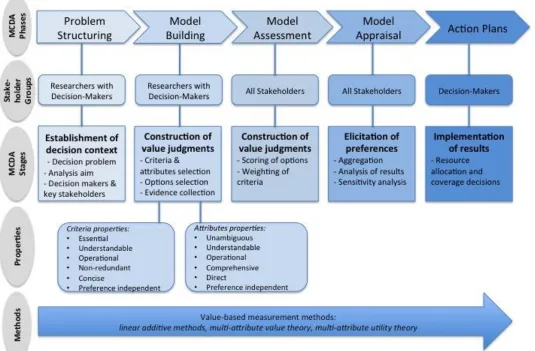
Paper 1 builds a generic methodological process to act as the conceptual basis for the development of a robust MCDA value framework in the context of HTA. It provides an introductory classification of different MCDA schools of thought before suggesting a specific methodological process for applying such methods in HTA. Overall, it aims to bring together theoretical foundations of MCDA with HTA application, thus possibly acting as a manual of good practice, while also suggesting different means of linking its use with policy-making.
The generic process of MCDA includes a number of common stages that would have to be adapted to the context of health care and HTA 1,92:
a. Establish the decision context. Define the aim of the analysis, who are the decision-makers and any other key players;
b. Establish objectives that indicate the overall purpose to be achieved and identify criteria of favourable and unfavourable effects;
c. Identify the options to be evaluated against the criteria;
d. Assign ‘scores’ to the options by assessing the performance of each option against the criteria and their value.
e. Assign ‘weights’ to the criteria by assigning relative weights to each of the criteria to reflect their relative importance to the decision.
f. ‘Aggregate’ scores and weights for each of the option by combining them together to derive overall value scores.
g. Analyse the results.
h. Conduct a sensitivity analysis to validate the results by testing the influence of changes in the scores or weights.
Overall, in order for the above tasks to be completed effort is needed in studying and learning the theoretical foundations of advanced decision sciences, understanding the characteristics of different MCDA methods, and reviewing past MCDA applications in various sectors for the development of a new conceptual methodological process that is adapted for the needs of HTA and in alignment with decision theory principles.
Paper 2
Paper 2 systematically reviews and synthesises evidence on the value measurement methods and techniques applied across a number of jurisdictions in Europe that employ HTA processes, focusing on the different evaluation criteria employed. The aim is to critically review, through literature and expert consultation, the value parameters considered as part of current methods applied for assessing and appraising the value of new medicines, with the view to incorporate these dimensions as value domains into the next paper, thus forming a model that feeds the value framework.
The application of MCDA in other contexts, such as transport, is relatively straightforward because the main aim of the analysis is usually conceptually easy to understand, and thus the appropriate criteria are easily identifiable. For example, when encountered with the objective of deciding on the location for the construction of a new railway, it would be expected to end up with criteria reflecting the following concerns: urban and environmental impact, integration with the rest of the transport network, complexity of construction and costs 93. In contrast, in the field of HTA, the concept of “value” is much more complicated and a complete set of criteria needs to be identified and adapted to describe the value of a new medical technology in a specific context or disease area. Consequently, a significant contribution is needed in order to establish a definition of value, by considering all possible and relevant value dimensions of NMTs and selecting the right attributes to describe those dimensions.
The databases of PubMed and Social Science Citation Index (through the Web of Science portal) are searched for peer review literature published in English3 using the following keywords: ‘value assessment AND pharmaceuticals/methodologies criteria’ and ‘health technology assessment AND pharmaceuticals/ methodologies criteria’. A review protocol for identifying the relevance of articles is used for inclusion and exclusion of the various studies. Additional input is included from the policy and grey literature. The
literature findings are validated and further insights are obtained from consultations with policy experts and using semi-structured interviews.
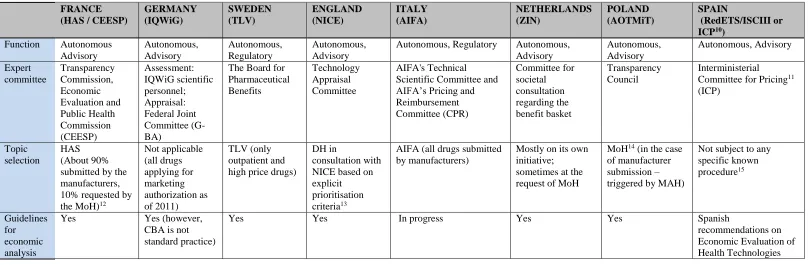
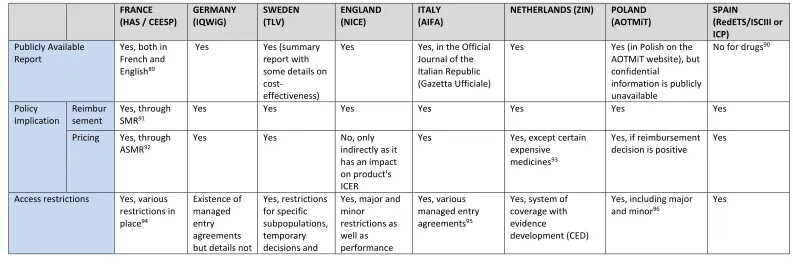
Understanding the methodologies that exist and the manner in which the criteria for value assessment are implemented in different HTA settings is required to identify the current limitations of existing value frameworks and the metrics of valuing NMTs from a comparative perspective; evidence of additional parameters that contribute to the perceived value of technologies, such as the burden of disease, the innovation level of the treatment, and wider socioeconomic implications, could inform the production of a robust methodological approach for more encompassing value assessment. The above critical review of the literature, in combination with expert communication, is used to identify, and subsequently feed into the development of a more comprehensive methodological framework for value assessment, by helping to identify and select a complete set of criteria that entirely describe the “value” of NMTs. In this context, the implementation of an MCDA framework can be a logical way forward.
In sum, achievement of the above tasks involve collecting both secondary and primary data, conducting a systematic literature review by studying specific literature of different countries and HTA agency guidelines, combining evidence together, seeking expert feedback, conducting semi-structured interviews, validating evidence and analysing results.
Paper 3
Paper 3 outlines the development of the value framework including the design of a value assessment model taking the form of a value tree. It commences with the theoretical axioms of Decision Analysis (DA), introducing the logic behind DA and the use of MCDA as a decision-making tool. It then links the findings of the systematic review and expert consultation with the new conceptual methodological process (Papers 2 and 1 respectively) for the design of a value tree, informing the selection of criteria needed to capture the value of new medicines. Finally, it outlines different types of MCDA methods, before suggesting a combination of techniques to operationalise the value tree so that it can be used for evaluating new drugs in HTA.
1. Establish the decision context. Define the aims of MDCA, and who the decision-makers and other key players are;
For the purpose of value-based assessment of NMTs, the decision context could adopt a societal point of view that aims to maximise social welfare. Key stakeholders involved could be regulators, health care professionals, methodology experts, patients, and possibly manufacturers.
2. Identify the objectives or criteria that capture value relevant to the decision-making context;
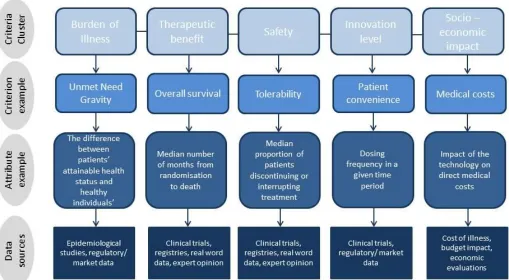
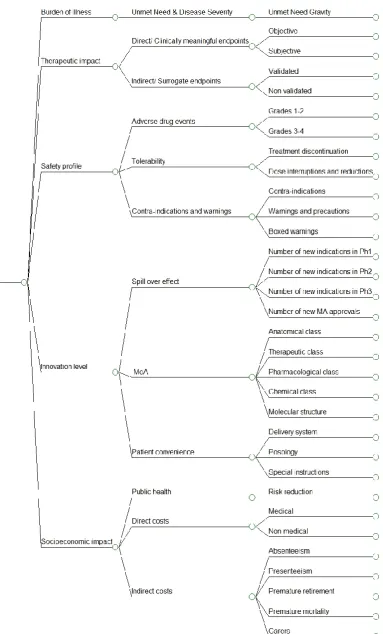
Possibly the most fundamental step affecting the MCDA model and the results of the analysis is to decide on the evaluation criteria for which the options are scored against. These criteria, or grading parameters, represent factors that are important when assessing the “value” of a drug in a VBP context, and could be chosen through the critical review and expert consultation carried out in the previous paper of the thesis and the limitations identified therein. The identification of a complete set of evaluation criteria with the objective of exhaustively describing all potential dimensions of value has not been successfully undertaken yet and forms a key intellectual contribution of the thesis. In particular, drug–indication characteristics are grouped into clusters addressing a particular treatment characteristic. Criteria clusters (groups) are constructed according to decision analysis theory on the principles of completeness (non-excludability), non-redundancy (parsimony), operationability (usefulness), and mutual independence of preferences (preference scores on one criterion are not affected by preference scores of the rest criteria)1. Five such key value domains, forming the relevant criteria clusters, are identified: (a) burden of disease, (b) therapeutic impact, (c) safety profile, (d) innovation level, and (e) socioeconomic impact. These areas form the higher or top-level criteria levels where the most important trade-offs take place and each of them in turn is made up of a number of more specific lower or sub-level criteria whose hierarchical representation takes the form of a value tree. A DA software is used (M-MACBETH) as a decision support system and tool to organise the clusters of evaluation criteria into a value tree which forms the basis of model, and also for scoring the options, weighting the criteria, analysing the results and conducting sensitivity analysis. 3. Provide an overview of MCDA modelling techniques, in regards to scoring,
A recommendation of particular MCDA methods and precise combination of techniques for the stages of ‘scoring’, ‘weighting’, and ‘aggregation’ is provided, completing the development of a new value framework.
From a policy perspective, this paper aims to provide a new methodological framework for assessing the overall value of new medicines from a societal perspective, while providing an explicit and complete set of evaluation criteria. To undertake and complete these tasks, effort is needed in understanding the use of advanced decision science methods and techniques, reviewing past MCDA applications, collecting secondary and primary data, conducting multiple rounds of literature reviews, seeking expert feedback, presenting the results and consulting with experts, combining evidence together and analysing results and linking decision science theory with HTA practice, so that a new methodological framework is developed that can serve the needs of decision-makers.
Papers 4 and 5
Paper 4 and Paper 5 constitute two separate case studies where the previously described and developed new MCDA framework is applied in practice to two different disease indications, namely (a) metastatic colorectal cancer (mCRC) and (b) metastatic castrate-resistant prostate cancer (mCRPC). Each of the papers involves an empirical testing of the methodological framework as well the adaptation of the generic value tree developed in Paper 3. Different drug treatments for each disease indication are used as the alternative options for the analysis, which are eventually assessed and compared with each other. Drugs are scored across a set of criteria, criteria are weighted according to their relative importance and overall value scores are produced, based on which the alternative treatments are ranked.
The second case study (Paper 5) relates to mCRPC, however preferences are elicited from the perspective of decision-makers, by working together with a group of evaluators from the national HTA agency of Sweden (TLV).
The methodology for both papers is based on the contents of Paper 3, outlining the development of the generic methodological framework for value assessment in the context of HTA. The value framework is adapted to the circumstances of each of the two disease conditions and the treatments available for each of them in order to be able to fully reflect their value, for example by incorporating specific evaluation criteria. Ultimately the aim for both papers is to test the newly developed methodological framework in practice.
Both primary and secondary data are used. Secondary literature sources (PubMed, Social Science Citation Index, and publicly available HTA appraisal reports) inform important value aspects of the drugs assessed which influence the adaptation of the general MCDA model developed in Paper 3 (e.g. selection of disease-specific clinical and surrogate endpoints). Primary data sources (i.e. expert opinion) are used for the validation of the model, and for the scoring and weighting steps of the process through a DA facilitated-workshop with stakeholder participation.
More specifically, for the purpose of scoring and weighting a facilitated workshop in the form of a decision conference is organised. In the first case study (Paper 4), key stakeholders participate including health care professionals (e.g. clinicians, pharmacologists, public health specialists), methodology experts (e.g. health economists, statisticians) and patient advocates (e.g. representatives from patient organisations), where a proportion of participants comes from existing or past NICE appraisal committees members that are responsible for the appraisal of cancer drugs. Approximately 7-15 experts should participate in the workshop, a number which has been shown to be ideal because it tends to preserve individuality while also allowing group processes; in other words, it is small enough to allow participants to reach an agreement but sufficiently large enough to represent all perspectives and interests 94. On the other hand, for the purpose of the second case study (Paper 5), a smaller number of participants would be needed (e.g. 3-6 experts), given that all of them would come from the same stakeholder group being affiliated with the Swedish HTA agency.
different options relating to the assessment criteria. Initially the existing model is validated (as adjusted already through evidence from the literature), possibly involving on-the-spot amendments. Once the structure of the model is agreed upon, participants are invited to score the performance of the various options against the criteria and weight the relative importance of the criteria. Finally, results are presented. The DA software M-MACBETH is used for the above stages.
Overall, the objective of the workshops is to elicit value judgements and the preferences of stakeholders and experts by mimicking the deliberation process used in HTA decision-making; the selected criteria are validated, options are scored against the criteria, and criteria are weighted according to their relative importance, producing overall value scores for each option so that they can be ranked according to their total value.
Results are analysed using tables and graphical illustrations where each individual criterion contribution to overall score is revealed; plotting the scores of any criterion or group of criteria against others (e.g. therapeutic vs. safety) permits one to compare options and visualise their performance against specific value dimensions. Sensitivity analysis is conducted to test the impact of different possible weights or scores on the overall value of the alternative treatments, thus testing input vagueness and possibly helping to resolve any existing preferences disagreements between the various stakeholders. The outcome is a combined perception of total value with the level of information available up to that point.
From a policy perspective these two papers provide case studies of applying in practice a conceptually new methodological MCDA framework for assessing the value of new medicines for the treatment indication of cancer, while empirically producing quantitative evidence relating to their value, in the form of MCDA weighted value scores. In order to undertake and complete these tasks, effort is needed in applying decision science methods and techniques in practice, collecting both secondary and primary data, conducting literature reviews, presenting the results and consulting with experts, organising, conducting and facilitating decision conferences, combining evidence together and analysing results, and producing policy recommendations.
1.2.3 Research Design and Methodology
96. Chapter 4 (Paper 1) adopts an exploratory research design investigating what are some of the critical features for a robust methodological approach of value assessment for NMTs in the context of HTA and based on MCDA principles96. Chapter 5 (Paper 2) adopts a descriptive research design outlining what evaluation criteria are considered as part of current HTA methods in different countries, analysing existing data through a systematic literature but also generating primary data through expert consultations96. Chapter 6 (Paper 3) adopts a combination of exploratory and descriptive research designs, making use of the findings from the previous two chapters in combination with decision analysis theory to explore and outline the development of the new value framework. Chapters 7 and 8 (Papers 4 and 5) adopt an evaluative research design to test the newly developed value framework in practice by aiming to assess the value of a set of alternative therapies and generating new primary data through two case studies that involve decision conferences for the collection of preferences from participants. Overall, this thesis uses characteristics of qualitative (Chapters 4-6) and quantitative (Chapters 7-8) methodologies, meanwhile adopting participatory/action methodology characteristics97. Ultimately, it aims to advance an action for change, possibly creating debate and discussion, being practical and collaborative in nature, while expecting that other stakeholders might engage as active collaborators 97.
1.2.4 Policy Implications
The proposed research agenda acknowledges that pharmaceutical policies must often balance multiple conflicting interests. An evaluation framework for medical technologies should satisfy primarily health policy goals and to some extent may afford to accommodate industrial policy goals, by assessing value of innovative technologies according to a comprehensive set of criteria and incentivising investment in socially desirable R&D.