STUDENTS' PERCEPTION OF AND ENGAGEMENT WITH FEEDBACK AS A FUNCTION OF YEAR OF
STUDY.
*Address for correspondence: Dr Nadia Ali, University of Huddersfield, Queensgate, Huddersfield. HD1 3DH (email: [email protected] Phone: 01484 473209)
Psychology students’ perception of and engagement with
feedback as a function of year of study
Nadia Ali,
Sarah Rose, Lubna Ahmed
Abstract
Undergraduate students’ perception of feedback and level of engagement with the feedback they receive has gained increasing attention in the educational literature recently to identify areas which require educators’ attention. However, research in this area has generally been based on limited self-selecting samples and has not considered how students’ relationship with feedback may alter depending on their year of study. To address this a survey measuring students’ views and practices regarding feedback was completed at a higher education institution by 447 first, second and third year psychology students, representing 77% of the cohort. Findings revealed that third years
responded more negatively in both areas than their first and second year counterparts, whose ratings on these aspects themselves were far from optimal. These findings highlight the need for early interventions to improve students’ perception of and engagement with feedback in the earlier years and to prevent the recorded deterioration later on in the degree course.
Introduction
Feedback has been identified as one of the strongest predictors of student achievement in an influential meta-analysis of over 500 studies (Hattie, 1999). Hattie found that feedback was nearly twice as instrumental as students’ socioeconomic background and slightly more influential than prior cognitive ability, both of which are considered to be strong predictors of achievement (Sirin, 2005). Consequently, educational institutions provide feedback on students' performance on assessed work aiming to highlight points students successfully managed and areas in which they need to improve. Whilst the value of providing feedback to students itself is not a contentious issue, students’ perceptions of and engagement with feedback is less clear
Carless (2006) investigated lecturers’ perceptions of students’ engagement with feedback. The main theme to emerge was that staff believed students are too grade-oriented and not interested in learning from feedback comments or are only interested in feedback comments which provide them with “correct” answers. In an attempt to explain the roots of such cynical perceptions Emanuel & Adams (2006) proposed that the adoption of a ‘customer service’ model by a growing number of universities affects students’ expectations of the institution in which they are enrolled. Within this context students are seen as “instrumental consumers of education, driven solely by the extrinsic motivation of the mark and as such desire feedback which simply provides them with correct answers” (p.53). Writing constructive feedback comments is a time consuming process and if academic staff embrace such cynical views they may be less willing to invest the time and effort needed to provide personally tailored feedback to individual students which encourages a deep approach to learning.
which would help them engage with their subject in a more meaningful way with feedback comments relating to critical analysis and explanation of mistakes valued more than feedback which explains the grade, prompting the authors to label students “conscientious consumers”. Higgins et al (2002) argued that the two positions are not mutually exclusive; students desire to obtain high grades does not preclude the desire for feedback which encourages deep learning.
The most widespread and reviewed source of information about students’ perception of and satisfaction with the feedback they receive are national student surveys such as the Australian Course Experience Questionnaire (Coates, 2009) and the UK National Student Survey (Higher Education Funding Council for England (HEFCE), 2012)). The picture from these appears negative regarding perception of feedback. Since the UK National Student Survey began, feedback consistently receives lower ratings than any other course feature. For example, in the most recent data 41% of students reported that feedback was not sufficiently detailed, 43% that it did not help clarify things they did not understand and 45% that it had not been promptly delivered (HEFCE, 2012). However, surveys of this type have been criticized for not being valid measures as a number of influential Higher Education Institutions (HEI's) choose not to participate in them (Dill and Soo, 2005) or even manipulate them to inflate their rankings (Ehrenberg, 2002). However, the trend in student dissatisfaction with feedback has also been confirmed by independent research. For example, Weaver (2006) found that
approximately 80% of design and business students' sampled felt feedback was too uninformative or brief to be helpful. These results are not confined to the UK as dissatisfaction with written feedback is also a prime concern internationally (Carless, 2006; Coates, 2009; Rowe & Wood 2008).
Consequently it seems lecturers assume that students engage with feedback at an
when employing this method because it cannot be assumed that the respondents who participated represent the views of non-respondents (Stoop, 2005). However, the golden standard of a 70% response rate is rarely met in survey research. This can potentially lead to skewed findings if respondents differ systematically to non-respondents. Confidence in research findings is further weakened as the samples are typically self-selecting. For instance, although Rowe and Wood (2008) and Carless (2006) report large sample sizes, the issue of self-selection was still inherent in their sample and response rate was not reported.
Low response rates combined with self-selecting samples plague much of the research in this area. These methodological issues can skew findings and thus limit what can be inferred with
confidence. In the case of perception of feedback, it is possible those students most willing to respond are the ones who are unhappy with the quantity and quality of feedback they receive, thus leading to the negative findings which dominate the research literature. In addition to the limitations in obtaining overall representative views, the changing nature of students' relationship with assessment feedback throughout the degree course is an important issue that is unexplored. There is limited research available to direct HEI's on developmental aspects of feedback.
The implicit assumption in the literature is that students’ perceptions of and needs for feedback are relatively static and can be satisfied through generic principles and techniques which do not need to account for the students’ position in their course. For example, Nicol and
However, one area of fruitful research relating to developmental aspects of feedback is the suggestion that feedback should feed-forward. The importance and benefits of applying past feedback to future assignments; so-called feed forward is undisputed (e.g., Hounsell, McCune, Hounsell and Litjens, 2008). As UK and international universities follow a model where advancement throughout the degree course entails increasing sophistication in skills it is plausible that students would expect feedback to alter across years with degree requirements, so that it can be effectively fed-forward for future assignments. Such a model can incorporate changing perceptions of and engagement with feedback as a function of year of study. We discuss this relationship further in the results and discussion section.
There are a number of reasons to assume relationship with feedback changes throughout a degree course. It is feasible that students’ expectations may become more aligned with lecturers’ over time resulting in final year students perceiving feedback differently to first year students. Similarly final year students, due to experience may be more equipped to interpret the feedback received and thus may be more motivated and able to take action on the received feedback in an attempt to improve their critical final year marks. Alternatively, tutors may provide more substantial feedback as students' progress in their course. In a small qualitative focus group, reported by Rowe and Wood (2008) some students felt that feedback was more comprehensive in the final year of study compared to the first and second year providing further evidence of probable differential utility of feedback across the years.
Contradictory findings presented by Scott, Badge, and Cann (2009) indicate first year Bioscience students’ perception of feedback is more positive than second year students, with the latter responding more negatively to questions probing how much guidance they received on how to use feedback to improve work. This trend reversed for engagement with feedback; with second year students more likely to engage in good practice with feedback received compared to first year
difficult to infer how important across year similarities and differences were.
Current study
A systematic comparison of students’ perception of and engagement with feedback across all years of study is currently lacking. Our research addresses this gap whilst controlling for potential methodological limitations by ensuring a representative response rate (at least 70% of students registered on the course). Based on the limited and contradictory findings available in the literature we predict that there will be a significant difference in students’ perception of and engagement with feedback as a function of year of study. However, due to contradictory research evidence we cannot predict whether students’ experience of feedback becomes more or less positive as they progress through their degree course.
Method
Participants
447 undergraduate psychology students from a UK University completed the questionnaire during a core lecture. The age of participants ranged from 18 to 39 years with a mean of 20.31 years (SD = 2.55). The sample consisted of 194 first year (85% of registered students), 125 second year (71%), and 128 third year (76%) respondents. The calculation for response rates are based on the number of students registered on the degree course.
Material
research reports (both group and individual), oral presentations and posters. Students’ experiences of this feedback received was assessed through questionnaire items covering students' expectations, engagement, motivation and ability to apply received feedback, as well as their perceptions regarding its purpose, effectiveness and quality. Questionnaire items were selected based on a review of the literature. An example of a scale item measuring perception of feedback is “The feedback I receive is usually detailed enough for me to improve”. An example of a scale item measuring engagement with feedback is “I look over previous feedback when preparing an assignment” (see appendix for full questionnaire).
This resulted in a survey in which participants responded to statements on a 5-point Likert scale (ranging from strongly disagree (1) to strongly agree (5)). In order to decrease response bias a mixture of positively and negatively phrased questions was included. Scores for negatively worded items were reversed prior to data analysis so that a higher score on each item indicated a more positive attitude and experience of feedback. An open ended question was also included to gather qualitative data relating to students' perception of feedback (See appendix). The questionnaire was administered five weeks into the second term of the degree course to ensure first year students had sufficient
experience of feedback and second and third year students had experience of feedback at the level they were studying at. Although students were taught by the researchers who administered the questionnaire none of the researchers were involved in the core lectures where the majority of data was collected and it was emphasized to students that participation was voluntary and their data would remain
confidential.
Data screening
The data was screened for missing and out of range values. Missing value analysis indicated
that data were missing completely at random (MCAR), Little’s MCAR test, χ² (635) = 607.974, p =
Questionnaire validation
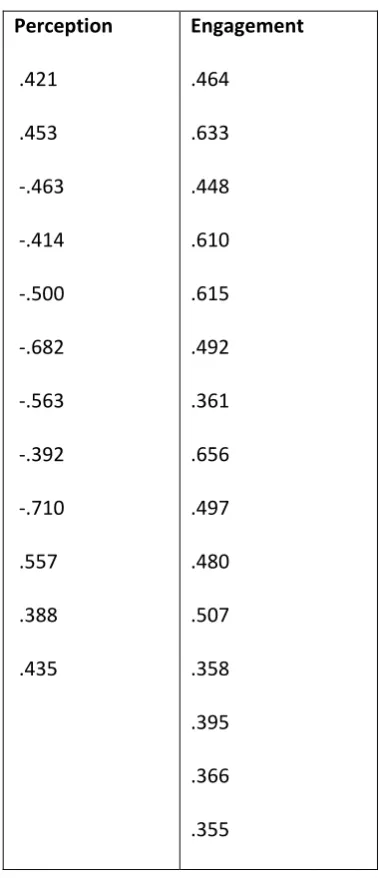
As the questionnaire covered a range of assessment and feedback related topics Principle Component Analysis (PCA) was used to reduce the number of items (Fabrigar et al., 1999) and identify items measuring perception of and engagement with feedback. PCA was conducted on 36 items with oblique rotation (direct oblimin). Factor loadings with an absolute value lower than 0.3 were
Table 1
Rotated factor loadings and communalities based on a principle components analysis with
oblimin rotation (N = 452)
Note
. Factor loadings <.3 are suppressed (Field, 2009).
Questionnaire reliability
Cronbach’s alpha was used to assess the reliability of the scales. Scale items measuring
perception of feedback (13 items) achieved a good α score of .76 and engagement with feedback (15
Perception
items) a similarly strong score of .77. Analysis of individual scale items revealed removal of any items would not increase the reliability score for both constructs.
Procedure
Ethical approval was granted by the ethics committee at the university where the research was conducted. Students were informed of the study at the end of core teaching sessions. Students
volunteering to take part in the survey were provided with a questionnaire, which they self-completed and returned to the researcher before leaving the lecture theater or seminar room. This helped to ensure a high response rate as the majority of students who had attended the teaching sessions volunteered to take part in the survey. An online version of the survey was also made available to all students who had not been present during the teaching session where data was collected. This was available online for a period of two weeks and all students were informed of the study via email. To control for the possibility of students completing both the online and paper copies students were asked to provide their student number on a detachable slip stapled to the front of the questionnaire. Students were informed that their number would never be matched to their details and would be removed from their questionnaire after data collection.
Results
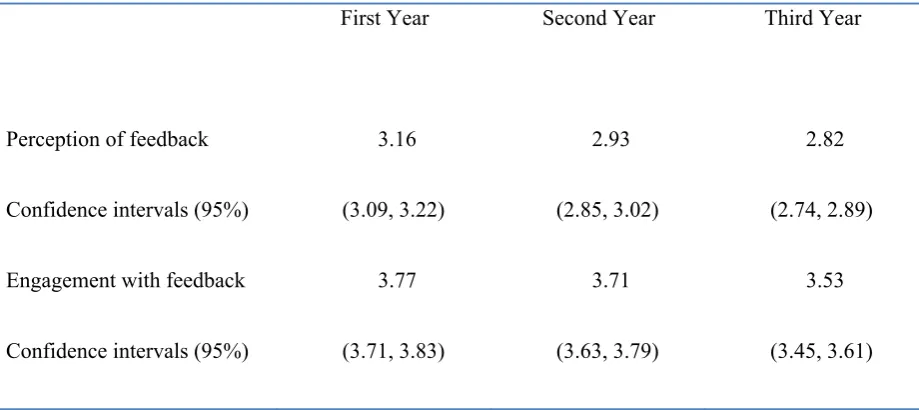
Table 2: Mean scores & confidence intervals for perception of and engagement with feedback.
First Year Second Year Third Year
Perception of feedback
Confidence intervals (95%)
3.16
(3.09, 3.22)
2.93
(2.85, 3.02)
2.82
(2.74, 2.89)
Engagement with feedback
Confidence intervals (95%)
3.77
(3.71, 3.83)
3.71
(3.63, 3.79)
3.53
(3.45, 3.61)
Two one-way ANOVAs were conducted to determine the effect of year of study on perception of and engagement with feedback. The decline in perception of feedback with year of study was significant F (2, 444) = 22.507 p < 0.001 ἠ²= .09, as was the pattern for engagement with feedback, F
(2, 444) = 11.706, p = .003, ἠ²= .05. Post hoc analysis was conducted using the Tukey Kramer
correction procedure to control for family wise error rate. For perception of feedback there was a significant difference (p<.001) between first and second and first and third year students, indicating that first year students held significantly more positive views of feedback compared to the second and third year students .There was no significant difference between second and third year students, indicating that the drop in scores in the second year is not followed by further deterioration in the third year.
For engagement with feedback there was no significant differences between first and second year students but differences between the second and third year students and first and third year
Qualitative results:
In addition to responding to the likert scale questions participants were invited to provide further information through a written response at the end of the questionnaire. An examination of this qualitative data reveals remarkable consistency in the areas students chose to comment. The three most commonly commented on issues were: quantity of feedback, constructiveness of feedback and
personalized feedback. The majority of comments relating to quantity of feedback related to the lack of individual feedback for exams. This is common practice in UK universities and students seem to be particularly sensitive to the dearth of feedback for this form of assessment (Hounsell et al., 2008). A typical comment provided by one of our participants was: "Lack of exam feedback means I can't improve in that area".
In the case of constructiveness of feedback many students asked for feedback comments highlighting how they could improve, and examples of how to improve which they could follow. Such comments clearly relate to the quality of feedback. However, they can also be considered to share similarities with the theme of quantity of feedback as they are asking for more feedback. A typical comment provided by one of our participants was: "I don't feel feedback is constructive enough, it is not enough to point out my mistakes - if I have done badly how do I improve?" The comments on constructiveness of feedback are echoed throughout the literature (e.g., Hounsell, 2007, Hounsell et al., 2008, Weaver, 2006) with Weaver (2006) in particular finding that the majority of participants in her
study felt that feedback lacked suggestions for improvement.
Discussion
The objectives of the current study were two-fold; to investigate if perception of and
engagement with feedback alters as a function of year of study and to capture a valid representation of students’ perception of and engagement with feedback. As outlined in the introduction it is logical to presume students’ engagement and requirements from feedback may alter with experience of the process as they progress in their course. However, the research to coherently support this view was lacking in the literature. In the current study students’ views on feedback across all years of study were investigated to asses if students’ relationship with feedback differs at different stages of the course.
Overall, it seems students begin with undecided perceptions of the feedback they receive, with first year scores averaging a low 3 (which is described as “neither agree nor disagree” on a 5 point likert scale) but these already poor perceptions rapidly deteriorate as early as the second year into the course, with scores averaging a 2 (disagree response) to items. This pattern is contrary to Rowe and Wood’s (2008) findings in which the senior students were the most satisfied and the junior students were the least satisfied with feedback. Qualms relating to the potential misrepresentation of views in self-selecting small sample studies such as Rowe and Wood’s (2008) were highlighted in the introduction. The discrepancy in findings across previous research studies and the current study support such concerns.
unfavorable their perception of feedback becomes.
Although the data reveals consistently higher scores for students’ engagement with feedback when compared to perception of feedback, the ambivalent scores across all years of study indicate early intervention is needed to further boost engagement with feedback and ensure engagement is maintained in the final year of study. This overall dissatisfaction is reflected in the manner in which third years engage with feedback. Although the progressive decline in perception of feedback across the years did not lower engagement with feedback scores for second year students this pattern did not hold with final year students who scored substantially lower on measures of engagement with feedback compared to first and second years. This trend is of particular concern as final year students have received, cumulatively, the greatest amount of feedback and therefore have the greatest
opportunity to assimilate and build on the feedback they have received over the years in their final most critical year. Increasingly, literature is focused on the role of the student in the feedback process (Boud, 1995, Nicol & MacFarlane-Dick, 2006) and so lack of engagement should be treated as urgently as negative perceptions are by HEI's.
This representative assessment of students’ engagement with feedback implies the cynical view held by lecturers is partially supported, with mean scores of 3 across the years of study. As such the current perceptions and behaviours of students provide support for both sides: those who argue that students are consumers and those who argue for students as conscientious consumers. The poor perception scores support students’ desire for feedback, thus supporting Higgins et al.’s (2002) view of students as ‘conscientious consumers’ who wish to engage with the subject matter and learning process in a non-superficial manner. However, this desire does not materialize into strong engagement scores which conflicts with the “conscientious consumers” profile.
transmission model has occurred in higher education and it is now accepted students actively construct their knowledge and learning, this model has been slower to influence assessment and feedback (Nicol & MacFarlane-Dick, 2006). Indeed, there is a growing literature base indicating that at best, students passively engage with feedback comments where they read the comments but fail to do anything further with them (Handley, Price & Miller, 2011). It is interesting to also note that none of the qualitative comments related to students practices with feedback or their level of engagement with feedback, all comments related to perception of feedback. The implications of these findings are that the recent introduction of substantially higher fees in English HEI's leaves the pedagogical process susceptible to an even more dramatic shift towards a consumer model. Higgins et al (2002) found evidence of students perceiving higher education as a service when fees were as low as £1,000 a year. The nine-fold increase in fees in less than a decade will most likely exasperate these perceptions.
This contradiction can also be explained by Hounsell's (2007) identification of a twin downward spiral which can account for increasingly negative perceptions and disengagement with feedback. Hounsell (2007) argues that the problem can stem from "end-loaded" assessments (where a number of assessments occur at the end of the term). Due to modularisation of degree courses this may mean the feedback is no longer relevant or students cannot use it as a learning tool. The implications of this are that a downward spiral occurs: students receive feedback which they perceive to be ineffectual and so their belief in feedback as a learning tool begins to diminish. Concurrently, lecturers'
perceptions change as they witness increasing disengagement with feedback creating a vicious cycle which can explain the downward spiral (Hounsell, 2007).
It would seem that first year students already feel feedback is not useful. With progression in the degree course perceptions decline and by the third year students may have repeatedly attempted and failed to apply unconstructive feedback which may explain the eventual decline in engagement. Hounsell, (2007 and Hounsell et al, 2008) discuss feed-forward as a potential solution to the end-loaded assessments and feedback problem. He argues feedback increases in value when it goes beyond
Hounsell, 2007, Hounsell, McCune, Hounsell and Litjens, 2008) when packaged as part of the wider degree program. If linked to year of study this would also account for the increasing sophistication of skills expected of students as they advance through the degree course (Mallet, 2004).
Although there are many suggestions within the feedback literature for strategies which could be implemented with the goal of improving students' perceptions of and engagement with feedback (such as feed-forward) there are few empirical studies which test the effectiveness of these
interventions. Evidence of the effectiveness of such interventions (such as introducing feed-forward and feedback portfolios) is greatly needed to enable universities to address negative perceptions of and low levels of engagement with feedback in an efficient and effective manner. The findings of this study emphasise the importance of timely interventions targeting students early in their degree course before any positive perceptions and engagement with feedback wanes. Moreover they also emphasise a need to tailor interventions as a function of year of study as the current findings illustrate that the dynamic of the student-feedback relationship differs for the three year groups.
Strategies implemented by educators to improve engagement with feedback could also improve perception of feedback if implemented carefully, thus addressing the twin decline in perception of and engagement with feedback. For example, the majority of qualitative comments related to quantity of feedback. An intervention encouraging students to create a portfolio of
The pedagogical implications of our findings are stark – in a number of institutions the final year of study accounts for the majority of marks awarded. If students at this stage perceive feedback negatively and are less likely to engage with feedback their academic competence will suffer. Reason, Terenzini and Domigo (2006) measured perception of feedback in a large scale empirical study and found that first-year students’ perception of the support they received was the biggest predictor of their development of academic competence. The implications are that if students perceive feedback negatively to begin with, it will impact their academic development and performance in proceeding years. As students’ progress in their course the material becomes more challenging and (usually) assessments are worth more marks. Negative perceptions of feedback in the second year of the course which coincide with an increase in the assessment weighting could be very damaging. This negative effect is further compounded by the drop in engagement with feedback scores in the final year of study.
Another key issue for HEI's to consider are esteem indicators of the university. The NSS results are used alongside other indicators to calculate institution rankings. The persistent negative ratings concerning perception of feedback when measured across the sector has received a lot of media attention and driven change in HEI's (Surridge, 2008). Our findings demonstrate institutions would fare better if attempts were made to maintain the less negative perceptions displayed by first year students which would boost assessment feedback scores which consistently emerge as one of the lowest scoring measures on the survey.
The views and practices of students reported here are derived from a sample taken in a single UK institution. A key question to establish is whether they will generalize to other HEI's within and outside the UK. The findings from the current study in conjunction with Scott et al's study (2009) suggest they will generalize within the UK. Furthermore, research conducted in a number of
students they tend to be more negative. For example, Rowe and Wood (2008) found that
international students are less likely to be satisfied with quantity and type of feedback received than home students. It would be interesting to therefore see whether year of study affects perception of and engagement with feedback in HEI's outside the UK.
However, there is no denying a longitudinal study would provide more illuminating
information about changes in perception of and engagement with feedback as a function of year of study and would advance the current research findings which adopted a cross-sectional survey. This would also control for changing perceptions depending on students experience of the course. However, the current study did time the survey to ensure students had sufficient experience at the level they were at and the instructions emphasized that the students should consider their overall experience.
Conclusion
References
Boud, D. 1995. Assessment and learning: contradictory or complementary? In: P. Knight (Ed.) Assessment and learning in higher education (London, Kogan Page).
Carless, D. 2006. Differing perceptions in the feedback process. Studies in Higher Education.31(2),
pp. 219–33.
Coates, H. B. 2009. Engaging students for success: Australasian Student Engagement Report.
Accessed June, 2013 http://research.acer.edu.au/higher_education/17.
De Corte, E. 2003. Transfer as the productive use of acquired knowledge, skills, and motivations. Current directions in psychological science, 12(4), 142-146.
Dill, D. D., & Soo, M. 2005. Academic quality, league tables, and public policy: A cross-national analysis of university ranking systems. Higher education, 49(4), 495-533.
Ehrenberg, R.G. 2002. Tuition Rising: Why College Costs so Much. Cambridge: Harvard University
Press.
Emanuel, R. & Adams, J. N. 2006. Assessing college student perceptions of instructor customer service
via the Quality of Instructor Service to Students (QISS) Questionnaire. Assessment & Evaluation in
Higher Education. 31(5), pp. 535-549.
Fabrigar, L. R., Wegener, D. T., MacCallum, R. C., & Strahan, E. J. 1999. Evaluating the use of
exploratory factor analysis in psychological research. Psychological Methods, 4, 272-299.
Field, A. 2009. Discovering statistics using SPSS. Sage Publications Limited.
Gibbs, G., & Simpson, C. 2004. Conditions under which assessment supports students’ learning. Learning and Teaching in Higher Education, 1(1), 3-31.
Hattie, J. A. 1999, August. Influences on student learning (Inaugural professorial address, University of Auckland, New Zealand). Accessed January, 2014
http://www.education.auckland.ac.nz/webdav/site/education/shared/hattie/docs/influences-on-student-learning.pdf.
Handley, K., Price, M., & Millar, J. 2011. Beyond ‘doing time’: investigating the concept of student
engagement with feedback. Oxford Review of Education, 37(4), 543-560.
HEFCE, 2012. National Student Survey summary data. Accessed June, 2013
http://www.hefce.ac.uk/whatwedo/lt/publicinfo/nationalstudentsurvey/nationalstudentsurveyda ta/2012/
Higgins, R., Hartley, P. & Skelton, A. 2002. The conscientious consumer: reconsidering the role of
assessment feedback in student learning, Studies in Higher Education, 27(1), 53–64.
Hounsell, D. 2007. Towards more sustainable feedback to students. In D. Boud & N. Falchikov, (Eds.). Rethinking assessment in higher education (pp 101-113). New York: Routledge.
Mallett, P. 2004. Self and peer-assessment of written work in English [case study 6] in C. Juwah et al (eds) Enhancing student learning through effective formative feedback. [SENLEF project] York: Higher Education Academy (available at:
http://www.jisctechdis.ac.uk/assets/Documents/resources/database/id353_senlef_guide.pdf)
Nicol, D. J., & Macfarlane‐Dick, D. 2006. Formative assessment and self‐regulated learning: A
model and seven principles of good feedback practice. Studies in Higher Education, 31(2),
199-218.
Reason, R. D., Terenzini, P. T., & Domingo, R. J. 2006. Research in Higher Education, 47(2),
149-175.
Rowe, A.D. & Wood, L.N. 2008 Student perceptions and preferences for feedback. Asian Social
Science, 4 (3), pp. 78-88.
Scott, J., Badge, J., & Cann, A. 2009. Perceptions of feedback one year on: A comparative study of the
views of first and second year biological sciences students. Bioscience Education, 13(2).
Sirin, S. R. 2005. Socioeconomic status and academic achievement: A meta-analytic review of
research. Review of Educational Research, 75, 417–453.
Stoop, I. A. L. 2005. The Hunt for the Last Respondent, The Hague, Netherlands: Social and Cultural
Planning Office.
Surridge, P. 2008. The national student survey 2005-2007: Findings and trends. A Report to the Higher
Education Funding Council for England.
Appendix
Questionnaire
Engagement with feedback
I always look over the written feedback in the summary box
I always look over the written comments on the script
I usually spend time reflecting on the feedback after I have read it
The purpose of the feedback is to help me learn how to improve
*I find the feedback helps me improve
I approach teachers if I want additional feedback
*I would like to receive more oral feedback on my work
I feel I need guidance on how to best use the feedback to improve
I keep a record all my feedback and refer to this again in future.
I look over previous feedback when preparing an assignment
I tend to spend more time reading over feedback when I get a low mark.
I tend to focus more on things that need improving rather than the things I have done satisfactorily
I make note of what I have done well and try to repeat this in future assignments
I make note of what I need to improve on and try to improve in this area for future assignments
I use other sources (e.g. books, online exercises) to improve on the areas that I have been told need improving
Perception of feedback
The feedback is always provided promptly, at the expected time
*I find the feedback helps me improve
I am happy with the amount of feedback I receive
I always agree with the feedback I receive
I feel the feedback is a one-way dialogue rather than a two-way process
*I would like to receive more oral feedback on my work
I tend to spend more time reading over feedback when I don’t agree with the awarded mark
I often find the feedback comments upsetting
The feedback I receive is usually detailed enough for me to improve
The feedback always includes examples of ‘good’ and ‘bad’ bits in my work
The feedback always includes examples of how to improve my work
I feel assignments are repeated enough times for the assignment specific feedback to be useful
Open ended question:
Please use this space to include any comments you may have, either to do with your experience of
receiving and using feedback in Psychology or any suggestions for changes/improvements'.