2017 2nd International Conference on Computational Modeling, Simulation and Applied Mathematics (CMSAM 2017) ISBN: 978-1-60595-499-8
2-Approximate Algorithm for Touring a Sequence
of Pairwise Disjoint Simple Polygons
Shun LYU and Bo JIANG
*Dalian Maritime University, Linghai Road 1, Dalian, China
*Corresponding author
Keywords: Computational geometry, Touring polygons problem, Approximate algorithm, Simple polygon, Ratio.
Abstract. In this paper, a 2-approximate algorithm is described to answer the previously open problem “What is the complexity of the TPP for disjoint non-convex simple polygons” which is known to NP-hard. We provide a O(kn) approximate algorithm, where k is polygon counts, and n is the number of vertexes of the polygons, to efficiently find a path which is 2 times at most than the shortest path. To solve this problem, we transform all of simple polygons into corresponding convex polygons, then process the shortest path of convex polygons according to the parity of polygons sequence and finally obtain the approximate path of simple polygons.
Introduction
Touring Polygons Problem
A fundamental problem in computational geometry is to find the Euclidean shortest path from the start point s to target point t in the plane. In some applications, the path is often required to visit some constrained regions, such as zookeeper problem, safari problem, and watchman route problem
[1].Touring polygons problem (TPP)[2] is a general problem including some visiting properties mentioned above and it is described as follows:
Let π be a plane, a sequence of pairwise disjoint simple polygons P=(P1, P2, ..., Pk) ∈ π. Two
points s, t∈π\ 1
k
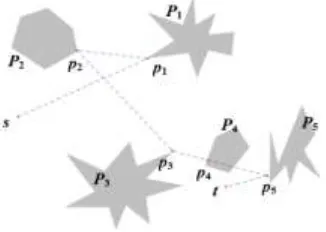
iPi. Simple polygon Pi is a flat shape consisting of straight, non-intersecting line segments or ‘sides’ that are joined pairwise to form a closed path. Our goal is to compute the shortest path Lopt=(s, p1, p2, ..., pk, t) that starts at s, visiting each polygon Pi(i=1, …, k) in order,
[image:1.595.218.381.551.667.2]and ends at t. Note that the access point of each pi is the first point that the path intersects with the polygon Pi. See Figure 1.
Figure 1. An instance of TPP with the shortest path Lopt=(s, p1, p2, p3, p4 , p5, t).
Current Work
TPP is a generalization of the traveling salesman problem (TSP) which is NP-hard if the order of the polygons is not given [2,4,5].We focus on solving the problem where the polygons must be visited in order.
When all of the polygons are in order, convex, pairwise disjoint, and start point, target point are fixed, an O(kn) algorithm to solve the problem is proposed in [6], where n is the total number of vertexes of polygons. Once non-convex polygon is allowable, the touring problem will be NP-hard[4].
As a follow-up of this work, Pan X et al. provided a heuristic algorithm where the given convex polygons are not obligatory [7]. An (1+(L2-L1)/L)-approximate solution is proposed in time
k(Ɛ)O(n), where n is the total number of vertexes of polygons, k(Ɛ) defines the numerical accuracy in dependency of a selected Ɛ> 0. The approximate algorithm mainly adopts Rubber-band algorithm [8] (a algorithm based on iteration) and the theoretical upper time bound k(Ɛ)O(n) is replaced in practice by O(n2).
In this paper, we provide a algorithm named CHDP to achieve a 2-approximate solution and upper time bound O(kn) in theory. We construct the convex hull of each simple polygon at first, and then we take the method of dividing the polygon in order and locating the edges in the reverse order to obtain the shortest path of convex hulls order, successively regulate odd polygons order and even polygons order in the end.
Our Work
In this paper, we propose an approximate algorithm to solve the unconstrained TPP, where simple input polygons have to satisfy the condition that their convex hulls are pairwise disjoint. The approximate path is less than 1.2 times of the shortest path after several practical experiments, and less than 2 times of the shortest path in theory if the distance between adjacent polygons is not short. That the distance is not short means polygon Pi-1 and polygon Pi+1 do not include in circle Oi
or intersect with circle Oi, where Oi is denoted by segment si of convex hull CPi, i = 1, 2, 3, ... n.
Construct Convex Hulls and Touring Convex Hulls Order
Touring disjoint polygons is NP-Hard [4], however, touring disjoint convex polygons can be solved in time O(kn)[6]. Therefore, we construct the convex hulls of each polygon and transfer simple polygons problem into convex polygons problem.
Lemma 1. The shortest path of touring simple polygons P(P1, P2,…, Pk) is not shorter than
touring the convex hulls C(P) (CP1, CP2, …, CPk) of corresponding polygons P(P1, P2,…, Pk),
|Dcp-opt| ≤ |Dp-opt|. |Dcp-opt| is the shortest path of touring convex hulls C(P)(CP1, CP2, …, CPk), and
|Dp-opt| is the shortest path of touring simple polygons P(P1, P2,…, Pk).
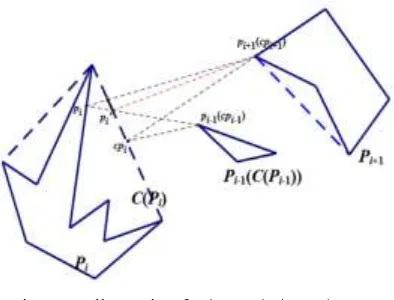
Proof. Assumed that there are a ordered set of polygons P(P1, P2, …, Pk), and corresponding
convex hulls C(P)(CP1, CP2, …, CPk). Define the shortest path for arbitrary polygons as Dp(p1, p2,
…, pk) and convex hulls as Dcp(cp1, cp2, …, cpk), pi, cpi is the initial point that the shortest path
intersect with Pi, C(Pi), i= 1, 2…, n. Obviously, pi is on the frontier of Pi, and it could exist on the
border of C(Pi)or inside C(Pi). If each point of pi is on the border of C(Pi), then the distance Dp(p1,
p2 , …, pk) = Dcp(cp1, cp2, …, cpk), |Dcp-opt| = |Dp-opt|. If there is a point pi inside C(Pi), its incident
line intersect C(Pi) at pi′. Because of D(pi′, pi) + D(pi, pi+1) > D(pi′, pi+1) by triangle principle, we
can get Dcp(cp1′, cp2′, …, cpk′) < Dp(p1, p2, …, pk), where cpi′= pi or cpi′= incident point pi′. Dcp(cp1′,
p2′,…, cpk′) is a path touring the convex hulls and consequently Dcp(cp1, cp2, …, cpk) ≤ Dcp(cp1′,
Figure 2. Illustrating for |Dcp-opt|≤ |Dp-opt|.
Here, each convex hull is convex polygon, therefore, we adopt the new algorithm on touring C(P)(CP1,CP2,…, CPn).
Touring Pairwise Disjoint Simple Polygons
Obviously, the shortest path of touring convex hulls order is not the path of touring simple polygons. The key is updating the points which are not on the frontier of simple polygons. If we update each point one by one, each point pi′ willupdate by an updated point pi-1 and a non-update
point pi+1′under the worst situation. The approximate path may be far from the shortest path of
touring C(P) under one time of iteration, because each update point pi is influenced by all previous update points. If we update the path by separately regulating odd polygons order and even polygons order, each point pi′ will update by two non-update point pi-1′, pi+1′at first round, and update by two
update points at second round. Each point is not influenced by other update points or is influenced once at most under the worst situation. This method can reduce the error effectively.
AlgorithmCHDP Main procedure
Input: a sequence of simple polygons P(P1, P2, …, Pn) in the plane π, two point s, t.
Output: the approximate path La(s, p1, p2, …, pn, t) which starts at point s=p0=p0′, then visits the
polygons P(P1, P2, …, Pn) at point pi in order, and ends at point t=pn+1=pn+1′, i=1, 2, ... , n.
Step1. Apply Melkman algorithm[9] to compute C(P)(CP1, CP2, …, CPn).
Step2. Compute the shortest path Lc(s, p1′, p2′, …, pn′, t) of touring C(P) called touring convex
hulls procedure[6,10].
Step3. For i=1, 3, ..., n, i is odd
If pi′ exist on Pi (also exist on CPi ), then pi′ = pi ;
If pi′ do not exist on Pi(exist on CPi ), find a point qi ∈ ∂P, such that:
D(pi-1′, qi)+D(qi , pi+1′) =min {D(pi-1′, pi)+D(pi, pi+1′), pi ∈ ∂P}, update pi=qi.
For i=2, 4, ..., n, i is even
If pi′ exist on Pi (also exist on CPi ), then pi′ = pi ;
If pi′ do not exist on Pi(exist on CPi ), find a point qi ∈ ∂P, such that:
D(pi-1 , qi)+D( qi, pi+1) =min {D(pi-1 , pi)+D(pi , pi+1), pi ∈ ∂P}, update pi=qi.
Step4. Output the approximate path La(s, p1, p2,…, pn, t).
Step1, owing to all of certain polygons, Melkman algorithm compute C(P) in linear time. Step2, the shortest path Lc(s, p1′, p2′, …, pn′, t) of touring C(P) can be computed in O(kn). Step3 and step4
Approximate Path
We adopt ratio to describe the performance of approximate algorithm. In this paper, ratio is Lopt La
, where La is the approximate path and Lopt is the shortest path. Ratio should be as low as possible.
Our algorithm must satisfy the condition that their convex hulls are pairwise disjointed; it means the distance between adjacent polygons should not be too short. See Figure 3a. In addition, there are still some situations that are thought impractical because of close distance between adjacent polygons. See Figure 3b.
[image:4.595.156.439.182.293.2]
(a) CPi intersect with adjacent polygon (b) impractical situation
Figure 3. The distance of adjacent polygons can not be short.
Above all, we denote that circle Oi has diameter si, i=1, 2, ..., n, polygon Pi-1 and polygon Pi+1 do
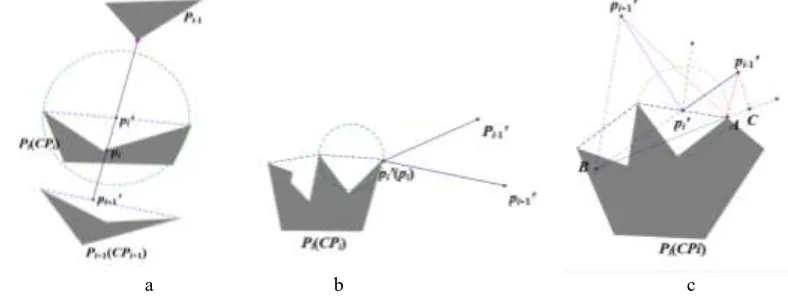
not include in circle Oi or intersect with circle Oi. There are three cases of update path contacted with CPi, which are as follows:
a b c
Figure 4. Types of contact of update path with CPi.
Case 1: Passing through.
If local shortest path of touring convex hulls pass through CPi,the shortest path Lc(s, p1′, p2′, …,
pn′, t) intersect Piat point pi inevitable. Update path is unchanged and pi ≠ pi′. See Figure 5a.
Case 2: Vertex bending.
If pi′ is a bend point, it is on the frontier of Pi. Thus pi = pi′, update path is unchanged. See Figure
5b.
Case 3: Edge reflection.
If local shortest path reflect at point pi′, and pi′ is not on the frontier of Pi. Update point pi change, and local update path (|pi-1′pi| + |pi pi+1′|)≤ 2(|p′i-1pi′| + |pi′p′i+1|). See Figure 5c.
Lemma 2. (|pi-1′pi| + |pi pi+1′|)≤ 2(|pi-1′pi′| + |pi′p′i+1|).
Proof. |pi+1′pi′|=|pi′B|, |pi+1′pi′|+|pi′pi-1′|=|pi-1′ B|. |pi+1′A|=|A B|, |pi+1′A|+|A pi-1′|=|A B|+|A pi-1′|.
∠ p′i-1BC=α, ∠ p′i-1AC=β.α∈ (0, 90˚), β∈ (0,90˚].
(|A B| + |A pi-1′|) / |pi-1′B|= (|pi-1′B| × cos α -|A pi-1′| × cos β +|A pi-1′|) / |pi-1′B|
= (|pi-1′B| × cos α - |pi-1′B| × sin β α sin
× cos β +|pi-1′B| × sin β α sin
) / |pi-1′B|
= cos α + sin α ×1sin -cosββ=cos α + sin α × tan 2β ≤ cos α + sin α = 2sin2α ≤ 2
[image:4.595.98.492.372.521.2]Proof. Assumed that |s, p1′|= l1, |p1′, p2′|= l2, ..., |pn′, t|= ln+1. The shortest path Lc(s, p1′, p2′, …,
pn′, t) of touring C(P), Lc= l1+ l2+ ... + ln+1. In addition, |s, p1|= l1′, |p1, p2|= l2′, ..., |pn, t|= l′n+1. The
approximate path La(s, p1, p2,…, pn, t), La= l1′+ l2′+ ... + ln+1′. The shortest path of touring simple
polygons P(P1, P2,…, Pn) is called Lopt ,Lc ≤Lopt . If pi′ do not exist on Pi (exist on CPi and the edge
si), ri is the radius of circle Oi , ri ≤ li , i=1,2, ... , n.
Lopt La
≤ Lc La
= (l1′+ l2′+ ...+ ln+1′) / (l1+ l2+ ...+ ln+1)= (l1′+ l2′+ ...+ li+ ...+ ln+1′) / (l1+ l2+ ...+ ln+1), (if
exist two adjacent points pi′=pi).
The worst situation is every point pi′ is not on the frontier of Pi. There are two steps: Update points p1, p3,..., pn, i= odd. Approximate path La′=(l1′′+ l2′′+ ...+ ln+1′′). Then, update points p2, p4, ...,
pn, i=even. Approximate path La = l1′+ l2′+ ...+ ln+1′.
Lopt La
≤ LaLc
= (l1′+ l2′+ ...+ ln+1′) / (l1+ l2+ ...+ ln+1)
=[(l1′+ l2′)+(l3′+ l4′)+ ...+(ln′+ ln+1′)] / (l1+ l2+ ...+ ln+1)
≤ 2(l1′′+ l2′′+ ...+ ln+1′′) / (l1+ l2+ ...+ ln+1)
≤ 2[(l1′′ + l2′′)+(l3′′+ l4′′)+ ...+(ln′′+ ln+1′′)] / (l1+ l2+ ...+ ln+1)
≤ 2× 2(l1+ l2+ ...+ ln+1) / (l1+ l2+ ...+ ln+1)=2
The algorithm provide a 2-approximate solution for unconstrained TPP in time O(kn), where k is the number of polygons and n is the number of vertexes.
The Implementation of Algorithm
The approximate algorithm has been implemented by program. We prove Lopt La
≤ 2 through
mathematical theory. On the one hand, majority of points pi′ exist on Pi, i=1, 2, ..., n. On the other hand, Lc is far less than Lopt in bad cases. Lopt
La
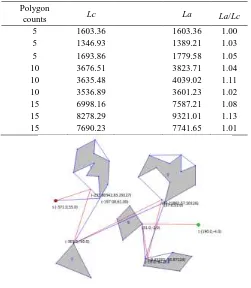
[image:5.595.173.424.476.764.2]is much less than 2 in practical result after several experiments with randomly polygons, see Table 1 and Figure 5.
Table 1. Several experiment results with randomly polygons.
Polygon
counts Lc La La/Lc
5 1603.36 1603.36 1.00
5 1346.93 1389.21 1.03
5 1693.86 1779.58 1.05
10 3676.51 3823.71 1.04
10 3635.48 4039.02 1.11
10 3536.89 3601.23 1.02
15 6998.16 7587.21 1.08
15 8278.29 9321.01 1.13
[image:5.595.173.422.479.763.2]15 7690.23 7741.65 1.01
Figure 5. Lc=1094.46, La=1127.34. Lc
La
Conclusion
In this paper, we propose a 2-approximate solution for touring arbitrary simple polygons with the condition that the distance of pairwise polygons are not too short. Our algorithm give an upper time bound O(kn) in practice, where k is the number of polygons and n is the number of vertexes.
Touring simple polygons is an open problem. How to solve the problem that adjacent polygons are intersecting is an interesting research problem. How to precondition convex hulls if adjacent convex hulls are intersecting is also a research area and we are now working on it. In addition, there are some limits when we prove the ratio. How to reduce these limits and improve ratio are our future study as well.
Acknowledgements
This work is supported by Liaoning Province Natural Science Foundation (No.20170540147) and the General Project of Liaoning Province Science and Research (No. L2015105).
References
[1] X. Tan, Approximation algorithms for the watchman route and zookeeper’s problems, Discrete Applied Math., 2004(136): 363-376.
[2] Dror M, Efrat A, Lubiw A, et al. Touring a sequence of polygons[C]. Conference Proceedings of the 35 Annual ACM Symposium on Theory of Computing, California, USA, 2003: 473-482.
[3] Jeffrey Hoeft, Udatta S. PALEKAR. Heuristics for the plate-cutting traveling salesman problem[J]. IIE Transactions, 1997, 29(9):719-731.
[4] Ahadi A, Mozafari A, Zarei A. Touring Disjoint Polygons Problem Is NP-Hard[M] // Combinatorial Optimization and Applications. Springer International Publishing, 2013: 351-360.
[5] Ahadi A, Mozafari A, Zarei A. Touring a sequence of disjoint polygons: Complexity and extension[J]. Theoretical Computer Science, 2014, 556:45-54.
[6] Tan X, Jiang B. Efficient Algorithms for Touring a Sequence of Convex Polygons and Related Problems[C]// International Conference on Theory and Applications of Models of Computation. Springer, Cham, 2017:614-627.
[7] Pan X, Li F, Klette R. Approximate Shortest Path Algorithms for Sequences of Pairwise Disjoint Simple Polygons[C]// Canadian Conference on Computational Geometry. DBLP, 2010: 175-178.
[8] Li F, Klette R. Rubberband Algorithms for Solving Various 2D or 3D Shortest Path Problems.[C] // International Conference on Computing: Theory and Applications. IEEE, 2007: 9-19.
[9] Melkman A A. On-line construction of the convex hull of a simple polyline[M]. Elsevier North-Holland, Inc. 1987.