2017 2nd International Conference on Computer, Network Security and Communication Engineering (CNSCE 2017) ISBN: 978-1-60595-439-4
A Hybrid Multi-level Mechanism for Application Integrity Checking
Xian-hua LIU
*, Kun-liang RUAN
and Chun YANG
Microprocessor Research & Development Center, Peking University, China*Corresponding author
Keywords: Integrity checking, Demand paging, Code security.
Abstract. The protection of the integrity of the computer system, although not able to deal with all security threats, is still essential to enhance the overall security of the system. Integrity check may be a reasonable way to protect application from tampering with low cost. This paper designs a multi-level check mechanism of application integrity with multiple inspection methods, which can better display the advantages of different inspection methods. Hybrid checking method may be utilized for different file integrity checking demands. The paper also demonstrate the implementation of a high-performance Linux page-level integrity checking method, in reference to the design in NetBSD system. Experiment results show that it may better deal with the application file rollback attacks. And on machine with limited resource, for example, thin client, the overhead of integrity checking can be lower than 10%.
Introduction
Confidentiality, Integrity and Availability are the three major elements of modern information security. The protection of the integrity of the computer system, although not able to deal with all security threats, is still essential to enhance the overall security of the system. Inspect the integrity of the softwares may find the malicious acts in time, help protect the integrity of computer systems. Since the complexity of application grows, tampering detection becomes more and more expensive. Integrity check may be a reasonable way to protect application from tampering with low cost.
Several methods have been proposed for application integrity check, each of them have their own advantages and weakness. This paper designs and implements a multistage mechanism, combining a page-level method and two file-level methods. The page-level method comes first, followed by a file-level method with feature data as extended attribute, and then another file-level method with feature data as embedded digital signature. Page-level methods have advantage in performance, because it only checks pages may be used. However, more storage is needed for its larger feature data. Embedded digital signature cannot be used for any type of file, but it is friendly to distribution.
The implement in this paper is based on Linux kernel 4.2.4 and Glibc 2.19, in which the program loader and demand paging routine are modified. Since file extended attributes and demand paging are well supported features in modern operating system, this mechanism can also be implemented on other platforms. Experiment shows that it also has a good performance. Even on machine with limited resource, for example, thin client, the overhead can be lower than 10%.
Related Work
In the past 30 years, application integrity protection research can be divided into two schools: file system integrity protection and code signature [1]. The former focuses on the file while the latter focuses on executables. Trusted computing provides an important application scenario for application integrity checking. File system integrity protection includes both storage and logic aspects. This article only discusses the logic level, especially the inspection methods.
Later, Patil et al. [5] designed I3FS based on the stack file system. In addition to supporting traditional file-level integrity checks, I3FS also supports page-level integrity checking. Kaczmarek et al. [6] designed a file system integrity protection scheme based on the LSM framework [7].
Pozzo et al. [8] proposed to use digital signature to protect the integrity of the program file. The code signature gradually attracts more attention with the rise of Internet. Kernel module signatures are the main practice of code signing, but are not mandatory. Microsoft has enabled kernel-mode code signing (KMCS) security policies on 64-bit NT6-series kernels. It is also common to check code signing during deployment. Signatures can be applied to applications or to installation packages.
There is no clear distinction between file integrity protection and code signing. Williams has designed an application integrity check scheme based on FreeBSD/OpenBSD and Lymn implemented a similar technology on NetBSD and extended page-level integrity checking [9]. Integrity checking has been studied on various platforms. Majority of these work make use of the LSM [7] framework, which allows security functionality implemented as a Linux kernel module.It is inefficient to directly compare the images. The mainstream scheme uses the cryptographic hash algorithm or the derived HMAC algorithm [10] to obtain the file feature and accomplish it by feature comparison.
It is difficult to balance between performance, ease of use and security. The fundamental purpose of introducing an application integrity check technique is to enhance the system security. Tripwire's security may be poor, but the performance advantage helps its success. I3FS emphasizes the importance of performance, while Verified Exec does not care. Verified Exec and TLC focus on ease of use, which is conducive to industrial realization. Our plan also draws on the Verified Exec and TLC technology, but in the design goals are more inclined to performance.
Multistage Mechanism for Application Integrity Checking
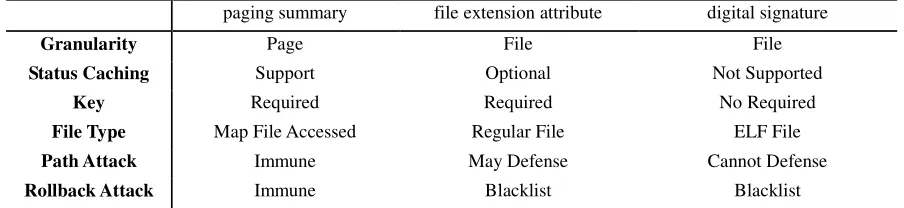
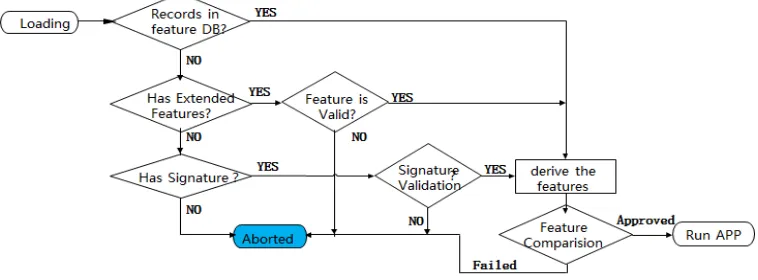
[image:2.612.80.532.553.657.2]The integrity of the application inspection methods are file-level and page-level two categories, and file-level methods can also be based on the characteristics of data management is divided into several different sub. This paper designs and implements a multi-level check mechanism for application integrity. It integrates three inspection methods, which are based on embedded digital signature, based on file extension attribute, and the method of paging summary. Table 1 shows a brief summary of some of the characteristics of these three methods.The three inspection methods used in this paper are prioritized, forming a multi-stage inspection process. The overall process as shown in Figure 1, the method is a typical pre-run mandatory inspection, does not pass the inspection process does not allow the operation. Both the file-based attribute checking and the embedded digital signature-based checking are load-based behaviors, while the check based on the paging summary is delayed by the operating system on-demand paging mechanism to the running time of the program.
Table 1. Comparison of integrity checking methods.
paging summary file extension attribute digital signature
Granularity Page File File
Status Caching Support Optional Not Supported
Key Required Required No Required
File Type Map File Accessed Regular File ELF File
Path Attack Immune May Defense Cannot Defense
Rollback Attack Immune Blacklist Blacklist
The implementation is based on the Linux kernel 4.2.4 and Glibc 2.19. A digital signature scheme based on RSA asymmetric encryption algorithm is selected. To achieve the same level of security as SHA256, the RSA algorithm uses a 3072-bit key. Some techniques attach a digital signature to a script at the end of the script to form a suffix signature. This method is not always effective because some scripts may use the end of the space to store data. It is more appropriate to check the integrity of the executable script by using the method based on the file extension attribute, so we do not consider embedding the digital signature in the executable script.
[image:3.612.117.496.234.374.2]The section table in the loadable ELF file contains all the sub-sections of the text. To facilitate the search of the inserted signature section, our method requires that the section table be omitted. we use the GNU Binutils toolset to add a section named ".signature" to the ELF file. This section is a non-loadable section that contains a digital signature for the entire contents of all loadable sections. The digital signature is generated based on the SHA256 and RSA3072 algorithms.
Figure 1. The flowchart of multi-level integrity checking.
In order to deal with the rollback attack, Doorn [11] proposed to use the blacklist to mark out the program files. However, frequent replacement of the key will bring a lot of inconvenience, signature keys are often valid for several years, which increase maintenance costs. In this paper, we label the valid time stamp for each digital signature to solve the problem of blacklist expansion. The digital signature format used in this paper is slightly different from the classical format. The signature length of the RSA3072 is 3072 bits, or 384 bytes. The content format is as follows: 344Byte + 3 Byte Reserved + 5 Bytes Time Stamp + 32 Bytes Digital Digest.
This paper does not use the function-constrained uselib system call. Verification work of the digital signature of the ELF file is achieved by the Linux kernel and the dynamic linker. RSA public key decryption is required for signature verification, and the Linux kernel implements the function using the multi-precision integer calculation code migrated from GNUPG. Since the dynamic linker does not support the RSA algorithm, we port the relevant code to Glibc.
In Linux, file extension attributes are logically grouped into several namespaces. The main namespaces are security, system, trusted and user. The operation privilege of the user space depends on the file itself. The trusted space is accessible only to privileged users. The security and system space operations are determined by the security subsystem. Since any user process may trigger the application integrity check mechanism, trusted space is clearly not enough. In this paper, we choose the similiar method like TLC to use the security namespace. Our method requires the addition of an extended property security.seal (the attribute named seal in the security space), which basically consists of two parts: the SHA256 digest of the file contents and the HMAC of the digest. HMAC relies on a global master key, the specific algorithm can be HMAC-MD5 or HMAC-SHA1. Because HMAC calculation is independent of file size, it usually does not become a performance bottleneck. In this paper, a more secure 160-bit master key and HMAC-SHA1 algorithm are chosen.
process on the victim machine to back up the files that are about to be phased out. However, the path attack will not face this problem, which may potentially cause greater harm. File path information may be added to the file digest to deal with path attacks. We uses a similar approach, adding the optional file path information to the security.seal. Taking into account the above factors, the security.seal attribute must contain HMAC, timestamps, and a numeric summary of the contents of the file, and you can add the file path in the following format: HMAC(40B)+Reserved(6B)+Time Stamp(10B)+Digital Digest(64B) +FilePath.
We add an enumeration the inode object to record the file integrity check status. The check status is initially UNKOWN, GOOD or BROKEN after checking, and when the file is writable, the status is reset to UNKOWN. The system checks integrity only for files that are in the UNKOWN state.As to the paeg-level integrity checking, it is not appropriate to add new enumeration. Our method adds a 2-bit tag to the page tag set (flags in the page object) to indicate whether or not it has been checked and tampered with. The two tags and the original dirty tags are combined into a page integrity check state.
Page-level state is a bit more complex than the file-level state. The checked flag for the page frame is initially 0, set after the integrity check, and the dirty flag set by the kernel's memory management subsystem. The kernel will call the function clear_page_dirty_for_io() to set the dirty flag to 0 when the page contents are written back to the external memory.
Evaluation and Analysis
We select the x86 platform for evaluation, which based on i7-4700MQ processor and 64-bit Ubuntu 14.04, the memory is 16GB of DDR3-1600. We use three different read speed flash as the storage, which are 50MB/s Kingston CF card, 121MB s Toshiba CF card and 195MB/s Kingston SSD. We selects Clang 3.7.1, Firefox 44.0 and LibreOffice 4.2.8.2 as representative softwares for evaluation, respectively record the startup and restart delay with different integrity checking methods.
First start-up speed in high-speed CF cards is about 2 times to the average CF cards, which coincides with the performance of the storages. The gap of startup time in SSD and high-speed CF card is less than the gap between their read performance. We believe the performance bottlenecks lie on the calculation. From the above phenomenon we can be roughly inferred, in the storage read rate of 150+MB/s, the calculation is the performance bottleneck of application integrity checking.
The checking method based on embedded digital signature mainly includes two processes: hashing and public key decryption. The HMAC-SHA1 algorithm for extended attribute integrity verification is faster than RSA3072. So the method based on embedded digital signatures is usually slower than the one based on file extension attributes. However, in this scenario, a method based on embedded digital signatures actually computes a hash value only for the loadable content in ELF file, whereas a check based on the file extension attribute requires the hash value to be computed for the entire file. This difference is more obvious when external memory read becomes performance bottlenecks. Our experiment results shows that, in the use of ordinary CF card case, method based on embedded digital signature has more than 3x times performance over the method based on file expansion properties.
In our evaluation, state caching is used in each method. The application skips inspection when the it starts again, so the restart delay is small. On the other hand, when the application starts again, the contents of the file have been cached by the system without accessing the external memory. As a result, there is no difference in the observed start-up latency for a re-booted application that performs an integrity check, even if they are using different external memories.
We also takes into account the hot start delay of the Linux desktop operating system, that is, the latency from the GRUB loading the kernel to the user login (POST and GRUB loading is not considered). The result is observed to assess the integrity check on the overall system performance.
implementation on Linux, it need 1.49MB to preserve all the characteristics and 184KB to save the index. This memory overhead could be ignored for PC, but may be a great issue in embedded devices. The three integrity checking methods are not functionally interchangeable, so the start-up latency in real-world use may ranges. We suggest using different method for difference files. As to the native executable files (including executables and dynamic libraries), method base on page digest is prefered. For scripts and application configuration files, the method based on file extension attributes may be a better choice, while the method based on digital signatures is appropriate for temporary files.
Summary
This paper designs a multi-level check mechanism of application integrity, and integrates three inspection methods. Among them, the method based on embedded digital signature mainly inherits the work of Doorn et al. [11], and the method based on file extended attribute inherits the work of Safford et al [4]. Both of these methods are file-level inspection methods. We introduce fine-grained validity management and path assignment support, in order to better resist the replacement attack. Inspired by Lymn's work [9], this paper also uses page-level inspection methods. In contrast, we adopts centralized feature data management. The hybrid approach can better display the advantages of different inspection methods. Secondly, in reference to the design in NetBSD system, we implement a high-performance Linux page-level integrity checking. We also improve the existing Linux-based file-level checks, which may better deal with the application rollback attacks.
Acknowledgement
This research was supported by the National Science Foundation of China, under grant No.6130004.
References
[1] Catuogno L, Galdi C. Ensuring Application Integrity: A Survey on Techniques and Tools. Proceedings of the 9th International Conference on. IEEE IMIS, 2015: 192-199.
[2] Farmer D, Spafford E H. The COPS security checker system[C]. Usenix Association. Berkeley, CA, 1990: 165–190.
[3] Vincenzetti D, Cotrozzi M. ATP-anti tampering program. Proceedings of the Security IV Conference, Berkeley, CA, 1993.
[4] Kim G H, Spafford E H. Experiences with tripwire: Using integrity checkers for intrusion detection[R]. Purdue University. 1994.
[5] Patil S, Kashyap A, Sivathanu G, et al. I3FS: An In-Kernel Integrity Checker and Intrusion Detection File System[C]. LISA. 2004, 4: 67-78.
[6] Kaczmarek J, Wrobel M. Modern approaches to file system integrity checking. Information Technology, 2008. IT 2008. 1st International Conference on. IEEE, 2008: 1-4.
[7] Wright C, Cowan C, Morris J, et al. Linux security module framework. Ottawa Linux Symposium. 2002, 8032: 6-16.
[8] Pozzo M M, Gray T E. A model for the containment of computer viruses. Aerospace Computer Security Conference, 2nd, McLean, VA. 1986: 11-18.
[9] Lymn B. Verified Exec-Extending the Security Perimeter. AUUG. Melbourne. Sept. 2004.
[10] Krawczyk H, Canetti R, Bellare M. HMAC: Keyed-hashing for message authentication. RFC 2104, Feb. 1997.